Can LLMs Uncover Hidden Physical Laws through Free Exploration?
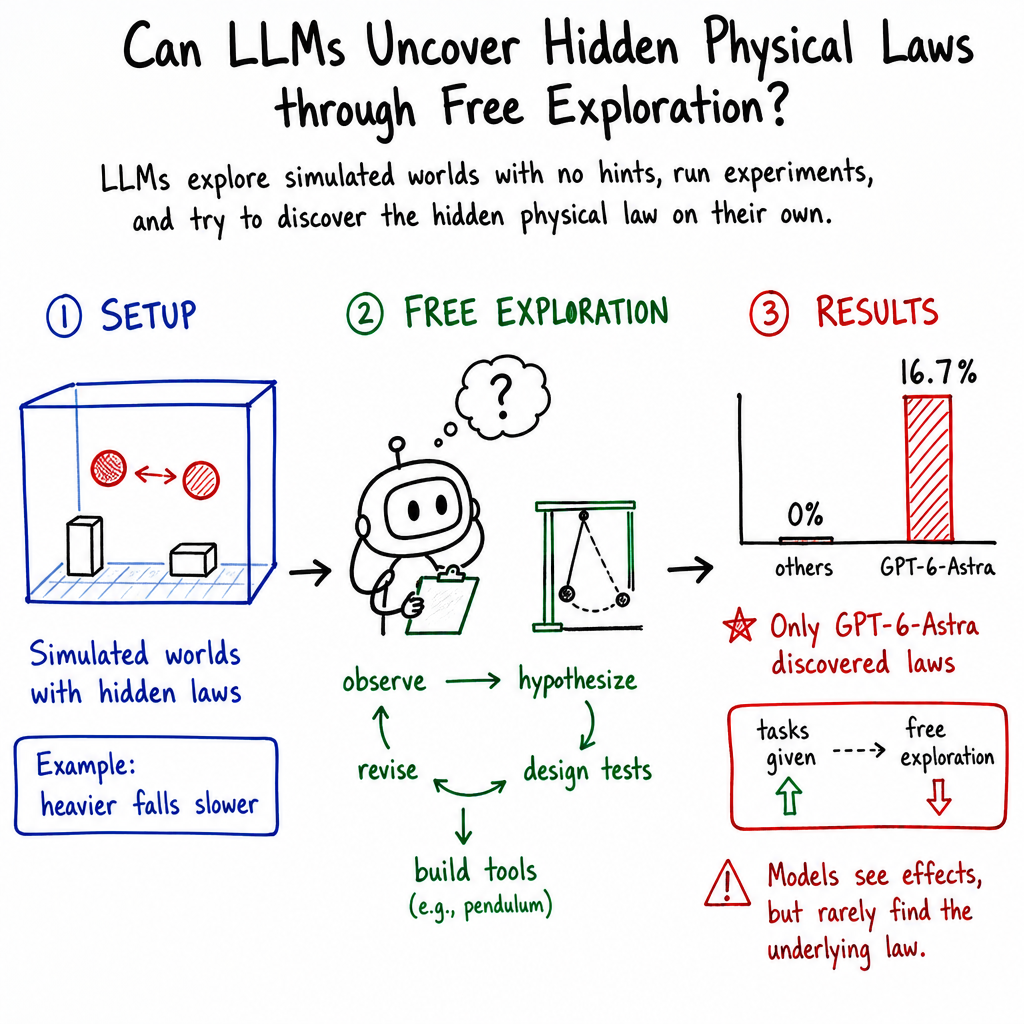
Abstract: Scientific discovery often begins with an unexpected observation that prompts a new research question. In a world with altered physical laws, can LLMs notice unexpected behavior, such as heavier objects falling more slowly, and discover the law through experiments without being told what to investigate? To evaluate this ability, we introduce LongChang, an automated framework that creates simulated worlds with altered physics, where one or more laws differ from ordinary physics. The evaluated LLMs act as explorers, manipulating objects and building tools to investigate their own questions without research tasks or hints about these laws. Separate LLM agents generate and review scenes, review tool designs, and evaluate reports for correctness and experimental support using the altered physical laws and exploration records. These records guide scene evolution for further exploration, allowing the full cycle to run without human intervention. Among 12 LLMs, GPT-6-Astra achieves a discovery rate of 16.7%, while the other 11 score 0%. The exploration records reveal uninvestigated anomalies and only partial identification of the altered physical laws.

Paper Prompts
Sign up for free to create and run prompts on this paper.
Explain it Like I'm 14
1. What is this paper about?
This paper studies whether LLMs—the technology behind many chatbots—can discover new scientific rules on their own.
The researchers created virtual worlds where the laws of physics are secretly changed. For example:
- Heavier objects might fall more slowly.
- A ball might suddenly move north after being pushed.
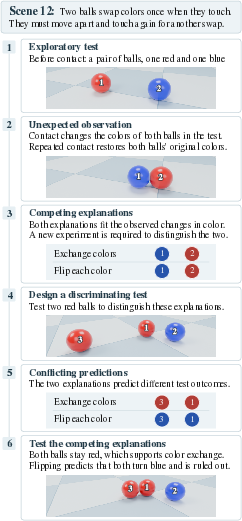
- Two red balls might attract each other.
- Gravity might change over time.
The AI is not told what is unusual. It must explore the world, notice strange events, ask its own questions, perform experiments, and explain the hidden rule.
The system used for this study is called LongChang.
2. What questions did the researchers ask?
The main question was:
Can an AI notice something strange and turn it into a scientific investigation without being given a research task?
More specifically, the researchers wanted to know whether an AI could:
- Notice that something does not behave normally.
- Decide that the unusual event is worth investigating.
- Create a useful question, such as “Why did this ball start moving by itself?”
- Design experiments to test different explanations.
- Build tools when necessary, such as a weighing platform or a pendulum.
- Discover the complete hidden physical rule.
- Support its conclusion with good experimental evidence.
This is different from simply answering a question that a human has already asked. The AI had to decide what to investigate in the first place.
3. How did the researchers test the AIs?
The virtual worlds
The researchers built 15 simulated scenes:
- One scene used ordinary physics.
- The other 14 scenes each contained one secret change to a physical law.
The worlds were like glass rooms containing objects such as balls, boxes, floor tiles, and tools. The AI could push, throw, grab, move, and release objects. It could also wait and observe what happened.
The simulations were created using a physics program called MuJoCo. A simulation is a computer-made world that follows programmed rules, much like a video game. In this case, the program calculated how objects moved and collided.
Free exploration
The AI received no special research question and no hint about the changed law. It had to explore freely.
For instance, if a ball moved strangely, the AI might:
- Repeat the same action.
- Compare the ball with another ball.
- Change the starting position.
- Test different colors, masses, or speeds.
- Build a device to measure what was happening.
This is similar to giving a student access to a science laboratory but not telling them which experiment to perform.
Building tools
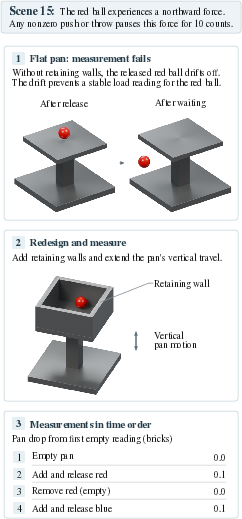
The AI could design its own scientific instruments. One example was a pendulum that could help measure whether gravity was tilted. Another was a platform for comparing the weight or behavior of balls.
Other AI systems checked whether these tools could actually be built and used in the simulation.
Judging the discoveries
The researchers used separate AI judges to examine the explorers’ final reports. A report had to meet two requirements:
- Correctness: Did it identify the actual hidden law?
- Evidence: Did the experiments really support the claim?
This distinction is important. An AI might guess the right answer but fail to perform experiments that prove it.
For example, saying “red balls attract each other” is incomplete if the AI never tests whether this is true for different red balls or at different distances.
4. What did the researchers find?
Very few AIs made complete discoveries
The researchers tested 12 different LLMs. Only one model, GPT-6-Astra, made any discoveries that were both correct and supported by experiments.
Its discovery rate was 16.7%. The other 11 models had a discovery rate of 0% under the free-exploration conditions.
This shows that discovering hidden rules without guidance is still extremely difficult for current AI systems.
Supporting observations was easier than finding the full law
GPT-6-Astra was good at recording evidence. About 97.6% of its reports had experimental support for at least some of their claims.
However, only 19.0% correctly identified the complete physical law.
For example, an AI might correctly observe that two red balls moved toward each other. But it might not discover:
- How far apart they needed to be.
- Whether all red balls behaved this way.
- Whether the effect depended on speed or position.
- What happened after a collision.
In other words, the AI often noticed part of the pattern but did not fully explain it.
Strange observations were often ignored
One important difference between the AIs was whether they followed up on unexpected events.
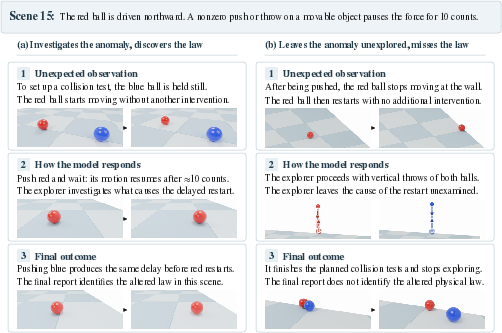
In one scene, a red ball began moving again after a delay. GPT-6-Astra stopped its original plan and investigated the surprise. It discovered that pushing or throwing the ball temporarily stopped a force acting on it for ten seconds.
Another AI noticed the same unusual movement but continued with its original experiment. It failed to ask why the ball had restarted.
This suggests that a strong scientific investigator must be willing to change plans when new evidence appears.
More time did not automatically help
Some tests gave the AI up to 500 actions instead of 100. This did not improve discovery much.
The reason was that some AIs stopped early or kept repeating unhelpful actions. Simply giving an AI more time is not enough if it does not know how to use that time well.
This is similar to giving someone a longer science-class period. More time will not help much if they do not choose useful experiments.
Tools helped, but building them was difficult
Allowing AIs to build tools increased GPT-6-Astra’s discovery rate from 4.8% to 16.7% in one comparison.
However, many tool-building attempts failed. Some AIs built devices that were unstable or did not measure what they intended. This shows that having access to tools is useful, but the AI must also know how to design and improve them.
A normal-physics test revealed overconfident mistakes
The ordinary-physics scene checked whether AIs would invent strange explanations when nothing unusual was happening.
About 36.1% of reports were rejected because they claimed that normal events were caused by hidden physical laws or because their evidence was not strong enough.
For example, an AI concluded that a floor tile had less friction because a ball traveled farther on it. But the ball had already been moving faster before the test, making the comparison unfair.
This shows why controlled experiments matter. Scientists must change one important factor at a time and keep other factors as similar as possible.
Automatically creating harder worlds was unsuccessful
The LongChang system also used exploration records to create new scenes. For example, if an AI made a mistake and later corrected it, the system used that mistake to design a more challenging world.
The new scenes could:
- Change an existing rule.
- Add a condition to the rule.
- Combine two hidden rules.
However, GPT-6-Astra discovered none of the three new, harder scenes completely. It often found part of the behavior but missed important details such as timing, location, or the exact trigger.
5. Why are these results important?
The study shows that scientific discovery is more than noticing patterns.
A capable scientific AI must complete a whole chain of reasoning:
- Notice something surprising.
- Decide that it matters.
- Form a clear question.
- Think of different possible explanations.
- Design a fair experiment.
- Collect useful evidence.
- Explain the rule completely.
- Admit what is still uncertain.
The tested AIs often succeeded at only some of these steps. They could observe events or perform actions, but they struggled to connect everything into a complete, well-tested scientific explanation.
6. Possible impact of the research
LongChang could help researchers build better AI systems for science. In the future, such systems might help scientists explore:
- New materials.
- Chemical reactions.
- Biology experiments.
- Space and planetary environments.
- Complicated computer simulations.
The paper also provides a useful way to test whether an AI truly understands how to investigate a problem, instead of merely repeating facts from its training data.
However, the study has an important limitation: the experiments happened in specially designed virtual worlds with known hidden rules. Real scientific problems are usually much messier, and humans may not yet know the correct answer. Therefore, success in LongChang would not automatically mean that an AI could make major discoveries in the real world.
Simple conclusion
The paper’s main message is that current LLMs are not yet reliable independent scientists. They can observe unusual events, use tools, and sometimes identify part of a hidden rule. But they often fail to investigate surprising clues, test competing explanations fairly, or describe a law completely.
LongChang is important because it tests a difficult but realistic ability: not just answering scientific questions, but deciding what question to ask and proving the answer through experiments.
Practical Applications
Immediate Applications
- Benchmarking autonomous scientific reasoning systems — Academia / AI research
- Deploy LongChang as a reproducible evaluation suite for testing whether an LLM can:
- notice an unexpected observation;
- formulate its own research question;
- design discriminating experiments;
- construct or revise measurement apparatus; and
- distinguish a supported conclusion from a plausible but unverified explanation.
- The separate metrics for law correctness, evidence support, control-condition rejection, action failure, and early stopping can provide a more informative evaluation than a single task-success score.
- Potential product/workflow: an automated regression-testing pipeline for scientific agents, run whenever a new model, prompt, tool interface, or memory system is introduced.
- Dependencies: MuJoCo or an equivalent simulator, deterministic scene initialization, reliable execution of tool actions, and independent validation of generated scenes. The reported results should not be generalized beyond the tested models and 15 scenes without broader benchmarking.
- Training and evaluation of anomaly-aware AI assistants — Software / enterprise analytics
- Use the framework’s exploration records to train agents not to ignore observations that conflict with their initial plan. The Scene 15 comparison demonstrates a concrete failure mode: an agent observes an unexpected restart but continues its original experiment.
- A practical workflow would require the agent to flag anomalies, suspend its current plan, propose competing explanations, and request a controlled comparison.
- Potential product: an “anomaly checkpoint” module for scientific, engineering, cybersecurity, or industrial-monitoring copilots.
- Dependencies: anomaly detection must be calibrated to avoid overwhelming users with harmless deviations. Real-world deployment would also require domain-specific sensors, uncertainty estimates, and human approval for consequential interventions.
- Automated experimental-report auditing — Academia, laboratories, regulated industries
- Adapt LongChang’s two-part evaluation—correctness and experimental support—to review laboratory reports, engineering analyses, or model-generated technical documents.
- The system could check whether:
- every claim is supported by a recorded observation;
- the experiment distinguishes competing explanations;
- relevant conditions and boundary cases are stated; and
- conclusions overreach the evidence.
- This directly addresses the paper’s finding that supported observations often coexist with incomplete identification of the governing law.
- Potential tool: a provenance-aware report reviewer linking each conclusion to experiment IDs, sensor records, or notebook entries.
- Dependencies: trustworthy logs, access to raw measurements, domain-specific validators, and safeguards against an LLM judge accepting a fluent but scientifically incorrect explanation.
- Simulation-based testing of robotics and embodied agents — Robotics / autonomous systems
- Use altered-physics scenes to test whether robots or embodied LLMs rely on unverified assumptions such as constant gravity, ordinary collision outcomes, fixed friction, or invariant object identities.
- Scenarios can include delayed effects, position-dependent forces, unusual rebounds, speed limits, or contact-triggered state changes.
- Potential workflow: before deployment, expose a robot policy to generated counterfactual environments and measure whether it detects deviations, safely stops, recalibrates, or requests human intervention.
- Dependencies: simulation-to-reality transfer remains a major limitation. The generated physics must be physically meaningful for the target robot, and safety evaluation must not rely solely on language-model judgments.
- Tool-design and instrument-prototyping assistants — Robotics / engineering
- The apparatus interface can support agents that propose simple mechanical fixtures or measurement devices when existing observations are insufficient.
- The weighing-platform example illustrates an iterative design loop: build a device, observe instability, add retaining walls, and increase the useful travel range.
- Potential products: rapid virtual prototyping systems for test rigs, calibration fixtures, educational apparatus, and laboratory automation.
- Dependencies: CAD or robotics interfaces, mechanical validity checks, realistic material and actuator models, and human engineering review before fabrication. The paper reports substantial build failures for several models, so automatic construction should initially remain supervised.
- Science and engineering education — Education
- Convert LongChang scenes into interactive laboratories in which students must identify anomalies, formulate hypotheses, design fair tests, and report uncertainty.
- The normal-control scenes are especially useful for teaching that unusual-looking outcomes do not necessarily imply new laws; the paper reports many false or unsupported anomaly claims under ordinary physics.
- Potential product: an adaptive virtual physics laboratory that generates follow-up experiments based on a student’s unresolved questions and corrected misconceptions.
- Dependencies: age-appropriate interfaces, pedagogically validated feedback, transparent scoring, and safeguards against teaching artifacts of the simulator as genuine physical facts.
- Evaluation of scientific-agent prompts and workflows — Research organizations / software engineering
- The controlled comparisons suggest practical prompt and interface interventions:
- explicitly instruct agents that assumptions may fail;
- require anomaly triage;
- ask for competing explanations;
- require a controlled test before accepting a law; and
- provide apparatus access when measurement is otherwise inadequate.
- Task guidance improved discovery from 16.7% to 28.6% in the reported experiment, although this was still a narrow simulated evaluation.
- Potential workflow: an agent orchestration template with planning, anomaly review, experiment design, execution, and independent evidence auditing stages.
- Dependencies: improvements may reflect prompt-specific effects and may not transfer to real research. Independent replication is necessary.
- Public-sector and industrial policy testing for AI systems — Policy / governance
- Regulators and organizations can use benchmarks based on LongChang to test whether an AI system:
- recognizes uncertainty;
- preserves an audit trail;
- distinguishes observation from interpretation;
- avoids unsupported causal claims; and
- behaves conservatively when environmental rules are uncertain.
- These capabilities are relevant to safety cases for laboratory automation, industrial control, autonomous vehicles, and AI-assisted decision systems.
- Dependencies: the benchmark should be supplemented with sector-specific standards, adversarial testing, human oversight requirements, and real-world incident simulations.
Long-Term Applications
- Autonomous discovery assistants for real laboratory science — Academia / healthcare / materials / energy
- A mature version of LongChang could connect an LLM explorer to robotic laboratories, microscopes, spectrometers, materials synthesis platforms, or biological assay systems.
- The system could identify unexplained behavior, generate competing hypotheses, select informative experiments, update its model, and produce an evidence-linked report.
- Possible applications include:
- discovering unusual material properties;
- identifying reaction conditions that produce unexpected yields;
- detecting anomalous cellular or clinical measurements; and
- finding degradation mechanisms in batteries or catalysts.
- Dependencies: safe and reversible experimental actions, high-quality sensors, statistical experimental design, laboratory scheduling, contamination control, domain models, and human review. Unlike LongChang, real-world laws are usually unknown, noisy, multicausal, and not fully available to an evaluator, making correctness assessment substantially harder.
- Closed-loop scientific discovery platforms — Materials, pharmaceuticals, energy
- The full cycle of scene construction, exploration, evaluation, and evolution could become a general architecture for generating new research environments from prior failures.
- Corrected errors could be used to create increasingly discriminating experiments—for example, separating two mechanisms that produce the same initial observation.
- Potential product: a self-improving experiment-planning platform that turns failed studies and unresolved questions into the next experimental campaign.
- Dependencies: reliable causal inference, validated simulation, management of negative results, protection against compounding errors, and a human scientist or trusted external system to verify discoveries. The paper’s evolved scenes produced 0% discovery despite 100% evidence support, showing that automatic scene evolution is not yet reliable.
- Adaptive digital twins for industrial systems — Manufacturing / energy / infrastructure
- An agent could monitor a digital twin of a factory, power plant, battery system, or robotic cell and investigate deviations from its nominal model.
- It could vary operating conditions in simulation, design diagnostic tests, and identify whether a fault is caused by a sensor, component, environmental condition, or interaction effect.
- Potential workflow: anomaly detection → hypothesis generation → low-risk simulation → controlled operational test → evidence-backed maintenance recommendation.
- Dependencies: accurate digital twins, secure access to operational data, strict intervention limits, interpretable causal models, and guarantees that experiments cannot damage equipment or compromise infrastructure.
- Safety validation for autonomous vehicles and robots — Robotics / transportation
- Future systems could use hidden-rule or counterfactual environments to test whether an agent recognizes that its world model is wrong—for example, when friction, braking, collision, or actuator behavior changes.
- The goal would not be to discover fundamental physics, but to verify safe adaptation, fallback behavior, and uncertainty communication.
- Dependencies: formally defined safety constraints, high-fidelity simulators, coverage of rare events, certified runtime monitors, and extensive physical testing. A LLM’s verbal recognition of an anomaly is insufficient evidence of safe control.
- Clinical and biomedical anomaly investigation — Healthcare
- A carefully constrained system could flag unexpected patterns in longitudinal patient data and propose non-invasive, clinically meaningful follow-up tests.
- The LongChang principle—do not treat an observation as an explanation, and design tests that distinguish alternatives—could improve diagnostic decision support.
- Potential workflow: detect deviation from an individualized baseline → generate differential explanations → identify the least risky discriminating measurement → present evidence and uncertainty to a clinician.
- Dependencies: clinical validation, privacy protection, demographic and measurement bias controls, causal—not merely correlational—evidence, regulatory approval, and clinician responsibility. Autonomous experimentation on patients would be inappropriate without stringent safeguards.
- Policy simulation and stress testing — Public policy / economics / finance
- The framework could support simulated policy worlds in which hidden behavioral or institutional rules differ from standard assumptions. Agents would investigate unexpected responses to tax, monetary, regulatory, or market interventions.
- In finance, this could become a stress-testing tool for detecting regime changes, liquidity effects, or previously unmodeled dependencies.
- Dependencies: credible behavioral simulations, adversarial modeling, transparency about assumptions, protection against feedback loops, and human policy review. Financial and social systems are not rigid physical environments, so findings would remain scenario-based rather than universal laws.
- Personal anomaly-aware assistants — Daily life / consumer software
- A future household or personal assistant could recognize when a device, appliance, vehicle, or routine behaves unexpectedly and guide the user through safe, controlled checks.
- For example, it might distinguish a faulty sensor from a real change in energy use by asking the user to repeat a measurement under matched conditions.
- Dependencies: reliable consumer-device integration, privacy-preserving data handling, simple explanations, user consent, and conservative recommendations. The assistant should not encourage unsafe physical experiments or present provisional causes as diagnoses.
- Formal standards for evidence-backed autonomous experimentation — Policy / academia
- LongChang’s separation of law correctness and evidence support could inform future standards for autonomous research systems.
- A mature standard might require an agent to provide:
- a precise claim;
- the conditions under which it applies;
- alternative explanations considered;
- experiments that discriminate among them;
- provenance for every conclusion; and
- explicit unresolved questions.
- Dependencies: agreement on domain-specific evidence thresholds, independent evaluators, reproducible experiment logs, and methods for assessing discoveries when no ground-truth law is available.
Glossary
- Action failure: The percentage of attempted actions that do not execute successfully in the simulation. “Action failure (AF) is the percentage of turns with failed actions.”
- Apparatus: A constructed device used to perform measurements or control experiments. “When an investigation needs additional control or measurement, the explorer can design apparatus such as the pendulum in Fig.~\ref{fig:apparatus-example}.”
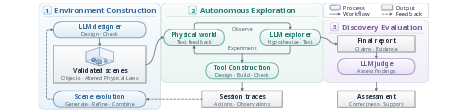
- Autonomous exploration: Investigation carried out by an agent that selects actions and questions without externally assigned goals. “Fig.~\ref{fig:task-overview} presents LongChang's automated cycle of physical law discovery: environment construction (Sec.~\ref{sec:environment-construction}), autonomous exploration (Sec.~\ref{sec:behavior}), and discovery evaluation (Sec.~\ref{sec:evaluation}).”
- Counterfactual setting: An experimental setup involving hypothetical conditions that differ from the actual or ordinary situation. “This counterfactual setting tests whether LLMs independently notice departures from ordinary physics and investigate them without research tasks or hints about the altered physical laws.”
- Controlled comparison: An experiment that changes one relevant factor while keeping other conditions comparable. “For example, slower falls for heavier objects could lead an explorer to ask how mass affects falling and design controlled comparisons to test this link.”
- Context compaction: A process that condenses an agent’s prior interaction history to reduce the amount of context it must process. “We compare budgets of 100 and 500 turns under free exploration without context compaction, with other settings matched.”
- Discovery rate: The proportion of experimental runs that satisfy both correctness and evidential-support requirements. “Discovery rate (D) is the percentage passing both checks.”
- Environment construction: The process of defining and creating a simulated world, including its objects, geometry, and rules. “Fig.~\ref{fig:task-overview} presents LongChang's automated cycle of physical law discovery: environment construction (Sec.~\ref{sec:environment-construction}), autonomous exploration (Sec.~\ref{sec:behavior}), and discovery evaluation (Sec.~\ref{sec:evaluation}).”
- Evidence support: The extent to which recorded experiments justify the claims made in a report. “Evidence support requires recorded experiments to justify all claims and reasoning at the stated level of certainty.”
- Experimental intervention: A deliberate action that changes an experimental state to test a hypothesis. “Physical law discovery involves inferring an environment's laws from observations and experiments.”
- Exploration record: A persistent log of an agent’s actions, observations, reasoning, and feedback. “These summaries identify tested conditions, unresolved questions, and explanations supported or corrected by later observations.”
- Free exploration: Exploration without an assigned research objective or advance information about the relevant phenomenon. “The initial prompt asks for free exploration without a research task or hints about the altered physics.”
- Law correctness: Whether a report correctly identifies the altered law and its relevant objects, conditions, triggers, and constants. “Law correctness requires identifying each altered physical law, its target objects, conditions, triggers, and constants identifiable in the reported units.”
- LLM judge: A LLM used to evaluate the outputs or claims of another LLM. “An LLM judge evaluates reports against altered physical laws and full exploration records, requiring law correctness (C) and evidence support (S) for discovery.”
- Mechanism: The physical rule or causal process responsible for an observed effect. “The designer uses three operations: generation creates new laws and scenes from source mechanisms, refinement modifies an existing scene, and composition combines source laws in a shared environment.”
- MuJoCo: A physics engine for simulating rigid-body dynamics and interactions. “The explorer's constructed tools interact physically with the other objects in the same simulated world.”
- Normal control: A baseline experimental condition in which no unusual law has been introduced. “The normal control assesses whether LLMs ground their conclusions in evidence when no physical law has been altered.”
- Object properties: Physical characteristics of simulated entities that can affect their behavior, such as mass or color. “Each base scene with altered physics modifies one physical law, producing effects that depend on object properties, spatial relations, contact events, or past actions.”
- Observable effect: A measurable outcome produced by a physical rule or intervention. “The designer records each altered physical law's target objects, conditions, and observable effects for evaluation, withholding this information from the explorer.”
- Physical intervention: An action that directly changes the state or motion of objects in a simulated environment. “The explorer chooses which observations to investigate, formulates its own research questions, and tests explanations through physical interventions.”
- Rigid-body simulation: A computational simulation in which objects are modeled as bodies that do not deform during interaction. “In the virtual ``glass room'' in Fig.~\ref{fig:discovery-teaser}, explorers manipulate objects and build tools that interact with the scene objects within a shared MuJoCo rigid-body simulation~\citep{todorov2012mujoco}.”
- Scene evolution: The automated generation, modification, or combination of simulated environments based on prior exploration results. “Scene evolution: automatically generating and revising scenes guided by exploration records.”
- Spatial relation: A positional relationship between objects, such as proximity, alignment, or containment. “Each base scene with altered physics modifies one physical law, producing effects that depend on object properties, spatial relations, contact events, or past actions.”
- Trajectory: The time-ordered path or sequence of states produced by an agent or object. “Trajectory-based benchmark construction uses tool-use records to create new tasks with solutions checked by re-execution~\citep{guo2025trace}.”
- Turn budget: The maximum number of interaction cycles available to an exploring agent. “We compare budgets of 100 and 500 turns under free exploration without context compaction, with other settings matched.”
- Controlled intervention: An experimental manipulation designed to isolate the effect of a particular variable or explanation. “We use model comparisons, controlled interventions, and exploration records to examine how LLMs form research questions and test explanations using experiments.”
- Velocity copying: A rule in which one object adopts another object’s velocity after a specified delay. “The designer combines the paused northward force with Scene~14's delayed motion copying: green takes red's launch velocity twelve seconds later.”
- World model: An internal or learned representation of an environment’s rules, dynamics, and predictable states. “Both WorldTest~\citep{warrier2026worldtest} and OneLife~\citep{khan2026onelife} examine predictive world models and explicitly ask explorers to learn environment rules.”