Gym-Anything for Robotics: Scaling physical simulations with digital agents
Abstract: Realistic, fast robotics simulations could enable large-scale training of embodied AI models that transfer to the real world. However, despite decades of progress, available simulations cover only a narrow range of real-world tasks and physical phenomena. The core bottleneck is that creating better simulations requires significant expert effort and therefore does not scale. To address this, we introduce Gym-Anything for Robotics, a framework in which coding agents create realistic robotics simulations. Our core insight is that simulation creation is a coding agent task, so improvements in coding agents translate directly into richer and more faithful simulations. We select simulations based on U.S. GDP data to cover economically valuable physical work, define what makes a good simulation and a good task, and develop an adversarial creation-audit loop that checks each simulation and task against these definitions. Using this pipeline, we build RoboWorld, a set of 25 simulations with 25 test and 175 training RL environments of varying difficulty. Even the best frontier models fail on every RoboWorld test task, achieving an average reward of only 0.06. Building on RoboWorld, we introduce several new ways for frontier models to improve, including in-context learning across repeated attempts, a privileged teacher that reads the simulator state and teaches a student in context, self-assisted learning from the model's own privileged experience, and code policies that generate demonstrations across varied scenes to train vision-language-action models (VLAs) such as . Each of these substantially improves performance. We release our pipeline, RL environments, and benchmark to facilitate future research. Code and data are available at https://gym-anything.github.io/robotics

Paper Prompts
Sign up for free to create and run prompts on this paper.
Explain it Like I'm 14
1. What is the paper about?
This paper presents Gym-Anything for Robotics, a system that uses AI coding agents to build realistic computer simulations for robots.
A robot simulator is like a video game world for robots. In this world, robots can practice jobs such as:
- Pouring wine
- Folding clothes
- Welding metal
- Working in a laboratory
- Cleaning objects
- Drawing on a whiteboard
- Moving items in a warehouse
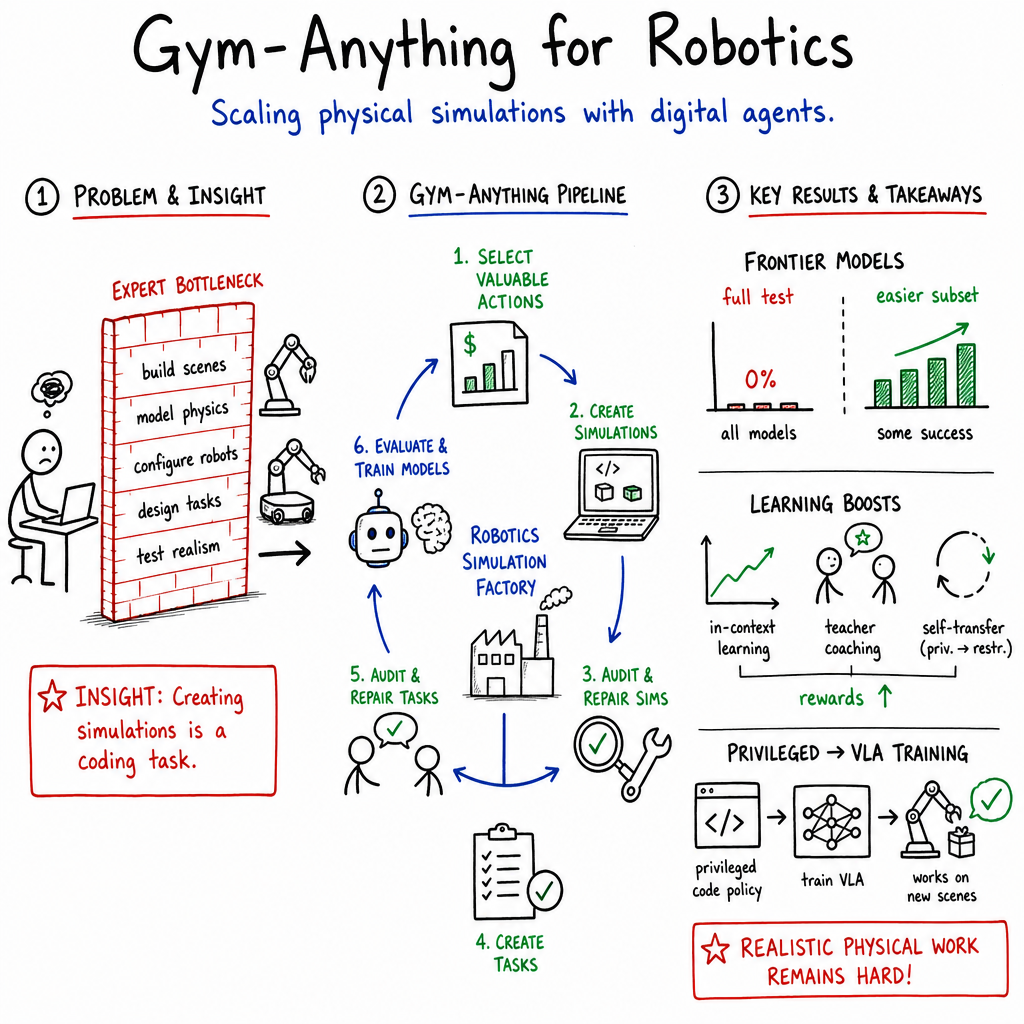
The main idea is that building these simulations is mostly a programming task. If AI systems become better at writing code, they may also become better at creating many useful and realistic robot-training environments.
The researchers use these environments to create RoboWorld, a collection of 25 simulations containing 200 training and testing environments.
2. What questions are the researchers asking?
The paper mainly asks four questions:
- Can AI coding agents build realistic robot simulations? The researchers want to know whether AI can create worlds with believable objects, movements, materials, and physics.
- Can these simulations cover important real-world work? Instead of choosing random robot tasks, the researchers use information about jobs and the economy to select activities that are especially valuable or common.
- Can current advanced AI models solve these robot tasks? They test several powerful AI models to see how well they can control robots in RoboWorld.
- Can robots learn more effectively in simulation? The researchers study whether robots can improve by practicing repeatedly, receiving advice, or learning from a more knowledgeable “teacher” model.
3. How did the researchers conduct the study?
Choosing useful simulations
The researchers began with information about jobs in the United States. They examined what people do at work and broke these activities into smaller physical actions, such as:
- Tightening a screw
- Pouring liquid
- Picking up an object
- Folding cloth
- Cutting or welding material
They then selected simulations that could teach many of these abilities. For example, a simulation about tightening bolts could help with many different jobs involving screws, tools, and mechanical parts.
They planned 120 possible simulation topics and built 25 of them for this paper.
Having coding agents build the simulations
An AI coding agent wrote the computer code for each simulation. The code had to describe:
- The objects in the scene
- The robot
- Cameras
- How objects move
- How materials behave
- The instructions for each task
- How success should be measured
Some simulations needed special physical effects. For example:
- Liquid should form drops and spill realistically.
- Cloth should bend and fold.
- Welded metal should melt and then become solid.
- Chemicals should mix and change color.
Checking the simulations with an audit process
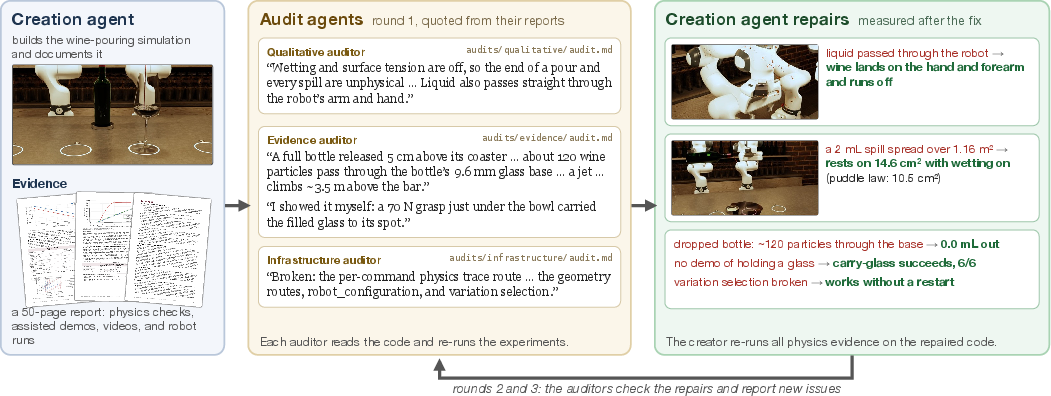
The researchers did not simply trust the AI-generated code. They used a repeated creation-audit loop.
This worked somewhat like a team of builders and inspectors:
- A creation agent built a simulation.
- Several audit agents inspected it.
- One auditor tried to break the simulation by finding unrealistic behavior.
- The creation agent fixed the problems.
- The process was repeated up to three times.
The auditors checked whether the simulation was:
- Realistic
- Physically possible
- Fast enough to run
- Useful for robot learning
- Resistant to cheating or bugs
For example, they checked that objects did not pass through walls or fly away when the robot used normal commands.
Creating and checking tasks
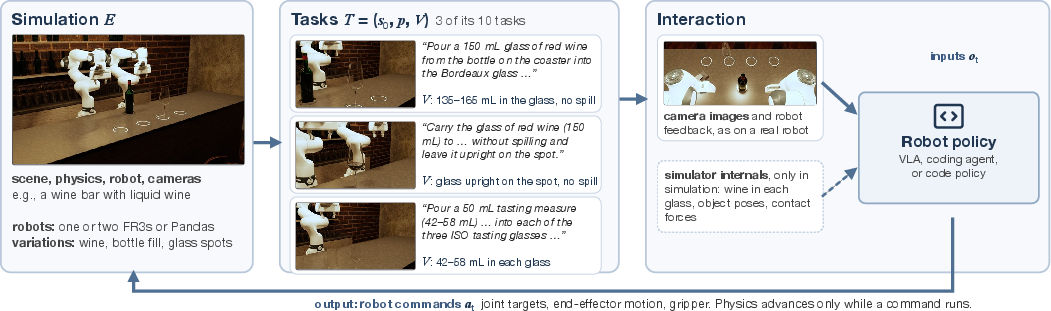
Each simulation contained several tasks. A task included:
- A starting situation
- An instruction written in ordinary language
- A method for deciding whether the robot succeeded
The researchers also created auditors specifically for tasks. These auditors checked that tasks were meaningful, possible to complete, and neither too easy nor impossibly difficult.
The reward system gave partial credit. For example, a robot cleaning a table could receive credit for putting some objects in the correct places, even if it did not finish everything.
Testing AI robot controllers
The researchers tested three advanced LLMs. These models could:
- Look at camera images
- Read robot information, such as joint positions
- Write code
- Send commands to the robot
The models had a limited amount of time to complete each task.
The researchers measured:
- Success rate: how often the robot completely finished a task
- Average reward: how much progress it made, even if it failed
They also studied several learning methods:
- Letting a model try the same task repeatedly
- Giving a model access to the simulator’s hidden information
- Having a teacher model give advice to a student model
- Using successful computer-written robot programs to train a vision-language-action model
A vision-language-action model, or VLA, is an AI system that looks at images, understands instructions, and chooses physical actions.
4. What were the main findings?
The simulations covered many kinds of physical work
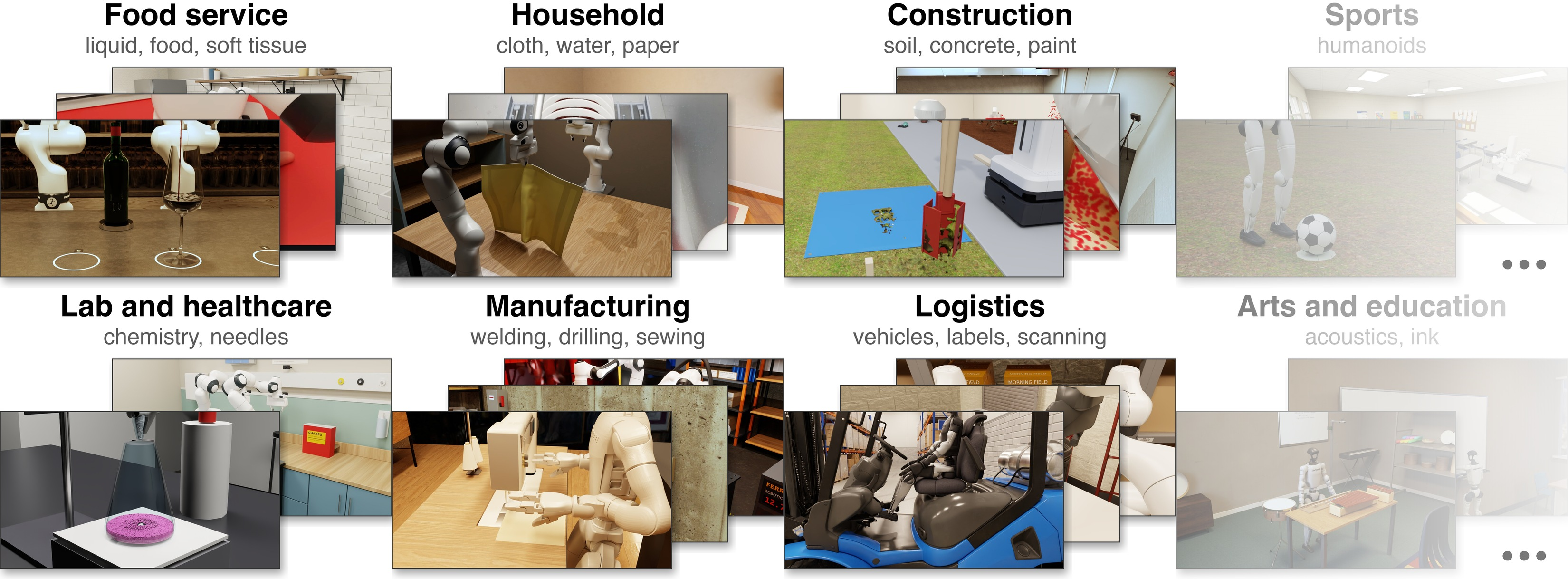
The researchers built RoboWorld with 25 simulations involving areas such as:
- Manufacturing
- Construction
- Food service
- Laboratories
- Households
- Healthcare
- Logistics
- Sports and education
The simulations included difficult physical effects involving liquids, cloth, chemicals, soil, soft materials, molten metal, and sound.
This made RoboWorld broader and more physically detailed than many older robot benchmarks.
Current advanced models struggled badly
The most important result was that the tested AI models failed all 25 official RoboWorld test tasks.
| Evaluation group | Best success rate | Best average reward |
|---|---|---|
| 25 official test tasks | 0% | 0.06 |
| 25 easier tasks | 32% | 0.48 |
On the easier tasks, the strongest model completed 32% of them. This shows that the models can solve some simple robot activities, but they are still poor at complicated physical work.
This is important because LLMs may appear intelligent when answering questions or writing code, but controlling a robot in the physical world is much harder. Robots must carefully understand space, movement, contact, timing, materials, and possible mistakes.
Repeated practice helped
The models improved when they could try a task more than once and remember what happened. This is called in-context learning. It is similar to a student trying a problem, studying the mistake, and trying again without changing their brain permanently.
The models improved even more when they could see the simulator’s hidden information, such as the exact location of objects or the forces between them.
A teacher could help a student
The researchers tested a teacher-student system. The teacher could see the simulator’s full internal state, while the student could only see camera images and robot feedback.
The teacher gave the student simple verbal hints, such as advice about what mistake it was making. The student could then use its own observations to try again.
This showed that information available inside a simulator can be useful even when it is not directly available to the final robot.
Computer-written policies could train another robot model
A coding agent with access to the simulator wrote programs that successfully controlled robots. These programs were run many times in different scenes to create training examples.
Those examples were then used to train a vision-language-action model called .
The model’s success rate improved from 0% to 53% on the tested tasks. This suggests that powerful AI models may be able to create training data for smaller robot-control systems.
5. Why are these findings important?
The paper shows a possible way to solve a major problem in robotics: there are not enough realistic simulations for robots to practice in.
Real-world robot training is expensive and risky. A robot could break equipment, spill chemicals, damage objects, or hurt someone. In a simulator, researchers can:
- Run thousands of trials quickly
- Reset the world instantly after a mistake
- Test many robots and object arrangements
- Read information that would be difficult to measure in the real world
- Train without needing constant human supervision
The researchers’ approach could make it much faster to create new training environments. Instead of a small team of human experts programming every detail, AI coding agents could build and improve many simulations, while other AI agents inspect them.
Conclusion
In simple terms, this paper describes a plan for making better “practice worlds” for robots. AI coding agents build realistic virtual workplaces, and other AI agents check whether those worlds behave properly. These worlds are then used to test and train robot-control systems.
The results show two things at once:
- Current AI models are still far from mastering realistic physical tasks.
- Simulation can give them valuable practice and can improve their performance.
If this approach continues to improve, it could help robots learn useful skills before being placed in the real world. In the future, this might lead to robots that are better at factory work, laboratory tasks, household jobs, healthcare assistance, and many other kinds of physical work.
Practical Applications
Immediate Applications
The paper’s most deployable contributions are its open simulation infrastructure, benchmark, audit workflow, and training methodology. These can be used now for research, prototyping, and evaluation, although successful transfer to physical robots still requires validation.
- Robotics research and benchmarking — Academia / software
- Use
Gym-Anything for RoboticsandRoboWorldas standardized environments for evaluating reinforcement-learning agents, vision-language-action models (VLAs), code policies, and frontier reasoning models. - Compare policies across heterogeneous tasks involving liquids, cloth, chemistry, welding, logistics, household work, laboratories, construction, and education.
- Use deterministic physical-state verifiers and continuous rewards instead of subjective video or VLM-based judgments.
- Assumptions and dependencies: The released code, assets, physics engines, and model interfaces must remain reproducible and sufficiently documented. Results may depend on simulator configuration, compute budget, model version, and access restrictions.
- Use
- Automated simulation and task generation — Robotics / software engineering
- Adapt the creation–audit loop to generate new robot environments by having coding agents:
- assemble scenes from digital assets,
- configure robot and physics parameters,
- create task descriptions and reward functions,
- run physical consistency checks,
- search for exploits and failure modes.
- This could support internal tools for robotics companies that need task-specific simulators without manually implementing every environment.
- Assumptions and dependencies: Coding agents must produce executable and physically meaningful code. Human experts are still needed to validate high-risk physics, material properties, safety constraints, and real-world relevance.
- Simulation quality assurance — Robotics platforms / digital twins
- Use the paper’s ten simulation criteria—realism, solvability, dynamics, speed, configurability, documentation, and exploit robustness—as a practical QA checklist.
- Add adversarial agents that deliberately search for:
- objects passing through surfaces,
- non-finite states,
- reward loopholes,
- physically impossible robot behavior,
- tasks that are unsolvable or incorrectly verified.
- This can become a CI-style testing workflow for simulation repositories, where every new environment is audited before being used for training.
- Assumptions and dependencies: Automated audits can detect only properties that are represented in the criteria and test cases. They do not guarantee sim-to-real fidelity.
- Robot-policy evaluation before hardware testing — Manufacturing, logistics, and service robotics
- Evaluate policies for operations such as pouring, folding, labeling, welding, object placement, cleanup, and tool manipulation before running them on expensive or hazardous hardware.
- Use variations in object pose, appearance, physics, and robot morphology to test robustness rather than evaluating only one nominal scene.
- Assumptions and dependencies: The simulated task must model the failure-relevant properties of the real operation, including friction, compliance, sensing noise, contact dynamics, and material variation.
- Curriculum design for embodied AI — Academia / robotics education
- Use the benchmark’s difficulty-controlled tasks to create curricula ranging from simple manipulation to multistep physical work.
- Generate tasks with graded rewards that measure partial progress—for example, the number of correctly placed objects or the fraction of a weld that satisfies quality constraints.
- This can improve reinforcement-learning stability and provide more informative training signals than binary success alone.
- Assumptions and dependencies: Difficulty estimates based on frontier models may not transfer directly to other models, robots, or control interfaces. Curriculum levels should be recalibrated for each learner.
- In-context robot learning and debugging — Robotics laboratories
- Allow a reasoning model to attempt a simulated task repeatedly, inspect failures, revise its strategy, and retry from a reset state without changing model weights.
- This offers a practical workflow for diagnosing action sequences, control APIs, perception failures, and task decomposition.
- Assumptions and dependencies: The approach requires fast, reliable resets and a context window large enough to retain useful observations. It may be too slow or expensive for real-time physical operation.
- Privileged-state coaching for policy development — Robotics / machine learning
- Use a teacher model with access to simulator state to identify errors and provide qualitative hints to a student model that sees only camera images and robot feedback.
- This can support training interfaces where developers inspect why a policy failed without exposing privileged coordinates or commands during evaluation.
- Assumptions and dependencies: The hints must be informative but not leak unrealistic information. Coaching in simulation may not capture failures caused by real sensor noise, latency, calibration error, or unmodeled contact dynamics.
- Synthetic demonstration generation for VLA training — Software / robotics
- Generate large numbers of demonstrations with privileged code policies, varied scenes, and multiple robot configurations.
- Use the resulting camera observations and proprioceptive data to train vision-language-action models that do not receive object-state information at inference time.
- The paper reports that this approach raises the performance of
π₀.₅from 0% to 53% on the studied setting, suggesting a practical route for reducing human demonstration requirements. - Assumptions and dependencies: Demonstrations must be diverse and physically realistic. Performance depends on the quality of visual rendering, domain randomization, camera placement, action representation, and the gap between simulated and real hardware.
- Workforce training and educational simulators — Education / vocational training
- Convert environments such as whiteboard manipulation, laboratory procedures, welding, food service, or logistics into interactive training tools for robotics students and operators.
- Students could practice planning and control, receive deterministic task feedback, and compare different robot embodiments.
- Assumptions and dependencies: The current benchmark is designed primarily for AI training rather than certified human instruction. Educational use would require improved interfaces, pedagogical feedback, accessibility features, and validation against professional procedures.
- Policy and public-sector prioritization of robotics research — Government / policy
- Reuse the GDP-grounded selection method to prioritize simulation and robotics investments according to:
- economic value,
- labor demand,
- strategic importance,
- STEM relevance,
- underrepresented physical capabilities,
- everyday-life impact.
- Public agencies could use this framework to identify high-value benchmarks for grants, national laboratories, or workforce programs.
- Assumptions and dependencies: GDP and occupational data are imperfect proxies for social value. A policy version should also incorporate safety, equity, environmental impact, labor conditions, and regional variation.
- Reproducible evaluation standards — Academia / industry
- Adopt common reporting requirements for robot simulations, including:
- physical parameters and data sources,
- solver assumptions,
- robot limits,
- physics checks,
- task-verifier definitions,
- exploit tests,
- variation ranges,
- restricted versus privileged access.
- This would make results easier to reproduce and reduce misleading comparisons between policies trained under different information conditions.
- Assumptions and dependencies: The community must agree on shared metadata formats and disclose simulator-specific limitations rather than treating benchmark scores as universally comparable.
Long-Term Applications
The more ambitious applications require validated sim-to-real transfer, broader physics coverage, additional hardware testing, and stronger safety guarantees. The paper demonstrates useful mechanisms, but it does not establish reliable deployment in these settings.
- Large-scale training of general-purpose physical robots — Robotics / manufacturing / logistics
- Build a broad library of GDP-grounded environments and use them to train generalist robots capable of switching among manipulation, inspection, assembly, packaging, laboratory, and household tasks.
- A common interface could allow the same policy family to operate single-arm, bimanual, mobile-manipulator, and humanoid platforms.
- Dependencies: Reliable transfer across embodiments, accurate contact and material simulation, realistic perception, robust action abstractions, and hardware-specific safety controllers are required.
- Industrial digital twins and predictive workflow optimization — Manufacturing / construction / energy
- Create digital twins of work cells in which robot policies are trained and tested under variations such as tool wear, part tolerances, fluid behavior, welding conditions, or material friction.
- The system could evaluate alternative layouts, robot choices, task sequences, and recovery behaviors before modifying a production line.
- Dependencies: High-fidelity facility scans, proprietary process data, calibrated material models, real-time synchronization, cybersecurity, and validation against production measurements.
- Simulation-based certification and safety testing — Industrial safety / regulation
- Use adversarial simulation agents to test whether a robot can exploit reward functions, enter unsafe configurations, damage objects, or behave unpredictably under rare environmental conditions.
- Regulators or manufacturers could require documented simulation campaigns before approving autonomous systems for selected tasks.
- Dependencies: Simulated hazards must correspond to real hazards, coverage metrics must be defensible, and simulation evidence cannot replace physical testing, formal verification, or human safety review.
- Robotic laboratory automation — Healthcare / pharmaceuticals / chemistry
- Extend liquid, titration, mixing, pipetting, and material-handling simulations to train robots for sample preparation, analytical chemistry, pharmaceutical formulation, and clinical laboratory workflows.
- The physical-state verifier could evaluate volume accuracy, contamination, mixing, reaction endpoints, and handling quality.
- Dependencies: Chemical models must be experimentally calibrated; biological and chemical variability, contamination risk, regulatory requirements, and real sensor limitations must be represented. A visually plausible reaction is not sufficient for clinical or pharmaceutical use.
- Healthcare and assistive robotics — Healthcare / eldercare
- Train robots for handling soft materials, containers, clothing, mobility aids, and household objects in assisted-living or clinical environments.
- Simulated variations could expose policies to different object placements, human-centered layouts, and robot embodiments before limited supervised trials.
- Dependencies: Human biomechanics, consent, privacy, fall and injury risks, deformable-object behavior, and interaction with unpredictable people are substantially more complex than the current benchmark. Extensive clinical validation would be necessary.
- Autonomous construction, maintenance, and repair — Construction / infrastructure / energy
- Develop environments for fastening, welding, drilling, inspection, material placement, cable routing, and repair under constrained or changing conditions.
- Policies could be trained on variations in geometry, lighting, tool condition, weather, and material properties.
- Dependencies: Outdoor perception, structural safety, force control, changing environments, regulatory standards, and accurate models of materials such as concrete, soil, molten metal, and corrosion are required.
- Household and service robots with broad task coverage — Consumer robotics
- Use the framework to train robots that can perform cooking, laundry, cleaning, pouring, sorting, classroom assistance, and object organization.
- GDP- and activity-grounded selection could help avoid optimizing only for laboratory manipulation tasks.
- Dependencies: Homes are highly diverse and partially observed; objects are damaged, misplaced, or novel; humans move unpredictably; and safety and privacy constraints are stringent. Simulated task success alone would not establish consumer readiness.
- Robotic skill markets and reusable simulation components — Software ecosystem
- Develop a library of reusable task modules, material models, robot interfaces, verifiers, and audit agents that can be composed into new environments.
- Companies could share validated simulation components for capabilities such as grasping, pouring, threading, folding, cutting, or force-controlled insertion.
- Dependencies: Interoperable APIs, licensing for digital assets, secure code execution, provenance of physical parameters, and mechanisms for certifying component quality are needed.
- Continual learning from real-world feedback — Robotics / machine learning
- Combine large-scale simulation with limited real-robot data: identify sim-to-real discrepancies, update physics parameters, regenerate tasks, and retrain policies.
- The creation–audit loop could become part of an iterative workflow in which real failures automatically inform new simulation variations and adversarial tests.
- Dependencies: Safe data collection, reliable discrepancy estimation, avoidance of catastrophic forgetting, and protection against learning unsafe behaviors from noisy or biased real-world data.
- Economic planning for automation — Policy / labor economics
- Use the action-group decomposition to estimate which physical capabilities could produce the greatest economic benefit from automation and which require further research.
- Policymakers could compare investments in robotics infrastructure, training, reskilling, and safety based on capability coverage rather than isolated demonstrations.
- Dependencies: Economic value does not equal social desirability. Analyses would need to include job quality, distributional effects, worker displacement, accessibility, environmental costs, and the possibility that automation changes task value itself.
- General embodied foundation models — AI research
- Train foundation models that combine language, vision, proprioception, action, and physical reasoning across many simulated domains.
- Privileged-state teachers and code-generated demonstrations could provide scalable supervision while restricted-access evaluation tests whether the learned skills depend on realistic sensory inputs.
- Dependencies: The current results show that frontier models still fail all 25 test tasks, so substantial advances in long-horizon planning, perception, contact reasoning, control, memory, and sim-to-real transfer remain necessary.
Glossary
- Adversarial creation-audit loop: An iterative process in which generated simulations are deliberately tested for flaws and then revised. “we develop an agentic creation-audit loop”
- Added-mass coupling: A fluid-mechanics model accounting for the additional effective inertia experienced by an object accelerating through a fluid. “added-mass coupling”
- Anisotropic membrane: A membrane whose mechanical properties differ according to direction. “anisotropic membrane and bending”
- Bimanual arm: A robotic system equipped with two manipulators that can coordinate their movements. “bimanual arms”
- Code policy: A program that controls a robot by transforming observations and state information into robot commands. “A code policy is a Python program that reads camera images, robot state, and privileged task-object state, and outputs only ordinary robot commands”
- Contact-line pinning: The resistance of the boundary between a liquid, solid, and surrounding gas to movement across a surface. “contact-line pinning”
- Continuous reward: A reward function that provides graded feedback reflecting partial progress rather than only success or failure. “The reward measures both progress and outcome”
- DFSPH (Divergence-Free Smoothed Particle Hydrodynamics): A particle-based fluid-simulation method designed to maintain near-incompressibility and suppress numerical divergence. “DFSPH, 2\,mm particles”
- Diffusive mixing: The process by which substances spread through random molecular motion and concentration gradients. “diffusive mixing”
- Domain randomization: Varying environmental properties during training so that a policy generalizes to new conditions. “variations of object poses, appearance, and physics”
- Embodied AI: Artificial intelligence situated in a physical or simulated body that perceives and acts in an environment. “large-scale training of embodied AI models”
- End-effector: The tool or terminal device attached to the end of a robotic arm. “an end-effector motion”
- Finite-mass fingers: Robotic gripper fingers modeled with physical mass rather than as massless or purely kinematic attachments. “finite-mass fingers”
- Friction grasp: A grasp that holds an object through frictional forces between the gripper and the object. “friction grasp up to 70\,N”
- Ground-truth state: The complete, exact state of an environment, including variables that may be hidden from an agent. “expose the full ground-truth state”
- Hydrostatic load: Force exerted by a fluid at rest due to the fluid’s weight and pressure distribution. “hydrostatic load”
- In-context learning: Improvement in task performance from information and experience provided within the current interaction context, without changing model parameters. “models can improve on RoboWorld tasks through in-context learning”
- Inverse kinematics: The computation of joint configurations or movements required to place a robot’s end-effector at a desired pose. “solving the inverse kinematics of the arms”
- Lip separation: The modeled detachment of a liquid stream from the edge or lip of a pouring container. “lip separation”
- Material state: The physical condition of a material, such as solid, liquid, or molten, represented by a simulator. “material states”
- MLS-MPM (Moving Least Squares Material Point Method): A hybrid particle-grid numerical method for simulating continuum materials and fluids. “MLS-MPM”
- Motion jerk: The rate of change of acceleration, used to characterize the smoothness of robot motion. “Franka velocity, acceleration, and jerk limits”
- Parliamentary? no.
- Privileged access: Access to internal simulator information unavailable to a robot operating in the real world. “Privileged access additionally exposes the simulator state and the task evaluation”
- Proprioception: Internal sensing of a robot’s configuration and motion, such as joint positions and velocities. “robot proprioception”
- Reinforcement learning: A learning paradigm in which an agent improves behavior through rewards received from interacting with an environment. “175 training RL environments”
- Reward shaping: Designing rewards to provide useful intermediate feedback toward a desired outcome. “The reward measures both progress and outcome”
- Self-contact: Physical interaction between different parts of the same deformable or articulated object. “self-contact”
- Simulation-to-real transfer: The transfer of policies or skills learned in simulation to physical robots. “that transfer to the real world”
- Solvability: The property that all interactions required by a task can be physically achieved in the environment. “Every interaction that is required by the tasks is physically achievable”
- Surface energy: Energy associated with the interface between different materials or phases, influencing wetting and droplet behavior. “surface energy”
- Surface tension: The tendency of a liquid surface to minimize its area because of cohesive molecular forces. “a liquid simulation may not handle surface tension”
- Teacher-student setup: A learning arrangement in which one model with additional information guides another model with more limited information. “a teacher-student setup where the teacher has privileged access and teaches a student model”
- Titration: A chemical analysis procedure in which a solution of known concentration is added to determine an unknown concentration or reaction endpoint. “a realistic titration requires the solution to form drops, mix, and turn pink rather than red at the endpoint”
- Viscosity? not explicit.
- Vision-language-action model (VLA): A model that maps visual and language inputs to actions for controlling an embodied agent. “code policies that generate demonstrations across varied scenes to train vision-language-action models (VLAs)”
- Wetting: The interaction between a liquid and a solid surface that determines how readily the liquid spreads across it. “Young's-law wetting”
- Young’s law: A relation describing the equilibrium contact angle of a liquid on a solid surface from interfacial tensions. “Young's-law wetting”

