LLMs Can Tackle High Energy Theoretical Physics, yet Gaps Remain: Part I, Quantum Field Theory
Abstract: Beyond math and code, LLMs are beginning to tackle problems that have traditionally required substantial training for theoretical physicists, but it remains unclear how far this capability extends and where it might break. As a first step toward pushing LLMs in high-energy theoretical physics, we introduce QFT-Bench, a benchmark of 75 graduate- to research-level problems requiring extensive reasoning and derivation across core Quantum Field Theory (QFT) subareas. Each question has a well-defined target and closed-form reference answer. Evaluation combines symbolic verification with LLM-based judge. Across 39 proprietary and open-source models, frontier models already demonstrate substantial capabilities on nontrivial QFT calculations, with the strongest models exceeding 95% accuracy. At the same time, clear gaps remain. Even strong models still make errors in calculations, conventions, and instruction following, while weaker models often fail at the level of physical concepts or derivations. We further monitor models' CoTs and show that current models exhibit nontrivial reasoning unfaithfulness, i.e., they could reach correct answers but the reasoning itself does not justify and logically support them. These results provide a quantitative assessment of current LLM capabilities in QFT and a first step toward broader evaluation in high-energy theoretical physics.
Paper Prompts
Sign up for free to create and run prompts on this paper.
Explain it Like I'm 14
1. What is the paper about?
This paper studies whether LLMs—the technology behind many AI chatbots—can solve difficult problems in quantum field theory (QFT).
QFT is a major part of modern physics. It is used to describe tiny particles, such as electrons and quarks, and the forces between them. The mathematics is extremely advanced and often requires many careful steps.
The researchers created a test called QFT-Bench to measure how well different AI models can solve these problems. Their main conclusion is:
The best AI models can solve many difficult QFT problems, but they still make important mistakes and do not always give trustworthy explanations.
2. What questions did the researchers ask?
The paper focuses on several main questions:
- Can AI models solve advanced QFT calculations?
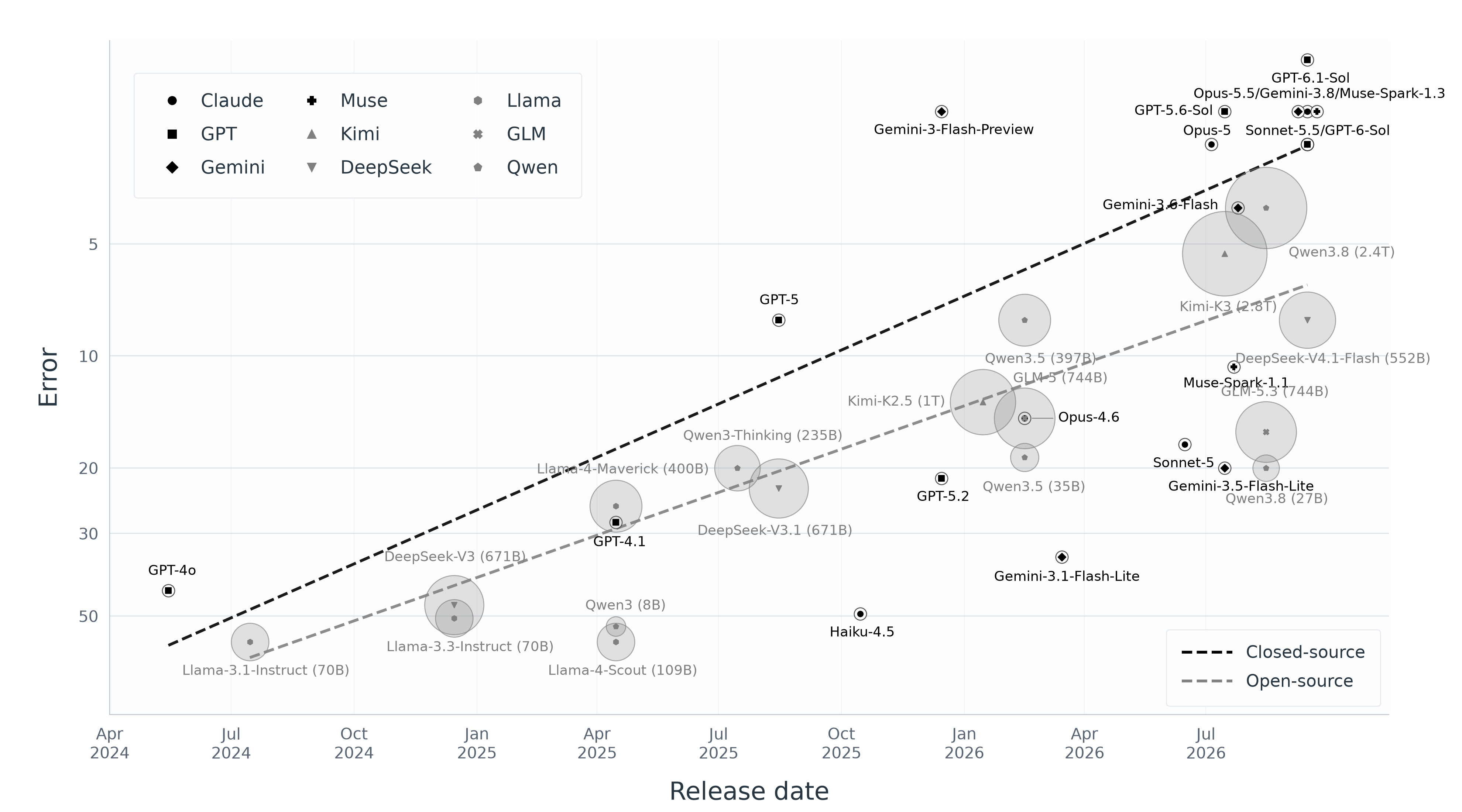
- Are newer and more powerful models better than older or smaller ones?
- How do closed-source models compare with open-source models?
- What kinds of mistakes do the models make?
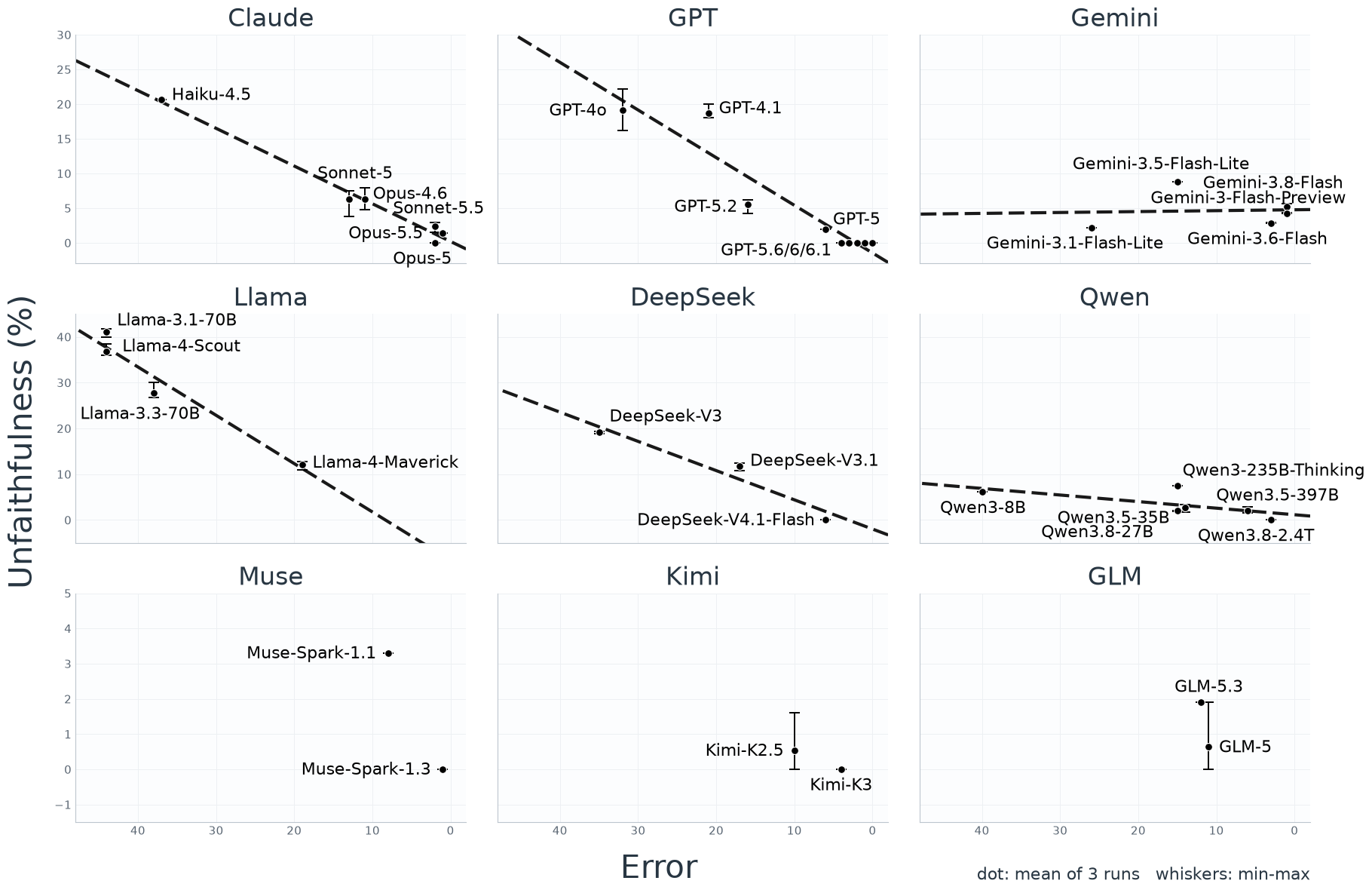
- When an AI gives the correct answer, does its step-by-step reasoning actually support that answer?
That last question is especially important. An AI might produce the right final answer by chance or because it has seen a similar formula before, even though some of its reasoning is wrong.
3. How did the researchers study this?
Creating QFT-Bench
The researchers made a collection of 75 difficult questions. These questions covered eight areas of quantum field theory, including:
- Classical field theory
- The quantization of particles and fields
- Quantum electrodynamics, which describes light and electrically charged particles
- Renormalization, a way of handling infinite results in physics calculations
- Quantum chromodynamics, which describes quarks and the strong force
- The Higgs mechanism
- Supersymmetry
- Conformal field theory
The questions were designed to be harder than ordinary school or undergraduate physics problems. Most were aimed at graduate students or beginning researchers.
Each question had a carefully prepared correct answer. The researchers also wrote step-by-step solutions so they could compare the AI responses with reliable reference solutions.
Testing many AI models
The researchers tested 39 different LLMs. These included both:
- Proprietary models, which are controlled by companies and usually cannot be inspected directly
- Open-source models, whose software or model weights are more widely available
The models were given a large amount of space to reason through each problem. Their answers were then checked in two ways.
Checking the answers
First, the researchers used a computer mathematics tool called SymPy. It checked whether the AI’s formula was mathematically equivalent to the official answer, even if it was written in a different form.
For example, the expressions $2x+2x$ and $4x$ look different but mean the same thing. A symbolic checker can recognize this.
If the computer could not decide whether an answer was correct—for example, because different physics conventions were being used—another LLM acted as a judge. It compared the response with the reference answer and solution.
Studying mistakes and reasoning
The researchers placed wrong answers into four main categories:
- Conceptual errors — using the wrong physics idea
- Calculation errors — using the right idea but making an algebra mistake
- Strong-prior errors — giving a familiar formula instead of following the exact rules in the question
- Instruction-following errors — failing to answer in the requested format or answering a slightly different question
They also studied reasoning faithfulness. This means asking whether the explanation really supports the final answer.
An example of unfaithful reasoning would be:
- The AI makes a mistake in the middle of a calculation.
- It later gives the correct final answer.
- It never explains or fixes the earlier mistake.
In that case, the final answer may be correct, but the displayed reasoning is not a valid proof.
4. What did the researchers find?
The strongest models performed very well
The best models solved most of the problems. The paper reports that 12 models achieved more than 95% accuracy, and the strongest model reached about 100% accuracy on the benchmark.
This is impressive because the questions required long calculations and knowledge of advanced physics, not just recalling simple facts.
The results also showed that:
- Newer models generally performed better than older versions.
- The strongest proprietary models usually performed better than open-source models.
- Larger and more capable models generally made fewer conceptual mistakes.
Smaller and weaker models struggled more
Some smaller models had much lower scores. Their mistakes often showed that they did not understand the physical ideas behind the questions.
For example, a model might misunderstand how many particle lines connect to a point in a diagram. That is not just an arithmetic error; it shows a problem with the underlying physics.
Strong models still made serious mistakes
Even the best AI systems were not perfect. Their errors often involved:
- Losing a minus sign or numerical factor
- Using the wrong mathematical convention
- Replacing the problem’s special definition with a more familiar one
- Giving the correct idea but not following the requested answer format
This shows that being good at advanced physics is not the same as being completely reliable.
Correct answers did not always have correct explanations
Across the models, about 7.2% of correct answers had unfaithful reasoning according to the researchers’ test.
In other words, some models reached the right answer even though their written calculations did not logically lead to it. This is similar to a student writing the correct answer on a math test while showing incorrect working.
The researchers found that stronger models tended to give more trustworthy reasoning. However, the problem did not disappear completely.
5. Why are these findings important?
Quantum field theory is one of the foundations of modern physics. It is used to study the Standard Model, which describes many known particles and forces.
If AI systems can reliably help with QFT, they might eventually assist scientists by:
- Checking long calculations
- Finding algebra mistakes
- Exploring possible theories
- Suggesting relationships between different physics ideas
- Helping researchers work through complicated equations more quickly
However, this paper shows that AI should not yet be treated as an independent physics expert. A model may sound confident while making a small mistake that changes the entire result.
The research also shows why testing only the final answer is not enough. Scientists need to check the whole reasoning process, just as a teacher checks both a student’s answer and their working.
Conclusion
This paper presents one of the first detailed tests of AI systems on advanced quantum field theory. The researchers created QFT-Bench, containing 75 challenging problems, and used it to compare 39 LLMs.
The results are encouraging: the best models can solve many difficult physics problems, sometimes with very high accuracy. But important weaknesses remain. Models can make conceptual, mathematical, or instruction-following errors, and they sometimes provide explanations that do not truly justify their answers.
The likely future is not that AI immediately replaces theoretical physicists. Instead, AI may become a powerful assistant—one that helps researchers calculate, check, and explore ideas. Human scientists will still need to verify the results and decide whether they make physical sense.
Practical Applications
Immediate Applications
- Automated QFT problem-solving assistants for researchers and students (academia; education; Immediate Application)
Frontier LLMs achieving above 95% accuracy on many QFT-Bench problems can already support routine derivations in classical field theory, QED, QCD, renormalization, electroweak theory, supersymmetry, and conformal field theory. A practical workflow would have the model:
- formalize the assumptions and conventions;
- produce a derivation;
- submit intermediate and final expressions to
SymPyor another computer-algebra system; - flag steps requiring expert review. This could reduce the time spent on algebraic manipulation, dimensional analysis, and textbook-level calculations. Dependencies: The model must be paired with symbolic verification and expert oversight. The paper reports errors in signs, normalization, field counting, conventions, and instruction following, so unverified outputs should not be treated as research results.
Interactive graduate-level physics tutoring and formative assessment (education; Immediate Application)
- conceptual misunderstandings;
- calculation or normalization mistakes;
- use of an inappropriate textbook formula;
- failure to answer the requested quantity or format.
- Dependencies: Educational deployment should expose uncertainty and encourage students to reconstruct derivations independently. Models with lower benchmark scores may be suitable for introductory assistance but not advanced grading without human review.
- Physics-aware code-generation assistants for symbolic calculations (software; high-energy physics; Immediate Application) The benchmark’s verification pipeline suggests a tool that converts natural-language QFT requests into symbolic-computation code for propagators, Feynman-rule manipulations, dimensional analysis, tensor contractions, and simplified amplitudes. Generated code could be checked through symbolic equivalence, unit tests, and known limits. Dependencies: Symbolic equivalence is not sufficient for all physics problems: gauge choices, conventions, analytically equivalent forms, and physical plausibility may require specialized validators or expert judgment.
- Automated regression testing for scientific LLMs (AI development; research infrastructure; Immediate Application)
- conceptual errors;
- arithmetic and sign errors;
- strong-prior or convention errors;
- instruction-following failures.
- Dependencies: The benchmark contains only 75 problems and has closed-form answers, so it should be supplemented with larger, contamination-resistant, open-ended, and experimentally connected evaluations.
- Model selection for physics workflows (industry; scientific software; Immediate Application) Organizations building physics-assistance platforms can use QFT-Bench-style testing to select models for narrowly defined tasks. Stronger models may be assigned derivation and research-support tasks, while smaller or cheaper models can handle formatting, literature summarization, or routine symbolic preprocessing. Dependencies: Benchmark performance may not transfer directly to novel research problems, long tool-use chains, or tasks involving numerical simulations. Cost, latency, data privacy, and reproducibility must also be evaluated.
- Human-in-the-loop checking of derivations and manuscripts (academic publishing; research collaboration; Immediate Application) LLMs can review draft calculations for inconsistent notation, missing assumptions, dimensional inconsistencies, and deviations from stated conventions. For example, they can check whether a gauge transformation, field normalization, or operator-ordering convention is used consistently throughout a derivation. Dependencies: Because the paper finds an average unfaithfulness rate of approximately 7.2% among correct responses, a plausible-looking explanation cannot be accepted as evidence that the calculation is valid. Independent symbolic or human verification remains necessary.
- Benchmark-informed policy for responsible scientific AI deployment (research governance; policy; Immediate Application)
- task-specific accuracy rather than general claims of “reasoning” ability;
- symbolic or numerical verification where available;
- uncertainty and failure cases;
- whether reasoning traces have been independently validated;
- the role of human approval in high-consequence decisions.
- Dependencies: Chain-of-thought text should not be treated as a fully reliable record of internal computation. Evaluation protocols should focus on reproducible derivations, tool traces, and independently checkable intermediate results.
- Personal productivity support for theoretical physicists (daily academic work; Immediate Application) Individual researchers can use LLMs to draft algebraic checks, translate notation between papers, generate preliminary LaTeX, explain standard QFT concepts, and prepare computational notebooks. This is most appropriate for low-risk preparatory work rather than accepting novel claims or final numerical results. Dependencies: Users must check citations, conventions, and derivations. The paper’s examples show that even highly capable models may produce a correct final expression for incorrect reasons.
Long-Term Applications
- End-to-end AI assistants for high-energy physics calculations (high-energy physics; scientific computing; Long-Term Application) A future system could connect an LLM to Feynman-diagram generators, symbolic algebra packages, integration-by-parts reduction tools, renormalization databases, numerical loop integrators, and simulation software. It could transform a physical question into diagrams, derive amplitudes, simplify expressions, verify symmetries, and generate numerical predictions. Dependencies: This requires reliable tool orchestration, convention management, gauge-invariance checks, numerical stability tests, and benchmark suites covering multi-stage workflows rather than isolated questions.
- AI-assisted discovery of symmetries, dualities, and theoretical connections (fundamental physics; Long-Term Application) The paper identifies the possibility of models discovering hidden relations between theories, new symmetries, or dualities. A practical research system could search across symbolic representations of QFTs, compare operator spectra and correlation functions, and propose conjectures for human physicists to test. Dependencies: High benchmark accuracy on closed-form derivations does not establish the ability to generate scientifically novel or physically meaningful theories. Candidate discoveries would require mathematical proofs, consistency checks, and eventually experimental or observational support.
- Automated generation of testable particle-physics hypotheses (particle physics; experimental planning; Long-Term Application) Models could combine QFT calculations with collider constraints, effective field theory parameterizations, and existing experimental data to propose new interactions, particles, decay channels, or signatures. Outputs could include predicted cross sections, branching ratios, and detector-level observables. Dependencies: This requires integration with validated numerical tools and current experimental databases. Predictions must satisfy unitarity, causality, gauge consistency, renormalizability or clearly stated effective-field-theory assumptions, and existing exclusion limits.
- Formal or semi-formal verification of physics derivations (theorem proving; scientific reliability; Long-Term Application) QFT-Bench demonstrates the value of mechanically checkable outputs. A longer-term direction is to encode larger portions of QFT—including operator algebras, renormalization identities, gauge fixing, and perturbative expansions—into proof assistants or domain-specific formal systems. LLMs could propose proof steps while formal tools certify them. Dependencies: Existing proof systems do not yet cover the full breadth and physical interpretation of QFT conveniently. Formalization is labor-intensive, and physical equivalence may involve analytical assumptions that are difficult to express in current automated systems.
- Faithfulness-aware scientific agents (AI safety; research automation; Long-Term Application) The reported gap between correct answers and logically valid reasoning motivates agents that independently recompute critical steps, compare multiple derivations, test limiting cases, and detect contradictions between displayed reasoning and final results. A system might assign a “verified derivation” status only when all essential transformations pass external checks. Dependencies: LLM-based judges alone may reproduce model biases. Faithfulness metrics need validation by physicists, symbolic tools, execution traces, and adversarial tests designed to detect plausible but invalid reasoning.
- Adaptive open-source QFT models for laboratories and universities (open science; institutional computing; Long-Term Application) QFT-Bench could be expanded into training and evaluation data for smaller, locally deployable models specialized in QFT. Such models could provide privacy-preserving assistance to research groups without relying on proprietary APIs. Dependencies: Training data must avoid benchmark leakage and include diverse conventions, derivation styles, and negative examples. Smaller models would need tool access and verification mechanisms to compensate for lower raw reasoning capability.
- AI-supported experimental design and control (particle physics; robotics and instrumentation; Long-Term Application) Once reliable theoretical agents are connected to detector simulations and laboratory control systems, they could optimize searches for predicted signatures, select parameter regions for scanning, or recommend measurements that best distinguish competing models. Dependencies: This application requires validated theory-to-detector pipelines, robust uncertainty quantification, safety controls, and human authorization. The present paper evaluates only symbolic QFT reasoning, not experimental decision-making.
- Curricula and accreditation standards for AI-assisted physics research (education and policy; Long-Term Application) Universities and professional societies could develop training around verification-aware use of AI: specifying conventions, checking dimensions, testing special cases, recognizing strong-prior errors, and distinguishing a correct answer from a faithful derivation. QFT-Bench-style assessments could become part of graduate computational-physics courses. Dependencies: Educational standards should not equate benchmark success with research competence. They must include open-ended reasoning, physical interpretation, collaboration, ethics, and the ability to formulate new problems.
- Everyday applications outside specialist science (daily life; Long-Term Application, indirect) The paper does not provide a direct consumer application such as healthcare, finance, or household automation. Its broader contribution is methodological: it shows how specialized reasoning systems can combine LLMs with symbolic verification and error monitoring. The same architecture could eventually support trustworthy assistants in engineering, energy modeling, or quantitative finance. Dependencies: Transferring the approach requires domain-specific benchmarks, formal validators, and risk controls. High performance on QFT cannot by itself establish reliability in medical, financial, legal, or safety-critical settings.
Glossary
- Abelian Higgs model: A gauge theory in which a complex scalar field acquires a vacuum expectation value, giving mass to a gauge field. “Consider the Abelian Higgs Lagrangian”
- Anomalous dimension: The quantum correction to the scaling dimension of a field or operator. “Regularization and Renormalization”
- BPS state: A state preserving part of the supersymmetry and saturating a mass or energy bound. “Supersymmetric Field Theories”
- Central charge: A quantity appearing in the Virasoro or supersymmetry algebra that commutes with all generators. “derive the central charge of the system”
- Chain of thought (CoT): A model-generated sequence of intermediate reasoning steps leading to an answer. “we also monitor models' CoTs”
- Chiral superfield: A supersymmetric multiplet constrained by a chirality condition and containing scalar and fermionic components. “with one chiral superfield ”
- Closed-form reference answer: An exact symbolic answer against which generated answers can be compared. “Each question has a well-defined target and closed-form reference answer.”
- Conformal field theory (CFT): A quantum field theory invariant under conformal, or angle-preserving scale, transformations. “Conformal Field Theories (CFT)”
- Contour orientation: The specified direction in which a contour is traversed during complex integration. “the contour orientation”
- Covariant derivative: A derivative modified to preserve invariance under a gauge transformation. “where ”
- Dimensional regularization: A method of regulating divergent integrals by analytically continuing the number of spacetime dimensions. “Regularization and Renormalization”
- Electroweak theory: The unified gauge theory of electromagnetic and weak interactions. “Electroweak and Higgs Mechanism”
- Feynman diagram: A graphical representation of perturbative terms in a quantum-field-theoretic calculation. “For a connected Feynman diagram”
- Feynman integral: A momentum-space integral associated with a Feynman diagram. “Refining integration-by-parts reduction of Feynman integrals with machine learning”
- Feynman propagator: A two-point correlation function representing the propagation of a quantum field between spacetime points. “the massive vector propagator”
- Gauge choice: A particular specification used to remove redundancy in the mathematical description of a gauge field. “different conventions and gauge choices”
- Gauge theory: A field theory whose physical descriptions are invariant under local transformations. “Non-Abelian Gauge Theory and QCD”
- Gram matrix: A matrix of inner products among basis states or vectors. “The Gram matrix is given by”
- Highest-weight state: A state annihilated by all raising operators of an algebra. “a normalized highest-weight state of the Virasoro algebra”
- Higgs mechanism: The process by which spontaneous symmetry breaking generates masses for gauge bosons. “Electroweak and Higgs Mechanism”
- Holomorphic: Depending analytically on a complex variable without dependence on its complex conjugate. “Conformal Field Theories (CFT)”
- Kac determinant: The determinant of the inner-product matrix for descendant states in a Virasoro representation. “compute the level-2 Kac determinant .”
- Loop order: The number of independent quantum loops in a perturbative diagram or calculation. “an exceptionally complex nine-loop scattering amplitude”
- Massive vector field: A spin-one field with nonzero mass, such as a massive gauge boson. “a massive vector field ”
- Monodromy: The transformation of a multivalued function or state after analytic continuation around a singularity. “the Seiberg--Witten monodromy problem”
- Noether charge: A conserved quantity derived from a continuous symmetry through Noether’s theorem. “compute the corresponding Noether charge ”
- Non-Abelian gauge theory: A gauge theory whose symmetry transformations do not commute, as in Yang–Mills theory. “Non-Abelian Gauge Theory and QCD”
- Noether generator: The canonical operator or charge that generates a continuous transformation. “the literal canonical Noether generator”
- Operator product expansion (OPE): An expansion expressing the product of nearby operators as a sum of local operators. “The energy-momentum tensor of the system reads ”
- Perturbation theory: An approximation method based on expanding physical quantities in powers of a small parameter. “field quantization, perturbation theory, renormalization, and gauge theories”
- Planar theory: A large-rank limit in which only diagrams with planar topology contribute at leading order. “planar super Yang--Mills theory”
- Propagator: A correlation function or kernel describing the propagation of a field or particle. “the massive vector propagator”
- Quantum chromodynamics (QCD): The quantum field theory describing the strong interaction through colored quarks and gluons. “Non-Abelian Gauge Theory and QCD”
- Quantum electrodynamics (QED): The quantum field theory of electromagnetism and electrically charged matter. “Quantum Electrodynamics (QED)”
- Quantum field theory (QFT): A framework combining quantum mechanics with special relativity to describe fields and particles. “Quantum Field Theory (QFT)”
- Radial ordering: An ordering of operators in a conformal field theory according to their radial distance from the origin. “radial-ordering convention”
- Regularization: A procedure that temporarily controls divergent expressions by introducing an auxiliary parameter or prescription. “Regularization and Renormalization”
- Renormalization: The systematic redefinition of parameters and fields to absorb ultraviolet divergences. “Regularization and Renormalization”
- Renormalization group: A framework describing how physical parameters change with the energy or length scale. “current models exhibit non-trivial unfaithfulness”
- Scattering amplitude: A quantum-mechanical quantity encoding the probability amplitude for a scattering process. “scattering amplitude in planar super Yang--Mills theory”
- Seiberg–Witten theory: A supersymmetric gauge theory framework whose low-energy behavior is characterized using complex geometry. “In the Seiberg--Witten monodromy problem”
- Spacetime dimension: The number of independent temporal and spatial coordinates in a physical theory. “Consider a theory in spacetime dimensions”
- Spontaneous symmetry breaking: The selection of a vacuum that does not share all symmetries of the underlying theory. “the Higgs mechanism”
- Superficial degree of divergence: The power-counting estimate of a Feynman diagram’s ultraviolet divergence. “Derive the superficial degree of divergence ”
- Superpotential: A holomorphic function of chiral superfields that determines interactions in a supersymmetric theory. “superpotential ”
- Supersymmetry: A symmetry relating bosonic and fermionic degrees of freedom. “Supersymmetric Field Theories (SUSY)”
- Symbolic equivalence: Equality of mathematical expressions after algebraic simplification or transformation. “check its symbolic equivalence to the reference answer”
- Vacuum expectation value: The expectation value of a field in the lowest-energy state of a theory. “Expanding about the vacuum gives”
- Virasoro algebra: The centrally extended algebra of conformal transformations in two dimensions. “the Virasoro algebra”
- Wess–Zumino model: A supersymmetric field theory containing chiral matter and a superpotential. “Consider a four-dimensional Wess--Zumino model”
- Yang–Mills theory: A gauge theory based on a non-Abelian Lie group, generalizing electromagnetism. “super Yang--Mills theory”

