Collaborative AI agents for autonomous experimental research with solid-state quantum spins
Abstract: An autonomous research laboratory could conduct an entire study, from formulating questions to preparing manuscripts. AI offers one route towards this goal. Recent AI systems take on several research roles, but may draw conclusions that the evidence does not support. Here, we present an autonomous research laboratory in which agents based on LLMs assess one another's work and can stop or redirect investigations. They can generate and reject research questions, require separate theoretical checks and conduct experiments designed to challenge their claims. We demonstrate these capabilities by investigating ensembles of quantum spins in diamond. The agents derived the minimum number of calibration settings needed to predict responses to a defined family of microwave pulse sequences. They checked the result computationally and designed experiments to distinguish competing predictions. An initial experiment agreed with the theoretical predictions, but repeated reference measurements showed that the signal was drifting during data collection. The agents therefore treated the result as inconclusive and revised the measurement protocol without relaxing the acceptance criteria. The revised experiment met those criteria and supported the theoretical predictions. This study demonstrates that collaborating AI agents can select research questions, derive theoretical results and test their predictions experimentally.
Paper Prompts
Sign up for free to create and run prompts on this paper.
Explain it Like I'm 14
1. What is this paper about?
This paper explores whether artificial intelligence can carry out scientific research in a careful and trustworthy way.
The researchers built a team of AI agents. Each agent had a different job, such as:
- suggesting research questions,
- checking mathematical ideas,
- planning experiments,
- running laboratory equipment,
- criticizing the work of other agents, and
- deciding whether the evidence was strong enough.
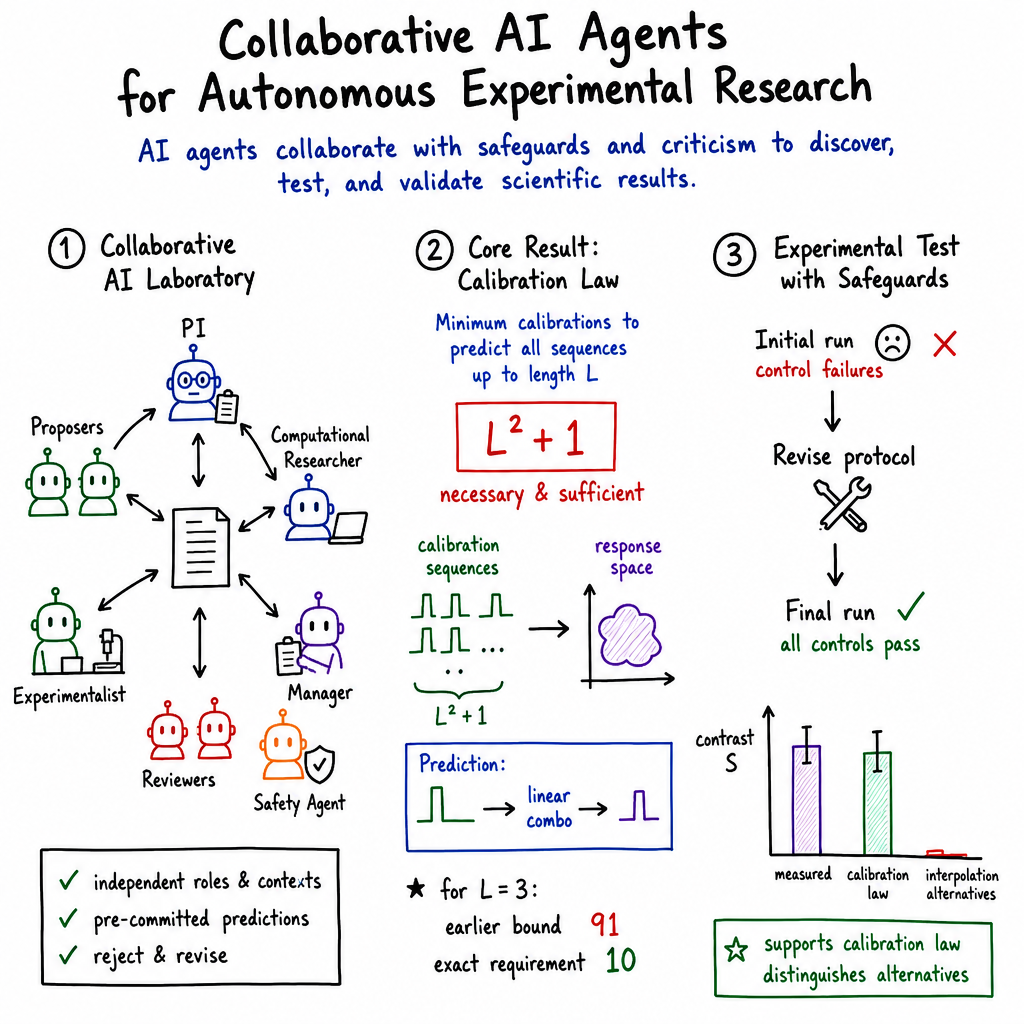
The AI team studied tiny quantum objects called spins inside diamond. The main goal was to discover how many measurements are needed to predict the results of many different microwave-pulse experiments.
2. What questions did the researchers ask?
The paper focused on two main questions:
- Can AI agents choose a useful and testable scientific question?
- Can they test their own ideas honestly, including rejecting their work when the evidence is weak?
For the diamond experiment, the specific question was:
What is the smallest number of calibration measurements needed to predict the results of other, unmeasured pulse sequences?
A calibration measurement is like checking a few known examples before predicting new ones. For example, if you want to predict how a machine will behave in many situations, you first test it in carefully chosen situations that reveal how it works.
3. How was the research done?
The AI research team
The system used several specialized AI agents. Their jobs were similar to the roles in a real research group:
- Proposers suggested possible research projects.
- The principal investigator, or PI, judged whether the ideas were new, important, logical, and possible to test.
- A computational researcher independently checked the mathematics using computers.
- An experimentalist controlled the laboratory equipment and collected measurements.
- A manager organized communication and helped improve research plans.
- Reviewers read the final work and looked for problems.
- A safety agent made sure the equipment stayed within safe limits.
The agents exchanged written reports. They were allowed to reject proposals and demand changes before the research moved forward. This is similar to a school science project in which different students check one another’s work instead of everyone simply agreeing.
Choosing the research question
The AI agents suggested many ideas, but most were rejected. Some were already known, some were not important enough, and others could not be tested with the available equipment.
After many unsuccessful proposals, the agents changed their instructions to avoid repeating the same kinds of ideas. Eventually, they improved one rejected proposal into a stronger question about predicting quantum-spin responses.
Developing and checking the theory
The AI team studied nitrogen-vacancy centres, often called NV centres, in diamond. These are tiny defects in a diamond that behave like controllable quantum spins.
The researchers sent carefully timed microwave pulses to the spins. The pulses could have different phases, which means the waves were shifted in different ways. Because different spins in the diamond behave slightly differently, the measured result is an average of many different behaviours.
The PI agent developed a mathematical rule saying that for pulse sequences of up to pulses, exactly
independent calibration measurements are both:
- enough to predict all the other responses, and
- necessary, meaning fewer measurements cannot always work.
For example, when , the rule requires:
calibration measurements.
The computational researcher independently checked this result and tested whether it would still work if the experiment included small extra errors.
Designing a fair experiment
The AI agents did not simply choose an experiment that was likely to agree with their theory. They designed a test where their theory made different predictions from simpler methods.
They first proposed an experiment, but the PI rejected it. The problem was that an ordinary interpolation method could have made the same predictions. Therefore, agreement with the measurements would not have shown that the new theory was correct.
The agents then designed a better experiment:
- They used 10 calibration measurements.
- They used these to predict four other measurements that were kept hidden.
- The predictions were fixed before the hidden measurements were examined.
- The experiment included extra control checks to detect equipment problems.
This is similar to deciding the answers and rules of a test before seeing the results, which helps prevent cheating or changing the rules afterward.
4. What did the researchers find?
The AI rejected weak ideas
The PI rejected 75 proposals before selecting a suitable research question. This showed that the system did not automatically accept the first idea it received.
The manager also noticed that many proposals were repeating the same mistakes. It changed the instructions so that later agents explored new directions.
The AI found an exact calibration rule
The main theoretical result was:
To predict all responses from pulse sequences of up to pulses, the minimum number of suitable calibration measurements is .
This was better than the earlier estimate. For three-pulse sequences, an earlier proposal suggested that as many as 91 measurements might be needed, but the improved theory showed that only 10 were necessary.
This matters because the number of possible pulse sequences can grow extremely quickly. A small number of carefully chosen measurements can replace a huge number of separate tests.
The AI caught a faulty experiment
The first major experiment seemed successful because its main measurements matched the theory. However, some control checks failed.
The researchers discovered that the signal from the diamond was changing during the experiment. The room lights had been switched on, and the signal also drifted over time. This meant that the apparent agreement could have been caused by changes in the equipment rather than by the theory.
The AI system therefore labelled the first experiment inconclusive instead of calling it a success.
The agents then changed the measurement procedure. They made the experiment switch conditions more quickly, randomized the order of measurements, and added more checks. They did not lower the standards for success.
The improved experiment supported the theory
The final experiment collected 21,600 valid one-second measurements. It passed all the required control checks.
The theory predicted a target result of approximately:
The experiment measured approximately:
The simpler competing methods predicted zero. Therefore, the final measurements supported the AI-generated calibration rule and disagreed with the simpler alternatives.
5. Why is this important?
The most important part of the paper is not only that the AI found a mathematical result. It is that the AI system showed some features of careful scientific thinking:
- It rejected ideas that were already known or not testable.
- It checked mathematics independently.
- It designed an experiment to distinguish its theory from competing explanations.
- It decided that an apparently successful experiment was not reliable because control checks failed.
- It changed the experimental procedure without changing the success rules.
- It only accepted the final result after the improved experiment passed its checks.
In other words, the AI did not simply search for evidence that supported its favourite idea. It tried to challenge the idea.
6. What could this mean for the future?
This research suggests that teams of AI agents might eventually help scientists perform more parts of the research process, from choosing questions to running experiments and writing papers.
Such systems could be useful for studying quantum devices, new materials, medicine, chemistry, and other fields where experiments can be partly automated.
However, the paper also shows that AI laboratories still need:
- reliable equipment,
- strong safety limits,
- independent checking,
- carefully planned controls, and
- human oversight, especially when deciding which scientific questions matter.
The larger lesson is that successful scientific AI should not merely produce answers quickly. It should also know when an answer is not yet supported by enough evidence. This paper presents an early example of AI agents working together to make, test, criticize, and improve a scientific discovery.
Practical Applications
Immediate Applications
- Automated calibration planning for quantum-control experiments — Quantum sensing, quantum computing, and laboratory instrumentation. The proven calibration law, requiring linearly independent measurements for phase-controlled sequences of up to pulses under persistent pulse errors, can be implemented now as a calibration-planning algorithm. Given a maximum sequence length, the tool can select a minimal basis of calibration sequences and compute predictions for unmeasured sequences. Potential outputs: pulse-sequence design software, calibration libraries, experiment-control plugins, and APIs that return predicted responses from measured calibration data. Dependencies: the pulse shape, duration, and amplitude must remain fixed; error parameters must be approximately persistent during each sequence; the selected calibrations must be linearly independent; repeated measurements are still needed to achieve the required precision.
- Reduced calibration overhead in NV-centre laboratories — Quantum sensing and experimental physics. NV-diamond laboratories can replace exhaustive measurements over a large or exponentially growing sequence family with a quadratic number of calibration settings. For example, sequences up to three pulses require 10 independent calibrations rather than the larger sufficient bound initially considered in the study. This can reduce instrument time and accelerate testing of new microwave-control protocols. Potential workflow: measure the calibration basis, estimate the transfer coefficients, predict candidate sequences, and experimentally validate only selected withheld sequences. Dependencies: the theoretical model applies to the specified family of phase-controlled pulses and does not automatically cover drifting pulse errors, changing pulse amplitudes, or arbitrary control waveforms.
- Model-based prediction of unmeasured control responses — Quantum-control software and hardware. The transfer-matrix method can be incorporated into software that predicts responses for unmeasured pulse sequences from calibration means. Such a predictor can support pulse compilation, rapid parameter sweeps, and early rejection of poorly performing control sequences before they are physically executed. Dependencies: predictions are reliable only within the calibrated response space. Out-of-family sequences, unmodeled environmental changes, and nonpersistent errors require additional validation or recalibration.
- Robust experimental quality-control workflows — Scientific instrumentation, semiconductor testing, biotechnology, and industrial automation. The paper demonstrates a deployable workflow in which measurements are not accepted solely because they match a prediction. Precommitted acceptance criteria, independent controls, prediction locking, randomized acquisition order, diagnostic checks, and explicit “inconclusive” outcomes can be integrated into laboratory automation systems. Potential tools: automated run-validation dashboards, instrument health monitors, experiment manifests with cryptographically locked predictions, and software that automatically halts or requests a revised acquisition when controls fail. Dependencies: controls must be designed before data analysis; instruments must expose sufficient diagnostic signals; the organization must permit inconclusive results rather than forcing binary success or failure.
- AI-assisted experimental troubleshooting — Autonomous laboratories and research operations. The agent workflow can be used today to investigate failed controls, identify likely sources of drift, propose pilot experiments, and revise acquisition schedules without weakening the original acceptance thresholds. In the demonstrated case, the system detected that different acquisition programs sampled a drifting signal at different times and recommended within-program phase toggling and randomized sequence ordering. Dependencies: the AI must have access to time-resolved logs, instrument metadata, and safe control interfaces. Human-defined operating limits remain necessary for equipment protection and unusual failure modes.
- Pre-registration and reproducibility infrastructure for computational and physical research — Academia and research governance. The paper’s separation of proposal generation, independent verification, experimental execution, and manuscript review can be adapted into research-management software. Before data collection, the system can store the hypothesis, predictions, analysis code, acceptance criteria, controls, and data hashes. Potential workflow: proposal submission → adversarial review → independent computational check → preregistered experiment → locked analysis → independent manuscript review. Dependencies: audit logs must be tamper-resistant, agent contexts must be sufficiently independent, and human researchers must still assess scientific importance and ethical implications.
- Teaching tools for scientific reasoning and experimental design — Higher education and professional training. The study provides a practical case for teaching identifiability, calibration, statistical controls, adversarial hypothesis testing, and the difference between agreement with a prediction and evidence supporting it. Students could interact with simulated agents that reject weak questions, identify confounded experiments, and classify results as supportive, contradictory, or inconclusive. Dependencies: educational versions should expose the assumptions and failure cases rather than presenting the agents as authoritative scientific judges.
- Research-support assistants for literature-independent idea triage — Academic research and industrial R&D. The proposal-selection architecture can help research groups filter candidate projects according to novelty, logical validity, significance, feasibility, and testability. The adaptive exclusion mechanism, which records recurring rejected idea families, can reduce duplicated proposals and redirect search toward underexplored directions. Dependencies: novelty assessment still requires reliable literature search and expert oversight; otherwise, agents may incorrectly label established work as novel or reject unconventional but valuable ideas.
- Policy guidance for trustworthy AI-enabled science — Research policy and institutional governance. Institutions can use the paper as a template for minimum safeguards in AI-assisted research: independent checking, explicit assumptions, precommitted predictions, safe operating boundaries, auditability, adversarial review, and mandatory “inconclusive” classifications when controls fail. Dependencies: the workflow must be adapted to field-specific risks, especially where experiments involve human subjects, hazardous materials, clinical decisions, or high-energy equipment.
Long-Term Applications
- Fully autonomous quantum-control laboratories — Quantum computing, quantum sensing, and robotics. A scaled version of the system could select control problems, derive calibration requirements, generate pulse programs, execute measurements, diagnose drift, and update experiments continuously across NV centres and other quantum platforms. It could search for improved sensing protocols or robust pulse sequences while preserving independent verification and locked evaluation criteria. Dependencies: more reliable instrument diagnostics, broader safety models, real-time feedback, better handling of nonstationary errors, and validated agent behavior across different hardware platforms.
- Automated calibration and pulse optimization for diverse quantum platforms — Superconducting qubits, trapped ions, neutral atoms, spin qubits, and photonic systems. The general strategy—characterize a response space rather than reconstruct every microscopic error distribution—could motivate analogous minimum-calibration laws for other quantum devices. AI agents could search for low-dimensional sufficient statistics and use them to reduce calibration time. Dependencies: each platform requires new mathematical theory; error models may not be persistent or low-dimensional; calibration settings may be expensive, destructive, or affected by drift on timescales shorter than an experiment.
- Self-correcting experimental facilities connected across laboratories — Distributed science and national research infrastructure. Multiple autonomous laboratories could share proposals, rejected hypotheses, calibration models, and independent replication requests. One laboratory might discover a candidate law, another could test it on different hardware, and a third could conduct adversarial experiments designed to expose hidden assumptions. Dependencies: interoperable data and instrument standards, secure remote access, provenance tracking, resource scheduling, and agreement on common acceptance criteria.
- AI-designed experiments in chemistry, materials science, and energy research — Drug discovery, catalysis, batteries, photovoltaics, and materials engineering. The same collaborative structure could generate hypotheses, simulate competing mechanisms, select discriminating synthesis or characterization experiments, and reject apparently successful runs when controls indicate contamination, instrument drift, or confounding variables. Potential products: autonomous synthesis platforms, closed-loop microscopy systems, catalyst-discovery pipelines, and battery-aging laboratories. Dependencies: safe robotic handling, reliable sensors, standardized representations of chemical and materials knowledge, and experimental designs capable of separating competing mechanisms rather than merely optimizing a proxy metric.
- Autonomous software and machine-learning research — Software engineering and AI research. The agents could generate algorithmic hypotheses, independently reproduce proofs or benchmarks, design evaluations that distinguish genuine improvements from leakage or tuning artifacts, and reject claimed gains when baselines or controls are inadequate. The paper’s criticism of unsupported conclusions is directly relevant to automated benchmark research. Dependencies: control of compute budgets, prevention of benchmark contamination, reproducible environments, independent test sets, and safeguards against agents optimizing evaluation criteria without improving the underlying capability.
- Continuous scientific monitoring and anomaly-response systems — Environmental monitoring, manufacturing, healthcare instrumentation, and infrastructure. The drift-detection workflow could evolve into systems that continuously compare reference measurements with expected invariances, detect changes in sensors or operating conditions, and automatically switch to diagnostic or recalibration protocols. Dependencies: stable reference signals, well-characterized invariances, low-latency instrumentation, and carefully bounded automated responses. In healthcare or public infrastructure, human authorization may remain mandatory.
- AI-assisted clinical and biomedical experimentation — Healthcare and pharmaceutical research. In carefully controlled settings, agent teams could propose mechanistic studies, independently check statistical assumptions, design experiments that distinguish competing treatment mechanisms, and classify results as inconclusive when quality controls fail. Similar workflows could support assay calibration and laboratory automation. Dependencies: regulatory approval, patient-safety protections, validated statistical methods, privacy-preserving data access, and substantially stronger human oversight than in the NV demonstration. The system should not independently make clinical decisions based on this paper’s results.
- Formal certification frameworks for autonomous scientific claims — Academia, industry, and policy. The paper suggests a future standard in which an AI-generated scientific claim is accompanied by a machine-readable evidence package: assumptions, proof checks, computational certificates, experimental predictions, controls, locked analyses, raw-data provenance, and independent review outcomes. Such packages could support reproducibility audits and regulatory evaluation. Dependencies: standardized evidence schemas, independently trusted verification agents or institutions, protection against correlated model failures, and methods for evaluating conceptual significance—not only numerical agreement.
- Human–AI research organizations with specialized scientific roles — All research sectors. Future laboratories may use persistent teams of proposer, investigator, verifier, experimentalist, safety, manager, and reviewer agents, with humans focusing on consequential questions, infrastructure, safety, and interpretation. The architecture could extend beyond a single experiment into multi-month research programs. Dependencies: reliable long-horizon memory, role diversity, resistance to shared model biases, transparent accountability, robust cybersecurity, and clear allocation of responsibility when an autonomous system makes an incorrect or unsafe decision.
Glossary
- Acousto-optic modulator: An optical device that uses sound waves to control the intensity or timing of a laser beam. “Continuous-wave 532-nm excitation was gated by an acousto-optic modulator”
- Admissible ensemble: A physically allowed collection or distribution of quantum systems satisfying specified constraints. “distinct physically admissible ensembles can produce identical calibration measurements”
- Berry–Esseen bound: A mathematical bound on how closely a standardized sum of random variables approximates a normal distribution. “A Berry–Esseen bound on sums of photon counts supplied a necessary condition”
- Calibration ambiguity: The greatest possible difference between predictions from ensembles that agree with the available calibration data. “Here, calibration ambiguity is the largest difference in target means between ensembles that agree on the short-sequence calibrations”
- Calibration law: A mathematical rule specifying the minimum calibration measurements needed to predict other experimental responses. “The calibration law provides a concrete example of conceptual progress during the investigation.”
- Calibration response: The measured output of a physical system for a selected reference input or pulse sequence. “Uniform identification of every target in this class required calibration responses spanning FL”
- Confocal microscope: An optical microscope that rejects out-of-focus light to produce high-resolution images or measurements. “Measurements were performed at room temperature using a confocal microscope”
- Contrast: A parameter describing the difference or visibility of a measured signal relative to a background level. “The proof established that these measurements span the space of possible ensemble responses, even with an unknown common fluorescence background and contrast.”
- Covariance: A statistical measure of how two quantities vary together. “This propagation included uncertainty in the calibration-derived predictions and the covariance between P and each residual”
- Determinant-maximizing acquisition design: An experimental-design strategy that selects measurements to maximize the determinant of an information-related matrix. “A determinant-maximizing acquisition design with N ≥ dL observations”
- Digital twin: A computational model used to simulate and evaluate the behavior of a physical system or experiment. “A digital twin created by the computational researcher evaluated the decision rule”
- Discriminating experiment: An experiment designed to produce different observable predictions for competing theories or models. “This cross-length design produced distinct predictions from the discovered law and simpler interpolation rules”
- Discrimination success probability: The probability that a statistical or experimental procedure correctly distinguishes between competing possibilities. “The indistinguishability criterion required an optimal discrimination success probability of at most 55%.”
- Detuning: The difference between the frequency of an applied field and a system’s resonant frequency. “Individual spins experience different detunings and microwave-drive strengths”
- Ensemble response: The aggregate measured behavior of a collection of physical systems with potentially different individual parameters. “The selected proposal established a polynomial upper bound of 8L2 + 6L + 1 independent response functions”
- Excess-variance factor: A multiplicative factor used to account for measured variance exceeding an ideal statistical variance. “Poisson-based variance contributions were multiplied by an excess-variance factor F ∗”
- Fourier interpolation: A method for estimating intermediate or unmeasured values using a finite sum of sinusoidal components. “The nine-point grid already contained sufficient information to determine those targets through Fourier interpolation.”
- Fluorescence readout: The measurement of a quantum system’s state through the light it emits after excitation. “7.7 NV apparatus and fluorescence readout”
- Global-phase invariance: The property that applying the same phase shift to all pulses does not change the measured physical response. “These controls tested whether applying the same phase shift to every pulse left the measured response unchanged.”
- Hyperfine triplet: Three spectral lines produced by interactions between an electron spin and a coupled nuclear spin. “The carrier was tuned to the central line of the 14N hyperfine triplet”
- Identifiability: The ability to uniquely determine model parameters or predictions from available observations. “a question of identifiability and sample complexity”
- Inhomogeneous spin ensemble: A collection of spins whose physical parameters, such as resonance frequencies or drive strengths, vary between members. “The selected research problem concerned predicting the collective response of an inhomogeneous spin ensemble”
- Interpolation baseline: A simpler reference method used for comparison with a proposed prediction method. “Two interpolation baselines were specified.”
- Least-squares estimation: A parameter-estimation method that minimizes the sum of squared differences between observations and model predictions. “combined with least-squares estimation”
- Linearly independent: Describing vectors or functions where none can be represented as a combination of the others. “The minimum L2 + 1 refers to calibration settings with linearly independent responses”
- Mean-squared prediction error: The expected squared difference between predicted and true values, combining systematic error and statistical variability. “Their sum defined the mean-squared prediction error”
- Microwave pulse sequence: An ordered series of microwave control pulses used to manipulate quantum states. “They can be manipulated through precisely controlled microwave-pulse sequences”
- Nitrogen-vacancy centre: A point defect in diamond consisting of a missing carbon atom adjacent to a nitrogen atom, usable as an optically readable spin system. “Ensembles of nitrogen-vacancy (NV) centres in diamond provide a suitable setting for this test.”
- Optical spin initialization: The preparation of a spin system into a specified quantum state using optical excitation. “Nitrogen-vacancy centres combine optical spin initialization and readout with programmable microwave control”
- Persistent pulse error: A pulse-control error whose parameters remain unchanged across the pulses in a sequence. “Each spin retained the same error parameters throughout a sequence.”
- Photon noise: Random measurement fluctuations arising from the discrete and probabilistic detection of photons. “For the specified six-pulse test, the certified prediction error remained at the photon-noise level”
- Poisson acquisition: A measurement model in which detected events are treated as samples from a Poisson counting process. “For the theoretical photon-noise analysis, acquisitions were modelled as independent Poisson counts”
- Principal investigator (PI): The role responsible for directing the research and evaluating its theoretical and experimental validity. “The principal investigator (PI) agent evaluated the proposals in batches”
- Quadrature waveform: A waveform component phase-shifted by 90 degrees relative to another component, used to control the amplitude and phase of a signal. “Programmed in-phase and quadrature waveforms controlled microwave phase and frequency offset through a mixer.”
- Rabi oscillation: Periodic oscillation of a quantum-state population caused by coherent driving with an electromagnetic field. “Qualification measurements compared Rabi oscillations at phases of 0◦, 60◦ and 120◦”
- Response-function space: The mathematical vector space spanned by functions describing all possible system responses. “The PI and the proposer defined FL as the real span of the response functions for sequences of at most L pulses.”
- Residual: The difference between an observed value and its predicted value. “For each withheld target, the prediction residual was defined as ri = Ti − (HC)i”
- Sample complexity: The number of observations or measurements required to achieve a specified level of inference or prediction. “a question of identifiability and sample complexity”
- Statistical indistinguishability: A condition in which available data cannot reliably distinguish between two competing models or ensembles. “remain statistically indistinguishable under the full calibration”
- Systematic offset: A consistent measurement displacement caused by a nonrandom experimental bias. “measurements expected to be equivalent acquired systematic offsets.”
- Transfer matrix: A matrix that maps measured calibration values to predicted target values. “The PI derived a 4 × transfer matrix H”
- Withheld target: An experimental response deliberately excluded from calibration and later used to test predictive performance. “The experimental objective was to test the predictive value of the calibration law using withheld sequence responses.”
- Weighted photon count: A photon-count measurement formed by combining counts from multiple detection windows using specified weights. “to obtain the weighted photon count per shot.”