The Agentic Scientist: Orchestrating Coding Agents for Automated Scientific (Co-)Discovery
Abstract: Modern coding agents are fundamentally reshaping the role of human input for computational research: they write code, launch in silico experiments, analyze their results, and autonomously operate with ever-increasing time horizons. Despite these developments, fully autonomous research agents suffer from a limited ideation radius and myopic hill-climbing search dynamics. To bridge this gap, we introduce The Agentic Scientist, an end-to-end distributed pipeline for human researchers to conduct computational research alongside modern coding agents. Building on its predecessor, our system decomposes research into task drafting, idea generation, planning, sandboxed experimentation, result aggregation, baseline and ablation construction, post-hoc analysis, and report writing. Importantly, each step in the pipeline is powered by the next generation of coding agents and leverages agentic self-verification. The overall research process is driven by a meta-controller that manages parallel research agents and enforces rubric verification at each stage. This design enables the same orchestration layer to be reused across heterogeneous domains with different execution environments, agentic coding harnesses, and evaluation metrics. Our system can be used across a spectrum of autonomy: either as a co-scientist tool or to perform end-to-end scientific investigation. Within the co-scientist setting, we leveraged a development version of our system to submit a single research paper, which got accepted for publication at ALIFE 2026. We further apply The Agentic Scientist fully autonomously to open problem-solving tasks in machine learning, and demonstrate the system's capability of scientific discovery across different domains of computational research. Our ablations suggest that reliable scientific autonomy depends not only on base model capabilities, but also on the cross-agent orchestration layer.
Paper Prompts
Sign up for free to create and run prompts on this paper.
Explain it Like I'm 14
1. What is this paper about?
This paper introduces The Agentic Scientist, a system that uses several AI coding agents to help carry out scientific research.
These AI agents can:
- Suggest research ideas
- Write and change computer programs
- Run experiments
- Check whether the experiments worked
- Compare different methods
- Analyze results
- Create graphs and diagrams
- Help write a research paper
The main goal is not simply to make one AI write code. It is to build a complete research team made of AI agents that can work together, while still allowing human scientists to guide and check their work.
2. What questions does the research ask?
The paper focuses on several important questions:
- Can AI agents do more than improve a program step by step? The researchers wanted to see whether AI could suggest genuinely different ideas instead of making only small changes to an existing method.
- Can several AI agents work together effectively? Different agents may explore different ideas, share useful discoveries, and avoid repeating failed experiments.
- Can the system check its own work? The researchers wanted the agents to use rules, called rubrics, to check whether an experiment was scientifically fair and correctly implemented.
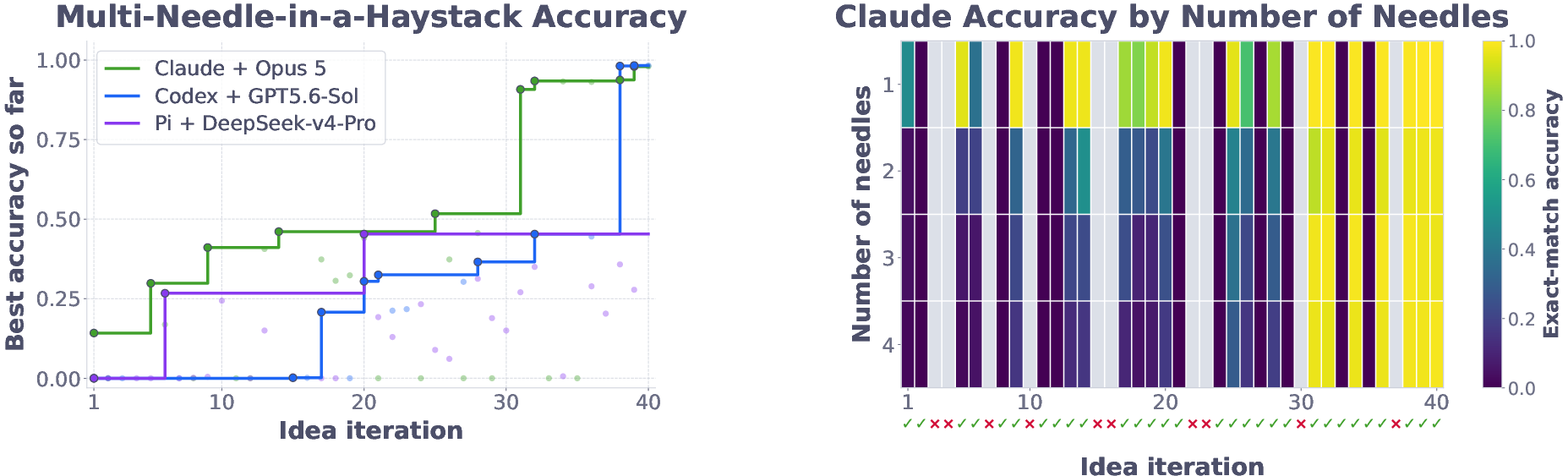
- Can the system work in many areas of computer science? They tested it on tasks involving LLMs, optimization, reinforcement learning, computer vision, and other areas.
- Can the system help human scientists produce real research? The researchers examined whether it could support a human-led project that eventually became a conference paper.
3. How was the research carried out?
The research pipeline
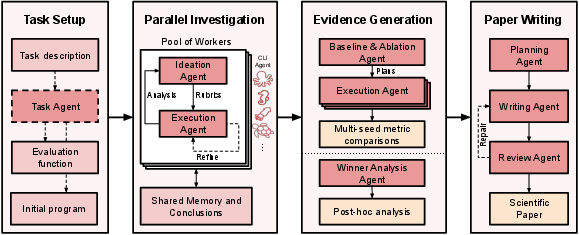
The Agentic Scientist works like a research laboratory with several stages.
First, a human researcher gives the system a research goal. For example, the goal might be to create a better way for a computer to learn or to improve a LLM.
The system then creates a detailed task specification. This is like writing the rules of a science experiment before beginning. It explains:
- What program should be tested
- How new versions of the program will be judged
- What counts as a correct result
- Which measurements should be recorded
The system also runs small preliminary tests, called smoke tests, to make sure the programs work before spending time on large experiments.
Parallel investigation
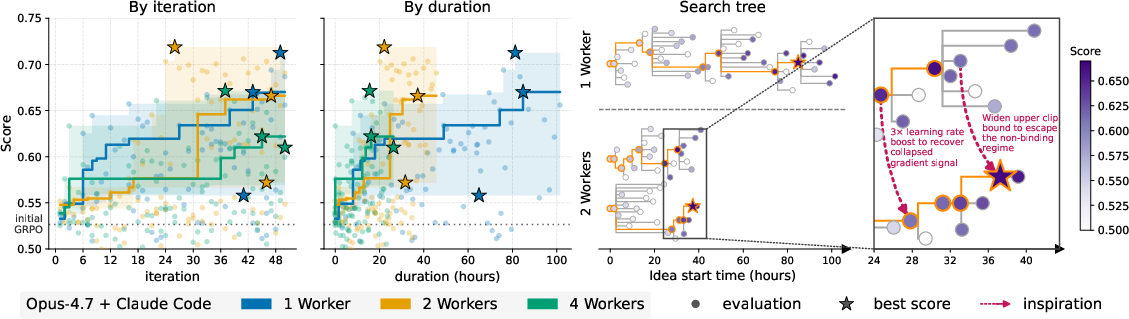
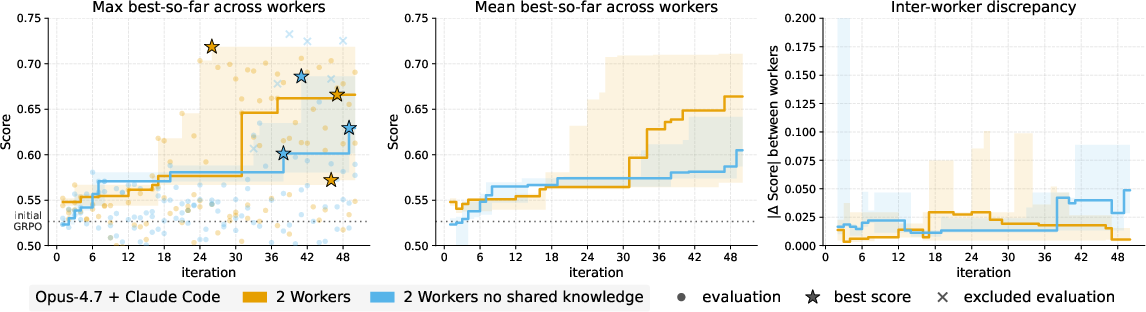
Next, several AI workers investigate different ideas at the same time. Each worker has its own workspace, similar to different scientists having separate laboratory tables.
At the beginning of each research cycle:
- An ideation agent suggests a clear hypothesis. A hypothesis is a testable idea, such as “changing this part of the program will make it learn faster.”
- An execution agent changes the code and tests the idea.
- The system records the results, including whether the program worked and whether the idea improved the score.
- Useful findings are shared with the other workers.
This is similar to several students trying different solutions to a difficult problem and then sharing what they learned.
Verification with rubrics
A rubric is a checklist of requirements. For example, an experiment might need to:
- Use the correct data
- Avoid using information that would make the test unfair
- Follow a biological rule
- Improve performance without secretly changing the task
The AI agents must show evidence that they followed these rules. A program is not accepted merely because it gets a high score.
Extra testing after discovery
When the system finds a promising program, it performs more careful tests.
These include:
- Baselines: Comparing the new method with an older or simpler method
- Ablations: Removing one part of the new method to see whether that part really matters
- Post-hoc analyses: Studying the results afterward to understand why the method worked or failed
An ablation is like taking parts out of a bicycle one at a time to discover which part is important for making it move.
Writing and checking the paper
Finally, the system uses the experiment results to help write a scientific paper. It links statements in the paper to actual data and code.
It also checks:
- Whether the numbers in the paper match the experiments
- Whether the figures are based on real results
- Whether the paper makes claims that are too strong
- Whether the paper follows formatting rules
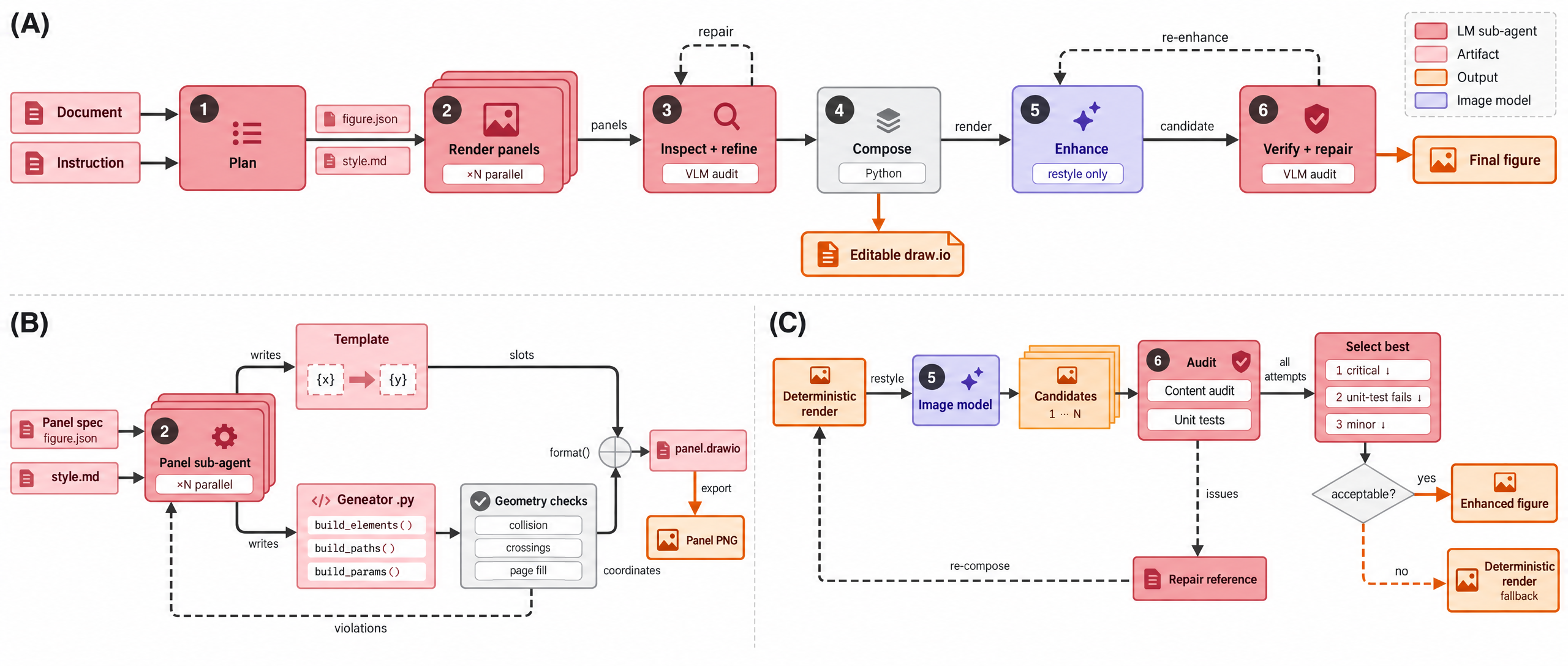
The system includes autoillustrate, another tool that creates scientific diagrams. Importantly, the diagrams remain editable, so human scientists can change them later.
4. What did the researchers find?
The system supported a real conference paper
A development version of The Agentic Scientist helped with research on Error Diffusion, a learning method inspired by biology.
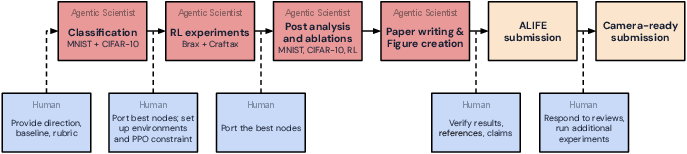
Human researchers chose the topic and set important rules. The AI system then helped develop algorithms, run experiments, inspect failures, and create plots. Humans carefully checked the results and edited the paper before submitting it.
The resulting paper was accepted as a talk at ALIFE 2026. However, the authors clearly state that this was not an entirely automatic paper. Humans:
- Chose the overall research direction
- Checked the code and results
- Corrected inaccurate claims
- Verified the references
- Revised the manuscript
- Remained responsible for the final submission
Error Diffusion worked beyond its original setting
The AI system extended Error Diffusion from simple two-class problems to more difficult multi-class classification tasks.
It also found several changes that improved performance, including:
- Adjusting the shape of certain mathematical functions for different layers
- Centering error signals within a batch of examples
- Using different starting values for two types of neurons
The method reached:
- 96.7% accuracy on MNIST, a handwritten-digit dataset
- 61.7% accuracy on CIFAR-10, a dataset of small color images
The importance of these results is that the method could work in more situations than originally expected. However, the best improvements depended on the task. A change that helped MNIST was not always the most important change for CIFAR-10.
The system discovered useful ideas in several fields
The researchers also tested the system on different machine-learning problems, including:
- Improving how LLMs learn from documents
- Designing better evolutionary optimization methods
- Fine-tuning LLMs for mathematical reasoning
- Improving world models
- Building sparse autoencoders
- Handling tabular data
- Searching for good hyperparameters
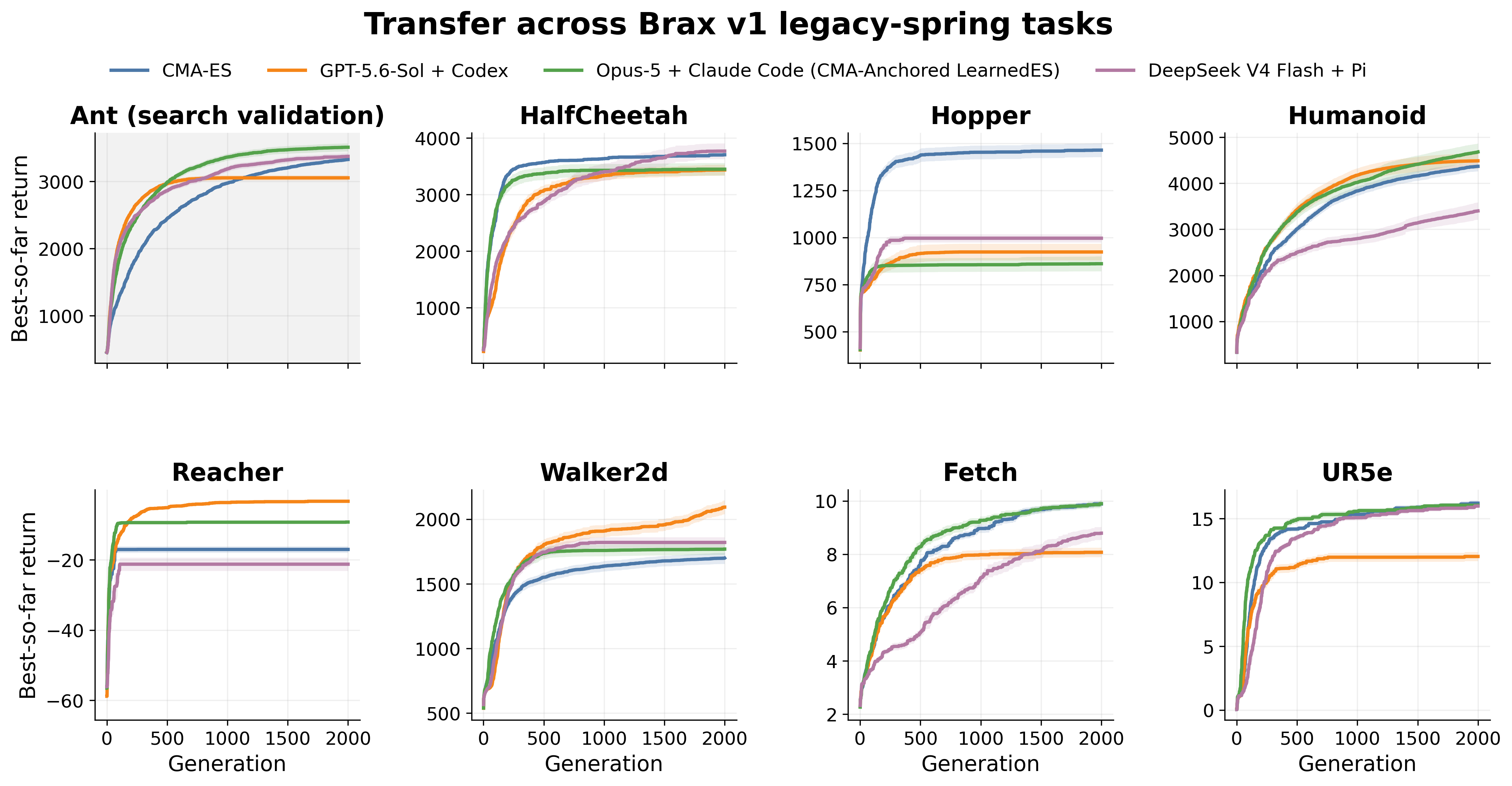
In one case, a meta-trained evolution strategy performed as well as or better than the well-known CMA-ES method on 5 out of 7 previously unseen Brax control tasks.
This suggests that the system can sometimes discover methods that transfer to new problems rather than only memorizing solutions for the task it was trained on.
Better AI models helped, but organization mattered too
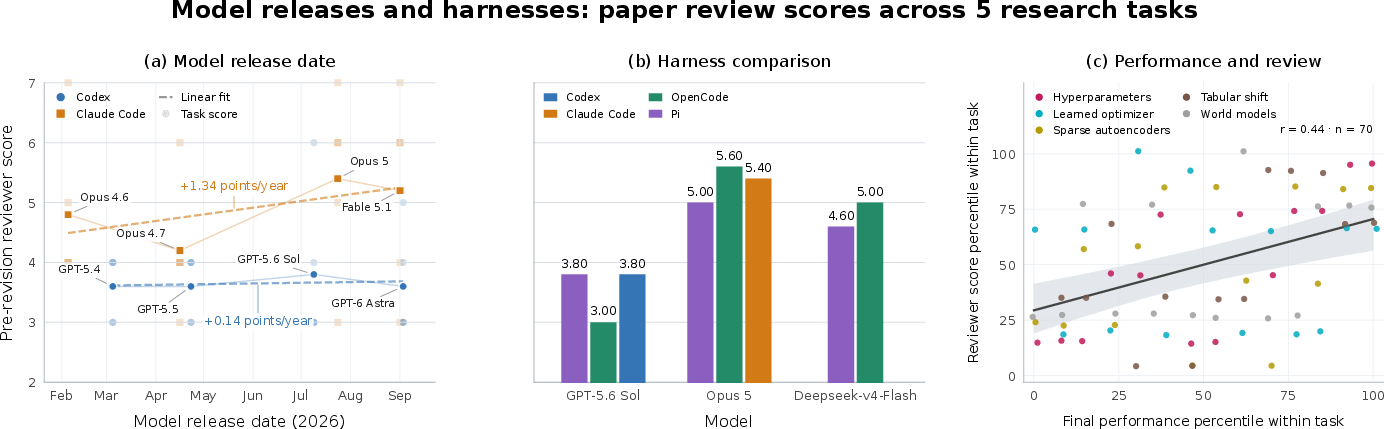
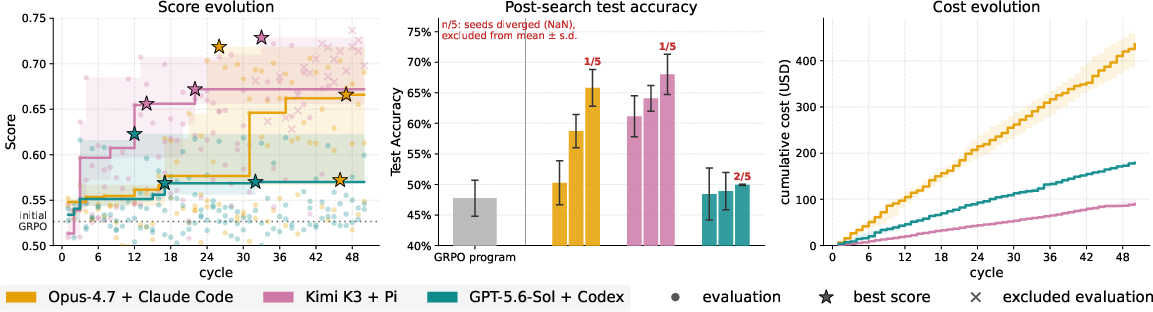
Newer and stronger LLMs generally produced better research results. However, the way the agents were organized also mattered.
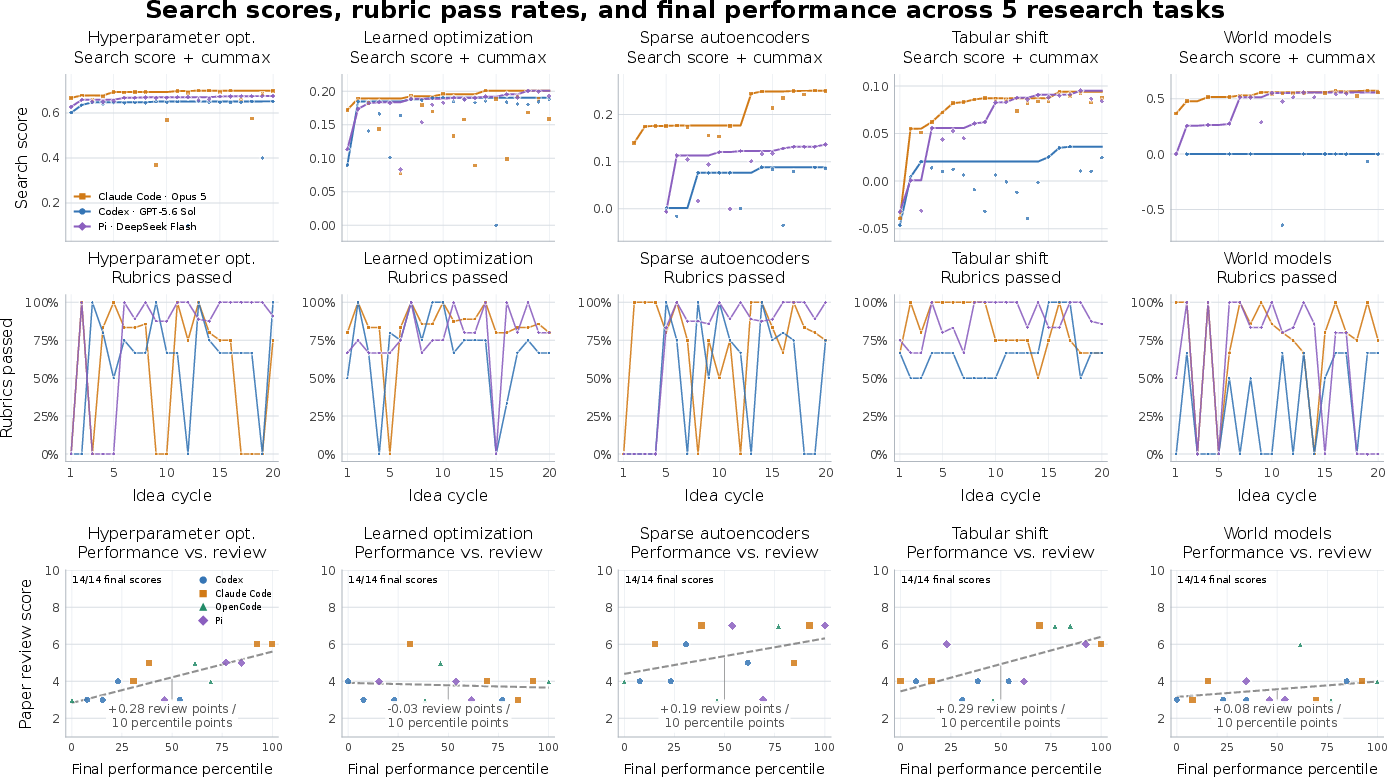
The paper tested several coding systems, called agent harnesses, including Codex, Claude Code, Pi, and OpenCode. No single harness was always best. The underlying AI model usually had a larger effect than the particular harness.
The researchers also found that research performance and the quality of the written papers were related in many tasks. Overall, the relationship was positive, although it was not perfect.
The system still has limitations
The authors do not claim that the system can replace scientists. Important limitations include:
- AI agents may make mistakes in code or scientific reasoning.
- A high score does not always mean that the idea is scientifically meaningful.
- AI-generated paper reviews are only approximate and are not the same as reviews by human experts.
- Some tasks still required humans to choose the research direction and prepare the experimental environment.
- AI agents may focus too much on small improvements instead of exploring completely new ideas.
- More experiments are needed to prove that the discoveries are reliable and useful outside the tested settings.
5. Why is this research important?
The paper shows a possible future in which humans and AI work together as research partners.
Instead of asking one AI to solve an entire problem, the system gives different AI agents different jobs. One agent may suggest an idea, another may write the code, another may test it, and another may check whether the claims are supported by evidence.
This teamwork could make research:
- Faster
- Less repetitive
- Easier to test across many ideas
- More organized
- Better documented
However, the research also shows why human supervision is still important. Scientists need to decide which questions are worthwhile, check whether the experiments are fair, and make sure the final claims are truthful.
Overall, The Agentic Scientist is best understood as an AI research assistant team, not an independent replacement for human scientists. Its biggest contribution is the organization of many AI tools into one system that can move from an idea to experiments, evidence, and a draft paper. If improved carefully, such systems could help researchers explore more possibilities and make discoveries in areas where computer experiments are possible.
Practical Applications
Immediate Applications
- Human–AI co-scientist workflows for computational research (academia, industrial R&D; deployable now) Researchers can use the orchestration layer to convert a research brief into an executable task specification, generate and test hypotheses, run parallel experiments in sandboxes, construct baselines and ablations, and produce an evidence-linked manuscript. This is most immediately applicable to machine learning, optimization, reinforcement learning, scientific computing, and other domains with executable evaluators. Potential workflow: research brief → task-drafting agent → parallel coding agents → shared experiment memory → verification and ablation → manuscript generation. Dependencies: a human must define or approve the research objective, evaluation criteria, safety constraints, and relevant baselines. Results still require expert verification; the paper explicitly reports substantial human revisions before conference submission.
- Automated machine-learning experimentation and model improvement (software, AI engineering, enterprise data science; deployable now) The system can search over model architectures, training procedures, optimizers, hyperparameters, and representation-learning methods under a fixed compute budget. The demonstrated task suite covers learned optimization, world models, sparse autoencoders, tabular distribution shift, and hyperparameter optimization. Potential products: an internal “research engineer” service, automated experiment manager, or pull-request workflow that proposes code changes, runs tests, compares metrics, and preserves reproducible artifacts. Dependencies: reliable task contracts, deterministic or sufficiently stable evaluation programs, pinned dependencies, disjoint search and final-evaluation data, and access to adequate compute.
- Reproducible experiment and ablation generation (academia, software quality, regulated R&D; deployable now) The retrospective evidence phase can automatically propose and execute controlled baselines, single-change ablations, multiseed comparisons, and post-hoc diagnostics. This can help research teams identify whether an apparent improvement comes from the proposed innovation or from confounding implementation changes. Potential workflow: selected implementation → code-diff analysis → ablation plans → independent validation → isolated execution → aggregated statistical report. Dependencies: the evaluator must expose relevant metrics and support repeated runs. Automated ablations may still be scientifically inappropriate if the agent misunderstands the causal role of a component.
- Artifact-grounded technical reporting and internal documentation (academia, software, corporate R&D; deployable now) The manuscript pipeline can link numerical claims to canonical experiment outputs, generate figures from stored artifacts, check compilation and page limits, and flag unsupported or overstated conclusions. The same process can be adapted to technical reports, model cards, experiment summaries, grant appendices, and engineering design documents. Dependencies: results must be stored in machine-readable form with clear provenance. The paper’s AI-review score is only a proxy and cannot replace peer review or expert fact-checking.
- Parallel exploration of alternative research hypotheses (research laboratories, algorithm design; deployable now) Independent workers can investigate different hypotheses in separate workspaces while exchanging distilled conclusions at cycle boundaries. This is useful when a conventional single-agent loop risks becoming a narrow hill-climbing process. Potential use cases: comparing optimization rules, testing architecture variants, searching reinforcement-learning improvements, or exploring alternative data-processing pipelines. Dependencies: adequate parallel compute, effective shared-memory summarization, and safeguards against workers propagating incorrect conclusions to one another.
- Automated generation of editable scientific diagrams (academia, education, technical communication; deployable now)
autoillustratecan transform a method description into an editabledraw.iosource, generate coordinated panels, render plots, and perform visual and factual audits. It can support papers, lecture slides, project documentation, grant proposals, and software documentation. Dependencies: generated diagrams require human review for scientific fidelity, accessibility, licensing, and correct interpretation. Image enhancement should not be allowed to introduce visual elements that are absent from the editable reference. - Research-code verification and reproducibility checks (software engineering, open science, institutional research infrastructure; deployable now) The task-drafting and validation stages can be used as a pre-publication or pre-release gate: check interfaces, run smoke tests, validate that search and final evaluators are independent, verify full-workload feasibility, and preserve experiment logs. Potential product: a continuous-integration service for research repositories that rejects incomplete experiments or unsupported claims before publication. Dependencies: checks can verify implementation contracts and evidence consistency, but they cannot establish that the scientific question is important or that the chosen metric is adequate.
- Education and training for computational research methods (universities, professional training; deployable now) Instructors can use the system to demonstrate the complete research lifecycle: hypothesis formation, controlled experimentation, ablation, statistical interpretation, and scientific writing. Students could inspect the agent’s proposed experiments and critique failures rather than merely receiving a final answer. Dependencies: educational use should emphasize critical evaluation and reproducibility rather than treating generated code or prose as authoritative. Compute cost and access to suitable benchmarks may limit classroom deployment.
- Internal decision support for technical R&D prioritization (industry, finance, energy, robotics, healthcare research; deployable now for exploratory work) Organizations can use the system to rank candidate technical interventions—such as model architectures, forecasting methods, control policies, or simulation parameters—before committing to expensive physical or production experiments. Dependencies: this is appropriate for simulation and prototyping, not unsupervised deployment in safety-critical settings. Domain-specific validation, governance, privacy controls, and human approval remain necessary.
Long-Term Applications
- End-to-end autonomous discovery in broader scientific domains (academia, pharmaceutical R&D, materials science, energy, climate modeling; requires further research and scaling) The architecture could eventually support autonomous discovery cycles in domains beyond machine learning, including molecular design, materials discovery, battery optimization, climate simulation, and scientific instrumentation. Agents could propose mechanisms, modify simulation code, execute virtual experiments, and generate candidate theories or designs. Dependencies: the domain must provide trustworthy simulators or experimental interfaces, measurable objectives, valid safety constraints, and mechanisms for confirming discoveries in the physical world. Simulation success alone may not transfer to laboratory or field performance.
- Closed-loop laboratory automation (healthcare, biotechnology, chemistry, materials, robotics; long-term) A future extension could connect the orchestration layer to robotic laboratories or automated hardware. The agent would select experiments, dispatch them to instruments, interpret measurements, update hypotheses, and schedule follow-up trials. Dependencies: robust hardware APIs, calibration, contamination and failure handling, biosafety, human authorization, and uncertainty-aware experiment selection. The current paper demonstrates sandboxed computational execution, not autonomous physical experimentation.
- Autonomous algorithm and software infrastructure design (software, distributed systems, energy systems, robotics; long-term) The system could evolve algorithms, compilers, scheduling policies, database operators, simulation components, or control software against multiple objectives such as latency, energy use, robustness, and cost. Its combination of program search, ablation, and evidence generation is relevant to infrastructure optimization beyond model training. Dependencies: multi-objective evaluators must prevent agents from exploiting measurement loopholes. Generated systems require security review, formal testing, regression testing, and compatibility validation before deployment.
- AI-assisted discovery of biologically inspired and resource-efficient learning rules (neuromorphic computing, robotics, edge AI; long-term) The Error Diffusion case study suggests a route for exploring learning algorithms that avoid standard backpropagation, preserve local information constraints, or maintain biologically motivated excitatory/inhibitory structure. Future systems could search for learning rules suitable for neuromorphic hardware or low-power edge devices. Dependencies: current evidence is limited to selected benchmarks and shows inconsistent performance in more difficult environments. Hardware-level energy benefits, scalability, convergence, and performance relative to modern backpropagation-based methods require independent validation.
- Automated adaptive control and robotics research (robotics, autonomous vehicles, industrial control; long-term) The demonstrated meta-trained evolution strategy and reinforcement-learning experiments could be extended into automated controller discovery for locomotion, manipulation, fleet coordination, and simulation-to-real transfer. The orchestration system could generate controllers, test them across randomized environments, and analyze failure modes. Dependencies: simulated benchmarks such as Brax do not establish real-world safety or transfer. Deployment would require robust uncertainty estimation, adversarial testing, hardware-in-the-loop validation, fail-safe policies, and human oversight.
- Scientific policy and research-program planning (government, funding agencies, institutional strategy; long-term) Aggregated experiment traces could eventually inform decisions about which research directions, benchmarks, or infrastructure investments are promising. Policymakers might use structured evidence from many computational campaigns to compare intervention strategies or identify underexplored areas. Dependencies: automated agents may reproduce benchmark bias, favor easily measurable objectives, or generate correlated errors. Policy use requires transparent provenance, independent replication, uncertainty reporting, and safeguards against treating AI-generated rankings as neutral scientific judgments.
- Large-scale autonomous literature-to-experiment systems (academia, corporate research, knowledge management; long-term) A future version could retrieve literature, identify unresolved claims, convert them into executable replication tasks, compare competing methods, and propose follow-up studies. This would combine the paper’s task drafting, evidence generation, manuscript auditing, and editable-figure capabilities with stronger literature grounding. Dependencies: reliable bibliographic retrieval, copyright-compliant access to papers and code, accurate interpretation of prior work, and mechanisms for resolving contradictory or irreproducible findings.
- Automated scientific peer-review and research integrity auditing (publishing, academia, funding; long-term) The claim-to-source maps, evidence audits, baseline checks, and reviewer-style agents could support editorial screening for missing comparisons, unsupported numerical claims, unverifiable figures, and methodological inconsistencies. Dependencies: AI review scores should remain advisory. Effective deployment requires calibrated evaluation against expert reviewers, protection against gaming, disclosure of automated assistance, and procedures for handling disagreements and domain-specific subtleties.
- Personalized everyday experimentation and optimization assistants (daily life, consumer software, energy and finance; long-term) Adapted versions could help users compare household energy strategies, personal learning schedules, budgeting plans, or travel options by defining objectives, testing alternatives, and explaining trade-offs. For example, an energy assistant could simulate appliance schedules under cost and emissions constraints. Dependencies: access to accurate personal data, privacy-preserving storage, transparent objective selection, and protection against harmful recommendations. Financial, medical, and safety-related decisions would require licensed professional oversight rather than autonomous execution.
- Collaborative scientific memory and institutional knowledge systems (academia, enterprise R&D, engineering organizations; long-term) The shared-memory and artifact-preservation mechanisms could evolve into durable institutional research infrastructure. Such systems would record rejected hypotheses, implementation failures, experimental provenance, and validated conclusions so that future teams avoid repeating unsuccessful work. Dependencies: standardized metadata, long-term storage, access control, versioning, protection of confidential research, and methods for distinguishing verified findings from speculative agent summaries.
- Self-improving research-agent ecosystems (AI research infrastructure; long-term) The paper’s ablation results indicate that orchestration—not only base-model capability—strongly affects scientific autonomy. A future ecosystem could automatically compare harnesses, communication protocols, rubric designs, search strategies, and verification agents, improving the research process itself. Dependencies: robust benchmarks for scientific validity, resistance to reward hacking, independent evaluation, and explicit limits on recursive self-modification. Higher autonomy should not be equated with greater reliability without external replication and expert review.
Glossary
- Ablation: An experiment that removes or changes one component of a system to measure its individual contribution. “The selected program is first instrumented with additional metrics, such as extra scores and time series data, so that every generated baseline and ablation can be compared in detail on common ground.”
- Agent harness: A software framework that enables an AI agent to interact with tools, code, files, and execution environments. “We run the task sweep across four agent harnesses: Codex, Claude Code, Pi, and OpenCode”
- Agentic orchestration: The coordination of multiple autonomous agents and computational processes to complete a complex workflow. “The overall research process is driven by a meta-controller that manages parallel research agents and enforces rubric verification at each stage.”
- Artifact provenance: The record of how a computational or textual artifact was produced and how it relates to its source evidence. “All logged idea provenance and attempt outcomes are retained and later condensed to guide interpretation during paper writing.”
- Backpropagation-free learning: A neural-network training approach that does not use conventional backpropagation to propagate gradients through the network. “A paper created with assistance by The Agentic Scientist on backpropagation-free error diffusion learning algorithms was accepted at ALIFE 2026”
- Beam search: A heuristic search strategy that retains only the most promising candidates at each stage. “Agentic Scientist & Domain-General & Beam Search (CLI Agents)”
- Bootstrap: A resampling or initialization procedure used to estimate uncertainty or create required computational artifacts. “When no usable checkpoint exists, an optional bootstrap stage enables checkpoint saving and reruns the evaluator once”
- Camera-ready: The final revised version of an academic paper prepared for publication after acceptance. “The subsequent ALIFE peer review process provides external evidence for the quality of the co-created paper submission.”
- Checkpoint: A saved state of a model or program, typically including parameters and optimizer information, that can be used for later evaluation or resumption. “Diagnostics may run new inference or analyze existing artifacts, such as checkpoints and logs.”
- CLI agent: An AI agent that interacts with a computer through command-line interface tools. “The Agentic Scientist, on the other hand, uses self-drafted rubrics-based verification and CLI agents for broader code edits and information protocols.”
- CMA-ES: Covariance Matrix Adaptation Evolution Strategy, an evolutionary optimization algorithm that adapts a probability distribution over candidate solutions. “a meta-trained evolution strategy that matches or exceeds CMA-ES on 5 of 7 unseen Brax control tasks.”
- Containerized execution: Running software inside isolated, reproducible operating-system environments called containers. “In containerized runs, the production check additionally requires the initial program to complete the full search workload to ensure operational feasibility.”
- Credit assignment: The process of determining which actions, units, or parameters contributed to an observed outcome. “Post-hoc analyses linked these results to the dynamics of credit assignment”
- Dale-constrained architecture: A neural architecture in which each neuron maintains a fixed sign of outgoing connections, reflecting Dale’s principle in neuroscience. “This enabled multiclass learning while preserving the dual-stream, Dale-constrained architecture, in which weight signs remain fixed throughout training.”
- Deep learning: A machine-learning paradigm based on neural networks with multiple layers of learned representations. “how can classical biologically-inspired learning algorithms be revived with modern deep learning techniques?”
- Dual-stream architecture: A model architecture that maintains separate computational pathways, such as excitatory and inhibitory streams. “This required the positive and negative streams to remain distinct dual-stream”
- Error Diffusion: A learning method that uses locally available activity and an error signal rather than standard backpropagation. “The Agentic Scientist was used to automate parts of the research process targeting the extension of a backpropagation-free neural network training method.”
- Evolution strategy: A derivative-free optimization method that searches for solutions by sampling and adapting populations or distributions of candidate parameters. “a meta-trained evolution strategy that matches or exceeds CMA-ES on 5 of 7 unseen Brax control tasks.”
- Falsifiable hypothesis: A research claim formulated so that an experiment could demonstrate that it is false. “The ideation agent must instead emit a structured idea bundle containing a title, a falsifiable hypothesis, an ordered implementation plan, and the target rubrics.”
- Gradient attenuation: The weakening of a gradient signal as it travels through layers or computational transformations. “requests more intuition about ED updates, non-negative activations, per-neuron error signals, baseline comparisons, ED-PPO architecture, and the meaning of gradient attenuation without backpropagation.”
- Grounded reporting: The practice of generating claims and explanations that are explicitly tied to verified computational artifacts and evidence. “The paper writing phase converts the outputs of the preceding phases into a manuscript through an artifact-grounded workflow that reviews and audits claims made in the paper”
- Hypernetwork: A neural network that generates parameters or parameter updates for another neural network. “our system discovers composition and optimization biases for hypernetwork-based LLM adaptation”
- Inductive bias: A built-in modeling preference that guides a learning algorithm toward particular hypotheses or solutions. “a hypernetwork-based inductive bias for rapid Transformer adaptation”
- In-context learning: Adaptation to a task using information supplied in the input context rather than updating model parameters. “Improve in-context balanced accuracy on held-out real table data”
- In silico experiment: An experiment conducted computationally through simulation or software rather than directly on a physical system. “they write code, launch in silico experiments, analyze their results”
- Meta-controller: A higher-level controller that coordinates and manages multiple agents or processes. “The overall research process is driven by a meta-controller that manages parallel research agents”
- Meta-learning: Learning how to learn, typically by training a model or optimizer across multiple tasks so that it adapts efficiently to new ones. “neural network-parametrized meta-black-box optimization”
- Meta-trained optimizer: An optimization procedure whose parameters have themselves been learned across prior optimization problems. “ELO's expert-supervised MLP optimizer, meta-trained on (Fashion-)MNIST”
- Multiclass classification: Classification in which an input may belong to one of more than two possible categories. “The Agentic Scientist first extended ED from binary to multiclass classification”
- Neural network parametrization: The specification of a neural network through a set of numerical parameters, such as weights and biases. “evolutionary optimization through meta-learned neural network parametrizations”
- Post-hoc analysis: Analysis performed after an experiment or model run to investigate its behavior or explain its results. “The post-hoc pipeline proposes, filters, executes, and aggregates diagnostics that characterize the behavior of the frozen selected program”
- Proxy metric: An indirect measurement used as an approximation for a target property that is difficult to measure directly. “we use the AI Reviewer's \citep{lu2026towards} 1--10 Overall score as a paper-level proxy metric”
- Reinforcement learning: A machine-learning paradigm in which an agent learns behavior through interactions and reward signals. “For RL experiments, an additional methodological constraint was added to the rubrics”
- Rubric-based verification: Evaluation against explicit criteria that specify whether an implementation or result satisfies required conditions. “The Agentic Scientist enhances previous versions with rubric-based verification”
- Sandboxed worker: An isolated computational process or environment in which an agent can execute code without directly affecting other processes. “coordinates parallel sandboxed workers”
- Scalar score: A single numerical value used to rank, compare, or select candidate solutions. “returns the scalar score used to rank and select candidates during the investigation phase”
- Self-verification: An agent’s process of checking its own outputs against specified requirements or evidence. “each step in the pipeline is powered by the next generation of headless coding agents and leverages agentic self-verification.”
- Sparse autoencoder: An autoencoder trained to represent inputs using mostly zero-valued latent activations. “Sparse autoencoders (SAE)”
- Surrogate gradient: An approximate gradient used in place of a true gradient when direct differentiation is unavailable or unsuitable. “It also replaces potentially misleading gradient language with
proxy'' orlocal surrogate'' gradient terminology” - Task specification: A formal description of a computational task, including its objective, interface, evaluation procedure, and constraints. “Before idea execution, The Agentic Scientist requires an executable task specification that defines the research goal and its evaluation.”
- Transformer adaptation: The process of modifying or fine-tuning a Transformer model for a new task or domain. “a hypernetwork-based inductive bias for rapid Transformer adaptation”
- Tree search: A search method that represents possible decisions or candidate solutions as branches in a tree. “The AI Scientist-v2 removed human-provided code templates and introduced progressive agentic tree search”
- Verification contract: A structured set of requirements that defines how a candidate is to be tested and judged. “The ideation agent turns one hypothesis into a typed contract, and the execution agent then tests that contract against the evaluator”
- Weight sign constraint: A restriction requiring a model’s weights to remain positive or negative according to a fixed rule. “in which weight signs remain fixed throughout training”