Embodied Playground: A Long-Horizon Agentic Robotics Benchmark for Physical, Strategic, and Spatial Reasoning
Abstract: Foundation models offer a promising basis for robotic agents, but long-horizon tasks require them to sustain coherent reasoning and reliable physical execution across interdependent stages. We introduce Embodied Playground, a benchmark for evaluating how foundation-model agents coordinate physical, strategic, and spatial reasoning throughout such tasks. Agents must track task progress, satisfy intermediate constraints, and revise their plans using execution feedback as earlier actions shape subsequent decisions. The playground comprises 410 task environments spanning basic manipulation, sequential puzzles, and multi-stage household activities, with variations in planning depth, geometric constraints, and physical execution demands. We curate EP-100, a representative selection of 100 tasks across five suites and 16 task types, together with the EP-Easy and EP-Hard difficulty splits and the compact EP-20 selection. A shared protocol specifies observation and tool access, resource budgets, repeated trials, and independent checks of goal completion, task-rule compliance, and physical validity. Embodied Playground provides a unified framework for studying whether foundation-model agents can sustain effective reasoning and action over extended task horizons. https://winniechen2002.github.io/Agent-bench-website/
Paper Prompts
Sign up for free to create and run prompts on this paper.
Explain it Like I'm 14
1. What is this paper about?
This paper introduces Embodied Playground, a test system for measuring how well artificial-intelligence agents can control robots during difficult, multi-step tasks.
Many AI tests ask whether a robot can do one simple action, such as picking up a cup. This paper asks a harder question:
Can an AI plan and carry out a long series of actions, while noticing mistakes and changing its plan when needed?
For example, a robot might need to organize objects, solve a puzzle, avoid breaking something, and finish with everything in the correct place. Earlier actions can affect what becomes possible later, so the robot must keep track of what it has done.
The paper mainly describes the benchmark and reports early results from testing two advanced AI systems.
2. What questions are the researchers asking?
The researchers want to find out whether AI agents can:
- Understand what they see in a robot’s surroundings.
- Plan several steps ahead.
- Understand spatial relationships, such as whether an object will fit into a space.
- Predict basic physical effects, such as sliding, falling, breaking, or rolling.
- Follow rules while completing a task.
- Remember the current state of a task.
- Use feedback from the robot to correct mistakes.
- Continue working successfully during long tasks rather than only succeeding at one short action.
- Work with different robot bodies, including robots with grippers and robots with more flexible hands.
In simple terms, the researchers are testing whether an AI can act more like a careful problem solver instead of simply guessing one movement at a time.
3. How did the researchers test the AI?
The task environments
Embodied Playground contains 410 simulated robot environments. A simulation is a computer-generated world where robots and objects behave according to physics rules. It is similar to a video game, but designed for scientific testing.
The tasks include:
- Launcher tasks: Aim objects at targets, sometimes using indirect effects such as knocking over other objects.
- Tower of Hanoi: Move disks between poles while following the puzzle’s rules.
- Cube tasks: Turn and solve pocket cubes or Rubik’s cubes.
- Kongming lock tasks: Assemble or take apart a complicated interlocking wooden-style puzzle.
- Household tasks: Organize shelves, place objects, insert parts, catch moving objects, or close doors.
These tasks test three main abilities:
- Spatial reasoning: Understanding positions, shapes, directions, and whether objects will fit.
- Physical reasoning: Predicting what will happen when objects touch, move, fall, roll, or break.
- Strategic reasoning: Choosing the correct order of actions and planning ahead.
How an AI interacts with the environment
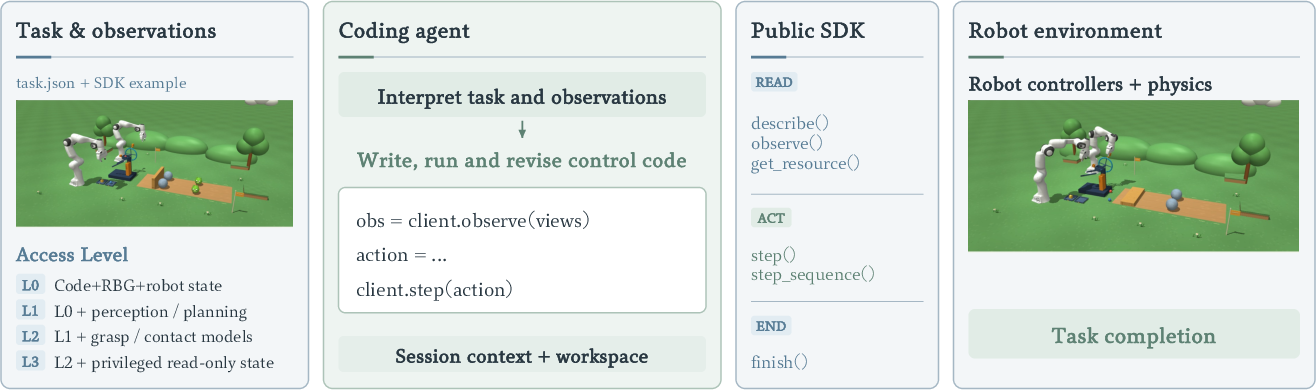
The AI receives information such as:
- A written description of the task.
- Camera images.
- Information about the robot’s position and movement.
- Certain details about the objects and environment.
The AI then writes computer instructions that control the robot. After the robot acts, the AI receives new observations and can update its plan.
This is similar to playing a strategy game:
- Look at the current situation.
- Decide what to do.
- Take an action.
- See what happened.
- Change the plan if necessary.
The environment provides four important operations:
describe: Explain the task and controls.observe: Show the robot’s permitted observations.step: Perform an action.finish: End the attempt and check whether the task was completed.
The evaluation sets
Because testing all 410 environments can take a long time, the researchers created smaller collections:
- EP-100: 100 representative tasks.
- EP-Easy: 50 easier tasks.
- EP-Hard: 50 more difficult tasks.
- EP-20: A small 20-task set for quicker testing.
The 100 tasks in EP-100 are divided among five groups: Launch, Tower, Lock, Cube, and Home.
Fair testing rules
The researchers fixed rules about:
- What information the AI could see.
- Which tools it could use.
- How many actions it could take.
- How much simulated and real time it had.
- How many times each task could be attempted.
- What counted as success.
A task counted as successful only if the robot:
- Reached the final goal.
- Followed all task rules.
- Satisfied physical requirements, such as releasing an object properly and leaving it stable.
This is important because a robot might appear to finish a task while secretly breaking a rule or leaving an object in an unstable position.
4. What were the main findings?
The paper tested two AI systems:
- GPT-6-Astra
- Opus-5.5-extra
The main score was called Pass@1. This means the percentage of conditions the AI completed successfully on its first valid attempt. Pass@2 means the percentage completed within two attempts.
Overall results
| AI system | Pass@1 | Pass@2 |
|---|---|---|
| GPT-6-Astra | 13.80% | 19.94% |
| Opus-5.5-extra | 29.22% | 35.85% |
This means that both systems struggled with the full collection of tasks, especially when compared with ordinary tests that involve only short or simple actions.
Opus-5.5-extra performed better overall. However, even it succeeded on fewer than half of the tested conditions.
For GPT-6-Astra, a second attempt helped:
- It succeeded on 64 of 400 conditions on the first attempt.
- A second attempt added 27 more successes.
- Even after two attempts, 309 conditions were still unsuccessful.
This shows that trying again can help, but it does not solve the main problem.
Easier tasks versus harder tasks
GPT-6-Astra performed better on EP-Easy than on EP-Hard:
| Set | Pass@1 | Pass@2 |
|---|---|---|
| EP-Easy | 18.42% | 27.41% |
| EP-Hard | 8.81% | 12.01% |
Opus-5.5-extra also performed better on easier tasks:
| Set | Pass@1 | Pass@2 |
|---|---|---|
| EP-Easy | 33.99% | 42.88% |
| EP-Hard | 24.21% | 28.48% |
This suggests that increasing the number of steps, physical challenges, or planning requirements makes the tasks much harder for AI agents.
Which tasks were easiest and hardest?
For GPT-6-Astra:
- Tower tasks were the strongest overall, especially the ordinary planning and physics versions.
- Launch tasks had moderate success, particularly simple aiming.
- Lock tasks were difficult, especially versions using flexible hands.
- Cube tasks were extremely difficult. The AI had no successful Rubik’s cube attempts in the reported results.
- Home tasks had mixed results. The AI did better at precise and dynamic actions than at longer household sequences.
The results show that a system may be good at one type of robot challenge but poor at another. A single overall score would hide these important differences.
Why are these findings important?
The findings show that advanced language-and-vision AI systems still have serious problems when they must:
- Remember many steps.
- Keep track of changing object positions.
- Make physically accurate movements.
- Follow several rules at the same time.
- Recover from mistakes.
- Coordinate planning with real or simulated movement.
An AI may be able to explain how to solve a puzzle in words, but that does not mean it can physically solve the puzzle with a robot. The benchmark measures the difference between knowing what should happen and making it happen successfully.
5. What could this research lead to?
Embodied Playground could become a useful standard test for future robot AI systems. Researchers could use it to compare different agents fairly and discover exactly where they fail.
For example, a failure might happen because an AI:
- Misunderstood what it saw.
- Chose an impossible movement.
- Used the wrong order of actions.
- Forgot an earlier step.
- Knocked over an object.
- Ran out of time or resources.
- Failed to react after something went wrong.
This detailed information could help developers build better robots with improved visual understanding, planning, memory, movement control, and error recovery.
The larger lesson is that making a truly capable robot is not just about giving it a powerful LLM. The robot must also understand space and physics, plan carefully, control its body, and continuously learn from what happens.
Overall, the paper presents Embodied Playground as a demanding “obstacle course” for robot intelligence. The early results show progress, but they also demonstrate that AI agents still have a long way to go before they can reliably perform complicated, multi-step tasks in the physical world.
Practical Applications
Immediate Applications
The paper’s main practical contribution is an evaluation framework rather than a deployed robotic product. Its standardized environments, interfaces, access levels, and episode-level metrics can nevertheless be used immediately in the following workflows:
- Robotics model and agent benchmarking — Industry and academia
- Run foundation-model robotic agents on
EP-20,EP-100, or the full 410-environment playground to compare long-horizon planning, perception, tool use, and physical execution. - Report not only success, but also
Pass@1,Pass@2, time to successful completion, token usage, action counts, invalid attempts, and first-failure categories. - Use suite-level results to diagnose whether a system is limited by strategic planning, spatial reasoning, contact manipulation, dynamics, or recovery from execution errors.
- Dependencies: Current results are simulation-based, and the benchmark’s robot embodiments and task definitions may not represent every target robot or deployment environment.
- Run foundation-model robotic agents on
- Regression testing for robotic software stacks — Robotics and software engineering
- Integrate EP tasks into continuous-integration pipelines for robot agents, motion planners, vision modules, and control libraries.
- Re-run fixed task conditions after changes to perception, inverse kinematics, grasp generation, planning, or agent prompts to detect regressions in long-horizon behavior.
- Use the protocol’s explicit task, environment, agent, tool, and version records to maintain reproducible test reports.
- Dependencies: The evaluation runtime must be deterministic or sufficiently controlled; simulator changes, tool-version changes, or altered physics parameters can invalidate direct comparisons.
- Testing robot-agent interfaces and tool permissions — Robotics platforms and AI infrastructure
- Compare agents under L0–L3 access settings:
L0: raw observations and self-written algorithms;L1: perception, geometry, dynamics, and planning tools;L2: grasp and contact models;L3: privileged state observations.- Measure how much performance comes from the foundation model itself versus external perception, planning, contact, or state-estimation tools.
- Use this to design safer and more transparent robot APIs in systems based on ROS, SDKs, code-generation agents, or tool-calling architectures.
- Dependencies: Tool grants must be specified precisely. L3 privileged observations are useful for diagnosis but do not reflect ordinary deployment conditions.
- Failure analysis and targeted system improvement — Industry and academia
- Use the independent evaluator to distinguish final-goal failure, task-rule violation, instability, object loss, timeout, invalid execution, and other physical failures.
- Create targeted improvement cycles—for example:
- improve state tracking for Tower of Hanoi;
- improve contact and dexterous manipulation for Kongming locks;
- improve orientation and regrasp planning for cube tasks;
- improve recovery and causal prediction for launcher tasks;
- improve sequencing and scene maintenance for household tasks.
- Dependencies: The benchmark identifies where failures occur, but additional trajectory inspection is required to determine the exact algorithmic cause.
- Evaluation of memory and replanning mechanisms — Agent research
- Compare agents that maintain explicit world-state estimates, execution histories, milestone records, or failure explanations against agents that replan from the latest observation only.
- Use long-horizon tasks with persistent physical changes and consumed resources to test whether memory improves later decisions rather than merely improving language-level reasoning.
- The difference between
Pass@1andPass@2can serve as a simple measure of recovery benefit: in the reported experiments, second attempts improved coverage but did not eliminate substantial failure rates. - Dependencies: The current protocol clears agent memory between episodes, so it evaluates within-episode adaptation rather than lifelong learning or cross-task memory.
- Curriculum design for robotics education and research training — Academia
- Use
EP-Easyfor introductory experimentation andEP-Hardfor advanced work on long-horizon planning and physical reasoning. - Use
EP-20for rapid iteration during coursework, lab meetings, or ablation studies, while treating it as a diagnostic subset rather than an unbiased estimate of full-set performance. - Students can implement increasingly capable systems: scripted controllers, symbolic planners, visual state estimators, language-model agents, and recovery policies.
- Dependencies: EP-20 is partly informed by pilot success evidence and is therefore unsuitable as the sole measure of general capability.
- Use
- Procurement and model-selection support — Robotics companies and integrators
- Evaluate candidate foundation models or robot-agent frameworks before deployment using identical task conditions, tool budgets, and observation profiles.
- Compare not only aggregate success but also sector-relevant profiles—for example, household sequencing, precision insertion, dynamic interaction, or dual-arm manipulation.
- Include token and wall-clock measurements when estimating operational cost.
- Dependencies: Benchmark performance should not be treated as a safety certification or as a direct predictor of performance in unmodeled real-world environments.
- Policy and standards development for embodied AI evaluation — Regulators and standards bodies
- Adapt the paper’s protocol as a template for reporting:
- observation and tool access;
- robot embodiment;
- action and time budgets;
- repeated trials;
- invalid and missing attempts;
- independent goal, rule, and physical-validity checks.
- Require evaluation reports to separate ordinary failures from infrastructure failures and to disclose privileged observations, pretrained controllers, and reference trajectories.
- Dependencies: A policy standard would require additional requirements for real-robot safety, human interaction, cybersecurity, privacy, and physical harm prevention, none of which are fully addressed here.
- Benchmark-inspired consumer robotics diagnostics — Daily life and domestic robotics
- Use the Home suite’s concepts—tidying, bookshelf organization, precision placement, and dynamic interactions—to test domestic robots before allowing them to manipulate household objects.
- A consumer-facing system could perform a short diagnostic covering object placement, clutter removal, insertion, moving-object interception, and spring-loaded doors.
- Dependencies: Simulated household tasks do not capture fragile objects, people, pets, unexpected clutter, damage costs, or the semantic ambiguity of real homes.
Long-Term Applications
The findings also support longer-term applications, but these require substantial research, real-world validation, or engineering development:
- Reliable long-horizon household robots — Robotics and home automation
- Develop household agents that decompose activities into milestones, maintain a persistent scene model, verify intermediate conditions, and revise plans after failed grasps or changed object configurations.
- Potential products include robots for tidying, shelf organization, kitchen preparation, connector insertion, door handling, and other multi-stage domestic tasks.
- Embodied Playground is relevant because it evaluates ordered milestones, final-scene requirements, stability, and physical validity rather than only isolated grasp success.
- Dependencies: Real homes introduce open-world variation, uncertain object properties, human presence, safety constraints, and much broader task distributions than the benchmark.
- Closed-loop robot programming assistants — Software and industrial automation
- Build systems that convert natural-language instructions into executable robot programs while monitoring execution and repairing plans when observations contradict predictions.
- The benchmark’s
describe–observe–step–finishinteraction model could inform a standardized runtime for model-generated programs and tool calls. - Such systems could support warehouse rearrangement, laboratory automation, inspection, and small-batch manufacturing.
- Dependencies: Generated code requires sandboxing, authorization controls, collision checking, recovery policies, and protection against unsafe or irreversible actions.
- Adaptive manipulation and recovery controllers — Robotics
- Combine foundation-model planning with specialized low-level controllers for grasping, contact, force control, trajectory correction, and dynamic interception.
- A high-level agent could select strategies while learned or model-based controllers handle precise execution and provide structured feedback.
- The sharp performance differences between parallel-gripper and dexterous tasks suggest that embodiment-aware planning and contact models will be important.
- Dependencies: The paper does not establish that better benchmark scores transfer to real hardware; sim-to-real gaps in friction, compliance, sensing, and actuator behavior remain major obstacles.
- Embodied-agent safety validation — Healthcare, eldercare, and public environments
- Extend the benchmark methodology to test whether robots preserve protected objects, obey ordering constraints, stop after unsafe contact, and recover conservatively from failures.
- In healthcare or eldercare, analogous tasks could evaluate medication-container handling, tray arrangement, assistive-object retrieval, and interaction near people.
- Independent checks of physical validity and persistent rule violations could become components of safety cases for autonomous robots.
- Dependencies: The current benchmark does not model human injury, uncertainty, privacy, medical regulation, or adversarial interaction. Real deployment would require human-centered safety evaluation and formal risk analysis.
- Standardized robot-agent certification and leaderboards — Policy and industry
- Create sector-specific certification tracks using benchmark families for manipulation, multi-stage household work, dexterity, dynamic interaction, and resource-constrained planning.
- Certification could require minimum performance across all prescribed conditions, not merely a high average score, thereby penalizing brittle behavior.
- Metrics such as all-four success, failure consistency, time, and resource use could complement aggregate success rates.
- Dependencies: Certification requires validated links between simulator performance and real-world reliability, representative task distributions, and protections against benchmark overfitting.
- Robot fleet monitoring and predictive maintenance — Logistics and manufacturing
- Use recurring benchmark episodes as health checks for robot arms, grippers, cameras, controllers, and agent software.
- Increasing rates of invalid attempts, timeouts, instability, or physical-rule violations could indicate sensor degradation, calibration drift, mechanical wear, or software regressions.
- A fleet-management tool could track performance by task type and embodiment over time.
- Dependencies: This application requires stable baseline distributions and methods for separating hardware degradation from agent or simulator changes.
- Training data and curriculum generation for embodied foundation models — AI research
- Use the 410 environments and their controlled variations to generate trajectories involving legal action sequences, failed attempts, recovery behavior, geometric constraints, and physical consequences.
- Training datasets could include successful demonstrations, counterexamples, failure explanations, state-transition traces, and tool-use records.
- Curriculum schedules could progress from direct aiming and simple manipulation to causal chains, dexterous assembly, and long-horizon household activities.
- Dependencies: Training directly on benchmark trajectories risks overfitting. Broader environments, randomized physics, novel embodiments, and real-world data would be needed to establish generalization.
- Digital twins for industrial and laboratory workflows — Manufacturing, energy, and science
- Adapt the benchmark’s long-horizon structure to digital twins of laboratory protocols, assembly lines, maintenance procedures, or equipment-operation sequences.
- Agents could be evaluated on whether they preserve intermediate constraints, account for consumed resources, and revise actions after sensor feedback.
- Potential tools include simulation-based commissioning systems and AI assistants for experimental or maintenance planning.
- Dependencies: The present environments are not domain-specific digital twins. Industrial use would require accurate process models, calibrated sensors, equipment interfaces, and rigorous authorization of actions.
- Human–robot collaboration and shared-task planning — Robotics and workplace automation
- Extend the protocol to tasks where a robot must coordinate with humans, preserve protected regions or objects, and recover when a human changes the scene.
- The benchmark’s rule-based and milestone-based evaluation could support tests of whether agents maintain task constraints while adapting to partner behavior.
- Dependencies: Human intent, communication, social expectations, and safety are absent from the current setup; real-world studies with participants would be necessary.
Overall, the paper supports immediate use as a reproducible testing and diagnostic framework. Its strongest long-term value lies in informing reliable closed-loop robot agents, but the reported success rates—particularly the low performance on several difficult suites—indicate that substantial advances in planning, dexterous manipulation, state tracking, recovery, and sim-to-real transfer are still required.
Glossary
- Active layer: A movable layer of a twistable puzzle that is currently engaged or being manipulated. “no active layer”
- Agent embodiment: The physical robot form and capabilities through which an agent acts. “Each entry pairs a task configuration with a robot embodiment.”
- Auxiliary fixture: An additional physical mechanism used to support or control an object during manipulation. “declared auxiliary fixtures for support, grasp attachment, and layer control”
- Azimuth aiming: Aiming based on horizontal angular direction relative to a reference axis. “Direct shots at single or paired targets, including azimuth aiming”
- Causal chain: A sequence in which one event produces effects that influence subsequent events. “scenes whose outcome depends on indirect causal chains”
- Contact-rich manipulation: Robotic manipulation involving substantial or complex physical contact between objects and the robot. “Kongming locks couple assembly or disassembly order with geometric feasibility and contact-rich manipulation.”
- Dexterous-hand control: Robotic control involving a multi-jointed hand capable of complex manipulation. “Shared task definitions across selected embodiments support comparisons between parallel-gripper manipulation and dexterous-hand control.”
- Dynamics prediction: Estimation of how objects will move or respond to forces over time. “including its own inverse kinematics, dynamics prediction, and planning”
- Embodied agent: An intelligent system that perceives and acts within an environment through a physical or simulated body. “Embodied-agent benchmarks examine reasoning through task performance under specified observation and action interfaces.”
- Embodied reasoning: Reasoning that incorporates an agent’s physical body, environment, and possible actions. “Embodied Playground provides a unified framework for studying whether foundation-model agents can sustain effective reasoning and action over extended task horizons.”
- Episode: A complete interaction sequence between an agent and an environment, from initialization to termination. “Each trial starts with a fresh environment and agent session.”
- Fracture threshold: The minimum physical condition, such as force or impact, required to break an object. “Breakable glass panes with fracture thresholds”
- Floating-hand control: Control of a simulated hand whose position and orientation are not constrained by a fixed robotic arm. “Pocket cube & 20 & Prescribed layer turns and regrasping & ALOHA; dual floating Sharpa”
- Foundation model: A large, broadly trained model that can be adapted to perform multiple tasks. “Foundation models offer a promising basis for robotic agents”
- Geometric constraint: A spatial or shape-related condition that restricts valid configurations or movements. “with variations in planning depth, geometric constraints, and physical execution demands”
- Geometric feasibility: The property of an action or configuration being physically possible given spatial relationships and object shapes. “geometric feasibility and contact-rich manipulation”
- Grasp proposal: A suggested way for a robot to position and use its gripper or hand to hold an object. “pretrained models that generate or refine grasp and contact proposals”
- Ground initialization: An environment setup in which a launcher or object begins in a ground-based state rather than a preloaded state. “Ground-mode initialization is outside their evaluation scope.”
- Inverse kinematics: The computation of robot-joint configurations needed to achieve a desired end-effector pose. “including its own inverse kinematics, dynamics prediction, and planning”
- Kinematic constraint: A restriction on movement resulting from the geometry or joint structure of a mechanism. “kinematic or dynamic constraints”
- Long-horizon task: A task requiring an agent to perform and coordinate many actions over an extended sequence. “long-horizon robotic tasks”
- Metric control: Robot control based on quantitative spatial measurements, such as distances or coordinates. “VABench studies active perception and metric control”
- Multimodal agent: An agent that processes and integrates multiple types of input, such as language, images, and physical state. “EmbodiedEval and EmbodiedBench evaluated multimodal agents in simulated tasks”
- Observation contract: A specification defining which environmental state information an agent is permitted to access. “according to the environment's observation contract.”
- Occlusion: The obstruction of an object or region of a scene by another object. “account for occlusion”
- Parallel-gripper manipulation: Robotic manipulation using a gripper whose opposing fingers move approximately parallel to one another. “comparisons between parallel-gripper manipulation and dexterous-hand control”
- Pass@1: The proportion of evaluation conditions solved on the first valid attempt. “Pass@1 measures success on the first valid attempt”
- Pass@2: The proportion of evaluation conditions solved within the first two valid attempts. “Pass@2 measures success within the first two valid attempts on the same condition.”
- Physical validity: The extent to which an execution satisfies required physical conditions, such as contact, release, and stability. “independent checks of final goal completion, task-rule compliance, and physical validity over the executed trajectory.”
- Privileged observation: Additional simulator state information made available to an agent beyond ordinary visual or sensory observations. “L3 privileged observations”
- Proprioception: Sensing or reporting a robot’s internal state, including joint positions, velocities, or configuration. “Public observations include camera images, robot proprioception, and declared task metadata”
- Regrasping: Releasing and repositioning a robot’s grasp on an object to continue manipulating it. “Prescribed layer turns and regrasping”
- Reference trajectory: A predefined sequence of states or actions used as a model of how a task may be executed. “additional pretrained action controllers and reference trajectories are excluded.”
- Scene graph: A structured representation of objects, attributes, and spatial relationships in a scene. “Spatial grounding developed through representations such as scene graphs, value maps, and keypoint constraints”
- Simulated seconds: Time advanced within the virtual physics simulation, distinct from real elapsed time. “Frame timestamps use simulated seconds”
- Spatial grounding: Connecting language or reasoning to concrete spatial entities and relationships in an environment. “Spatial grounding developed through representations such as scene graphs, value maps, and keypoint constraints”
- Stability condition: A requirement that an object or configuration remain unchanged or physically valid for a specified duration. “including any required release and stability conditions.”
- Strategic reasoning: Reasoning about action dependencies, ordering, and decisions across an extended task. “Strategic reasoning concerns action dependencies and decisions over extended horizons.”
- Suite-balanced aggregation: A scoring method that assigns equal weight to task groups or suites regardless of their number of tasks. “Every subset is scored with the suite-balanced aggregation of Section~\ref{sec:metrics}”
- Symbolic solving: Solving a problem through discrete symbols, rules, and logical transformations rather than continuous physical simulation. “installed tools for visual reconstruction, geometry, inverse kinematics, motion planning, symbolic solving”
- Task-rule compliance: Adherence to the procedural rules governing valid task execution. “independent checks of goal completion, task-rule compliance, and physical validity”
- Trajectory prediction: Forecasting the future path or motion of an object. “Launcher tasks combine trajectory prediction with indirect effects”
- Tool grant: An explicit authorization allowing an agent to use a particular external software capability or model. “The actual tool set is fixed explicitly.”
- Workspace: The region of space that a robot can reach and manipulate within its mechanical limits. “relate task-relevant positions and orientations to the robot's workspace”
- Wall-clock time: Actual elapsed real-world time, including computation, startup, and initialization. “A separate supervisor enforces elapsed wall time, including startup and initialization.”