Hy-Nomas: Towards Free-form Interactive World Generation
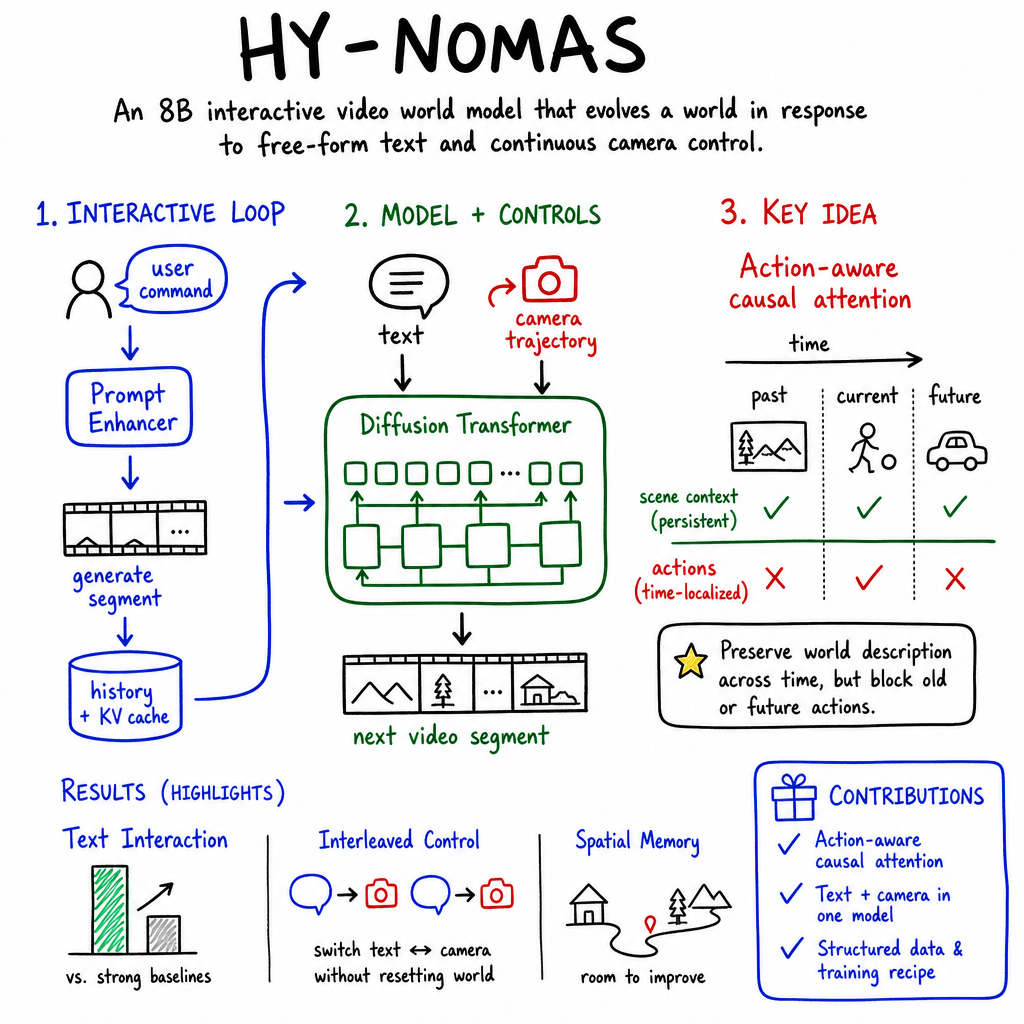
Abstract: Interactive world generation requires models to follow successive commands while preserving relevant history and action consequences. We present Hy-Nomas, a video world model with an 8B diffusion backbone that supports free-form text instructions and continuous camera control across multiple interaction turns. It generates variable-length segments conditioned on current inputs and cached history. Our central design aligns structured video captions with action-aware causal attention: descriptive context remains accessible across segments, while action instructions are restricted to their intended temporal windows. A vision-language Prompt Enhancer (PE) translates user requests and multimodal interaction histories into structured conditions for the next segment. A multi-stage curriculum progressively introduces causal generation, text interaction, camera control, and training on model-generated histories, followed by diffusion distillation. In human evaluation, Hy-Nomas shows superior performance over existing world models. We release model weights, code and benchmarks, together with a lightweight adaptation workflow, to support reproducible research on interactive world generation.
First 10 authors:
Paper Prompts
Sign up for free to create and run prompts on this paper.
Explain it Like I'm 14
1. What is the paper about?
This paper introduces Hy-Nomas, an artificial intelligence system designed to create and control virtual worlds as videos.
Unlike a normal video generator, which makes one short clip from one prompt, Hy-Nomas lets a person interact with the world repeatedly. For example, a user could say:
- “Show me a small robot in a forest.”
- “Make the robot pick up the red ball.”
- “Move the camera behind the robot.”
- “Make it walk toward the lake.”
The system tries to remember what happened before and make the next video segment match those earlier events.
The name world model means that the AI is not only generating pictures. It is trying to represent a changing environment, including objects, characters, actions, camera movement, and the results of previous commands.
2. Main research questions and objectives
The researchers wanted to solve several problems:
- Can an AI follow many instructions one after another?
- Can it remember important details from earlier video segments?
- Can it make actions happen at the correct time?
- Can it avoid repeating old actions by accident?
- Can users control both what happens and where the camera looks?
- Can it keep the scene consistent when objects or characters appear again later?
- Can it generate longer interactive videos without the world becoming confusing or unrealistic?
The main goal was to combine free-form text instructions with continuous camera control in one model. “Free-form” means that users do not have to use a small list of fixed commands. They can describe actions naturally in ordinary language.
3. How did the researchers build and train it?
Training with many kinds of video
The researchers collected a large collection of videos showing:
- People and objects moving
- Physical interactions, such as picking things up
- Camera movements
- Real and virtual environments
- Changes that happen over longer periods
They cleaned the videos by removing poor-quality clips, repeated videos, clips with strange camera movement, and videos with sudden unwanted cuts.
They also grouped similar videos together. This is similar to sorting a large box of photographs into folders so that the AI sees a wide variety of examples instead of seeing the same type of video repeatedly.
Giving videos detailed descriptions
A vision-LLM examined the training videos and wrote structured descriptions of them. These descriptions recorded:
- What the scene looks like
- Which characters and objects are present
- The identity of each subject
- What changes from one part of the video to the next
- Which action happens when
- What the result of each action is
- How the camera moves
For example, instead of simply labeling a video “a person and a ball,” the system might record:
- At the beginning, a person stands beside a red ball.
- From seconds 2 to 4, the person reaches toward the ball.
- From seconds 4 to 5, the person picks it up.
- The ball is now in the person’s hand.
- The camera moves slowly to the left.
This timing information helps the model understand not just what happens, but also when it happens.
Turning video into a smaller representation
Raw video contains an enormous number of pixels. Processing every pixel directly would require too much computer memory.
Hy-Nomas first uses a video autoencoder. This is like compressing a large movie into a smaller code that still contains the important visual information. The model works with this smaller code and later converts it back into normal video frames.
Generating video with diffusion
Hy-Nomas is based on a diffusion model. A diffusion model begins with random visual noise and gradually changes it into an organized image or video.
A simple analogy is cleaning a very messy drawing step by step until it becomes a clear picture. In Hy-Nomas, the model starts with noise and gradually creates a video segment that matches:
- The user’s instruction
- The previous video history
- The desired camera movement
The model has about 8 billion parameters, which are adjustable values learned during training. These parameters help it recognize patterns in video and language.
Making the model remember the past
Hy-Nomas generates video in separate segments, or short pieces. Each new segment can use information from the current instruction and earlier segments.
The model stores useful information from previous segments in a key-value cache, often called a KV cache. This works somewhat like keeping notes from earlier pages of a story so that the next page remains consistent.
The system uses causal attention. This means the model can use the present and the past, but not information from the future. This is important because a real interactive system should not know what will happen before the user gives the next command.
Action-aware attention
The researchers found that ordinary causal attention was not enough. If the model could always see every old action description, it might repeat actions that had already happened.
To address this, Hy-Nomas separates descriptions into two kinds:
- Persistent descriptions, such as “the scene contains a red house,” which can remain available later
- Temporary action instructions, such as “the person opens the door,” which should only affect the correct time period
This is similar to using a story outline where the setting remains visible on every page, but a particular instruction is crossed out after it has been completed.
Controlling the camera
Hy-Nomas can also receive camera movements. The researchers recorded how cameras move through space, including:
- Forward and backward movement
- Sideways movement
- Turning left and right
- Looking up and down
- Zooming or changing viewpoint
The system represents camera movement as a series of continuous changes rather than only using fixed commands. This allows smoother control of speed, direction, and scale.
Keyboard controls can also be converted into camera paths. For example:
Wmoves forwardSmoves backwardAandDmove sideways- Mouse or arrow-key movements control turning
Training in stages
The model was trained gradually instead of learning everything at once. The main stages were:
- Adapt a previous video model to the new compressed video format.
- Teach it to generate video segments in time order.
- Teach it to understand when specific actions should happen.
- Add camera control.
- Improve visual quality using better training videos and captions.
- Train it using its own earlier predictions, including imperfect ones.
- Reduce the number of steps needed to generate video quickly.
This gradual process is called a training curriculum. It is similar to teaching a student basic skills first and more difficult skills later.
4. Main findings and results
The paper reports that Hy-Nomas can:
- Follow successive free-form text instructions
- Continue a changing world across multiple interaction turns
- Preserve important scene details and subject identities
- Combine text instructions with camera movement
- Generate minute-scale visual rollouts
- Keep descriptive information available across segments
- Limit action instructions to the correct time period
- Reduce action-order mistakes
- Reduce accidental repetition of previous actions
- Support both text-controlled and camera-controlled segments
According to the paper’s human evaluation, Hy-Nomas performed better than existing world models on the tested interactive tasks.
The researchers also released:
- Model weights
- Source code
- Evaluation benchmarks
- A lightweight adaptation method using LoRA
LoRA is a way to customize a large AI model by training a much smaller set of additional parameters. It is like adding a small specialty module to a general-purpose tool instead of rebuilding the entire tool.
Why these results matter
A model that only creates isolated clips is less useful for interactive applications. Hy-Nomas is designed to support a continuous experience, more like exploring a game world or directing an animated story.
The ability to separate long-lasting scene information from temporary actions is especially important. Without this separation, a character might repeatedly open the same door, an object might suddenly return to an earlier position, or an instruction might happen at the wrong time.
Camera control is also significant because users need to control not only what happens, but also what they see. This could make generated worlds feel more like explorable environments rather than ordinary videos.
5. Implications and possible impact
Hy-Nomas could contribute to several future applications:
- Interactive games and virtual worlds
- Training environments for robots or autonomous systems
- Virtual reality experiences
- Interactive films and animation
- Educational simulations
- Creative tools for artists and filmmakers
- Research into how AI understands actions and physical consequences
For example, a student might explore an ancient city and ask questions while moving the camera around. A game designer might describe a world in natural language and let the AI create scenes interactively. A robot researcher might use similar systems to study how actions change an environment.
However, the system still has important challenges. Generated worlds can gradually lose detail or consistency, especially during long interactions. The model may also produce physically incorrect events, because making video look believable is not the same as truly understanding physics. Small mistakes can build up over time, causing characters, objects, or locations to change unexpectedly.
Overall, the paper presents Hy-Nomas as a step toward AI-generated worlds that people can explore and control through ordinary language and camera movement. Its most important idea is to combine memory, timed actions, and camera control so that the generated world behaves more like an ongoing environment than a collection of unrelated video clips.
Practical Applications
Immediate Applications
The released weights, code, benchmarks, bounded-cache inference, and LoRA adaptation workflow make the following applications potentially deployable now, subject to available GPU infrastructure and validation of model outputs.
- Interactive game and virtual-world prototyping — gaming and software development. Developers can use Hy-Nomas to generate playable-looking environments from successive text commands, such as “open the door,” “make the robot walk toward the vehicle,” or “move the camera behind the character.” Continuous camera trajectories can be generated from keyboard and mouse input, enabling rapid prototyping of scenes, cutscenes, and exploratory game concepts.
- Potential workflow: user command or keyboard input → Prompt Enhancer converts the request and visual history into structured conditions → Hy-Nomas generates the next video segment → cached history is reused for the next interaction.
- Dependencies: generated video is not necessarily a deterministic, physically simulated game state; integration with a game engine, collision system, action validator, or persistent state database would be required for production gameplay.
- Previsualization and storyboarding — film, television, advertising, and animation. Directors and designers can explore camera movements, subject actions, and scene changes interactively rather than rendering every storyboard variant manually. Text and camera controls can be interleaved to test alternative shots or transitions.
- Potential products: an interactive storyboard tool, virtual cinematography assistant, or text-controlled shot-planning interface.
- Dependencies: temporal identity preservation, visual continuity, and action consistency must meet professional production standards; generated footage may still require human editing and conventional rendering.
- Virtual cinematography and camera-path design — media production, robotics simulation, and visualization. The continuous relative-pose representation supports fine-grained control of translation, rotation, speed, and duration. Users can convert W/A/S/D and mouse inputs into camera trajectories and preview the resulting viewpoint immediately.
- Potential workflow: define a scene and subject behavior with text, navigate using keyboard or mouse, and export candidate camera paths for downstream animation or simulation.
- Dependencies: the model’s camera control is learned from estimated trajectories and may not preserve metric scale or exact geometry. Export to a 3D scene or physically accurate camera rig would require additional reconstruction.
- Synthetic training data for perception and interaction models — robotics, autonomous systems, and computer vision. Hy-Nomas can generate diverse visual sequences containing object motion, human actions, camera movement, and action consequences. These sequences may be used for preliminary testing, data augmentation, or curriculum design for visual prediction, tracking, and action-recognition systems.
- Potential datasets: multi-turn videos paired with structured captions, localized actions, camera trajectories, and subject identities.
- Dependencies: synthetic or generated data may contain artifacts, incorrect physics, or biased action distributions. Real-world validation and filtering are necessary before using it for safety-critical robotics or autonomous driving.
- World-model research and benchmarking — academia and industrial R&D. Researchers can use the open model, Hy-Nomas-Bench, evaluation metrics, and training code to reproduce experiments on multi-turn interaction, spatial memory, action timing, camera navigation, and interleaved controls.
- Potential research workflow: fine-tune the base model with LoRA, test alternative prompt-enhancement strategies, compare attention masks, or evaluate error accumulation over long rollouts.
- Dependencies: meaningful comparisons require consistent hardware, inference settings, prompts, benchmark protocols, and disclosure of model-generated histories.
- Lightweight domain customization — software, education, architecture, and enterprise visualization. The LoRA workflow can adapt the base or distilled model to a particular visual style, environment type, or command vocabulary without retraining the full 8B-parameter model.
- Examples: adapting to a company’s product-design scenes, an architectural visualization style, a specific game universe, or a controlled set of educational environments.
- Dependencies: sufficient domain-specific video-caption pairs are needed; LoRA adaptation may improve appearance or vocabulary while leaving fundamental physical-consistency problems unresolved.
- Interactive educational demonstrations — education and training. Instructors can create exploratory visual lessons in which students issue commands and observe the consequences, for example navigating a historical setting, manipulating virtual objects, or exploring camera perspectives in physics and art courses.
- Potential product: a conversational visual simulator embedded in a classroom or training platform.
- Dependencies: educational content requires factual review, age-appropriate filtering, accessibility features, and safeguards against hallucinated or misleading visual outcomes.
- Rapid concept exploration for product and environment design — architecture, industrial design, and urban planning. Designers can issue iterative commands about scene layout, object movement, viewpoint, and style to compare early concepts before committing to CAD, 3D modeling, or physical prototypes.
- Dependencies: the generated output is primarily visual and should be treated as exploratory material, not as a source of engineering measurements, code-compliant plans, or manufacturable geometry.
- Interactive visual interfaces for nontechnical users — creative tools and daily life. A user can combine natural-language requests with camera navigation to explore generated environments without learning a specialized 3D authoring tool. This could support personal visualization, virtual tours, creative play, and idea communication.
- Dependencies: practical consumer deployment depends on inference latency, cloud cost, content moderation, privacy handling for interaction histories, and reliable behavior across long sessions.
Long-Term Applications
These applications require further research, integration with external systems, improved reliability, or scaling beyond the capabilities demonstrated in the paper.
- Embodied robotics simulation and policy training — robotics and automation. A future version could serve as a controllable visual simulator in which a robot issues actions, receives visual observations, and learns from action-dependent state transitions. Continuous camera control and action-aware temporal conditioning are useful foundations for navigation, manipulation, and human–robot interaction.
- Potential workflow: robot policy proposes an action → Hy-Nomas renders the predicted observation → the policy updates its action → validated trajectories are transferred to a physical robot.
- Dependencies: the current model primarily generates video rather than enforcing exact geometry, contact dynamics, object permanence, or robot embodiment. Sim-to-real transfer, calibrated physics, action APIs, deterministic state tracking, and safety validation are required.
- Persistent virtual environments and agentic world simulation — gaming, metaverse platforms, and AI agents. Hy-Nomas could become a visual layer for long-running worlds that maintain object states, character identities, environmental changes, and consequences across many user or agent actions.
- Potential products: persistent AI-generated game worlds, interactive NPC environments, or testbeds for autonomous agents.
- Dependencies: minute-scale rollouts and cached context are not equivalent to indefinite persistence. A separate symbolic state store, world database, event log, consistency checker, and recovery mechanism would be needed to prevent drift and contradictory states.
- Training and evaluation environments for autonomous agents — AI research and safety. Agents could be evaluated on instruction following, memory, planning, camera navigation, and recovery from earlier mistakes in procedurally varied visual worlds.
- Potential benchmark: multi-turn tasks requiring an agent to inspect a scene, perform sequential actions, remember prior changes, and reach a target state.
- Dependencies: evaluation environments must expose reliable action semantics and hidden ground-truth states. Generated visual plausibility alone is insufficient for measuring planning or physical reasoning.
- Digital twins and operational simulation — manufacturing, logistics, energy, and infrastructure. A specialized world model could provide visual forecasts of factories, warehouses, power facilities, or construction sites under proposed interventions and camera movements.
- Potential workflow: ingest sensor or video history → issue an operational change → generate predicted visual outcomes → compare against physical telemetry and planning models.
- Dependencies: the released model is trained primarily on video and captions, not calibrated sensor streams or domain-specific physical laws. Deployment would require multimodal sensor fusion, real-time constraints, domain adaptation, uncertainty estimates, and strict human oversight.
- Healthcare and medical training environments — healthcare and professional education. A carefully constrained derivative could simulate procedural scenes, patient-room navigation, or training scenarios involving camera movement and sequential instructions.
- Potential products: visual rehearsal tools for clinical education, surgical-camera planning, or emergency-response simulation.
- Dependencies: medical applications require validated anatomy, clinically accurate temporal dynamics, privacy-preserving data, regulatory review, and explicit separation from diagnostic or treatment decisions. The general-purpose model should not be used directly for patient care.
- Interactive architectural and urban digital twins — construction, real estate, and public policy. Future systems could allow planners to navigate proposed spaces, alter layouts, simulate pedestrian or vehicle movement, and inspect the consequences from arbitrary camera paths.
- Dependencies: reliable geometry, scale, lighting, visibility, traffic rules, and population behavior must be grounded in structured 3D or GIS data. Video generation alone cannot provide planning-grade measurements or legal compliance.
- Real-time virtual production and autonomous scene direction — film, broadcasting, and XR. With substantial inference acceleration, the model could generate live visual environments responsive to performers, directors, and camera operators, including interactive virtual sets and adaptive viewpoints.
- Dependencies: the current diffusion process and 8B backbone may be too expensive or slow for high-resolution, low-latency production. Further distillation, hardware optimization, temporal consistency improvements, deterministic controls, and integration with production pipelines are required.
- Policy and emergency-response simulation — public policy, disaster management, and civil defense. A domain-adapted model could help stakeholders explore visual scenarios involving evacuation routes, infrastructure failures, crowd movement, or emergency interventions.
- Dependencies: policy decisions require calibrated probabilities and trustworthy causal models, whereas Hy-Nomas generates plausible visual continuations. It would need coupling to validated traffic, epidemiological, structural, or environmental simulators and must not be treated as a forecasting authority without empirical calibration.
- Interactive scientific visualization — science, engineering, and research communication. Scientists could use text and camera commands to explore hypothesized processes, visualize experimental setups, or generate intuitive explanations of complex spatial and temporal phenomena.
- Dependencies: generated visuals may be persuasive but scientifically incorrect. Quantitative simulation engines and structured data should provide the underlying facts, with Hy-Nomas serving only as an explanatory rendering or exploration layer.
- Long-horizon personal assistants and memory-based visual interaction — consumer software and accessibility. A future assistant could remember a user’s evolving virtual workspace, respond to successive commands, and provide visual demonstrations of procedures or plans.
- Dependencies: this requires robust privacy controls, user-specific memory, predictable state changes, low latency, multimodal input, and protection against retaining or exposing sensitive interaction histories.
Glossary
- Activation checkpointing: A memory-saving technique that stores selected activations and recomputes others during backpropagation. “All main transformer blocks use activation checkpointing”
- Adaptive spatiotemporal downsampling: Reducing video resolution and frame density according to spatial and temporal characteristics to lower computational cost. “We modularize the pipeline and apply adaptive spatiotemporal downsampling to reduce memory usage and improve throughput.”
- Action-aware causal attention: An attention mechanism that restricts action-related text to its associated temporal interval and segment. “To address these issues, we introduce action-aware causal attention”
- Autoregressive rollout: Sequential generation in which each generated segment becomes context for producing the next segment. “This representation records scene changes and action timing to support segment-wise autoregressive rollout training.”
- Bounded-cache inference: Inference that limits the amount of historical information retained in a model’s key-value cache. “Bounded-cache inference and a LoRA workflow”
- Camera-to-world pose: A transformation describing the camera’s position and orientation relative to a world coordinate system. “For each segment, given camera-to-world poses ”
- Causal diffusion transformer (DiT): A diffusion transformer modified so that information flows only from current or earlier temporal segments. “A pretrained bidirectional diffusion transformer (DiT)”
- Classifier-free guidance: A diffusion-sampling method that strengthens conditioning without requiring a separately trained classifier. “Classifier-free text guidance (Ho & Salimans, 2022) and camera guidance are applied during integration.”
- Continual pre-training (CPT): Further training of an existing pretrained model on new data or objectives while retaining its learned parameters. “Table 2 summarizes the five stages, with continual pre-training (CPT) divided into three successive regimes.”
- Cross-attention: An attention operation in which queries from one representation attend to keys and values from another representation. “visual tokens attend to temporally aligned camera tokens within the same segment through cross-attention”
- DCAE-V: A video autoencoder that compresses video spatially and temporally into a latent representation. “Hy-Nomas uses a DCAE-V video autoencoder”
- Diffusion distillation: Training a diffusion model to reproduce the behavior of a more computationally expensive diffusion process using fewer sampling steps. “Finally, causal distillation reduces the sampling steps”
- Discrete camera motion: Camera movement represented by a finite set of commands rather than continuous geometric transformations. “to predict discrete camera motion (such as WASD keyboard inputs) directly from video.”
- Dual-stream MMDiT: A multimodal diffusion-transformer architecture that processes different modalities in separate but interacting streams. “Text and video tokens are processed by dual-stream MMDiT blocks.”
- Euler steps: Numerical integration steps based on Euler’s method for approximating the solution of a differential equation. “integrated toward using 100. Euler steps.”
- FLOPs: Floating-point operations used as a measure of computational workload. “We therefore estimate the computational cost of each sample directly.”
- Flow matching: A generative-model training objective that teaches a network to predict a velocity field transporting noise toward data. “The model is trained with linear flow matching”
- FSDP2 hybrid sharding: A distributed-training strategy that shards model parameters, gradients, and optimizer states across selected GPU groups. “We combine Ulysses-style sequence parallelism (SP), data parallelism (DP), and FSDP2 hybrid sharding”
- Hierarchical clustering: An unsupervised clustering method that organizes data into nested groups based on similarity. “group videos by visual similarity through hierarchical clustering”
- Inverse dynamics model (IDM): A model that infers the action or control causing an observed state transition. “We additionally train a video-based inverse dynamics model (IDM)”
- Key-value (KV) cache: Stored attention keys and values reused during autoregressive generation to avoid recomputing earlier context. “historical visual and semantic context carried forward through the autoregressive key-value (KV) cache.”
- Latent representation: A compact learned encoding of data used instead of directly processing the original pixels. “We encode an RGB video ... into a compact spatiotemporal representation”
- LoRA (Low-Rank Adaptation): A parameter-efficient fine-tuning method that learns low-rank updates to a pretrained model. “A LoRA workflow that transfers adapters from the base model to its distilled counterpart”
- MagiAttention: An attention implementation designed to efficiently process structured and irregular attention masks. “We therefore adopt the Flex-Flash-Attention (FFA) kernel from MagiAttention”
- MMDiT: A multimodal diffusion transformer architecture used to jointly process text and video representations. “A dedicated cross-attention module in each MMDiT block”
- Muon optimizer: An optimization algorithm that applies orthogonalization to weight matrices during neural-network training. “We train the DiT using Muon”
- Optical flow: The apparent motion of pixels or visual features between consecutive video frames. “ViPE-derived motion labels refined using dense optical flow.”
- Prompt Enhancer (PE): A vision-language component that converts user requests and interaction history into structured generation conditions. “A vision-language Prompt Enhancer (PE) translates user requests and multimodal interaction histories into structured conditions”
- Radial distortion: Lens-induced geometric deformation in which straight lines appear curved, especially near image edges. “jointly estimate per-frame focal length and radial distortion”
- Relative pose: The motion of a camera between two frames, expressed independently of a global coordinate frame. “Frame-to-frame relative motion as ”
- Segment forcing: Training a generative model on its own previously generated segments so that it learns to handle imperfect autoregressive histories. “Segment forcing subsequently trains the model with cached context from its own predictions”
- Segment-wise causal attention: Attention that is bidirectional within a segment but allows access only to current and preceding segments. “We therefore replace it with segment-wise causal attention aligned with the temporal structure of the input captions.”
- Sequence parallelism: A distributed-computing method that partitions one long token sequence across multiple GPUs. “Sequence parallelism partitions a single packed sample across a small group of GPUs”
- Semantic deduplication: Removing items that convey essentially the same meaning, even when their surface appearance differs. “standardized preprocessing, filtering, semantic deduplication”
- SLAM: Simultaneous localization and mapping, the estimation of a camera’s movement while constructing or using a spatial map. “we tune the backend SLAM sliding window and optimization schedules”
- Spatiotemporal representation: A representation encoding both spatial structure and temporal evolution in video. “into a compact spatiotemporal representation”
- Structured captioning: Caption generation organized into predefined fields describing scenes, subjects, actions, and temporal information. “We design structured video captions to preserve subject identity, scene context, and action chronology”
- Timestep embedding: A neural representation of the current diffusion time used to condition denoising computations. “diffusion timestep embeddings modulate both streams.”
- Trajectory drift: The accumulated error in an estimated movement trajectory over time. “balance optimization scope against accumulated trajectory drift.”
- VAE (variational autoencoder): A neural encoder-decoder that maps data to a probabilistic lower-dimensional latent space and reconstructs it. “The 3D VAE decoder maps denoised video latents to RGB frames.”
- Vision-LLM (VLM): A model trained to jointly interpret visual inputs and natural-language information. “A vision-LLM (VLM), the Prompt Enhancer (PE)”
- World model: A model that predicts how an environment changes in response to observations and actions. “We define a video world model as an interactive virtual environment that renders visual observations of future states in response to user commands.”

