Infinite Worlds with Versatile Interactions
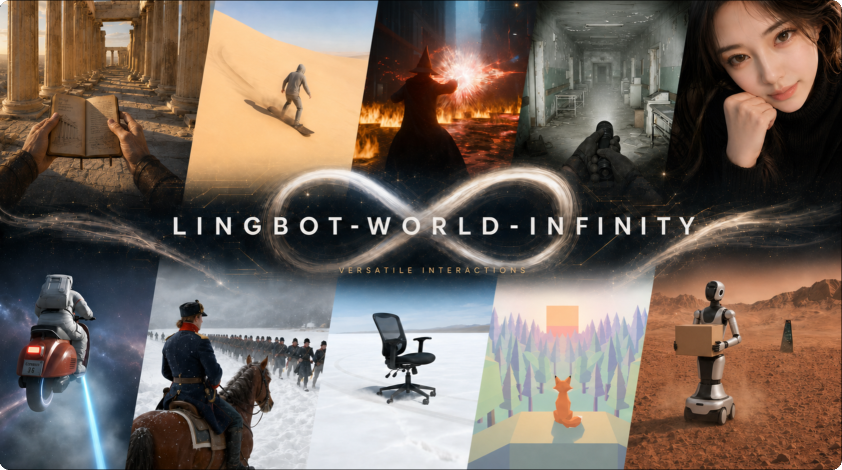
Abstract: We present LingBot-World 2.0 (also known as LingBot-World-Infinity), an advanced iteration of LingBot-World featuring four distinct upgrades. (1) Our model achieves an unbounded interaction horizon while maintaining consistent output quality, benefiting from a carefully crafted causal pretraining paradigm. (2) Through distilling a real-time variant from the base model, our system guarantees rapid response time, sufficient to drive 720p video streams at 60 fps. (3) Compared to the previous version, this update introduces highly diverse interactive elements, comprising a broader spectrum of actions (e.g., attacking, archery, spell-casting, and shooting) alongside a richer variety of text-driven events. (4) We pioneer the integration of an agentic harness within the domain of world modeling, wherein a pilot agent is tasked with planning and executing character behaviors, while a director agent is responsible for synthesizing novel environmental elements as the scene progresses. Additionally, to facilitate a shared experience, we develop an interface that permits multiple players to simultaneously immerse themselves in this vivid world simulator. We pair our primary 14B model with a lightweight 1.3B counterpart, which supports effortless deployment on a single GPU.
First 10 authors:

Paper Prompts
Sign up for free to create and run prompts on this paper using GPT-5.
Top Community Prompts
Explain it Like I'm 14
Infinite Worlds with Versatile Interactions — A simple guide
What is this paper about?
This paper introduces a computer system that can create an endless, interactive video world in real time. Think of it like a never‑ending video game level that the computer invents on the fly as you walk around, fight, cast spells, or change the weather—without pre-made scenes. The system aims to keep the visuals clear and stable for a very long time (hours), respond quickly to your actions, and support rich kinds of interactions.
What questions were they trying to answer?
The authors wanted to solve a few big problems:
- How can we keep an AI-generated world stable and good-looking for a long time, instead of getting blurry or weird after a few minutes?
- How can we make it fast enough to feel smooth and responsive (like a real game) at HD quality (720p) and 60 frames per second?
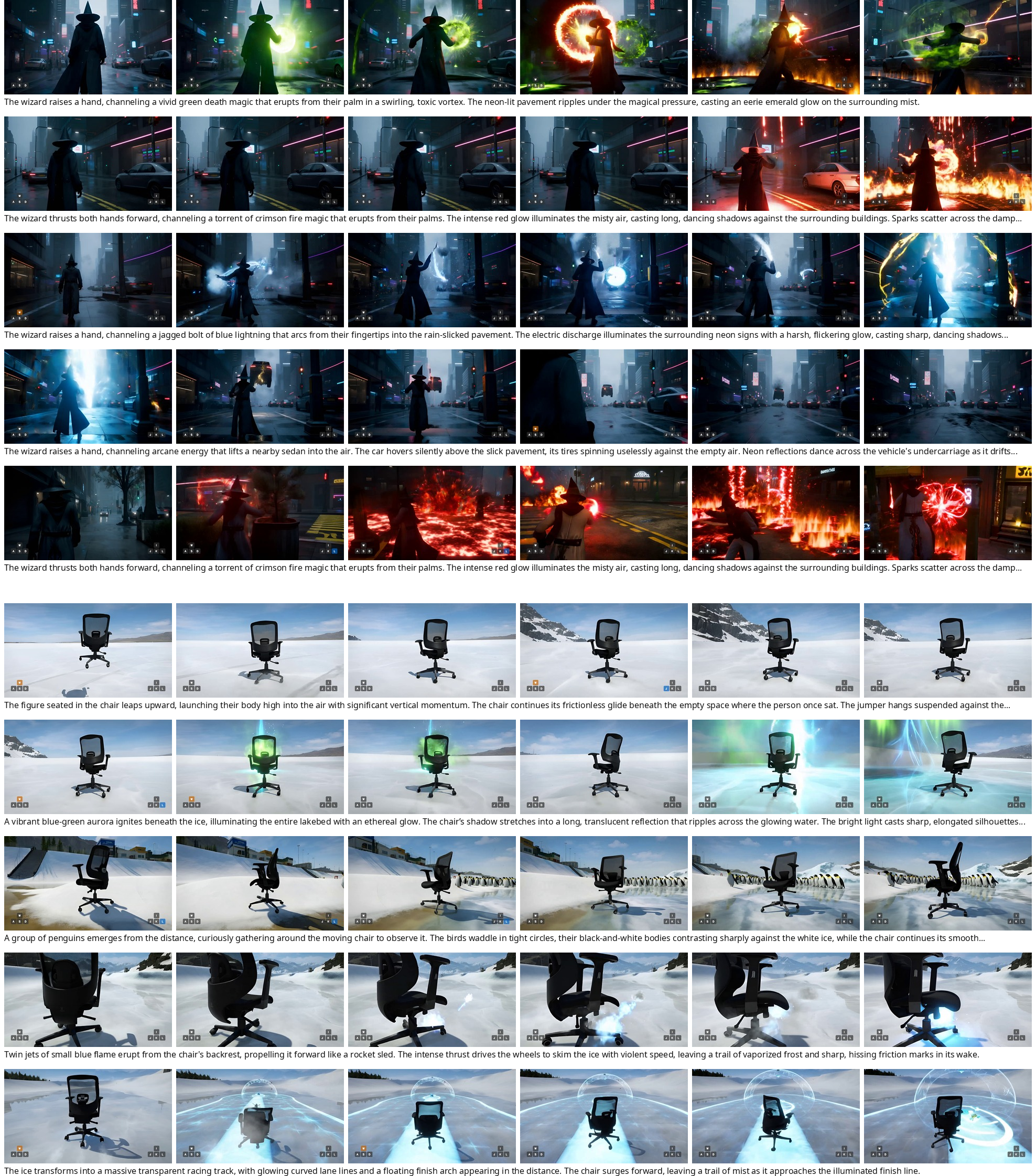
- How can users do more than just move the camera—like fight, use a bow, cast spells, or change the environment—while the world reacts logically?
- How can we organize the system so it can “think” about what should happen next and keep the world interesting without a human writing a script for every moment?
How did they do it? (In everyday language)
To reach these goals, they built and trained a “world model” and wrapped it in a smart control system. Here are the key ideas, explained simply:
- Autoregressive, causal video generation (no time travel):
- The model makes video one frame at a time, always using only what happened before (like telling a story sentence by sentence). “Causal” here just means “the future depends on the past,” which helps prevent nonsense and keeps scenes coherent over time.
- A special attention strategy to stay sharp over time:
- Inside the model, they use a “Mixture of Bidirectional and Autoregressive (MoBA) attention mask.” Think of this like rules about who can “look at” what information while drawing the next frame.
- Autoregressive: focuses forward in time (no peeking at the future).
- Bidirectional: briefly allows “looking both ways” to keep quality high.
- Mixing them helps the model keep high visual quality while still generating frame-by-frame without drifting into chaos.
- Rich control signals:
- The system listens to two kinds of actions:
- Camera movement (where you move/look).
- Text prompts that can change what happens (e.g., “start snowing,” “draw a bow,” “spawn a flock of birds”).
- Better training data that matches real interactions:
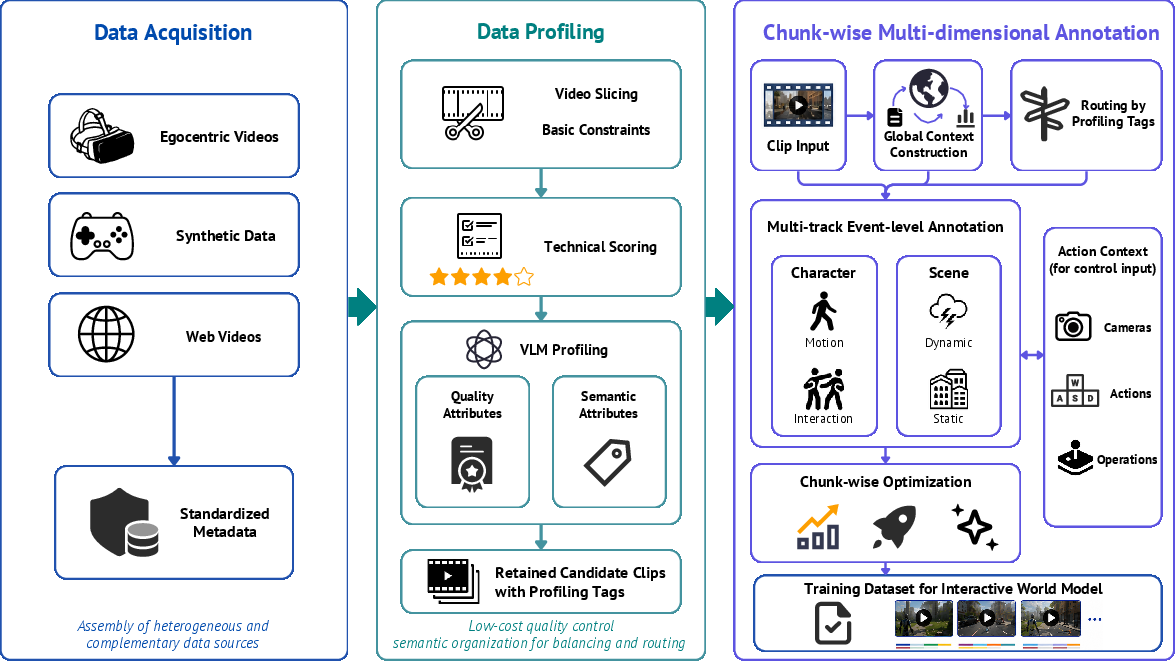
- They built a data engine that takes lots of videos (from real life, games, and the web), cleans them up, and adds two kinds of descriptions:
- Global captions: what the whole video is about.
- Chunk-wise captions: short, time-local descriptions that change as the scene changes.
- This teaches the model to follow instructions that can change over time, just like live gameplay.
- Distillation: making a fast “student” model from a slow “teacher”:
- The first model is powerful but too slow for real-time use. They “distill” it into a smaller, faster model—like a top student learning from a master teacher.
- Consistency distillation: compresses many slow steps into a few fast ones while keeping the result similar.
- Distribution matching (DMD): helps the student keep high visual quality and avoid drifting or getting messier over long sessions.
- A “Director and Pilot” agent system:
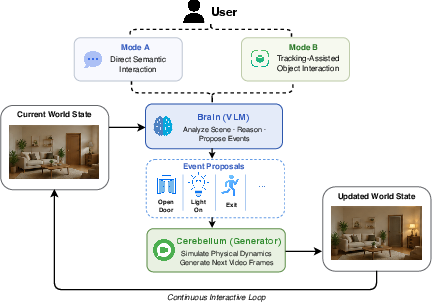
- Director (a vision-LLM): thinks about the scene, proposes events, keeps the story logical (e.g., “a storm rolls in,” “an enemy approaches”).
- Pilot (the video generator): turns those ideas into actual moving pictures that look real and consistent.
- Together, they keep the world lively and goal-focused without a pre-written script.
- Real-time engineering and interface:
- Lots of speed-ups under the hood (faster attention, parallel work across GPUs, streaming frames as they’re ready).
- A “refiner” sharpens frames and smooths motion.
- Smart memory management keeps the most relevant recent history to improve coherence and speed.
- A user interface with game-like controls and hotkeys for actions and events; it even supports multiple users.
What did they find, and why is it important?
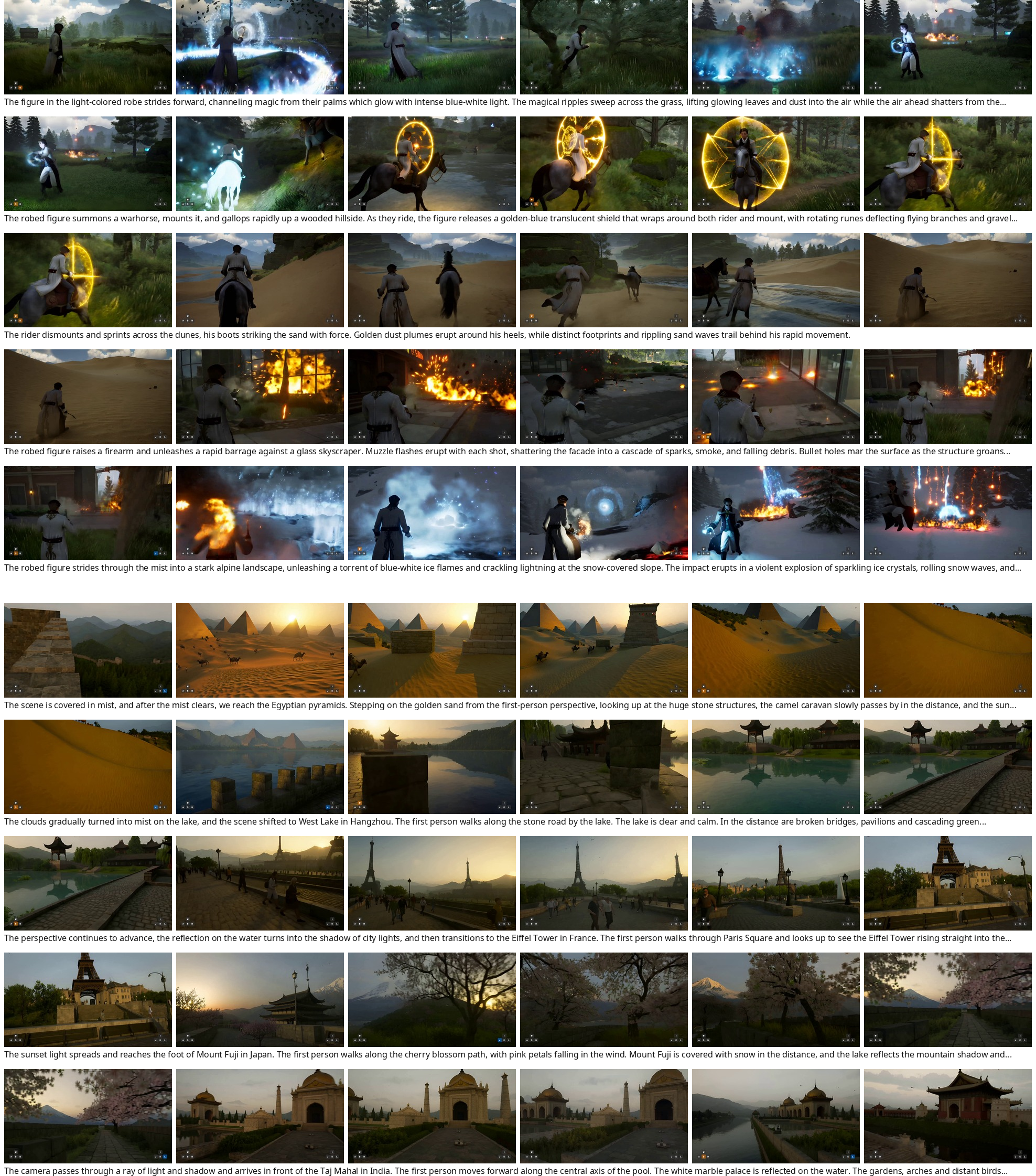
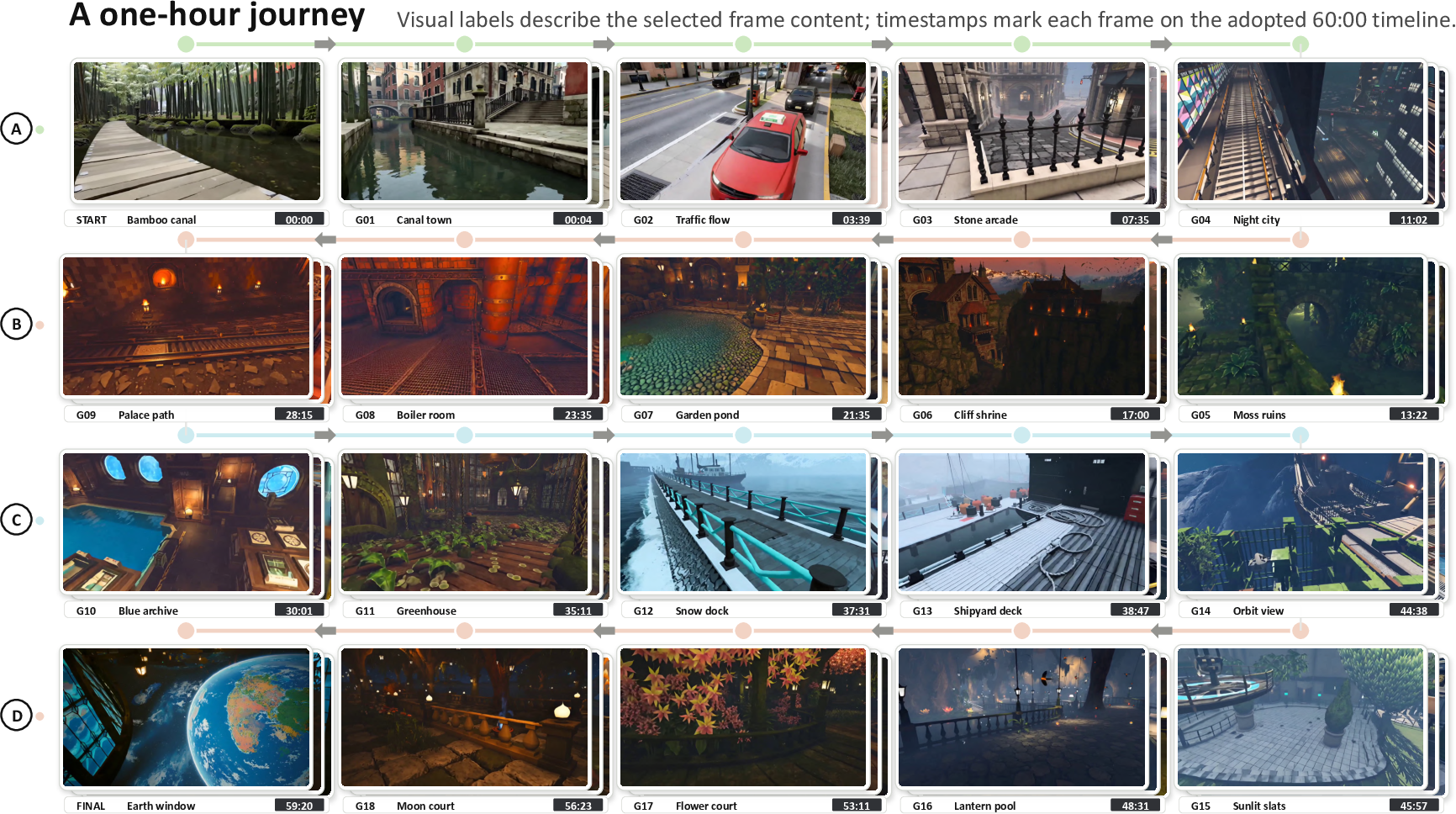
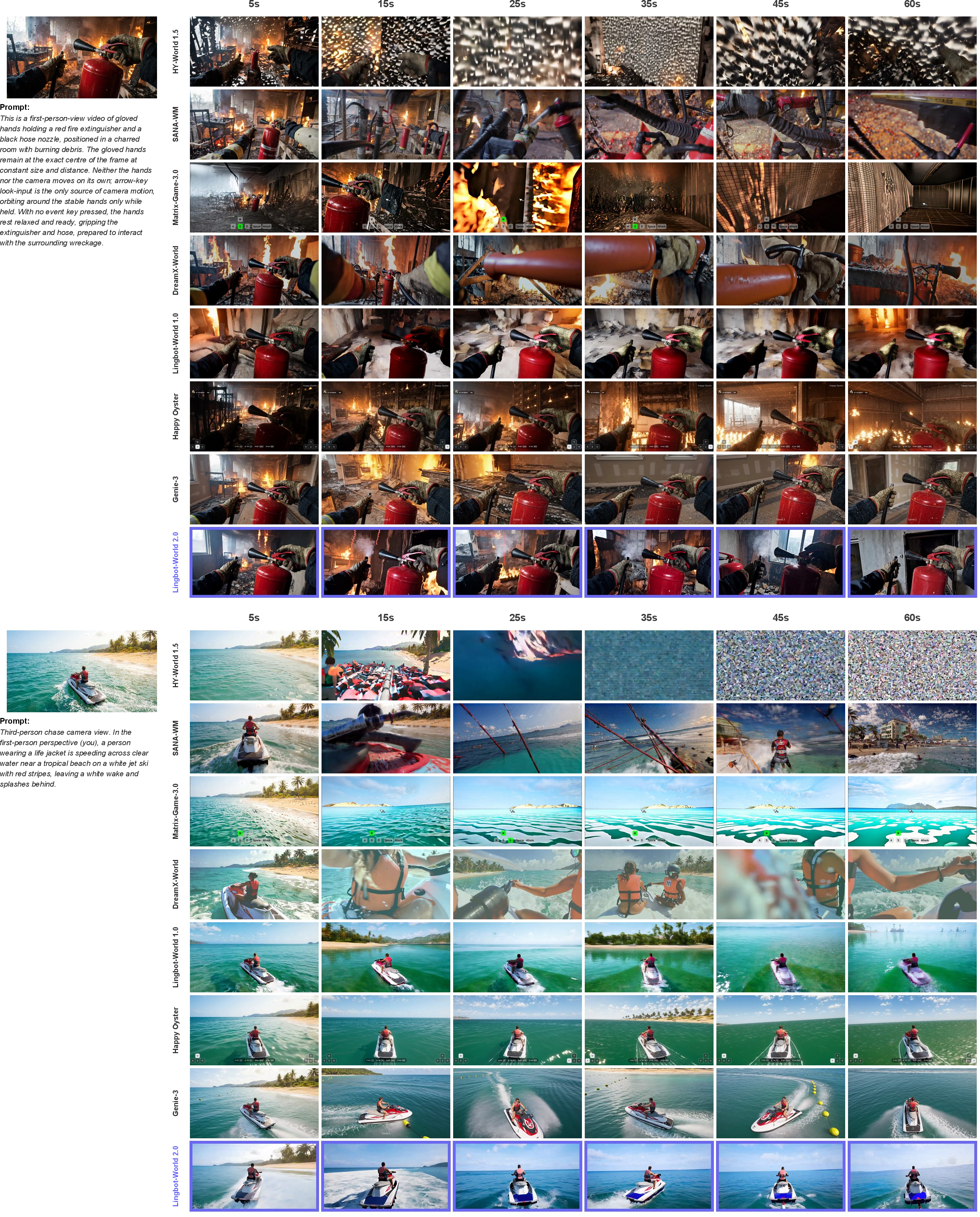
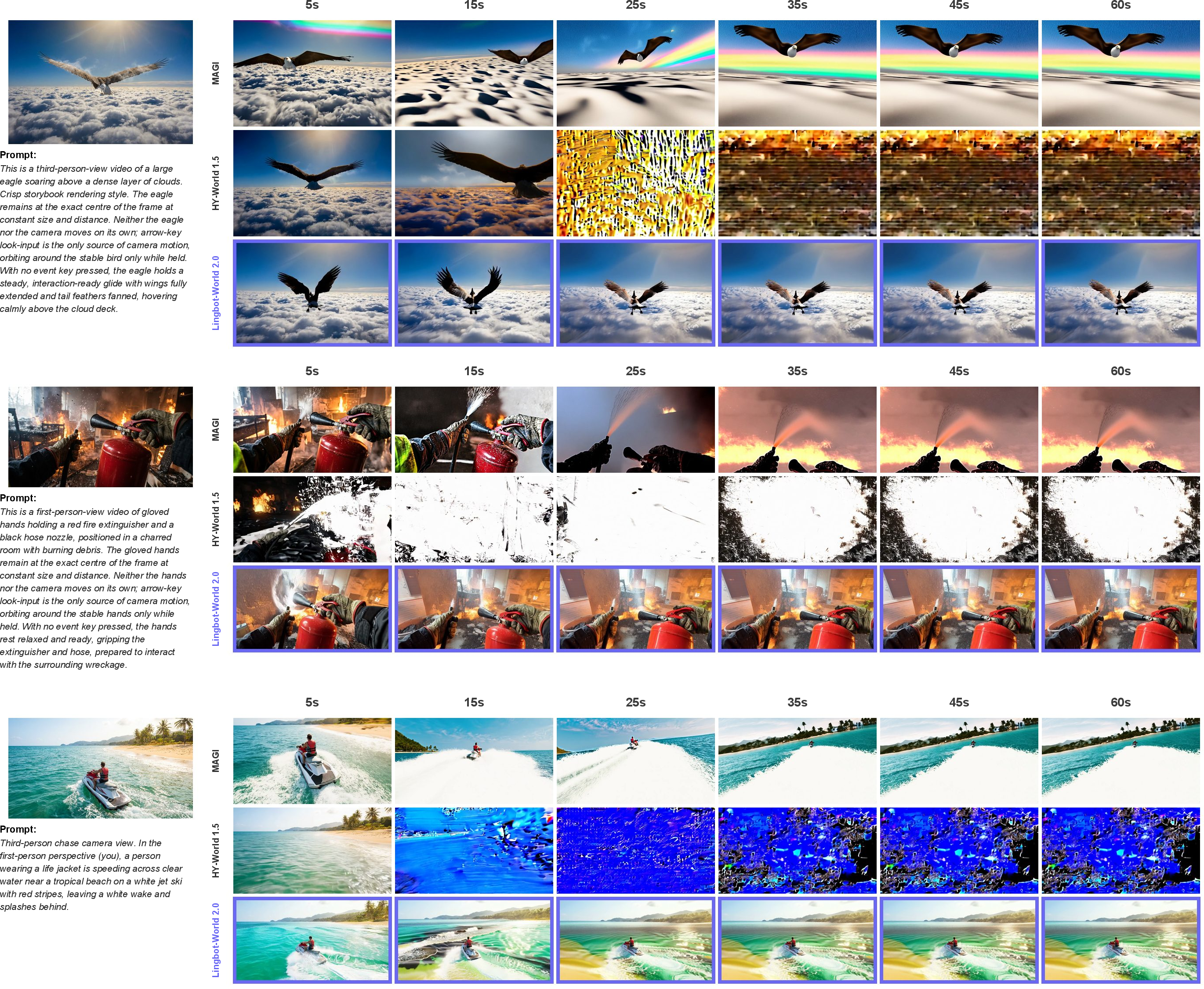
- Long, stable sessions: They ran the system for over an hour without the visuals collapsing or drifting into nonsense—this is rare for AI-generated video.
- Real-time performance: It runs at 720p and 60 frames per second, so it feels smooth and responsive.
- Rich interactions: It handles more than just walking around—you can fight, shoot, cast spells, and change the environment (like summoning rain or snow) with text.
- Open and accessible: They release both a powerful 14B model and a smaller 1.3B model (easier to run on a single GPU), plus the agent framework and interface.
This matters because it pushes AI from short, scripted video clips toward open-ended, playable worlds. It’s a step toward AI-created games, training simulators, and interactive storytelling, all generated on the fly.
What could this lead to? (Implications)
- New types of games and experiences: Worlds that grow and change with your actions, without level designers building everything by hand.
- Education and training: Custom, on-demand scenarios for practicing skills (e.g., driving, teamwork, safety training).
- Creativity tools: Artists and creators can direct a world with text instead of building every asset and animation manually.
- Research: A testbed for studying long-term AI behavior, planning, and physics understanding in simulated environments.
What are the current limits?
- Memory and persistence: The model doesn’t truly “remember” far-off places once they fall out of its recent view; returning later can produce a new version instead of the exact same area.
- Character and style consistency: Over very long times, individual characters or the art style can slowly change.
- Physics isn’t perfect: Because it learns from pixels, it sometimes misses true physical rules (e.g., objects might pass through each other).
- Compute cost: Real-time high quality still needs strong hardware; further efficiency is needed to run on everyday devices.
The takeaway
The paper shows a big step toward endless, interactive AI worlds that are fast, stable, and fun to play with. By training a strong “teacher” model, distilling it into a fast “student,” and pairing it with a Director–Pilot agent team, the system can generate rich scenes that react to you in real time—bringing AI-generated, open-ended virtual worlds much closer to reality.
Knowledge Gaps
Knowledge gaps, limitations, and open questions
Below is a consolidated list of concrete gaps, limitations, and unresolved questions identified in the paper, phrased to guide actionable follow-up research.
- Long-horizon stability lacks quantitative evaluation: no standardized metrics (e.g., time-to-drift, temporal LPIPS/PSNR over rolling windows, FVD/FID over segments, trajectory re-simulation divergence) or controlled protocols beyond a single hour-long qualitative session.
- Absence of ablations isolating contributions of key components (MoBA mask, chunk-wise prompts, Plücker camera conditioning, consistency distillation vs. DMD, dynamic KV scheduling, refiner) to stability, fidelity, and interaction responsiveness.
- MoBA attention mask design raises causality and leakage questions: how is bidirectional self-attention prevented from inducing future information leakage at training time; how does mask blending/weighting evolve with context length; what is the train–inference distribution gap and its effect on stability?
- Cross-attention masking details are under-specified: how is the “global prompt” prevented from leaking future events, and how sensitive is performance to prompt partitioning schemes?
- No empirical study of context-length scaling: impact of KV-cache size, pruning strategies, and attention window policies on long-horizon coherence, latency, and memory footprint.
- World persistence is acknowledged as limited but no concrete mechanisms are tested for identity/state recall (e.g., external memory/scene graphs, slot-based object IDs, map-building, or retrieval-augmented generation), nor benchmarks to measure re-localization fidelity after revisits.
- Identity and style consistency is recognized as an issue, but there is no metricized evaluation (e.g., face/character embedding drift, style distance over time) or mitigation strategies (ID losses, reference conditioning, LoRA style anchors).
- Physics plausibility remains weak and unquantified: no measurements of collision violations, momentum consistency, contact stability, or scene geometry consistency; unclear whether integrating lightweight physics priors or differentiable simulators would help.
- Camera control correctness is unvalidated: no metrics of 3D consistency under user-driven camera trajectories (e.g., reprojection error, multiview consistency) or robustness to sharp turns/zoom.
- Action controllability is not evaluated with success/failure rates, latency-to-effect, or confusion between action classes; no benchmarks for complex, multi-step tasks or hierarchical action sequences.
- Data/annotation reliability is uncertain: VLM-based chunk-wise captions may hallucinate; there is no inter-annotator agreement study, error analysis, or calibration of annotation quality across data sources.
- Dataset transparency and release: details on dataset size, composition per source (egocentric vs. synthetic vs. web), licensing status, and whether the curated annotations are released are missing, limiting reproducibility and bias auditing.
- Generalization across domains and to OOD prompts is untested: no stress tests for distribution shifts, contradictory instructions, rapid context switches, or adversarial prompt sequences.
- Multi-user “simultaneous immersion” is unvalidated: no architecture description for state synchronization, conflict resolution between users, causal consistency under concurrent actions, or measurements of network latency and its effect on coherence.
- Director–Pilot harness lacks quantitative evaluation: no metrics on director proposal quality (coherence, causal correctness), acceptance rate, turnaround latency, or failure modes (e.g., contradictory proposals, oscillations).
- Choice and configuration of the Director VLM are unspecified: model size, training/tuning procedure, prompt templates, memory mechanisms, and compute cost are not detailed; no ablations over different VLMs.
- No study of harness stability under load: how event proposal frequency and video generation latency interact; potential race conditions between director updates and pilot rollouts.
- Spatio-temporal refiner is treated as a black box: training data, objective, artifact rates, temporal flicker introduced/removed, latency overhead, and contribution to overall quality are not quantified; no comparisons with/without refiner.
- Distillation details are under-specified for reproducibility: exact step counts of the student, schedules for CD/DMD, teacher/student noise schedules, and their effect on latency/quality trade-offs.
- Potential distillation biases/drift are not measured: does the student inherit or amplify teacher biases; is there catastrophic forgetting of rare dynamics; how does student performance degrade over extremely long sessions (>1 hr)?
- Real-time performance claims lack rigorous benchmarks: per-frame latency breakdown (model, VAE, refiner, streaming), jitter distribution, worst-case latencies, and performance on commodity consumer GPUs vs. multi-GPU servers.
- Compute and energy costs are not reported: training budgets, inference power draw, and carbon footprint; scalability to higher resolutions (e.g., 1080p/4K) and higher FPS remains unclear.
- Safety/content moderation is unaddressed: policies and filters for violent/unsafe content (e.g., combat, shooting), prompt injection defenses for the Director VLM, and mechanisms to prevent harmful or copyrighted content generation.
- Evaluation fairness vs. baselines is unclear: training data scale and domain overlap with compared systems, parameter counts, sampling budgets, and standardized evaluation settings are not disclosed.
- Lack of human studies: no user evaluation of perceived control, responsiveness, presence, or quality; no UX studies for the UI or the cognitive load of event proposals and controls.
- Robustness to failure modes is not characterized: recovery from accumulated artifacts, error detection and self-correction strategies, and resilience to upstream subsystem failures (tracking, VLM).
- Audio is absent: no synchronization between video events and sound, no modeling of ambient or interaction-triggered audio, which limits immersion and game applicability.
- Save/load and cross-session persistence are missing: no mechanism to serialize world/agent state, resume sessions, or ensure consistency across sessions/clients.
- Multi-agent interactions are unexplored: how the model scales to multiple controllable characters/agents, emergent behavior, coordination/competition, and collision of agent proposals.
- Legal/ethical aspects of data usage are not detailed: provenance, rights for web and game-derived assets, and compliance with licenses and terms of service.
- Extensibility to embodied/robotic settings is untested: whether the action-conditioned world model can inform real-world control or sim-to-real transfer; no benchmarks linking learned dynamics to physical actuation.
- Calibration under heavy prompt switching is unmeasured: how frequent global state shifts (e.g., weather, time) affect temporal consistency, identity, and stability over long horizons.
- Absence of a community benchmark for interactive world modeling: no proposal of standardized tasks, datasets, and metrics to evaluate long-horizon, action-conditioned, real-time generative worlds.
Practical Applications
Immediate Applications
The following applications can be deployed now by leveraging the paper’s open models, data engine, real-time inference stack, and agentic harness. Each item notes relevant sectors and critical dependencies that affect feasibility.
- Game prototyping and AI-driven sandbox experiences (Gaming, Software)
- Use the 14B/1.3B world models with the Director-Pilot harness to rapidly prototype interactive scenes, actions (e.g., melee, archery, spell-casting), and environment events (e.g., weather) at 720p/60fps.
- Tools/workflows: “Director-Pilot SDK” as a plug-in for Unity/Unreal; real-time streaming API for playable demos; hotkey-bound event system for fast iteration.
- Dependencies/assumptions: Mid-to-high-end GPU for real time (even with the 1.3B), content moderation for UGC, acceptance of current limits in physics and character/style consistency.
- Previsualization and virtual production (Media/Entertainment, Advertising)
- Drive live previz for cinematics and commercials, switching prompts to explore scene variants and camera paths without asset-heavy pipelines.
- Tools/workflows: Real-time “World Event Editor” for directors; spatio-temporal refiner for enhanced perceptual quality; shot boards generated from long, unbroken rollouts.
- Dependencies/assumptions: Visual style may drift over very long sessions; lack of identity continuity limits exact scene recall.
- Interactive education modules and virtual field trips (Education)
- Create guided, multi-user experiences for history, geography, language learning, or STEM demos using text interventions and context-aware event proposals.
- Tools/workflows: Teacher dashboards to register replayable events; student sessions via low-latency streaming; analytics via the harness event log.
- Dependencies/assumptions: Content safety policies; curriculum alignment; limited physics fidelity for lab-grade simulations.
- UX/HCI prototyping and usability studies (Software/Product)
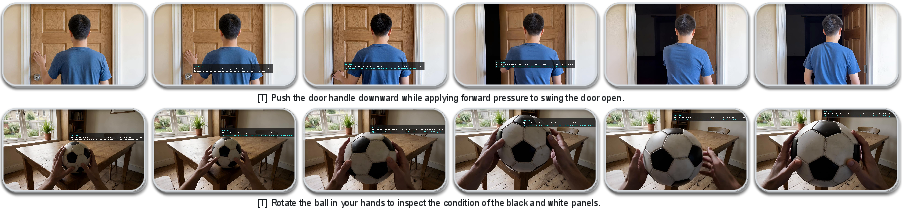
- Rapidly test interaction concepts in live, responsive virtual worlds with controllable navigation and object-centric interactions tracked by SAM.
- Tools/workflows: Instrumented sessions with event cards; A/B tests on interaction sequences; mixed methods (logs + think-aloud studies).
- Dependencies/assumptions: Requires measurement hooks; scene persistence limitations across very long runs.
- Synthetic video data generation for computer vision (Academia, Software/AI)
- Generate diverse action-conditioned videos with chunk-wise captions for tasks like action recognition, temporal grounding, or egocentric perception.
- Tools/workflows: Use the multi-granularity annotation pipeline; schedule scene evolutions via prompt tracks; export clip-level metadata.
- Dependencies/assumptions: Potential domain gap to real data; imperfect physics; need for dataset governance and deduplication.
- Embodied AI/RL evaluation in open-ended settings (Academia, AI)
- Use the agentic harness to study planning, causal reasoning, and long-horizon stability without building a bespoke simulator.
- Tools/workflows: Benchmarks for long-horizon behavior; scripted Director prompts to define tasks; Pilot-controlled action loops.
- Dependencies/assumptions: No true long-term memory; regenerated regions on revisit; physics inaccuracies for control-heavy tasks.
- AR/VR experiences for relaxation and creative exploration (Consumer, Wellness)
- Personal virtual spaces, guided meditation with dynamic weather/time-of-day changes, or interactive sightseeing with prompt-driven transitions.
- Tools/workflows: Low-latency streaming to HMDs; curated event libraries; session recording for creators.
- Dependencies/assumptions: Motion comfort and latency constraints; platform integration; content guardrails.
- Virtual events and social spaces (Media, Consumer)
- Multi-user interactive sessions for live shows, collaborative storytelling, or community meetups with VLM-proposed scene events.
- Tools/workflows: Session orchestration; role-based event hotkeys; shared playback and event timelines.
- Dependencies/assumptions: Moderation and safety; network QoS for synchronized experience.
- Creative ideation tools for marketers and designers (Advertising, Design)
- Rapid storyboard generation and scenario exploration for campaigns; variant testing with controlled environment shifts and action sequences.
- Tools/workflows: Generative “idea boards” from hour-long runs; marketer-friendly UI for prompt scheduling; export to editing suites.
- Dependencies/assumptions: Brand safety and IP policy compliance; consistency limits for strict brand guidelines.
- Applied inference engineering (Software/ML Infra)
- Adopt the few-step distillation recipe (Consistency + DMD) and dynamic KV cache scheduling to speed up other video/transformer workloads.
- Tools/workflows: Integrate dynamic cache into inference servers; pipeline latent generation and VAE decoding asynchronously.
- Dependencies/assumptions: Engineering effort for integration; hardware-dependent performance gains.
- Clinical exposure scenarios in controlled VR (Healthcare, with clinician oversight)
- Qualitative exposure for phobias (e.g., heights, storms) where visual control is more important than exact physics.
- Tools/workflows: Therapist-configured scene events; session logs for outcomes tracking; moderated content flows.
- Dependencies/assumptions: Clinical approval; safety protocols; individual patient variability; no clinical claims without trials.
- Research platform for long-horizon generative modeling (Academia)
- Open baseline to investigate anti-drift training, causal masking (MoBA), and mixed attention strategies for video.
- Tools/workflows: Reproducible scripts; ablation hooks; long-horizon stress tests.
- Dependencies/assumptions: Compute access; reproducibility of pretraining data filters.
Long-Term Applications
These opportunities likely require advances in long-term memory, physics fidelity, geometry/identity consistency, safety tooling, or efficiency for edge devices.
- Fully generative, persistent open-world games (Gaming)
- Worlds with consistent identities and evolving narratives; NPCs directed by the “Director” agent; physics back-ends for collisions and constraints.
- Potential products: “Generative MMO” with player co-creation; runtime authoring tools for live ops.
- Dependencies/assumptions: Compact long-term memory; reliable geometry and character persistence; scalable moderation and provenance.
- Digital twins for AEC and urban planning (Architecture/Engineering/Construction, Public Policy)
- Rapid scenario visualization (lighting, weather, crowd flows) for stakeholder engagement and public consultations.
- Potential workflows: Import coarse GIS/scan data; Director-driven environment changes; participatory sessions.
- Dependencies/assumptions: Integration with geometry-accurate models; validated physical and human-behavior dynamics; compliance and procurement.
- Robotics/control training in simulation (Robotics, AV)
- Closed-loop training for navigation, manipulation, and multi-agent coordination with long-horizon tasks.
- Potential tools: Coupling to a physics engine and sensor simulators; programmatic task curricula via Director prompts.
- Dependencies/assumptions: High-fidelity physics and collision models; accurate sensor models; sim-to-real validation.
- Emergency response and disaster drills (Public Safety, Policy)
- Multi-agent, long-horizon simulations for evacuations or extreme weather response with dynamic, context-aware events.
- Potential workflows: Scenario libraries; after-action replay; integration with command-and-control training.
- Dependencies/assumptions: Validated crowd/structural physics; measurement frameworks; regulatory acceptance.
- Clinical VR training and rehabilitation (Healthcare)
- Physical therapy and surgical training with precise kinematics, haptics, and patient-specific models.
- Potential products: Procedural rehearsal environments; adaptive rehab tasks.
- Dependencies/assumptions: Medical-grade fidelity and validation; device integration; regulatory approval.
- Autonomous driving and traffic scenario generation (Mobility)
- Long-horizon, interactive traffic scenes with rare edge cases for training and evaluation.
- Potential workflows: Scenario scripting via Director; performance measurement against defined metrics.
- Dependencies/assumptions: Grounded vehicle dynamics, sensor realism, labeling; liability and audit trails.
- Enterprise training simulators (Energy, Manufacturing, Utilities)
- Operator training for control rooms and maintenance under varied conditions with programmable incidents.
- Potential products: “Generative procedure simulator” tied to SOPs; scenario authoring dashboards.
- Dependencies/assumptions: Coupling to physics/process models and SCADA data; safety and compliance validation.
- Personalized, embodied tutoring in persistent worlds (Education)
- Memory-aware tutors that track progress, adapt challenges, and create context-rich scenarios over months.
- Potential workflows: Student profiles; long-term world state; mixed assessment.
- Dependencies/assumptions: Long-term memory and identity consistency; pedagogy-aligned content; privacy safeguards.
- On-device AR assistants and ambient computing (Consumer Hardware, Software)
- Context-aware, low-power world generation for glasses/edge devices, augmenting reality with dynamic simulations.
- Potential products: “Ambient world overlays” for guidance or entertainment.
- Dependencies/assumptions: Major efficiency gains; model compression; robust latency control.
- Content authenticity and governance ecosystems (Policy, Media)
- Watermarking/provenance and usage policies for interactive synthetic video; detection tools and standards.
- Potential workflows: Built-in provenance tags; dashboards for compliance and audit; policy-aligned content filters.
- Dependencies/assumptions: Cross-industry standards; robust watermarking under transformations; legal frameworks.
Cross-cutting assumptions and dependencies
- Compute and latency: Real-time 720p/60fps typically needs a capable GPU; edge deployments require further optimization and compression.
- Safety and moderation: Open-ended generation demands guardrails (prompt filtering, toxicity filters, provenance).
- Physics and identity limitations: Current model lacks accurate collisions/geometry and long-term memory; revisit-induced “regeneration” can break persistence.
- Data and licensing: Use of web/synthetic/egocentric sources requires careful governance and rights management.
- Integration effort: Tooling (SDKs, APIs) will be needed to embed the Director-Pilot harness into existing engines and workflows.
Glossary
- Adaptive layer normalization (AdaLN): A conditioning mechanism that adapts layer normalization parameters using external signals to modulate a network. "utilize an adaptive layer normalization~(AdaLN) mechanism~\cite{xu2019understanding} to incorporate these control signals into the diffusion process without disrupting the pre-trained visual priors."
- Agentic harness: A scaffolding of cooperating agents around a core model to plan, act, and sustain interactive behavior. "we pioneer the integration of an agentic harness within the domain of world modeling"
- Autoregressive generation: Generating each new frame conditioned only on past frames and current inputs. "enabling autoregressive generation while preserving the fidelity of the base generator."
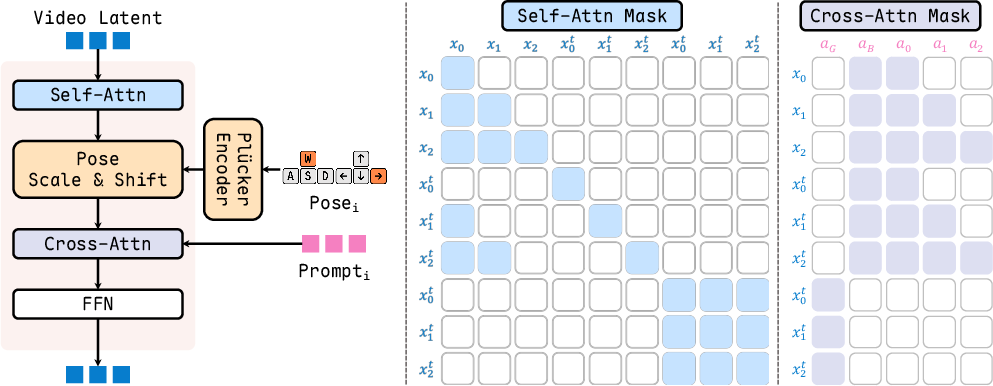
- Bidirectional component (attention): An attention module that attends across all tokens/frames in both temporal directions during training. "A bidirectional component with full attention (the bottom-right block of the mask) is then integrated, helping the model adapt to flexible-length video generation and promoting its transition from bidirectional to autoregressive generation."
- Causal cross-attention mask: A masking scheme to prevent future information from leaking into cross-attended conditioning. "We also design a causal cross-attention mask for leak-free conditioning and flexible interaction."
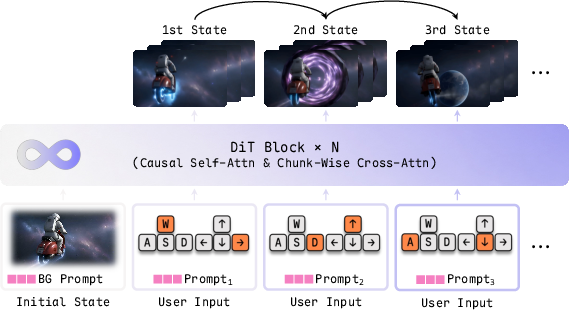
- Causal generative process: A formulation where each state is generated from earlier states and current inputs, never future ones. "We therefore cast world simulation as a causal generative process along the time axis."
- Causal video model: A video generator constrained to use only past context when predicting future frames. "An interactive world simulator is implemented as a causal video model."
- Consistency distillation: Distilling a multi-step diffusion teacher into a few-step student by enforcing trajectory consistency. "we combine consistency distillation~\cite{song2023consistency} to reduce the number of denoising steps"
- Consistency model: A student generator trained via consistency distillation to produce step-invariant predictions. "we distill the teacher into a consistency model~\cite{song2023consistency, lin2025apt2, zheng2026rcm, zhu2026causal} "
- Diffusion Transformer (DiT): A transformer architecture adapted to diffusion-based generative modeling. "The action comprises camera poses and chunk-wise prompts, injected into the DiT block to enable user interaction."
- Distribution Matching Distillation (DMD): Training a generator to match the data distribution by minimizing KL divergence between noised student and data distributions. "we employ distribution matching distillation (DMD)~\cite{yin2024dmd}, which optimizes the generator using the gradient of the KL divergence between the noised student distribution and the noised data distribution."
- Exponential moving average (EMA): A smoothed running average of parameters used for stabilization in training. "where is a distance metric and denotes an exponential moving average (EMA) of the student parameters ."
- Flow-matching objective: An objective that learns continuous-time velocity fields to transform noise into data. "We optimize {} with a conditional flow-matching objective."
- KL divergence: A measure of divergence between probability distributions used to guide training. "the gradient of the KL divergence between the noised student distribution and the noised data distribution."
- KV-cache: Cached key/value tensors in attention that store and reuse context for efficient long-sequence inference. "A key component of our real-time system is a dynamic KV-cache scheduling mechanism."
- Lower-triangular pattern (attention): A masking pattern that restricts attention to the current and previous positions to enforce causality. "in a lower-triangular pattern, preventing any future semantics from leaking in."
- Mixture of Bidirectional and Autoregressive (MoBA) attention mask: A hybrid mask combining teacher-forced autoregressive and bidirectional attention blocks. "we propose Mixture of Bidirectional and Autoregressive Attention Mask, a causal self-attention mask where a bidirectional component is appended to the teacher forcing~\cite{williams1989learning} mask"
- Plücker embeddings: A six-dimensional representation of 3D lines/rays used to encode per-pixel camera geometry. "we represent camera pose using {Pl\"ucker embeddings}~\cite{he2024cameractrl,he2025cameractrl}"
- Probability-flow ODE (PF-ODE): The deterministic ODE corresponding to diffusion model dynamics used for sampling and distillation. "latent states lying on the same teacher probability-flow ODE (PF-ODE) trajectory should map to identical predictions under ."
- Rectified-flow interpolation: A specific interpolation used in flow-matching that defines target velocities along straightened trajectories. "and the target velocity follows the rectified-flow interpolation."
- SAM (Segment Anything Model): A foundation segmentation model used here for tracking and object-centric interactions. "we integrate a SAM-based (Segment Anything Model) action-proposal loop"
- Self-rollout: Running the model on its own predictions (without teacher forcing) to assess or improve long-horizon stability. "we apply DMD over long self-rollout trajectories rather than only on teacher-forced states~\cite{huang2025self}."
- Spatio-temporal refiner: A post-processing module that enhances spatial detail and temporal smoothness of generated video. "we append a lightweight spatio-temporal refiner after remote VAE decoding."
- Teacher forcing mask: An attention mask where the model predicts the current state using clean past context during training. "With teacher forcing mask, the model predicts the current state from the clean context for autoregressive video generation."
- Teacher-forced states: Training states where ground-truth context is used instead of model-generated context. "rather than only on teacher-forced states~\cite{huang2025self}."
- Variational Autoencoder (VAE) decoding: Decoding latent representations back to pixel frames using a VAE decoder. "VAE decoding is performed on dedicated workers with parallelism."
- Vision-LLM (VLM): A model that jointly processes visual and textual inputs for reasoning and control. "a Vision-LLM (VLM) serves as the ``Director'' of the world"
Collections
Sign up for free to add this paper to one or more collections.