Recursive Self-Improvement through Multi-Agent Self-Supervision
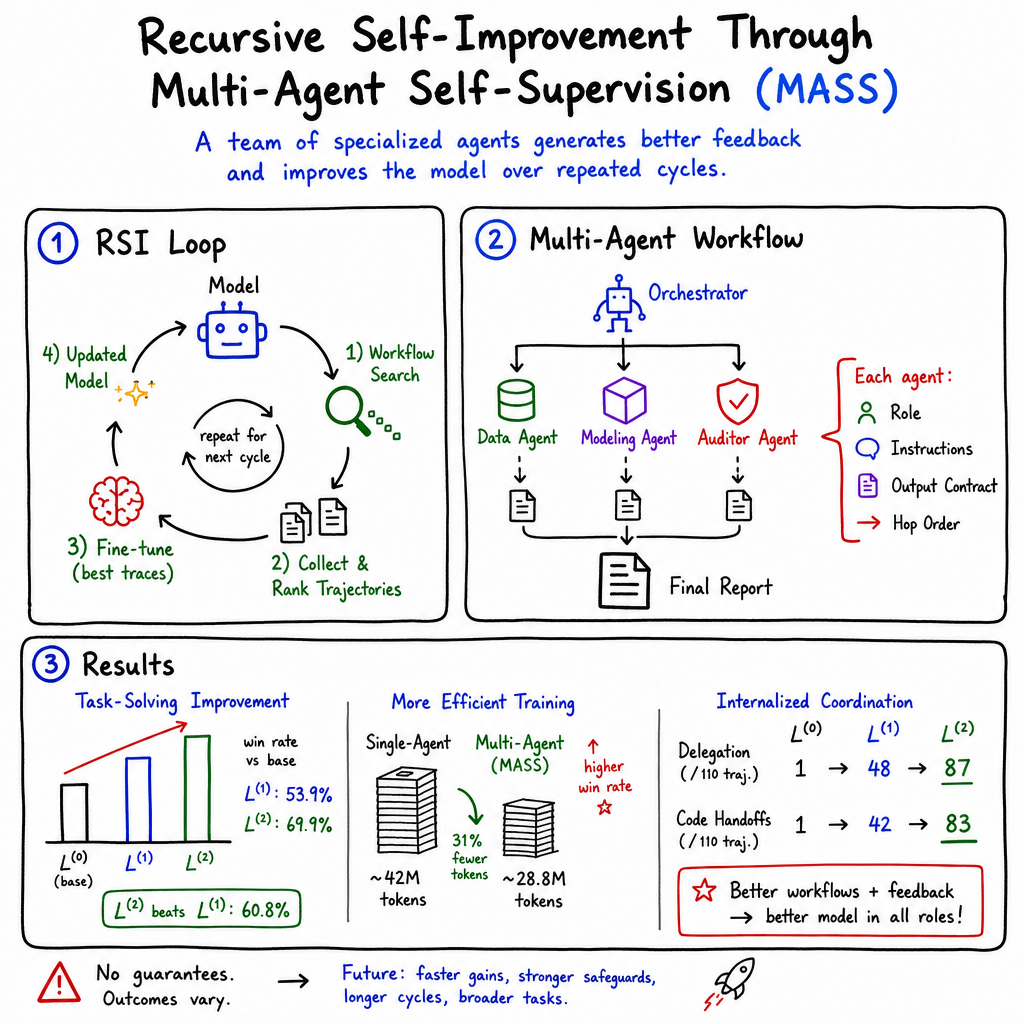
Abstract: Recursive self-improvement (RSI) of a model on non-verifiable tasks, such as open-ended research, faces a supervision bottleneck when its outputs exceed what even human experts can reliably assess, leaving the model itself (optimizee) as the best available optimizer and evaluator. However, a single model instance struggles to critique and improve its own complex reasoning under this homogeneous loop. To address this, we propose Multi-Agent Self-Supervision (MASS), an RSI method that alternates between evolutionary workflow optimization and supervised fine-tuning on self-generated trajectories. Guided by early findings that multi-agent topologies excel at complex reasoning, MASS prompts a single base model to iteratively propose, execute, and self-evaluate multi-agent workflows. Through an evolutionary search constrained by structural guardrails, the model optimizes these computational-graph-like orchestrations, discovering the most effective distinct roles and information routing for a given task. Over two MASS cycles with Qwen3.6-27B, the model achieves 1.2-1.6x higher performance per output tokens on four open-ended public benchmarks. Because the improved model subsequently acts as a better optimizer and evaluator, this alternating framework enables a continuous, recursive bootstrapping of the model's capabilities. Moreover, multi-agent traces are also more training-efficient: a student trained on them outperforms a single-agent student trained on 1.4x more training tokens. These findings suggest that jointly learning orchestration and bounded subagent execution from multi-agent trajectories can provide an effective signal for RSI.
Paper Prompts
Sign up for free to create and run prompts on this paper.
Top Community Prompts
Explain it Like I'm 14
1. What is this paper about?
This paper studies how an AI LLM might improve itself without needing humans to check every answer.
This idea is called recursive self-improvement (RSI). It means that an AI improves its methods, learns from its own work, and then uses the improved version to improve even more.
The researchers introduce a method called Multi-Agent Self-Supervision, or MASS. Instead of asking one AI to do everything alone, MASS makes several copies of the same AI act like a team. Each copy has a different job, such as:
- planning the work,
- carrying out a smaller task,
- checking the result, or
- suggesting a better plan.
The main idea is that an AI team may notice mistakes and solve difficult problems better than one AI working alone.
2. What questions did the researchers ask?
The paper focuses on several important questions:
- Can an AI improve its own problem-solving process? The researchers wanted to know whether an AI could design better “workflows,” or step-by-step plans, for solving complicated tasks.
- Can several copies of the same AI supervise one another? Since human experts may not always be available, the researchers tested whether AI copies could give useful feedback to each other.
- Does teamwork help the AI learn more efficiently? They compared training on multi-agent teamwork with training on long conversations from only one AI.
- What part of teamwork matters most? They studied whether success came from giving agents different jobs, deciding the order in which they work, or improving how they pass information to one another.
3. How did the researchers do the study?
The basic MASS cycle
The researchers used a LLM called Qwen3.6-27B. They ran the following cycle twice:
- Create a team plan. The AI designed a workflow describing which agents should work on which parts of a task.
- Run the team. Different copies of the model followed the workflow. For example, one might analyze data, another might write code, and another might check the results.
- Judge the result. Another copy of the model compared the new result with an earlier result and gave feedback.
- Improve the workflow. The AI used the feedback to create a better team plan.
- Train the model on the best examples. The researchers collected successful teamwork conversations and used them to fine-tune the model. Fine-tuning is like giving the AI extra practice so that it becomes more likely to repeat useful behaviors.
- Repeat the process. The newly trained model then became the planner, worker, and judge in the next cycle.
A simple analogy is a school science project. First, students try different ways of dividing the work. They keep the plan that produces the best project. Then everyone studies the best examples so the whole class becomes better at planning and working. Finally, they try again with their improved skills.
What tasks did they use?
The AI worked on research-style programming tasks in areas such as:
- finance,
- robotics, and
- pharmacy.
For example, it might be asked to test an investment strategy, compare protein-design methods, or build a robotics experiment.
The researchers also tested the models on public benchmarks, which are standardized exams for AI systems. These included tasks involving scientific research, data science, computer programming, and command-line tools.
To make the final comparison fair, the researchers used separate, stronger AI systems to judge the results. These outside judges were not part of the self-improvement process.
4. What did they find?
The improved model performed better
After two MASS cycles, the model did better on four research benchmarks. Its score per output token increased by about 1.2 to 1.6 times.
An output token is a small piece of text, such as part of a word. Measuring performance per token is similar to asking, “How much useful work does the AI do for each unit of effort?”
On three private test tasks, the results also improved:
- After one cycle, the new model beat the original model about 53.9% of the time.
- After two cycles, it beat the original model about 69.9% of the time.
These results suggest that the model was not merely producing longer answers. It was becoming more effective.
The AI became a better judge
The model also became better at judging other answers.
Its agreement with the outside judges increased from:
| Model version | Agreement with outside judges |
|---|---|
| Original model | 73% |
| After one MASS cycle | 91% |
| After two MASS cycles | 93% |
This is important because self-improvement depends on judging whether a new answer is actually better. If the judge is poor, the AI could accidentally reward bad work.
The AI found good workflows faster
The improved model discovered successful team plans more quickly than the original model.
The best workflows often improved the way information was passed between agents. For example, instead of simply telling an agent to “analyze the problem,” a workflow might require it to return:
- its main conclusion,
- the evidence supporting it,
- possible errors, and
- specific files or calculations that the next agent should inspect.
The order of communication also mattered. One agent might prepare data before another analyzes it, while a final agent checks everything at the end.
Multi-agent training used data efficiently
The researchers compared two kinds of training:
- training on long tasks completed by one AI, and
- training on multi-agent tasks where one AI planned and other AIs handled smaller jobs.
The multi-agent training worked better with fewer training tokens. One multi-agent student reached a 68.3% win rate against the original model, while a single-agent student reached 64.0% even after being trained on about 1.4 times more tokens.
This suggests that breaking a difficult task into smaller jobs may make learning easier.
The AI learned teamwork behaviors
After training, the model sometimes delegated work and shared code even when the special workflow instructions were removed.
For example, delegation increased from:
- 1 out of 110 trials for the original model,
- to 48 out of 110 after one cycle,
- and 87 out of 110 after two cycles.
This suggests that the model did not simply memorize one particular workflow. It learned a general habit of coordinating work.
There were still weaknesses
The method was not perfect. The AI sometimes made poor judgments or changed a workflow in a way that made it worse. The paper also found that the optimizer—the part responsible for inventing better workflows—could be a major bottleneck.
In other words, the AI could eventually find good plans, but it did not always find them quickly or reliably.
The researchers also tested several benchmarks where performance stayed flat or decreased slightly. This shows that improvement did not happen equally on every type of task.
5. Why is this research important?
The paper suggests that AI improvement may not require making one giant AI think harder by itself. Instead, it may be useful to organize several copies of an AI into a structured team.
This could help with difficult tasks such as:
- scientific research,
- programming,
- engineering,
- data analysis, and
- designing experiments.
The most important lesson is that how information is organized and shared may matter as much as the intelligence of each individual agent. A group can be more capable when each member has a clear role and passes useful information to the right teammate.
However, the results should be interpreted carefully. This is a preprint, meaning it has not necessarily gone through full peer review. The experiments were also limited in size and used only two improvement cycles. AI systems could still repeat mistakes if all of their copies share the same misunderstanding.
Overall, MASS is a promising approach to making AI systems better at solving complex problems. It shows that an AI might improve not only by learning better answers, but also by learning better ways for its own parts to work together.
Knowledge Gaps
Knowledge gaps, limitations, and open questions
- Limited scale of recursive improvement: The study evaluates only two MASS cycles, leaving unresolved whether gains persist, saturate, or reverse after many more cycles.
- Small and narrow training set: Post-training uses 119 trajectories from eight synthetic tasks across finance, robotics, and pharmacy, so it is unclear whether the method scales to larger, more diverse, and independently authored task distributions.
- Synthetic-task dependence: Most training tasks are generated by GPT-5.5, and three held-out synthetic tasks are used for in-domain testing; performance on naturally occurring research problems, expert-designed tasks, and real laboratory workflows remains uncertain.
- Weak evidence for broad domain generalization: Improvements are reported on selected research and coding benchmarks, but the paper does not establish transfer to domains such as mathematics, law, writing, multimodal science, physical experimentation, or tasks requiring substantial human interaction.
- Unclear causal source of the gains: The experiments do not fully disentangle the effects of multi-agent decomposition, additional inference-time computation, longer trajectories, improved prompting, supervised fine-tuning, workflow search, and exposure to more task-specific data.
- Incomplete compute and cost accounting: “Performance per output token” does not capture total inference cost, workflow-search cost, subagent calls, wall-clock time, tool execution, training compute, or memory usage. MASS may therefore be less efficient under end-to-end resource accounting.
- Insufficient comparison with stronger baselines: The study does not comprehensively compare MASS with independently designed workflow optimizers, reinforcement learning, preference optimization, self-consistency, debate, reflection, retrieval-augmented systems, or multi-agent methods using distinct models.
- No systematic comparison of agent heterogeneity: All agents share the same model and weights. It remains unknown whether heterogeneous models, specialized subagents, independently sampled checkpoints, or models with different training objectives reduce correlated errors more effectively.
- Potential benchmark contamination and overlap: The paper does not provide a detailed contamination analysis for Qwen3.6-27B, the synthetic task generator, the public benchmarks, or the external judging models. Improvements may partly reflect memorization or training-distribution overlap.
- Reliance on language-model judges: External evaluation uses GPT-5.5 and Claude Opus 4.8, which may share biases with the systems being evaluated and may be unreliable for technical correctness, reproducibility, or scientific validity.
- Insufficient human and objective validation: The results lack systematic expert review, executable verification, replication of reported experiments, and domain-specific ground-truth assessment for the generated research artifacts.
- Uncertainty in judge reliability: Six external judgments per pair are reported, but inter-judge agreement, calibration, sensitivity to prompt wording, position bias, and robustness to alternative judging protocols are not fully characterized.
- Possible evaluator overfitting: MASS selects workflows and training trajectories using the same model family’s self-evaluations, while final evaluation uses a small set of external judges. The extent to which workflow search overfits self-evaluation criteria is unresolved.
- Self-evaluation accuracy is narrowly defined: Evaluator accuracy rises from 73% to 93%, but the paper does not clarify the task distribution, class balance, confidence calibration, error types, or whether accuracy remains high on adversarial, novel, or high-stakes outputs.
- No protection against recursive error amplification: The method assumes that improved evaluators and optimizers will continue to produce better supervision, but there is no formal or empirical analysis of failure cascades, reward hacking, systematic hallucinations, or convergence toward shared false beliefs.
- Unclear global optimization behavior: The elite-size-one evolutionary search may discard workflows that are temporarily worse but ultimately superior. The paper does not evaluate population-based search, diversity preservation, rollback strategies, or exploration–exploitation trade-offs.
- Workflow instability remains unresolved: The paper observes sharp performance regressions between workflow iterations, but does not develop mechanisms for detecting, preventing, or recovering from such regressions.
- Limited workflow search space: Workflows are textual orchestrator–subagent specifications with constrained sequential routing. The study does not test dynamic graphs, parallel execution, loops, conditional branching, persistent memory, tool-specific routing, or learned communication protocols.
- Unclear role of structural guardrails: The contribution of the stated structural constraints is not isolated. It remains unknown whether guardrails improve reliability, reduce search diversity, or prevent discovery of more effective workflow architectures.
- Task-specific workflow overfitting: A separate workflow is optimized for each training task. The study does not determine whether MASS can learn reusable workflows that transfer across tasks without task-specific search.
- Ambiguous interpretation of information-flow analyses: Mutual information and total-correlation estimates rely on two text-embedding models and small workflow collections. Their sensitivity to embedding choice, estimator bias, sample size, and representation design is not established.
- Correlation between workflow structure and performance is not causal: The observed increase in task-specific contracts and hops does not show that these components cause the performance improvements. Controlled interventions on routing and output contracts are needed.
- Limited analysis of internalized behaviors: Increased delegation and code handoffs are treated as evidence of workflow internalization, but the study does not establish whether these behaviors improve correctness, merely increase coordination activity, or introduce unnecessary overhead.
- Potential data-selection bias: Tasks for which workflow search fails are excluded from teacher-data collection. This may make the training data disproportionately favorable and obscures performance on tasks where MASS cannot discover a successful workflow.
- Validation leakage in student comparisons: Some ablation checkpoints are selected using external strong-model judgments, unlike the main MASS procedure. This creates differences in model-selection supervision that complicate comparisons among training datasets.
- Insufficient statistical power: Results are based on three trials for several benchmark measurements, a small number of synthetic test tasks, and pairwise win rates. Confidence intervals, statistical tests, and robustness across random seeds are limited.
- Unclear variance across tasks and domains: Aggregate improvements may conceal substantial task-level failures or domain-specific regressions. More detailed per-task distributions and worst-case performance are needed.
- Negative transfer is underexplored: MASS reduces performance on Terminal-Bench 2.0 and SWE-bench Verified across generations, but the causes, persistence, and mitigation of these regressions are not investigated.
- No long-term capability-retention analysis: The paper does not assess whether recursive fine-tuning causes forgetting of general capabilities, tool use, coding skills, factual knowledge, or safety behaviors outside the target tasks.
- Limited model and adaptation diversity: Results use one 27B model, one coding-agent harness, one LoRA configuration, and one base-model family. Applicability to smaller, larger, dense, mixture-of-experts, or fully fine-tuned models remains unknown.
- Dependence on a fixed harness: Because the coding-agent environment and tools remain fixed, it is unclear whether MASS can improve or adapt the execution environment itself, or whether its gains depend on specific qwen-code behavior.
- No analysis of inference-time reliability: The study reports average benchmark outcomes but does not examine failure recovery, reproducibility across repeated executions, sensitivity to tool errors, or robustness to incomplete or noisy tool outputs.
- Open-ended research quality is incompletely measured: Benchmark scores and pairwise preferences do not establish whether generated reports are scientifically novel, factually correct, reproducible, ethically appropriate, or useful to human researchers.
- Safety and misuse risks are not assessed: The paper does not examine whether recursive workflow optimization increases the ability to conduct harmful research, exploit tools, manipulate evaluators, or autonomously pursue unsafe objectives.
- No formal guarantees of improvement: MASS provides no monotonicity, convergence, safety, or correctness guarantees; the conditions under which recursive self-improvement is expected to improve rather than degrade performance remain unspecified.
- Scalability of search is unresolved: Workflow optimization is performed independently for training tasks and requires repeated executions and evaluations. The computational and operational cost of scaling to thousands of tasks or continuous deployment is not established.
- Unclear optimal composition of training data: The study fixes a 2:1 subagent-to-orchestrator sampling ratio, but does not determine how this ratio, trajectory ranking method, windowing strategy, or inclusion of lower-ranked examples affects learning.
- Benefits of bounded subagent execution are not isolated: The claim that bounded local trajectories provide denser supervision is plausible but not directly tested against controls matched for task decomposition, context length, number of prediction targets, and semantic content.
- No investigation of human-in-the-loop supervision: The paper focuses on homogeneous self-supervision and external evaluation, leaving open whether sparse expert feedback, verifier-generated signals, or human corrections can be combined with MASS to improve reliability and efficiency.
Practical Applications
Immediate Applications
- Research and engineering copilots for long-horizon technical work — scientific computing, software engineering, data science
- Deploy MASS-style workflows in existing coding-agent systems to divide a complex assignment among specialized roles such as planner, data analyst, implementer, verifier, and report writer.
- A practical workflow could have one agent inspect datasets, another implement the experiment, a third reproduce the results, and an orchestrator integrate the outputs into executable code and a research report.
- This is supported by the reported gains on ScienceAgentBench, MLR-Bench, DSBench, and AstaBench, where the second MASS generation achieved approximately
1.2–1.6×higher score per output token than the base model. - Dependencies: access to a reliable coding sandbox, version control, tool-use permissions, task-specific evaluation criteria, and safeguards against self-evaluation errors.
- Automated software maintenance and debugging — software industry
- Integrate multi-agent handoffs into issue-resolution systems for repositories: one agent reproduces a bug, another identifies the likely cause, another proposes a patch, and a final agent runs tests and reviews the change.
- The paper’s evidence that post-training increases delegation and code handoffs suggests a route to agents that spontaneously organize software work rather than producing one undifferentiated trajectory.
- Potential products include repository bots that generate patches, tests, documentation, and pull-request summaries as separate but coordinated outputs.
- Dependencies: comprehensive automated tests, sandboxed execution, code-review gates, protection against unauthorized repository changes, and external validation because performance on SWE-bench did not improve in the reported experiments.
- Task-specific agent workflow optimization — enterprise AI platforms
- Use the workflow-search component to automatically generate and compare textual agent specifications containing roles, call order, output contracts, and information-routing rules.
- Organizations could maintain a workflow registry for recurring tasks such as customer-support escalation, compliance review, procurement analysis, or incident response.
- The most actionable design insight is to optimize what agents communicate and when, rather than merely increasing the number of agents. Output contracts can require structured artifacts such as JSON, test results, citations, confidence estimates, or unresolved issues.
- Dependencies: a sufficiently informative evaluation signal, regression testing across representative tasks, and retention of multiple candidate workflows because the paper observes performance regressions during search.
- More token-efficient model post-training — model developers and academic labs
- Generate multi-agent trajectories and use them as supervised fine-tuning data, jointly training orchestrator behavior and bounded subagent execution.
- This can reduce the amount of training data required: in the reported ablation, a multi-agent student reached a
68.3%win rate while using roughly31.4%fewer processed supervised tokens than a larger single-agent baseline. - A practical workflow is to select high-quality trajectories using pairwise model judgments, remove workflow prompts from the training examples, and fine-tune the model to internalize delegation and handoff behavior.
- Dependencies: adequate compute, careful trajectory filtering, avoidance of evaluator bias, and confirmation that gains transfer beyond the synthetic finance, pharmacy, and robotics tasks used for training.
- Research-assistant pipelines with structured verification — academia
- Universities and research groups can use MASS-like systems to produce reproducible computational studies: literature or data preparation, method implementation, statistical analysis, independent verification, and report generation can be assigned to separate agents.
- The system can require each subagent to return a bounded artifact, such as a cleaned dataset, executable script, benchmark table, or methodological critique, allowing human researchers to inspect intermediate work.
- This is particularly suitable for computational biology, machine learning experimentation, quantitative social science, and simulation-based research.
- Dependencies: authoritative datasets, domain-specific checks, human review for scientific validity, and provenance tracking. The paper does not establish that self-generated research conclusions are scientifically correct without external verification.
- Quantitative finance research assistance — finance
- Implement a workflow in which agents independently perform market-data acquisition, signal construction, backtesting, transaction-cost modeling, capacity estimation, and robustness analysis.
- The paper’s finance task illustrates how communication contracts can force agents to pass backtest results, assumptions, and failure cases to an integrating orchestrator.
- A near-term product could be an analyst copilot that produces candidate strategies and audit-ready backtest reports, rather than automatically executing trades.
- Dependencies: licensed and accurate market data, leakage-resistant backtesting, realistic execution-cost models, regulatory compliance, and mandatory human approval. The findings do not justify autonomous investment decisions.
- Robotics simulation and tool-use benchmarking — robotics and education
- Use separate agents for task decomposition, symbolic planning, behavior-cloning implementation, simulator execution, and failure-mode analysis.
- MASS can help generate reproducible PyBullet or RoboTAP experiments and compare planning approaches under standardized metrics such as success rate, tool selection, and recovery behavior.
- This can support robotics laboratories, benchmark construction, and classroom projects without immediately placing the system in control of physical hardware.
- Dependencies: accurate simulators, well-defined task contracts, hardware-independent evaluation, and transfer testing before deployment on robots.
- Internal evaluation and quality-assurance systems — AI governance and MLOps
- Use an improved model as a first-pass evaluator for generated code, analyses, or workflows, while withholding an external evaluator or human review for periodic calibration.
- The paper reports evaluator agreement increasing from
73%to93%relative to external strong-model judgments after two cycles, suggesting utility for triage and regression detection. - Possible tools include dashboards that compare workflow versions, record pairwise judgments, detect regressions, and identify tasks where the evaluator is uncertain.
- Dependencies: independent test sets, calibration against humans or stronger external models, explicit uncertainty handling, and protection against correlated model failures.
- Personal productivity and complex planning assistants — daily life
- Apply the method to multi-step personal tasks such as trip planning, household budgeting, study planning, or comparing major purchases.
- For example, separate agents could gather options, check constraints, estimate costs, identify risks, and summarize a recommendation for user approval.
- The practical benefit is improved organization and cross-checking rather than unrestricted autonomy.
- Dependencies: current and trustworthy external information, privacy-preserving data access, user confirmation before consequential actions, and clear disclosure that multiple agents may share the same underlying biases.
- Curriculum and experimentation framework for AI education — education
- Use MASS as a teaching framework for agent decomposition, prompt contracts, evaluation design, imitation learning, and software reproducibility.
- Students could compare single-agent and multi-agent solutions to the same research task, measure token efficiency, and analyze where information handoffs improve or fail.
- Dependencies: accessible compute, transparent logs, reproducible assignments, and instruction on the limitations of model-based evaluation.
Long-Term Applications
- Recursive improvement of domain-specific scientific agents — healthcare, pharmacy, materials science, and energy
- A mature MASS system could iteratively improve agents that design experiments, analyze results, propose follow-up studies, and update their own workflows.
- In pharmacy, for example, one agent could select protein structures, another run inverse-folding analyses, another compare sequence-quality metrics, and a verifier check reproducibility and statistical validity.
- Similar workflows could support materials discovery, battery optimization, drug screening, and fusion-control research, where experimental or simulation cycles are expensive.
- Dependencies: trusted scientific verifiers, laboratory or simulator feedback, safety and regulatory review, high-quality domain data, and mechanisms that prevent plausible but incorrect self-generated conclusions.
- Autonomous laboratory and engineering optimization loops — life sciences, robotics, and energy
- MASS could eventually coordinate a closed loop linking hypothesis generation, experimental design, robotic execution, measurement analysis, and workflow revision.
- The model’s role would extend from optimizing textual coordination to selecting experiments or simulations that improve the next cycle.
- Potential systems include self-optimizing materials laboratories, biological assay platforms, robotic manipulation testbeds, and energy-system simulators.
- Dependencies: reliable laboratory automation, safe action constraints, physical-world observability, robust error recovery, and independent experimental confirmation. The current paper only demonstrates language-model workflow optimization in coding environments.
- Model–workflow co-evolution at production scale — AI infrastructure
- Future systems could jointly optimize model weights, agent topology, tool interfaces, memory policies, and evaluation harnesses instead of optimizing only textual workflows.
- This could produce compact models that have internalized common delegation patterns and therefore achieve multi-agent-like behavior with less inference-time orchestration.
- Possible infrastructure includes a workflow compiler that searches over graphs, contracts, routing policies, and model assignments, then distills successful graphs into specialized models.
- Dependencies: stable training objectives, large and diverse task distributions, rollback mechanisms, compute-efficient search, and safeguards against optimization toward evaluator-specific artifacts.
- Independent or heterogeneous evaluator ensembles — safety-critical AI
- The homogeneous MASS loop could be extended with evaluators that differ in model family, training data, tools, or verification method.
- In healthcare, finance, legal analysis, and infrastructure control, one agent could generate a proposal while independent evaluators check evidence, constraints, and worst-case risks.
- This would address the paper’s central concern that a single shared model can reinforce its own errors.
- Dependencies: genuinely independent evaluators, transparent disagreement handling, formal or executable verifiers where possible, and governance rules preventing the system from selecting only favorable judges.
- Autonomous software organizations — software and enterprise operations
- Long term, a persistent agent organization could manage project planning, implementation, testing, security review, deployment, monitoring, and incident response.
- Workflow optimization could adapt the organization’s topology to the repository, programming language, risk level, and release process.
- The model might learn to decide when to delegate, when to request clarification, and when to halt because evidence is insufficient.
- Dependencies: reliable long-term memory, identity and access controls, audit trails, reversible deployment, security isolation, and strong guarantees against cascading automated errors.
- Policy analysis and public-sector decision support — government and regulation
- Agencies could use coordinated agents to gather evidence, model policy scenarios, check legal constraints, estimate distributional effects, and identify disagreements among assumptions.
- A workflow could require separate agents to argue for and against a proposal, reproduce quantitative estimates, and produce a traceable evidence map for human policymakers.
- MASS’s emphasis on explicit information contracts could help make complex policy analyses more inspectable.
- Dependencies: representative and current data, legally valid sources, protection against political or demographic bias, human accountability, and independent review. The system should remain advisory rather than making binding policy decisions.
- Personal autonomous agents with learned coordination — daily life
- Future assistants could coordinate calendars, finances, health-related routines, travel, communications, and household devices through specialized internal roles.
- The assistant could learn recurring user-specific workflows, such as checking dietary constraints, comparing prices, scheduling appointments, and requesting confirmation before purchases.
- Dependencies: strong privacy controls, secure tool access, reliable identity verification, user-overridable policies, continuous monitoring, and limits on actions affecting health, money, or safety.
- Formalized self-improvement benchmarks and governance standards — academia and policy
- The paper motivates benchmarks that separately measure task solving, workflow optimization, evaluator accuracy, token efficiency, regression frequency, and transfer to unseen domains.
- Future standards could require independent external evaluation, workflow versioning, adversarial tests, and reporting of failures rather than only aggregate win rates.
- Such benchmarks would help distinguish genuine capability improvement from optimization against a self-generated or correlated evaluator.
- Dependencies: broad task coverage, reproducible harnesses, independent judging organizations, access to hidden test sets, and agreed definitions of meaningful improvement.
- Safe recursive capability improvement — AI safety research
- A long-term application is a controlled RSI platform that can improve problem-solving workflows while restricting changes to model weights, tools, permissions, and deployment environments.
- Candidate improvements could be accepted only when they pass external tests, safety evaluations, reproducibility checks, and rollback criteria.
- This would turn the paper’s experimental loop into a monitored development process rather than an unconstrained self-modifying system.
- Dependencies: trustworthy external evaluators, interpretability and auditing tools, secure compute environments, immutable evaluation suites, human authorization, and formal policies governing which aspects of the system may change.
Glossary
- AdamW: An optimizer that combines Adam with decoupled weight decay for training neural networks. “Optimization uses AdamW (Loshchilov & Hutter, 2017)”
- Agent scaffold: The fixed software and prompting framework in which an AI agent operates. “all run in the same agent scaffold (qwen-code)”
- Artifacts: Outputs or intermediate products generated during an agent’s execution. “where τt is a single (orchestrator-subagent) trajectory, and yt is the resulting deliverable workspace”
- Backtest: An evaluation of a trading strategy using historical market data. “The finance task asks the agent to backtest an equity long–short strategy”
- Bradley–Terry model: A probabilistic model that converts pairwise preferences into ranked scores. “A Bradley–Terry model converts these pairwise judgments into workspace-level scores.”
- Bounded execution: Completion of a limited, localized task rather than an entire long-horizon objective. “subagent trajectories demonstrate bounded local execution”
- Code handoff: The transfer of a code artifact from one subagent to another for further use or modification. “A code hand-off (H) occurs when a subagent successfully reads a Python file whose latest recorded writer is a different subagent”
- Computational graph: A representation of computation as interconnected operations or components. “the model optimizes these computational-graph-like orchestrations”
- Cosine decay: A learning-rate schedule that decreases the rate according to a cosine-shaped curve. “cosine decay to 10% of the peak learning rate”
- Distillation: Training a model to reproduce or internalize behavior generated by another model or system. “distilling their collective gains as self-supervision”
- Embedding: A numerical vector representation of text or another object that captures semantic properties. “component embeddings (Zc) and task-description embeddings (T)”
- Elite size one: An evolutionary-search strategy that retains only the single best candidate for producing subsequent candidates. “This resembles an evolution process with an elite size one”
- Evaluator agreement: The degree to which an evaluator’s judgments coincide with those of a reference evaluator. “The agreement increases from 0.73 for L(0) to 0.91 for L(1) and 0.93 for L(2).”
- Evolutionary search: An optimization method that iteratively generates and selects candidate solutions according to their performance. “Through an evolutionary search constrained by structural guardrails”
- External strong-model judgment: An evaluation supplied by a powerful model that is kept separate from the system being trained. “Final performance is assessed separately using external strong model judgments withheld from the agents and workflow optimizer”
- Fine-tuning: Further training of a pretrained model on a specialized dataset or behavior. “The outer loop fine-tunes the shared LM on rollouts from the optimized workflow”
- Generative trajectory: A sequence of model actions, messages, and tool interactions produced while solving a task. “The 119 teacher trajectories yield 2,435 training windows”
- Homogeneous loop: A self-improvement process in which the same model performs multiple roles, such as solving, evaluating, and optimizing. “a single model instance struggles to critique and improve its own complex reasoning under this homogeneous loop”
- Information flow: The movement and organization of information among computational agents or workflow components. “Our first hypothesis is that optimizing how agents exchange information can provide useful self-supervision for RSI.”
- Information handoff: The deliberate transfer of task-relevant information or artifacts between agents. “post-training internalizes information-handoff behaviors”
- Inverse folding: The computational design of a protein sequence intended to produce a specified three-dimensional structure. “Pharmacy task evaluates inverse-folding models on Protein Data Bank backbones”
- Long-horizon task: A task requiring many dependent steps, actions, or intermediate decisions to complete. “12 synthetic research-programming (long-horizon) tasks”
- LoRA: A parameter-efficient fine-tuning method that learns low-rank updates to a pretrained model’s weights. “with a newly initialized LoRA adapter”
- Masked context: Context supplied to a model but excluded from the training loss. “with preceding context optionally retained but masked from the loss”
- Mutual information: A quantity measuring the statistical dependence between two variables. “We estimate this using mutual information bIi between component embeddings (Zc) and task-description embeddings (T ).”
- Multi-Agent Self-Supervision (MASS): The paper’s recursive method that combines multi-agent workflow optimization with supervised fine-tuning on generated trajectories. “To address this, we propose Multi-Agent Self-Supervision (MASS), an RSI method”
- Orchestrator: An agent that assigns tasks to subagents, coordinates their interactions, and integrates their outputs. “the workflow defines a textual specification of an orchestrator–subagent architecture”
- Output contract: A specification of the information a subagent must return to the orchestrator. “The contract specifies what information the subagent returns to the orchestrator”
- Pairwise tournament: A ranking procedure that compares candidates against one another in pairs. “where j1̸ = j2 ∈ [M ], in a pairwise tournament”
- Permutation adjustment: A statistical procedure that uses randomized rearrangements to assess or correct the significance of an estimate. “report both unadjusted and permutation-adjusted estimates”
- Post-training: Training performed after pretraining to specialize or improve a model’s behavior. “MASS’s inner loop refines workflows through an iterative feedback process”
- Recursive self-improvement (RSI): A process in which an AI system uses the results of one improvement cycle to produce further improvement cycles. “Recursive self-improvement (RSI) of a model on non-verifiable tasks”
- Self-supervision: Training supervision generated from the model’s own outputs or processes rather than from external human labels. “These findings suggest that jointly learning orchestration and bounded subagent execution from multi-agent trajectories can provide an effective signal for RSI.”
- Subagent: An agent assigned a limited task within a larger multi-agent workflow. “the orchestrator delegates work, exchanges information, and invokes subagents”
- Supervised fine-tuning (SFT): Training a model to predict target outputs from labeled or selected examples. “We next internalize the behavior induced by the workflows w∗t obtained from Algorithm 2 through supervised fine-tuning (SFT).”
- Task decomposition: The division of a complex task into smaller subtasks. “Manually revising task decompositions, tool use, and verification steps to optimize these workflows”
- Total correlation: A multivariate information-theoretic measure of the dependence or redundancy among several variables. “We estimate this using total correlation dT C among all four components.”
- Trajectory–workspace pair: A paired representation containing an agent’s execution sequence and the resulting output workspace. “yielding candidate trajectory–workspace pairs”
- Workflow internalization: The process of incorporating workflow behavior into a model’s learned parameters through training. “Workflow internalization by supervised fine-tuning”
- Workflow optimization: The iterative improvement of an agent organization, including its roles, instructions, call order, and communication structure. “MASS alternates between multi-agent workflow optimization and model fine-tuning”
- Workflow topology: The arrangement and connectivity of agents and information pathways in a multi-agent system. “multi-agent topologies excel at complex reasoning”
- Zero-shot coordination: Effective coordination among agents without providing an explicit workflow at inference time. “These behaviors emerge without providing the optimized workflow at inference time.”

