NeoHorse-1: Towards Recursive Self-Improvement via Agentic Post-Training with Routing Harness
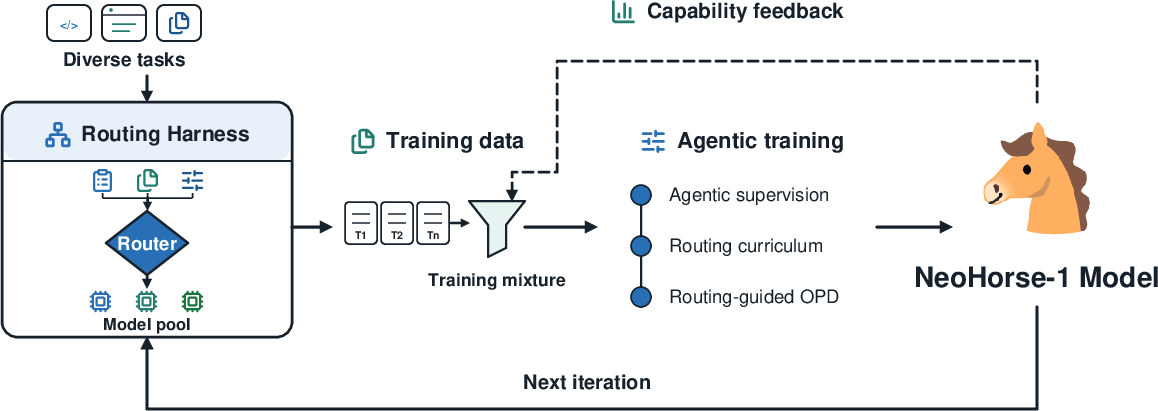
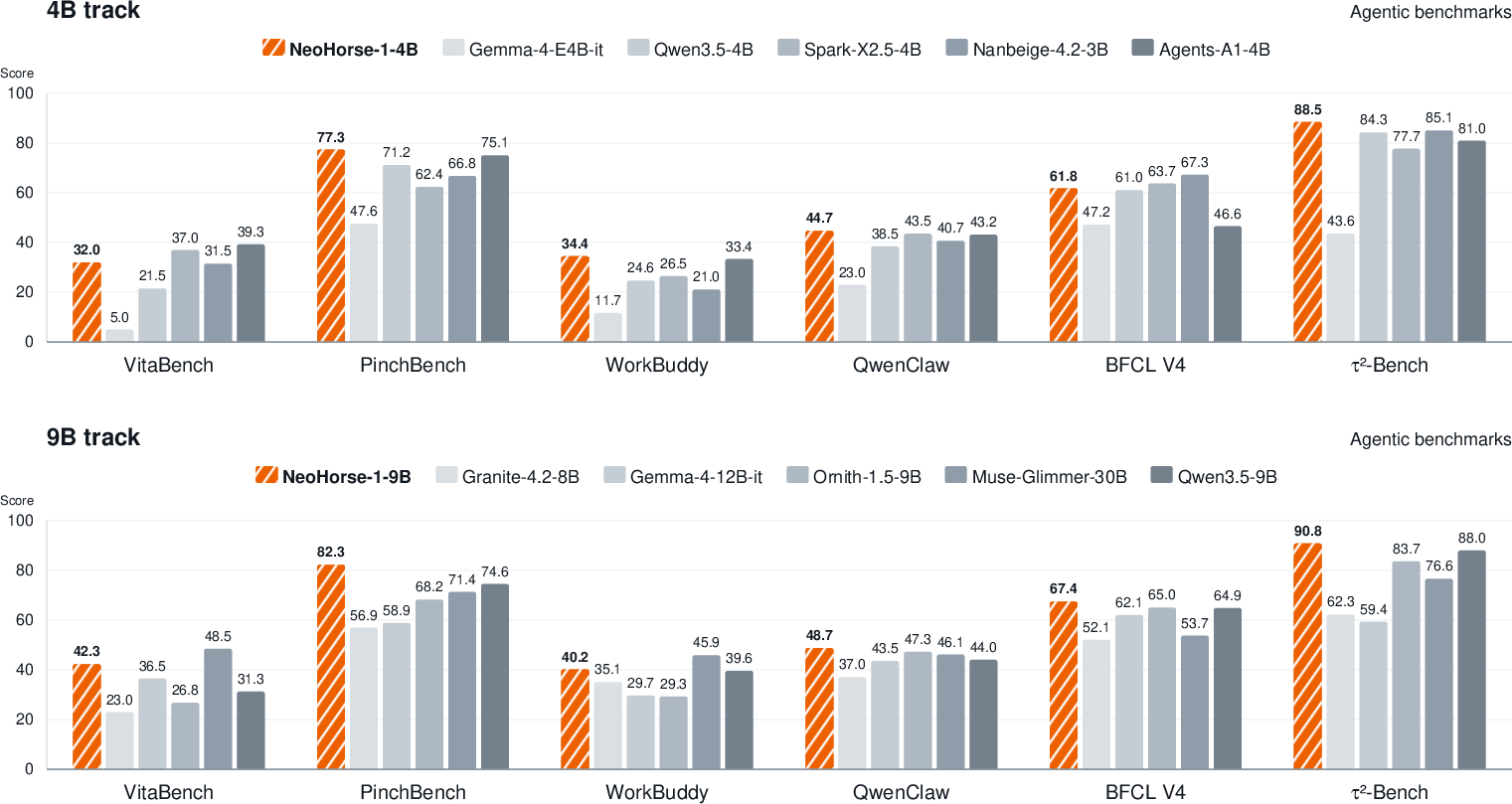
Abstract: Recursive self-improvement (RSI) requires a concrete mechanism through which an AI system observes its capabilities and converts that evidence into the next round of learning. We present NeoHorse-1, a family of agent-native models developed to explore this path through agentic post-training. Our system combines a heterogeneous model pool with intelligent routing, recording the predicted capability demand, selected service tier, and subsequent interaction for each user turn. These records are converted into training examples that preserve interleaved reasoning, tool calls, and harness context, and are admitted through structural validation, six-dimensional semantic evaluation, and subscene-level labeling. Routing signals organize supervised fine-tuning into a three-stage curriculum and extend to routing-guided on-policy distillation, where a teacher supervises student-generated responses under the same progression. Capability-guided allocation then converts evaluation feedback into the next training mixture, closing an evaluation-selection-update loop in which what the system learns to do shapes what it learns from next. Across eleven benchmarks covering harness-based agents, tool use, coding, and instruction following, post-training raises the macro-average from 58.94 to 64.87 at 4B and from 65.60 to 69.04 at 9B, substantially narrowing the aggregate gap between the post-trained 4B model and the 9B base model. NeoHorse-1 provides an initial prototype of this feedback-driven process and a path toward harness-mediated RSI across successive iterations.
First 10 authors:


Paper Prompts
Sign up for free to create and run prompts on this paper.
Top Community Prompts
Explain it Like I'm 14
1. Paper overview
This paper introduces NeoHorse-1, a family of AI models designed to become better at working as agents. An AI agent is a system that can do more than answer questions: it can plan, use tools, write code, search for information, and interact with software.
The paper explores a first step toward recursive self-improvement. This means creating a loop in which an AI system:
- Does tasks and records what happens.
- Studies what it did well and badly.
- Uses that information to train a better version of itself.
- Sends the improved version back to do more tasks.
The researchers use a system called a routing harness to manage this process. The harness is like a traffic controller: it sends easy tasks to smaller or simpler models and difficult tasks to stronger models, while recording the results.
2. Main objectives and research questions
The researchers wanted to find out whether information collected while AI agents are working could be used to train better agents.
In simple terms, they asked:
- Can records of an agent’s actions, tool use, mistakes, and successes become useful training examples?
- Can a routing system estimate how difficult a task is?
- Can those difficulty estimates help organize training from easier examples to harder ones?
- Can a teacher AI guide a student AI while the student is producing its own answers?
- Can evaluation results show which abilities the model needs to improve next?
- Does this training improve performance on agent tasks, coding, tool use, and instruction following?
- Can this process eventually become a repeating self-improvement loop?
The paper does not claim to have achieved a fully independent, self-improving AI. Instead, it presents an early prototype of the machinery needed for such a system.
3. Research methods and approach
Collecting agent experiences
The system records complete trajectories. A trajectory is the full history of an agent trying to complete a task, including:
- The user’s request
- The agent’s reasoning
- Tool calls, such as searching or running code
- Results returned by those tools
- Mistakes and recovery attempts
- The final outcome
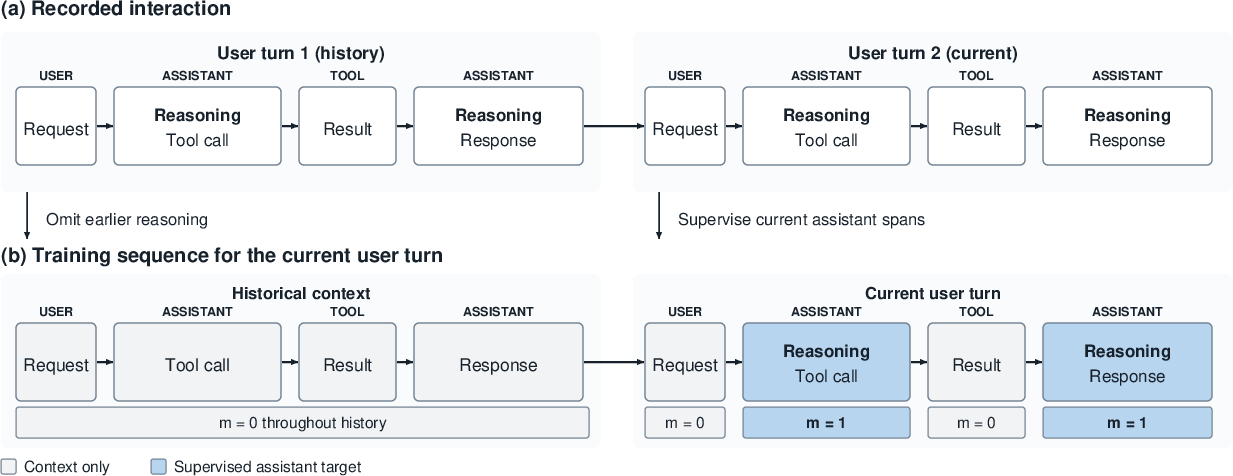
The researchers divide these long histories into smaller user turns. A user turn starts with a request and includes the agent’s responses and tool actions until the next request or the end of the task.
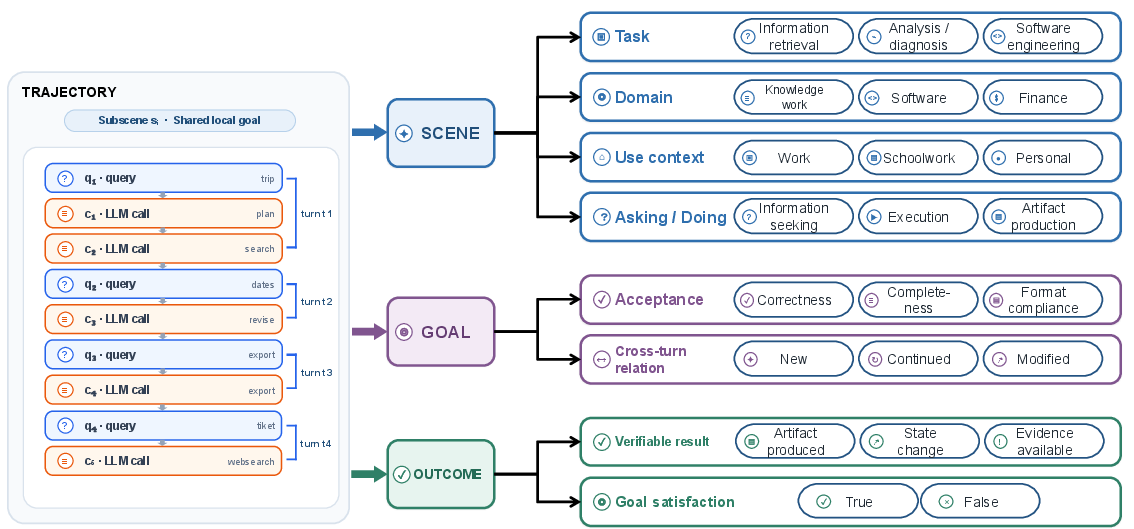
They also group related turns into subscenes. A subscene is like a chapter in a conversation where the agent is working toward one local goal.
Checking the data
Before using these experiences for training, the researchers check them in several ways.
First, they use structural validation. This is similar to checking whether a form has been filled out correctly. They look for problems such as:
- Missing responses
- Tool calls without matching results
- Events appearing in the wrong order
- Confusing or incomplete endings
Second, they use semantic evaluation. This means judging what the interaction actually achieved. They examine six areas:
- Did the agent achieve the goal?
- Did it follow the instructions?
- Did it use tools correctly?
- Did its claims match the available evidence?
- Did it recover from mistakes?
- Did it finish properly?
Each area can receive a result such as PASS, WARN, or FAIL.
Using routing as a difficulty guide
The routing system places tasks into four levels:
| Level | Simple explanation |
|---|---|
| C0 | Easy, limited-risk tasks |
| C1 | Normal everyday tasks |
| C2 | Tasks needing several steps or tool use |
| C3 | Very difficult or high-reliability tasks |
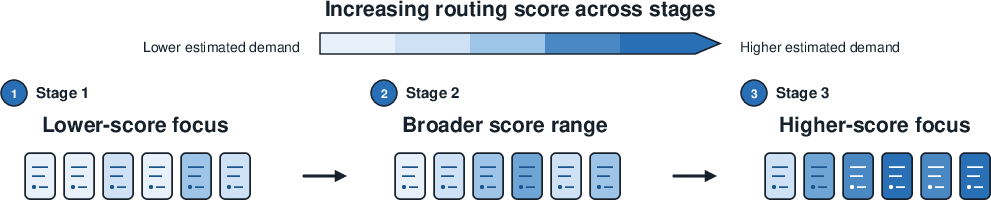
The researchers use these levels as an estimate of how much ability a task requires. Importantly, the level is treated as a guide for ordering examples, not as a perfect measure of difficulty.
Training with a curriculum
The researchers use curriculum learning, which is similar to teaching a student math by starting with basic problems and gradually introducing harder ones.
Training happens in three stages:
- The model sees mostly easier examples.
- It sees a mixture of easier and more demanding examples.
- It receives more difficult examples while still keeping some easier examples for balance.
This training method is called supervised fine-tuning, or SFT. In everyday language, the model studies examples of good agent behavior and adjusts its internal settings to imitate them.
The training examples include more than final answers. They can contain reasoning, tool calls, tool results, and visible responses. This helps the model learn the entire process of completing a task.
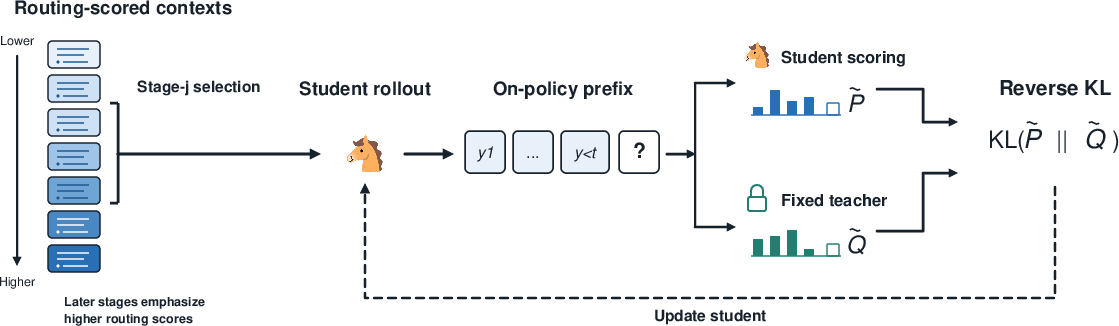
On-policy distillation
The paper also uses on-policy distillation. Imagine a student trying to solve a problem in its own way while a teacher watches. Instead of only showing the student old examples, the teacher observes the student’s current attempt and gives guidance.
Here:
- The student is the model being trained.
- The teacher is a stronger or fixed model.
- The student generates its own responses.
- The teacher shows which next words or actions would be more likely to be useful.
This is important because an AI may behave differently when it generates its own response than when it simply copies a recorded example.
Choosing future training data
After testing the model, the researchers create a capability profile showing where it is strong and weak. They then change the next training mixture to include more examples from weak areas.
This creates the intended feedback loop:
1 2 3 |
Run tasks → record experiences → evaluate abilities
      ↑                              ↓
Train an improved model ← choose data for weak areas |
4. Main findings
The researchers tested NeoHorse-1 at two sizes:
- A smaller model with about 4 billion parameters
- A larger model with about 9 billion parameters
They evaluated the models on ten benchmarks covering:
- Agent tasks
- Tool use
- Coding
- Instruction following
- Multi-step interaction
The average scores improved after agentic post-training:
| Model | Before training | After training | Improvement |
|---|---|---|---|
| NeoHorse-1-4B | 58.94 | 64.87 | +5.93 |
| NeoHorse-1-9B | 65.60 | 69.04 | +3.44 |
The biggest improvements appeared in tasks involving:
- Harness-based agents
- Tool use
- Executing several steps
- Checking results
- Recovering from errors
The smaller 4B model also became much closer, overall, to the larger 9B base model. This suggests that carefully chosen training experiences can help a smaller model perform more like a larger one on some tasks.
Why these results matter
The results suggest that an AI agent’s work history is valuable training material. The model can learn not only from whether its final answer was right, but also from:
- How it planned
- Which tools it chose
- Whether it checked its work
- How it reacted to errors
- How it completed a task over several steps
The results also suggest that a routing system can do more than choose which model answers a request. Its records can help decide what the models should learn next.
5. Implications and possible impact
NeoHorse-1 presents a possible way to make AI development more automatic and continuous. Instead of humans manually collecting every training example, deployed agents could generate useful experiences while doing real tasks.
In the future, a system based on this idea might:
- Notice that it often fails at a certain type of task.
- Collect or create more examples of that task.
- Train an updated model.
- Test the updated model.
- Repeat the process.
This could make AI agents better at practical activities such as coding, research, customer service, and using computer software.
However, the paper describes an early prototype, not a completely self-improving AI. Humans still design the training process, select the benchmarks, provide the teacher models, and decide how the data is used. The system also needs further testing to determine whether improvements continue over many training rounds and whether the model avoids learning incorrect or unsafe behaviors.
Overall, the paper’s main message is that the records created when AI agents work can become a powerful feedback system. By observing actions, measuring weaknesses, and choosing better training data, AI models may gradually become more capable and more useful.
Knowledge Gaps
Knowledge gaps, limitations, and open questions
- The proposed recursive self-improvement loop is not demonstrated across multiple completed training–deployment iterations; the paper reports a single post-training cycle rather than sustained recursive improvement.
- It remains unclear whether the reported gains compound over successive iterations or eventually saturate, regress, or amplify undesirable behaviors.
- The paper does not isolate the contribution of routing-guided data allocation from ordinary data scaling, repeated training, model quality improvements, or increased exposure to agentic trajectories.
- The causal effect of the three-stage routing curriculum is unresolved because there is no full ablation comparing it with random ordering, conventional difficulty-based curricula, reverse ordering, or no curriculum.
- The relative value of hard routing scores versus soft score-weighted ordering is not quantified.
- The reliability and calibration of routing-estimated capability demand are not established; the paper does not report whether higher routing scores consistently predict task difficulty, failure probability, or training value.
- It is unclear how routing scores transfer across model versions, deployments, harnesses, domains, and changing service-tier definitions.
- The effects of policy-adjusted routing decisions, user overrides, service availability, and multi-model aggregation on the training signal are not separately evaluated.
- The paper does not determine whether routing signals encode genuine capability demand or confounding factors such as task length, domain, risk level, prompt style, or infrastructure constraints.
- The capability-guided allocation procedure is described conceptually, but its exact optimization rule, sampling proportions, update frequency, and stability properties are insufficiently specified for independent reproduction.
- The method for converting a deficiency profile into a new training mixture is not compared against simpler baselines such as uniform resampling, loss-based sampling, failure-only sampling, or uncertainty-based allocation.
- The paper does not evaluate whether reallocating data toward underperforming regions causes catastrophic forgetting or reduces performance on already-strong capabilities.
- The training corpus is described only approximately as containing – trajectories; detailed counts by source, domain, routing tier, quality status, outcome, and model/harness are not provided.
- The mixture and weighting of proprietary harness-generated data versus public datasets are not fully disclosed, limiting reproducibility and making it difficult to attribute performance gains to particular data sources.
- The paper does not report how public datasets and harness trajectories differ in formatting, quality, task distribution, or contamination risk.
- The effectiveness of retaining current-turn reasoning while omitting earlier-turn reasoning is not tested against alternative context policies, including retaining all reasoning, omitting all reasoning, or selectively summarizing prior reasoning.
- It remains unknown whether training on recorded reasoning and tool-call traces improves actual execution competence or mainly increases imitation of trajectory style.
- The study does not assess whether the models reproduce inaccurate, unsafe, or strategically misleading reasoning present in source trajectories.
- Structural validity is distinguished from task success, but the paper does not report how frequently structurally valid trajectories contain incorrect tool choices, fabricated evidence, invalid arguments, or silently failed tasks.
- The semantic judge’s accuracy, inter-rater agreement, calibration, and susceptibility to model-generated evidence are not quantified.
- The six semantic quality dimensions are treated as independent, but their correlations, redundancy, and relative importance for downstream performance remain unexplored.
- The paper does not evaluate the impact of annotation errors, low-confidence labels,
WARNcases, orNOT_EVALUATEDcases on training outcomes. - The thresholds and policies for admitting, reviewing, recovering, or quarantining trajectories are not accompanied by sensitivity analyses.
- The benefits of training on informative failures and recovery trajectories are not isolated from the benefits of training on successful trajectories.
- The proposed subscene-level labeling scheme has not been validated for consistency across annotators, domains, languages, or long multi-goal conversations.
- The extent to which the evaluation suite is representative of real deployment traffic is unknown; most reported tasks are benchmarked environments rather than naturally occurring user interactions.
- The evaluation is limited to text-based tasks, leaving multimodal perception, GUI interaction, speech, and other deployment settings unexamined.
- The paper does not establish whether gains generalize to unseen tools, harnesses, APIs, environments, or domains not represented in the training trajectories.
- The reported benchmarks do not fully test long-horizon reliability, persistent memory, changing environments, adversarial users, or nonstationary tool behavior.
- The evaluation does not systematically measure inference cost, latency, energy use, token consumption, or tool-call efficiency, despite the method being motivated by routing and service allocation.
- Macro-average benchmark gains may conceal regressions on individual tasks, domains, failure modes, or capability tiers; per-category variance and statistical significance are not sufficiently characterized in the provided text.
- The paper does not report confidence intervals, repeated-seed results, or statistical tests needed to determine whether the improvements are robust.
- Comparisons with models based on official reports or blog posts are not necessarily matched for prompts, inference settings, harnesses, or evaluation procedures, limiting the strength of cross-model conclusions.
- The effects of sampling temperature, thinking mode, output limits, penalty settings, and harness configuration are not studied through controlled sensitivity experiments.
- The contribution of supervised fine-tuning and routing-guided on-policy distillation is not separately quantified through a complete factorial ablation.
- The on-policy distillation procedure uses a fixed teacher, but the paper does not investigate teacher quality, teacher–student size ratios, teacher diversity, teacher refresh strategies, or teacher failure modes.
- The consequences of using reverse KL with top- candidate tokens plus an aggregated residual bin are not compared with forward KL, full-vocabulary distillation, alternative divergences, or different values of .
- The OPD objective supervises student-generated prefixes but does not address exposure to low-quality, unsafe, or tool-invalid student trajectories beyond the teacher’s token-level distribution.
- It remains unclear whether routing-guided context scheduling improves OPD because of curriculum ordering specifically or simply because it changes the task mixture and rollout distribution.
- The paper does not evaluate whether the student learns to exploit teacher distributions without acquiring reliable environment-grounded behavior.
- Tool execution during on-policy distillation is insufficiently specified, leaving open whether the student interacts with live environments, replayed observations, or static contexts and how tool outcomes affect learning.
- The models are evaluated primarily at 4B and 9B parameters, so the scaling behavior of the approach at smaller, larger, or substantially different architectures remains unknown.
- The claim that the 4B model narrows the gap to the 9B base model is aggregate-level; the paper does not establish whether this reflects broad capability improvement or concentration of gains in a subset of benchmarks.
- The method’s robustness to distribution shift, changing routing policies, new tools, and evolving user behavior is not experimentally established.
- The paper does not analyze safety, security, privacy, or misuse risks arising from storing and training on deployment trajectories that may contain sensitive user inputs, tool outputs, credentials, or executable actions.
- No mechanism is presented for preventing recursive feedback loops from reinforcing systematic evaluator errors, routing biases, spurious correlations, or deployment-specific artifacts.
- The proposed evaluation–selection–update loop may optimize toward the selected benchmarks and deficiency metrics; its resistance to Goodhart effects and benchmark overfitting remains unresolved.
- The paper does not define stopping criteria, rollback mechanisms, or safeguards for later recursive iterations that produce regressions or increasingly undesirable behavior.
- The computational and operational cost of continuously collecting, validating, judging, labeling, reallocating, and retraining on trajectories is not reported.
- The method’s dependence on proprietary or rapidly changing harness components, such as OpenSquilla and versioned service tiers, may limit reproducibility and portability to other serving infrastructures.
- The paper does not compare routing-guided post-training with direct reinforcement learning from executable outcomes, preference optimization, rejection sampling, or joint model–harness optimization under matched data and compute budgets.
- It remains open whether the routing harness itself can be automatically improved, rather than merely supplying data and scores to improve the underlying model.
- The relationship between improved benchmark execution and genuine recursive self-improvement is conceptually asserted but not formally defined or measured; in particular, the paper does not quantify whether the system improves its ability to improve future training procedures.
Practical Applications
Immediate Applications
- Cost- and capability-aware AI routing for production services (software, customer support, enterprise AI) Organizations can deploy a routing harness that classifies each request into capability tiers such as routine, general-purpose, multi-step, or high-reliability. The system can then select smaller models for low-risk requests and stronger or multi-agent configurations for complex tasks. This can reduce inference cost and latency while preserving quality. Potential tools/workflows: model cascades, ticket triage, adaptive chatbot backends, escalation systems, and reliability-aware API gateways. Dependencies: reliable routing predictions, stable tier definitions, monitoring for misrouted high-risk requests, and explicit policies for privacy, latency, and cost.
- Agentic customer-service automation (retail, telecom, airlines, financial services) The demonstrated improvements in multi-turn tool use and task completion can support agents that retrieve account information, modify reservations, process returns, or troubleshoot services through controlled APIs. The trajectory format provides a way to train agents on complete interaction histories rather than isolated question–answer pairs. Dependencies: authenticated tools, transactional safeguards, human escalation, audit logs, and domain-specific evaluation. The benchmark gains do not by themselves establish safety for unsupervised financial or customer-affecting actions.
- Coding assistants that execute and verify software tasks (software engineering, DevOps) NeoHorse-style training can be applied to coding agents that edit repositories, run tests, inspect build errors, and revise implementations. Preserving tool calls, observations, recovery attempts, and terminal outcomes is directly useful for learning repository-level workflows rather than only code completion. Potential products: IDE agents, pull-request assistants, automated bug-fixing systems, and CI failure-resolution agents. Dependencies: sandboxed execution, repository permissions, deterministic test environments, protection against destructive commands, and verification of generated patches.
- Structured trajectory logging and replay for AI operations (MLOps, enterprise software, academia) The paper’s representation of trajectories as linked user turns, subscenes, tool calls, observations, outcomes, and routing records can be implemented as an observability standard for agent systems. Teams can replay failures, inspect causal tool-call chains, compare model versions, and identify where an interaction broke down. Potential tools: trajectory databases, agent trace viewers, replay systems, quality dashboards, and data-lineage platforms. Dependencies: consistent serialization, schema versioning, privacy-preserving storage, and accurate association between tool calls and results.
- Automated quality assurance for tool-using agents (software, robotics, business-process automation) The structural validation pipeline can serve as a deployable gate that detects malformed conversations, orphaned tool results, duplicate identifiers, missing responses, unresolved calls, and ambiguous terminal states. The six semantic dimensions—goal attainment, instruction adherence, tool use, evidence consistency, recovery, and termination—can provide a practical evaluation checklist. Dependencies: deterministic checks should be used wherever possible; model-based judges require evidence-grounding, calibration, coverage tracking, and human review for consequential decisions.
- Adaptive data curation for post-training (AI research and model development) Developers can use routing demand, task attributes, execution quality, and outcomes to construct training mixtures targeted at observed weaknesses. Instead of uniformly adding more data, a training pipeline can increase coverage for underperforming combinations such as high-demand tool use, error recovery, or particular application domains. Potential workflow: collect trajectories → validate and decontaminate → label scene, goal, and outcome → evaluate capability gaps → reallocate the next training mixture. Dependencies: sufficient trajectory volume, representative deployment data, protection against feedback-loop bias, and strict separation between training and evaluation sets.
- Routing-guided curriculum learning for existing models (academia, industrial fine-tuning) The paper provides an immediately reusable training strategy: order examples using predicted capability demand, gradually introduce more demanding interactions, and retain lower-demand examples for coverage. This can be applied to supervised fine-tuning without changing the underlying loss function. Dependencies: routing scores must correlate sufficiently with task demand; otherwise the curriculum may encode serving policy or availability rather than difficulty. The approach should be compared against random, heuristic, and outcome-based curricula.
- Capability dashboards for model and policy management (AI governance, enterprise operations) The prediction–action–outcome separation can support dashboards showing which task types are routed to which service tiers, where failures occur, how much recovery costs, and whether routing decisions are justified by outcomes. This can inform model selection, capacity planning, and service-level agreements. Dependencies: calibrated metrics, stable tier semantics across model versions, representative traffic, and controls preventing sensitive user information from appearing in reports.
- Human-in-the-loop escalation and review (healthcare administration, legal services, finance, public services) Routing and structured quality signals can trigger escalation when an agent detects high capability demand, failed verification, poor evidence consistency, or repeated recovery attempts. This is particularly suitable for systems that already require human approval before consequential actions. Dependencies: clearly defined escalation thresholds, qualified reviewers, response-time guarantees, and a policy that treats uncertainty or missing evidence as a reason for review rather than success.
- Research and teaching infrastructure for agentic AI (academia and education) The open model, repository, data organization, and evaluation methodology can be used to reproduce experiments on trajectory SFT, curriculum learning, on-policy distillation, routing, and agent evaluation. Universities can build course laboratories around replayable tool-use environments and compare models under common harnesses. Dependencies: availability and licensing of the referenced models and datasets, adequate compute, reproducible harness versions, and careful handling of benchmark contamination.
Long-Term Applications
- Sustained harness-mediated recursive self-improvement (AI research) The proposed evaluation–selection–update loop could become a continual improvement system in which deployed interactions reveal capability gaps, the data allocator selects new training material, and updated models are returned to the harness for another iteration. This would move beyond one-time post-training toward an operational data flywheel. Dependencies: evidence that improvements persist across multiple iterations; safeguards against performance collapse, distribution drift, reward hacking, benchmark overfitting, and self-reinforcing errors; and independent evaluations that are not generated by the improving system itself.
- Continual adaptation to changing enterprise workflows (business software, operations) A production agent could learn from newly introduced tools, changed APIs, updated policies, and evolving user behavior. Routing records and subscene labels could identify new capability regions requiring training, enabling more rapid adaptation than periodic manual dataset construction. Dependencies: continual-learning methods, strict rollback mechanisms, data governance, protection against poisoning, and validation before updated models are exposed to real users.
- Joint optimization of models, routing policies, and agent harnesses (AI infrastructure) Future systems could optimize not only model weights but also tool selection, context management, service-tier policies, recovery strategies, and aggregation mechanisms. The paper’s separation of predicted demand, policy-adjusted route, served model, and outcome provides the instrumentation needed for such joint optimization. Dependencies: a well-defined objective balancing quality, cost, latency, safety, and fairness; stable interfaces; causal attribution between harness changes and model changes; and methods that prevent the system from optimizing easily measured metrics at the expense of actual task success.
- On-policy distillation for self-generated, domain-specific workflows (healthcare, science, engineering, finance) A stronger teacher could supervise student responses on prefixes generated by the student itself, including domain-specific tool calls and recovery states. This may help close the gap between training on expert trajectories and deployment, where the model encounters its own mistakes and unusual states. Dependencies: access to a trustworthy teacher, compatible tokenization and tool templates, high compute cost, reliable handling of unsafe student actions, and validation that distillation does not merely reproduce teacher biases or errors.
- Autonomous research and engineering agents (scientific discovery, software, robotics) With additional advances, the loop could train agents to design experiments, write and test code, analyze results, revise hypotheses, or improve their own scaffolding. In robotics, analogous trajectory records could connect perception, planning, control actions, environmental feedback, and recovery behavior. Dependencies: grounded environments, reliable outcome verification, simulation-to-real transfer for robotics, domain experts, safety constraints, and substantially stronger long-horizon planning than established by the current text-only results.
- High-reliability agents in regulated sectors (healthcare, finance, law, public administration) The structured quality dimensions and evidence-grounded evaluation could support agents that perform constrained professional workflows, such as preparing clinical documentation, reconciling financial records, or assembling legal research. Capability-aware routing could reserve the strongest models and additional verification for sensitive cases. Dependencies: regulatory approval, explainability, auditability, access controls, validated domain datasets, liability allocation, human sign-off, and evidence that benchmark performance transfers to real operational environments.
- Personalized daily-life assistants with adaptive service tiers (consumer technology) The methods could support assistants that handle simple reminders and information requests locally while escalating complex planning, travel, shopping, or software-operation tasks to stronger models or multi-step agents. Subscene-level tracking could preserve goals across interruptions, modifications, and resumptions. Dependencies: user consent, persistent but privacy-preserving memory, dependable integrations with calendars and services, protection against unauthorized transactions, and robust handling of ambiguous user goals.
- Fairness- and risk-aware allocation of computational resources (policy, public-sector AI, cloud infrastructure) Routing logs could be extended to study whether high-quality service is allocated equitably across languages, user groups, domains, or geographic regions. Policy makers and platform operators could require reporting on route decisions, failure rates, escalation rates, and resource disparities. Dependencies: fairness definitions appropriate to the application, representative data, privacy-preserving measurement, transparency about tier policies, and safeguards against using capability estimates as proxies for protected characteristics.
- Standardized benchmarks for recursive and harness-level improvement (academia and policy) The paper points toward evaluations that measure not only final answers but also tool use, verification, recovery, termination, routing quality, data-allocation decisions, and performance across successive improvement cycles. Such benchmarks could distinguish genuine capability growth from test-specific optimization. Dependencies: independent task generation, contamination-resistant evaluation, reproducible harnesses, long-term study protocols, and metrics that capture cost, latency, reliability, and safety alongside accuracy.
- Automated discovery of training and deployment failures (AI safety and governance) A mature version of the pipeline could detect when a model is systematically failing in a particular scene, goal type, outcome state, or capability tier, then recommend additional data, a new tool constraint, a routing change, or human intervention. This would turn operational telemetry into a semi-automated safety and quality-management system. Dependencies: causal diagnosis rather than correlation alone, independent monitoring, adversarial testing, secure data pipelines, and human approval for changes that affect training or deployment behavior.
Glossary
- Agentic post-training: Training an AI model using interaction trajectories, tool use, and execution feedback. “Our system couples a heterogeneous model pool with intelligent routing”
- Agentic routing: Dynamically selecting a model or sub-agent for a request based on its requirements and interaction state. “Adding agentic routing allows this layer to select models according to the request and the evolving interaction state”
- Causal attention: An attention mechanism in which each token can attend only to preceding tokens, preventing access to future information. “With causal attention, each assistant response can use earlier actions and tool results in the sequence, but not later ones.”
- Capability-guided data allocation: Adjusting the composition of training data according to measured strengths and weaknesses of a model. “The quality dimensions of Section~\ref{sec:data-quality}, semantic attributes of Section~\ref{sec:data-labeling}, and routing signals of Section~\ref{sec:routing-data} organize deployment trajectories by user intent, capability demand, execution quality, and outcome.”
- Capability demand: The estimated level of model ability required to complete an interaction successfully. “The harness router operates at the user-turn level and estimates capability demand from the current request, recent dialogue, previous routing decisions, and available execution state”
- Coarsened distribution: A probability distribution simplified by grouping multiple outcomes into shared categories or bins. “yielding coarsened distributions and over bins.”
- Curriculum learning: A training strategy that introduces examples in an ordered progression, often from easier to more difficult cases. “Curriculum learning is a training strategy that presents examples according to an estimated notion of difficulty”
- Decontamination: Removing training examples that overlap with evaluation data to prevent test-set leakage. “the same matching infrastructure screens every training candidate against our evaluation suites”
- Deduplication: Identifying and removing identical or near-identical data records. “The corpus is deduplicated at exact and near-duplicate granularity”
- Direct preference optimization: A method for training LLMs directly from preference comparisons without separately fitting a reward model. “Llama 3 extends this recipe with synthetic multi-step tool-use data and iterative SFT, rejection sampling, and direct preference optimization”
- Distribution gap: The difference between the data distribution used for training and the distribution encountered during deployment or evaluation. “On-policy distillation (OPD) reduces this distribution gap”
- Execution trajectory: A recorded sequence of model actions, tool interactions, observations, and outcomes during task completion. “Post-training data for an agentic model is not adequately represented by static instruction--response pairs.”
- Harness: An execution framework that manages an agent’s context, tools, environment interactions, and feedback. “A harness is the execution layer that manages an agent's context, tools, and interaction with its environment”
- Heterogeneous model pool: A collection of models with differing capabilities, sizes, or specializations. “Building on the harness-native data flywheel of Agentic Routing~\citep{liu2026agenticrouting}, our system design combines a heterogeneous model pool with multiple harnesses”
- Inference configuration: The set of parameters and serving choices controlling a model’s generation process. “Models, pricing, and inference configurations may change across deployments”
- Interleaved thinking: A pattern in which reasoning and tool calls alternate as the model responds to an interaction. “This pattern is referred to as \emph{interleaved thinking}”
- Long-horizon interaction: An interaction requiring many sequential steps, decisions, or tool operations before completion. “Search-R1, ReTool, and RAGEN study this paradigm for search, tool use, and long-horizon interaction”
- Loss mask: A binary indicator specifying which tokens contribute to the training loss. “We use a binary token-level loss mask ”
- Macro-average: An average calculated by first computing scores for individual tasks or categories and then giving each equal weight. “post-training lifts the macro-average score of the 4B model from 58.94 to 64.87”
- On-policy distillation: Distillation in which the student generates its own inputs or responses while receiving supervision from a teacher. “On-policy distillation (OPD) provides teacher supervision on these student-generated prefixes.”
- Orphan observation: A tool observation that lacks a corresponding initiating tool call or valid causal connection. “The same stage detects missing responses, orphan observations, duplicated or conflicting tool-call identifiers”
- Post-training: Model training performed after initial pretraining, typically involving supervised fine-tuning, preference optimization, or distillation. “NeoHorse-1's post-training methods provide the learning component of this design.”
- Prediction--action--outcome record: A structured record linking a system’s prediction, selected action, and resulting task outcome. “Aligning these fields yields a prediction--action--outcome record”
- Recursive self-improvement: An iterative process in which an AI system uses experience or evaluation to improve itself or its improvement process. “Recursive self-improvement (RSI) denotes an iterative process in which an AI system uses experience, evaluations, or generated artifacts to improve its model, scaffold, or improvement procedure”
- Rejection sampling: A sampling procedure that generates candidate outputs and retains only those meeting a desired criterion. “Llama 3 extends this recipe with synthetic multi-step tool-use data and iterative SFT, rejection sampling, and direct preference optimization”
- Reverse Kullback–Leibler divergence: A divergence measure that compares a student distribution to a teacher distribution in the direction . “we minimize the response-normalized reverse KL”
- Routing-guided curriculum: A curriculum whose ordering is determined by capability estimates produced by a routing system. “We use routing estimates of this demand to organize SFT examples into a curriculum.”
- Routing-guided on-policy distillation: On-policy distillation in which routing scores determine the order of contexts used for student generation. “Routing-guided on-policy distillation.”
- Semantic event stream: A normalized, ordered representation of meaningful events in an interaction. “For structurally usable trajectories, we construct a normalized semantic event stream”
- Semantic judge: A model or evaluation component that interprets trajectory evidence to assess task-level properties. “Cases that require task-level interpretation are evaluated by a semantic judge”
- Service tier: A routing category representing a particular level of model capability, cost, or reliability. “It assigns each turn to one of four service tiers”
- Subscene: A group of adjacent user turns sharing a local goal within a larger interaction. “A subscene groups adjacent user turns that share a local goal”
- Supervised fine-tuning (SFT): Training a pretrained model to reproduce labeled target outputs. “Trajectory-based supervised fine-tuning (SFT) provides a practical route for transferring planning and tool use into model parameters.”
- Teacher logits: The teacher model’s pre-softmax token scores used to supervise a student model. “the teacher supplies token-level logits on student-visited states”
- Token-level divergence: A divergence computed separately between model probability distributions at each generated token position. “Each response contributes its average token-level divergence”
- Trajectory-based supervision: Training supervision derived from complete interaction sequences rather than isolated input–output pairs. “Trajectory-based supervised fine-tuning (SFT) provides a practical route for transferring planning and tool use into model parameters.”
- User turn: A user request together with the assistant responses and tool interactions that follow it until the next request or termination. “We define a user turn as a user request together with the assistant responses and tool interactions that follow it”
- Zero-shot generalization: The ability to perform tasks or handle conditions not directly represented in training examples. “IFBench~\citep{pyatkin2025generalizing} focuses on generalization to diverse and previously unseen constraints”

