ScienceBuddy: Recursive-in-Recursive Self-Improvement for Interactive Scientific Agents
Abstract: We introduce and release ScienceBuddy, an interactive scientific research workspace that brings continually improving scientific agents into researchers' everyday workflows. ScienceBuddy supports researchers in carrying out scientific tasks while transforming their requests, feedback, and execution evidence into tasks and evaluation rubrics for continual learning. At its core is recursive-in-recursive self-improvement, a paradigm that couples harness evolution with model reinforcement learning: the inner recursion improves the harness with the model fixed, while the outer recursion trains the model under the improved harness. Harness evolution shapes training experience, and model learning creates new opportunities for harness adaptation. We present case studies of researcher interaction, harness refinement, and model learning, with the benchmark cases spanning four scientific task families. By releasing ScienceBuddy as a research product, we make this paradigm available to the scientific community and take a step toward discovery intelligence: scientific AI that advances through sustained collaboration with researchers and evolves alongside the research it supports. Website: http://science-buddy.io
Paper Prompts
Sign up for free to create and run prompts on this paper.
Top Community Prompts
Explain it Like I'm 14
1. What is this paper about?
This paper introduces ScienceBuddy, an AI workspace designed to help scientists with research tasks.
ScienceBuddy can:
- Read scientific papers and images
- Search databases
- Write and run code
- Analyze data
- Create tables and explanations
- Keep track of previous work
- Let researchers inspect how it reached an answer
The main idea is that ScienceBuddy should not stay the same forever. It should learn from researchers’ questions, corrections, and feedback. The paper presents a method called recursive-in-recursive self-improvement, which means improving both:
- How the AI works—its instructions, tools, and procedures
- What the AI knows and can solve—its trained model
These two kinds of improvement take turns helping each other.
2. What questions did the researchers ask?
The paper focuses on four main questions:
- How can researchers’ conversations help improve an AI scientist? For example, can a researcher’s follow-up question show the AI what a good answer should include?
- Can improving the AI’s procedures and training the AI model together make it better over time?
- Can the AI perform better just by changing its instructions and working procedures, without changing its main model?
- Can additional training help the model solve a wider range of scientific problems, even when its procedures stay the same?
In simple terms, the researchers wanted to know whether an AI could become a better research assistant by learning from real scientific teamwork.
3. How did the researchers build and test ScienceBuddy?
The scientific workspace
ScienceBuddy includes 224 tools in 22 groups. These tools cover areas such as:
- Genetics
- Cancer biology
- Medicine
- Drug research
- Microscopy and biological images
- Scientific literature
- Database searches
It can work with documents, images, tables, and biological sequences. It can also run programs written in Python, R, and Bash.
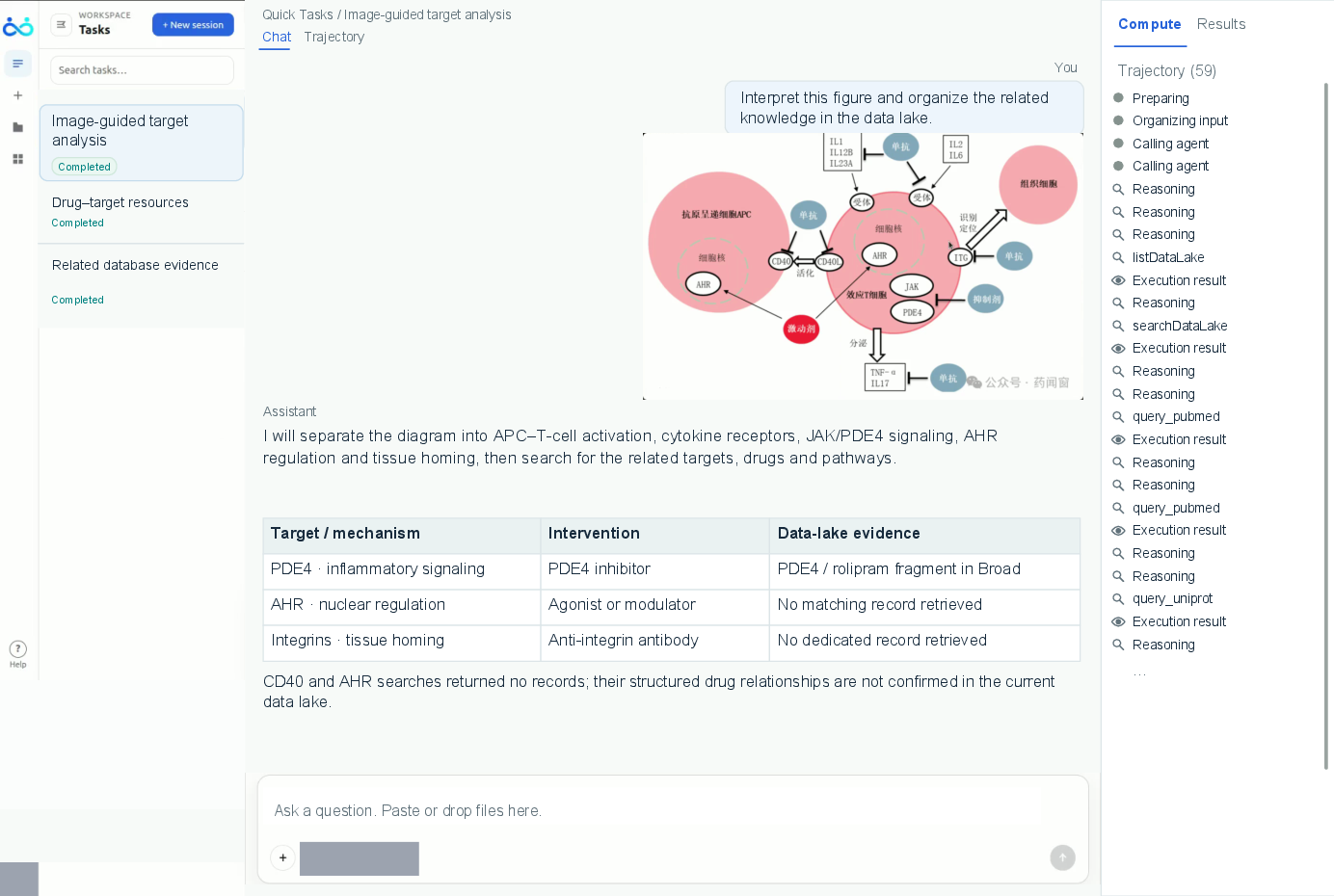
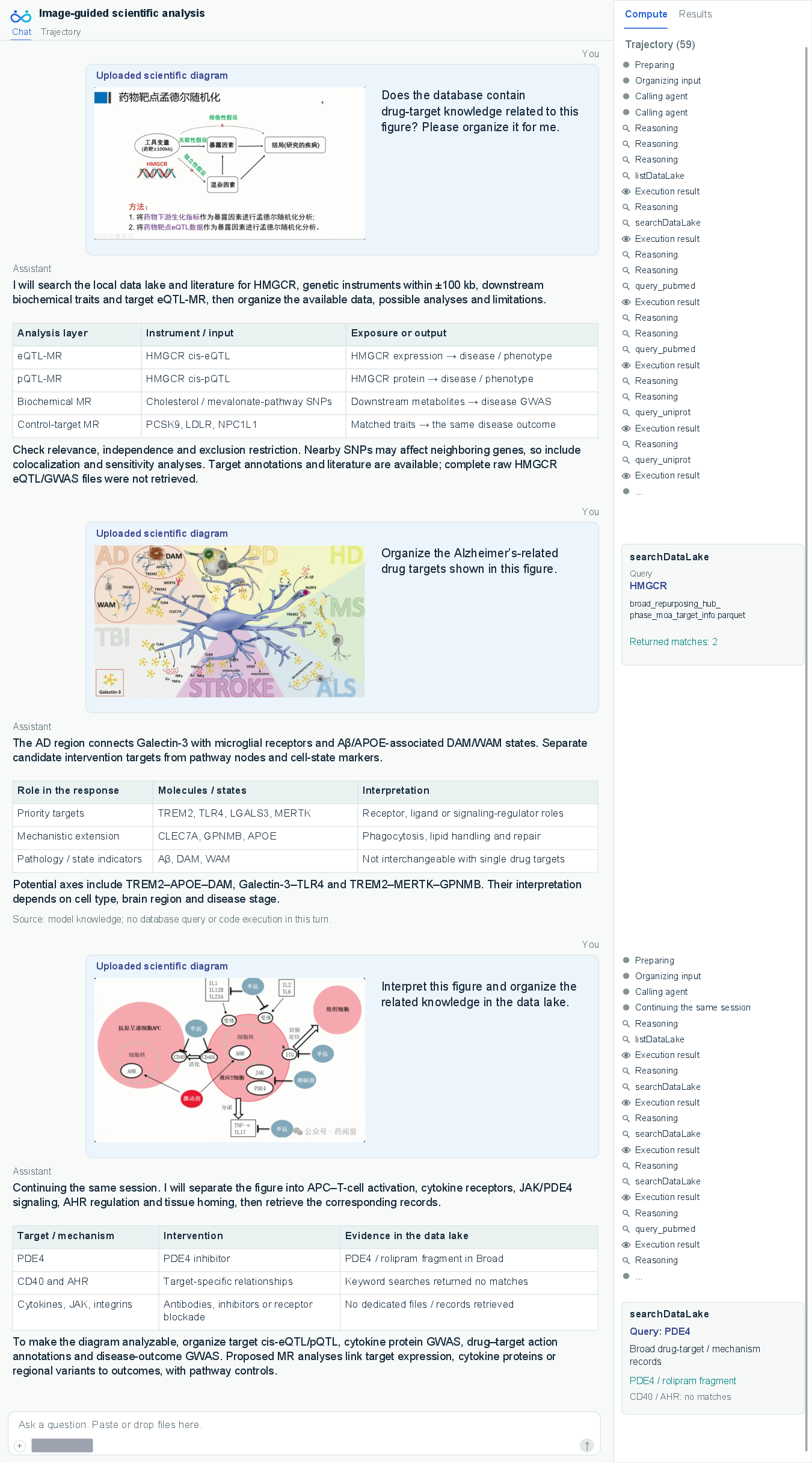
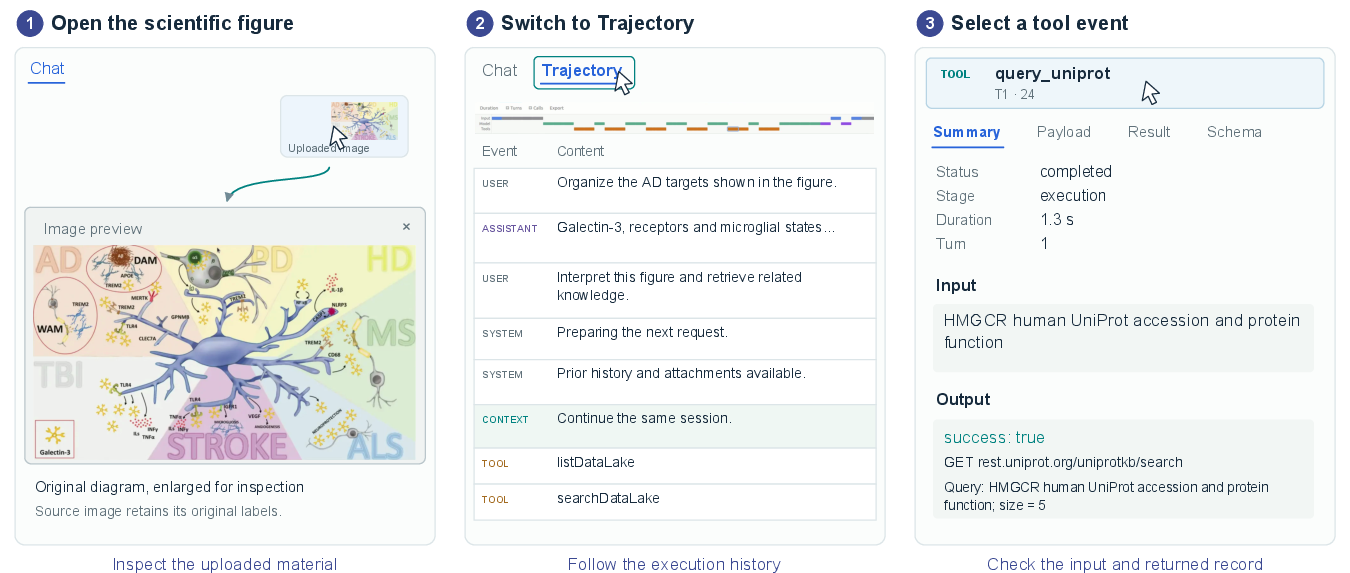
A researcher can ask a question, upload data, inspect the AI’s actions, and ask it to revise its work. This is similar to watching a student solve a problem step by step instead of seeing only the final answer.
The “harness”
The paper uses the word harness for the collection of instructions, skills, and procedures that guide the AI.
A harness is like a rulebook and tool belt. It tells the AI things such as:
- When to inspect the data first
- Which tool to use
- How to search a database
- How to organize evidence
- How to check whether an answer is complete
The researchers can change the harness without changing the AI’s main model.
Turning conversations into tests
When a researcher interacts with ScienceBuddy, the researchers examine:
- The original question
- The researcher’s later corrections or requests
- The AI’s actions
- The files and results it produced
- What a successful answer should contain
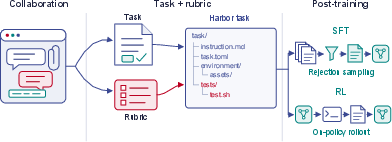
They turn this information into a scientific task and a rubric.
A rubric is a scoring guide, much like a teacher’s marking scheme. It may ask:
- Did the AI answer the correct question?
- Did it use suitable evidence?
- Did it follow the requested method?
- Did it create the required table, graph, or report?
This allows the researchers to test whether later versions of the AI are better.
The two improvement loops
The system improves in two nested loops.
Inner loop: improving the harness
First, the researchers keep the AI model fixed and change only the harness.
A separate AI system studies failed or incomplete attempts and suggests a small change, such as:
- Adding a new instruction
- Improving a skill
- Changing how information is shown to the model
- Making the AI check a database record more carefully
The proposed change is tested on the same tasks. It is kept only if it follows the rules and improves the score.
This is similar to changing the instructions on a recipe while keeping the cook the same.
Outer loop: improving the model
After improving the harness, the researchers train the main AI model using new scientific tasks.
The AI tries to solve tasks, receives scores from the rubrics, and is trained to make higher-scoring attempts in the future. This is a type of reinforcement learning, which is similar to practicing a game while receiving points for good moves.
The improved model is then tested again with the harness. After that, researchers can interact with the new system, creating more evidence for the next improvement cycle.
4. What did the researchers find?
The paper reports several important results.
Both the harness and the model improved
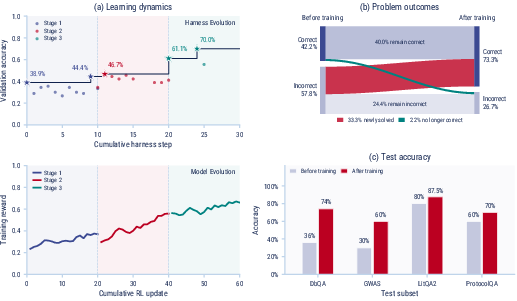
In a three-cycle experiment, the researchers repeatedly improved the harness and then trained the model.
The overall accuracy on previously unseen scientific problems increased from 42.2% to 73.3%.
Among the test problems:
- 33.3% changed from incorrect to correct
- Only 2.2% changed from correct to incorrect
The improvement appeared across all four scientific task groups studied:
- Reading scientific literature
- Judging database information
- Troubleshooting research procedures
- Assessing genes and genetic variants
This suggests that the system did not merely memorize a few examples. It became better across several types of scientific work.
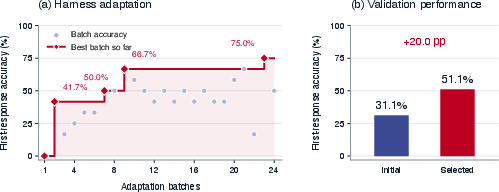
The harness helped even when the model did not change
When the researchers kept the model’s weights fixed but improved its harness, validation accuracy rose from 31.1% to 51.1%.
This is a gain of 20 percentage points.
That result is important because it shows that better instructions and procedures can make an AI more useful, even without fully retraining the model.
The improved harness learned procedures such as:
- Inspecting available data and database structures
- Looking up genes and genetic regions
- Checking whether scientific records match the question
- Extracting evidence clearly
- Submitting answers in the required format
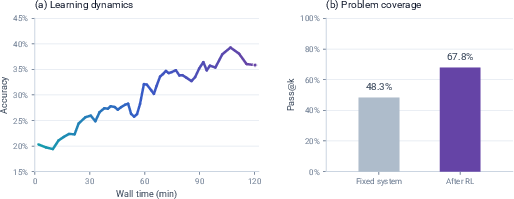
Model training helped even when the harness did not change
In another experiment, the researchers kept the harness fixed and trained the model.
They measured problem coverage, meaning the percentage of different problems the AI could solve at least once within four attempts.
Coverage increased from 48.3% to 67.8%.
This means the model learned to solve a wider variety of scientific problems, not just perform better on the exact tasks it had practiced.
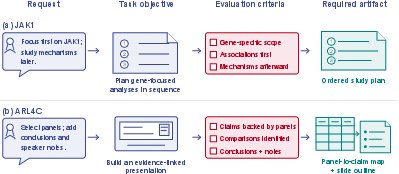
Researcher feedback was useful for defining tasks
The paper describes examples involving:
- Planning a study of the gene JAK1 and cancer treatment
- Preparing a scientific presentation about ARL4C
Researchers clarified what they wanted, what evidence should be included, and how the final work should be organized.
The authors used these exchanges to create clearer tasks and scoring rules. In other words, researcher feedback did more than correct one answer—it helped define what the AI should learn to do in the future.
5. Why are these findings important?
Science is not just about producing an answer. A useful scientific assistant must also:
- Use reliable evidence
- Explain its reasoning
- Choose suitable methods
- Check its work
- Adapt to the researcher’s goals
ScienceBuddy tries to support all of these needs. Its workspace lets researchers inspect the AI’s actions instead of blindly trusting the final response.
The results suggest that AI research assistants may improve in two different ways:
- By learning better habits and procedures
- By improving the underlying model’s abilities
Combining these methods may be more powerful than using either method alone.
6. Possible impact and limitations
If systems like ScienceBuddy continue to improve, they could help researchers:
- Search large scientific databases faster
- Organize evidence from many papers
- Analyze complicated biological data
- Test possible explanations
- Prepare research plans and presentations
- Find mistakes or missing steps in an analysis
The biggest long-term idea is that AI scientists could improve through continued cooperation with human scientists. Researchers would guide the system, while the system would gradually become better at supporting research.
However, the paper does not show that ScienceBuddy can replace scientists. The researchers still need to check its results, judge whether its evidence is trustworthy, and decide whether its conclusions make scientific sense. The experiments are also case studies with particular tasks and tools, so more testing would be needed in other fields.
Overall, the paper presents ScienceBuddy as a research assistant that learns from collaboration. Its main contribution is a plan for improving both the AI’s working methods and its scientific abilities over repeated cycles of human feedback, testing, and training.
Knowledge Gaps
Knowledge gaps, limitations, and open questions
- The evaluation is based on only three co-evolution cycles, so it remains unclear whether recursive improvement is stable over longer time horizons or eventually saturates, oscillates, or degrades.
- The paper does not report statistical significance, confidence intervals, standard deviations, or results across multiple random seeds, making it difficult to assess whether the reported gains are reproducible.
- The causal contribution of recursive-in-recursive coordination is not isolated: there is no comparison with harness-only improvement, model-only reinforcement learning, simultaneous joint optimization, or alternating optimization without feedback-derived task construction.
- The reported improvements are not compared against strong alternative baselines, such as prompt optimization, standard supervised fine-tuning, offline reinforcement learning, reflection-based agents, existing scientific agents, or larger untuned models.
- The paper does not quantify how much performance comes from the harness edits, the task/environment augmentation, the reward design, the auxiliary model, or the increased training exposure.
- The harness evaluation uses relatively small task sets and reports aggregate accuracy without sufficiently breaking down performance by scientific domain, task difficulty, input modality, tool dependency, or error type.
- The relationship between validation performance and genuine scientific usefulness is unresolved; gains on LAB-Bench and Biomni-Eval1 may not translate to authentic research workflows or novel scientific problems.
- The held-out test set is described as separate, but the paper does not provide enough information about dataset construction, overlap checks, contamination controls, or whether the base model may have encountered the benchmark tasks during pretraining.
- The rubric-construction process is insufficiently validated. The paper does not report inter-rater agreement, expert review, rubric calibration, or systematic audits of whether collaboration-derived criteria measure scientific correctness rather than compliance with researcher preferences.
- Fixed judges are used for scientifically interpretive criteria, but their reliability, calibration, bias, sensitivity to persuasive but incorrect answers, and agreement with domain experts are not established.
- Researcher feedback is treated as evidence for task and rubric construction, yet the paper does not specify how disagreements between researchers, incomplete requests, mistaken assumptions, or contradictory feedback are resolved in practice.
- The two researcher interactions are qualitative demonstrations rather than a systematic user study; researcher population, task diversity, time savings, usability, trust, and satisfaction are not measured.
- The paper does not evaluate whether researchers can effectively detect and correct incorrect outputs using the trajectory, artifact, and evidence inspection interfaces.
- The scientific outputs shown in the workspace demonstrations are plans, summaries, and proposed analyses; the system is not evaluated on experimentally verified discoveries, reproducible analyses, or downstream laboratory outcomes.
- The system’s ability to distinguish literature-supported facts from model-generated speculation is not quantitatively evaluated, particularly when database searches fail or when the agent answers from internal model knowledge.
- The paper does not provide a systematic assessment of factuality, citation correctness, evidence completeness, statistical validity, or hallucinated tool results across scientific tasks.
- The effects of long-context interaction and persistent workspace memory remain unclear. No experiments isolate whether retained context improves performance or instead introduces stale, irrelevant, or erroneous information.
- The safety implications of executable Python, R, Bash, database access, file persistence, and researcher-uploaded inputs are not analyzed, including sandboxing, data exfiltration, malicious files, prompt injection, and destructive commands.
- The paper does not investigate privacy and governance risks associated with storing researcher conversations, uploaded biomedical data, execution traces, and derived training tasks for future model updates.
- The asynchronous deployment protocol is described conceptually, but the paper does not measure service interruption, version inconsistency, rollback behavior, or the impact of background updates on active research sessions.
- Retaining all harness and environment versions may create unbounded storage, evaluation, and maintenance costs; the scalability of version management is not quantified.
- The computational and financial costs of auxiliary-model diagnosis, repeated harness evaluation, environment augmentation, and GRPO training are not reported.
- The use of GPT-6 Astra as a fixed auxiliary model introduces a major dependency, but the paper does not test whether harness evolution works with smaller, open-weight, or domain-specialized auxiliary models.
- The bounded edit policy may restrict useful structural changes, but the paper does not compare different edit budgets, edit granularities, or more expressive harness modifications.
- The acceptance rule accepts a candidate whenever its mean development score improves, without accounting for uncertainty, task difficulty, effect size, or multiple testing; this may favor noisy or overfitted edits.
- Although prior successful tasks are retained, the paper does not report detailed regression rates across older tasks, nor does it establish whether the system suffers from catastrophic forgetting after repeated harness and model updates.
- The development-task reuse strategy may lead to harness overfitting, but the paper does not evaluate transfer to independently collected tasks, new laboratories, new tool versions, or scientific domains outside biomedicine.
- Environment augmentation is described broadly, but the paper does not specify how augmented tasks preserve scientific validity or whether synthetic variations accurately represent real research conditions.
- The RL reward is trajectory-level and shared across generated tokens; the paper does not analyze credit assignment, tool-use learning, inefficient reasoning, reward hacking, or whether agents learn superficial rubric strategies.
- The possibility of exploiting executable checks, fixed judges, or artifact requirements is not tested. In particular, the system may optimize for rubric appearance without producing scientifically valid conclusions.
- The paper does not compare GRPO with alternative optimization methods or ablate reward components such as correctness, evidence, methodology, and artifact quality.
- The model-learning experiment reports problem coverage under pass@4, but does not report single-attempt accuracy, calibration, robustness to attempts, diversity of solutions, or whether repeated attempts rely on invalid trial-and-error behavior.
- Improvements in training reward are presented alongside test gains, but the paper does not analyze the relationship between reward and external scientific correctness or identify cases where reward increased while scientific quality declined.
- The reported figures and appendices are incomplete or deferred in the supplied manuscript, including detailed experimental settings, dataset descriptions, implementation protocols, and in one case a placeholder for the main figure; this limits independent verification.
- The release claims reproducibility, but the paper does not establish whether all model checkpoints, task packages, researcher-derived rubrics, evaluation scripts, tool versions, random seeds, and infrastructure configurations are publicly available.
- The framework’s applicability beyond biomedical research is asserted but not demonstrated; performance in chemistry, physics, materials science, ecology, social science, or clinical settings remains unknown.
- The paper does not examine multilingual interaction, culturally varied research practices, accessibility, or researchers with different levels of computational and domain expertise.
- It remains unclear how the system handles tasks requiring genuine novelty, ambiguous hypotheses, conflicting evidence, negative results, or research questions for which no executable rubric can be specified in advance.
- The paper does not define when human review is mandatory, how uncertainty is communicated, or how responsibility is assigned when the agent’s recommendations contribute to incorrect scientific decisions.
- The long-term question of whether continual interaction produces scientific discovery rather than merely better benchmark performance remains unresolved; no evidence shows that the system generates novel, validated hypotheses or accelerates completed research projects.
Practical Applications
Immediate Applications
- Biomedical research copilot for literature and database analysis — Healthcare, biotechnology, and academia. Researchers can use ScienceBuddy to upload papers, figures, tables, biological sequences, and images; retrieve information from literature and biomedical databases; and generate structured evidence tables. The demonstrated workflows support gene and variant assessment, pathway interpretation, molecular target identification, and cancer-biology analysis. Potential tools and workflows: an interactive workspace combining literature search, UniProt or similar database queries, Python/R/Bash execution, evidence tables, and traceable research reports. Dependencies and assumptions: database access must be current and licensed where necessary; retrieved evidence requires expert verification; the current tool catalog is primarily biomedical rather than general scientific.
- Reproducible analysis and protocol-development assistant — Life sciences and computational biology. ScienceBuddy can convert a research question into an executable analysis plan, including recommended tools, intermediate checks, and expected artifacts. For example, the JAK1 case translates a broad oncology question into single-cell analysis, treatment-interaction testing, immune-signature scoring, and downstream cell-communication analysis. Potential outputs: reusable Python, R, or Bash workflows; analysis notebooks; protocol checklists; intermediate datasets; visualizations; and documented assumptions. Dependencies and assumptions: generated code must be tested against real datasets; package versions, data quality, computational resources, and domain-specific methodological choices affect reliability.
- Inspectability and audit trails for AI-assisted research — Research governance and regulated science. The Trajectory view, event timeline, tool metadata, inputs, outputs, intermediate files, and persistent workspace can support review of how an answer was produced. This is immediately useful for research groups that need to distinguish retrieved evidence from model-generated interpretation. Potential products: provenance dashboards, experiment logs, AI-use documentation, and review workflows for computational biology or pharmaceutical research. Dependencies and assumptions: trace capture must be complete and tamper-resistant; inspectability does not itself establish scientific correctness; organizations would need retention, access-control, and privacy policies.
- Evidence-linked scientific communication — Academia, pharmaceuticals, and research administration. The ARL4C case shows that the system can connect claims to supporting experimental comparisons, select presentation panels, and draft speaker notes. This can accelerate preparation of lab meetings, grant presentations, internal reviews, and conference materials. Potential outputs: slide outlines, panel-to-claim maps, figure summaries, speaker notes, and evidence matrices. Dependencies and assumptions: the system must preserve the distinction between correlation, mechanism, and causal evidence; researchers should verify every claim against the source figure or paper.
- Interactive troubleshooting of scientific protocols — Laboratory science and biotech operations. The benchmark includes protocol troubleshooting, and the workspace can combine procedural instructions, uploaded data, tool outputs, and follow-up questions. Laboratories could use it to identify missing controls, inspect failed computational steps, or suggest diagnostic experiments. Potential workflow: upload a protocol and error logs, request a structured diagnosis, execute bounded computational checks, and review proposed corrective steps. Dependencies and assumptions: current evidence is stronger for computational and database-supported troubleshooting than for autonomous wet-lab intervention; safety review and human approval remain essential.
- Domain-specific agent evaluation infrastructure — AI engineering and academia. The paper’s conversion of researcher interactions into executable tasks and rubrics can be used now to evaluate scientific agents more systematically. Teams can package an instruction, input assets, runtime environment, tests, and rubric into reproducible evaluation tasks. Potential tools: benchmark repositories, regression-test suites for agent harnesses, continuous evaluation pipelines, and task-specific scorecards. Dependencies and assumptions: researcher feedback is informative but not automatically ground truth; rubrics need expert review, independent validation sets, and safeguards against evaluation leakage.
- Prompt, skill, and context-management optimization without retraining model weights — Software and enterprise AI. The inner recursion provides a deployable pattern for improving an agent’s instructions, reusable skills, and context settings while keeping the underlying model fixed. This can improve first-response performance without the cost or governance burden of full model retraining. Potential products: versioned agent-harness registries, bounded prompt optimizers, skill libraries, and automated regression testing for enterprise copilots. Dependencies and assumptions: candidate edits require fixed development tasks and held-out tests; improvements may be benchmark-specific; the auxiliary editing model must not introduce unsafe or unreviewed procedural changes.
- Human-in-the-loop AI assistance for daily knowledge work — Education and professional productivity. The interaction model—ask a question, inspect execution, provide clarification, and request revision—can be applied to students, analysts, and technical professionals working with documents, spreadsheets, images, and code. Users can retain a persistent workspace rather than repeatedly restating context. Potential applications: research-note organization, evidence-based writing, data-analysis tutoring, technical report drafting, and document-to-presentation workflows. Dependencies and assumptions: users need interfaces that expose uncertainty and provenance; the system should not be treated as an autonomous authority for medical, legal, financial, or safety-critical decisions.
- Policy and institutional guidance for adaptive scientific AI — Research policy and AI governance. The paper provides a concrete framework for governing systems that change over time: retain harness and environment versions, separate development from held-out evaluation, record rejected edits, and re-evaluate an inherited harness after model updates. Institutions can adopt these practices immediately in AI-assisted research environments. Dependencies and assumptions: governance teams must define acceptable data use, researcher-consent procedures, model-update approval, audit intervals, and incident-response processes.
Long-Term Applications
- Continuously improving biomedical discovery agents — Drug discovery, genomics, and precision medicine. At scale, the recursive-in-recursive framework could connect repeated researcher interactions with progressively improved procedures and model policies for target discovery, variant interpretation, pathway analysis, and therapeutic hypothesis generation. A mature system could learn which evidence checks, database queries, and computational analyses are most useful for different research objectives. Potential products: laboratory research operating systems, target-prioritization agents, variant-assessment platforms, and adaptive drug-discovery workbenches. Dependencies and assumptions: requires large, diverse, high-quality interaction records; validated scientific rubrics; robust protection of unpublished and patient-sensitive data; and prospective validation against experiments and clinical evidence.
- Closed-loop computational experiment planning — Biology, chemistry, materials, and robotics. If connected to simulators, laboratory automation, or robotic instruments, ScienceBuddy could propose experiments, execute computational prechecks, evaluate results, and refine its procedures through repeated cycles. The current paper supports planning and computational execution, but not autonomous physical experimentation. Potential workflow: formulate a hypothesis, generate a rubric and protocol, run simulations or bounded analyses, select the next experiment, and update the agent from verified results. Dependencies and assumptions: requires safe tool interfaces, instrument integration, calibrated uncertainty, physical-world feedback, experimental budgets, and human approval for irreversible actions.
- Cross-domain discovery intelligence — Energy, materials science, climate, and engineering. The architecture is not inherently limited to biomedicine. With domain-specific tools, data lakes, and rubrics, it could support battery-material discovery, catalyst screening, climate-model analysis, semiconductor design, or engineering failure diagnosis. Potential products: domain-adapted scientific workspaces with specialized tool modules and evolving procedural libraries. Dependencies and assumptions: transferring the method requires new tools, domain experts, reliable simulators or datasets, and evaluation criteria that capture both numerical correctness and scientific usefulness.
- Adaptive educational and research-training environments — Higher education and workforce development. Interaction-derived tasks and rubrics could support personalized training in experimental design, statistical analysis, programming, and scientific reasoning. The system could identify recurring learner errors, refine its instructional harness, and train models on validated educational trajectories. Potential tools: laboratory-method tutors, reproducible-data-analysis coaches, rubric-driven thesis assistants, and research-skills simulators. Dependencies and assumptions: educational rubrics must measure reasoning rather than superficial answer matching; student privacy and assessment integrity must be protected; instructors must remain involved in high-stakes evaluation.
- Enterprise-grade self-improving agent platforms — Software and automation. The model–harness separation could become a general architecture for customer-support, coding, compliance, analytics, or operations agents. Harnesses could evolve from observed failures while model updates are trained on fresh, verified trajectories. Potential products: agent platforms with versioned prompts, tools, policies, evaluation suites, and asynchronous background improvement. Dependencies and assumptions: requires strong isolation between online service and training pipelines, protection against feedback poisoning, rollback mechanisms, monitoring for distribution shift, and independent safety evaluations.
- Regulated decision-support systems — Healthcare, finance, and public policy. The framework could support adaptive decision aids that improve from expert feedback while preserving explicit procedures and evaluation records. In healthcare, this might involve evidence synthesis or treatment-plan review; in finance, document analysis and compliance checks; in policy, evidence comparison and scenario analysis. Dependencies and assumptions: deployment would require regulatory approval, explainability appropriate to the domain, validated performance across demographic and institutional subgroups, strict data governance, and a clear prohibition on unsupervised final decisions.
- Scientific knowledge infrastructure built from interaction-derived benchmarks — Academia and national research systems. Aggregated, de-identified researcher interactions could yield continually expanding benchmark suites that reflect real scientific objectives rather than only static exam-style questions. These benchmarks could measure evidence quality, reproducibility, artifact completeness, and appropriate uncertainty handling. Potential outputs: shared Harbor-style task repositories, institutional evaluation exchanges, and public leaderboards for scientific-agent reliability. Dependencies and assumptions: requires consent and de-identification, protection of intellectual property, expert adjudication of rubrics, and controls against benchmark contamination.
- Long-horizon agent memory and collaborative research continuity — Daily research practice and institutional knowledge management. Persistent workspaces and retained harness histories could allow an agent to support a project over months or years, remembering prior analyses, failed approaches, data dependencies, and accepted methodological conventions. Potential workflow: maintain a project-level evidence graph, link each conclusion to source artifacts, preserve model and harness versions, and generate updated analyses when new data arrive. Dependencies and assumptions: long-term memory must handle outdated information, conflicting researcher instructions, access permissions, personnel changes, and deletion requirements; persistent memory must not silently convert provisional conclusions into established facts.
- Autonomous evolution of scientific agent ecosystems — Long-term AI research. The recursive-in-recursive design could eventually support populations of specialized agents, harnesses, tools, and environments that are selected according to scientific performance and safety criteria. This would extend the paper’s two-level loop into broader co-evolution of models, procedures, evaluation environments, and tool interfaces. Dependencies and assumptions: this is substantially beyond the demonstrated results. It would require reliable meta-evaluation, safeguards against reward hacking and benchmark overfitting, interpretable change histories, robust external validation, and mechanisms ensuring that improved benchmark scores correspond to genuine scientific progress.
Glossary
- Agent harness: A software layer that organizes an agent’s instructions, skills, context, tools, and execution procedures. “a pluggable harness organizes model behavior through instructions, reusable skills, and context-management procedures.”
- Agentic reasoning: Reasoning performed by an autonomous system that can plan, invoke tools, and act within an environment. “multimodal input, long-context agentic reasoning, and researcher interaction”
- Artifact: A file, result, or other produced object generated during task execution. “Requests, clarifications, execution records, and artifacts jointly establish task objectives, constraints, and success criteria.”
- Augmented environment: A task environment modified to vary inputs, conditions, or dependencies for training. “we augment researcher-derived tasks by varying scientific inputs and analysis conditions or extending dependencies between computational steps.”
- Auxiliary model: A separate model used to analyze or modify another model’s operating procedures. “We use GPT-6 Astra as a separate, fixed auxiliary model for trajectory diagnosis and harness editing.”
- Biological sequence: An ordered string of biological units, such as nucleotides or amino acids, representing genetic or protein information. “Researcher-provided documents, tables, sequences, and images enter a persistent workspace”
- Cell-state marker: A measurable molecular feature associated with a particular cellular condition or identity. “Successive responses organize targets, distinguish pathways from cell-state markers, and identify data needed for further analysis.”
- Cellular attribution: The process of determining which cells or cell types are responsible for an observed biological effect. “It highlighted depletion and conditional knockout comparisons for cellular attribution”
- Context management: The selection, organization, and updating of information supplied to a model during execution. “instructions, skills, and selected context-management procedures constitute the editable components of the harness.”
- Cytoband: A visually identifiable region of a chromosome used to specify genomic location. “Task-specific procedures include gene-set membership checks, cytoband lookup, and database-specific evidence extraction.”
- Data lake: A centralized repository that stores large quantities of raw or heterogeneous data. “Online database interfaces and a local data lake provide complementary access to biomedical evidence.”
- Discovery intelligence: The capacity of scientific AI systems to advance knowledge through sustained interaction and adaptation. “take a step toward discovery intelligence, where scientific agents evolve through sustained collaboration”
- Episodic memory: Memory that stores information about particular past events or interactions. “Reflexion retains verbal lessons in episodic memory”
- Environment augmentation: The systematic modification of task environments to create varied or more difficult training cases. “Environment augmentation under an evolving harness.”
- Evaluation rubric: A structured set of criteria used to assess whether a task response satisfies specified requirements. “We consolidate these criteria into task-specific rubrics”
- Execution trace: A chronological record of an agent’s actions, tool calls, observations, and outputs. “Researchers submit questions and data, inspect execution traces and artifacts, and refine analyses through follow-up exchanges.”
- Frontier model: A highly capable, state-of-the-art machine-learning model. “Pluggable frontier models and agent harnesses support scientific analysis within this shared environment.”
- Gene-set membership: The determination of whether a gene belongs to a defined collection of biologically related genes. “Task-specific procedures include gene-set membership checks”
- GRPO (Group Relative Policy Optimization): A reinforcement-learning method that updates a policy using relative rewards among groups of generated trajectories. “We use GRPO”
- Harness evolution: The iterative modification and evaluation of an agent’s instructions, skills, and execution procedures. “At its core is recursive-in-recursive self-improvement, a paradigm that couples harness evolution with model reinforcement learning”
- Held-out test set: Evaluation data withheld from training and development procedures to measure generalization. “the final held-out test set, which never informs editing or selection.”
- Immune microenvironment: The collection of immune cells, molecules, and conditions surrounding a biological tissue or tumor. “the immune microenvironment in small-cell lung cancer”
- Immunotherapy: Treatment that modifies or stimulates the immune system to combat disease. “A researcher asked ScienceBuddy to design a study of JAK1, immunotherapy outcomes”
- Inner recursion: The repeated procedure that improves the agent harness while keeping the task model fixed. “the inner recursion holds the task model fixed while a separate, fixed auxiliary model diagnoses failures”
- Long-context reasoning: Reasoning over a large amount of retained input, history, or intermediate information. “Long-context agentic reasoning.”
- Mendelian randomization: A causal-inference method that uses genetic variants as instrumental variables to estimate relationships between exposures and outcomes. “an HMGCR Mendelian-randomization diagram”
- Model checkpoint: A saved version of a model’s parameters at a particular stage of training. “The final checkpoint and selected harness are carried into the next cycle”
- Model–harness co-design: The coordinated development of a model and the procedures that control its behavior. “We introduce a paradigm for model--harness co-design”
- On-policy rollout: A trajectory generated by the current policy being trained or evaluated. “RL collects fresh on-policy rollouts and uses rubric scores as rewards.”
- Persistent workspace: A computing environment that retains files, context, and intermediate results across interactions. “Researcher-provided documents, tables, sequences, and images enter a persistent workspace”
- Policy trajectory: The sequence of actions and observations produced by a model policy during task execution. “the terminal reward supplies a trajectory-level advantage shared across generated tokens.”
- Post-training: Model optimization performed after initial pretraining, often using supervised or reinforcement-learning data. “The same tasks support two post-training routes”
- Recursive-in-recursive self-improvement: A framework in which repeated harness adaptation is nested within repeated model-learning cycles. “We propose recursive-in-recursive self-improvement”
- Rejection sampling: A sampling procedure that retains only generated outputs satisfying specified acceptance criteria. “SFT retains rubric-qualified generated trajectories through rejection sampling”
- Reinforcement learning (RL): Machine learning in which a policy is optimized using rewards from interactions with an environment. “The outer recursion calibrates augmented task environments against the current model and selected harness, then trains on fresh on-policy rollouts”
- Rubric-qualified trajectory: An execution sequence that meets the requirements specified by an evaluation rubric. “SFT retains rubric-qualified generated trajectories”
- Schema check: A validation procedure that verifies whether a proposed edit conforms to an allowed structural format. “A schema check enforces the permitted edit scope and size budget.”
- Single-cell transcriptome: The collection of RNA transcripts measured within an individual cell. “using public single-cell transcriptomes and IMpower133 bulk RNA data.”
- Task model: The model responsible for carrying out the scientific task under the direction of a harness. “the task model remains fixed while a fixed auxiliary model diagnoses failures”
- Task-specific rubric: An evaluation rubric constructed for the requirements of an individual task. “The resulting rubric combines task-specific correctness checks with relevant evidence and artifact requirements.”
- Trajectory diagnosis: The analysis of an agent’s execution sequence to identify failures or unmet requirements. “Following evidence-based trajectory diagnosis”
- Trajectory-level reward: A single reward assigned to an entire sequence of agent actions rather than to individual actions. “The terminal reward supplies a trajectory-level advantage shared across generated tokens.”
- UCell/AUCell: Computational methods for scoring the activity of predefined gene signatures in single-cell expression data. “UCell/AUCell to signature scoring”
- Validation set: A dataset used to compare systems or tune procedures without serving as the final test set. “The selected harness is then evaluated on validation tasks, alongside the initial harness”
- Variant assessment: The evaluation of genetic variants for their identity, significance, or potential biological effect. “gene and variant assessment”
- Workflow execution environment: The software and computational resources in which an agent performs tools, code, and analyses. “The task package combines the instruction, input assets, execution environment , and rubric”

