- The paper introduces the SCION paradigm, an agentic operating system that automates and audits scientific workflows through hierarchical multi-agent collaboration.
- It presents a novel target-conditioned inverse search and budget-constrained batch active search, which iteratively refines candidate discoveries using real-time feedback and constraints.
- Empirical evaluations in materials analysis, molecule design, and antibody screening demonstrate SCION’s superior performance and traceability compared to traditional methods.
Rethinking Scientific Discovery in the Agentic Era: The SCION Paradigm
Introduction: The Need for an Organizational Nexus in Scientific Workflows
"Rethinking Scientific Discovery in the Agentic Era" (2607.03863) addresses a pronounced gap in the current AI4Science landscape: although deep learning and agentic approaches have advanced individual research tasks, the orchestration of end-to-end scientific workflows remains manually coordinated, drastically limiting throughput, traceability, and reusability. The paper introduces SCION (Scientific Collaborative Innovation with Agentic Organizational Nexus), positing a new paradigm in which scientific intent, task decomposition, tool invocation, verification, and memory formation are made auditable, adaptive, and recoverable within a unified multi-agent system.
SCION is conceptualized not as a personal assistant or a modular toolchain, but as an agentic operating system that operationalizes research execution at the laboratory or organizational level by integrating intent representation, hierarchical agent collaboration, context governance, and layered memory.
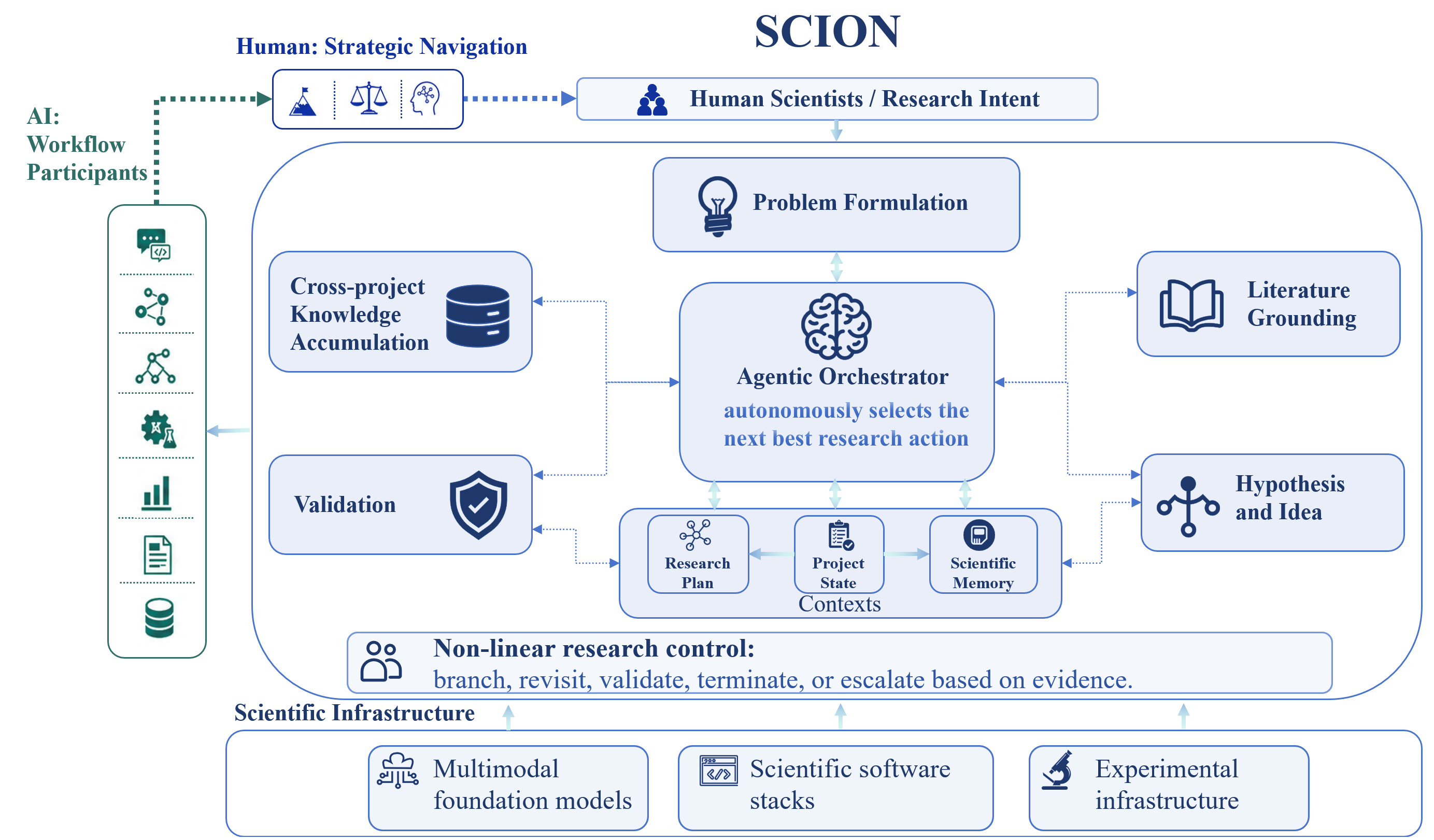
Figure 1: SCION as the organizational nexus bridging high-level scientific intent with tools, agents, artifacts, and memory during research execution.
SCION’s Organizational and Architectural Foundations
SCION distinguishes itself via the central role of the Research Execution Plan (REP), a compiled representation of high-level scientific intent that enumerates objectives, constraints, dependencies, verifiability criteria, required artifacts, and fallback strategies. This REP serves as the backbone for orchestrated agentic activity, shifting research workflows from ephemeral scripts or informal communication to persistent, machine-auditable operational objects.
The architecture comprises:
- Hierarchical Multi-Agent Runtime: Agents are organized in a hierarchy, realizing cognitive division of labor to maintain project-level cleanliness while offloading operational work to specialized agents for literature grounding, ideation, scientific reasoning, execution, and collaboration.
- Selective Context Construction: Each agent receives a tailored context block informed by mission, objective, environment, tools, skills, and memory, ensuring role-appropriate visibility and limiting prompt bloat or contamination.
- Layered Epistemic Memory: Session (L1), durable (L2), and reference (L3) memory scopes maintain continuity, recoverability, and auditability; memory access is profile-governed and role-specific.
- Governed Delegation and Recovery: Dedicated delegation machinery supports asynchronicity, explicit rationale, critic checkpoints, anomaly detection, and intermediate rollback, ensuring robust long-horizon execution.
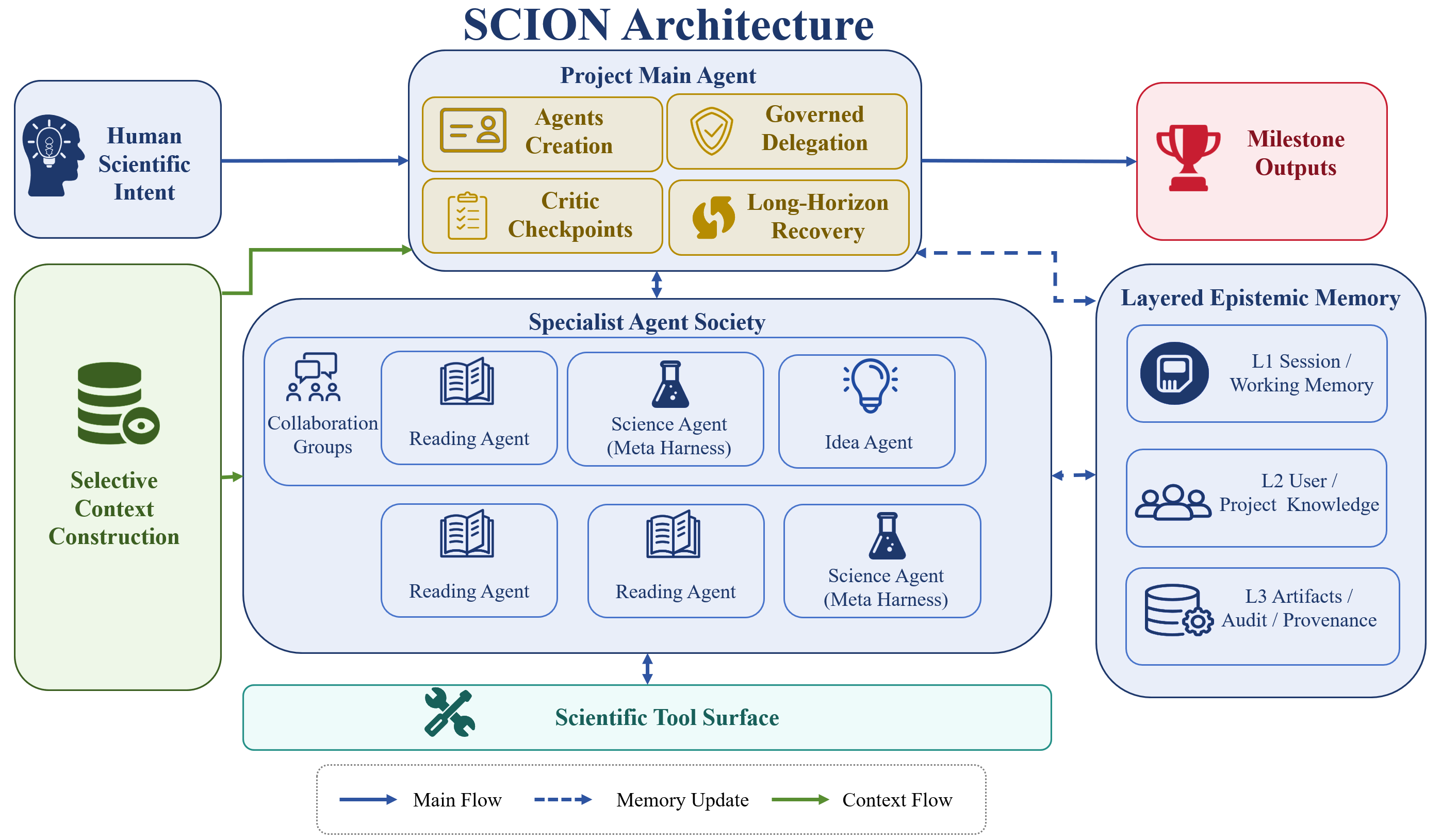
Figure 2: SCION’s core architecture showing hierarchical multi-agent organization, context, memory, and governed delegation enabling persistent, auditable workflows.
A central contribution is formalizing the scientific discovery process in SCION as a target-conditioned inverse search—shifting the operational focus from forward prediction (i.e., property estimation) to an inverse-design paradigm under governed verification and adaptive memory updates.
Target-Conditioned Inverse Search
Given a forward process f:X→Y mapping candidate objects (e.g., molecules, materials, proteins) to observed or predicted properties, SCION’s Science Agent operationalizes an approximate inverse search:
X∗≈fSA−1(Y∗)
where fSA−1 denotes a system-realized inverse operator that, for a specified target Y∗, iteratively refines X via planning, candidate generation, tool-driven execution, verification, and memory update. This procedure is adaptively realized—not via a closed-form inverse—but as a search pipeline that is robust to verification feedback, constraints, and runtime failures.
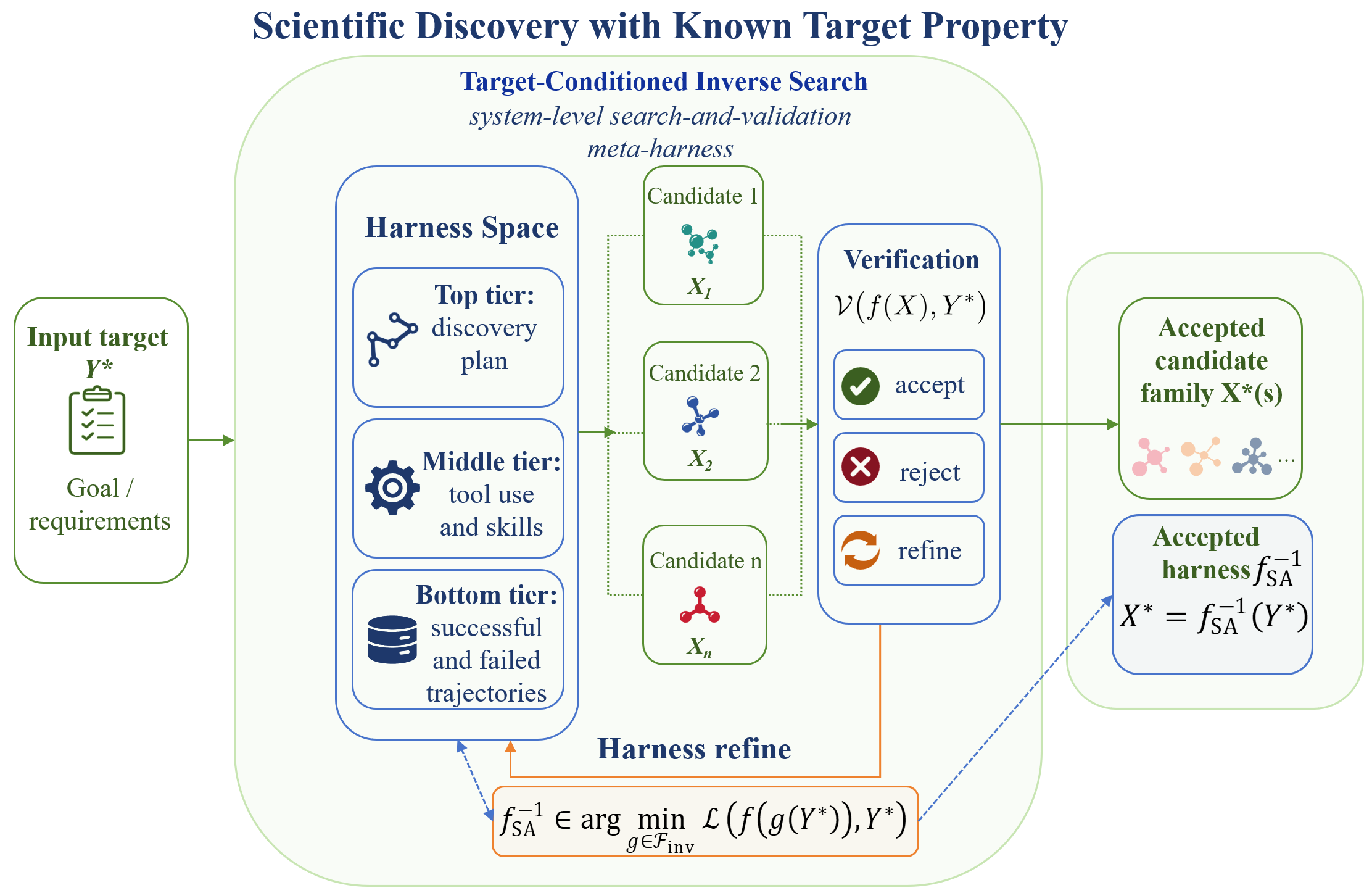
Figure 3: Science Agent performing inverse search by refining candidates through planning, generation, execution, verification, and memory updates.
Batch Active Search and Hidden Targets
For settings where the target property is unknown or only partially observable, discovery is framed as budget-constrained batch active search. In this scenario, the system iteratively selects candidate batches for evaluation under a query budget, incorporates continuous (graded) and binary feedback, updates beliefs, and adapts future search policies to maximize high-value discoveries.
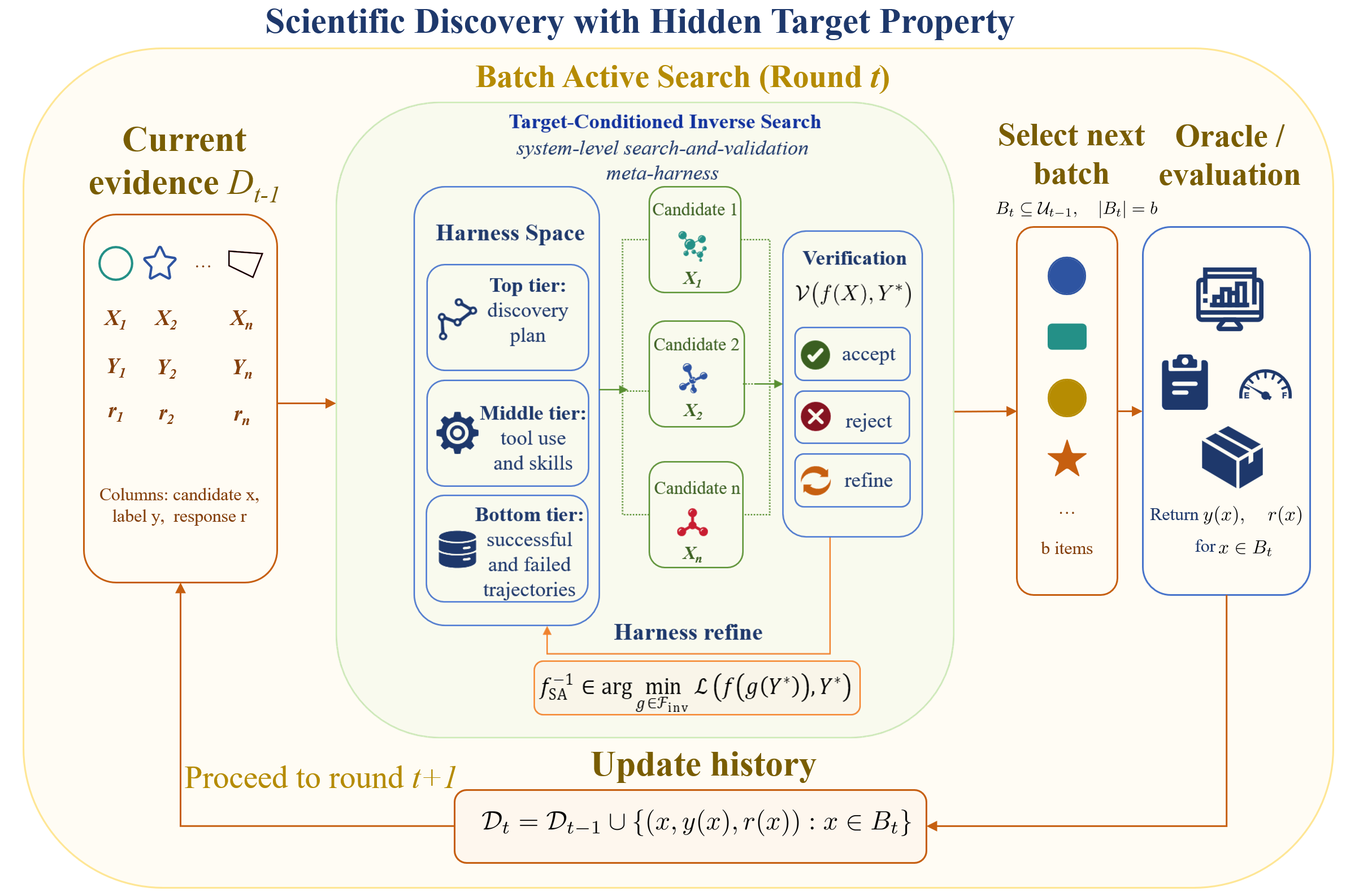
Figure 4: SCION orchestrating batch active search under hidden target properties using iterative, feedback-conditioned policy revision.
Application Instantiations
The paper demonstrates SCION’s generality by instantiating its inverse-search and active-search mechanisms in three scientific domains:
- Theoretical Materials Analysis: SCION coordinates generation, simulation, and verification of crystal structures, handling constraints such as charge balance and thermodynamic feasibility by encoding these in the REP and enforcing branch-level traceability.
- Multi-Property Molecule Design: Candidate molecular graphs are generated and filtered under multiple property constraints (e.g., toxicity, potency, synthesizability) using coordinated agents for generation, property prediction, verification, and memory reuse. The success rates under challenging, multi-objective tasks are significantly higher when using SCION's agentic workflow.
- Target-Specific Antibody Screening: SCION’s active-search approach leverages feedback from previous screens (both binary hits and graded properties) to allocate limited experimental budgets efficiently, optimizing next-batch selection strategies and improving downstream enrichment for successful candidates.
Empirical evaluation covers four benchmarks:
- Scientific Reading and Physics Reasoning: On the CMPhysBench benchmark, SCION achieves a SEED score of 44.10 and final-answer accuracy of 35.58%, outperforming EvoScientist and other leading agentic baselines in both symbolic and numeric reasoning.
- Idea Generation: Pairwise LLM-judged novelty comparisons show SCION winning over all existing autonomous research agents across nearly all queries (including 100% win rates against some baselines).
- Multi-Property Molecule Generation: On tasks demanding simultaneous satisfaction of 3-4 competing constraints, SCION achieves an average success rate of 0.3064 (compared to 0.1897 for the next-strongest baseline), underscoring its efficacy in orchestrating constraint-aware, auditable workflows.
- Antibody Screening (Active Search): In a simulated next-round selection, SCION’s F1 rises to 0.370 (vs. 0.278 for ARIS), yielding up to 33% relative improvement over the closest baseline in batch positive recovery.
These strong numerical results support the claim that auditable, profile-governed, multi-agent orchestration yields measurably more reliable and constraint-satisfying discovery versus pipeline or monolithic agentic baselines.
Implications, Limitations, and Prospects
SCION reframes the role of AI in scientific discovery—from model-centric prediction to runtime orchestration of executable, auditable scientific plans. This elevates agentic AI from reactive assistants to operational collaborators, with potential to unlock new productivity frontiers in laboratory automation, cross-project knowledge transfer, and provenance-traceable scientific workflows.
The practical implications for laboratory informatics include streamlined human oversight (strategic navigation, ethical alignment, high-dimensional judgment), robust recoverability and repeatability, memory-driven knowledge accumulation, and systematic failure analysis.
On the theoretical front, the meta-harness formulation invites further work on:
- Learning optimal or near-optimal search policies for complex, multi-stage, partially observed scientific problems.
- Integrating real-time experimental feedback with cognitive agent societies in cyber-physical lab environments.
- Formalizing the tradeoffs between autonomy, traceability, and human-in-the-loop governance across scientific disciplines.
Coupling SCION’s agentic organization with high-throughput automated experimentation and robust FAIR-compliant data infrastructure may ultimately provide a substrate for cyber-physical autonomous science.
Conclusion
SCION, as formalized in "Rethinking Scientific Discovery in the Agentic Era," advances an organizational and architectural transformation for AI-enabled science. By positioning scientific workflows as first-class computational objects and operationalizing discovery as inverse and active search under persistent memory and governed collaboration, SCION achieves both superior empirical results and a robust foundation for traceable, adaptive, multi-agent scientific innovation. Future development should explore integration with physical automation, policy-driven oversight, and advanced epistemic governance to further elevate the agentic paradigm in scientific discovery.