Unlocking Lossless Speedups in LLMs via Discrete Diffusion
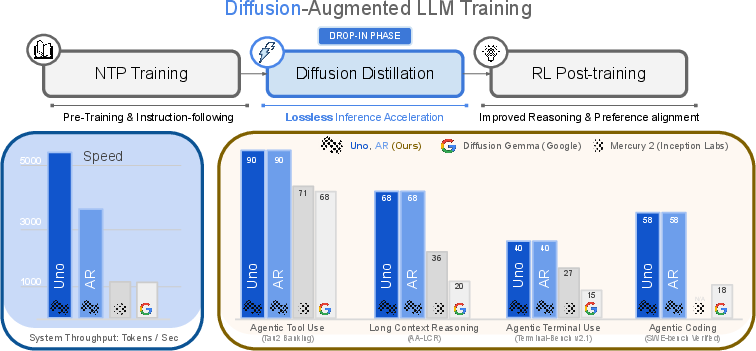
Abstract: LLMs owe much of their success to next-token prediction (NTP), but their autoregressive (AR) structure requires slow, sequential token generation. To overcome this bottleneck, we introduce diffusion-augmented LLMs, a new class of models that defines an AR model distribution while using diffusion to draw multiple tokens in parallel from that distribution. We decouple the parameters of these models into two sets: AR weights, trained using the standard NTP objective, and lightweight diffusion weights, trained to generate multiple tokens simultaneously. The diffusion weights are learned through a simple Diffusion Distillation phase that adds negligible overhead to existing LLM training pipelines. We also introduce -Spec, a family of samplers that enables lossless acceleration and inference-time scaling at a fixed context length. Unlike speculative decoding, our method requires no separate draft model. Unlike diffusion LLMs (d-LLMs), it accelerates generation without sacrificing the quality of the underlying AR model. The resulting models, called Uno, can be trained from scratch or built by augmenting existing open-weight AR LLMs. Uno achieves higher throughput than leading speculative-decoding methods at every evaluated batch size and delivers up to speedups over the base AR model, including at the largest batch size supported by the device. Notably, our 8B Uno model outperforms the leading open d-LLM, the 26B DiffusionGemma, and the proprietary Mercury 2 across all evaluated benchmarks in agentic tool use, coding, and long-context reasoning. We release code and checkpoints at: https://s-sahoo.github.io/uno/
Paper Prompts
Sign up for free to create and run prompts on this paper.
Top Community Prompts
Explain it Like I'm 14
1. What is the paper about?
This paper presents a way to make LLMs produce text faster without making their answers worse.
Most modern LLMs write text one token at a time. A token can be a word, part of a word, or punctuation. For example, to write:
“The cat is sleeping.”
the model might generate “The,” then “cat,” then “is,” and so on. This method is reliable, but it can be slow because each new token depends on the previous ones.
The researchers introduce a new model called Uno. Uno combines:
- a normal LLM that is good at producing high-quality answers, and
- a diffusion-based system that guesses several tokens at once.
Uno then checks those guesses using the normal LLM. This allows it to be faster while still producing the same kind of output as the original model.
2. What questions did the researchers ask?
The paper mainly investigates these questions:
- Can an LLM generate several tokens at once without losing answer quality?
- Can this be done without training or storing a separate smaller “draft” model?
- Can the model remain faster when many users are using it at the same time?
- Can the same method speed up reinforcement learning, where an AI generates many trial answers during training?
- Can Uno perform as well as or better than other fast-generation models?
The researchers were especially interested in practical speed. They did not only test one request at a time. They also tested large batches of requests, which is more like how AI services work in real life.
3. How did they conduct the research?
Normal language-model generation
The original model uses autoregressive generation. This means it predicts the next token based on the tokens already written.
An everyday analogy is completing a sentence while only being allowed to write one word before checking your work. It is careful, but it takes a long time.
Diffusion-based drafting
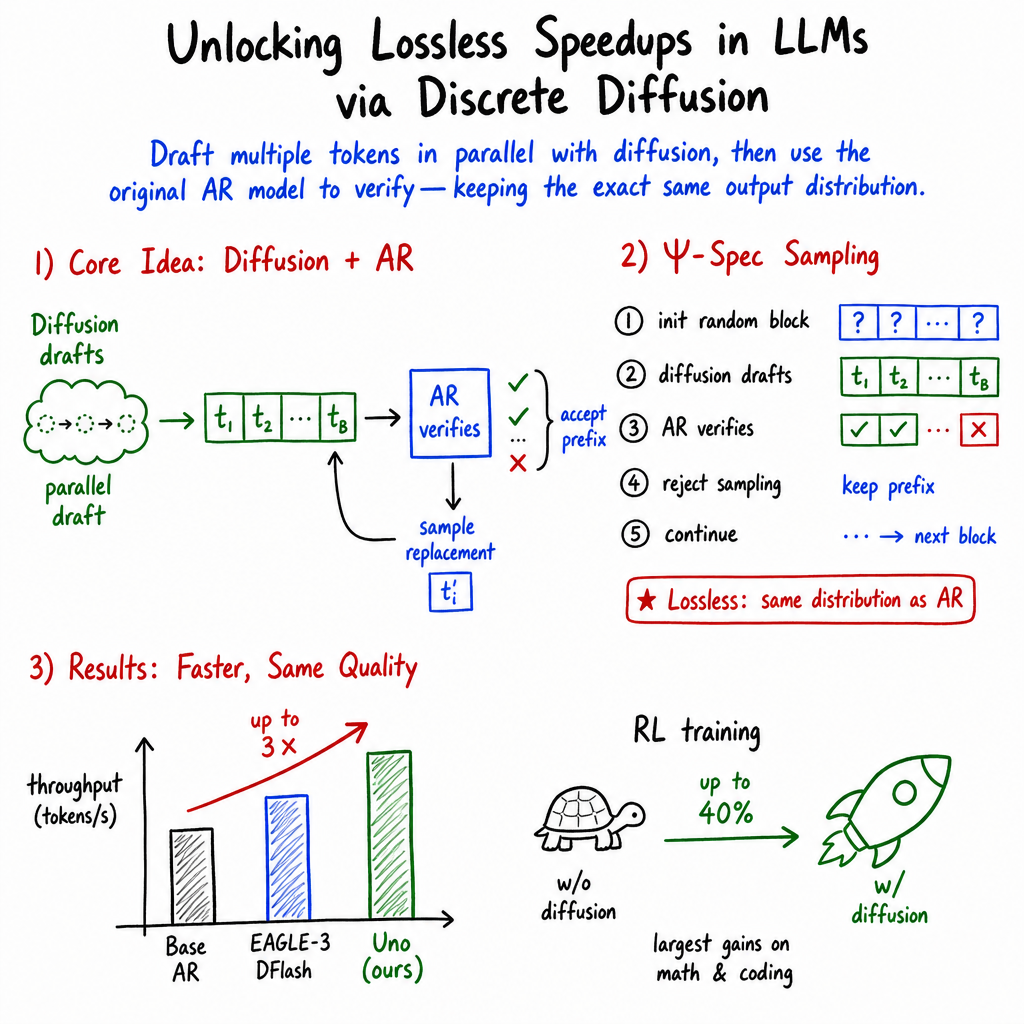
Uno adds a second pathway that can make a quick guess about a whole group, or block, of tokens.
This is similar to trying to fill in several missing words in a sentence at the same time. The diffusion system begins with very uncertain or random tokens and gradually improves them until they form a possible sequence.
The researchers use small extra components called LoRA adapters for this diffusion pathway. These are lightweight additions to the model rather than a completely separate model. The original language-model weights are kept unchanged.
Training the extra pathway
The researchers use a process called diffusion distillation. In simple terms, the normal LLM acts like a teacher:
- The normal model generates tokens carefully, one at a time.
- The diffusion pathway learns to imitate those predictions in parallel.
The researchers train the diffusion components while keeping the main LLM frozen. This helps preserve the original model’s quality.
They also use a total variation loss. This is a mathematical way of encouraging the quick guesses and the normal model’s predictions to be similar. The closer they are, the more likely the quick guesses will be accepted.
Checking the guesses
Uno uses a method called -Spec, pronounced “Psi-Spec.”
The process works roughly like this:
- The diffusion pathway quickly proposes several tokens.
- The normal LLM checks those proposed tokens.
- The model accepts the longest correct part of the proposal.
- If a token is rejected, the normal model replaces it with a properly chosen token.
This checking step is important because it makes the acceleration lossless. In this context, “lossless” means that the final output follows the same probability rules as the original normal LLM. The model is faster, but it is not supposed to change the underlying answer distribution.
Experiments
The researchers tested Uno in two ways:
- They trained a new model from scratch.
- They added the diffusion components to an existing open model, Qwen3-8B, without retraining its main parameters.
They evaluated Uno on tasks involving:
- tool use and computer agents,
- coding,
- mathematics,
- long-context reasoning,
- general knowledge, and
- question answering.
They compared it with normal autoregressive models, speculative-decoding systems, and other diffusion LLMs such as DiffusionGemma, Nemotron-Labs-Diffusion, and Mercury 2.
They measured both:
- quality, such as how often the model solved a task correctly, and
- throughput, meaning how many tokens the system could generate per second.
4. What were the main findings?
Uno was faster than the original model
Uno generated text faster than its base autoregressive model at every tested batch size.
The paper reports that:
- Uno was about 2.2 times faster for a single request.
- It was about 1.5 times faster at the largest tested batch size.
- In some settings, the paper reports speedups of up to about 3 times.
A batch is a group of requests processed together. Large batches matter because real AI services often serve many users at the same time.
The quality stayed similar to the base model
Uno was designed to preserve the original model’s behavior. The researchers report that it had similar qualitative performance to the base autoregressive model while being faster.
This is important because some other fast-generation methods gain speed by changing the model in ways that can reduce answer quality.
Uno performed strongly against other diffusion models
The 8-billion-parameter Uno model reportedly outperformed larger competing diffusion models on the evaluated tasks, including:
- agentic tool use,
- coding,
- and long-context reasoning.
According to the paper, Uno performed better than:
- DiffusionGemma,
- Nemotron-Labs-Diffusion, and
- Mercury 2 on most of the reported categories.
The paper also reports that Uno achieved much higher system throughput than Mercury 2 in its comparison.
Uno also helped reinforcement-learning training
The researchers used Uno to speed up reinforcement learning, a process in which an AI tries many possible actions or answers and learns from the results.
Faster generation means the AI can complete more training attempts in the same amount of time. The paper reports up to a 40% reduction in end-to-end training time for some expert models, especially mathematics and coding models.
After further training, the speed advantage mostly remained. The number of tokens accepted per generation step decreased by only about 6%.
It does not need a separate draft model
Many speculative-decoding methods use one large model and one smaller model:
- The small model makes guesses.
- The large model checks them.
Uno does not need a separate draft model. Its lightweight diffusion adapters perform the drafting inside the same overall model. This can reduce memory use and simplify deployment.
5. Why are these findings important?
LLMs are becoming part of chatbots, coding tools, search systems, and computer agents. These applications often need to produce long answers or many responses at once.
If an LLM can generate more tokens per second:
- users wait less time,
- companies need fewer expensive GPUs,
- AI systems can handle more users,
- and researchers can run reinforcement-learning experiments more quickly.
Uno’s main contribution is the attempt to combine the strengths of two approaches:
- Autoregressive models are usually accurate and reliable but slow.
- Diffusion models can generate many tokens in parallel but may lose quality or become less useful at large batch sizes.
Uno uses diffusion for speed and autoregressive generation for verification. The normal model acts like a careful editor checking the diffusion system’s quick draft.
Conclusion
The paper introduces Uno, an LLM that uses a lightweight diffusion system to suggest several tokens at once and a normal LLM to verify them. The experiments suggest that this can provide significant speedups while preserving the quality and output behavior of the original model.
The method could make future AI systems cheaper and faster, especially systems that serve many users or generate long reasoning and coding responses. However, the results come from the authors’ selected tests and hardware settings, so more independent research would be needed to determine how well the method works across other models, devices, languages, and real-world applications.
Knowledge Gaps
Knowledge gaps, limitations, and open questions
- Limited model-scale validation: The method is primarily demonstrated with an approximately 8B-parameter Uno model; its effectiveness for much smaller, larger, mixture-of-experts, encoder–decoder, or state-space models remains unestablished.
- Narrow hardware evaluation: Throughput results are largely measured on a single H200 GPU using a custom Nano-vLLM implementation. Generalization to other GPUs, TPUs, accelerators, multi-GPU deployments, quantized inference, and production serving stacks is unresolved.
- Incomplete end-to-end systems analysis: The paper reports token throughput but provides limited analysis of latency distributions, time to first token, inter-token latency, memory consumption, energy use, communication overhead, and scheduler effects under realistic heterogeneous workloads.
- Unclear reproducibility of the throughput comparisons: Several implementation details that can materially affect results—kernel optimizations, compilation settings, precision choices, batching policies, KV-cache management, and baseline-specific tuning—are not fully reported.
- Potentially asymmetric baseline comparisons: The compared models differ in parameter count, training data, context length, hardware, precision, sampling configuration, and architectural design. It remains unclear how much of Uno’s advantage persists under parameter-, data-, precision-, and hardware-matched comparisons.
- Insufficient comparison with strong speculative-decoding baselines: Although EAGLE-3 and DFlash are mentioned, the presented experimental discussion emphasizes diffusion-language-model baselines. A comprehensive, matched comparison against self-speculative decoding, Medusa-style methods, draft-model speculative decoding, and other current speculative systems is still needed.
- Limited ablation of diffusion-adapter design: The paper fixes the LoRA rank, scaling factor, insertion locations, and adapter parameterization in the main experiment. The accuracy–memory–throughput trade-offs associated with adapter rank, layer selection, attention/MLP placement, and alternative adapter types remain unexplored.
- Unclear dependence on block size and sampler configuration: Only a small number of block sizes, branching factors, and candidate budgets are evaluated. The optimal settings across model sizes, context lengths, batch sizes, hardware, and workload types are not characterized.
- No systematic study of acceptance-rate dynamics: The paper reports TPF, but does not fully analyze acceptance rates by token position, block position, prompt type, generation phase, temperature, context length, or post-training stage. Such analysis is necessary to explain when and why the method succeeds or fails.
- Distribution-preservation claims are narrower than the practical evaluation: Rejection sampling theoretically preserves the AR target distribution under the stated assumptions, but the paper does not quantify numerical deviations introduced by finite-precision arithmetic, tree candidate pruning, implementation approximations, batching, or sampler-specific heuristics.
- The meaning of “lossless” is not empirically stress-tested: The paper does not provide large-sample statistical tests showing that Uno and the base AR model have indistinguishable output distributions, pass rates, calibration, toxicity rates, refusal behavior, or long-tail behavior across diverse prompts.
- Robustness under temperature and sampling changes is unclear: Most reported configurations use a specific temperature, top-, and top- setup. The effect of these choices on acceptance rates, quality preservation, and speed is not systematically evaluated.
- Training-data mismatch is insufficiently investigated: The open-weight experiment trains diffusion adapters on OpenThoughts rather than the original AR training distribution, but the limits of this transfer are unknown. It is unclear how domain shift affects acceptance, factuality, coding, multilingual performance, and safety.
- Diffusion-distillation data requirements are not established: The paper uses billions of distillation tokens, but does not determine the minimum amount of data, the importance of data diversity, or whether synthetic, unlabeled, domain-specific, or sampled-on-policy data would be more effective.
- Training-cost comparisons are incomplete: The claim of negligible training overhead is not supported by a full comparison of additional compute, memory, energy, wall-clock time, optimizer states, storage, and engineering complexity relative to training or serving a separate speculative draft model.
- Stability after continued RL training is underexplored: The reported retention of speedup after RL is based on a particular training recipe and a nominal TPF decrease. The relationship between policy drift, adapter staleness, acceptance rates, and downstream quality over longer or more aggressive RL runs remains unresolved.
- RL speedup evidence is incomplete: Detailed RL results are deferred to a future revision, leaving unclear the number of rollouts, hardware allocation, reward-model and tool-call overheads, variance across tasks, and whether the reported end-to-end gains persist beyond the selected mathematics and coding settings.
- Adapter updating during RL is not studied: The paper freezes diffusion adapters during RL, but does not compare this strategy with periodically refreshing, jointly training, or distilling adapters from the evolving AR policy.
- Long-context behavior is not sufficiently characterized: Although the model supports very long contexts, the throughput test uses a 1K-token prompt and 8K-token output. Performance, acceptance, memory use, and quality at 32K–512K contexts and long generated trajectories require systematic evaluation.
- Tool-use and environment-interaction overheads are underexamined: The reported RL gains are smaller when tool calls dominate runtime, but the paper does not evaluate realistic end-to-end agent latency including network delays, tool execution, retries, branching, and asynchronous scheduling.
- Quality evaluation lacks broader behavioral coverage: The benchmark suite emphasizes reasoning, coding, and agentic tasks. Multilingual generation, factuality, calibration, safety, robustness to adversarial prompts, instruction following, summarization, dialogue, and creative generation are not comprehensively assessed.
- Benchmark statistical reliability is unclear: The paper does not consistently report confidence intervals, number of sampled generations, random seeds, significance tests, or sensitivity to sampling randomness, making it difficult to determine whether observed quality differences are statistically meaningful.
- Potential benchmark contamination is not addressed: The relationship between the proprietary training data, OpenThoughts, and the evaluated benchmarks is not disclosed sufficiently to assess contamination or memorization effects.
- Inference-time scaling remains largely hypothetical: The paper explicitly leaves systematic study of using more than one denoising step unresolved. The quality–compute curve, optimal number of denoising steps, interaction with AR verification, and conditions under which diffusion sampling could outperform the AR model are unknown.
- Theoretical guarantees for multi-candidate tree sampling need clarification: The paper states that verification preserves the target distribution, but the interaction between multiple candidates, prefix pruning, candidate ranking, and residual sampling should be formally specified and empirically validated.
- Failure modes of one-step block denoising are not identified: It remains unclear which linguistic structures, token types, domains, or generation stages produce poor drafts and whether adaptive block sizes or confidence-based termination could mitigate them.
- Applicability beyond causal Transformers is unvalidated: The framework claims compatibility with SSMs and other causal architectures, but no experiments demonstrate that the proposed training and verification procedures transfer beyond the evaluated Transformer.
- Memory overhead is incompletely reported: The additional LoRA parameters, activations, candidate trees, verification batches, and KV-cache requirements may affect deployment capacity, especially at large block sizes and batch sizes. A complete memory breakdown is missing.
- Interaction with quantization and compression is unknown: The experiments use bfloat16, while practical deployments often use weight-only, activation, or KV-cache quantization. The effects of quantization on draft quality, rejection correction, exactness, and throughput are unresolved.
- Serving under dynamic request lengths is not evaluated: Fixed 1K/8K tests do not capture variable prompt lengths, early stopping, mixed generation lengths, streaming requests, cancellations, or continuous batching.
- No analysis of worst-case latency or tail behavior: Aggregate throughput may conceal high latency variance caused by rejected drafts, tree verification, or heterogeneous request lengths. P95/P99 latency and service-level-objective performance remain unreported.
- The relationship between AR quality and diffusion-draft quality is not fully understood: The paper assumes that freezing the AR pathway separates quality from speed, but does not establish whether adapter training can indirectly affect quality through decoding bugs, numerical interactions, or changes in the effective sampling procedure.
- Cross-checkpoint and cross-training-stage transfer is unexplored: It is unclear whether adapters trained after SFT remain effective after different RL algorithms, model merges, alignment procedures, continued pretraining, or substantial changes to tokenizer and context-length configuration.
- The method’s economic advantage is not quantified: A complete cost analysis comparing Uno with separate draft models, larger accelerators, alternative speculative methods, and diffusion LLMs is needed to determine when the additional adapter training and verification computation are financially beneficial.
Practical Applications
Immediate Applications
The paper’s main practical contribution is a diffusion-augmented autoregressive LLM that uses lightweight LoRA-based diffusion adapters for parallel drafting while retaining the original autoregressive model as a verifier. Because verification preserves the base model’s output distribution, the most immediate applications are deployment and training optimizations rather than entirely new model capabilities.
- Higher-throughput LLM serving for commercial APIs (Software, cloud infrastructure, enterprise AI)
- Deploy Uno-like adapters alongside an existing open-weight causal LLM to generate several candidate tokens in parallel and verify them with the original model.
- Use the Linear sampler at high batch sizes to maximize aggregate system throughput and the Tree sampler at batch size one or low concurrency to reduce individual request latency.
- Potential products include drop-in inference engines, model-serving plugins, and scheduler policies that automatically select sampler parameters based on batch size, context length, and GPU utilization.
- The paper reports speedups of roughly at the largest tested batch size and approximately at batch size one for its Uno model, although these figures should be validated on additional hardware and workloads.
- Dependencies: access to model weights or an equivalent architecture, implementation support for gated LoRA and tree attention, sufficient GPU memory for the adapter and verification pass, and tuning of block size , branching factor , and candidate budget .
- Lower-cost inference for agentic applications (Software agents, customer service, automation)
- Apply the method to systems that produce long reasoning traces, invoke tools, branch into multiple agents, or retry failed actions.
- Faster token generation can reduce latency and accelerator-hours in coding agents, terminal agents, airline or retail assistants, and workflow automation systems.
- The application is especially relevant because the paper evaluates agentic tool use and reports that speedups persist at realistic serving batch sizes rather than only at batch size one.
- Dependencies: tool-call latency may dominate total execution time; the paper explicitly observes smaller gains in tool-use and web-search RL workloads when external calls are the bottleneck. Faster generation also does not remove latency from databases, APIs, browsers, or human approval steps.
- Accelerated coding assistants and software-development workflows (Software engineering)
- Integrate diffusion-augmented decoding into IDE assistants, code-completion servers, repository agents, and automated patch-generation systems.
- Candidate code blocks can be drafted in parallel while the original AR model verifies them, potentially improving completion responsiveness and the throughput of batch code-review or test-generation jobs.
- The approach is suitable for open-weight coding models because the paper demonstrates augmentation of an existing AR model without retraining its base parameters.
- Dependencies: exact distribution preservation does not guarantee that every downstream workflow is behaviorally identical under implementation errors; code-generation quality, latency of compilation/tests, and acceptance rates may vary with programming language and domain.
- Faster long-context document processing and reasoning (Knowledge management, legal technology, research tools)
- Use the method for summarization, document question answering, report generation, and long-context reasoning where output sequences are long and KV-cache and weight-transfer costs are substantial.
- Serving systems could retain the existing long-context AR model while adding adapters trained on representative instruction or reasoning data.
- Potential products include faster legal-document assistants, enterprise search agents, scientific literature systems, and report-generation pipelines.
- Dependencies: the reported throughput tests use fixed input and output lengths, including a 1K/8K setup; real performance will depend on prompt length, context-window implementation, memory bandwidth, KV-cache capacity, and output-length distribution.
- Reduced cost and latency for reinforcement-learning post-training (AI research, model development)
- Train diffusion adapters after supervised fine-tuning and use them to accelerate rollout generation during PPO-, GRPO-, or DAPO-style RL.
- The paper reports up to a 40% end-to-end RL training speedup in mathematics and code-specialist training, with a nominal 6% decrease in tokens per forward pass after RL updates.
- This can shorten experimentation cycles for model alignment, reasoning optimization, tool-use training, and domain-specialist models.
- Dependencies: the adapters must remain sufficiently aligned with the evolving AR policy; acceptance rates may deteriorate under large policy updates. Rollout acceleration is less useful when reward computation, environment simulation, or tool calls dominate runtime.
- Retrofitting existing open-weight LLMs (Model infrastructure, research engineering)
- Add rank-constrained diffusion adapters to deployed models such as decoder-only Transformers, without retraining or modifying the original AR weights.
- This creates a practical migration path: preserve existing checkpoints, safety tuning, evaluation results, and model interfaces while adding an acceleration layer.
- The same design may be applicable to other causal architectures, including state-space models, as suggested by the paper.
- Dependencies: the method requires compatibility between the base architecture and the proposed adapter/gating mechanism. Adapter rank, training data, context length, and block size must be re-optimized for each model.
- Serving-system optimization and adaptive decoding (Cloud operations, hardware utilization)
- Implement a runtime controller that switches between Linear and Tree sampling according to concurrency, available compute, memory pressure, and latency objectives.
- At high batch sizes, the system can avoid expensive multi-candidate verification; at low batch sizes, it can use spare compute to verify several candidates concurrently.
- This could improve GPU utilization and reduce cost per generated token in multi-tenant inference clusters.
- Dependencies: benefits are hardware- and workload-dependent. Verification overhead can eliminate gains if candidate trees are too large or if the device is already compute-bound.
- Energy and carbon reduction in LLM data centers (Energy, sustainability policy)
- If the throughput improvements translate into fewer GPU-hours per request, operators can reduce energy consumption or serve more requests with the same hardware fleet.
- The method may be useful for carbon-aware scheduling, capacity planning, and energy-efficiency reporting.
- Dependencies: lower energy per token is not established directly by the paper. Extra diffusion computations, adapter memory, verification passes, and increased demand caused by lower prices could offset some savings; direct power measurements are required.
- Reproducible research and benchmarking tools (Academia)
- Use the released code, checkpoints, Nano-vLLM, and SGLang integrations to reproduce comparisons between AR decoding, speculative decoding, and diffusion-based methods.
- Researchers can study throughput at fixed input and output lengths, batch sizes, and acceptance rates rather than comparing models with different reasoning-trace lengths.
- Dependencies: reproducibility depends on access to comparable GPUs, exact software versions, sampler settings, and full benchmark details. The supplied paper text appears truncated before all experimental tables and results are presented.
Long-Term Applications
The paper also suggests broader applications that require validation beyond the reported experiments, improvements to the sampling framework, or integration with production-scale systems.
- A general acceleration layer for foundation-model families (AI infrastructure)
- Develop standardized diffusion adapters that can be attached to multiple causal LLMs, including different Transformer sizes, mixture-of-experts systems, and state-space models.
- Model providers could distribute a base checkpoint plus task-specific acceleration adapters, allowing one AR model to support different latency-throughput tradeoffs.
- Dependencies: the paper demonstrates only a limited set of architectures and models. Adapter transferability, quantization compatibility, multilingual performance, and robustness across domains remain to be established.
- Quality-preserving acceleration for safety- and compliance-sensitive systems (Healthcare, finance, public administration)
- Because AR verification and rejection correction are intended to preserve the base model’s sampling distribution, the method could accelerate regulated applications without changing an already validated model’s output distribution.
- Possible uses include clinical documentation, financial analysis, fraud-investigation assistants, public-sector case processing, and compliance reporting.
- Dependencies: “lossless” refers to the target probabilistic distribution under a correct implementation, not to correctness, factuality, fairness, or regulatory compliance. Each application would still require domain validation, auditability, privacy protection, and testing under deployment-specific sampling settings.
- High-speed autonomous software and robotics agents (Robotics, industrial automation)
- Faster generation could support agents that repeatedly plan, call tools, inspect observations, and revise actions, including warehouse robots, customer-service systems, and computer-use agents.
- A diffusion draft could propose multi-step action or tool-call sequences, while the AR verifier checks the sequence before execution.
- Dependencies: physical control and safety systems require hard real-time guarantees, uncertainty estimation, and action-level validation. Token-generation speed alone may not improve control-loop performance if perception, planning, networking, or actuator latency dominates.
- Inference-time compute scaling without increasing context length (Reasoning systems, education, scientific computing)
- The paper proposes using additional diffusion denoising steps as an inference-time quality-compute tradeoff while maintaining a fixed context length.
- This could support configurable modes such as “fast answer,” “verified answer,” and “high-compute reasoning” for tutoring systems, mathematical assistants, scientific discovery tools, and technical support.
- Dependencies: the paper leaves systematic evaluation of this scaling strategy for future work. It is not yet established when additional denoising surpasses AR quality, whether verification should be disabled in that regime, or how quality changes across tasks.
- Large-scale RL and synthetic-data generation (AI research, education, science)
- Faster rollouts could make it more economical to generate synthetic reasoning traces, preference data, coding trajectories, theorem-proving examples, or tool-use episodes.
- This may enable larger RL batches, more environment interactions, and broader exploration within a fixed training budget.
- Dependencies: faster sampling can amplify both useful and harmful data. Generated data still requires quality filtering, reward-model reliability, deduplication, contamination checks, and monitoring for distribution drift.
- Edge and on-device language generation (Mobile devices, embedded systems, personal assistants)
- A compact LoRA diffusion pathway could potentially reduce latency for local assistants, offline translation, accessibility tools, and embedded conversational systems.
- The approach might also allow a single device to serve several concurrent local applications more efficiently.
- Dependencies: the reported experiments use large H200 GPUs and an approximately 8B-parameter model. Edge deployment requires quantization, memory reduction, specialized kernels, thermal testing, and proof that verification overhead does not negate the benefit on mobile or embedded hardware.
- Cost-aware multi-tier model serving (Finance, cloud platforms)
- Providers could offer service tiers based on decoding configuration: low-latency tree sampling for interactive users, high-throughput linear sampling for batch jobs, and additional denoising for premium reasoning requests.
- Autoscaling systems could select a sampler based on request priority, GPU occupancy, and cost targets.
- Dependencies: service-level agreements require predictable latency, while speculative acceptance rates are stochastic and may vary by language, prompt, temperature, and model version. Capacity planners would need robust tail-latency measurements, not only average throughput.
- Policy standards for evaluating efficient LLMs (Public policy, standards bodies, academia)
- The paper’s fixed-length 1K/8K throughput methodology could inform more rigorous procurement and disclosure standards for AI systems.
- Evaluations could require reporting batch-size-one latency, maximum feasible system throughput, tokens per forward pass, acceptance rate, output quality, power consumption, and performance under realistic agentic workloads.
- Dependencies: no single benchmark captures all deployment conditions. Standards should also require disclosure of hardware, precision, quantization, context length, sampler settings, rejection behavior, and whether quality comparisons use matched output lengths.
- Open-source acceleration ecosystems and modular model products (Open-source software, academia)
- A mature ecosystem could provide reusable diffusion-adapter training recipes, automatic adapter-rank selection, sampler autotuning, hardware-specific kernels, and integrations with inference frameworks.
- Model publishers might release certified acceleration adapters separately from base models, simplifying updates and allowing users to retain a stable AR checkpoint.
- Dependencies: adapter licensing, model-safety compatibility, security of third-party adapters, reproducibility of claimed speedups, and maintenance across rapidly changing serving frameworks must be addressed.
Glossary
- Autoregressive (AR) model: A model that generates each token sequentially, conditioning on previously generated tokens. “Autoregressive (AR) LLMs factorize the joint distribution using the chain rule”
- Batch size: The number of requests or sequences processed together in one computation. “We report throughput at batch size 1 and at the largest batch size that fits on a single H200 GPU.”
- Bidirectional attention: An attention mechanism in which tokens can attend to tokens on both sides of their position. “It also uses masked diffusion with bidirectional attention within draft blocks.”
- Bfloat16: A reduced-precision floating-point format commonly used for efficient deep-learning computation. “whereas Uno and the other baselines use bfloat16.”
- Block-causal attention mask: An attention mask that permits causal attention within designated blocks while controlling access between blocks. “Specifically, we use a block-causal attention mask that permits causal attention within _1^{(b)}_{}: V^L \to \Delta^Lt=1t=0x:V^L\times[0,1]\rightarrow\Delta^L to draft a block of tokens in parallel”
- Diffusion LLM (d-LLM): A LLM that generates text by progressively removing noise from a token sequence. “Unlike diffusion LLMs (d-LLMs), it accelerates generation without sacrificing the quality of the underlying AR model.”
- Discrete diffusion: A diffusion process defined over discrete states, such as categorical tokens, rather than continuous values. “Discrete diffusion corrupts a clean sequence”
- Entropy-bounded diffusion sampler: A diffusion sampler that restricts sampling according to an entropy threshold. “DiffusionGemma uses ... an entropy-bounded diffusion sampler with a bound of 0.1”
- Gated LoRA: A LoRA adaptation whose effect is selectively enabled or disabled at particular sequence positions. “We achieve this using gated LoRA”
- Hadamard product: Element-wise multiplication between two vectors or matrices. “ and respectively denote the dot and Hadamard products”
- Inference-time scaling: Increasing computation during inference to improve output quality without retraining the model. “-Spec introduces an additional axis for inference-time scaling in LLMs”
- Key-value (KV) cache: Stored attention keys and values reused during autoregressive generation to avoid recomputation. “enables efficient inference primitives such as KV caching”
- Likelihood: The probability assigned by a model to observed data or a sequence. “This factorization leads to strong likelihood modeling”
- LoRA (Low-Rank Adaptation): A parameter-efficient fine-tuning method that learns low-rank updates to existing weight matrices. “We parameterize the diffusion weights as LoRA (Low RAnk) adapters”
- Memory-bound: Limited primarily by the rate of memory access rather than arithmetic computation. “decoding is often memory bound, especially at long context lengths”
- Mixture-of-experts: A model architecture containing multiple specialized subnetworks, only some of which are activated for each input. “DiffusionGemma is a sparse 26B mixture-of-experts model”
- Next-token prediction (NTP): Training a LLM to predict the token immediately following a given context. “LLMs owe much of their success to next-token prediction (NTP)”
- One-hot vector: A vector containing one active entry that identifies one category among many. “We denote scalar discrete random variables with categories as `one-hot' column vectors”
- Prefix: The initial contiguous portion of a sequence. “accepting the longest valid prefix”
- Predictor-corrector: A sampling strategy that alternates prediction steps with correction steps to improve generated samples. “incorporating predictor-corrector capabilities”
- Prior distribution: A simple reference distribution from which a generative process begins. “Discrete diffusion corrupts a clean sequence $\in V^L \sim q_{\mathrm{data}$ into a simple prior”
- Quantization: Representing model values with lower numerical precision to reduce memory and computation. “Mercury~2 does not disclose its quantization”
- Rejection sampling: A sampling method that accepts or rejects proposed samples according to a target distribution. “verifying them via rejection sampling in a single forward pass”
- Renormalized residual distribution: The probability distribution formed from the unaccepted probability mass after a proposal is rejected. “the verifier samples a replacement from the renormalized residual distribution”
- Rollout: A generated trajectory or sequence used for training or evaluating a model, particularly in reinforcement learning. “This speedup benefits multi-user serving and RL post-training.”
- Sparse attention: An attention mechanism that restricts token interactions to selected positions or windows. “DiffusionGemma uses strided attention”
- Speculative decoding: A generation method in which a smaller model proposes tokens and a larger model verifies them. “Speculative decoding accelerates generation by verifying tokens proposed by a smaller draft model”
- State-Space Model (SSM): A sequence model based on latent state transitions rather than standard self-attention. “including causal Transformers and State-Space Models (SSMs”
- Teacher distribution: The probability distribution produced by a reference model that supervises another model during distillation. “The frozen base model defines the autoregressive teacher distribution”
- Total Variation distance: A measure of the difference between two probability distributions, calculated here as the sum of absolute probability differences. “we minimize the blockwise Total Variation (TV) distance between the diffusion and the AR distributions”
- Tree attention: An attention strategy designed to evaluate multiple candidate sequences arranged as a prefix tree. “candidates are verified concurrently as a prefix tree using tree attention”
- Uniform-state diffusion: A discrete diffusion process whose corruption distribution approaches a uniform distribution over token categories. “uniform-state diffusion uses ” - **Verification pathway**: The model component that evaluates and accepts or rejects tokens proposed by a drafting component. “the verification pathway uses$”
- Warmup-stable-decay (WSD): A learning-rate schedule with an initial warmup period, a stable phase, and a decay phase. “with a WSD configuration and a 3,000-step warmup”

