Papers
Topics
Authors
Recent
Search
2000 character limit reached

DiffusionGemma Technical Report

Published 31 Jul 2026 in cs.CL and cs.AI | (2608.00146v1)

Abstract: We introduce DiffusionGemma, an experimental open-weight LLM that uses discrete diffusion to generate text at exceptionally high speed. Rather than decoding one token at a time, DiffusionGemma iteratively refines blocks of 256 tokens in parallel, avoiding the sequential decoding bottleneck of conventional autoregressive (AR) LLMs. Instead of training from scratch, we obtain DiffusionGemma by fine-tuning the mixture-of-experts Gemma 4 model with 3.8B activated and 25.2B total parameters. Our compute-efficient two-stage training pipeline uses fewer than 10% of the starting AR model's total training token budget. The first stage uses supervised fine-tuning to teach bidirectional denoising, while the second stage combines reinforcement learning with sampler distillation to jointly improve generation quality and inference efficiency. DiffusionGemma establishes a new Pareto frontier for the trade-off between generation speed and model capability. Averaged across our full evaluation suite, it generates around 20 tokens per forward pass and achieves roughly 1,500 output tokens per second on a single NVIDIA H100 GPU, which is substantially faster than AR models even with state-of-the-art speculative decoding. DiffusionGemma also retains the starting model's support for thinking mode, multimodal inputs, and long contexts. Despite diffusion fine-tuning, it remains capable of AR generation with only minor performance degradation, suggesting a path toward hybrid diffusion-AR decoding.
Summary

  • The paper introduces DiffusionGemma, an open-weight discrete diffusion LLM that denoises 256-token blocks in parallel and reaches 1,479 tokens per second at 19.74 tokens per forward pass on one NVIDIA H100.
  • Its joint reinforcement-learning and sampler-distillation pipeline reduces denoising steps to roughly 12–16 while maintaining competitive results on GPQA-Diamond, LiveCodeBench, GSM8K, and MMLU-Pro.
  • The model enables bidirectional self-correction, adaptive compute allocation, and rapid structured generation, while retaining AR usability and supporting LoRA adaptation such as 84% Sudoku accuracy with four times fewer denoising steps.

DiffusionGemma: Accelerating Open-Weight LLMs with Discrete Diffusion

Introduction and Motivation

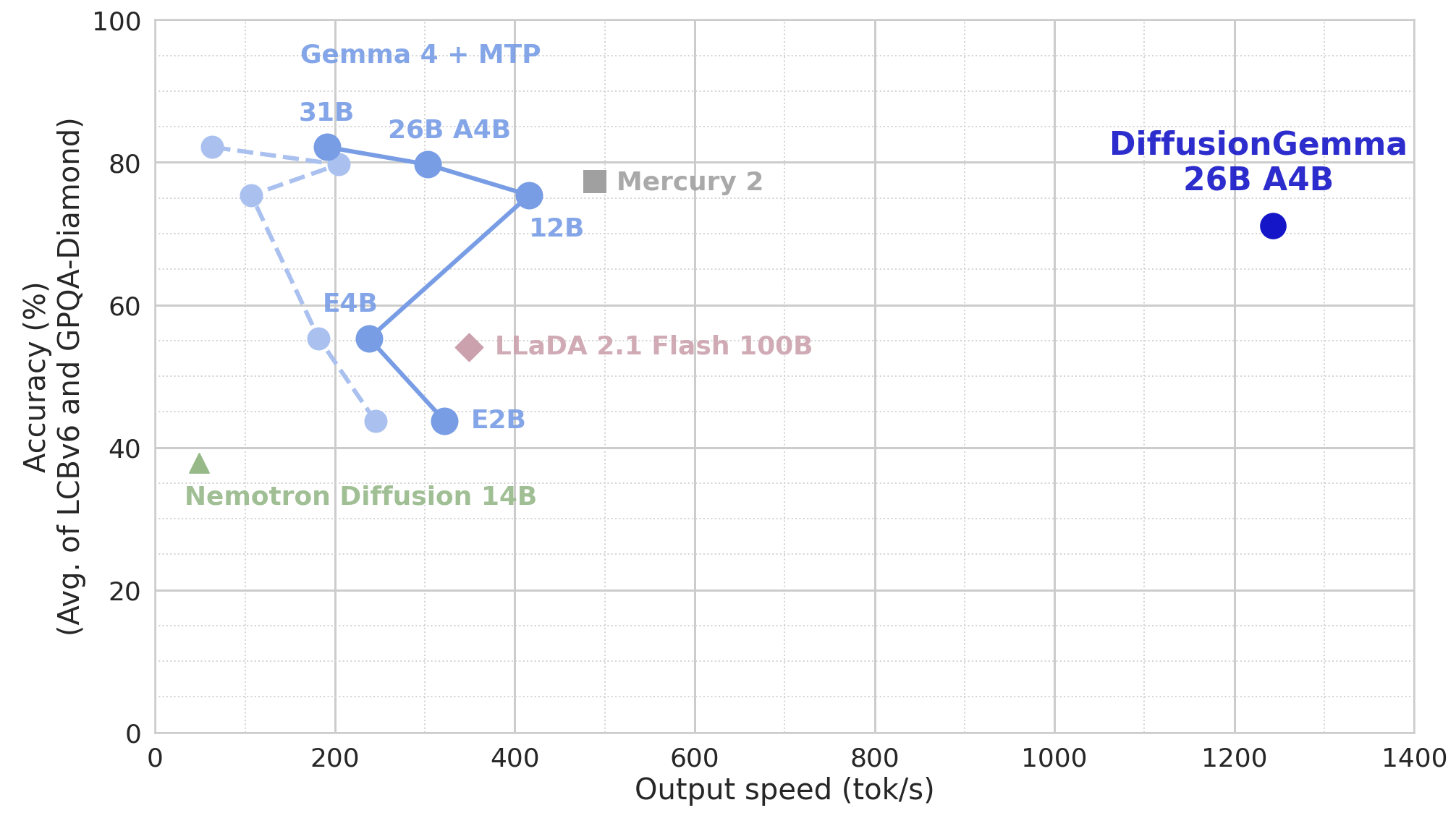
DiffusionGemma defines an experimental open-weight LLM instantiating discrete diffusion for text generation, utilizing a block-parallel denoising mechanism instead of traditional autoregressive (AR) decoding. The model is derived by finetuning the Gemma 4 26B mixture-of-experts (MoE) AR LLM and offers a compute-efficient generation pipeline that outputs entire blocks of 256 tokens in parallel. This reduces the memory-bound bottleneck of AR decoding and introduces ultra-fast inference, moving the hardware utilization from memory to compute-bound regimes. Empirically, DiffusionGemma achieves an average of 20 tokens per forward pass (TPF) and can produce approximately 1,500 output tokens per second (TPS) on a single NVIDIA H100 GPU, surpassing major AR and open diffusion baselines Figure 1.

Figure 1

Figure 1: DiffusionGemma establishes a new Pareto frontier for the trade-off between generation quality and decoding speed, outperforming both AR and previous diffusion-based models.

Notably, DiffusionGemma exposes open, permissively licensed weights and reference implementations, targeting both research transparency and practical downstream adaptation.

Discrete Diffusion Framework

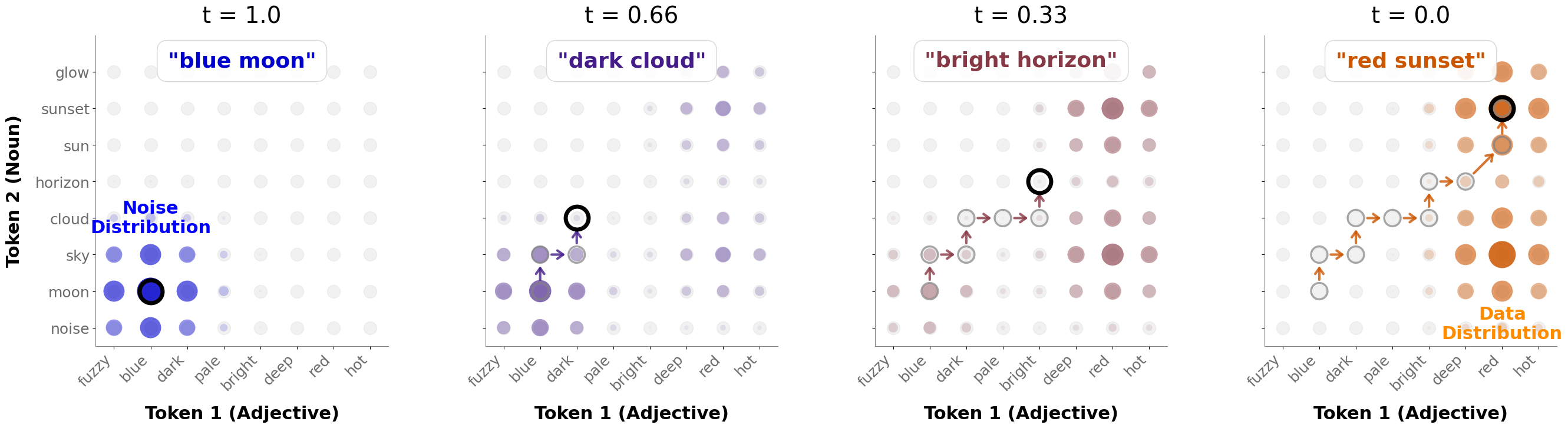
Instead of AR factorization, DiffusionGemma adopts a continuous-time Markov chain over categorical token spaces, parameterized by a monotonic noise schedule. The generative process is formally rooted in recent discrete flow-matching and Markov score-based modeling literature: data is progressively corrupted to noise during training; denoising is modeled as a blockwise, bidirectional process. At inference, the model reconstructs text from noise by iteratively refining a canvas of token states in parallel. Each denoising step stochastically transitions tokens based on their marginal posterior distributions, leveraging self-conditioning.

Figure 2

Figure 2: Stylized illustration of discrete diffusion with parallel sampling and probability paths across a 2D canvas.

Compared to continuous diffusion over projected embeddings, the strict categorical formalism avoids projection mismatch and rounding artifacts, preserving theoretical and statistical integrity in the generative trajectory.

Model Architecture and Blockwise Generation

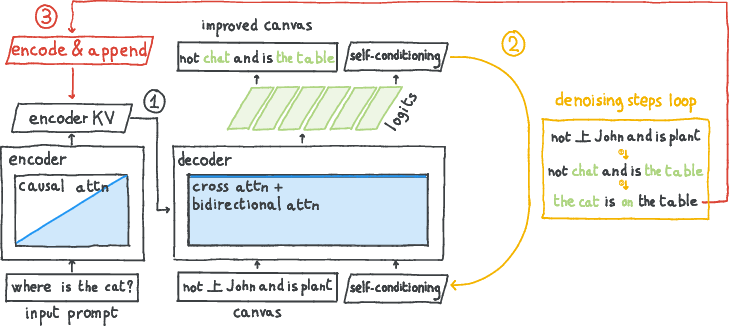
DiffusionGemma utilizes an encoder-decoder Transformer architecture, with weights initialized from the public Gemma 4 AR checkpoint. The encoder performs causal context encoding into a Key-Value (KV) cache, while the decoder leverages bidirectional attention for parallel denoising. Generation proceeds in block-autoregressive (block-AR) fashion: canvases of 256 tokens are iteratively denoised, with the completed block appended to the context, supporting efficient long-sequence generation.

Figure 3

Figure 3: The inference pipeline: context encoding, parallel denoising via bidirectional decoder, and context update for next block.

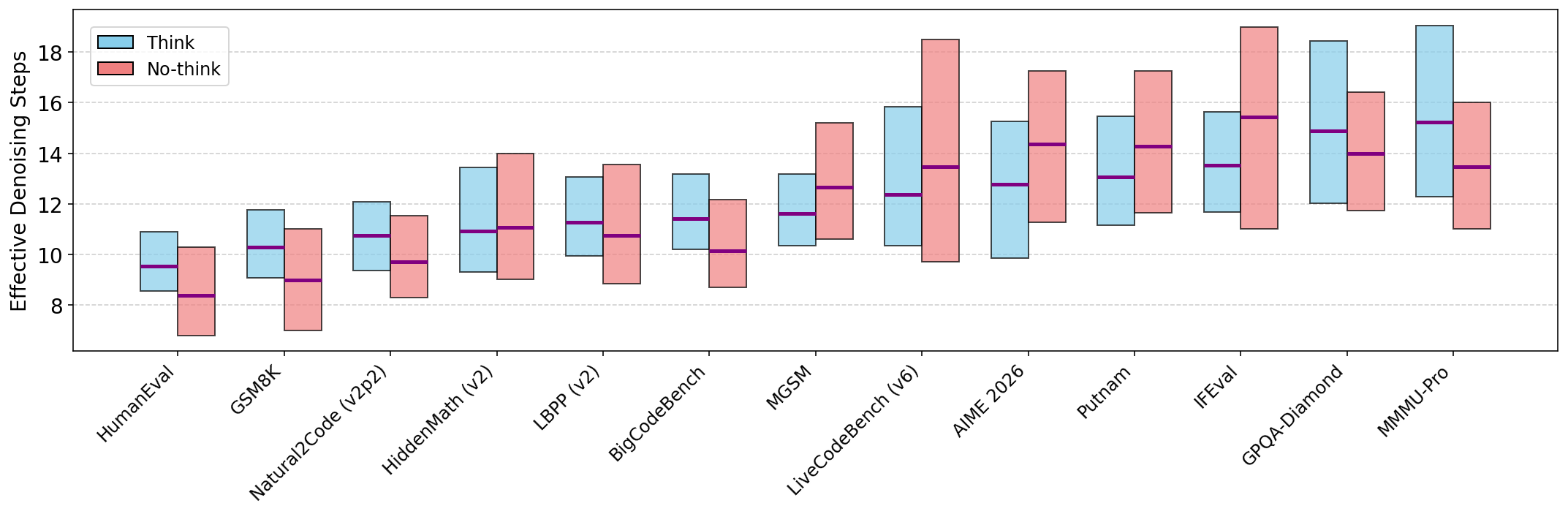
Sampling is governed by an entropy-bounded strategy with temperature annealing and adaptive stopping, balancing quality, diversity, and compute. Hard convergence is enforced when confidence thresholds are met, further optimizing inference latency Figure 4.

Figure 4

Figure 4: Adaptive stopping modulates the number of denoising steps according to task complexity and domain, reducing unnecessary computation.

Training Pipeline: Supervised Finetuning and Joint RL/Sampler Distillation

Two training stages are employed:

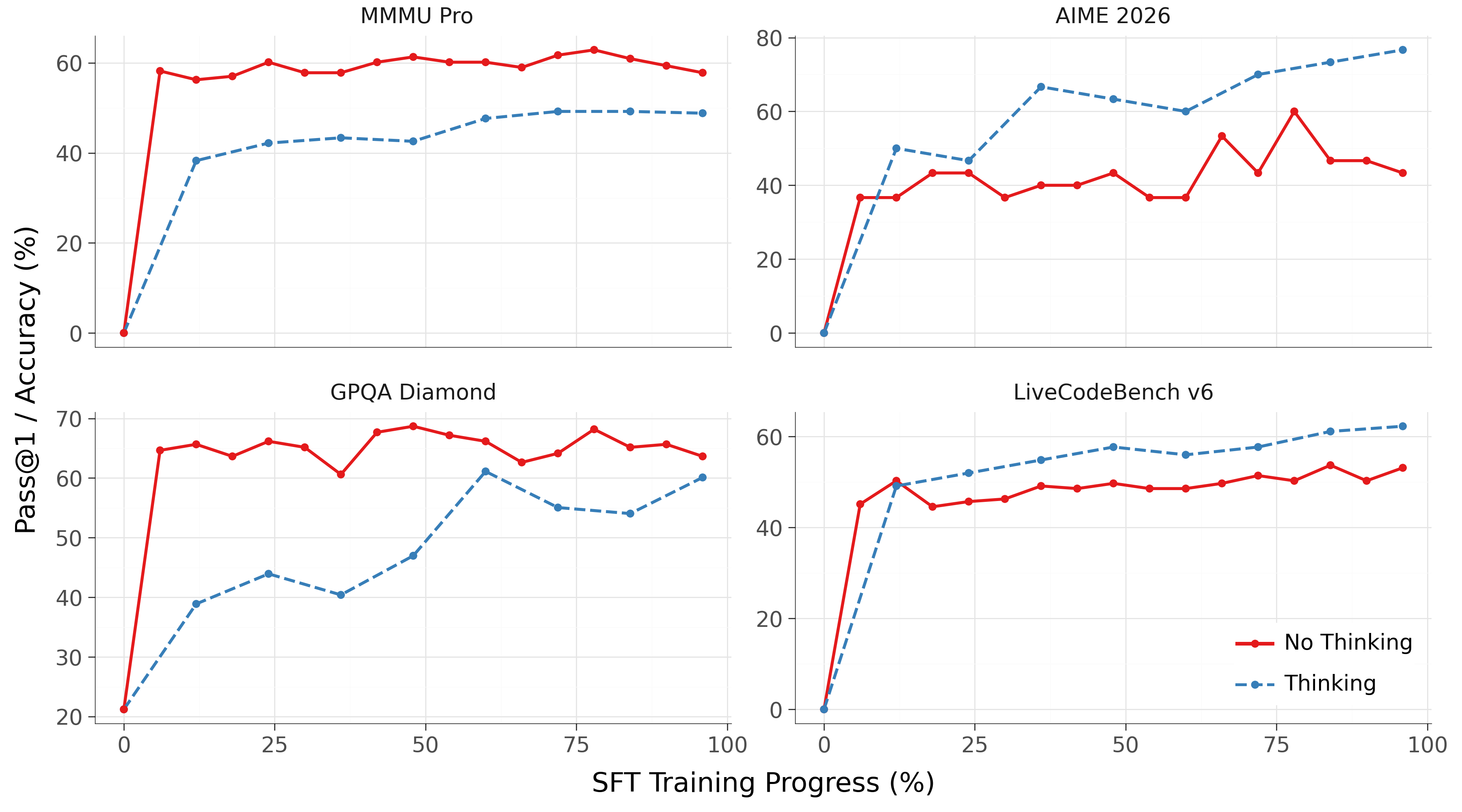
  1. Supervised Fine-Tuning (SFT): The model adapts to bidirectional, blockwise discrete diffusion via cross-entropy minimization using noise-corrupted inputs sampled at random time schedules. Downstream performance grows log-linearly, with significant gains for extended SFT in reasoning-oriented (“thinking”) mode (Figure 5, Figure 6).

Figure 5

Figure 5: SFT performance evolution differentiating thinking and non-thinking behaviors.

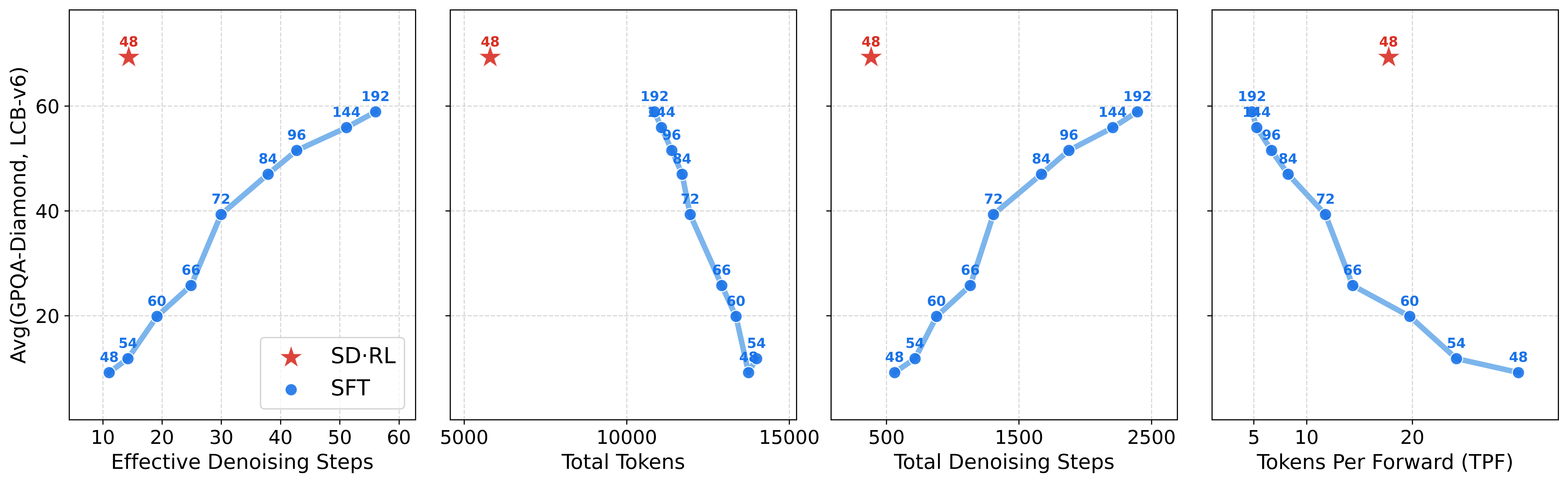
  1. Joint RL and Sampler Distillation: To simultaneously raise generation quality and compress the denoising trajectory for ultra-low latency inference, an online objective combines reward maximization and sampler distillation. This curriculum results in reduced effective denoising steps and higher reward over time Figure 7. The resulting model advances the speed-to-quality Pareto frontier notably compared to the SFT baseline, especially in the few-step regime (Figure 8, Figure 9).

Figure 8

Figure 8: RL- and distillation-optimized checkpoints deliver significantly improved quality-speed tradeoffs over SFT baselines as measured by TPF and benchmark score.

Inference Efficiency and Hardware Optimization

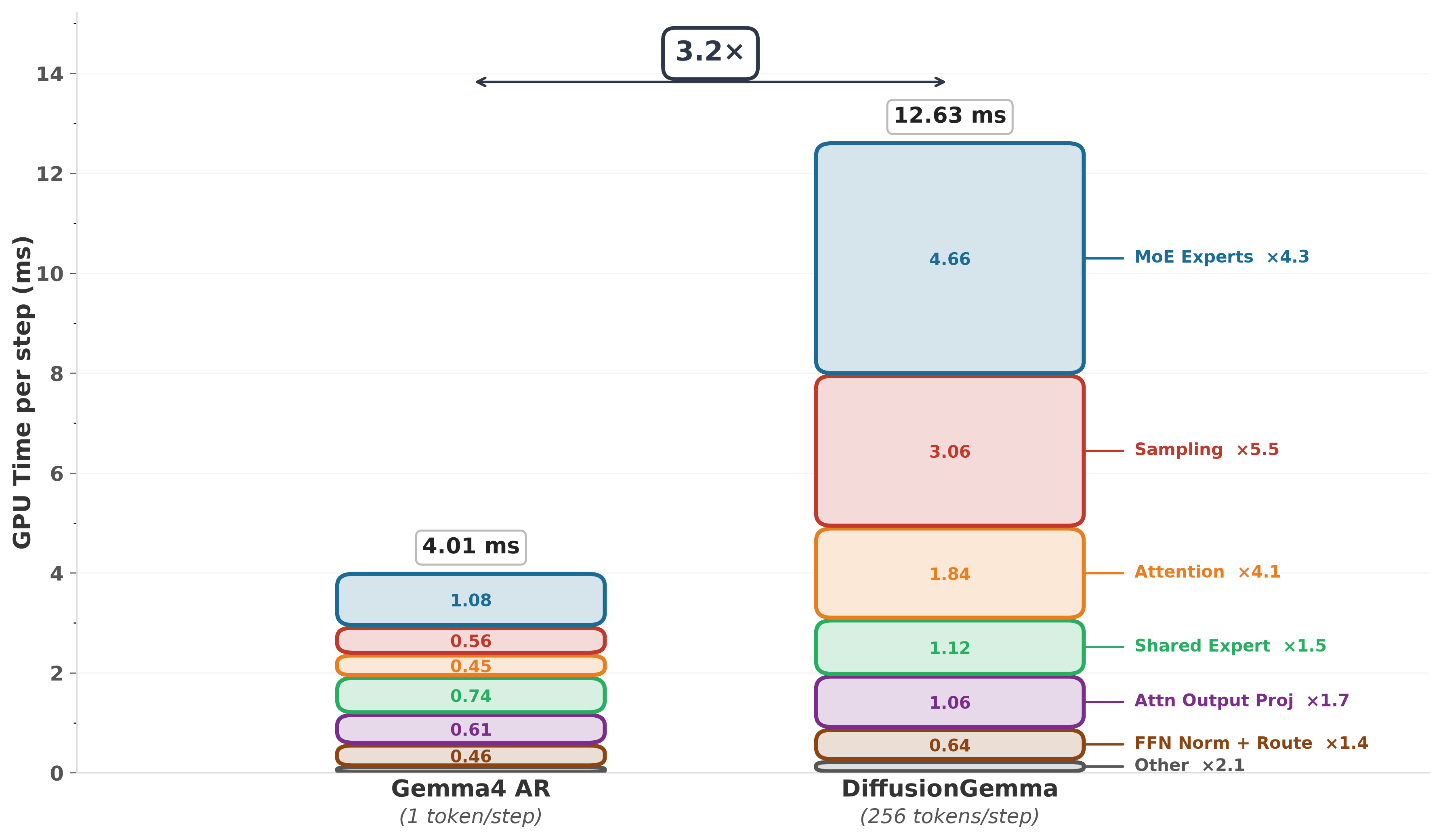
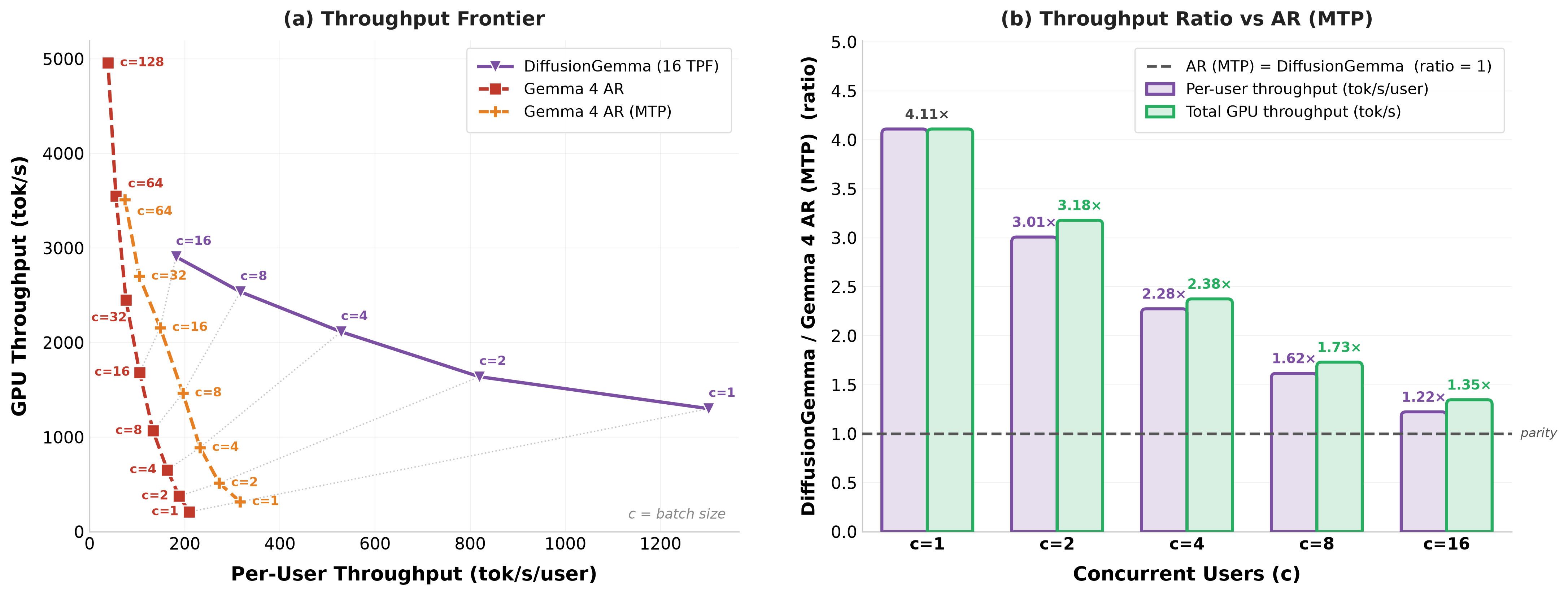
The practical efficiency of DiffusionGemma arises from substantially fewer overall forward passes with moderately heavier each-pass compute. Per-step, DiffusionGemma is only 3.2× slower than AR for single-token generation, yet processes 256 tokens in parallel. Careful GPU kernel and MoE optimizations, including use of FlashAttention and efficient memory management, ensure minimal throughput loss per step Figure 10. In low-batch-size regimes, both per-user and aggregate throughput exceed AR baselines and even AR models using multi-token prediction (MTP), only becoming less efficient at batch sizes well beyond standard user-facing scenarios Figure 11.

Figure 10

Figure 10: Per-step GPU breakdown shows blockwise MoE and softmax dominate overhead, but the overall gain in TPF outweighs these factors.

Figure 11

Figure 11: DiffusionGemma outperforms AR and AR+MTP models in both total and per-user throughput at typical concurrency levels.

Experimental Results and Strong Numerical Claims

  • Quality and Speed: DiffusionGemma achieves 1,479 TPS at 19.74 TPF (reflecting 5–10× acceleration over AR and at least 2× over proprietary Mercury 2 diffusion LLMs), with average effective denoising steps around 12–16.
  • Benchmark Coverage: On complex eval suites (GPQA-Diamond, LiveCodeBench-v6, GSM8K, MMLU-Pro, etc.), DiffusionGemma delivers competitive performance versus AR and proprietary diffusion LLMs, while substantially outperforming open-weight diffusion competitors.
  • Retention of AR Capability: Importantly, the model remains usable in AR mode with weights shared from the diffusion checkpoint, with only minor loss in benchmark accuracy.
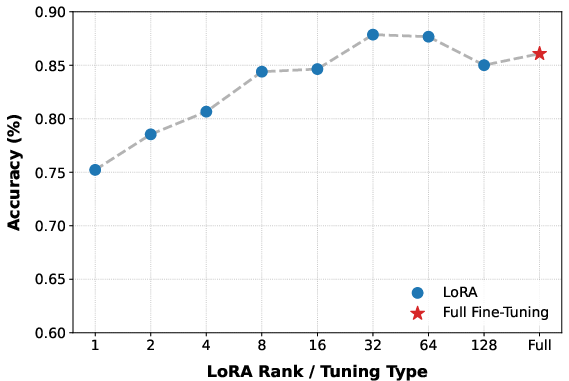
  • Practical Adaptation: The open-source downstream SFT toolkit enables rapid finetuning with LoRA on consumer hardware. For example, domain adaptation on Sudoku achieves 84% accuracy and a 4× reduction in denoising steps post-finetuning Figure 12.

Figure 12

Figure 12: Parameter-efficient LoRA downstream adaption enables strong accuracy for structure-constrained tasks at reduced compute cost.

Analysis: Architectural and Practical Implications

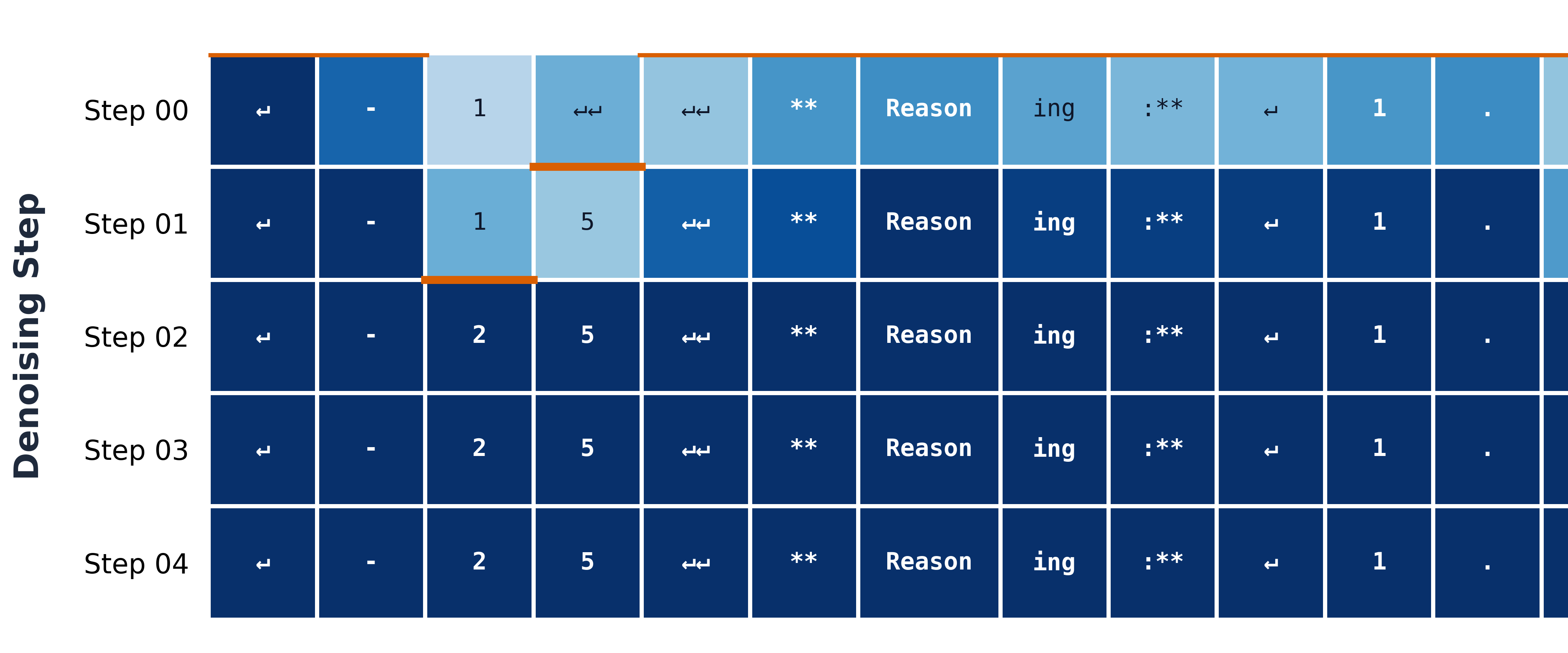
  • Bidirectional Reasoning and Self-Correction: DiffusionGemma leverages parallel, bidirectional attention to revise earlier tokens based on later context during denoising, a property not possible in AR models. Denoising traces for arithmetic reasoning and logical puzzles exhibit iterative self-correction, preventing typical AR failure modes (Figures 15, 23).

Figure 13

Figure 13: Denoising trace for arithmetic reasoning: the final answer and supporting steps converge together in 5 refinement steps, illustrating non-causal revision.

  • Dynamic Compute Allocation: Through adaptive stopping, DiffusionGemma allocates more or fewer refinement steps according to task difficulty, balancing latency and performance dynamically (Figures 24, 25).
  • Structured Generation Acceleration: For tasks with rigid syntactic targets (e.g., JSON extraction, code editing), convergence often occurs in only 2–3 steps due to immediately lockable structure, providing dramatic speedups over AR decoding.
  • Conciseness and Output Efficiency: RL-distilled checkpoints tend to output more concise, token-efficient generations, effectively compounding inference speedups.

Limitations

Despite establishing a new Pareto frontier, DiffusionGemma introduces certain trade-offs:

  • Its absolute performance on some reasoning tasks lags the AR initialization, attributable to non-pretrained initialization, shorter SFT, and aggressive RL-driven step compression.
  • Emergent concise outputs, while beneficial for speed, limit long-form, detailed responses common in AR-optimized LLMs.
  • Occasional error modes include token stuttering or degeneration under ultra-aggressive stopping, and throughput falls below AR at high batch sizes unless further optimized.

Conclusion and Future Directions

DiffusionGemma demonstrates the feasibility of compute-efficient, blockwise discrete diffusion for ultra-fast text generation at scale. The release provides a practical baseline for further advances in inference optimization, bidirectional reasoning, and hybrid AR-diffusion frameworks. Directions for future work include larger-scale SFT and RL alignment, specialized sampling algorithms for distinct prompt varieties, further MoE and batch-size optimization, and deeper exploration of discrete-continuous hybrid flows and flow matching for text. Critically, the open-weight release sets a platform for empirical study of non-AR generative mechanisms under realistic LLM workloads and paves the way for domain-specific, efficient adaptation across industry and academic applications.


Reference:

DiffusionGemma Technical Report (2608.00146)

Paper to Video (Beta)

No one has generated a video about this paper yet.

Whiteboard

No one has generated a whiteboard explanation for this paper yet.

Knowledge Gaps

Knowledge gaps, limitations, and open questions

  • The paper does not fully specify the joint sampler-distillation and reinforcement-learning objective, including its mathematical formulation, loss weighting, policy-gradient or optimization algorithm, reward models, and stabilization techniques, limiting reproducibility.
  • The composition, size, filtering, and licensing of the SFT and reinforcement-learning datasets are not reported in sufficient detail to assess data coverage, contamination, or reproducibility.
  • The claimed benefit of the unified training procedure is not isolated through controlled ablations comparing SFT alone, reinforcement learning alone, sequential training, and sampler distillation alone.
  • The contribution of individual design choices—multinomial diffusion, self-conditioning, entropy-bounded sampling, temperature annealing, adaptive stopping, and the 256-token canvas—is not quantified through systematic ablations.
  • The paper does not establish whether the reported quality–speed frontier generalizes beyond the selected benchmarks, particularly to factuality, retrieval, planning, tool use, conversational interaction, multilingual reasoning, and long-form generation.
  • Evaluation appears concentrated on aggregate benchmark averages; per-task, per-language, per-prompt-length, and per-output-length results are needed to reveal where diffusion generation succeeds or fails.
  • The comparison with proprietary and competing models may not be fully controlled because hardware, precision, batching, software stacks, reasoning effort, and API-serving conditions differ across systems.
  • The reported throughput of approximately 1,500 tokens per second is not accompanied by a complete latency breakdown covering prompt encoding, KV-cache updates, denoising, sampling overhead, memory transfers, compilation, and end-to-end time to first token.
  • It remains unclear whether the speed advantage persists at realistic batch sizes, concurrent-user loads, variable prompt lengths, streaming settings, and production serving conditions.
  • The energy consumption, memory footprint, peak activation memory, and total cost per generated token are not compared with autoregressive and speculative-decoding baselines.
  • The paper does not evaluate performance across a broader range of hardware, including consumer GPUs, CPUs, mobile accelerators, and multi-GPU systems; the reported RTX 6000 result is attributed to a third party and is not independently characterized.
  • The computational trade-off of processing 256-token canvases with bidirectional attention is not analyzed as context length, canvas size, or batch size increases.
  • The optimality of the fixed 256-token canvas length is unresolved; smaller and larger canvases may produce different quality, latency, memory, and error-propagation profiles.
  • Because completed canvases are permanently frozen, the paper does not quantify how often early-block mistakes propagate into later generations or whether mechanisms for revising prior blocks would improve quality.
  • The block-autoregressive architecture may impose cross-block coherence limitations, but the paper provides no dedicated evaluation of discourse consistency, entity tracking, citation continuity, or long-horizon reasoning.
  • The theoretical assumption of conditional independence among token updates is acknowledged but not empirically measured; the frequency and severity of grammatical, semantic, and logical inconsistencies remain unknown.
  • The relationship between the training corruption process and the inference sampler is insufficiently characterized, especially given that training samples uniformly corrupted tokens while inference repeatedly applies entropy-based selective resampling and temperature changes.
  • The use of a uniform vocabulary prior may be inefficient or harmful for large vocabularies; alternative priors, absorbing-mask processes, structured corruption, or learned corruption schedules are not compared.
  • The entropy-bounded sampler’s theoretical mutual-information or error bound is not validated empirically, and it is unclear how the fixed budget values generalize across languages, domains, sequence lengths, and model checkpoints.
  • The adaptive stopping rule relies on mean entropy and agreement between consecutive argmax predictions; its calibration, failure cases, sensitivity to threshold choices, and relationship to actual output correctness are not established.
  • Lower entropy is treated as a proxy for successful denoising, but the paper does not test whether entropy reduction can produce confidently incorrect answers, repetitive text, or reduced diversity.
  • The effects of temperature annealing on factuality, diversity, calibration, repetition, and reasoning quality are not separately evaluated.
  • The reported average of roughly 12 denoising steps may conceal substantial variance and expensive tail cases; latency distributions, worst-case behavior, and correlations between step count and task difficulty require fuller analysis.
  • It is unclear how generation quality changes continuously as the denoising budget is reduced, beyond the reported operating points; a detailed quality-versus-step curve is needed for practical latency selection.
  • The paper does not determine whether the model’s diffusion outputs follow the same probability distribution as its autoregressive outputs or whether diffusion sampling introduces systematic distributional bias.
  • Retained autoregressive capability is reported only as an aggregate performance observation; the extent of degradation across reasoning, coding, multimodal understanding, safety, calibration, and long-context tasks is not fully characterized.
  • The proposed hybrid diffusion–autoregressive decoding strategy is suggested but not implemented or evaluated, leaving its routing policy, quality gains, and latency benefits unresolved.
  • The claimed retention of multimodal capabilities lacks detailed modality-specific experiments, including image complexity, multiple images, visual grounding, OCR, and interactions between visual context and denoised text blocks.
  • Long-context claims are not supported by systematic tests of context length, retrieval position, context dilution, KV-cache growth, and generation quality over extended responses.
  • The paper does not evaluate multilingual performance or determine whether the English-oriented training and sampling choices transfer equally well to languages with different tokenization, morphology, scripts, and word-order properties.
  • Downstream adaptation is described as computationally accessible, but the paper does not report fine-tuning costs, data requirements, convergence behavior, catastrophic forgetting, or quality–speed trade-offs for domain-specific models.
  • The safety profile of parallel denoising is not investigated, including harmful-content refusal, jailbreak robustness, prompt injection, privacy leakage, toxicity, bias, and the possibility that intermediate token revisions weaken safety behavior.
  • No analysis is provided of robustness to adversarial prompts, corrupted context, distribution shifts, noisy multimodal inputs, or unusually long and structured outputs.
  • The paper does not report hallucination, factuality, calibration, abstention, or uncertainty-quality metrics, despite relying heavily on entropy as an inference-control signal.
  • The release’s permissive licensing and downstream deployment implications are discussed, but model-card information on training-data provenance, intended use, misuse risks, and responsible deployment constraints is absent from the provided report.
  • Several equations, algorithm expressions, section references, and metadata in the manuscript are malformed or incomplete, creating uncertainty about the exact implemented method and hindering independent reproduction.

Open Problems

We haven't generated a list of open problems mentioned in this paper yet.

Tweets

Sign up for free to view the 8 tweets with 191 likes about this paper.

HackerNews

  1. DiffusionGemma Technical Report (164 points, 40 comments)