SKILL.state: Scalable Long-Horizon Agent Skills
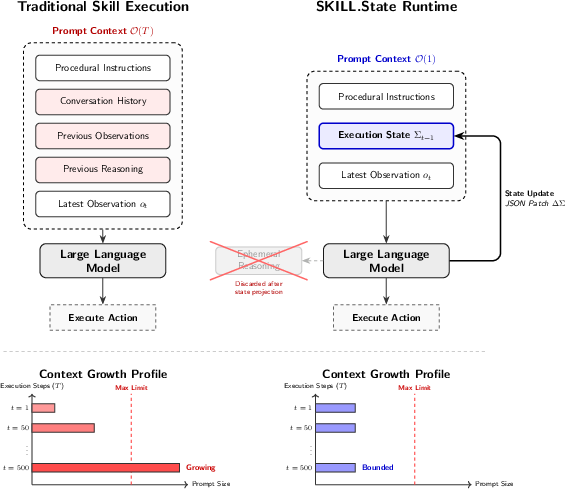
Abstract: LLMs increasingly act as autonomous agents executing complex, long-running procedural skills. Existing agent runtimes maintain execution by continually appending observations, actions, and intermediate reasoning traces to an ever-growing conversation history, causing latency degradation and context-poisoning failures over long horizons. We present SKILL.state, a runtime architecture that replaces append-only conversational history with an explicit, mutable execution state. At each execution step, the model receives only the immutable skill specification, the current structured execution state, and the latest observation. Intermediate reasoning is discarded immediately after producing a validated state update, preventing prompt growth with execution history. Across diverse datasets, models, and execution environments, SKILL.state improves task accuracy while substantially reducing cumulative token consumption. Our results demonstrate that explicit execution state is an effective and architecture-agnostic abstraction for scalable long-horizon agent skills.
Paper Prompts
Sign up for free to create and run prompts on this paper.
Top Community Prompts
Explain it Like I'm 14
1. What is this paper about?
This paper introduces SKILL.state, a new way for AI agents to remember what they are doing during long, complicated tasks.
An AI agent powered by a LLM, or LLM, might need to complete many steps. For example, it could:
- Manage items in a warehouse
- Fix problems in computer code
- Search a Linux computer for hidden information
- Help a customer change a flight or request a refund
Usually, the AI is shown the entire conversation from all earlier steps. As the task continues, this history becomes very large. The paper argues that this makes the AI slower, more expensive, and more likely to become confused.
SKILL.state solves this by keeping a small, organized record of the current situation instead of repeatedly showing the whole past conversation.
2. What questions did the researchers study?
The researchers wanted to know:
- Can an AI perform long tasks better if it uses an organized state instead of a long conversation history?
- Does this method use fewer words, or “tokens,” and therefore cost less to run?
- Does it help prevent confusion caused by old or irrelevant information?
- Can the AI quickly recover when the outside world changes unexpectedly?
- Does the method work across different tasks and different AI models?
The main idea is similar to using a checklist. Instead of rereading every note ever written, the AI receives only the instructions, the latest information, and a clear checklist of what is currently true.
3. How did the researchers test the idea?
The usual approach
In many AI systems, every new step is added to a growing transcript:
- The AI thinks.
- It chooses an action.
- The environment gives an answer.
- All of this is added to the history.
- The AI reads the entire history before making the next decision.
This is like asking someone to solve a 200-step puzzle while forcing them to reread every thought and mistake they made earlier.
The problem is that the transcript grows over time. Important information can become buried among irrelevant details. This is sometimes called context poisoning: old or distracting information can interfere with the AI’s current decision.
The SKILL.state approach
SKILL.state gives the AI only three main things at each step:
- The skill instructions: the permanent rules for the task
- The current state: an organized record of important facts
- The latest observation: the newest information from the environment
For example, in a warehouse task, the state might record:
- Which item is on each shelf
- Which items have already been shipped
- The current working location
- A summary of commands already tried
The AI may still reason through the problem in several steps, but after choosing an action, its detailed reasoning is thrown away. Only the useful update is saved in the state.
A simple version of the process is:
- Read the instructions, current state, and newest observation.
- Think about what should happen next.
- Suggest an action and an update to the state.
- The computer checks whether the update has the correct format.
- Save the new state.
- Perform the action.
- Repeat.
The state update is written in a structured format similar to a small data table or a JSON file. This makes it easier for the computer program to check and update reliably.
The tests
The researchers compared SKILL.state with several other systems:
| System | How it remembers the past |
|---|---|
| Prompt/ReAct | Keeps the entire conversation history |
| Memory | Keeps recent steps and a written summary |
| Stateful/LangGraph-style | Keeps structured information but also retains the conversation |
| SKILL.state | Keeps only the current structured state and latest observation |
They tested these systems using:
- SkillExecBench, a new test set with warehouse and software-repository tasks
- InterCode CTF, where AI agents solve Linux computer-security challenges
- Sierra -Bench, where agents handle customer-service tasks for airlines and retailers
They measured:
- Accuracy: whether the AI completed the task correctly
- Prompt size: how much text the AI had to read at each step
- Total token use: how much text the AI processed during the complete task
A token is a small piece of text, such as part of a word. Fewer tokens usually mean lower cost and faster processing.
4. What did they find?
The prompts stayed small
The strongest result was that SKILL.state kept its prompt size almost constant, even when tasks became much longer.
In the warehouse test:
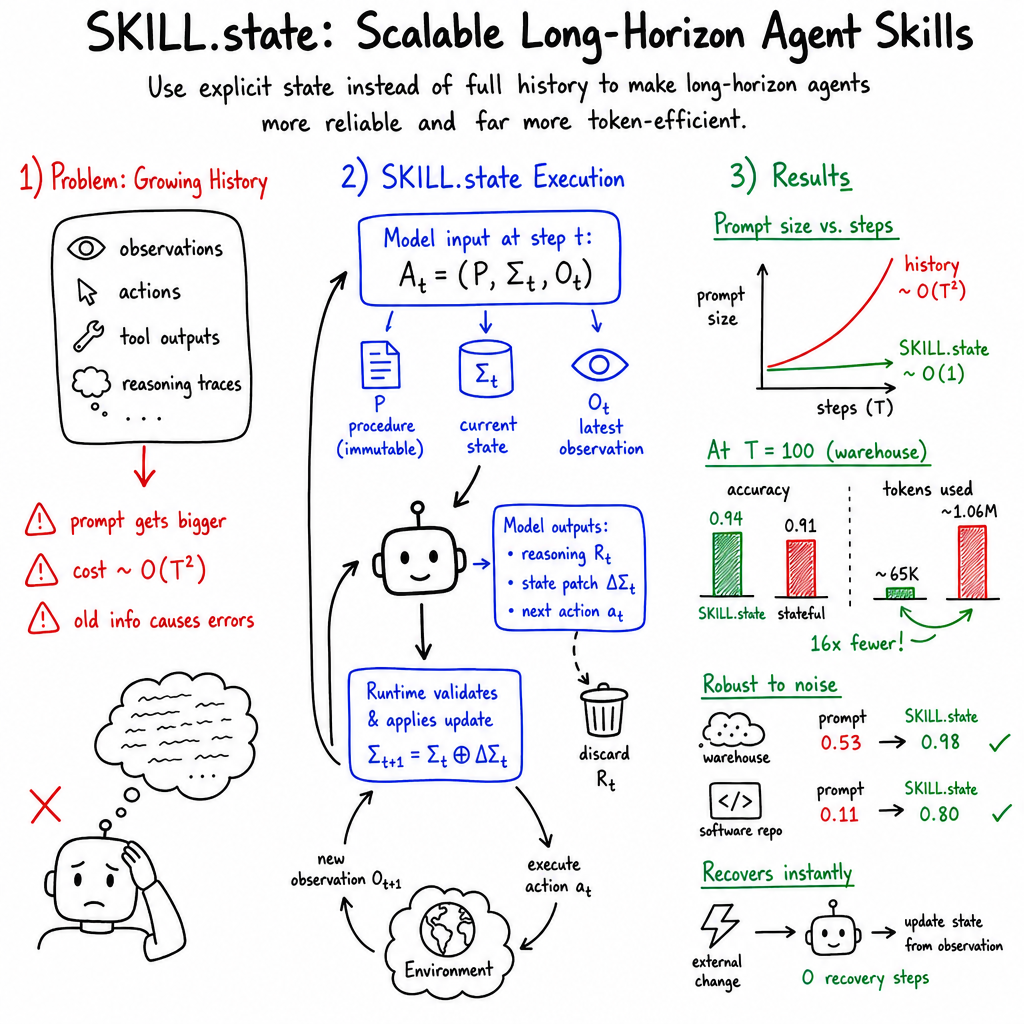
- At 100 steps, SKILL.state used about 65,000 total tokens
- A stateful comparison system used about 1,062,000 tokens
- At 200 steps, SKILL.state used about 122,000 tokens
- The memory-based system used about 6.1 million tokens
This means SKILL.state used far less text while completing long tasks.
The researchers describe this difference using computer-science notation:
- Traditional systems grow roughly as , meaning their total text use can grow very quickly as the number of steps, , increases.
- SKILL.state grows roughly as , meaning its total text use increases more steadily with the number of steps.
For a 14-year-old, this is like comparing a notebook where every new page includes a copy of all earlier pages with a notebook that keeps only one updated summary page.
Accuracy improved on long tasks
SKILL.state generally matched or outperformed the other systems.
In the warehouse experiment with 200 steps:
- SKILL.state: about 94% accuracy
- Prompt/ReAct system: about 74%
- Memory system: about 84%
- Stateful system: about 88%
The advantage became clearer as the tasks got longer. The ordinary systems became more likely to make mistakes because their histories became crowded.
It handled distractions better
The researchers added irrelevant events, such as background computer messages and unrelated warehouse activity.
With a lot of noise:
- The ordinary prompt system fell to about 53% accuracy
- SKILL.state remained near 98% accuracy
The reason is that irrelevant information was not automatically carried into the next step. Only information judged useful was added to the structured state.
It recovered better from unexpected changes
The researchers also changed the environment secretly. For example, an outside actor might move an item in the warehouse.
History-based systems sometimes continued believing the old information for 5 to 8 steps. SKILL.state could update its state immediately after receiving the new alert, needing zero recovery steps in the reported examples.
It worked on real-world-style tasks
On the public benchmarks, SKILL.state had the highest success rate in all three reported settings:
- InterCode CTF: 54.2% success
- Retail customer service: 58.3% success
- Airline customer service: 32.4% success
It also used fewer tokens than the comparison systems. For example, in InterCode CTF, it used about 60% fewer tokens than the ordinary ReAct approach.
Short prompts alone were not enough
The researchers tested other methods that also kept prompts short, such as:
- Keeping only the latest few steps
- Making a short summary
- Automatically compressing the text
These methods performed much worse. For example, in one warehouse test:
| Method | Accuracy |
|---|---|
| Full history | 84% |
| Sliding window | 18% |
| Short summary | 52% |
| Automatic text compression | 22% |
| SKILL.state | 94% |
This suggests that the important benefit is not simply “use less text.” The important part is choosing and organizing the right facts in a structured state.
5. Why are these findings important?
Long-running AI agents could be useful for jobs that require many connected decisions. However, showing an AI its entire past can cause three major problems:
- The amount of text becomes too large.
- Running the AI becomes more expensive and slower.
- Old or irrelevant information can cause mistakes.
SKILL.state offers a different design. It treats the AI’s memory like a carefully maintained scoreboard rather than a giant diary.
This could make AI agents more practical for:
- Software development
- Online research
- Customer support
- Business workflows
- Computer control
- Scientific experiments
- Multi-step planning
6. Limitations and possible problems
The method is not perfect. It works best when researchers can decide in advance what information belongs in the state.
It may struggle when:
- The needed information is not known ahead of time
- The AI notices too late that an old observation was important
- The complete history is needed for auditing or explaining decisions
- Several AI agents must edit the same state at the same time
The AI must also produce correctly formatted state updates. Smaller AI models sometimes made mistakes, such as accidentally deleting useful information or producing badly formatted JSON. The paper suggests that stricter computer-controlled formatting could help.
Conclusion
The paper’s main message is that AI agents should not always remember everything they have ever said. Instead, they can work more effectively by maintaining a clear, structured record of the facts that matter right now.
According to the experiments, SKILL.state made long tasks more accurate, more resistant to distractions, and much cheaper to run. If future research solves its limitations, this approach could help create AI agents that can handle long and complicated jobs without becoming overwhelmed by their own conversation history.
Knowledge Gaps
Knowledge gaps, limitations, and open questions
The paper leaves the following issues unresolved:
- Schema-authoring burden is not quantified: The study does not measure the human expertise, time, or engineering effort required to design and maintain a domain-specific execution schema.
- The boundary of state sufficiency is unclear: No formal method is provided for determining whether a structured state contains all information necessary for future decisions in a given task.
- Dynamic schema discovery is not evaluated: The paper acknowledges tasks in which the relevant state structure emerges during execution, but does not test adaptive schema induction or state expansion.
- Delayed relevance of observations remains unresolved: The runtime may permanently discard an observation that appears irrelevant but becomes important later; no mechanism for recovering such information is proposed or evaluated.
- State-update omission is not systematically addressed: The approach relies on the model recognizing and committing all future-relevant facts, yet experiments do not isolate the effects of missed, incomplete, or incorrect state updates.
- Semantic state corruption remains possible: Deterministic validation prevents malformed patches from entering persistent state, but it does not establish that a syntactically valid patch is factually correct or consistent with the environment.
- The rollback–retry mechanism is underspecified: The paper does not report retry rates, additional token costs, latency, failure behavior after repeated invalid patches, or whether retries introduce correlated errors.
- External state synchronization is only partially examined: The state-recovery experiment uses selected drift scenarios, but does not evaluate continuous, concurrent, delayed, or adversarial changes to the environment.
- Observation–state conflict resolution is unclear: The runtime does not specify which source takes precedence when the latest observation contradicts the stored structured state.
- Historical provenance and explainability are sacrificed: Since reasoning traces and prior observations are discarded, the paper does not evaluate whether the system can support auditing, debugging, legal compliance, or explanations of why an action was taken.
- Long-term learning across episodes is unexplored: It remains unknown how SKILL.state interacts with persistent memory, cross-task transfer, user preferences, or learning from previous failures.
- Multi-agent execution is not evaluated: The proposed merge operator has no demonstrated semantics for concurrent writes, conflicting updates, partial failures, synchronization, or agent-specific permissions.
- Security properties of mutable state are unexamined: The paper does not test whether malicious observations, tools, users, or agents can inject false state updates, overwrite critical fields, or exploit schema semantics.
- The comparison with baselines may not isolate architecture alone: The evaluated runtimes use different output formats and processing requirements, and the paper does not establish that prompts, retry policies, action-generation constraints, and implementation quality are fully matched.
- Compression baselines may be under-optimized: Only particular summarization, sliding-window, and
LLMLinguaconfigurations are tested; stronger retrieval, hierarchical memory, structured compression, or adaptive summarization baselines could change the conclusions. - The cost of state serialization and validation is omitted: Token accounting focuses on model prompts and outputs, without clearly reporting CPU time, serialization overhead, validator cost, storage, and network latency.
- Wall-clock efficiency is not demonstrated: Lower token consumption is reported, but end-to-end latency, throughput, parallelism, and monetary cost under realistic API pricing are not measured.
- The claimed prompt footprint depends on bounded state and observations: The experiments do not establish how performance behaves when the structured state, procedural specification, or latest tool observation itself grows with task complexity.
- State scalability for large relational structures is unknown: The paper tests selected warehouse and repository configurations but does not determine whether large graphs, nested objects, histories, or cross-entity dependencies remain usable within a bounded prompt.
- Generalization beyond the evaluated domains is uncertain: The benchmarks emphasize inventory management, simulated repositories, CTF tasks, and customer service; embodied robotics, scientific workflows, web browsing, software engineering, and safety-critical operations are not tested.
- Real-world environmental noise is incompletely modeled: The synthetic distractor events may not capture ambiguous, correlated, misleading, delayed, or contradictory observations encountered in deployed systems.
- Robustness to partial observability is unclear: The experiments do not systematically vary missing observations, unreliable sensors, tool failures, stale database reads, or inaccurate environment feedback.
- Planning requirements may exceed one-step state transitions: The architecture generates one action per step, but the paper does not evaluate tasks requiring persistent multi-step plans, counterfactual reasoning, branching search, or revisiting discarded alternatives.
- The effect of discarding chain-of-thought is not isolated: It is unclear whether performance changes arise from removing history, forcing structured patches, altering prompts, or constraining the output format.
- The open-weight error analysis is narrow: The taxonomy is reported for one model and one horizon, so its applicability across models, domains, schemas, and longer executions is unknown.
- Statistical evidence is limited: Synthetic results use only five generator seeds, while uncertainty estimates and significance testing for the public benchmark results are not reported.
- Model and benchmark reproducibility is uncertain: The paper references model versions such as Gemini-3-Flash and Gemma-4-31B without fully specifying checkpoints, API settings, prompt lengths, tool latency, or evaluation-time implementation details.
- Task-level success is not linked to failure propagation: The paper reports aggregate accuracy and pass rates but does not analyze how a single erroneous state update affects later actions, recovery probability, or episode termination.
- No principled state minimization objective is given: The paper states that the state should contain only future-relevant information, but does not define algorithms or metrics for minimizing redundancy while preserving task performance.
- Schema evolution is not studied: There is no evaluation of how schemas can be versioned, migrated, extended, or kept backward-compatible when task rules or tools change during deployment.
- Safety and action authorization are underexplored: Structured state validation does not by itself guarantee that proposed actions respect permissions, transaction boundaries, irreversible-operation safeguards, or human-approval requirements.
Practical Applications
Immediate Applications
- Long-running software engineering agents (software development; deployable now)
- Integrate SKILL.state into coding agents that manage Git branches, pull requests, CI failures, releases, and rollbacks. A structured state could track active branches, unresolved review comments, test results, modified files, and release prerequisites instead of replaying the full terminal or repository transcript.
- Potential tools/workflows: GitHub/GitLab coding assistants, CI triage bots, automated release managers, and repository-maintenance workflows built on JSON-schema validation and patch-based state updates.
- Evidence from the paper: The simulated repository environment directly models commits, PRs, merges, and CI statuses; the approach also improves interactive command-line performance on InterCode CTF.
- Dependencies: The state schema must capture all information relevant to future actions; destructive operations should require deterministic validation, permissions, and human approval.
- Customer-service automation with transactional APIs (retail, airlines, banking, telecommunications; deployable now)
- Use explicit state to track customer intent, identity-verification status, policy constraints, available options, completed API calls, and unresolved issues across multi-turn workflows such as refunds, rebooking, cancellations, and order changes.
- Potential products: Contact-center agents, agent-assist tools, API orchestration middleware, and workflow engines that maintain a validated transaction state while exposing only the latest user or database observation to the model.
- Evidence: On Sierra -Bench, SKILL.state achieved higher success rates than the evaluated baselines in both retail and airline settings while reducing token consumption.
- Dependencies: Transactional APIs must support idempotency, authorization, rollback, and database consistency. The state representation must not omit policy-relevant facts or customer constraints.
- Warehouse and inventory-control agents (logistics, manufacturing, retail; deployable now)
- Apply the architecture to agents coordinating receiving, storage, movement, shipment, maintenance alerts, and inventory reconciliation. The state can maintain item locations, reserved stock, pending orders, maintenance holds, and action outcomes.
- Potential workflows: Warehouse-management-system copilots, exception-handling bots, and robotic fulfillment controllers that receive sensor events and issue validated Store, Move, Ship, or Wait actions.
- Evidence: In the warehouse benchmark, the method maintained approximately constant prompt size and preserved high accuracy through 200 steps, including under noisy telemetry and external state changes.
- Dependencies: Real deployments require reliable inventory identifiers, event ordering, synchronization with the warehouse database, and safety checks before physical actions. The benchmark’s discrete environment is simpler than a real warehouse.
- Security operations and incident-response assistants (cybersecurity; deployable now for supervised use)
- Track tested hypotheses, discovered indicators, active files or hosts, command summaries, containment status, and remediation steps while investigating incidents or executing approved penetration tests.
- Potential tools: SOC investigation copilots, sandbox-based malware-analysis agents, CTF training systems, and command-line security assistants.
- Evidence: The InterCode CTF results show improved pass@1 performance and lower token use when hypotheses and discovered artifacts are explicitly retained rather than inferred from command history.
- Dependencies: Strict sandboxing, least-privilege credentials, command allowlists, audit logging, and human approval are essential. Because the method discards reasoning traces, a separate action log is needed for forensic accountability.
- Cost and latency reduction in agent-serving infrastructure (cloud AI, enterprise software; deployable now)
- Replace full conversational transcripts with bounded prompts containing the immutable skill definition, validated state, and latest observation. This can reduce inference latency, context-window pressure, and API expenditure for repetitive multi-step agents.
- Potential infrastructure features: State-aware agent runtimes, JSON-schema registries, state-patch validators, rollback/retry handlers, token-cost monitors, and migration layers for ReAct-style agents.
- Evidence: At a 100-step warehouse horizon, the paper reports a 16.2-fold reduction in cumulative tokens relative to a stateful conversational baseline.
- Dependencies: Savings depend on the size of the state and latest observation, model pricing, output length, validation overhead, and the quality of schema design. The paper’s asymptotic advantage does not guarantee equal savings for short tasks.
- Robust workflow automation under noisy telemetry (industrial IT, observability, operations; deployable now)
- Filter irrelevant alerts during state-patch generation so that transient monitoring events do not permanently pollute later prompts. Suitable workflows include cloud operations, ticket routing, supply-chain monitoring, and database administration.
- Potential workflow: Event stream → observation classifier → LLM-proposed state patch → deterministic validator → approved tool action.
- Evidence: In the warehouse noise experiment, SKILL.state retained scores of at least 0.97 under medium and high distractor rates, whereas the history-based prompt runtime degraded sharply.
- Dependencies: The filtering model must distinguish relevant anomalies from apparent distractors; false filtering can remove information needed for later decisions. Critical events should be persisted outside the model state.
- Evaluation and teaching infrastructure for long-horizon agents (academia and industry research; deployable now)
- Use SkillExecBench-style environments to test whether an agent preserves relational state, handles noisy observations, recovers from external changes, and remains accurate under fixed token budgets.
- Potential outputs: Benchmark suites for warehouse operations, software repositories, API workflows, and state-recovery stress tests; dashboards comparing accuracy, prompt size, cumulative tokens, and recovery steps.
- Dependencies: Benchmarks should include realistic nondeterminism, schema-mismatch cases, adversarial observations, and trajectory-level evaluation. Results from synthetic environments should not be treated as direct evidence of production reliability.
- Schema-validated personal productivity assistants (daily life and education; deployable now for low-risk tasks)
- Apply the method to assistants managing trip planning, household tasks, study plans, subscriptions, shopping lists, or appointment workflows. The state might include pending tasks, deadlines, preferences, confirmations, and completed actions.
- Potential products: Calendar and travel assistants that maintain compact task state while calling booking, reminder, and payment APIs.
- Dependencies: Users must be able to inspect and correct state; sensitive data requires access controls and retention policies. Financial commitments, medical decisions, and irreversible bookings should include confirmation steps.
- Deterministic state validation and rollback as an agent-safety pattern (policy, governance, and enterprise risk; deployable now)
- Require agents to propose structured patches that are checked against schemas, type constraints, permissions, business rules, and allowed transitions before execution. Invalid updates can trigger rollback and retry rather than corrupting persistent state.
- Potential controls: State-transition logs, policy engines, approval gates, invariant checkers, and conformance tests for agent workflows.
- Dependencies: Validation must cover semantic errors, not only valid JSON syntax. Since discarded reasoning cannot serve as an audit record, organizations must separately retain observations, proposed actions, executed actions, and state versions.
Long-Term Applications
- Multi-agent coordination through shared execution state (software, robotics, enterprise automation; requires further research)
- Extend the architecture so multiple agents collaborate through a shared state rather than exchanging growing conversational transcripts. For example, planning, execution, verification, and escalation agents could write to separate namespaces in a common workflow state.
- Potential systems: Multi-agent software-development teams, robotic warehouse fleets, scientific-research assistants, and disaster-response coordination platforms.
- Dependencies: Concurrent writes require deterministic conflict resolution, versioning, locking or transactional updates, provenance, and clearly defined ownership. The paper explicitly identifies these issues as untested in its single-agent implementation.
- Robotics and embodied agents with sensor-to-state control loops (robotics, manufacturing, autonomous vehicles; requires scaling and physical validation)
- Represent a robot’s operational state—pose, object locations, task goals, battery, safety constraints, grasp status, and failed attempts—explicitly while supplying the model with only current sensor observations.
- Potential products: Long-horizon household robots, warehouse picking systems, inspection drones, and maintenance robots.
- Dependencies: Sensor fusion, real-time latency, uncertainty representation, safety-certified controllers, and recovery from partial observability are necessary. A text state alone may be insufficient for continuous dynamics and high-frequency control.
- Healthcare workflow agents (healthcare and life sciences; requires rigorous validation)
- Maintain structured state for appointment coordination, referral management, prior authorization, laboratory follow-up, medication reconciliation, and clinical research workflows.
- Potential tools: EHR workflow assistants and research-coordination agents that track required documents, pending results, eligibility criteria, and compliance checkpoints.
- Dependencies: The state must preserve clinically relevant history when needed; omission of an earlier observation could create patient-safety risks. Deployment requires privacy protection, interoperability, clinician oversight, regulatory approval, and extensive prospective evaluation. The paper does not validate medical use.
- Energy-grid and industrial process management (energy, utilities, manufacturing; requires domain-specific modeling)
- Use state-centric agents to coordinate maintenance schedules, alarms, work orders, equipment conditions, and operational constraints over long horizons.
- Potential systems: Grid-operations copilots, plant-maintenance agents, and demand-response workflow managers.
- Dependencies: State transitions must be grounded in authoritative telemetry and deterministic control systems. Safety-critical actions need formal verification and fail-safe mechanisms; language-model decisions should remain supervisory rather than directly controlling infrastructure until validated.
- Financial operations and compliance automation (finance, insurance, accounting; requires auditing and regulatory work)
- Track customer requests, transaction status, approval thresholds, KYC/AML checks, policy exceptions, and reconciliation results across multi-step processes.
- Potential products: Claims-processing agents, loan-document workflows, payment-reconciliation assistants, and compliance case-management systems.
- Dependencies: Every state mutation must be attributable and reproducible. Because the paper’s core design discards intermediate reasoning, regulated deployments would need immutable external logs, data lineage, explainable decision records, access controls, and human review for consequential actions.
- Trajectory-aware auditing, debugging, and scientific reproducibility (academia, regulated industry, public administration; requires architectural extension)
- Combine compact operational state with an append-only provenance layer that preserves observations, state patches, tool outputs, model versions, and executed actions. This would retain the efficiency benefits of SKILL.state without losing historical evidence.
- Potential tools: Replayable agent traces, state-version diffing, causal debugging systems, and reproducibility packages for agent experiments.
- Dependencies: This addresses a stated limitation: SKILL.state alone is unsuitable when the historical trajectory is itself the target output. Storage, privacy, tamper resistance, and standardized provenance formats remain open engineering and policy questions.
- Dynamic-schema agents for open-ended discovery (scientific discovery, research automation, exploratory analysis; requires further research)
- Develop mechanisms that can infer, revise, and validate state schemas as an agent encounters previously unknown entities or relationships—for example, in literature review, laboratory experimentation, or novel software repositories.
- Potential systems: Research agents maintaining evolving experiment state, hypothesis graphs, sample metadata, and instrument conditions.
- Dependencies: Dynamic schema evolution must prevent accidental deletion, preserve backward compatibility, and identify when an earlier observation becomes relevant. This directly addresses the paper’s limitation that fixed schemas may fail when relevant structure is not known in advance.
- Personal autonomous agents with persistent, privacy-preserving state (daily life; requires research and governance)
- Build assistants that coordinate long-term household, education, health, and financial tasks while retaining only a structured minimum state in the active context and storing sensitive history separately.
- Potential products: Personal operating systems for goals, obligations, permissions, and recurring workflows.
- Dependencies: Users need transparent state inspection, correction, export, deletion, and consent controls. The system must distinguish operational state from private conversational history and avoid silently dropping information that later becomes important.
- Standardized policy and certification frameworks for stateful agents (public policy and standards; long-term)
- Establish requirements for state schemas, transition validation, rollback behavior, external-drift handling, audit logs, error recovery, and human intervention in autonomous systems.
- Potential outputs: Industry standards, procurement criteria, safety certifications, and regulatory testing protocols for long-horizon agents.
- Dependencies: Standards should account for domain risk, model updates, data protection, adversarial observations, and the difference between operational efficiency and explainability. Further empirical evidence across real deployments is needed before performance claims can support regulation.
- Smaller, on-device long-horizon agents (edge computing, accessibility, consumer electronics; requires model and runtime optimization)
- The bounded prompt footprint could enable long-running assistants on constrained devices or lower-cost models, provided structured output generation is reliable.
- Potential products: Offline field-service assistants, embedded industrial controllers, educational devices, and privacy-preserving home assistants.
- Dependencies: The paper reports that open-weight models frequently fail through state overwrites, type coercion, and malformed JSON. Grammar-constrained decoding, stronger state-diff training, schema-aware fine-tuning, and robust recovery mechanisms are prerequisites for dependable deployment.
Glossary
- Agent runtime: Software infrastructure that manages an autonomous agent’s interaction, reasoning, actions, and execution state. “Modern agent runtimes almost universally adopt a conversational execution model.”
- Asymptotic complexity: Mathematical characterization of how an algorithm’s resource requirements scale with input size. “Consequently, cumulative prompt complexity grows strictly linearly with the execution horizon.”
- Attention sink: A token or position that attracts disproportionate attention in a transformer model and can help stabilize streaming inference. “LLMs exhibit degraded retrieval over long contexts, motivating streaming attention.”
- Autonomous agent: A system capable of pursuing objectives and taking actions with limited direct human control. “LLMs increasingly act as autonomous agents executing complex, long-running procedural skills.”
- Binary exploitation: The use of vulnerabilities in compiled programs or executable files to gain unintended behavior or access. “A suite of 100 Linux bash Capture-The-Flag challenges spanning reverse engineering, forensics, cryptography, and binary exploitation.”
- Bounded prompt footprint: A prompt size that remains limited and does not increase with the number of execution steps. “SKILL.state maintains a bounded prompt footprint.”
- Capture-the-Flag (CTF): A cybersecurity competition or benchmark in which participants solve challenges to obtain hidden strings called flags. “InterCode CTF, featuring interactive Linux terminal exploitation.”
- Canonical execution state: The authoritative representation of the information needed to continue an execution. “SKILL.state prevents history accumulation entirely by maintaining the canonical execution state required for the next computation.”
- Chain-of-Thought (CoT): A sequence of intermediate reasoning steps generated by a LLM to solve a problem. “where denotes the multi-step Chain-of-Thought reasoning trace”
- Context corruption: Degradation of model performance caused by irrelevant, misleading, or obsolete information in the input context. “Experiment 2: Context Corruption (Noise Robustness)”
- Context window: The maximum amount of text or tokens that a LLM can process in one input. “early observations leave the context window.”
- Constrained decoding: A generation method that restricts model outputs to a specified grammar, schema, or set of valid tokens. “For smaller open-weight models, integrating grammar-constrained decoding can eliminate syntactic formatting errors.”
- Cumulative token complexity: The total number of input or output tokens processed across all execution steps. “leading to cumulative token complexity:”
- Deterministic validation: Rule-based verification that checks whether a generated output satisfies predefined correctness constraints. “deterministically validates the proposed state transition”
- Dialogue State Tracking (DST): The computational task of maintaining a structured representation of user goals and slot values across dialogue turns. “Dialogue State Tracking (DST) maintains user slot values across conversational turns in task-oriented dialogue”
- Distractor event: An irrelevant observation or event introduced to test whether a system can ignore noise. “inject distractor events (system telemetry, irrelevant git branch activities, and rule overrides)”
- Episodic retrieval: Retrieval of information associated with particular past events or episodes. “Long-horizon agent architectures typically preserve conversational semantics through episodic retrieval”
- Execution horizon: The number of sequential steps or interactions performed during a task. “Let denote the execution horizon.”
- Execution state: A structured representation of the current information required to determine an agent’s next action. “The state contains only information required for future execution”
- First-class runtime abstraction: A concept explicitly represented and directly supported by a software system rather than treated as incidental data. “SKILL.state treats execution state as a first-class runtime abstraction.”
- Grammar-constrained decoding: Constrained decoding based on a formal grammar that limits generated outputs to syntactically valid structures. “integrating grammar-constrained decoding can eliminate syntactic formatting errors”
- Ground-truth world transition: The known, authoritative change in an environment resulting from an action. “providing sequential procedural tasks with deterministic ground-truth world transitions”
- Hallucination: A model-generated statement or action that is unsupported by, or inconsistent with, the available evidence. “history-based baselines hallucinate for 5 to 8 consecutive turns”
- Immutable procedural specification: A task description or set of instructions that cannot be modified during execution. “where denotes the immutable procedural specification”
- Inference cost: The computational or monetary resources required to generate a model prediction. “increasing token consumption and inference cost”
- Long-horizon execution: Performance of a procedure involving many sequential decisions or interactions. “We evaluate runtime accuracy and context expansion across execution horizons scaling from to steps.”
- Long-context reasoning: Reasoning over inputs containing a very large number of tokens. “Context Management and Long-Context Reasoning”
- Memory-augmented runtime: An agent execution system that supplements the current prompt with stored summaries or retrieved prior information. “A.2 Memory-Augmented Runtime”
- Multi-agent system: A system in which multiple autonomous agents coordinate to complete tasks. “multi-agent environments introduce concurrent writes”
- Null-deletion semantics: A merge rule in which assigning
nullto a field removes that field from the state. “where denotes the runtime's dictionary merge operator with null-deletion semantics.” - Open-weight model: A machine-learning model whose trained parameters are publicly available for use or modification. “Across multiple execution horizons and runtime baselines, we demonstrate that state-centric execution maintains competitive task performance”
- Pass@1: The probability that the first generated answer or attempt passes an evaluation. “In InterCode CTF, success is binary pass@1”
- Perplexity: A model-based measure of how surprising or unlikely a sequence of tokens is. “Uses budget-aware small-model perplexity compression to prune tokens”
- Persistent state: Information retained and made available across successive execution steps. “This model projects transient reasoning into persistent structured state”
- Prompt compression: Reduction of a language-model prompt while attempting to preserve information relevant to the task. “prompt compression techniques”
- Prompt footprint: The amount of input context, usually measured in tokens, supplied to a model invocation. “maintains a bounded prompt footprint”
- Quasi-static dialogue: A dialogue whose structured state changes relatively slowly while the conversation remains available as the primary record. “DST tracks auxiliary state alongside full conversational transcripts in quasi-static dialogues”
- ReAct: An agent framework that interleaves natural-language reasoning with environment actions. “Prompt (ReAct-style): Appends every observation, intermediate reasoning trace, and action”
- Relational dependency: A logical relationship in which the validity or meaning of one entity depends on another entity. “structured state maintenance preserves exact relational dependencies”
- Rollback-retry cycle: A recovery procedure that reverses an invalid update and attempts generation again. “an invalid patch triggers a rollback-retry cycle.”
- Schema: A formal specification of the fields, types, and structure permitted in data. “Schemas are authored once per domain rather than per task”
- Sufficient statistic: A compact representation that preserves all information needed for a specified inference or decision. “SKILL.state treats the structured state as a sufficient statistic”
- State patch: A structured set of insertions, modifications, or deletions applied to an existing execution state. “A JSON block fenced with json ... containing both your State Patch and your Action.”
- State transition: A formally defined change from one execution state to the next. “SKILL.state reformulates procedural skill execution as an explicit state transition process.”
- Stateful runtime: An execution system that explicitly stores and updates structured state between interactions. “Stateful (LangGraph-style): Injects a structured state block into the context window”
- Statistical significance: The likelihood that an observed experimental difference is unlikely to have arisen by random variation. “Differences between SKILL.state and baselines at extended horizons () are statistically significant”
- Structured output adherence: The degree to which a model follows a required structured format and schema. “small-model degradation stems from structured output adherence rather than reasoning capacity”
- Structured state: Machine-readable execution information organized according to a predefined schema. “ is the structured execution state”
- Token budget: A fixed limit on the number of tokens allowed in a model prompt or computation. “pinned to the token budget of SKILL.state”
- Token consumption: The total number of tokens processed during an execution. “while substantially reducing cumulative token consumption.”
- Tool-agent-user interaction: An interaction setting in which an agent uses tools while communicating with or acting on behalf of a user. “A benchmark for tool-agent-user interaction in enterprise customer service”
- Top- sampling: A decoding strategy that samples from the smallest token set whose cumulative probability reaches a specified threshold. “Decoding is controlled at temperature $0.0$ and top- $1.0$”
- Trajectory: The ordered sequence of states, observations, reasoning steps, and actions produced during execution. “when the task objective is defined over the historical trajectory itself”
- Type coercion: Automatic conversion of a value from one data type to another. “Schema Comprehension / Type Coercion”
- World model: An internal or explicit representation of the environment and its relevant dynamics. “eliminating the need to repeatedly reconstruct world models from textual history”