ASI-Bench: At the Dawn of Artificial Superintelligence
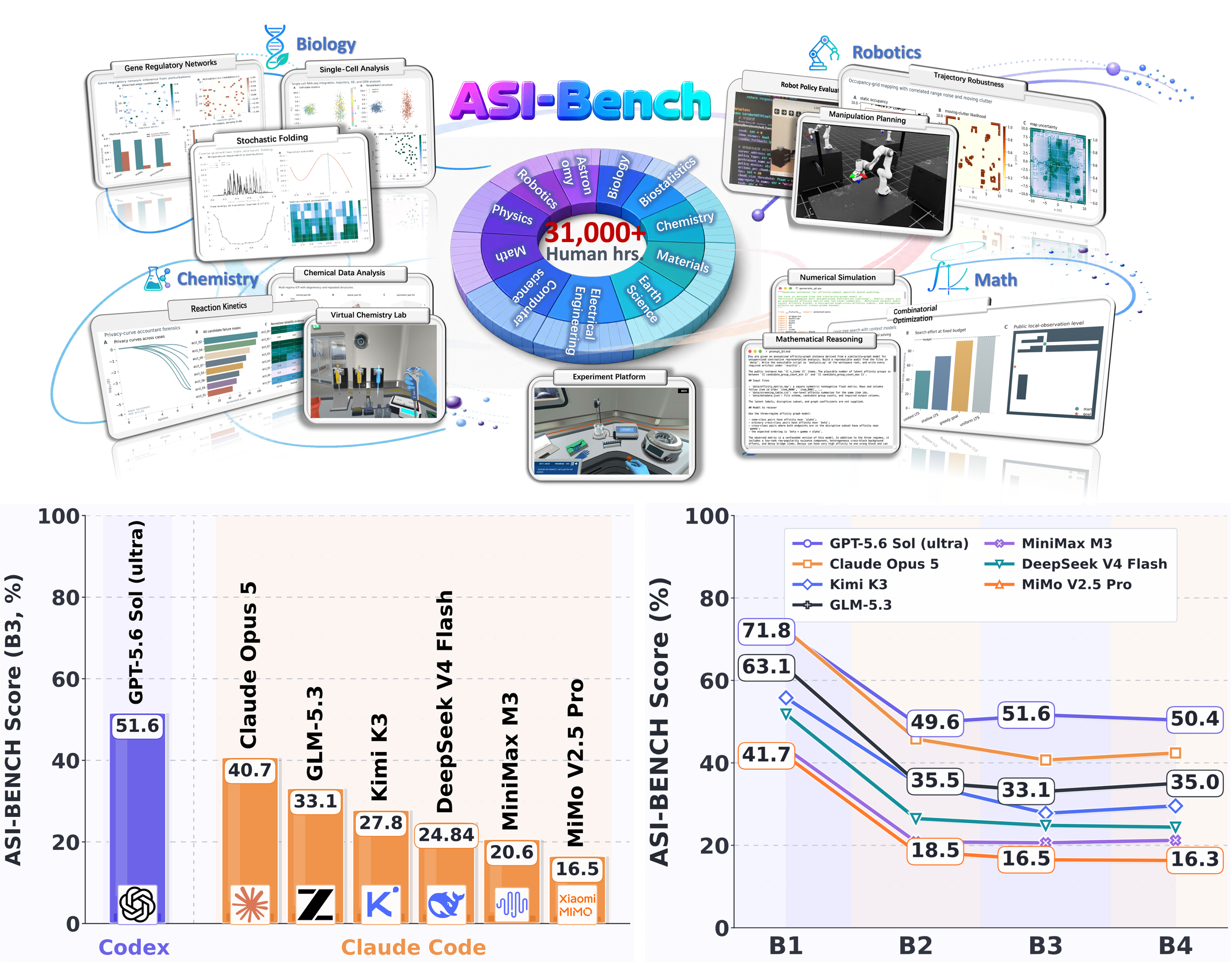
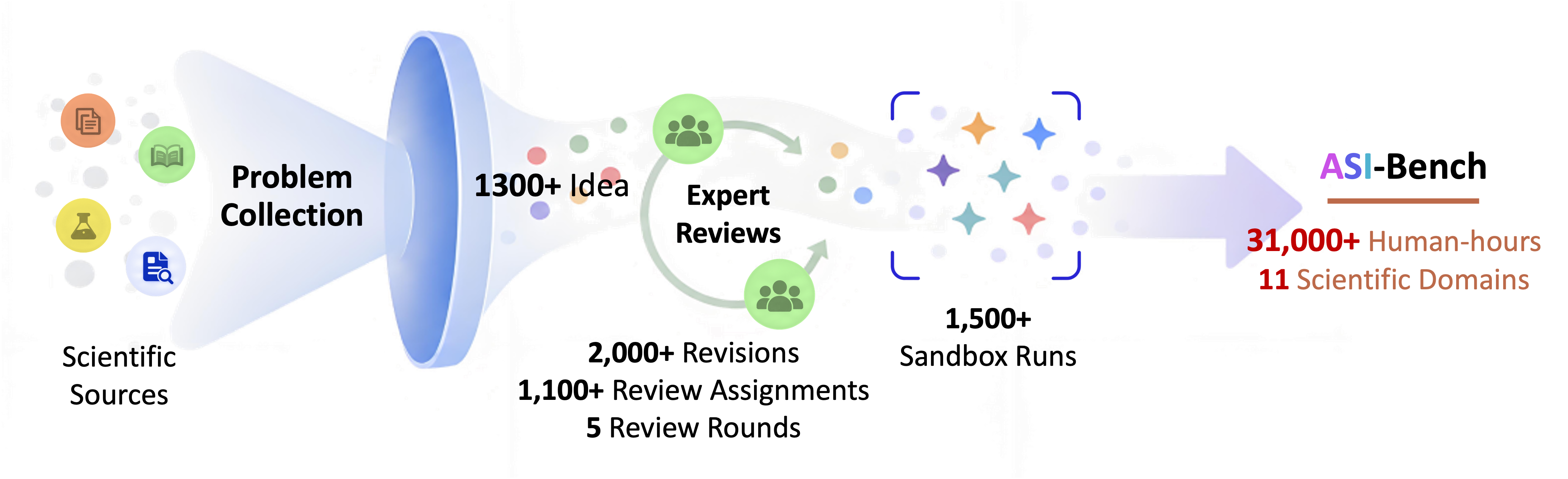
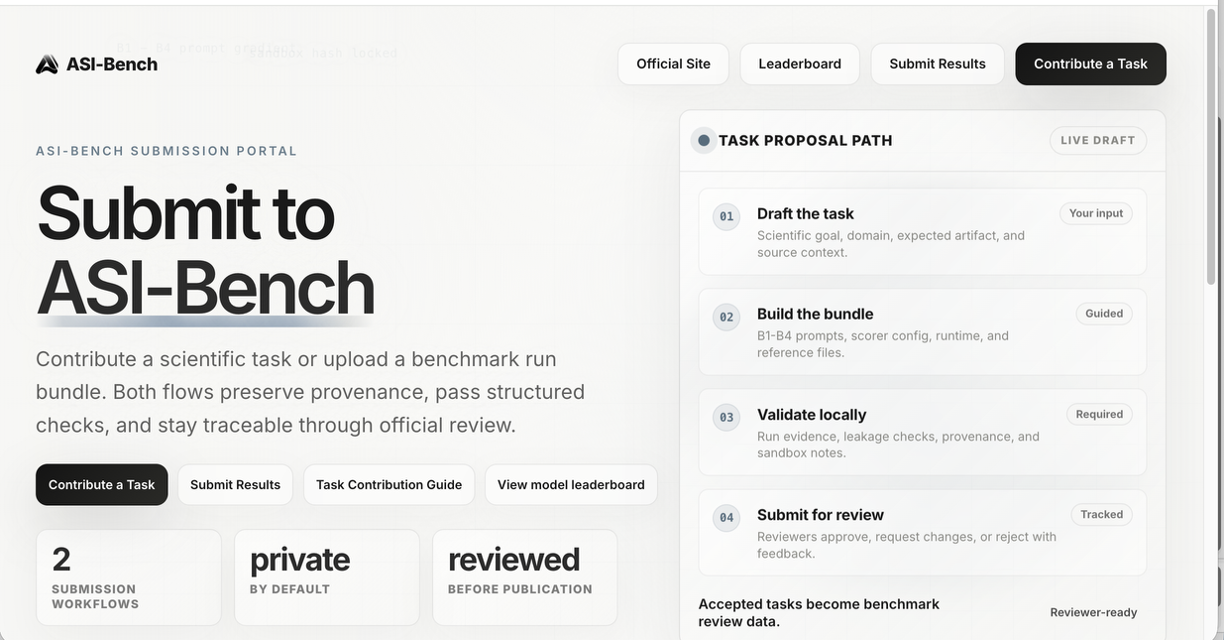
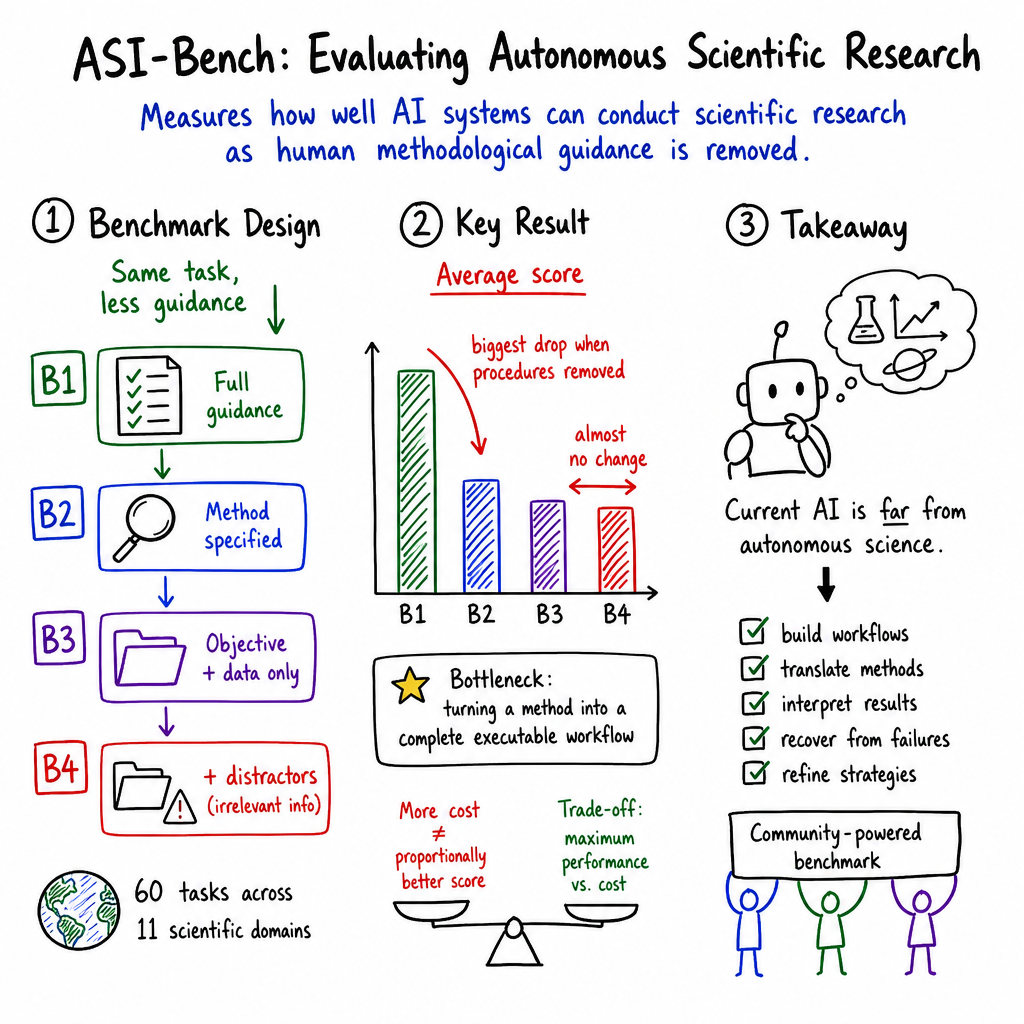
Abstract: Artificial superintelligence (ASI) requires AI to move beyond mastering existing knowledge toward exploring the unknown, creating new knowledge, and turning new ideas into verifiable results. However, the capabilities of today's AI systems are still largely built on learning, compressing, and applying existing human knowledge. Accordingly, existing benchmarks primarily test whether AI can produce correct answers based on learned knowledge, or whether it can complete tasks under extensive human guidance. We therefore introduce ASI-Bench, the first benchmark to jointly evaluate AI systems' capabilities of innovative exploration and autonomous scientific execution across general research domains, and the first to progressively withdraw human methodological guidance within the same research project to test how far AI can proceed on its own. Built by over 40 experts with the cost of 31,000+ human hours, ASI-Bench contains 60 project-level research tasks across 11 scientific domains and progressively reduces methodological guidance to test whether AI can independently select methods, conduct research, and produce verifiable results. All tasks undergo expert review, AI-assisted auditing, sandbox execution, and scorer validation. Across 18 state-of-the-art agent--model configurations, the average score drops from 50.91 with full methodological guidance to 29.10 with only the method specified and 26.62 when agents must determine the method themselves. This sharp decline shows that current systems remain heavily dependent on human guidance and are still far from autonomously conducting end-to-end, project-level scientific research. ASI-Bench is open to the world. We invite researchers and builders everywhere to contribute new tasks, challenge the limits of today's AI, and help accelerate humanity's collective path toward artificial superintelligence at https://asibench.apexin.ai/submit.
First 10 authors:
Paper Prompts
Sign up for free to create and run prompts on this paper.
Top Community Prompts
Explain it Like I'm 14
1. Main topic
This paper introduces ASI-Bench, a test designed to measure how well artificial intelligence can carry out scientific research on its own.
Many current AI tests ask questions with known answers or tell the AI exactly which steps to follow. ASI-Bench asks a harder question:
Can an AI choose its own research plan, carry out the investigation, fix mistakes, and produce trustworthy results?
The name refers to artificial superintelligence, meaning a future kind of AI that could perform intellectual tasks far beyond human abilities. The paper argues that testing independent scientific research is an important step toward understanding whether AI is moving in that direction.
2. Research questions and objectives
The researchers mainly wanted to find out:
- How well can today’s AI systems complete long, complicated scientific projects?
- What happens when humans provide less and less information about how to solve the problem?
- Can AI choose suitable scientific methods by itself?
- Can AI turn a general method into a detailed, working procedure?
- Can AI work across many different scientific subjects, such as physics, biology, medicine, astronomy, and robotics?
- Which matters more: the AI model itself or the surrounding software system that helps it plan and use tools?
The central idea is similar to giving students different versions of a science project:
- Give them a complete instruction sheet.
- Tell them only the general method.
- Give them the goal and data, but make them decide how to investigate.
- Add distracting information and see whether they stay focused.
3. Research methods
Building the benchmark
The researchers created 60 scientific research projects covering 11 fields, including:
- Mathematics and physics
- Chemistry and biology
- Astronomy and materials science
- Earth science and medicine
- Computer science, robotics, and electrical engineering
These were not simple questions. Each project could require an AI to understand a problem, choose a method, write code, run experiments, study the results, correct errors, and produce evidence that its answer was reliable.
More than 40 experts helped build the benchmark. The work took over 31,000 human-hours. The tasks were checked several times by experts, tested by AI tools, and run in isolated computer environments called sandboxes. A sandbox is like a safe practice room where an AI can run programs without damaging other systems.
Four levels of guidance
Each project was tested in four versions, called B1 to B4:
| Version | What the AI receives | What the AI must do |
|---|---|---|
| B1 | The full method and detailed instructions | Follow the procedure correctly |
| B2 | Only the general method | Turn the method into specific working steps |
| B3 | The research goal and data, but no method | Choose the method and design the investigation |
| B4 | The same information as B3 plus irrelevant details | Do the research while ignoring distractions |
This setup is called a guidance gradient. It means the researchers gradually remove human help to see how independent the AI really is.
Testing AI systems
The researchers evaluated 18 combinations of AI models and agent systems. An agent system is software that helps an AI plan actions, run code, use tools, and keep track of a long project.
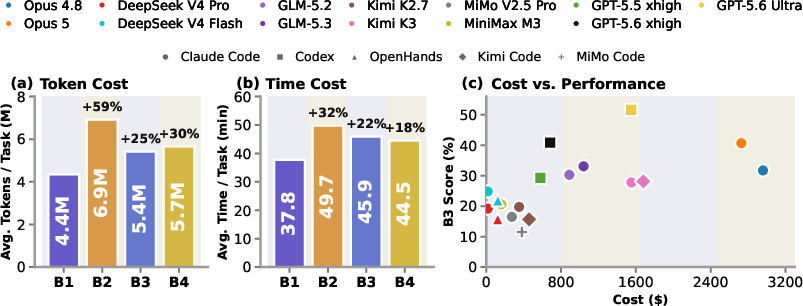
The systems received scores for their scientific results. The researchers also measured how many computer tokens they used, how long tasks took, and how much each run cost.
4. Main findings
AI performance fell sharply when instructions were removed
Across all tested systems, the average scores were:
- B1: 50.91, with complete instructions
- B2: 29.10, with only the method explained
- B3: 26.62, when the AI had to choose the method itself
- B4: 26.99, when distractions were added
The biggest drop happened between B1 and B2. This means that current AI systems can often follow a detailed research recipe, but they struggle when they must create the recipe themselves.
The further drop from B2 to B3 was smaller. This suggests that choosing a method may not be the main problem. The harder part is turning that method into all the correct practical steps needed to finish the research.
An everyday comparison would be the difference between:
- Being told exactly how to build a model bridge,
- Being told to use “a strong bridge-building method,” and
- Being given materials and asked to decide how to build a safe bridge.
AI does much better in the first situation.
Even the strongest systems were not fully independent
The best reported system scored 51.60 on B3, where it had to choose its own method. This is better than the other systems, but it is still far from perfect.
The researchers conclude that current AI is not yet reliable at independently conducting complete scientific investigations. It can be helpful in research, but it still often needs humans to explain the plan and important steps.
More reasoning helped, but did not solve the problem
Giving an AI more time or computing power to think improved its performance. For example, one version of a model increased its B3 score from 40.86 to 51.60.
However, this improvement required much more reasoning. Simply allowing an AI to think longer does not yet make it a fully independent scientist.
The supporting software matters
The paper found that the same AI model could perform differently depending on the agent harness—the software system surrounding the model.
This system controls how the AI plans, runs programs, handles errors, and organizes information. In some cases, changing the harness produced a large improvement.
This means that scientific ability does not come only from the LLM. It also depends on the tools and workflow around it. A powerful brain may still perform poorly if it is given an awkward workbench.
More computer effort did not always mean better results
Tasks with complete instructions were cheapest and fastest. When the AI had to explore and make more decisions, it used more tokens and took longer.
Interestingly, spending more money did not always guarantee a much better score. Some systems achieved similar results at much lower costs. This shows that researchers must consider both performance and efficiency when designing AI research systems.
Distractions had little additional effect
The B4 results were almost the same as B3 results. Adding irrelevant information did not greatly reduce performance.
This suggests that the largest challenge was not ignoring distractions. The bigger challenge was figuring out the research procedure in the first place.
5. Why the findings matter
ASI-Bench is important because it tests something that many earlier AI benchmarks do not: long, open-ended scientific work.
A system may be excellent at answering questions, writing short pieces of code, or following instructions. That does not necessarily mean it can discover something new. Real research involves uncertainty, failed attempts, changing plans, and checking whether results are believable.
The paper shows that current AI systems still depend heavily on human guidance, especially detailed instructions. They are better at acting like skilled assistants following a research plan than like independent scientists creating and testing their own plans.
6. Potential impact
ASI-Bench could become a common way for researchers to compare AI systems that claim to perform scientific research. It may help developers discover exactly where an AI fails—for example, in choosing methods, writing code, understanding results, or correcting mistakes.
The benchmark could also encourage the creation of better AI research assistants and better surrounding software. As AI improves, researchers can repeat the tests to see whether systems become more independent.
However, the benchmark is not a complete measure of intelligence. Scientific research includes creativity, teamwork, ethics, communication, and judgment, which may not all be captured by computer-based tasks.
In simple terms, the paper’s main message is this: today’s AI can often follow a scientist’s instructions, but it is still much less capable when it must decide how to do the science by itself. ASI-Bench provides a demanding test for measuring progress toward truly autonomous scientific discovery.
Knowledge Gaps
The paper leaves the following knowledge gaps, limitations, and open questions unresolved:
- Limited task scale and coverage: The benchmark contains only 60 tasks across 11 domains, and it does not establish whether this sample adequately represents the breadth, difficulty, and methodological diversity of scientific research.
- Uneven domain representation: The paper does not report the number, difficulty, or performance distribution of tasks within each scientific domain, making it unclear whether aggregate scores are dominated by a small subset of fields.
- Potential selection bias in task construction: The 60 retained tasks were selected from more than 1,300 candidate ideas, but the exclusion criteria, retention rates by domain, and characteristics of discarded tasks are not reported.
- Unclear ecological validity: It remains uncertain whether the tasks reflect real research environments, where objectives evolve, data are incomplete or noisy, experiments may require physical infrastructure, and collaboration with human researchers is common.
- Fixed objectives may underrepresent scientific autonomy: Agents receive predefined research objectives, datasets, required outputs, and evaluation criteria; therefore, the benchmark does not test whether systems can identify important problems, formulate research questions, or prioritize worthwhile directions.
- B3 does not fully measure scientific innovation: Although B3 removes explicit methodological guidance, agents still operate within human-selected problems, datasets, environments, and output definitions. The extent to which performance reflects genuine innovation rather than solution search within a constrained space is unresolved.
- No evaluation of hypothesis novelty or scientific significance: The benchmark appears to score task completion and verifiable artifacts, but it does not establish whether agent-generated methods, hypotheses, or findings are novel, scientifically important, or publishable.
- Ambiguity in method-selection evaluation: The paper interprets the small B2-to-B3 performance drop as evidence that method selection is not the main bottleneck, but this may reflect limited method diversity, forgiving task designs, or agents defaulting to familiar approaches rather than successfully selecting among meaningful alternatives.
- Guidance levels may not be psychologically or computationally equivalent: B1–B3 differ in the amount, specificity, and structure of information supplied to agents. The observed score differences may therefore combine the effects of methodological guidance, prompt length, prior information, ambiguity, and search-space size.
- B4 provides a narrow test of robustness: The distraction condition uses task-irrelevant information, but the paper does not show whether the distractors vary in plausibility, salience, adversariality, or modality. Consequently, B4 may not capture realistic forms of misleading scientific evidence or conflicting instructions.
- No systematic ablation of guidance components: The study does not isolate the effects of removing individual elements such as equations, parameter values, implementation steps, validation procedures, or solver choices.
- Restricted tool setting: The main results are explicitly obtained without external tool access, leaving open how systems perform with literature search, web browsing, specialized scientific software, databases, simulators, laboratory instruments, or code repositories.
- Limited assessment of multimodal research: The benchmark’s treatment of images, plots, equations, experimental records, and other scientific modalities is not described in sufficient detail to determine whether it evaluates multimodal scientific reasoning.
- Unclear evaluation metric validity: The paper does not fully specify the scoring rubric, task-level weights, artifact-quality criteria, or how partial credit is assigned, making it difficult to assess whether the scores align with meaningful scientific progress.
- Potential mismatch between automated scores and scientific correctness: Automated or code-based scoring may reward outputs that satisfy formal checks without supporting valid scientific conclusions. The correlation between benchmark scores and expert judgments of correctness is not quantified.
- Insufficient inter-rater reliability evidence: Although tasks undergo multiple human reviews, the paper does not report reviewer agreement, scorer calibration, adjudication procedures, or uncertainty in expert judgments.
- Reference-solution dependence: The benchmark appears to rely substantially on expert-produced reference artifacts and expected solutions. This may penalize scientifically valid alternative approaches that differ from the reference workflow.
- Alternative-method validity is unresolved: The paper does not demonstrate that the scoring system can recognize multiple correct methods, unexpected discoveries, or scientifically defensible results that diverge from the task designers’ assumptions.
- No human or expert baseline: The results are not compared with graduate students, domain experts, research engineers, or human teams under comparable guidance conditions, so the practical meaning of scores such as 26.62 or 51.60 remains unclear.
- No calibration of score thresholds: The benchmark does not establish what score corresponds to competent research execution, reliable publication-quality work, or autonomous completion without human intervention.
- Limited statistical power: With only 60 tasks and generally three runs per configuration, estimates of model differences and domain-specific effects may be unstable, particularly for individual tasks or subgroups.
- Inconsistent replication across systems: At least one configuration is evaluated using a single run, preventing variance estimation and weakening comparisons involving that system.
- No significance testing or confidence intervals: The paper reports means and sample standard deviations but does not provide confidence intervals, paired tests, effect sizes, or corrections for multiple comparisons.
- Run-to-run variability is not explained: The study does not identify whether variability arises from stochastic model generation, tool execution, task ambiguity, harness behavior, or unstable evaluation environments.
- Model and benchmark contamination remain uncertain: The paper mentions leakage checks but does not provide a systematic contamination audit for training data, public task descriptions, source papers, repositories, or benchmark release materials.
- Generalization beyond the released tasks is untested: Results on the fixed 60-task suite do not show whether systems can transfer their research strategies to newly contributed, hidden, or temporally held-out tasks.
- Leaderboard overfitting is a future risk: The paper does not specify how task refreshes, private test sets, submission limits, or contamination monitoring will prevent optimization against the public benchmark.
- Harness–model interactions are confounded: Comparisons use different harnesses, prompting strategies, execution policies, context management schemes, and possibly stopping criteria. The paper does not provide controlled component-level ablations to attribute gains to particular harness mechanisms.
- Backbone model comparisons may not be temporally or operationally fair: Model versions, inference settings, context limits, rate limits, system prompts, and API behavior are not described in enough detail to ensure reproducibility or fair comparison.
- No analysis of failure modes by research stage: The paper claims that failures may involve knowledge, method selection, implementation, interpretation, error correction, or stability, but it does not quantify failure rates at each stage or trace how early failures affect final scores.
- Long-horizon state management is not separately evaluated: The benchmark includes many interaction and execution steps, but it does not isolate memory loss, plan drift, context-window limitations, or degradation across increasingly long projects.
- Scientific error correction is insufficiently characterized: It remains unclear whether agents detect and correct invalid assumptions, numerical errors, data leakage, faulty interpretations, or merely retry failed code until an executable artifact is produced.
- Cost comparisons are difficult to reproduce: Monetary cost depends on provider pricing, token accounting, caching, parallelism, retries, and execution infrastructure, none of which are specified sufficiently for independent verification.
- Cost–performance trade-offs are not modeled statistically: The paper presents descriptive comparisons but does not evaluate scaling laws, Pareto efficiency, uncertainty-adjusted costs, or whether higher expenditure reliably improves performance across tasks.
- Resource constraints are not systematically varied: The benchmark does not study how performance changes with token budgets, wall-clock limits, compute allocation, tool-call limits, or interruption and recovery conditions.
- Safety and reliability are largely unexplored: The evaluation does not assess whether autonomous agents produce unsafe experimental recommendations, mishandle sensitive biomedical information, fabricate evidence, or take irreversible actions.
- Reproducibility of generated findings is not evaluated: Producing a verifiable artifact during one run does not establish that the same agent can reproduce the result across seeds, environments, datasets, or independent implementations.
- Robustness to data quality is unknown: The benchmark does not systematically test missing values, measurement noise, distribution shifts, mislabeled data, contradictory observations, or insufficient sample sizes.
- Collaboration and human-in-the-loop settings are absent: The study focuses on autonomous execution but does not examine how agents perform when they can request clarification, delegate to specialists, receive feedback, or collaborate with multiple agents or human researchers.
- The relationship between benchmark success and real-world scientific impact is unvalidated: It remains open whether ASI-Bench scores predict performance in laboratory discovery, peer-reviewed research, software-based science, or sustained research programs outside sandboxed tasks.
Practical Applications
Immediate Applications
- Model and agent selection for AI-for-science programs (academia, industry; software/scientific computing) Organizations can evaluate foundation models, research agents, and agent harnesses using ASI-Bench’s B1–B4 settings before deploying them in scientific workflows. B1 can test reliable execution of specified procedures, while B3 and B4 can assess method-independent research and robustness to irrelevant information. Potential workflow: run candidate systems on representative tasks, compare domain-level scores and failure traces, then select different systems for procedural automation versus exploratory research. Dependencies: access to the benchmark environment, reproducible task configurations, sufficient API or compute budgets, and awareness that the current benchmark contains only 60 tasks across 11 domains.
- Regression testing for research-agent software (software engineering, AI infrastructure) ASI-Bench can function as a continuous integration suite for agent frameworks. Developers can run benchmark subsets after changing planning modules, memory systems, tool interfaces, error-recovery logic, or execution harnesses. Actionable use: track whether a new orchestration layer improves B2/B3 performance without causing regressions in B1 reliability, execution time, or artifact validity. Dependencies: stable task versions and sandboxed execution; benchmark scores must be supplemented with cost, latency, safety, and reproducibility metrics.
- Diagnosis of bottlenecks in autonomous research systems (AI research, academic labs) The B1–B4 gradient provides a practical diagnostic workflow for separating different capabilities: following a complete procedure, operationalizing a named method, independently selecting a method, and resisting distraction. The paper’s results indicate that converting a high-level method into a complete procedure is a particularly important weakness. Potential tools: failure-taxonomy dashboards that classify errors in problem interpretation, method operationalization, coding, experimentation, validation, and recovery from failure. Dependencies: meaningful trajectory logging and expert review are required; aggregate scores alone cannot identify the cause of failure.
- Benchmark-driven evaluation of research-agent harnesses (software, cloud AI platforms) The results show that the same model can perform differently depending on the surrounding harness. Companies can therefore compare planning, tool-use, code-execution, context-management, and verification components independently of the underlying model. Actionable use: maintain a standardized “model × harness” evaluation matrix rather than reporting model scores alone. This can guide development of research copilots, coding agents, laboratory-planning systems, and simulation assistants. Dependencies: fair comparisons require matched prompts, compute limits, tool permissions, and repeated runs.
- Procurement and cost–performance planning for AI research services (industry, research administration) The reported cost differences support practical decisions about when to use inexpensive systems for routine execution and when to use more expensive reasoning configurations for difficult exploratory work. For example, a lower-cost system may be appropriate for B1-like procedural tasks, whereas higher inference-time reasoning may be reserved for B3-like investigations. Potential product: a routing system that assigns tasks to models based on required autonomy, expected scientific risk, and budget. Dependencies: published costs are configuration- and provider-dependent; real deployments may incur additional costs for data storage, tools, human review, and failed experiments.
- Training and curriculum design for AI-agent developers (academia, professional education) The guidance gradient can be used as a staged curriculum: begin with fully specified procedures, remove implementation details, then remove the method itself and introduce distractors. This directly trains agents to move from execution toward planning, method selection, validation, and self-correction. Potential workflow: use B1 failures to improve tool use, B2 failures to improve procedural decomposition, and B3 failures to improve research planning and hypothesis testing. Dependencies: benchmark tasks should not be overfit; training should include new, held-out scientific problems.
- Standardized reporting for claims about autonomous research (policy, academia, industry) Research groups can report performance separately at B1, B2, B3, and B4 rather than making broad claims based on conventional question-answering or coding benchmarks. This offers a more transparent distinction between procedure following and genuine methodological autonomy. Dependencies: the benchmark should be combined with expert assessment, leakage checks, reproducibility tests, and disclosure of model versions, prompts, harnesses, tools, and costs.
- Human-in-the-loop research copilots (healthcare research, engineering, chemistry, materials science) Given the sharp performance decline when guidance is removed, current systems are better suited to assist researchers than to replace them. Researchers can provide the method and validation criteria while the agent performs literature organization, implementation, parameter sweeps, simulations, and draft artifact generation. Potential products: experiment-planning assistants, reproducible analysis notebooks, simulation workflow generators, and automated report-preparation tools. Dependencies: expert approval remains necessary, particularly for medical, chemical, biological, electrical, and safety-critical applications.
- Research-policy and funding evaluation (government and research institutions) Funding agencies and public laboratories can use benchmark results to assess whether proposed AI-for-science systems demonstrate reliable autonomy rather than only strong knowledge retrieval. Scores can become one component of capability and readiness assessments for publicly funded research automation. Dependencies: policy decisions should not rely on a single benchmark, and domain-specific validation is essential because macro-averaged scores may conceal weaknesses in high-risk fields.
Long-Term Applications
- Semi- or fully autonomous scientific research pipelines (scientific computing, chemistry, biology, materials, medicine) Future systems could use ASI-Bench-like evaluations as acceptance tests for end-to-end research pipelines that formulate approaches, implement models, run experiments, interpret results, revise hypotheses, and produce verifiable artifacts. Such systems could support drug discovery, materials optimization, climate modeling, robotics, and engineering design. Required development: stronger method operationalization, reliable long-horizon memory, experiment planning, uncertainty estimation, tool integration, and independent result verification. Dependencies: laboratory or simulation access, safe execution, high-quality data, domain-expert oversight, regulatory approval, and protection against fabricated or irreproducible findings.
- Automated discovery platforms with adaptive method selection (chemistry, materials science, energy, biotechnology) An advanced agent could compare competing models or experimental procedures, select the most informative next experiment, diagnose failed runs, and iteratively refine a research program. In energy and materials research, this could support battery, catalyst, semiconductor, or photovoltaic discovery. Required development: closed-loop integration with laboratories, robotics, simulation software, and measurement systems. Dependencies: accurate simulators or laboratory instrumentation, safe chemical and biological handling, sufficient experimental throughput, and validated objective functions.
- Autonomous medical and biomedical research assistants (healthcare, medicine, biostatistics) With substantial additional validation, agents could generate and test statistical analyses, identify disease mechanisms, propose clinical hypotheses, and design follow-up studies. ASI-Bench’s emphasis on verifiable artifacts and cross-domain execution could help evaluate such systems before clinical or translational use. Dependencies: privacy-preserving data access, clinical validation, causal rather than merely correlational reasoning, ethics review, regulatory compliance, bias monitoring, and mandatory clinician oversight. The paper does not establish that current systems are safe for diagnosis or treatment.
- AI-managed engineering and robotics experimentation (robotics, electrical engineering, aerospace, manufacturing) Long-term systems could autonomously design controllers, run simulations, select experiments, analyze sensor data, and revise designs for robots, circuits, power systems, or aerospace components. The benchmark’s project-level structure is relevant to these multi-stage workflows. Dependencies: reliable simulators, hardware-in-the-loop testing, real-time safety constraints, robust fault handling, cybersecurity, and certification for physical systems.
- Scientific research infrastructure and community standards (academia, publishers, public research organizations) The open benchmark could evolve into a living standard with domain-specific task pools, continuously updated hidden tests, executable reference solutions, artifact validation, and reproducibility checks. It could support shared leaderboards, model cards, agent capability profiles, and publication requirements for autonomous research claims. Dependencies: sustained expert participation, governance for task submissions, prevention of benchmark contamination, version control, international access, and mechanisms for retiring saturated or leaked tasks.
- Adaptive AI-research training environments (education and workforce development) ASI-Bench could eventually support interactive training environments in which students or agents receive progressively less methodological support and are evaluated on planning, experimentation, documentation, and verification. This could be used in graduate research training, computational science courses, and industrial R&D onboarding. Dependencies: pedagogically validated scoring, explanations of failures, safeguards against rewarding plausible but scientifically invalid reasoning, and human instructors capable of interpreting benchmark outputs.
- Regulatory readiness tests for high-autonomy AI systems (public policy, safety, governance) Regulators could use benchmark families modeled on ASI-Bench to assess whether an AI system can independently pursue open-ended technical objectives, especially when connected to external tools or physical infrastructure. Results could inform deployment tiers, monitoring requirements, access controls, and mandatory human-approval checkpoints. Dependencies: substantially broader task coverage, adversarial and safety evaluations, tests with external tools, assessment of misuse potential, and clear links between benchmark performance and real-world risk.
- Autonomous knowledge-generation services for everyday users (daily life, education, productivity) In the longer term, consumers could use research assistants to investigate complex questions, compare evidence, construct reproducible analyses, or develop personalized learning and project plans. Unlike ordinary chat systems, such tools would be expected to expose sources, methods, uncertainty, and verification artifacts. Dependencies: reliable fact-checking, transparent uncertainty communication, protection against overreliance, privacy safeguards, low operating costs, and clear differentiation between exploratory advice and professional guidance.
- Scientific capability forecasting and progress monitoring (policy, investment, strategic planning) Repeated performance measurements across the B1–B4 gradient could help institutions monitor whether AI progress is shifting from knowledge retrieval toward independent research planning and execution. Trends in B3/B4 performance may be particularly informative for forecasting the emergence of more autonomous systems. Dependencies: longitudinal benchmark stability, resistance to training contamination, comparable compute and prompting conditions, and complementary evaluations of safety, generalization, and real-world scientific impact.
Glossary
- Agent harness: The software framework that coordinates an AI model’s reasoning, tool use, execution, and research workflow. “the same model can be paired with different agents or harnesses”
- Agentic execution: The ability of an AI system to autonomously perform multistep actions toward a goal. “rapid progress in scientific reasoning, coding, data analysis, and agentic execution”
- Artificial superintelligence (ASI): A hypothetical AI system whose general intellectual abilities substantially exceed those of humans. “Artificial superintelligence (ASI) requires AI to move beyond mastering existing knowledge”
- Autonomous execution: The ability to complete a task or research process independently of human intervention. “general intelligence, innovation, and autonomous execution”
- Autonomous research: Scientific investigation performed by an AI system with minimal human direction. “To test autonomous research.”
- Backbone model: The underlying foundation model used by an agent or software system. “Different backbone models can be evaluated within the same agent framework”
- Biostatistics: The application of statistical methods to biological, medical, and health-related data. “medicine and biostatistics”
- Computational reproducibility: The ability to reproduce computational results using the same data, code, and procedures. “PaperBench~\cite{Sta25} focuses on research replication and computational reproducibility.”
- Diagnostic metric: A quantitative measure designed to reveal why or where system performance changes. “The last three columns report B2B1, B3B1, and B4B3, respectively”
- Dynamical system: A mathematical model describing how a system changes over time. “the same nonlinear two-dimensional dynamical system task”
- End-to-end execution: Completion of all stages of a process, from initial input to final result. “ASI-Bench uses cross-domain project-level research to evaluate general intelligence, independent method selection to evaluate innovation, and end-to-end completion to evaluate autonomous execution.”
- Evaluation leakage: The unintended exposure of information that enables a system to obtain a high evaluation score without solving the intended task. “They also check for information leakage and unintended shortcuts”
- Evaluation misalignment: A mismatch between what an evaluation measures and the capability it is intended to measure. “Tasks with unresolved scientific errors, unstable execution, evaluation misalignment, or unintended solution paths are revised or excluded.”
- Foundation model: A large, general-purpose model trained on broad data and adaptable to many downstream tasks. “New foundation models, reasoning models, research agents, and general-purpose agents”
- General intelligence: Broad problem-solving ability that transfers across tasks and domains. “This design distinguishes following a complete procedure, translating a specified method into an executable workflow, and independently conducting the research, enabling a unified assessment of general intelligence, innovation, and autonomous execution.”
- Guidance gradient: A systematic variation in the amount of human methodological assistance supplied to an AI system. “Its B1--B3 guidance gradient further measures whether these capabilities persist”
- Hypothesis-driven discovery: Scientific discovery organized around proposing and testing explanatory hypotheses. “DiscoveryBench~\cite{Maj24} hypothesis-driven discovery”
- Inference-time reasoning: Additional computation performed while a model generates an answer, often to improve multistep reasoning. “Stronger inference-time reasoning does improve this capability”
- Information leakage: Unintended availability of task information that can make a solution easier without requiring the intended reasoning. “They also check for information leakage and unintended shortcuts”
- Isolated sandbox: A restricted execution environment that safely separates a task from external systems. “Each retained task is further validated through end-to-end execution in isolated sandboxes.”
- Macro-averaged score: An average computed by giving each task or category equal weight, regardless of its size. “Scores are macro-averaged over tasks”
- Method operationalization: Converting an abstract scientific method into concrete procedures, code, and executable steps. “Together, these results identify method operationalization, rather than method selection or distraction, as the primary bottleneck”
- Method autonomy: The ability of an AI system to independently choose the method used to solve a research problem. “Method Autonomy”
- Methodological guidance: Human-provided instructions about the scientific method or procedure to follow. “ASI-Bench progressively reduces methodological guidance”
- Nonlinear system: A system whose output or evolution is not proportional to its inputs, often producing complex behavior. “the same nonlinear two-dimensional dynamical system task”
- Numerical formulation: The mathematical representation of a problem that enables approximate computational solution. “the governing PDE, numerical formulation, and solver procedure are explicitly provided”
- Numerical method: An algorithm for obtaining approximate solutions to mathematical problems through computation. “choose an appropriate numerical method”
- Open-ended research: Investigation in which the problem-solving path or solution is not fully predetermined. “whether AI can autonomously conduct scientific research when both the problem and the path to a solution are open-ended.”
- Parameter choice: The selection of numerical or model values that determine how an algorithm behaves. “B1, which specifies the method, implementation steps, and parameter choices”
- Partial differential equation (PDE): An equation involving derivatives of a function with respect to multiple variables, commonly including space and time. “In B1, the governing PDE, numerical formulation, and solver procedure are explicitly provided”
- Project-level research: A sustained research task involving multiple stages, decisions, experiments, and outputs rather than a single question. “It consists of 60 project-level research tasks across 11 scientific domains”
- Reference artifact: A trusted output or result used to validate a task or compare system performance. “Reviewers examine the scientific formulation, task specification, B1--B4 information design, reference results, and evaluation criteria.”
- Research artifact: A concrete, verifiable output produced during scientific investigation, such as code, data, or results. “ultimately producing verifiable scientific artifacts”
- Research replication: Repeating a prior study or experiment to determine whether its results can be obtained again. “PaperBench~\cite{Sta25} focuses on research replication and computational reproducibility.”
- Robustness: The ability of a system to maintain performance when conditions include noise, irrelevant information, or other disturbances. “B4 introduces task-irrelevant information under the B3 setting to evaluate robustness.”
- Scorer validation: Verification that the software or procedure assigning evaluation scores behaves correctly. “All tasks undergo expert review, AI-assisted auditing, sandbox execution, and scorer validation.”
- Scientific autonomy: The capacity to independently plan, conduct, evaluate, and refine scientific research. “To measure scientific autonomy”
- Scientific discovery: The process of generating and validating new knowledge about the natural or engineered world. “Current systems remain far from reliable autonomous scientific discovery.”
- Scientific domain: A specialized field of scientific inquiry used to categorize research tasks. “ASI-Bench contains 60 project-level research tasks across 11 scientific domains”
- Scientific artifact: A research output that can be inspected or verified, such as an implementation, dataset, or experimental result. “ultimately producing verifiable scientific artifacts”
- Spatio-temporal data: Data indexed across both spatial locations and time. “The agent receives only the observed spatio-temporal data”
- State-of-the-art: Representing the highest reported level of performance or capability currently available. “Across 18 state-of-the-art agent--model configurations”
- Task-irrelevant information: Information included in a task that does not contribute to solving its intended research problem. “B4 retains the B3 setting but adds plausible yet task-irrelevant information”
- Verifiable result: An outcome that can be checked through explicit evidence, procedures, or computational evaluation. “turn them into verifiable results”
- Workflow: An ordered sequence of actions and computational procedures used to complete a task. “whether it can determine what procedure should be pursued in the first place”

