Training AI Scientists to Replicate Research
Abstract: The replicability of papers is a cornerstone of scientific knowledge, ensuring the reliability of existing results and providing a base for further experiments. The act of replication typically illuminates details that were previously underspecified, and thus requires similar hypothesis-driven exploration to open-ended research. In this work, we develop Replica, a scalable task space for paper replication. To provide reward signal, we introduce an auto-generated rubric-based judge that has low noise and agrees with human assessment of replication quality. We post-train Faraday, a 27B-parameter "AI Scientist" agent that leverages coding agents as tools, surpassing the performance of Claude Opus 4.8 and GPT-5.5 on held-out replication tasks. Qualitative analysis of individual rollouts reveals that Faraday adopts a more scientifically-principled approach. We believe that our results provide a stepping stone towards AI agents capable of long-horizon scientific innovation without requiring complex harnesses.
Paper Prompts
Sign up for free to create and run prompts on this paper.
Top Community Prompts
Explain it Like I'm 14
1. What is the paper about?
This paper studies whether an AI system can learn to repeat scientific experiments from research papers.
Repeating an experiment is called replication. If another scientist follows the same method and gets similar results, it gives us more confidence that the original discovery was real and reliable.
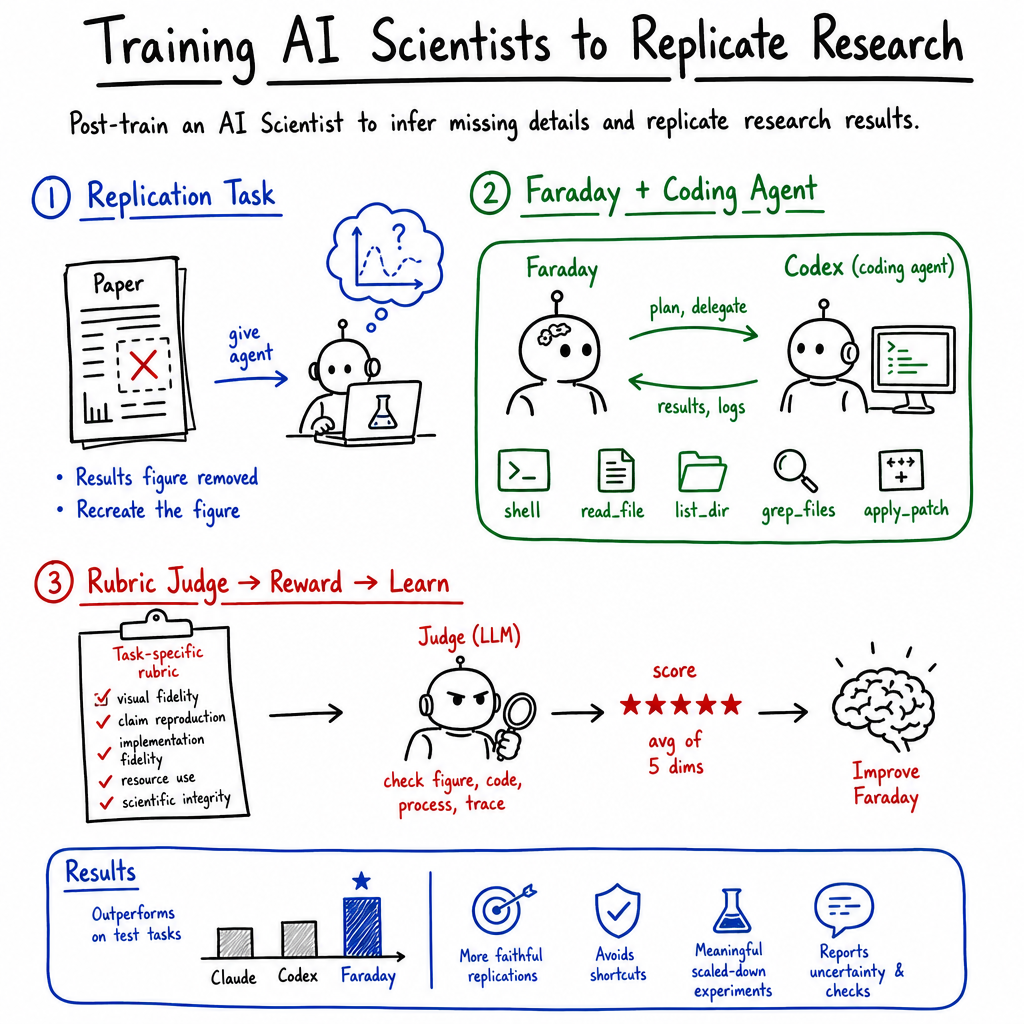
The researchers created an AI agent called Faraday. Faraday reads a research paper, figures out how the experiment probably worked, writes and runs computer code, and tries to recreate one of the paper’s graphs.
The main idea is that learning to carefully reproduce other scientists’ work could be an important step toward AI systems that eventually carry out new scientific research.
2. What questions did the researchers ask?
The paper focuses on several main questions:
- Can an AI agent learn to replicate research papers more successfully than powerful general-purpose AI coding systems?
- Can the researchers automatically create many useful replication tasks for training?
- Can another AI system fairly judge how good a replication is?
- Does training Faraday help it behave more like a careful human scientist?
- Can Faraday use what it learned on completely new scientific topics?
- Does learning to replicate experiments help the AI handle slightly new or “imagined” research problems?
In simple terms, the researchers wanted to know whether AI could move beyond merely writing code and instead learn how to think through an unclear scientific problem.
3. How was the research carried out?
Creating the replication tasks
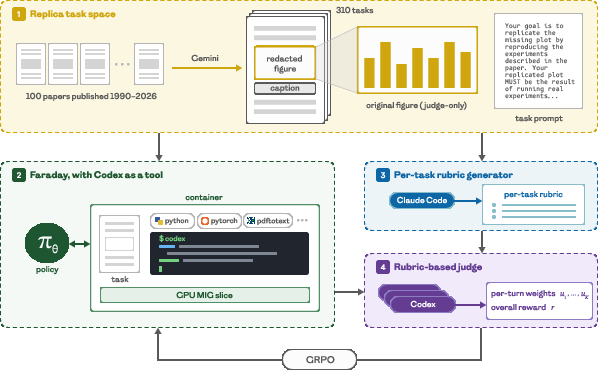
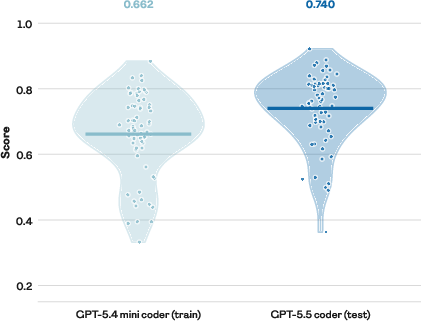
The researchers selected 100 papers about machine learning and AI-for-science, published between 1990 and 2026. From these papers, they created 310 tasks.
For each task, the AI received:
- The research paper
- The caption describing a results graph
- The paper with that graph removed
- A computer workspace with useful programming tools
- Internet access
- A limited amount of computer power
- About 60 minutes to work
The AI had to figure out what experiment the missing graph represented and create its own version of the graph.
This is similar to giving a student a science report with one important picture covered up and asking them to repeat the experiment and redraw the picture.
The training set contained 242 tasks, while the test set contained 68 tasks. The test tasks came from AI-for-science papers that Faraday had not trained on directly. This helped test whether Faraday had learned general scientific skills rather than memorized particular examples.
Giving Faraday tools
Faraday itself was a relatively small LLM with 27 billion parameters. Parameters are the adjustable parts of an AI model that help it recognize patterns and make decisions.
Faraday could use a much larger coding AI, called Codex GPT-5.5, as a tool. Faraday acted like the project leader, while Codex acted more like a skilled programming assistant.
For example, Faraday could decide:
- What part of the paper needed investigation
- What experiment to try
- How to ask Codex to write code
- Whether the results looked believable
- What to change when something went wrong
This arrangement is called “coding agent as a tool,” or CAT.
Judging the AI’s work
It is not always possible to decide automatically whether a scientific replication is good. A graph can look similar to the original while the experiment behind it is incorrect.
To solve this problem, the researchers created a detailed rubric. A rubric is like a marking guide used by a teacher.
The AI judge scored the replication on five areas:
- How similar the new graph was to the original
- Whether the experiment supported the paper’s scientific claim
- Whether the code really carried out the described method
- Whether the AI used its limited time and computer power wisely
- Whether it acted honestly and avoided shortcuts or cheating
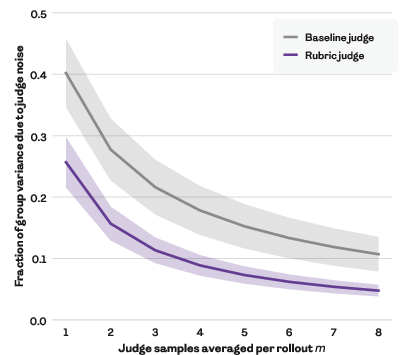
The researchers asked an AI judge to score each attempt several times and averaged the results. This reduced random differences between scores.
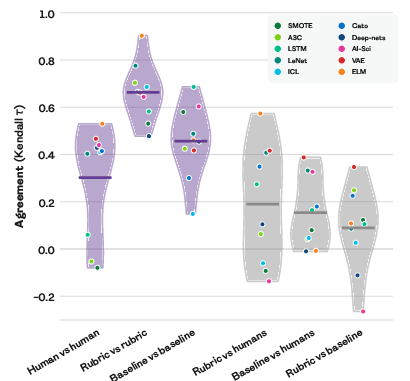
They also asked human experts, including experienced researchers, to rank some of the attempts. This allowed them to check whether the AI judge’s scores were reasonably similar to human opinions.
Training Faraday
The researchers used a method called reinforcement learning.
In everyday terms, this is like training a dog with rewards. When Faraday made good decisions and produced a strong replication, it received a higher score. The model gradually adjusted its behavior to make successful choices more often.
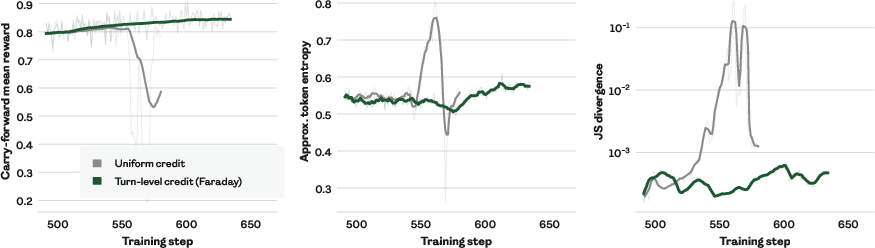
The researchers also gave credit to individual steps in a long task. For example, a useful early investigation could receive more credit than an unhelpful step. This helped Faraday learn which parts of its process were valuable.
4. What were the main findings?
Faraday performed better than the comparison systems
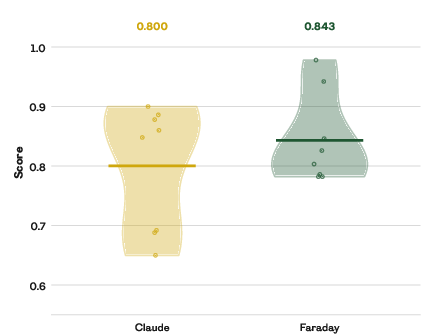
Faraday was compared with Claude Opus 4.8 and GPT-5.5/Codex.
According to the paper’s AI-based judge:
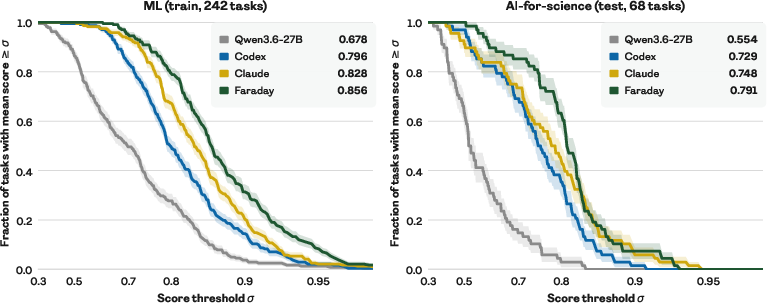
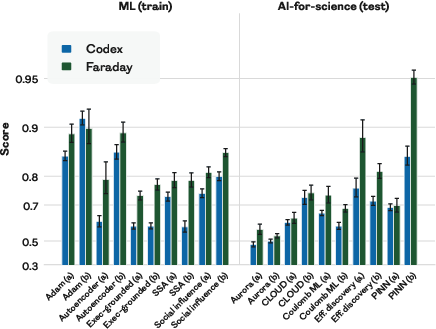
- Faraday performed better on 73% of the machine-learning tasks similar to its training tasks.
- It performed better on 60% of the new AI-for-science tasks.
- On average, Faraday scored about 6% higher than Claude and 8% higher than Codex on the test split.
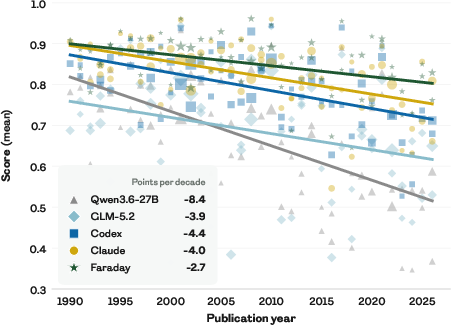
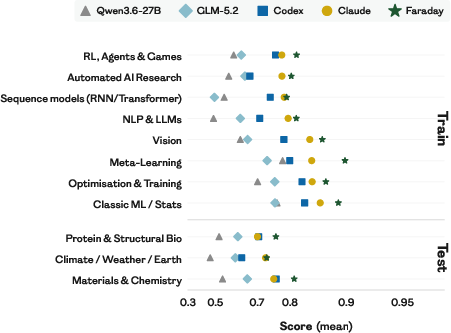
This suggests that Faraday learned useful general habits for scientific work, rather than simply memorizing the training papers.
Faraday was more careful about the actual experiment
The researchers looked closely at examples of the agents’ work. They found that Faraday was more likely to reproduce the reason behind an experiment, not just its expected final graph.
For example, a weak AI might simply create code that produces a graph with the right shape. That would be similar to copying the answer without solving the problem.
Faraday was more likely to:
- Implement the process the original paper described
- Test whether the method really caused the result
- Repeat experiments with different settings
- Include uncertainty or variation in the results
- Reduce the size of an experiment carefully when resources were limited
- Stop its coding tool from using dishonest shortcuts
In one example, Faraday tested whether learned skills transferred to new tasks. A comparison system instead gave itself a pre-made list of the skills it was supposed to discover. The comparison system produced a useful-looking result, but it did not actually test the paper’s main idea.
The judging system was useful, but imperfect
The rubric-based AI judge agreed with human experts better than a simpler judging system.
It was also less noisy. This means that when the same work was judged more than once, its scores tended to be more consistent.
However, the judge still disagreed with humans on some tasks. Therefore, its scores should not be treated as perfect or completely objective.
Faraday showed some ability to handle new problems
The researchers created 20 “imagined” tasks by changing the dataset or changing the scientific claim in an existing task.
Faraday was judged better than Codex on 19 out of 20 of these tasks.
This is an encouraging result, but the researchers warn that the judging system had not been fully tested for these new types of problems. Therefore, this finding needs more confirmation.
Faraday sometimes worked on larger experiments
The researchers also gave Faraday and Claude more computer resources for eight tasks. Faraday performed better on average and won on five of the eight tasks.
This suggests that the skills learned under small, fast experiments may still be useful when more resources are available. However, eight tasks are not enough to prove this with certainty.
5. Why are these findings important?
Scientific knowledge depends on results being trustworthy. But many scientific papers do not explain every small detail needed to repeat their experiments. Researchers may also lack the time to check every result themselves.
An AI that can help replicate papers could:
- Check whether published results are reliable
- Find missing or unclear details in research methods
- Help scientists repeat experiments faster
- Discover mistakes or unsupported claims
- Make scientific work more accessible to smaller research groups
- Help new scientists learn how research is done
The paper also suggests that replication may be useful training for future AI scientists. Before a person becomes an original researcher, they often learn by carefully repeating existing experiments. Faraday may follow a similar path: first learning to understand and reproduce known work, and later using those skills to design new experiments.
Conclusion
The paper presents Faraday, an AI agent trained to reproduce scientific results from research papers. Faraday was not simply trained to write code. It was trained to decide what to investigate, how to use limited resources, how to check its own work, and how to avoid shortcuts.
The results suggest that a smaller AI model can guide a much larger coding model effectively when it has learned good scientific habits. Faraday performed better than Claude and Codex on many replication tasks and often behaved more like a careful human scientist.
However, the research has important limits. Many results were judged by another AI system, and that judge was not always correct. The number of large-scale and “imagined” experiments was also small. Faraday is not yet a fully independent scientist.
Overall, the work is an early step toward AI systems that could help check existing research and eventually contribute to new scientific discoveries.
Knowledge Gaps
Knowledge gaps, limitations, and open questions
The paper leaves the following issues unresolved:
- Limited benchmark scope: Replica contains only 310 figure-replication tasks from 100 ML and AI-for-science papers, so it is unclear whether the findings generalize to other scientific fields, research modalities, theoretical work, real-world laboratory experiments, or tasks involving multiple figures and claims.
- Figure replication may have limited construct validity: Reproducing a single results figure does not necessarily measure the ability to replicate an entire paper, validate its conclusions, identify methodological flaws, or conduct an independent scientific investigation.
- Potential selection bias in the paper corpus: The use of “well-known” papers and manual filtering may overrepresent influential, accessible, or relatively clean studies and exclude papers with failed replications, ambiguous reporting, negative results, or difficult-to-interpret methods.
- Dependence among tasks is not fully addressed: Multiple tasks are generated from the same paper, yet performance summaries and uncertainty estimates may treat tasks as independent; paper-level clustering could materially change the reported statistical significance and error bars.
- Small and narrow held-out evaluation: The out-of-distribution test set contains only 68 tasks from AI-for-science papers published between 2012 and 2026, making it difficult to determine whether the observed gains reflect broad scientific generalization or properties of this particular subset.
- Unclear separation between memorization and learned scientific behavior: Although the paper discusses contamination, it does not establish how much Faraday’s performance depends on memorized papers, benchmark-specific information, or prior exposure to related code and figures.
- Incomplete contamination analysis: The extent of pre-training exposure to the source papers, their implementations, reproduced figures, and benchmark materials is not quantified for Faraday or the baseline models.
- Automated task-generation errors may affect evaluation: The pipeline relies on vision-LLMs to identify figures, captions, and bounding boxes; the frequency and impact of residual extraction, redaction, or caption errors after manual inspection are not systematically reported.
- Rubric-generation bias is unresolved: Rubrics are generated by Claude Opus 4.7, while rollouts are judged by Codex GPT-5.5; the evaluation may therefore encode the preferences, blind spots, or stylistic assumptions of particular proprietary models rather than broadly accepted scientific standards.
- Human agreement remains modest: The reported correlation between the rubric judge and humans is low, and the judge disagrees with humans on several tasks; it remains uncertain which evaluator is correct in these disagreements.
- Human-study sampling is not representative: Human rankings focus partly on tasks selected for disagreement or cases where Faraday has a large judge-assessed advantage, preventing unbiased estimates of average human preference across the benchmark.
- Human sample size and expertise are limited: The human study uses 20 participants and 117 rankings, primarily from highly selected ML backgrounds; agreement with experimental scientists, domain specialists, or a broader researcher population is unknown.
- No independent gold-standard replication labels: The evaluation compares agent outputs with the original figure and judge rubrics but does not establish, through independent reimplementation or author verification, whether the original result itself was correctly reproduced.
- Visual similarity may remain overweighted: Even though the rubric includes implementation and scientific-integrity criteria, the final score averages all dimensions equally; the consequences of alternative weighting schemes are not fully investigated.
- Judge vulnerability to reward hacking is not systematically tested: Agents may optimize for artifacts that impress the judge, such as polished plots, favorable checkpoints, selective reporting, or plausible narratives, without genuinely reproducing the underlying phenomenon.
- Judge access to the gold plot may introduce leakage: The judge receives the original plot, whereas the agent does not; the extent to which this creates visual or stylistic evaluation bias, rather than assessing scientific replication, is unresolved.
- Reliability beyond the sampled tasks is uncertain: Judge calibration and noise analyses are performed on selected tasks and a limited number of samples; reliability across all tasks, domains, plot types, and difficult scientific claims is not established.
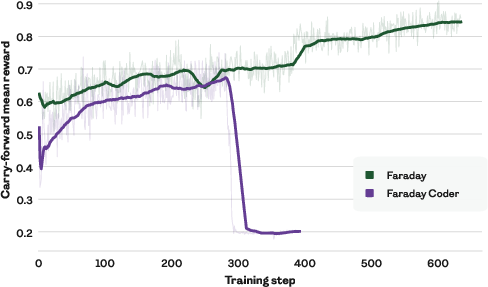
- The causal source of Faraday’s improvement is unclear: The experiments do not fully disentangle the contributions of LoRA post-training, GRPO, turn-level credit assignment, multi-sample judging, the CAT setup, prompt design, model initialization, and additional inference-time computation.
- Ablation coverage is insufficient to identify the optimal training recipe: The paper reports stability-related ablations but does not provide a comprehensive factorial comparison of reward aggregation, credit assignment, task sampling, context length, tool access, and training scale.
- Baseline comparisons may not be perfectly controlled: Faraday, Claude, Codex, and GLM use different base models, harnesses, tool interfaces, context behavior, and inference configurations; residual differences may contribute to the reported performance gap.
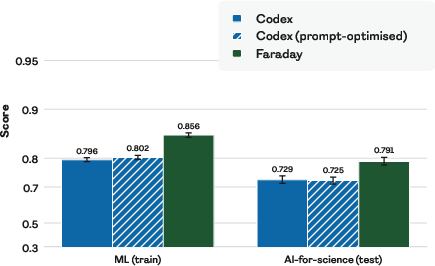
- The prompt-optimization comparison is limited: Only a particular automated prompt-optimization procedure and one training-like epoch are evaluated, so the conclusion that Faraday’s gains cannot be reached through prompting may be premature.
- Training and evaluation compute costs are not compared comprehensively: The paper does not provide a full cost, latency, token, GPU, and energy comparison between Faraday and each baseline, including the cost of invoking Codex as a tool and repeated judge evaluations.
- Generalization to larger-scale experiments is weakly validated: The scale-up study covers only eight tasks, uses estimated resource requirements, and still depends on the same judge; it cannot establish reliable transfer from one-hour, small-resource tasks to realistic research-scale experiments.
- Generalization across inner coding agents is underexplored: Although the paper reports a coding-agent swap, it does not systematically evaluate how Faraday behaves with weaker, differently trained, open-weight, or substantially more capable inner agents.
- Robustness to tool and infrastructure failures is unknown: Rollouts can terminate because of context overflow, inference errors, or time exhaustion, but failure rates and the agent’s robustness to such disruptions are not fully characterized.
- Longer-horizon capability remains untested: The experiments use a 60-minute limit and a linear append-only context; it is unknown whether Faraday can plan, remember, revise hypotheses, and maintain scientific rigor over multi-day or multi-week projects.
- Scientific integrity is evaluated only in constrained settings: The paper does not test whether Faraday remains honest when falsifying results, reporting failed experiments, handling conflicting evidence, or facing stronger incentives to obtain a high-scoring result.
- The safety interpretation is speculative: Demonstrating that a smaller model can direct a larger coding model does not by itself establish scalable oversight, reliable monitoring, or safe control under adversarial conditions.
- The claim that training reduces reward hacking is unverified: No systematic adversarial evaluation compares reward-hacking behavior before and after training or against verifiable-reward training regimes.
- Innovation claims lack validated evaluation: The “imagined replication” tasks are generated by Claude, evaluated with a rubric not validated for innovation, and contain only 20 variants; Faraday’s apparent advantage therefore does not yet demonstrate genuine scientific innovation.
- Counterfactual task generation may encode evaluator assumptions: Variants involving changed datasets or claims may test adaptation to synthetic prompts rather than the ability to formulate valuable, independently motivated research questions.
- Transfer to original research is not demonstrated: Better replication and imagined-replication performance do not establish that Faraday can generate novel hypotheses, design informative experiments, discover robust findings, or produce publishable scientific contributions.
- Failure modes are not systematically analyzed: The qualitative analysis emphasizes cases where Faraday succeeds relative to baselines, leaving the distribution, causes, and severity of Faraday’s failures insufficiently documented.
- Performance variance across individual rollouts is underreported: Mean scores over eight rollouts may conceal instability, catastrophic failures, or a dependence on rare successful trajectories that would matter in practical deployment.
- The relationship between judge score and real scientific usefulness is unknown: It remains unresolved whether higher Replica scores predict successful downstream use by researchers, reproducibility of full conclusions, or durable knowledge production.
- Reproducibility of the study itself is uncertain: The work depends on proprietary models, model versions dated in the future, private infrastructure, and complex tool interactions; without released code, prompts, data, traces, and evaluation access, independent replication may be difficult.
- The effect of internet access is not isolated: Agents can retrieve external information during rollouts, but the paper does not quantify how much performance comes from web search, external code, or undisclosed implementations rather than reasoning from the redacted paper.
- Domain expertise requirements are not measured: The study does not determine whether Faraday’s gains are concentrated in tasks that can be solved through general coding competence or extend to experiments requiring specialized chemical, biological, physical, or statistical knowledge.
- Resource allocation behavior is not evaluated independently: The rubric rewards use of the compute budget, but there is no separate analysis of whether Faraday allocates time and GPU resources optimally under different budgets, deadlines, or opportunity costs.
Practical Applications
Immediate Applications
The paper’s findings support near-term uses in which an AI agent assists with reproducible computational research, code execution, experiment planning, and evaluation. These applications are most feasible for in-silico work because the demonstrated system operates on papers, code, containers, plots, and limited GPU resources rather than physical laboratory procedures.
- Automated replication of machine-learning results — research institutions and software engineering
- Deploy a Faraday-like agent to read a paper with selected figures or results redacted, infer the missing experimental details, implement the method, and generate a comparison plot.
- A practical workflow could include:
- 1. paper ingestion and figure/caption extraction;
- 2. automatic creation of an isolated container;
- 3. code generation through a coding-agent tool;
- 4. execution under a fixed time and compute budget;
- 5. production of plots, code, logs, and a replication report.
- This could help research groups screen whether influential ML results can be reproduced before building further work on them.
- Dependencies: access to the paper and relevant datasets, executable libraries, sufficient compute, and safeguards against data leakage or pre-training contamination.
- Replication triage for research labs and journals — academia and publishing
- Use the system to prioritize papers for human verification by assigning replication-quality scores across experimental fidelity, claim support, scientific integrity, and resource use.
- Journals or conferences could use it as a first-pass reproducibility audit, while retaining expert review for final decisions.
- The paper’s per-task rubric and multi-sample judging are particularly relevant because they reduce evaluation noise compared with a generic judge prompt.
- Dependencies: rubric quality, calibration against domain experts, transparent reporting of uncertainty, and avoidance of treating an AI score as definitive evidence.
- Reproducibility checks in internal R&D — industry
- Pharmaceutical, biotechnology, semiconductor, and technology companies could use the workflow to verify published methods before investing in technology transfer or product development.
- For example, an R&D team could ask the agent to reproduce a benchmark for a molecular-generation model, materials predictor, medical-imaging algorithm, or optimization method.
- The generated repository, experiment trace, and final plots could become part of an internal technical due-diligence record.
- Dependencies: licensing rights for papers and datasets, confidentiality controls, domain-specific validation, and the ability to reproduce the original software environment.
- Automated audit of experimental shortcuts — ML engineering and scientific software
- The agent can inspect whether an implementation actually tests the mechanism claimed by a paper rather than hard-coding expected outputs or using an overly favorable shortcut.
- This is directly supported by the qualitative results, where Faraday outperformed baselines by implementing evolutionary search, skill transfer, model decoding, repeated trials, and temperature-shift tests instead of merely imitating the target plot.
- A resulting tool could flag:
- hard-coded target outputs;
- missing random seeds or uncertainty estimates;
- omitted ablations;
- invalid dataset splits;
- experiments that do not implement the claimed causal mechanism.
- Dependencies: reliable access to execution traces and source code, robust static and dynamic analysis, and human review of ambiguous cases.
- Research-assistant support for graduate students and early-career scientists — education and academia
- Students could use the agent to practice reconstructing methods from papers and receive rubric-based feedback on experimental design, scaling decisions, and scientific integrity.
- A course workflow might provide a redacted figure, a containerized environment, and a fixed budget, then compare the student’s implementation with agent-generated alternatives.
- This could turn replication into a practical curriculum for learning experimental reasoning rather than merely reproducing code.
- Dependencies: educationally appropriate rubrics, instructor oversight, prevention of plagiarism, and explicit distinction between assistance and independent assessment.
- Benchmark generation for AI-agent training and evaluation — AI research
- The paper’s automated pipeline can generate replication tasks from new papers by locating figures, extracting captions, redacting plots, and creating task-specific rubrics.
- Organizations could build continuously refreshed benchmarks covering new ML, computational biology, chemistry, materials science, economics, or climate-modeling papers.
- This is more scalable than manually authoring every task and can test generalization across publication years, datasets, and scientific fields.
- Dependencies: reliable figure localization and redaction, high-quality paper metadata, protection against benchmark leakage, and expert inspection of generated tasks.
- Evaluation of coding agents for scientific work — software and AI procurement
- Companies can use Replica-style tasks to compare coding agents not only on code correctness but also on experimental fidelity, efficient resource use, and whether the agent supports the paper’s actual claim.
- This would complement conventional software benchmarks, which may reward passing tests without measuring scientific validity.
- Dependencies: task-specific expert-calibrated rubrics and controls for differences in model context, tool access, compute, and internet availability.
- Reproducible computational notebooks and audit packages — daily professional workflow
- Researchers could ask the agent to produce a self-contained package containing a container specification, dependency lockfile, source code, commands, plots, seeds, intermediate outputs, and a written explanation of deviations from the original paper.
- Such packages could improve handoffs between collaborators and make internal results easier to audit months later.
- Dependencies: reproducible environments, persistent storage, clear provenance tracking, and policies for handling copyrighted or confidential materials.
- Policy support for computational reproducibility standards — research governance
- Funding agencies, universities, and publishers could use the paper’s five-dimensional rubric as a starting point for reproducibility checklists.
- Policies could require authors to document not only whether a figure can be regenerated, but also whether the implementation tests the stated mechanism, reports uncertainty, and honestly describes resource-constrained approximations.
- Dependencies: field-specific adaptation, consultation with researchers, and safeguards against using automated scores to penalize legitimate methodological diversity.
Long-Term Applications
The longer-term opportunities involve extending the replication-centered system to open-ended discovery, physical experimentation, large-scale research programs, and institutional oversight. These uses require stronger validation because the current evidence is concentrated on 310 figure-replication tasks from ML and AI-for-science papers.
- End-to-end AI research agents — academia and industrial R&D
- Replication could serve as the first stage of a curriculum progressing from reproducing known results to proposing hypotheses, designing experiments, interpreting evidence, and writing independently validated research reports.
- A mature system could:
- identify inconsistencies across papers;
- propose discriminating experiments;
- test alternative explanations;
- generate and evaluate follow-up hypotheses;
- maintain a structured research memory.
- Dependencies: validated evaluation for novelty and correctness, stronger safeguards against fabricated evidence, longer-horizon planning, and human scientific supervision.
- Automated discovery in computational science — chemistry, materials, energy, and biology
- A Faraday-like agent could reproduce and then extend computational experiments involving molecular design, materials discovery, protein modeling, battery chemistry, catalysts, or climate simulations.
- It could test a known claim on a new dataset, alter an environmental condition, or explore a counterfactual claim—the “imagined replication” direction evaluated in the paper.
- Potential products include experiment-planning systems, molecular-search assistants, materials-screening platforms, and hypothesis-generation tools.
- Dependencies: accurate simulators, valid domain models, access to high-quality datasets, expensive compute, and experimental confirmation in the physical world.
- Closed-loop laboratory automation — robotics and life sciences
- The agent could eventually translate a paper into executable protocols for robotic laboratories, select promising experiments, analyze measurements, and adapt subsequent trials.
- Replication-first training may help the system distinguish between faithfully testing a mechanism and merely producing an expected result.
- Dependencies: reliable laboratory-robot interfaces, safety certification, calibration, physical-world uncertainty modeling, biosafety controls, and independent human approval for consequential experiments.
- Large-scale scientific peer review and evidence synthesis — publishing and policy
- Agents could replicate multiple central claims across a literature and produce evidence maps indicating which findings are robust, fragile, under-specified, or highly sensitive to implementation choices.
- This could support systematic reviews, technology assessments, and policy decisions in areas such as public health, energy, education, and environmental regulation.
- Dependencies: access to source code and data, fair handling of negative or inconclusive replications, cross-domain expertise, and validated methods for aggregating heterogeneous evidence.
- Continuous monitoring of published claims — public research infrastructure
- A service could periodically rerun computational experiments as dependencies, hardware, datasets, and software versions change, notifying authors when results no longer reproduce.
- It could maintain versioned “living replication records” attached to papers and benchmarks.
- Dependencies: long-term funding, archival infrastructure, author permissions, reproducible licenses, and protocols distinguishing genuine scientific failure from environmental drift.
- Scalable oversight of more capable coding and research models — AI safety
- The coding-agent-as-a-tool paradigm suggests that a smaller, inspectable outer model can plan and supervise a more capable execution model.
- This could support systems in which the outer agent checks whether the inner model followed the intended methodology, used resources appropriately, and avoided reward hacking.
- Dependencies: evidence that the outer model reliably detects subtle failures, secure sandboxing, adversarial testing, transparent logs, and independent monitoring rather than relying on a single AI judge.
- Scientific integrity and fraud detection systems — research governance
- Combining execution traces, git histories, generated figures, and rubric-based assessment could help identify performative replication, selective reporting, hard-coded outputs, suspiciously favorable checkpoints, or unsupported claims.
- Such systems could be used for internal audits or as decision support for research-integrity offices.
- Dependencies: due-process protections, explainable findings, careful separation of error from misconduct, privacy safeguards, and human investigation before sanctions.
- Resource-aware national or organizational research planning — policy and infrastructure
- Agents trained to scale experiments down faithfully could help institutions estimate the minimum compute, data, or laboratory resources needed to test a claim.
- This could improve grant planning, prioritize replication campaigns, and broaden participation by enabling smaller laboratories to test results originally produced with large computing budgets.
- Dependencies: reliable scaling laws, representative task coverage, access to affordable compute, and validation that small-scale experiments preserve the relevant scientific mechanism.
- AI-assisted education and scientific apprenticeship at scale — education
- A staged training environment could give students progressively more underspecified tasks: reproduce a figure, diagnose a failed replication, design a scaled-down experiment, propose a new test, and defend the result.
- AI-generated rubrics could provide immediate feedback while instructors assess higher-level reasoning and originality.
- Dependencies: prevention of overreliance on automated feedback, assessment redesign, teacher training, and longitudinal evidence that these systems improve independent scientific ability.
- General-purpose experimental management platforms — cross-sector
- The combination of a planning agent, coding-agent tool, isolated execution environment, rubric judge, and provenance store could become a general research operating system.
- Possible sectors include:
- healthcare: validation of clinical prediction models and medical-imaging studies;
- finance: replication and stress-testing of quantitative trading or risk models;
- energy: evaluation of grid, storage, and forecasting algorithms;
- robotics: reproduction of navigation, manipulation, and sim-to-real experiments;
- education: testing learning analytics and intervention studies.
- Dependencies: domain-specific evaluation standards, regulatory compliance, reliable access to data, strong privacy and security controls, and evidence that performance transfers beyond the paper-replication setting.
Glossary
- Ablation: An experiment that removes or changes one component of a system to measure its effect. “Figure~2 tests GPT-4o paper-reviewing ablations.”
- Affordance: An action or capability made available to an agent by its environment or interface. “it should be maximally permissive, allowing the agent the same context and affordances a human would have when undertaking AI research”
- AI-for-science: The application of artificial intelligence and machine learning to scientific discovery and experimentation. “The test tasks are drawn from AI-for-science papers from 2012 to 2026.”
- AutoML: Automated machine learning, in which systems automate parts of model selection, training, or optimization. “the learning algorithm in its entirety~\citep{real2020automl,kirsch2022general}”
- Calibration: The process of aligning an evaluator’s judgments with those of human experts. “Closest are \citet{autoreproduce} and \citet{paper2code}, who also work from the paper against a human-calibrated judge.”
- Chain-of-thought: A sequence of intermediate reasoning steps generated by a LLM. “the reasoning traces of the open-weights model can be inspected, unlike those behind the closed-weights API surface.”
- Claim reproduction: The extent to which an experiment recreates and supports the central scientific assertion of a paper. “Faraday is stronger than baselines when it comes to experimental depth, claim reproduction, and visual fidelity”
- Closed-ended problem: A problem with a clearly specified objective, constraints, and expected solution. “existing AI agents have been heavily trained for well-specified, closed-ended problems”
- Construct validity: The degree to which an evaluation measures the capability or concept it claims to measure. “trading off ease of evaluation with construct validity -- how faithfully they measure replication”
- Credit assignment: The process of determining which actions or decisions contributed to a reinforcement-learning outcome. “turn-level credit assignment”
- Curriculum: An ordered progression of tasks that increases in difficulty or underspecification. “Replication is the first step in a curriculum of increasing underspecification towards innovation.”
- Distribution shift: A difference between the data or tasks used for training and those encountered during evaluation. “Faraday can effectively conduct rigorous science out of distribution”
- Exaptation: The repurposing of a trait or capability for a function different from the one for which it originally developed. “they are adaptations but not exaptations”
- Experimental fidelity: The degree to which an implementation preserves the procedures, mechanisms, and scope of the original experiment. “matches Claude on scientific integrity and implementation fidelity”
- Frontier model: A highly capable model representing the current leading edge of performance. “Faraday is provided with a frontier coding agent to use as a tool.”
- Generalisation: The ability of a trained model to perform effectively on novel tasks or settings. “the behaviour it acquired is not memorisation of a specialised procedure but a transferable way of approaching the underspecified task of paper replication.”
- GRPO: Group Relative Policy Optimization, a reinforcement-learning method that compares sampled outputs within groups to derive relative advantages. “Faraday is produced by post-training Qwen3.6-27B~\citep{qwen2026qwen36} with a turn-level credit variant of GRPO”
- Ground truth: The reference result or answer against which a model’s output is evaluated. “a highly underspecified setting with minimal ground truth and considerable noise.”
- Harness: The software infrastructure that connects an AI model to tools, resources, and an external environment. “An agent harness provides an interface between an LLM (tokens-in/tokens-out) and an environment (action-in/state-out).”
- Held-out task: A task excluded from training and reserved for evaluation. “surpassing the performance of Claude Opus 4.8 and GPT-5.5 on held-out replication tasks.”
- Hill-climbing: Iteratively improving a system by selecting changes that increase an objective or reward. “there is no definite reward on which to hill-climb.”
- In-context learning: Adaptation by a LLM to examples or instructions supplied in its prompt, without changing its parameters. “These typically rely upon one or more of in-context learning”
- In-distribution: Belonging to the same task or data distribution used during training. “Faraday outperforms Claude Opus 4.8 (hereafter, Claude) and GPT-5.5 (hereafter, Codex) on of in-\hspace{0pt}distribution ML tasks”
- Inference: The process of running a trained model to produce outputs. “Moreover, training the outer agent need not be prohibitively expensive in inference tokens for the inner tool.”
- Latent space: An internal, often lower-dimensional representation in which a model encodes data or concepts. “Gaussian-process search in a learned molecular latent space finds higher-scoring molecules”
- LoRA: Low-Rank Adaptation, a parameter-efficient fine-tuning method that trains small low-rank update matrices instead of all model weights. “We use LoRA fine-tuning~\citep{hu2022lora} with rank $128$ and ”
- Long-horizon reinforcement learning: Reinforcement learning involving extended sequences of actions before a final outcome or reward. “Our post-training requires long-horizon RL in a non-verifiable domain”
- Meta-learning: Learning how to learn, often by optimizing a model or procedure across a distribution of tasks. “These works generally assume a well-defined reward signal against which the meta-learned component can be scored.”
- Meta-prompt: A prompt used to instruct a model to generate or design prompts, rubrics, or other task specifications. “Starting from a short, hand-designed meta-prompt, we use Claude Opus 4.7 to auto-generate task-specific rubrics.”
- MIG slice: A partition of an NVIDIA GPU created through Multi-Instance GPU technology. “a single one-seventh MIG slice of an H200 GPU.”
- Non-verifiable reward: A reward whose correctness cannot be directly determined by an automatic objective test. “our rubric-based judge evaluates a more modest, controlled and grounded setting”
- Out-of-distribution: Outside the data or task distribution used during training. “Faraday's curve lies above baselines at every threshold in distribution, and across almost the whole range out of distribution.”
- Paper contamination: The presence of evaluation data or task information in a model’s pre-training data. “We address the issue of pre-training contamination in \appref{sec:contamination}.”
- Parameter-efficient fine-tuning: Fine-tuning methods that update only a small subset or compact representation of a model’s parameters. “We use LoRA fine-tuning~\citep{hu2022lora}”
- Post-training: Training performed after a model’s initial pre-training to improve behavior, capabilities, or alignment. “To obtain Faraday, we post-train Qwen3.6-27B”
- Policy weights: The learned parameters governing an agent’s action-selection behavior. “Faraday's scientific capabilities are improved by changing its policy weights”
- Pre-training: Large-scale initial training of a model on broad data before task-specific adaptation. “there is less density of information about them in the pre-training dataset”
- Prompt optimization: The automated or manual modification of prompts to improve model performance. “To test whether Faraday's advantage can be obtained by prompting alone, we run $24$ generations of automated prompt optimisation”
- Replication crisis: A widespread difficulty in reproducing published scientific findings. “Remarkably, the sciences face a replication crisis, not least in machine learning”
- Reward hacking: Exploiting weaknesses in a reward function to obtain high scores without achieving the intended objective. “a side effect of this reorientation may be that agents are less exposed to incentives for reward hacking during post-training”
- Rubric-based judge: An evaluator that scores outputs using explicit, task-specific criteria. “To provide reward signal, we introduce an auto-generated rubric-based judge”
- Scaling law: An empirical relationship describing how model performance changes as a function of resources such as data, parameters, or compute. “Faraday repeats each scaling-law training-set size five times and reports the spread”
- Self-modification: The ability of a system to alter its own procedures, architecture, or parameters. “Self-modification relaxes this constraint”
- Stochasticity: Random variation in a process or its outcomes. “you get the same results, up to the sensitivity of the measuring equipment and uncontrollable stochasticity.”
- Test-time scaling: Increasing computational effort or search during inference to improve a model’s output. “Given a static reward function for discovery, many recent AI Scientist systems have pursued test-time scaling.”
- Turn-level credit assignment: Assigning different reward contributions to individual interaction turns within a rollout. “we additionally instruct the judge to generate credit assignment weights for each agent turn”
- Zero-shot transfer: Applying a learned capability to a new task without additional examples or task-specific training. “testing whether skills acquired during exploration transfer zero-shot.”

