SimpleOPD: Simple Tokenizer-Agnostic On-Policy Distillation for Long-Context Reasoning
Abstract: On-policy distillation (OPD) offers a promising way to transfer reasoning capabilities from stronger teacher models, but applying it to long-context reasoning teachers and short-context students introduces practical challenges, including tokenizer mismatch, teacher-student distribution mismatch, response length explosion, and training instability. In this work, we study this setting by transferring proof-reasoning capabilities from the long-context reasoning model SU-01 to short-context student models. To handle tokenizer differences, we perform OPD in a shared text space and align only tokens that occupy identical text spans under the student and teacher tokenizers. To mitigate the problem of excessive generation length and frequent truncation, we introduce a student reference KL loss and mask the advantages of special termination tokens such as </think> and <|im_end|>. This strategy constrains the student from drifting excessively from its initial policy, thereby mitigating the teacher-student distribution mismatch problem and fostering steady length growth. Experiments on both same-family and different-family student models, including Qwen3, Qwen3.5, Intern-S2, GLM-4.7, Gemma-4, show consistent gains in mathematical reasoning, especially natural-language math proving. Notably, Intern-S2-Preview improves by 21.2 points on ProofBench, reaching 55.2 and surpassing Gemini-2.5-Pro. It also improves on science benchmarks such as HLE and HiPhO, suggesting that OPD transfers reasoning capabilities that generalize beyond the mathematical training domain.
First 10 authors:
Paper Prompts
Sign up for free to create and run prompts on this paper.
Top Community Prompts
Explain it Like I'm 14
1. What is this paper about?
This paper presents a method called SimpleOPD for teaching smaller or shorter-context LLMs how to reason better.
The researchers use a powerful model called SU-01 as a teacher. SU-01 can spend a very long time solving difficult mathematics problems, sometimes using more than 100,000 pieces of text. The researchers want to transfer some of this ability to student models that have less memory and shorter limits for their answers.
The main challenge is that different LLMs do not split text into pieces in the same way. These pieces are called tokens. For example, one model might treat “playing” as one token, while another might split it into “play” and “ing.”
The paper proposes a simple way to deal with this problem and shows that it can significantly improve mathematical reasoning.
2. What questions did the researchers ask?
The researchers mainly wanted to know:
- Can a long-context teacher model teach its reasoning skills to a shorter-context student?
- Can this work even when the teacher and student use different tokenizers and belong to different model families?
- How can the training be stopped from making the student produce extremely long, repetitive, or unfinished answers?
- Can the student learn useful reasoning skills from the teacher without simply copying complete teacher-generated answers?
- Will skills learned from mathematics also help with science problems?
3. How did the researchers do it?
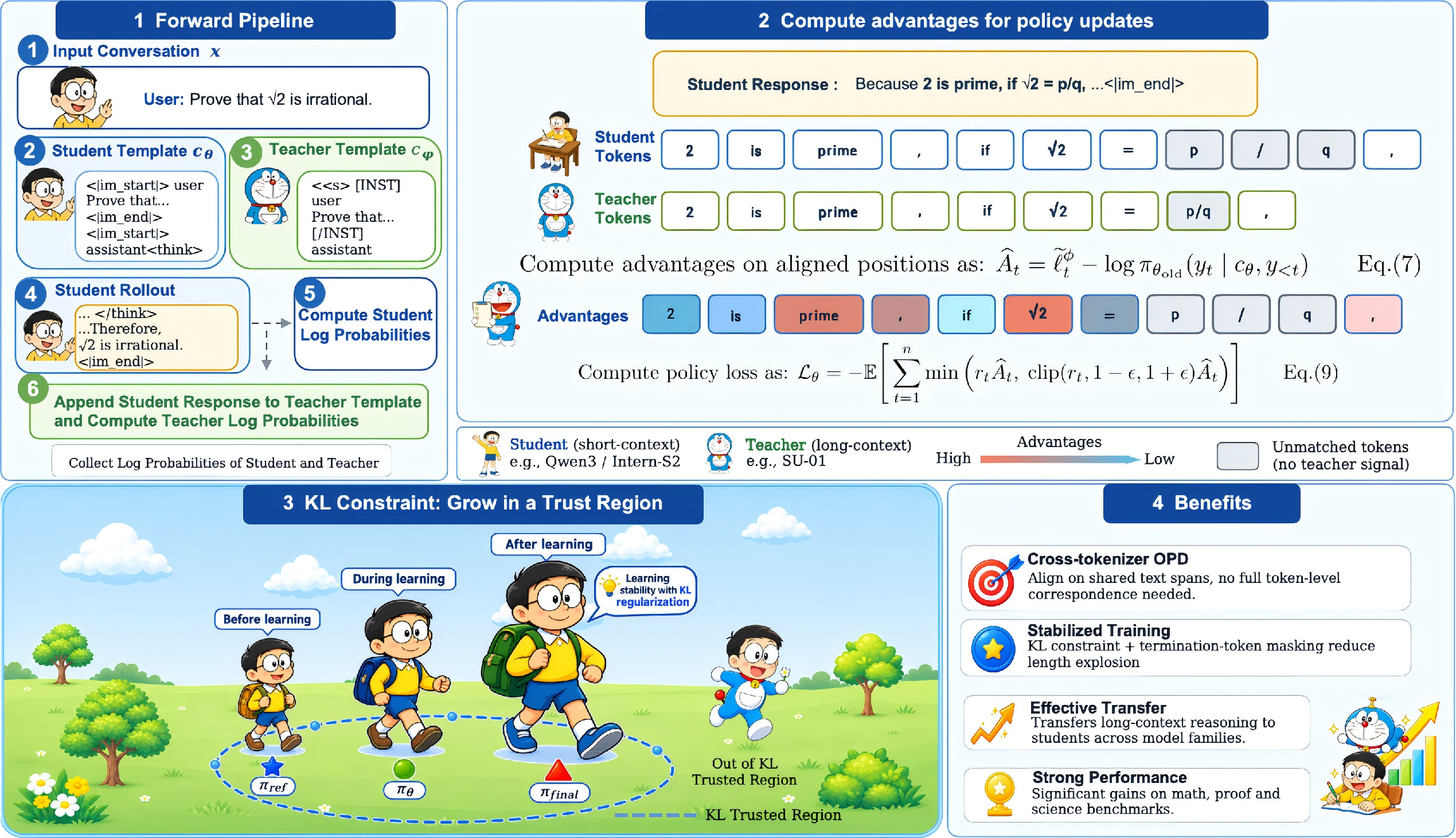
On-policy distillation
The method is called on-policy distillation.
A useful analogy is a student trying to solve a problem while a teacher watches. Instead of giving the student a finished answer, the teacher looks at the student’s own steps and gives advice about each step.
In this paper:
- The student model tries to solve a mathematics proof problem by itself.
- The teacher reads the student’s answer.
- The teacher gives information about how likely each part of the answer is according to the teacher’s own reasoning.
- The student is trained to make choices that are more like the teacher’s choices.
This is different from ordinary training on teacher-written examples because the student is learning from its own attempts.
Matching different tokenizers
Because the teacher and student divide text into different tokens, the researchers do not try to match every token.
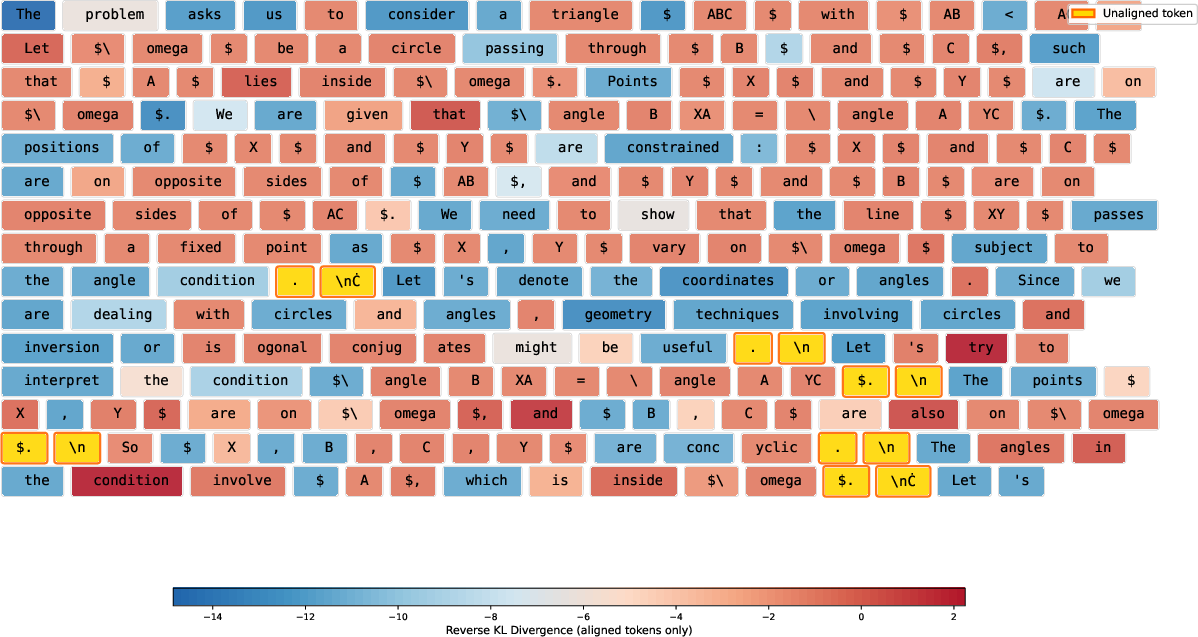
Instead, they compare the actual written text. If a teacher token and a student token cover exactly the same piece of text, they are matched. For example, if both models treat the word “triangle” as one identical piece, the teacher can give advice about that piece.
If the pieces do not match exactly, the researchers leave that position alone rather than making an unreliable guess. This is similar to comparing two versions of a sentence and only matching words that clearly cover the same letters.
Preventing overly long answers
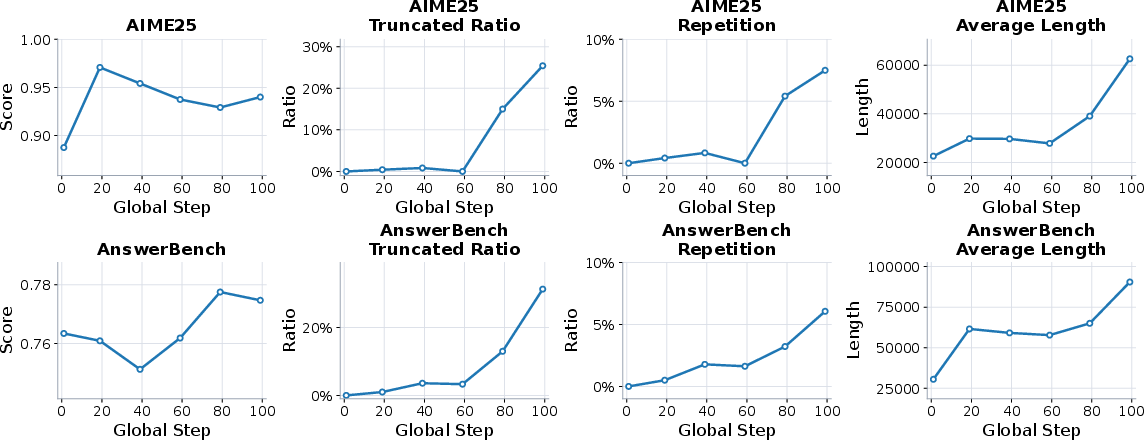
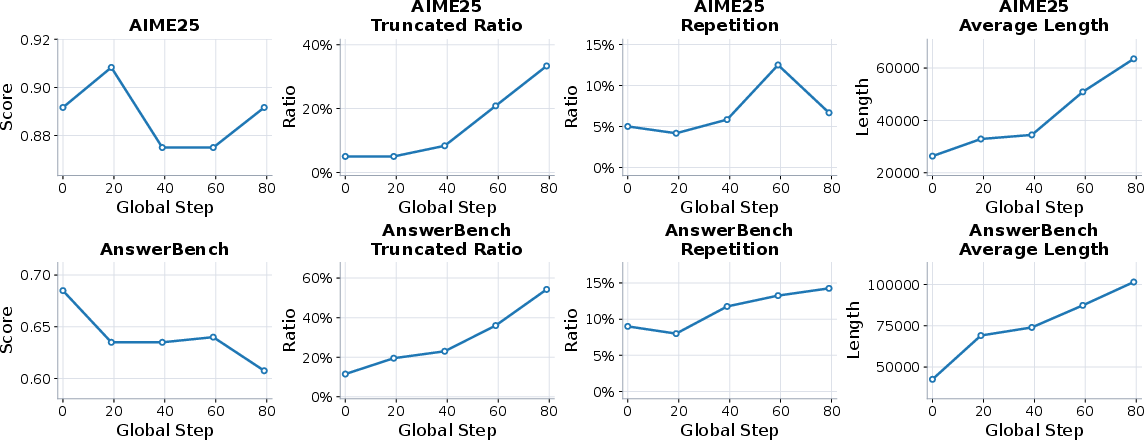
Directly copying the teacher’s behavior caused problems. Since SU-01 can reason for a very long time, students sometimes began producing enormous answers. They could repeat themselves, reach their maximum length, and get cut off before finishing.
The researchers used two protections:
- Termination-token masking: They stopped the teacher from strongly influencing special tokens that tell the student to finish thinking or end its answer.
- Student reference KL loss: They encouraged the student not to move too far away from its original behavior.
The second technique is like telling a student: “Learn from this expert, but do not completely forget everything you already know.” In technical language, this uses a measure called KL divergence, which compares two probability patterns.
Testing the models
The researchers trained several student models, including models from the Qwen, Intern, GLM, and Gemma families. They used thousands of mathematics proof problems from sources such as:
- Open Proof Corpus
- Art of Problem Solving
- Mathematics competition books
- Chinese mathematics communities and olympiad materials
They tested the models on mathematics and science benchmarks. Some tests checked whether the final answer was correct, while others used a judge model to assess the quality of written proofs.
4. What were the main findings?
The method improved mathematical reasoning
SimpleOPD improved all of the main student models on mathematical tasks.
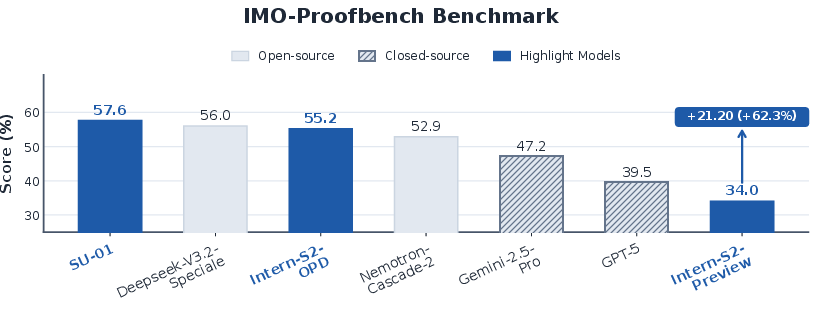
For example, the Intern-S2-Preview model improved on ProofBench from 21.7 to 44.5 in one evaluation. In another evaluation using Gemini-2.5-Pro as the judge, it improved from 34.0 to 55.2, a gain of 21.2 points.
This is important because ProofBench focuses on writing and explaining mathematical proofs, not merely guessing a final number.
Other examples included:
| Student model | ProofBench before | ProofBench after |
|---|---|---|
| Qwen3-4B | 11.42 | 23.72 |
| Qwen3-30B-A3B | 13.80 | 36.47 |
| Qwen3.5-4B | 15.90 | 28.61 |
| Qwen3.5-35B-A3B | 26.78 | 42.39 |
| Intern-S2-Preview | 21.70 | 44.50 |
The gains occurred both when the teacher and student used similar tokenizers and when they used different ones.
The training protections were necessary
Without the extra protections, the students often:
- Produced much longer answers over time
- Repeated parts of their reasoning
- Failed to use ending tokens
- Had their answers cut off
- Became less stable during training
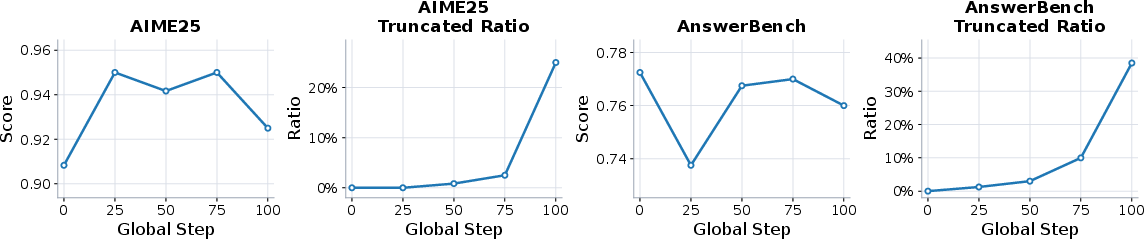
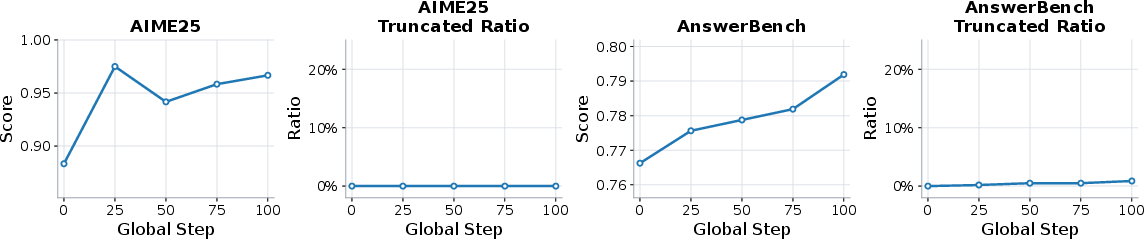
Masking the termination tokens helped, but it did not completely solve the problem. Adding the reference KL loss made the training much more stable and reduced truncation to almost zero in one experiment.
For Intern-S2-Preview, adding this loss increased:
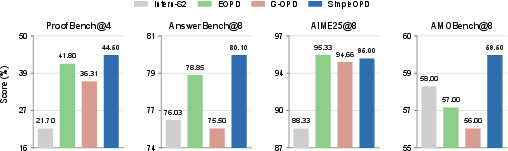
- ProofBench from 21.7 to 38.5
- AnswerBench from 76.03 to 79.10
- AIME25 from 88.33 to 95.80
The method worked across different model families
SimpleOPD was also tested between models made by different groups and using different tokenizers.
GLM-4.7-Flash improved on ProofBench from 30.8 to 39.7. Gemma-4 improved from 25.5 to 34.2 on the same benchmark.
However, the results suggest that bigger differences between tokenizers can make learning more difficult. Gemma improved on proof tasks but did not improve on every test.
The skills transferred to science
Although the training examples were only mathematics problems, the improved student also performed better on some science tests.
For example, Intern-S2-OPD improved on HiPhO, a physics reasoning benchmark, from 38.6 to 41.1. It also improved on a science research benchmark from 1.7 to 5.0.
This suggests that the model learned broader habits of reasoning, such as breaking hard problems into steps, rather than memorizing only mathematical facts.
Longer training examples helped
When the models were allowed to learn from reasoning sequences up to 32,000 tokens instead of only 6,000, their proof performance generally improved.
This makes sense because difficult proofs often require many connected steps. Short examples may leave out the later parts of the teacher’s reasoning.
5. Why is this research important?
The paper shows that a smaller model does not always need to copy complete answers from a much larger model to become better. It can learn by watching how a stronger model evaluates its own attempts.
The proposed approach may help researchers:
- Transfer advanced reasoning skills to smaller and cheaper models
- Teach models from different families to learn from one another
- Use powerful long-context teachers with students that have shorter context limits
- Avoid expensive collections of perfectly written training answers
- Improve reasoning in areas beyond the original training subject
There are still limitations. The method depends on finding enough matching text between different tokenizers, and large tokenizer differences may reduce its effectiveness. Training long reasoning sequences can also be expensive. In addition, the reported results come from particular models, datasets, and evaluation systems, so more testing would be needed.
Simple conclusion
SimpleOPD is a way to teach smaller AI models better problem-solving by having a stronger model guide their own attempts. The researchers solved two major problems: different models split text differently, and long-context teachers can make students produce answers that are too long.
With careful text matching, protection against excessive changes, and special handling of ending tokens, the student models became much better at writing mathematical proofs. They also improved on several science problems. This suggests that reasoning skills can be transferred between very different AI systems, potentially making strong reasoning available in models that are smaller, faster, and less expensive to use.
Knowledge Gaps
Knowledge Gaps, Limitations, and Open Questions
The paper demonstrates promising gains, but leaves the following issues unresolved:
- Limited teacher diversity: Most experiments use SU-01, a single Qwen-based teacher. It remains unclear whether SimpleOPD works with teachers from substantially different architectures, training objectives, reasoning styles, or non-mathematical domains.
- Insufficient characterization of context-length mismatch: The paper describes students as “short-context,” but does not systematically vary student context windows or quantify how the teacher–student context-budget ratio affects performance, truncation, and stability.
- Unclear causal contribution of each method component: The main experiments combine cross-tokenizer alignment, termination-token masking, reference KL regularization, and PPO updates. A complete factorial ablation is missing to determine interactions and isolate the contribution of each component across model families.
- Limited analysis of the reference KL loss: The KL coefficient is tested only at a few manually selected values and mainly for GLM-4.7-Flash. The optimal coefficient as a function of model size, tokenizer mismatch, teacher strength, training stage, or context length remains unknown.
- No comparison with alternative length-control methods: The paper does not compare reference KL and termination masking against explicit length penalties, adaptive truncation, length-conditioned rewards, entropy regularization, supervised termination losses, or curriculum-based context expansion.
- Incomplete understanding of length explosion: The proposed explanation attributes excessive generation primarily to teacher supervision and termination-token behavior, but the paper does not establish whether the phenomenon is caused by reverse-KL optimization, PPO clipping, rollout sampling, tokenizer alignment, teacher reasoning style, or their interaction.
- Weak theoretical justification for partial token alignment: The aligned-token objective is presented as a surrogate for reverse KL, but its optimization bias, consistency, and relationship to a true sequence-level divergence under different tokenizations are not formally analyzed.
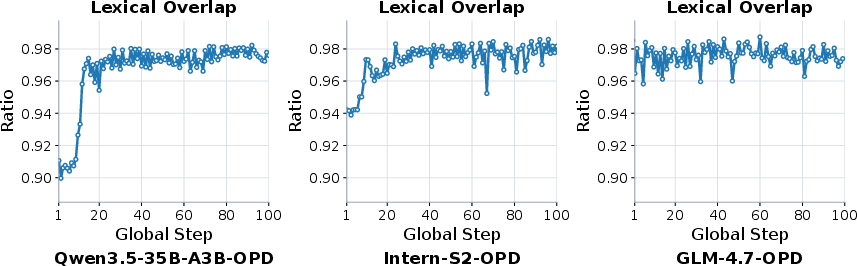
- Potentially sparse or biased supervision from unmatched tokens: Unmatched student tokens fall back to the student policy, receiving no direct teacher signal. The paper reports lexical overlap ratios but does not quantify how unmatched-token frequency, location, or clustering affects learning, especially near crucial reasoning transitions.
- No evaluation of alternative cross-tokenizer objectives: The method is not compared against character-level or byte-level probability aggregation, span-level alignment, sequence-level distillation, vocabulary projection, or learned tokenizer-agnostic representations.
- Alignment robustness is underexplored: The method assumes exact surface-string equality without normalization. Its behavior with Unicode variants, whitespace differences, escaped characters, formatting changes, multilingual text, code, or model-specific special-token conventions is not evaluated.
- Chat-template mismatch remains unresolved: Although teacher and student use separate templates, the paper does not test whether semantic or structural differences in those templates influence teacher probabilities and distillation quality.
- Narrow training-data scope: Training uses approximately 4,500 mathematical proof problems, largely from olympiad and community sources. The method’s effectiveness with larger, noisier, multilingual, non-olympiad, or non-mathematical datasets is unknown.
- Unclear data contamination and benchmark overlap: The paper does not report deduplication or contamination checks between the training corpora and ProofBench, AnswerBench, AIME25, AMOBench, or the science benchmarks. Consequently, some gains may reflect data overlap rather than capability transfer.
- Limited baseline coverage: Comparisons focus on a small number of OPD variants. There is no systematic comparison with supervised fine-tuning on teacher trajectories, rejection sampling, distillation using complete teacher distributions, RL with verifiable rewards, or standard long-chain-of-thought curriculum training under matched compute.
- Uncontrolled compute and sample-efficiency comparisons: The paper does not report teacher-query cost, generated-token counts, GPU hours, memory use, throughput, or performance per unit compute. It therefore does not establish whether SimpleOPD is more efficient than competing approaches.
- Best-checkpoint selection may introduce evaluation bias: Checkpoints are selected using AIME@4 and AnswerBench@1, while several reported results use different sampling counts and benchmarks. The paper does not clarify whether the selection set is held out or whether repeated checkpoint evaluation creates implicit test-set tuning.
- Evaluation reliability is uncertain for judged benchmarks: ProofBench depends on LLM judges, but inter-judge agreement, judge calibration, sensitivity to proof style and verbosity, and human verification are not reported. Results also use different judges in different sections, complicating direct comparisons.
- Statistical significance is not established: The paper reports averages over a small number of rollouts but provides no confidence intervals, standard deviations, seed variation, or significance tests. The stability of the reported gains across training runs is therefore unclear.
- Proof quality is not decomposed: ProofBench scores indicate overall judged performance, but the paper does not analyze validity, completeness, originality, relevance, verbosity, or reliance on informal gaps. It remains uncertain which aspects of proof reasoning are transferred.
- Generalization claims are based on limited science benchmarks: Improvements on HLE, HiPhO, and FrontierScience are reported for primarily one student model and one teacher. More domains, languages, model families, and task formats are needed to determine whether the observed transfer is robust or incidental.
- Possible capability trade-offs are insufficiently measured: The paper reports selected math and science benchmarks but does not evaluate instruction following, factuality, coding, dialogue quality, calibration, refusal behavior, safety, or general knowledge to verify that reference KL preserves broader student capabilities.
- Long-term training stability is unknown: Experiments use 100 rollout iterations and selected checkpoints. It is unclear whether performance eventually saturates, collapses, or resumes length explosion with longer training or larger rollout budgets.
- Effect of rollout and optimization choices is unclear: Batch size, number of responses per prompt, PPO update count, clipping coefficient, temperature, and rollout length are largely fixed. Their effects on alignment coverage, stability, and final performance are not systematically studied.
- Teacher confidence and uncertainty are not used: The method treats matched teacher log-probabilities uniformly, without examining whether filtering or weighting supervision by teacher entropy, calibration, or proof-step confidence improves transfer.
- Student capacity limits are not characterized: The paper does not determine whether there is a minimum student size, architecture, or pre-existing reasoning ability required for successful distillation, nor whether very small students can benefit without severe verbosity or forgetting.
- Reproducibility details are incomplete: Important implementation information—such as exact data splits, prompt formats, checkpoint schedule, KL formulation and masking implementation, optimizer settings, random seeds, and hardware configuration—is insufficiently specified for fully independent reproduction.
Practical Applications
Immediate Applications
- Low-cost reasoning-model specialization for software and AI platforms
- Apply SimpleOPD to transfer capabilities from an expensive, long-context teacher model into smaller student models with lower inference cost and latency.
- Likely products include compact mathematics tutors, coding assistants, scientific QA systems, and on-device reasoning models.
- The paper reports substantial gains for several students, including improvements of up to 22.8 points on ProofBench for Intern-S2-Preview and 17 points on AnswerBench for Qwen3-4B.
- Dependencies: access to a strong teacher model, sufficient GPU resources for on-policy rollouts, licensing rights for both models, and validation that the student’s reduced context window is adequate for the target workload.
- Cross-vendor and cross-tokenizer model adaptation
- Use the shared-text-space alignment procedure to distill capabilities between models that use different tokenizers, vocabularies, or model families.
- This could support model providers that want to import specialized reasoning behavior without retraining a student from scratch or forcing teacher and student to share a vocabulary.
- The workflow can be implemented as: generate with the student → decode to text → re-encode with the teacher tokenizer → align identical text spans → apply OPD updates.
- Dependencies: exact preservation of response text and offsets; compatible chat-template reconstruction; adequate lexical overlap between tokenizers. The paper suggests that substantially different tokenization, such as SentencePiece versus byte-level BPE, can reduce transfer quality.
- Mathematical education and tutoring systems
- Deploy distilled models as automated tutors that generate multi-step explanations, proof outlines, hints, and alternative solutions for olympiad, university, and advanced secondary-school mathematics.
- Proof-focused training is particularly relevant to systems that must explain why an answer is correct rather than merely return a numerical result.
- Educational platforms could use a smaller OPD-trained model for routine interactions and escalate difficult problems to the long-context teacher.
- Dependencies: proof correctness must be checked with symbolic tools, formal verifiers, or expert review. Benchmark improvements do not by themselves guarantee pedagogical quality, factual correctness, or age-appropriate explanations.
- Automated mathematical solution review
- Integrate OPD-trained models into workflows for checking student submissions, generating rubric-based feedback, identifying missing proof steps, and suggesting lemmas or counterexamples.
- A practical workflow would combine the model with a rule-based or formal mathematics verifier, similar to the paper’s use of verifiable evaluation for some benchmarks.
- Dependencies: natural-language proof assessment remains difficult; the model should not be used as the sole grader in high-stakes settings. Human moderation and calibrated confidence estimates are required.
- Scientific and technical question answering
- Use the distilled reasoning capability in physics, engineering, and science assistants for multi-step derivations, hypothesis analysis, and research-literature question answering.
- The reported improvements on HLE, HiPhO, and FrontierScience benchmarks suggest some transfer beyond the mathematical training domain.
- Potential tools include laboratory planning assistants, physics-problem solvers, technical documentation agents, and research copilots.
- Dependencies: the out-of-domain gains are modest on several benchmarks and do not establish reliability in real scientific environments. External retrieval, unit checking, simulation, and expert validation remain necessary.
- Stable post-training of long-form reasoning models
- Incorporate termination-token masking and student-reference KL regularization into existing OPD pipelines to reduce response-length explosion, repetition, missing end markers, and context-window truncation.
- This is immediately useful for organizations already using PPO-style or OPD-style post-training, especially when the teacher generates substantially longer reasoning traces than the student can accommodate.
- The paper reports that reference KL reduced truncation to nearly zero in one experiment and improved both proof and answer benchmarks.
- Dependencies: the KL coefficient must be tuned to the teacher–student gap. Excessive regularization can prevent the student from learning the teacher’s capabilities, while weak regularization may permit instability.
- Efficient model distillation for internal enterprise systems
- Enterprises can distill a proprietary reasoning model into a smaller model for private deployment in legal analysis, technical support, finance, or operations.
- The student can preserve its original general capabilities through reference KL while acquiring a targeted reasoning skill from the teacher.
- This can reduce API costs, data-transfer exposure, and dependence on a single large model provider.
- Dependencies: sensitive training prompts and teacher outputs must be handled under appropriate privacy controls. Domain-specific evaluation is essential because mathematical reasoning gains may not transfer uniformly to legal, financial, or operational decisions.
- Research and teaching tool for studying heterogeneous model transfer
- Academic groups can use the open implementation, models, and alignment method as a baseline for experiments in knowledge distillation, tokenizer compatibility, reinforcement learning, and long-context reasoning.
- The lexical-overlap ratio provides a practical diagnostic for estimating how much of a student trajectory receives teacher supervision.
- Dependencies: results may depend strongly on the particular teacher, student architectures, rollout budget, data mixture, context lengths, and evaluator models. Reproduction should include independent judges and contamination checks.
Long-Term Applications
- General-purpose capability transfer across model ecosystems
- Develop a standardized “reasoning capability compiler” that transfers capabilities among models from different vendors, architectures, and tokenization schemes.
- Such a system could convert a large teacher’s proof, planning, coding, or scientific-reasoning behavior into specialized students optimized for cloud, edge, or embedded deployment.
- Future versions would need alignment methods that handle partial token overlaps rather than discarding unmatched spans, potentially using character-level, byte-level, latent, or distribution-over-span supervision.
- Dependencies: research is needed to quantify information loss from partial alignment, preserve semantic equivalence under formatting changes, and prevent teacher-specific artifacts from being copied.
- Edge and on-device reasoning assistants
- Distill large long-context teachers into compact models for smartphones, laptops, robots, vehicles, and industrial controllers.
- Applications could include offline tutoring, field-engineering diagnosis, maintenance guidance, and privacy-preserving personal assistants.
- The paper’s approach is relevant because it targets short-context students while transferring behavior from long-context teachers.
- Dependencies: substantial compression, quantization, memory optimization, safety testing, and latency improvements are still required. A short-context student may fail on tasks requiring access to the full original reasoning trace.
- Robotics and long-horizon planning
- Transfer long-horizon planning and verification behavior into smaller models that control robots, software agents, or autonomous systems.
- A distilled model could generate plans, check intermediate constraints, recover from failed actions, and provide structured explanations to operators.
- The paper directly studies mathematical reasoning rather than embodied control, so this is a prospective extension rather than a demonstrated application.
- Dependencies: training data must include state transitions, actions, observations, and safety constraints. Real-world deployment requires simulators, action-level verifiers, uncertainty handling, and strict fail-safe mechanisms.
- Formal mathematics and theorem-proving assistants
- Combine natural-language proof reasoning from OPD with proof assistants such as Lean, Coq, or Isabelle.
- A future workflow could use the distilled model to propose proof strategies and intermediate lemmas, while a formal checker verifies every generated step.
- This could accelerate theorem formalization, educational proof feedback, and mathematical research.
- Dependencies: natural-language token alignment alone does not guarantee formal correctness. High-quality paired datasets, theorem-prover integration, tactic generation, and methods for handling failed proofs are required.
- Scientific discovery and engineering design
- Distill long-context scientific reasoning into smaller domain models that propose experiments, derive equations, compare hypotheses, or optimize engineering designs.
- Multi-teacher OPD could combine mathematical, physical, chemical, and domain-specific teachers while retaining a compact student suitable for iterative search.
- The paper’s observed out-of-domain transfer provides preliminary motivation, but not evidence sufficient for autonomous discovery.
- Dependencies: verified simulations, reliable retrieval, provenance tracking, experimental validation, and safeguards against plausible but physically impossible recommendations.
- Adaptive multi-teacher distillation
- Extend SimpleOPD to select among multiple teachers based on task type, confidence, context length, or token-level entropy.
- For example, a mathematics teacher could supervise proof structure, a coding teacher could supervise executable solutions, and a safety teacher could constrain refusals and policy behavior.
- This could produce general-purpose students without requiring a single teacher to excel in every domain.
- Dependencies: teacher arbitration, conflicting supervision, reward calibration, and prevention of catastrophic forgetting remain open technical problems. Multi-teacher systems may also increase training cost and governance complexity.
- Automatic context-budget management
- Build training and inference systems that learn when to terminate reasoning, summarize intermediate results, or allocate additional tokens selectively.
- The paper’s termination-token masking and KL regularization could serve as components of a broader controller for balancing reasoning quality against latency and context cost.
- Potential products include budget-aware coding agents, customer-service systems with predictable response times, and scientific assistants that reserve long reasoning only for difficult queries.
- Dependencies: termination quality must be evaluated jointly with correctness; simply shortening outputs may suppress necessary reasoning. Dynamic budgets, difficulty estimation, and task-specific stopping criteria are needed.
- Model governance, auditing, and policy evaluation
- Use cross-tokenizer OPD to create smaller audit models that approximate the reasoning behavior of frontier systems under controlled test suites.
- Governments, regulators, and independent evaluators could deploy such models to conduct affordable stress tests for mathematical, scientific, safety, or compliance reasoning.
- Distilled models might also help organizations evaluate whether a capability can be reproduced in smaller systems, which is relevant to compute governance and deployment risk assessments.
- Dependencies: a distilled model is not necessarily behaviorally equivalent to its teacher. Audits must measure capability preservation, failure modes, bias, refusal behavior, and distribution shift rather than relying only on benchmark scores.
- Personalized daily-life assistants
- Distill specialized teachers into compact assistants for household budgeting, homework help, travel planning, health-information explanation, and document analysis.
- A local student model could provide lower-cost and more private reasoning while a larger teacher is used only for difficult or ambiguous cases.
- Dependencies: high-stakes uses such as medical, financial, or legal advice require domain validation, current information retrieval, privacy protection, and human escalation. The paper does not demonstrate reliability in these daily-life domains, so deployment should initially remain assistive rather than autonomous.
Glossary
- Ablation study: An experiment that removes or varies one component of a method to measure its effect. “Ablation study on the student-reference KL coefficient”
- Advantage: An estimate of how much better an action is than a reference policy expectation in reinforcement-learning optimization. “We also mask the advantages of special termination tokens”
- Autoregressive model: A model that predicts each token conditionally on previously generated tokens. “Subsequent work has broadened OPD beyond standard autoregressive students”
- BPE (Byte-Pair Encoding): A subword tokenization algorithm that builds a vocabulary by iteratively merging frequent symbol pairs. “SU-01 is based on the Qwen model family and uses a byte-level BPE tokenizer.”
- Byte-level tokenizer: A tokenizer that represents text starting from byte units, allowing coverage of arbitrary character sequences. “uses a byte-level BPE tokenizer”
- Chain-of-thought reasoning: A reasoning approach in which a model generates intermediate steps before producing an answer. “established long chain-of-thought reasoning as a central test-time scaling paradigm”
- Checkpoint: A saved model state from a particular point during training. “The best checkpoint is selected based on the average score of AIME@4 and AnswerBench@1.”
- Chat template: A formatting scheme that converts conversational messages into the textual input expected by a LLM. “The student and teacher with different tokenizers may use different chat templates”
- Context budget: The maximum amount of input and generated text that a model can process within its context window. “promote steady response-length growth within the student's context budget”
- Cross-tokenizer alignment: The process of matching tokens from different tokenizers by their corresponding text spans. “\subsection{Cross-tokenizer Alignment}”
- Distillation: Training a smaller or weaker model to reproduce behavior learned by a stronger model. “We perform OPD in a shared text space”
- Entropy: A measure of uncertainty in a probability distribution. “EOPD, which supplements reverse-KL OPD with forward KL at positions where the teacher has high token-level entropy”
- Forward KL divergence: A direction of Kullback–Leibler divergence that measures the discrepancy from one probability distribution to another in the forward orientation. “supplements reverse-KL OPD with forward KL”
- Frontier model: A highly capable model representing the current state of the art. “surpasses several strong frontier models”
- Generalization: The ability of a trained model to perform well on data or tasks beyond those used during training. “achieves better generalization than off-policy settings”
- Heterogeneous model: A model that differs from another model in architecture, vocabulary, tokenizer, or other structural properties. “we investigate heterogeneous OPD for transferring long-context reasoning capabilities across diverse models”
- Importance-sampling ratio: The ratio between the probability assigned by an updated policy and that assigned by the policy that generated the data. “The importance-sampling ratio is”
- Incremental text span: The portion of decoded text contributed by an individual token. “denote the incremental text spans contributed by the corresponding response tokens”
- Knowledge distillation: A training technique in which a student model learns from the outputs or distributions of a teacher model. “On-policy distillation (OPD) offers a promising way to transfer reasoning capabilities from stronger teacher models”
- KL coefficient: A scalar controlling the strength of a Kullback–Leibler regularization term. “We evaluate coefficients of 0.5, 1.0, and 1.2 to study this trade-off.”
- KL divergence: A measure of the difference between two probability distributions. “we introduce a reference KL loss to constrain the student policy”
- Lexical overlap ratio: The fraction of student tokens that can be matched to teacher tokens through identical text spans. “We report the lexical overlap ratio”
- Long-context reasoning: Reasoning that requires processing or generating unusually long sequences of tokens. “transferring long-context reasoning capabilities to short-context models”
- Log-probability: The logarithm of a model’s probability assignment to a token or sequence. “The teacher log-probability associated with token is”
- On-policy distillation (OPD): Distillation in which the teacher evaluates trajectories generated by the current student policy. “Unlike off-policy approaches that distill knowledge from fixed teacher-generated data, OPD actively queries the teacher”
- Off-policy: A learning setting in which training data are generated by a policy different from the one currently being optimized. “Unlike off-policy approaches that distill knowledge from fixed teacher-generated data”
- PPO (Proximal Policy Optimization): A policy-gradient reinforcement-learning algorithm that limits updates using a clipped probability ratio. “using the PPO clipped policy loss”
- Partial one-to-one mapping: A correspondence in which each element can match at most one element on the other side, but some elements may remain unmatched. “ is a partial one-to-one mapping”
- Policy: A probability distribution describing the actions a model takes given its current context. “the student policy executed by the rollout engine”
- Policy drift: The degree to which an updated policy departs from its original behavior. “This strategy constrains the student from drifting excessively from its initial policy”
- Post-training: Model optimization performed after initial pretraining, often involving supervised fine-tuning, reinforcement learning, or distillation. “in the post-training landscape of LLMs”
- Reference policy: A fixed policy used as a baseline or regularization target during optimization. “This coefficient controls the extent to which the student is regularized toward its reference policy”
- Reverse KL divergence: Kullback–Leibler divergence computed with the student distribution as the first argument and teacher distribution as the second. “This objective is a token-aligned surrogate for the reverse KL divergence”
- Rollout: A sampled sequence of actions or tokens generated by a policy. “The reported results are the averages over 4 rollouts for ProofBench”
- Rollout engine: A system that efficiently executes model inference to generate sampled responses. “the student policy executed by the rollout engine”
- Segmentation: The division of a text string into a sequence of tokens. “ and are ordered segmentations of the same response string”
- SentencePiece: A tokenizer framework that segments text into subword units without requiring whitespace-based preprocessing. “Gemma uses a SentencePiece-based tokenizer”
- Special token masking: Excluding designated control or structural tokens from a loss or gradient calculation. “we mask the OPD loss on the structural tokens”
- Student–teacher distribution mismatch: A discrepancy between the probability distributions produced by the student and teacher models. “thereby mitigating the teacher-student distribution mismatch problem”
- Student-reference KL loss: A KL-based regularization loss that keeps the student near its initial policy. “adding a student reference KL loss to prevent the student policy from deviating excessively from its initial distribution”
- Supervised fine-tuning (SFT): Training a model on labeled input–output examples, usually using a likelihood objective. “without supervised fine-tuning on teacher-generated trajectories”
- Surface string: The decoded natural-language text corresponding to a sequence of tokens. “the response surface string ”
- Teacher forcing: A training procedure that conditions a model on reference preceding tokens rather than its own sampled outputs. “teacher-generated trajectories”
- Test-time scaling: Improving model performance by allocating additional computation during inference. “long chain-of-thought reasoning as a central test-time scaling paradigm”
- Token alignment: Matching tokens across sequences or tokenizers according to their positions or textual spans. “For token alignment, let and denote the incremental text spans”
- Token-level supervision: Training guidance supplied separately for individual generated tokens. “thereby providing dense token-level supervision grounded in the student's own policy”
- Tokenizer mismatch: The incompatibility that arises when two models divide the same text into different token sequences. “To handle tokenizer differences”
- Tokenization: The conversion of text into a sequence of discrete tokens. “the same response string is factorized into different token sequences”
- Truncation: The premature stopping or cutting off of a generated sequence at a maximum length. “direct OPD can cause rapid response-length growth, frequent truncation”
- Unmatched token: A token for which no corresponding token with the same text span exists in the other tokenization. “while unmatched positions fall back to the student's log-probability”
- Verifier: A procedure or model that checks whether a generated answer is correct. “we first use a rule-based verifier for testing”
- Vocabulary: The set of tokens that a tokenizer and model can represent. “most existing studies assume a shared vocabulary”
- Rollout batch: A collection of sampled trajectories used together for one or more optimization updates. “To enable multiple policy updates on the same rollout batch”