Rethinking On-Policy Self-Distillation for Thinking Models
Abstract: Self-distillation is a promising recipe for self-improvement in LLMs. In this setting, a model can serve as its own teacher when given privileged information, such as a solution to a math problem. This seems especially appealing for thinking models, which can use test-time reasoning to absorb the privileged information. Surprisingly, we show that privileged self-distillation degrades thinking models on long reasoning traces: across five Qwen3 and OLMo thinking models evaluated on AIME24, AIME25, and HMMT25, privileged-context distillation causes a relative drop of up to 17% in avg@16 accuracy. The degradation scales with the amount of privileged context withheld from the student and is most pronounced at long rollout budgets, where thinking models otherwise obtain their largest gains. This failure mode is not specific to self-distillation: on-policy distillation (OPD) improves thinking models, but privileged OPD reverses these gains. Our diagnostics link this failure mode to how privileged teacher context reshapes learning at high-entropy forking positions, where multiple continuations remain plausible and may lead to different reasoning paths. Privileged context lowers fork rates in thinking-model rollouts but not in instruction-model rollouts. This leads to an interesting dichotomy, where privileged context can help instruction-tuned models but hurts stronger thinking models. The effect is visible when the student begins a self-correction branch, where privileged OPD penalizes sampled reconsideration tokens that vanilla OPD supports. Thinking models trained with a privileged teacher produce fewer verification, backtracking, and hedging markers, even after length normalization. These findings indicate that self-distillation for strong thinking models requires attention to token-level signal, especially around correction and reasoning steps.
Paper Prompts
Sign up for free to create and run prompts on this paper using GPT-5.
Top Community Prompts
Explain it Like I'm 14
What is this paper about?
This paper studies a popular way to make AI LLMs teach themselves, called on‑policy self‑distillation. The twist they test is giving the “teacher” version of the model extra help (like the correct answer or a full worked solution) that the “student” won’t have during real use. The authors focus on “thinking models” — models trained to show their work with long chains of thought. Their main message: giving the teacher extra information can actually make these thinking models worse at long, careful reasoning, even though it sometimes helps simpler instruction‑following models.
What questions did the researchers ask?
They asked:
- If a thinking model learns from its own teacher that sees extra information (like the final answer or a full solution), does the student get better or worse?
- Does the effect depend on how much extra information the teacher gets (just the answer vs. the full solution)?
- Is the problem only about training on short examples, or is it specifically caused by the teacher’s extra information?
- What changes inside the model’s behavior when this extra information is used?
- Does the effect differ between instruction‑tuned models (which give short answers) and thinking models (which explore, check, and backtrack)?
How did they study it?
To keep things simple, here’s the setup in everyday terms:
- Teacher–student training: Imagine the model plays two roles. The student tries to solve a problem and writes its steps. The teacher looks at those steps and gives guidance about what the next token (next word/piece of a word) should be. The student then learns to match the teacher’s guidance on each token.
- Privileged information: Sometimes the teacher gets extra context that the student doesn’t get in real life, like:
- Just the final answer (sparse hint), or
- A full worked solution (dense hint).
- On‑policy: The teacher gives feedback on the student’s actual attempt (not on perfect solutions). This keeps training focused on the student’s real behavior.
- Training vs. evaluation length: They trained with short outputs (about 4,096 tokens) but tested with very long outputs (up to 38,912 tokens), because thinking models do best when allowed to “think longer.”
- Models and data: They used several “thinking” and “instruction” models from Qwen3 and OLMo families. Tasks included math contests (AIME 2024/2025, HMMT 2025) and a numbers puzzle game (Countdown).
- Measurements:
- avg@16: For each problem, they sample 16 attempts and average how many are correct. Higher is better.
- pass@1 and pass@16: Common “did it get it right in one try” and “in 16 tries” scores.
- Rollout budget: How long the model is allowed to think/write.
- Behavior markers: Words like “wait,” “hmm,” “but,” “maybe,” “check,” “verify,” which often signal exploring, double‑checking, or changing course.
- Forking positions: Moments where multiple next steps are plausible (high uncertainty). Good thinking models often branch, revisit, or hedge at these points.
What did they find?
Here are the main results:
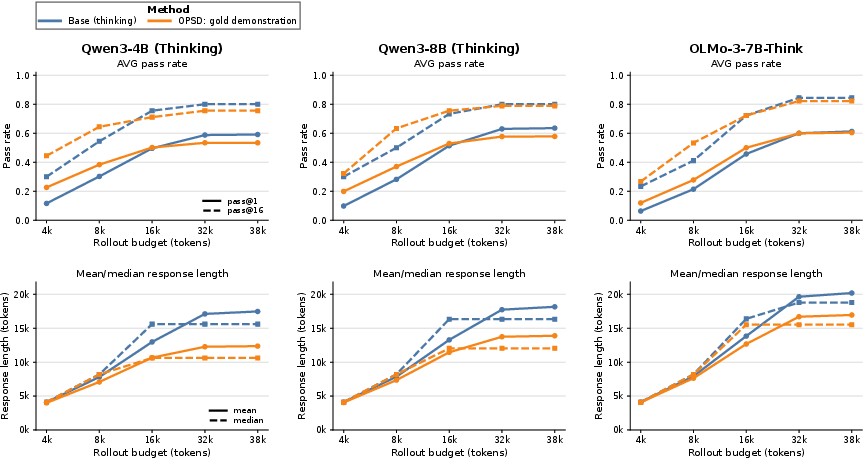
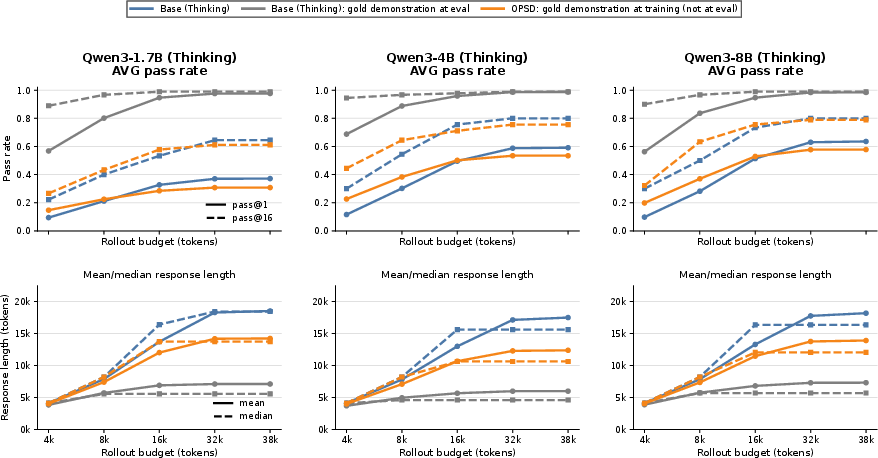
- Giving the teacher extra context often hurts thinking models, especially when they are allowed long rollouts (long chains of thought). They report up to a 17% relative drop in long‑budget accuracy.
- The harm grows with denser extra information. A full worked solution hurts more than just revealing the final answer.
- Instruction‑tuned models (short answers) usually improve with this method, but thinking models (long, exploratory reasoning) tend to get worse.
- The problem isn’t just “training is short but testing is long.” When the teacher does NOT get extra information (vanilla on‑policy distillation), the student improves even with the same short training length. Adding privileged info flips the improvement into a drop.
- Students trained with a privileged teacher start producing much shorter answers at test time. They inherit the teacher’s brevity, but not the teacher’s accuracy boost.
- Thinking behaviors shrink. Students use fewer “explore and correct” markers like “wait,” “hmm,” “but,” “maybe,” “check,” and “verify,” even after adjusting for length.
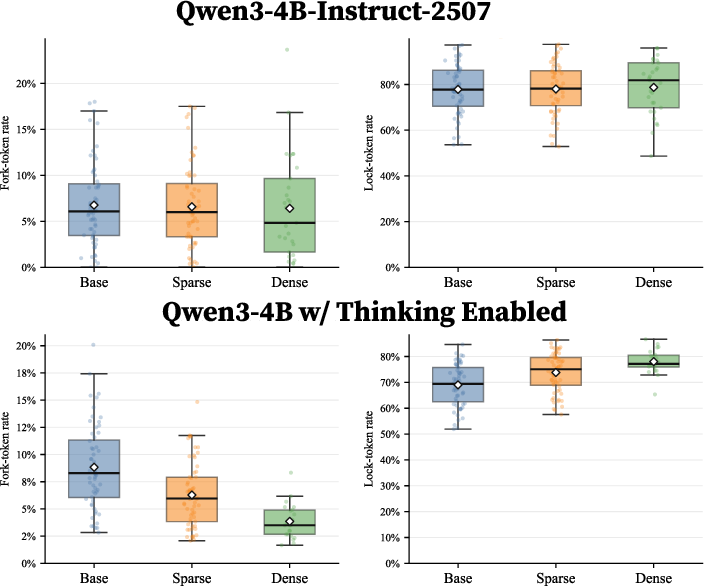
- Forking gets suppressed. With privileged teacher context, the places where a model might branch or reconsider (forks) become rarer; “locked‑in” steps become more common. This change is strong for thinking models and small for instruction models.
Why might this happen?
The authors’ explanation in simple terms:
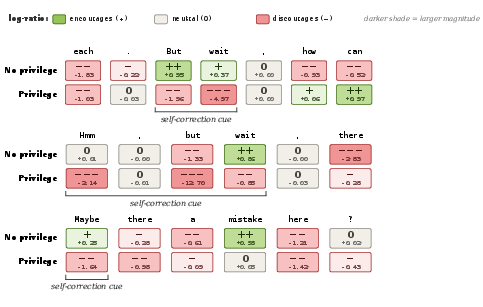
- When the teacher knows the answer, it tends to prefer smooth, straight‑line writing toward that answer, and it “dislikes” hesitation or self‑correction tokens (like “but,” “wait,” “maybe”), even when those moments are part of productive exploration.
- This flips the “credit” at crucial decision points: tokens that normally help the model pause, branch, and catch mistakes get discouraged.
- Over time, the student learns to avoid those exploration moves. It writes shorter, more confident paths — but loses the ability to correct itself or explore alternatives when stuck. That’s bad for long, tough problems where thinking models normally shine.
What is the impact and what should we do next?
Implications:
- Do not assume “more teacher info = better student” for thinking models. Extra teacher context can unintentionally train away the very exploration skills that make these models powerful on hard problems.
- Sparse hints may be safer. Just giving the final answer is less harmful than giving the full worked solution. Targeted, small nudges might help without collapsing exploration.
- Protect exploration signals. Future methods should detect and handle “forking” moments carefully so the model keeps useful behaviors like branching, hedging, checking, and backtracking.
- Tune where and how supervision is applied. It may be better to apply privileged guidance only in parts of the solution or in specific stages, instead of everywhere in the token stream.
- For long‑horizon agents and complex reasoning, design training that preserves search quality, not just short, confident answers.
In short: Training thinking models with a teacher who knows the answer can backfire by suppressing exploration. To truly improve these models, we need distillation methods that respect and reinforce the moments when the model pauses, branches, and rethinks — the very moves that lead to correct solutions on hard tasks.
Knowledge Gaps
Knowledge gaps, limitations, and open questions
Below is a consolidated list of concrete gaps and open questions that remain unresolved and could guide future research.
- Causal mechanism: Does suppressing tokens at high-entropy forking positions directly cause the long-budget accuracy drop, or is it only a correlated signature? Test by explicitly reweighting/preserving fork tokens during training and measuring whether long-budget performance recovers.
- Fork/lock diagnostics robustness: How sensitive are results to the chosen fork/lock thresholds (e.g., top-1 < 0.25 for fork, > 0.65 for lock) and to alternative forking metrics (e.g., entropy thresholds, mutual information, gradient-based critical-token detectors)?
- Lexical marker validity: To what extent do lexical proxies (wait, hmm, but, maybe) faithfully track high-entropy decisions across models, tokenizers, and languages? Develop tokenizer- and language-agnostic detectors for forking/self-correction beyond wordlists.
- Training vs evaluation budget mismatch: While OPD controls suggest mismatch is not the sole cause, does increasing the training completion cap (e.g., 8k–32k tokens) reduce degradation under privileged OPSD? Run controlled ablations across training caps.
- Divergence choice and calibration: How do different token-level divergences (forward KL, reverse KL, JSD, DPO/KTO-style objectives) and temperature calibration of the teacher affect fork suppression and long-budget performance?
- Teacher sharpness and entropy: Does softening the privileged teacher distribution (e.g., higher temperature, label smoothing) reduce negative credit on exploration tokens without losing short-budget gains?
- Token-level reweighting: Can selective weighting (or masking) of tokens at high-entropy positions prevent privilege-induced sign reversals on self-correction cues while retaining benefits on low-entropy “lock” positions?
- Privileged-context dosage and placement: Beyond “answer-only” vs “full demonstration,” which granular forms (short hints, critiques, error tags, step-localized hints) and placements (prefix vs interleaved vs suffix) avoid long-budget degradation?
- Scheduling privileged supervision: Does alternating or mixing privileged and unprivileged OPD within and across batches/epochs maintain exploration while leveraging privileged signals? Evaluate curricula that gradually increase or taper privileged information.
- Teacher–student asymmetry: Why do students inherit the teacher’s shorter rollouts but not its pass@k gains at long budgets? Identify which aspects of the teacher’s privileged-conditioned policy fail to transfer when privilege is absent at evaluation.
- Larger or different teachers: How do effects change with larger teachers, architecture mismatches (teacher > student), or ensembles? Can a more capable teacher reduce harmful gradients at fork positions?
- Off-policy vs on-policy scoring: Would scoring diverse off-policy prefixes (e.g., from larger seeds or exploratory samplers) with privileged teachers mitigate exploration collapse compared with purely on-policy scoring?
- Interaction with decoding parameters: How do sampling temperature, nucleus/top-k sampling, and deterministic decoding at evaluation interact with fork suppression and length compression?
- Process-based supervision: Can process-level signals (e.g., step correctness, verifier feedback, explicit branch success/failure labels) target credit more precisely at critical steps than raw token KL?
- RL-based alternatives: Do RL approaches with privileged critics (e.g., credit assigned to branches that lead to correctness) avoid suppressing exploration better than token KL-based OPSD?
- Domain generality: Does the degradation extend beyond math to code, multi-hop QA, long-form reasoning, planning/agents, tool-use, or multi-modal reasoning? Benchmark across diverse long-horizon domains.
- Data scale and diversity: The study uses ~15k examples. How do effects change with larger and more diverse training sets (100k–1M), different curricula, or hard-example mining?
- Granular error analysis: Which problem types (by topic, difficulty, required backtracking) are most harmed by privileged OPSD? Provide per-category and per-step analyses to pinpoint vulnerable behaviors.
- Temporal credit assignment: Do sign reversals cluster at early vs late stages of reasoning? Analyze when in the trajectory privilege most harms self-correction tokens.
- Stability and variance: How robust are findings across random seeds, multi-epoch training, different batch sizes, and optimizers? Provide variance estimates and stability diagnostics.
- Length-control confounds: Can we disentangle length compression from reasoning quality by enforcing matched-length evaluation or penalizing premature finalization at training time?
- Layerwise or module-specific effects: Does freezing early layers or isolating updates to reasoning heads mitigate loss of exploratory behavior while still absorbing privileged knowledge?
- Detection under different “thinking modes”: How consistent are results across different thinking prompts/templates, chain-of-thought styles, or model families with divergent internal reasoning behaviors?
- Safety and calibration implications: Does suppressing hedging/backtracking degrade epistemic calibration or safety in high-stakes settings requiring verification and reconsideration?
- Reproducibility and benchmarks: Standardize fork/lock diagnostics, marker sets, and reporting (including full token lists and thresholds) to facilitate cross-study comparison and replication.
- Mitigation strategies remain untested: The paper discusses potential directions (e.g., accounting for forking positions) but does not propose or evaluate concrete fixes; designing and validating such methods is an open agenda.
Practical Applications
Practical Applications of “Rethinking On-Policy Self-Distillation for Thinking Models”
The paper shows that privileged on-policy self-distillation (OPSD)—where a teacher sees answers or full solutions—can degrade “thinking” models’ long-budget reasoning by suppressing exploration at high-entropy “forking” positions and reducing self-correction markers. Vanilla on-policy distillation (OPD) without privileged context improves students, and sparse privileged hints (final answer only) do less harm than dense demonstrations. These findings have immediate implications for how industry and academia train, evaluate, and deploy reasoning models, and they motivate longer-term method and policy development.
Immediate Applications
Below are concrete actions organizations can implement now to reduce risk and improve outcomes when training or deploying reasoning-capable LLMs.
- Calibrate distillation strategies for thinking models (use unprivileged teachers)
- Sectors: AI/ML platforms, software, foundation model providers
- What to do: Prefer vanilla OPD (teacher sees the same prompt as student) or a larger unprivileged teacher for thinking models. Avoid OPSD with dense privileged context (full solutions) when the model will reason at test time.
- Tools/workflows: Update fine-tuning pipelines to route thinking models to OPD-only recipes; add a gating flag “privileged_context=false” for thinking checkpoints.
- Assumptions/dependencies: Access to a stronger teacher or same-arch teacher with unprivileged prompts; findings derived from math tasks but align with long-horizon reasoning intuitions.
- If privileged context is unavoidable, use sparse hints instead of full demonstrations
- Sectors: AI/ML, education tech, enterprise assistants
- What to do: Replace full solutions with minimal hints (e.g., final-answer-only or short targeted nudges) during distillation. The paper shows sparse hints preserve long-budget behavior better than dense demos.
- Tools/workflows: Implement a “hint budget” parameter; automatic truncation of teacher context; CI check that privileged context length stays under a threshold.
- Assumptions/dependencies: Requires controlled content assembly for teacher prompts; some tasks may need more than an answer-only hint.
- Disable thinking during OPSD training but keep it on at inference if you must use OPSD
- Sectors: AI/ML model training teams
- What to do: Run OPSD on non-thinking rollouts while preserving thinking at eval. The paper shows this preserves performance versus enabling thinking during OPSD training.
- Tools/workflows: Toggle “thinking mode” off for training data generation; keep chain-of-thought or long-form reasoning enabled at inference.
- Assumptions/dependencies: Your stack must reliably toggle thinking vs non-thinking behaviors.
- Add budget-curve evaluation and response-length tracking to acceptance criteria
- Sectors: AI/ML, MLOps, evaluation labs, policy/standards bodies
- What to do: Evaluate pass@1 and pass@k across short and long rollout budgets (e.g., 4k→38k tokens) and track mean/median response length. Reject models that lose long-budget gains or show pronounced length collapse after OPSD.
- Tools/workflows: “Budget Curves” dashboards; automated alerts on long-budget regressions and length compression.
- Assumptions/dependencies: Compute budget for long-rollout evaluation; task-specific scoring.
- Monitor fork/lock rates and epistemic/self-correction markers during training
- Sectors: AI/ML tooling, research labs
- What to do: Instrument token-level diagnostics: fork rate (top-token prob < 0.25), lock rate (> 0.65), and density of markers (e.g., “wait”, “but”, “maybe”, “check”, “verify”, “hmm”). Use these as guardrails—drop or reweight updates that suppress these signals.
- Tools/workflows: Train-time “Fork Monitor” dashboard; token-mask analyzers; CI thresholds on marker density changes.
- Assumptions/dependencies: Lexical markers are proxies, not ground truth; still effective as early-warning metrics.
- Use mixed batches or curriculum: interleave unprivileged OPD with (sparse) privileged OPSD
- Sectors: AI/ML R&D
- What to do: Alternate between batches with unprivileged OPD and batches with answer-only hints. Keep privileged proportion low to avoid fork suppression while retaining some compression benefits.
- Tools/workflows: Curriculum schedulers; batch samplers with privileged quota controls.
- Assumptions/dependencies: Requires experimentation to set the ratio; domain-dependent tuning.
- Adopt divergence and weighting choices that reduce over-penalization at high-entropy tokens
- Sectors: AI/ML
- What to do: When using token-level divergences (JSD, forward/reverse KL), downweight positions identified as forks or flagged by epistemic markers; or exclude them from privileged supervision. This aligns with the paper’s token-level signal analysis.
- Tools/workflows: Loss reweighting hooks keyed to entropy thresholds or marker sets.
- Assumptions/dependencies: Access to per-token probabilities and entropy; careful validation to avoid harming overall learning.
- Domain deployment guidelines for safety-critical applications
- Healthcare, finance, legal, security/defense
- What to do: For clinical decision support or risk modeling, avoid distillation recipes that suppress verification/backtracking markers. Require long-budget evaluations and marker audits before deployment.
- Tools/workflows: Procurement checklists that include “deliberation integrity” metrics (fork rate, verification markers).
- Assumptions/dependencies: Task-appropriate gold evaluations; governance processes to enforce guidelines.
- Education and tutoring systems: maintain self-correction behaviors
- Sectors: Education
- What to do: Do not compress tutors using dense privileged OPSD that reduces hedging and self-correction. Prefer unprivileged OPD or sparse hints so tutors continue to “show work” and revise mistakes.
- Tools/workflows: Tutor fine-tuning pipelines with hint-only privileged context; UX controls to display verification/backtracking steps.
- Assumptions/dependencies: Balance between verbosity and pedagogical value; user preferences.
- Product UX: “deliberative mode” toggle at inference
- Sectors: Consumer assistants, enterprise copilots
- What to do: Offer a user-facing switch that increases exploration (e.g., higher sampling temperature, allow longer rollouts, encourage self-correction tokens) for complex tasks.
- Tools/workflows: Preset decoding profiles: “concise” vs “deliberative.” Track success rates vs length for each mode.
- Assumptions/dependencies: Compute budget; user tolerance for longer outputs.
Long-Term Applications
These directions require further research, algorithmic development, or standardization before broad deployment.
- Fork-aware distillation algorithms
- Sectors: AI/ML research, foundation model providers
- What: Design distillation schemes that explicitly detect high-entropy forking positions and gate or reshape the teacher signal there (e.g., neutralize penalization of exploration or reward self-correction tokens).
- Tools/products: “ForkGuard” loss modules; per-token advantage shaping; entropy-triggered masking.
- Dependencies: Robust fork detection beyond lexical proxies; validation across domains.
- Privileged-context schedulers and hint design
- Sectors: AI/ML research, education, agent frameworks
- What: Learn when and how much privileged information to reveal (answer-only, micro-hints, targeted feedback), and where to apply it in the trajectory. Automate minimal-hint policies to preserve search.
- Tools/products: Adaptive hinting controllers; teacher-context optimizers.
- Dependencies: Online signal about search state; reliable detection of critical steps.
- Exploration-preserving objectives and RL hybrids
- Sectors: AI/ML research
- What: Develop divergences or RL fine-tuning that explicitly boosts exploration on critical tokens (e.g., contrastive objectives, reverse-KL variants, advantage shaping on “critical tokens”).
- Tools/products: Libraries implementing exploration-aware token weighting; integration with RLHF/RLAIF stacks.
- Dependencies: Off-policy stability; reward design for long-horizon tasks.
- Architecture and interface designs that separate “search” from “explanation”
- Sectors: AI/ML, agent platforms
- What: Modularize internal search/planning from external verbalization so privileged distillation can target correctness without collapsing internal branching.
- Tools/products: Dual-head models (search head + narrative head); plan-then-speak decoders.
- Dependencies: Training signals for each head; alignment to user experience.
- Long-horizon agent training frameworks with targeted teacher hints
- Sectors: Robotics, software agents, autonomy
- What: Apply minimal privileged hints to improve success without suppressing exploration in planning and control (e.g., step-wise guardrails, waypoint hints).
- Tools/products: Agent training toolkits supporting hint-conditioned teachers and fork-aware updates.
- Dependencies: Simulator or environment feedback; careful evaluation of exploration vs performance.
- Standards and audits for “deliberation integrity”
- Sectors: Policy, compliance, evaluation consortia
- What: Define and standardize metrics and reporting for long-budget performance, fork/lock rates, and deliberation-marker density. Require pre-deployment reporting for high-stakes systems.
- Tools/products: Benchmark suites with budget curves; audit templates and certification processes.
- Dependencies: Community consensus; task diversity beyond math.
- Cross-domain validation and datasets labeled for forks/critical steps
- Sectors: Academia, open-source communities
- What: Build benchmarks and annotations for forking/critical tokens across coding, scientific reasoning, legal analysis, clinical cases, and multi-step planning.
- Tools/products: Open datasets with critical-step tags; shared leaderboards tracking exploration metrics.
- Dependencies: Annotation cost; inter-annotator agreement on “forks.”
- Combined self-revision + distillation pipelines
- Sectors: AI/ML research
- What: Integrate self-revision (e.g., SD-Zero style) to get dense learning signals without relying on privileged teacher context that suppresses exploration; then apply carefully gated distillation.
- Tools/products: End-to-end recipes that stage self-revision before fork-aware distillation.
- Dependencies: Stability and cost of multi-stage training; domain transfer.
- Training at matched or multi-scale reasoning budgets
- Sectors: AI/ML
- What: Study whether increasing training completion caps or mixing multiple length budgets preserves long-budget gains while maintaining efficiency.
- Tools/products: Budget curriculum schedulers; dynamic truncation strategies.
- Dependencies: Compute cost; may not fully solve fork suppression without token-level gating.
- Safety overlays that audit and enforce verification/backtracking in critical workflows
- Sectors: Healthcare, finance, legal, critical infrastructure
- What: Build runtime monitors that detect absence of verification/backtracking steps and trigger re-generation or human-in-the-loop review.
- Tools/products: “Deliberation watchdogs” integrated with AI orchestration layers.
- Dependencies: Reliable runtime detectors; governance for escalation paths.
Key Assumptions and Dependencies (cross-cutting)
- Generalization beyond math: Findings are established on math/competition datasets; transfer to coding, scientific, or open-domain reasoning should be empirically verified.
- Model type: Results focus on “thinking” models that benefit from long, branching rollouts; instruction-only models may respond differently (often positively) to OPSD.
- Compute and tooling: Many recommendations require per-token probabilities, entropy estimates, and long-budget evaluation—implying non-trivial compute and MLOps instrumentation.
- Marker proxies: Epistemic tokens (“wait”, “but”, “maybe”, etc.) are proxies for forks; better structural detectors will improve precision.
- User/product trade-offs: Shorter outputs can be desirable for UX; do not optimize for brevity at the expense of correctness in high-stakes or complex tasks.
- Data/IP constraints: Availability of privileged information (answers, solutions) and licensing (e.g., Qwen/OLMo) can constrain implementation choices.
These applications translate the paper’s central insight—privileged teacher context can suppress the exploration that powers test-time reasoning—into concrete practices and research directions for building reliable, high-performing thinking systems.
Glossary
- advantage: In RL-style token credit assignment, the relative benefit of a sampled token versus a baseline, used to reinforce or penalize choices. "Under vanilla on-policy distillation, these tokens carry positive advantage."
- avg@16: An evaluation metric measuring mean per-sample correctness across 16 generated solutions per problem. "privileged-context distillation causes a relative drop of up to 17\% in avg@16 accuracy."
- backtracking markers: Lexical cues (e.g., “wait”, “actually”) indicating a model is reconsidering or revising a prior step. "Thinking models trained with a privileged teacher produce fewer verification, backtracking, and hedging markers, even after length normalization."
- completion cap: A training-time limit on the number of tokens generated per rollout. "Unless otherwise noted, training rollouts are capped at 4,096 completion tokens."
- deliberation markers: Tokens or phrases that explicitly signal reasoning behaviors such as verification, hedging, or backtracking. "OPSD reduces explicit deliberation markers in paired thinking-model rollouts."
- epistemic token: A word that conveys uncertainty or reconsideration (e.g., “wait”, “hmm”, “maybe”), often appearing at decision points. "Forks are often marked by short epistemic and revision tokens such as wait, hmm, but, and maybe."
- final-answer-only context: A sparse privileged input to the teacher providing just the final answer rather than a full solution. "final-answer-only context causes milder damage, while full-solution context causes substantially more."
- fixed-trajectory scoring: An analysis method where the same generated sequence is rescored by different teachers to compare token-level signals. "fixed-trajectory scoring shows sign reversals on self-correction cues; and trained students emit fewer deliberation markers."
- fork rate: The proportion of high-entropy decision points (forks) in a rollout where multiple continuations remain plausible. "Privileged context lowers fork rates in thinking-model rollouts but not in instruction model rollouts."
- fork suppression: The reduction or penalization of branching/uncertainty moves during reasoning due to privileged supervision. "We refer to this phenomenon as fork suppression: privileged-context self-distillation undermines the very deliberative behaviors that made thinking models natural candidates for self-improvement in the first place."
- forking positions: High-entropy decision points where multiple plausible next tokens can lead to different reasoning paths. "which we call {\em forking positions} in line with recent work~\citep{bigelow2024forking,lin2024critical,vassoyan2025ignore,zhang2026embarrassingly}."
- forward KL: The Kullback–Leibler divergence D_KL(p‖q) used from teacher to student, emphasizing covering teacher support. "The divergence can be instantiated as forward KL, reverse KL, JSD, or another token-level distillation divergence."
- generation cap: An evaluation-time maximum length for each generated response. "our main evaluation adopts a long generation cap: we generate 16 samples per problem, each with a maximum length of 38,912 tokens."
- gold demonstration: A full worked-out solution provided as privileged in-context guidance for the teacher. "the OPSD teacher (the base model when provided the in-context gold demonstration)."
- hedging markers: Words indicating uncertainty or tentative statements (e.g., “maybe”, “seems”). "Thinking models trained with a privileged teacher produce fewer verification, backtracking, and hedging markers, even after length normalization."
- high-entropy: Refers to positions with diffuse next-token distributions where several continuations are plausible. "A fork is a high-entropy position where several plausible continuations remain available and may lead to different reasoning paths;"
- instruction-tuned model: A model fine-tuned to follow user instructions rather than to perform explicit multi-step deliberation. "OPSD helps instruction-tuned models more reliably than thinking models."
- JSD: Jensen–Shannon divergence, a symmetric divergence used for token-level distillation. "We use JSD distillation for one epoch with effective batch size 64;"
- length normalization: Adjusting counts by output length to compare behaviors independent of response size. "Thinking models trained with a privileged teacher produce fewer verification, backtracking, and hedging markers, even after length normalization."
- lock position: A locally constrained point in a rollout where the top next token is highly likely, indicating low uncertainty. "a lock is a locally constrained position where the continuation is comparatively determined."
- lock rate: The proportion of locally determined (low-entropy) positions in a rollout. "We then report per-rollout fork and lock rates."
- on-policy distillation (OPD): Training a student to match a teacher on trajectories sampled from the student’s own policy. "on-policy distillation (OPD) improves thinking models, but privileged on-policy distillation reverses these gains."
- on-policy self-distillation (OPSD): OPD where the teacher is the same model (or its copy), often augmented with privileged context. "On-policy self-distillation (OPSD) has emerged as an exciting approach for self-improvement in LLMs"
- pass@1: The probability a single sampled solution is correct under the evaluation decoding distribution. "Empirical pass@1 is the same per-sample correctness quantity as avg@16, estimated from sampled rollouts under the evaluation decoding distribution."
- pass@16: The probability at least one of 16 sampled solutions is correct, often reported in an unbiased form. "avg@16 is distinct from unbiased pass@16, which measures whether at least one of the 16 samples solves the problem."
- pass@k: A family of metrics measuring whether any of k generated samples solves the problem. "its pass@k remains high and often improves."
- per-token log-ratio: The difference in log-probabilities assigned by teacher and student to each sampled token, used to analyze token-level credit. "Cells show the sign and magnitude of the per-token log-ratio ."
- privileged context: Information available to the teacher but not to the student at test time (e.g., answers, full solutions). "Privileged context lowers fork rates in thinking-model rollouts but not in instruction model rollouts."
- privileged on-policy distillation: OPD where the teacher is conditioned on extra information unavailable to the student. "privileged on-policy distillation reverses these gains."
- rollout: A sampled trajectory of tokens generated by a policy in response to an input prompt. "We then train the student by minimizing a token-level divergence between the teacher and student next-token distributions along this sampled rollout:"
- rollout budget: The allowed length or compute allocation for generating and exploring candidate solutions at evaluation time. "The degradation is strongest at long rollout budgets"
- SD-Zero: A self-distillation method that converts sparse feedback into dense supervision via self-revision. "Appendix~\ref{app:sd-zero-srt} shows a similar pattern in an SD-Zero-style self-revision pipeline"
- self-distillation: Training a model using its own outputs (or a copy’s), often to compress or refine behaviors. "Self-distillation has emerged as a promising recipe for self-improvement in LLMs"
- self-revision: A stage where the model reflects on and edits its own outputs to produce improved trajectories. "the self-revision stage helps both the instruction-tuned and thinking models, but the subsequent OPSD stage further helps only the instruction-tuned model and hurts the thinking model."
- self-teacher: The teacher model derived from (or identical to) the student in self-distillation setups. "our work focuses on recent privileged-context on-policy self-distillation methods, where the self-teacher is additionally given information unavailable to the student,"
- student policy: The model being trained, whose trajectories are sampled for on-policy supervision. "Here is the prefix before token , is the teacher policy, is the student policy being updated,"
- teacher policy: The reference model providing the target token distribution for distillation. "Here is the prefix before token , is the teacher policy, is the student policy being updated,"
- test-time compute scaling: The practice of allocating more generation steps/samples at evaluation to improve performance. "which often uses long rollout budgets to benefit from test-time compute scaling,"
- thinking models: Models post-trained to explicitly deliberate via multi-step reasoning at inference time. "Thinking models are natural candidates for self-improvement."
- token-level divergence: A divergence (e.g., KL, JSD) computed between teacher and student next-token distributions at each position. "We then train the student by minimizing a token-level divergence between the teacher and student next-token distributions"
- top-candidate dominance heuristic: A rule for classifying positions as forks or locks based on the teacher’s top-token probability. "We classify positions from the teacher distribution along sampled rollouts with a top-candidate dominance heuristic:"
- unbiased pass@16: An estimator of pass@16 that corrects for sampling bias, measuring if any of 16 samples solves the problem. "avg@16 is distinct from unbiased pass@16, which measures whether at least one of the 16 samples solves the problem."
- vanilla OPD: On-policy distillation without any privileged teacher-side information. "Vanilla OPD leaves the aggregate epistemic-token density nearly unchanged,"
- verification markers: Words indicating a check or confirmation step in reasoning (e.g., “check”, “verify”). "Verification markers drop from $1.63$ to $1.35$ per 1,000 generated tokens"
Collections
Sign up for free to add this paper to one or more collections.