Enhancing Rubric-based RL via Self-Distillation
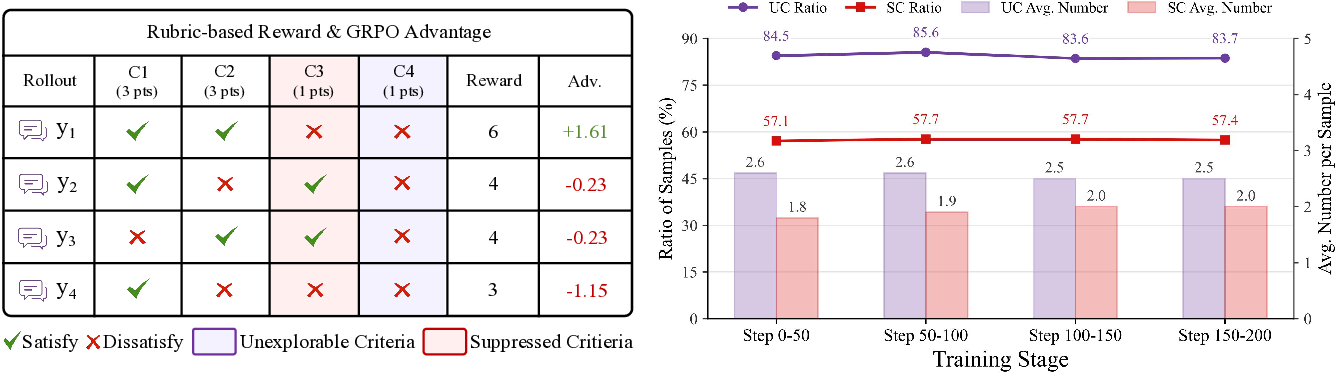
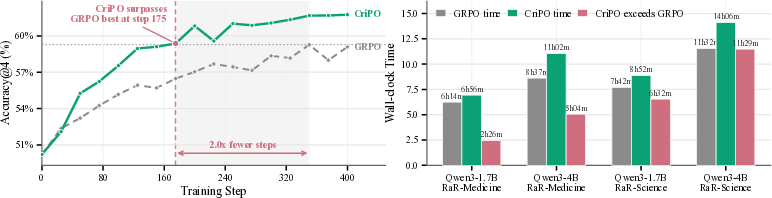
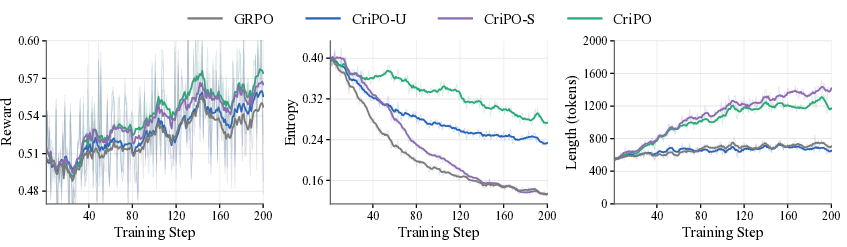
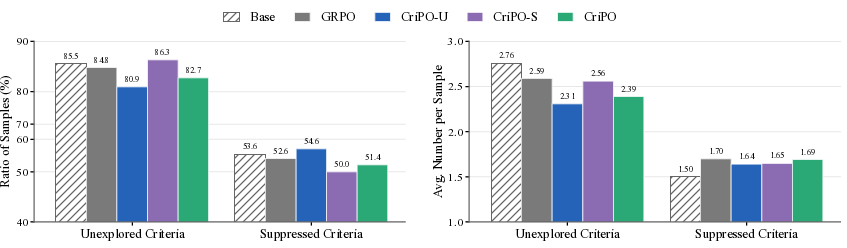
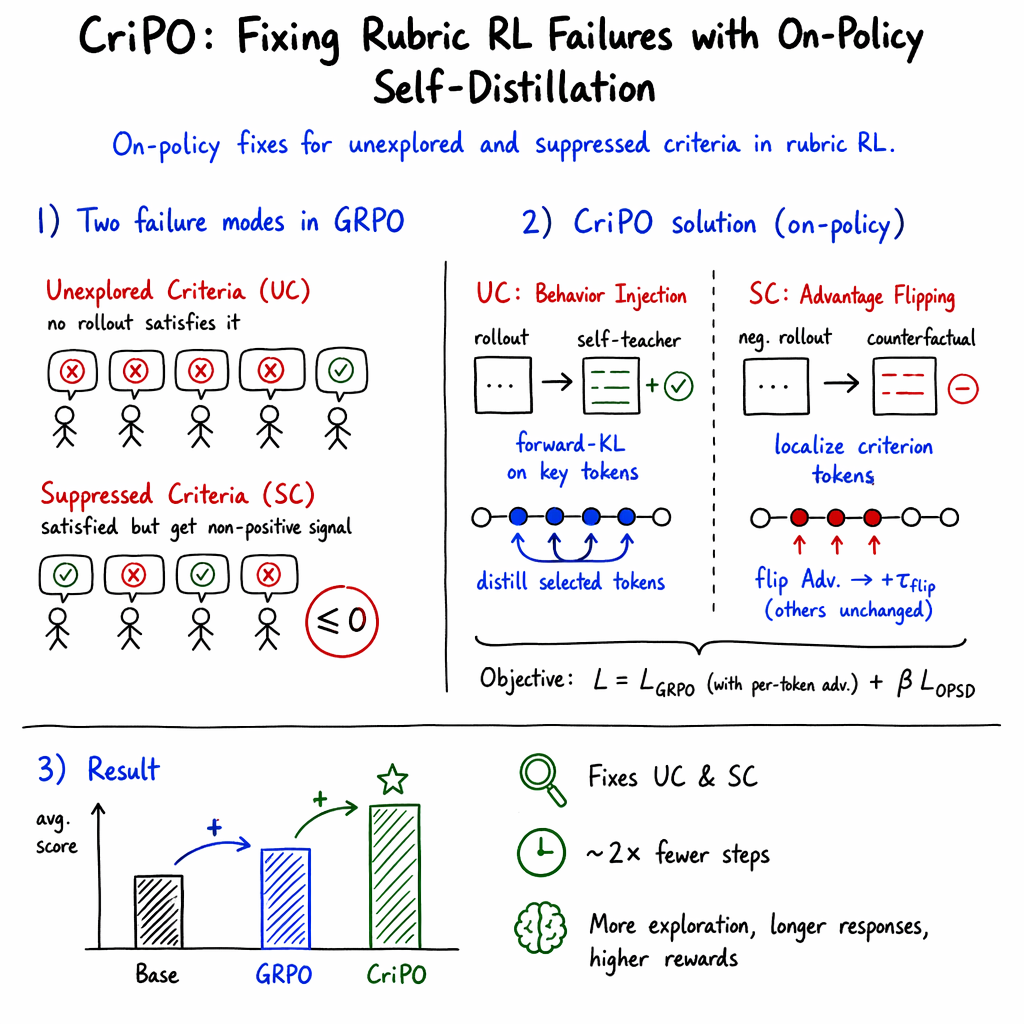
Abstract: Rubric-based RL has recently shown promise in improving LLMs on open-ended tasks. A widely recognized limitation of rubric-based RL is limited exploration: criteria that no rollout manages to satisfy (Unexplored Criteria, UC) receive no optimization signal. Recent methods address this by incorporating rubric information as external guidance during rollout, yet they introduce a train-inference mismatch: the policy is optimized on rollouts produced under external guidance while this guidance is absent at inference time, causing error accumulation through autoregressive decoding. Moreover, these exploration-focused approaches overlook a fundamentally different failure mode that we term Suppressed Criteria (SC) -- criteria that are satisfied by some rollouts yet whose learning signals are lost during optimization because scalar reward aggregation assigns them non-positive aggregate advantages. Our analysis reveals that SC are remarkably prevalent: over 57% of samples exhibit this failure mode throughout training, with an average of 1.8 SC per sample. To simultaneously address both UC and SC without introducing training-inference mismatch, we propose Criterion-Distilled Policy Optimization (CriPO), which enhances rubric-based RL via on-policy self-distillation. For UC, CriPO constructs a criterion-injection self-teacher and computes a localized forward-KL loss to inject missing behaviors into the policy. For SC, CriPO employs a counterfactual self-teacher to locate criterion-relevant tokens in negative-advantage rollouts and flips their token-level advantages to positive values, preserving useful patterns that would otherwise be suppressed. Experiments on medicine and science benchmarks demonstrate that CriPO consistently outperforms rubric-based RL, achieving stronger final performance with approximately $2\times$ fewer optimization steps.
Paper Prompts
Sign up for free to create and run prompts on this paper using GPT-5.
Top Community Prompts
Explain it Like I'm 14
Overview
This paper is about teaching LLMs—like chatbots—to write better answers for open-ended tasks (for example, medical advice or science explanations) using a “rubric.” A rubric is a checklist of what a good answer should include, such as being accurate, complete, safe, and clear. The authors show that common training methods miss important parts of the rubric and then introduce a new training approach, called CriPO, that helps the model learn all the useful behaviors the rubric asks for—without causing problems when the model is later used on its own.
What questions does the paper ask?
The paper focuses on two simple questions:
- How can we help a model learn from a rubric when some checklist items never appear in its practice answers?
- How can we keep good habits the model already shows in parts of its answers from being “hidden” or punished by how we score the whole answer?
How do they approach the problem?
First, two common problems with “rubric-based” training are identified:
- Unexplored Criteria: Some checklist items never show up in any of the model’s practice answers. If an answer never includes, say, “cite reliable sources,” the training has nothing to reward there, so the model doesn’t learn that behavior.
- Suppressed Criteria: Sometimes an answer gets some parts right (e.g., “be safe”) but gets a low overall score because it misses other parts. The training then pushes the whole answer down, accidentally punishing the good parts along with the bad.
Many past methods try to fix the “unexplored” problem by giving the model extra hints during practice, like telling it the checklist while it writes. That can work, but it creates a mismatch: during training the model gets hints; during real use it doesn’t. That mismatch can lead to more mistakes later.
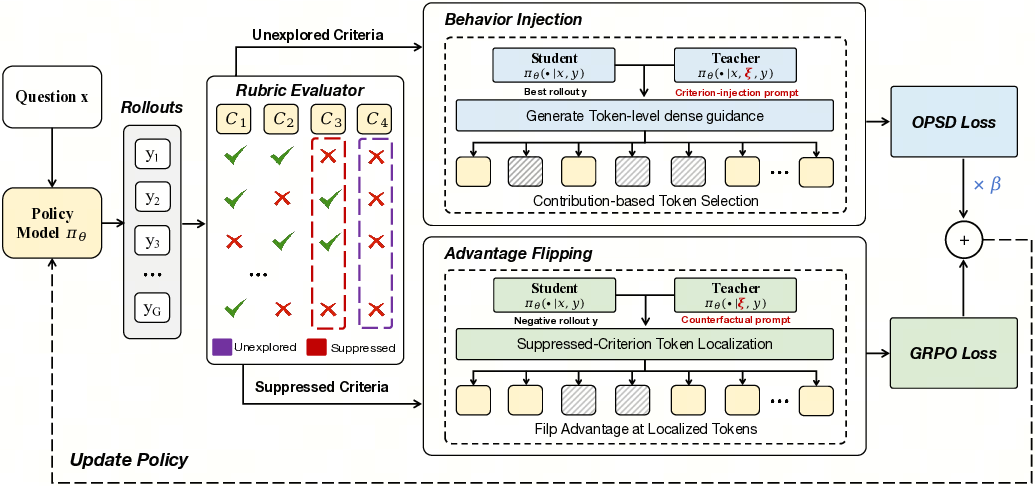
The authors’ solution, CriPO, uses a “self-teaching” idea that avoids this mismatch:
- Think of the model as both a student and a teacher. The “teacher” version only gives gentle guidance based on the rubric. The “student” version is the real model that must work on its own.
- The model compares what it would write normally (student) with what it would write if reminded about a specific rubric item (teacher). Then it learns from the differences at the exact words where the reminder really mattered.
Here’s how CriPO handles each problem:
- For Unexplored Criteria: It picks the best answer from the group (the one closest to the rubric), then asks the teacher version to minimally revise it to include the missing checklist items. The model then copies only the small, important changes—like adjusting a few crucial words—so it learns the new behavior without overfitting or noise. This is like a coach fixing just the key moves in your routine, not changing everything.
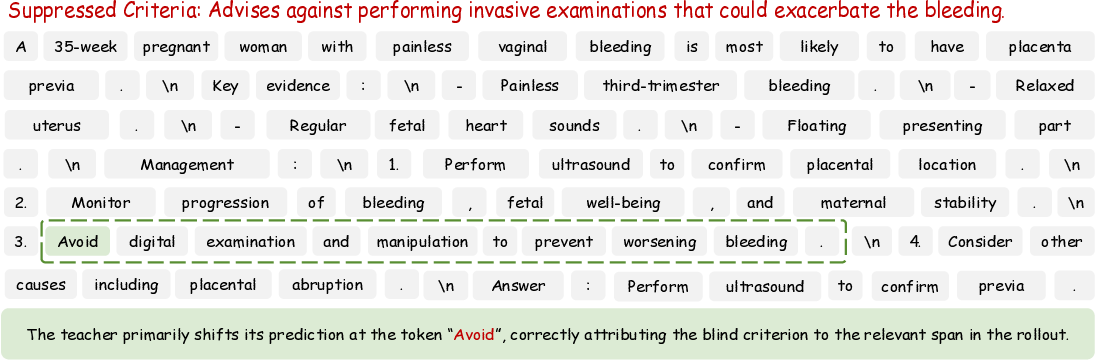
- For Suppressed Criteria: It finds parts of an answer that did satisfy a checklist item (like a safety warning) even if the total score was low. It then gives small, positive credit to the exact words that showed those good behaviors, instead of letting them be buried by the overall score. This keeps good habits from being lost.
Two careful design choices make this work well:
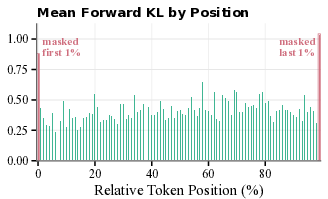
- It only edits the few words where the teacher’s reminder strongly changes the next-word choice. This avoids noisy, unnecessary changes.
- It applies edits to the best answer in the group when injecting new behaviors, making the fix smaller and more reliable.
What did they find?
In tests on medicine and science question-answering:
- CriPO beat strong baseline methods, including a popular group-based reinforcement learner (GRPO) and a method that uses hindsight instructions (HeRL).
- It reached the same (or better) final quality in about half the training steps—roughly 2× faster to match GRPO’s best performance.
- The two problems they identified are common: most training batches had missing checklist items and over half had “suppressed” (good but hidden) behaviors. CriPO reduced both.
- A version that only fixed Unexplored Criteria and a version that only fixed Suppressed Criteria each helped, but the full CriPO—fixing both—worked best overall.
Why this matters:
- The model learns to cover more of the rubric (like being safer, clearer, and more complete), not just chase a single score.
- Training stays stable because it still uses a reliable reinforcement learning backbone, and the self-teaching only adds targeted nudges where needed.
Why is this important?
- Better real-world answers: For open-ended tasks (like health or science information), there’s no single “right” sentence. Rubrics help define quality. CriPO ensures the model actually learns all parts of that quality—especially the ones it used to miss or accidentally punish.
- No hint dependency: The model learns from “teacher hints” during training but does so in a way that doesn’t require hints at test time, avoiding train–use mismatch.
- More efficient training: Getting higher quality with fewer steps saves compute and time.
- Safer, more reliable AI: By protecting good behaviors (like safety notes) from being suppressed, the model is more likely to keep them in future answers.
Takeaway
CriPO is a smarter way to train LLMs with rubrics. It:
- Adds missing behaviors by learning small, meaningful edits from a self-teacher.
- Preserves good behaviors by rewarding the exact words that showed them, even if the full answer wasn’t perfect.
- Improves performance and efficiency without relying on training-time crutches that disappear later.
This approach can help build better assistants for areas like medicine, science, and education—where answers must be not only correct, but also safe, thorough, and easy to understand.
Knowledge Gaps
Unresolved Gaps, Limitations, and Open Questions
Below is a consolidated list of concrete knowledge gaps and limitations that remain open, along with actionable questions for future work:
- Per-criterion credit assignment remains indirect: the backbone still aggregates rubric scores into a scalar reward. Explore vector-valued (multi-objective) policy gradients with per-criterion advantages or multi-critic architectures and compare against CriPO’s advantage flipping.
- Suppressed-criteria definition depends on binary rubric scores and ad hoc thresholds (sum of advantages < 0 or = 0 with |S| < G/2). Evaluate robustness with continuous rubric scores, different thresholds, and varying group sizes G.
- Reliability of the self-teacher is untested: the teacher is the student conditioned on rubrics, risking error reinforcement. Assess alternatives (stronger/frozen teacher, cross-model ensembles, or EMA teachers) and quantify effects of teacher noise on learning.
- Token localization heuristic for suppressed criteria (Δ log-prob and confidence threshold) lacks validation. Benchmark against human annotations and attribution methods (e.g., integrated gradients, attention rollout, leave-one-out) to verify that selected tokens truly encode the criterion.
- Cross-criterion interference is unmeasured: injecting behavior for one criterion may harm others. Quantify interference matrices and develop scheduling or Pareto-front methods to balance competing criteria.
- On-policy claim vs privileged conditioning: even if rollouts are on-policy, the teacher uses rubric prompts not present at inference. Measure exposure bias reduction explicitly (e.g., prefix-error propagation metrics) and compare to guided rollouts.
- Hyperparameter sensitivity (β, γ, α, τ_flip, group size G, clipping ranges) is not thoroughly studied. Provide comprehensive sweeps, uncertainty estimates, and adaptive/learned schedules (e.g., trust-region or meta-learned β).
- Compute and energy overhead are only partially characterized (steps-to-target). Report full wall-clock, GPU-hours, memory footprint, and latency per step, including extra forward passes for teachers and rubric judging; study scalability with model size and number of criteria.
- Generalization beyond medicine and science remains unclear. Evaluate on broader open-ended tasks (e.g., legal, safety alignment, creative writing, tutoring), and on multilingual datasets to test domain and language transfer.
- Evaluation relies on LLM-as-judge; risk of judge gaming and verbosity bias is unaddressed. Include blinded human evaluations, task-specific objective metrics (e.g., factuality, safety violations), and adversarial stress tests.
- Judge dependence and transferability are not analyzed: training uses Qwen3-32B judge, evaluation uses GPT-4o-mini. Quantify cross-judge stability, correlation to human ratings, and vulnerability to judge drift or bias.
- Medical safety is not assessed by clinicians. Incorporate domain-expert review and safety audits (e.g., contraindication checks, harm likelihood, adherence to clinical guidelines), and measure hallucination and harm metrics.
- Stability analysis is qualitative. Provide formal or empirical convergence diagnostics (gradient variance, clipping saturation, entropy collapse, catastrophic forgetting) and conditions where CriPO remains stable vs OPSD alone.
- Forward-KL choice for behavior injection is justified heuristically. Compare against reverse-KL, JS-divergence, temperature-scaled KL, and adaptive divergence selection; analyze exploration–exploitation trade-offs theoretically and empirically.
- Advantage flipping may incentivize verbosity. Disentangle informativeness from length by using length-controlled baselines, conciseness/focus rubrics, or brevity regularizers; report length-normalized quality metrics.
- Dependence on rubric quality and weights (ω_j) is untested. Study robustness to noisy, incomplete, or adversarial rubrics; learn criterion weights online or via Bayesian calibration; enable rubric revision during training.
- Partial satisfaction is not modeled: binary treatment of criteria loses granularity. Extend to soft/graded criterion satisfaction and proportional token-level credit assignment.
- Counterfactual teacher “minimal change” assumption is unverified. Quantify edit distances and semantic drift between original and counterfactual responses; add constraints or regularizers to enforce locality of edits.
- Applicability to other RLVR/LLM post-training backbones (e.g., PPO, DPO-style objectives, KL-regularized RLHF, advantage-weighted likelihood) is untested. Run controlled cross-backbone comparisons.
- Group-size and sampling strategy effects are unexplored. Analyze how G, temperature, and nucleus parameters affect rates of Unexplored/Suppressed Criteria and downstream performance; consider adaptive group sizing or curiosity bonuses.
- Training duration and scale: results emphasize ~200 steps; long-horizon dynamics (overfitting, late-stage instability, plateauing) are unreported. Provide extended learning curves and early-stopping criteria.
- Reproducibility is unclear (full code, prompts, seeds, checkpoints, and judge configurations are not provided). Release artifacts and report variance across seeds.
- Data governance concerns (privacy, copyright, licensing) are not addressed for medical/scientific datasets; clarify compliance and assess potential leakage risks.
- Cost of rubric evaluation at scale may be prohibitive. Investigate learned rubric reward models (trained on rubric judgments) to amortize judge calls while preserving interpretability and per-criterion fidelity.
- GRPO–OPSD gradient interaction is unexamined. Measure gradient cosine similarity and interference; explore gradient surgery or adaptive β to mitigate conflicting updates.
- Extension to multi-turn interactions and tool-use is open. Evaluate CriPO in conversational settings with context carryover and in tool-augmented reasoning where criteria depend on external actions.
Practical Applications
Immediate Applications
Below are concrete ways practitioners can use the paper’s findings and methods today, with links to sectors, suggested tools/workflows, and feasibility notes.
- Healthcare: Fine-tune clinical assistants to meet multi-criteria rubrics (e.g., safety, factuality, empathy, guideline adherence)
- What to do: Replace plain rubric-based GRPO with CriPO when customizing LLMs for medical QA and triage. Encode safety/clinical guidelines as rubrics; use CriPO’s behavior injection for unmet safety criteria and advantage flipping to preserve correctly met safety constraints within otherwise weak answers.
- Tools/workflows: Extend existing RL pipelines (e.g., Hugging Face TRL/VERL) with (1) criterion-injection prompts for unexplored criteria; (2) counterfactual teacher prompts for token-level advantage flipping; (3) dashboards that track “unexplored” and “suppressed” criteria rates.
- Benefits: Stronger alignment to safety rubrics, fewer optimization steps (~2× fewer than GRPO), reduced training–inference mismatch vs rubric-guided rollouts.
- Assumptions/dependencies: High-quality domain rubrics; reliable LLM-as-a-judge for scoring; access to model weights and RL training infra; careful hyperparameter tuning (γ, α, τ_flip, β).
- Education: Rubric-aligned tutoring and feedback generators
- What to do: Build course- or instructor-specific rubrics (clarity, reasoning steps, scaffolding, tone). Fine-tune models using CriPO so that missing rubric behaviors (e.g., step-by-step explanations) are injected without relying on rubric prompts at inference.
- Tools/workflows: Authoring tool for rubrics; teacher-student prompt templates (as in the paper) for revising prior responses; token-level logging of flipped advantages for transparency.
- Benefits: Better rubric adherence with stable inference behavior (no guided prefixes at deployment).
- Assumptions: Clear grading rubrics; LLM judge that reliably scores criterion-wise feedback.
- Enterprise/Software: Customized assistants aligned to style guides, safety policies, and checklists
- What to do: Define rubrics for brand style, compliance, and content quality; fine-tune with CriPO to prevent desirable but underweighted behaviors (e.g., disclaimers, citations) from being suppressed.
- Tools/workflows: “Criterion health” monitors during training; automatic detection of unexplored vs suppressed criteria to trigger targeted self-distillation steps; integration into CI/CD for model post-training.
- Benefits: Reduced exposure bias vs guided generation training; measurable improvements over GRPO (+1.4–3.2 points in tested settings); cost savings via faster convergence.
- Assumptions: Availability of rubric definitions; judge model availability and bias control; compute budget for OPSD passes.
- Safety & Compliance (cross-sector: finance, legal, healthcare)
- What to do: Encode must-have compliance criteria (e.g., risk disclosures, prohibited content avoidance) and use advantage flipping to protect these behaviors from being washed out by scalar reward aggregation.
- Tools/workflows: Compliance rubrics; counterfactual self-teacher prompts that weaken only the compliance sections to locate tokens tied to compliance; audit trail of where/when tokens get positive advantages.
- Benefits: Retains critical safety/compliance behaviors even when the overall response is mediocre.
- Assumptions: Well-specified compliance rubrics; judge reliability on safety criteria.
- Research & Evaluation (Academia/Industry R&D)
- What to do: Use the paper’s metrics to track “unexplored” and “suppressed” criteria prevalence during training; run ablations on token filtering and best-rollout selection to improve stability.
- Tools/workflows: Training dashboards tracking counts/ratios of failure modes; automated hyperparameter sweeps for γ (KL contribution threshold), α (teacher confidence), β (OPSD weight).
- Benefits: Diagnose failure modes in multi-criteria RL; improve training stability over standalone OPSD.
- Assumptions: Access to training logs and rollout groups; reproducible data pipelines.
- Cost/Compute Optimization for LLM Fine-tuning
- What to do: Adopt CriPO to reach or surpass GRPO’s performance with ~2× fewer optimization steps, especially when fine-tuning small/medium models for open-ended tasks.
- Tools/workflows: Budget-aware schedulers that stop early based on reward/criterion convergence; per-step overhead accounting (additional teacher passes) offset by fewer total steps.
- Benefits: Lower training cost; faster iteration.
- Assumptions: Sufficient GPU memory/time for teacher passes; stable judge throughput.
Long-Term Applications
These require additional research, scaling, or engineering before broad deployment.
- Generalized Multi-Objective Alignment Platforms
- Vision: Extend CriPO to robustly optimize dozens of objectives (quality, safety, bias, helpfulness, domain constraints) with dynamic weights; include learned reward models instead of LLM judges.
- Potential products: “Criterion Manager” services managing objective weights; automatic detection/mitigation of cross-criterion suppression.
- Dependencies: More reliable per-criterion scoring; adaptive weighting strategies; safeguards against judge bias.
- Domain-agnostic Safety Governors with Token-Level Control
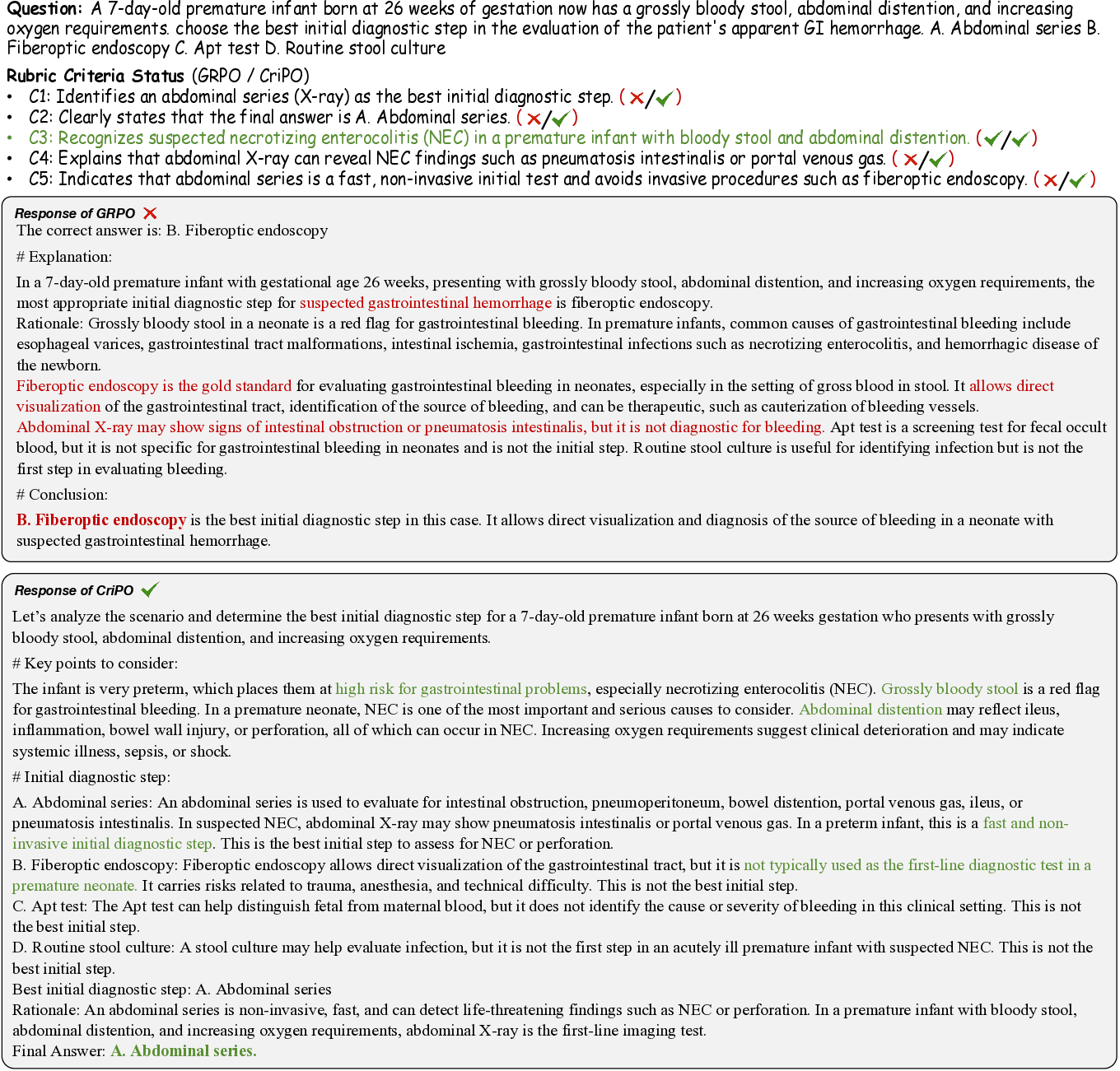
- Vision: Learn reusable token-level maps for safety-critical behaviors (e.g., “avoid invasive exams” spans) that can be transferred across tasks and models to ensure such behaviors persist.
- Potential tools: Token-level compliance controllers; editors that “pin” behaviors across updates.
- Dependencies: Stable token localization across architectures; causal validation of token spans; governance frameworks.
- Extension to Multimodal and Agentic Systems (Robotics, Multimodal Assistants)
- Vision: Apply criterion injection and local advantage flipping to multimodal policies (text, vision, action sequences) and long-horizon agents where rubrics encode task constraints and safety.
- Potential products: Rubric-aligned robot policy training; agent tool-use checklists enforced via on-policy distillation.
- Dependencies: Multimodal rubric judges; token/action-level alignment across modalities; real-world validation.
- Policy and Standards: Procurement and Evaluation Guidelines for AI Systems
- Vision: Standardize multi-criteria training/evaluation methods that explicitly measure unexplored vs suppressed criteria and require on-policy alignment (no training–inference mismatch).
- Potential outcomes: Regulatory guidance or benchmarks specifying criterion-level accountability and reporting.
- Dependencies: Consensus on rubrics per domain; standardized judge protocols; open datasets and shared metrics.
- Automated Rubric Discovery and Refinement
- Vision: Tools that infer missing or redundant criteria by analyzing persistent unexplored/suppressed patterns, then propose rubric edits or reweighting.
- Potential products: “Rubric Engineer” that co-optimizes rubrics and policies to reduce failure modes.
- Dependencies: Meta-optimization frameworks; robust causal analyses linking criteria to outcomes; human-in-the-loop review.
- Reduced Reliance on LLM-as-a-Judge via Learned, Audited Reward Models
- Vision: Train calibrated, auditable reward models per criterion to replace or complement LLM judges; use CriPO to leverage these models at token-level granularity.
- Potential products: Criterion-specific reward model repositories; certification pipelines.
- Dependencies: Large, annotated datasets; bias/robustness audits; monitoring drift and calibration.
- Cross-Organizational Shared Rubrics and Safety Libraries
- Vision: Sector-wide, open rubrics for healthcare, finance, and education to standardize criteria and facilitate transfer learning with less data.
- Potential products: Rubric registries; pre-trained “criterion-injection” modules.
- Dependencies: Collaborative consortia; legal/IP frameworks; harmonization across jurisdictions.
- Continual and Lifelong Learning with Criterion Tracking
- Vision: Continuously update models with new criteria and detect when criteria become suppressed after domain shifts; use CriPO to adapt without catastrophic forgetting.
- Potential tools: Criterion drift detectors; scheduled advantage flipping for at-risk criteria.
- Dependencies: Streaming evaluation; robust scheduling policies; monitoring infrastructures.
Notes on Feasibility and Risk
- Judge dependence: Results hinge on judge quality; biases or instability can misguide training.
- Engineering complexity: CriPO introduces teacher passes and token-level bookkeeping; teams need MLOps support.
- Hyperparameter sensitivity: γ, α, τ_flip, β require tuning; defaults may not generalize across domains.
- Data and rubric quality: Ambiguous or overly broad criteria reduce signal-to-noise; invest in rubric design and pilot scoring.
- Governance: Token-level advantage flipping should be audited to avoid reinforcing undesirable patterns.
Glossary
- Aggregate advantages: The sum of per-rollout or per-token advantages used to guide updates; if non-positive, helpful behaviors can be penalized or ignored. Example: "because scalar reward aggregation assigns them non-positive aggregate advantages."
- Advantage flipping: A localized correction strategy that changes selected negative advantages to positive to preserve useful behaviors. Example: "Advantage Flipping for Suppressed Criteria"
- Autoregressive decoding: Token-by-token generation where errors early in the sequence can propagate to later tokens. Example: "causing error accumulation through autoregressive decoding."
- Behavior injection: Introducing missing, criterion-specific behaviors into the policy via targeted self-distillation. Example: "The overall loss of behavior injection is as follows:"
- Contribution-Guided Token Filtering: Selecting only the token positions with the largest KL contributions to reduce noise in self-distillation. Example: "Contribution-Guided Token Filtering."
- Counterfactual self-teacher: A self-conditioned teacher that edits a response to remove satisfied criteria to reveal criterion-relevant tokens by contrast. Example: "For suppressed criteria, CriPO employs a counterfactual self-teacher to locate criterion-relevant tokens in negative-advantage rollouts"
- Criterion-Distilled Policy Optimization (CriPO): The proposed method that augments GRPO with on-policy self-distillation to fix unexplored and suppressed criteria. Example: "we propose Criterion-Distilled Policy Optimization (CriPO), which enhances rubric-based RL via on-policy self-distillation."
- Criterion-injection self-teacher: A self-conditioned teacher that revises a response to satisfy unmet criteria, providing signals for missing behaviors. Example: "CriPO constructs a criterion-injection self-teacher and computes forward-KL divergence as an auxiliary loss to inject missing criterion-specific behaviors into the policy."
- Distributional gap: A mismatch between the training and inference distributions that can degrade performance. Example: "thereby obtaining learning signals without any distributional gap between training and inference."
- Entropy collapse: Degeneration where the model’s output distribution loses diversity, harming exploration. Example: "including privileged-information leakage, unreliable self-teacher signals, or entropy collapse"
- Exposure bias: Error accumulation caused by training under different conditions than inference, especially with guided prefixes. Example: "This discrepancy constitutes exposure bias"
- Forward-KL divergence: The KL direction D_KL(teacher || student) used to encourage the student to cover teacher modes for exploration. Example: "computes forward-KL divergence as an auxiliary loss"
- Group-relative advantage: An advantage computed by normalizing rewards within a sampled group to stabilize policy updates. Example: "GRPO then computes a group-relative advantage by normalizing the reward within the group"
- Group Relative Policy Optimization (GRPO): An RL algorithm that optimizes policies using group-normalized rewards and PPO-style clipping. Example: "We adopt Group Relative Policy Optimization (GRPO) as the core RL algorithm for training LLMs with rubric-based rewards."
- Hindsight guidance: Using feedback from failed trajectories and unmet criteria to guide generation of revised rollouts. Example: "leverages failed trajectories and their unmet criteria as hindsight guidance for generating revised rollouts."
- Importance ratio: The likelihood ratio between current and rollout policies used in clipped objectives. Example: "where ρ_{i,t}=... is the importance ratio"
- On-policy rollout: A trajectory sampled from the current policy, ensuring no off-policy mismatch. Example: "Given an on-policy rollout "
- On-Policy Self-Distillation (OPSD): Distilling from a self-teacher conditioned on privileged information while staying on the model’s own rollouts. Example: "On-Policy Self-Distillation (OPSD) has recently emerged as a promising paradigm"
- Privileged information: Auxiliary guidance (e.g., rubrics) available at training time but not at inference time. Example: "a self-teacher distribution conditioned additionally on privileged information ."
- PPO-style clipped surrogate objective: A stable policy-gradient objective that clips importance ratios to avoid large, unstable updates. Example: "The policy model is optimized with the PPO-style clipped surrogate objective:"
- Reinforcement Learning from Verifiable Rewards (RLVR): RL methods that optimize using rewards derived from verifiable outcomes (e.g., exact answers, test cases). Example: "Reinforcement Learning from Verifiable Rewards (RLVR), instantiated by methods such as GRPO"
- Reverse-KL (instantiation): The KL direction D_KL(student || teacher) used in some OPSD formulations, often sharper and less exploratory. Example: "reverse-KL instantiation"
- Rollout: A sampled sequence (trajectory) from the policy for evaluation and training. Example: "during rollout generation"
- Rubric-based Reinforcement Learning (RL): RL that uses multi-criteria rubric scores (via an LLM judge) aggregated into rewards for training. Example: "Rubric-based Reinforcement Learning (RL) has recently shown promise in improving LLMs on open-ended tasks."
- Reward ambiguity: Loss of criterion-specific learning signals when multiple criteria are compressed into a single scalar reward. Example: "reward ambiguity: aggregating multiple criteria into a single scalar reward obscures criterion-specific token contributions"
- Scalar reward aggregation: Combining multiple criterion scores into a single reward number for optimization. Example: "because scalar reward aggregation assigns them non-positive aggregate advantages."
- Self-teacher: The same model conditioned on extra (privileged) context that provides target distributions for distillation. Example: "constructs a privilege-conditioned self-teacher and provides token-level supervision"
- Stop-gradient: An operation that prevents gradients from flowing through a tensor, stabilizing teacher signals in distillation. Example: "where denotes the stop-gradient operation."
- Suppressed criteria: Criteria that are satisfied in some rollouts but whose learning signals are lost due to non-positive aggregate advantages. Example: "Suppressed Criteria—criteria that are satisfied by some rollouts yet whose learning signals are lost during optimization because scalar reward aggregation assigns them non-positive aggregate advantages."
- Token-level advantages: Advantages assigned per token (rather than per rollout) to enable local credit assignment. Example: "flips their token-level advantages to positive values"
- Training-inference mismatch: A discrepancy where training uses guidance not available at inference, leading to degraded performance. Example: "they introduce a training-inference mismatch"
- Unexplored criteria: Criteria for which no rollout in the group satisfies the condition, yielding no learning signal. Example: "criteria that no rollout manages to satisfy (Unexplored Criteria) receive no optimization signal."
Collections
Sign up for free to add this paper to one or more collections.

