Boogu-Image-0.1: Boosting Open-Source Unified Multimodal Understanding and Generation
Abstract: We introduce Boogu-Image-0.1, an open-source unified multimodal understanding and generation model family, comprising Base, Turbo, Edit, and Edit-Turbo variants. It delivers competitive performance in high-quality text-to-image generation, fast inference, instruction-based editing, and bilingual (Chinese-English) text rendering. Closed-source multimodal systems like Nano-Banana-Pro and GPT-Image-2 achieve strong performance through system-level integration rather than a single model, yet their internal practices remain largely undisclosed. In this work, we demonstrate that targeted improvements in model understanding, data quality, and training pipelines, coupled with agentic inference-time scaling, can substantially enhance generation and editing performance even under highly constrained compute budgets. Comprehensive evaluations show that Boogu-Image-0.1 consistently matches or surpasses other open-source models across standard benchmarks, and achieves results approaching leading closed-source systems. Notably, this is accomplished with only 208.62 million unique images. The base model's theoretical training cost is only approximately $400K. We share practical discussions that we believe are valuable to the broader research community, and release weights, code, and recipes under Apache 2.0 to advance the open ecosystem for unified multimodal understanding and generation. Our code is available here: https://github.com/Boogu-Project/Boogu-Image.









Paper Prompts
Sign up for free to create and run prompts on this paper.
Top Community Prompts
Explain it Like I'm 14
What is this paper about?
This paper introduces Boogu-Image-0.1, a family of open-source AI models that can both understand instructions and create or edit images. Think of it as a very smart art assistant that not only draws what you ask for, but also really “gets” what you mean—even if your request has lots of details or tricky parts (like precise text in an image, specific styles, or multi-step edits). The team focused on making the model good at understanding, not just drawing, and they did it on a surprisingly small budget compared with many big tech systems.
What questions did the researchers ask?
The team set out to answer a few simple, important questions:
- Can an open-source image model be both fast and high-quality, and also follow complex instructions well?
- Does giving the model better “understanding” (like stronger language skills and reasoning at run time) actually improve pictures and edits?
- Can we train a strong model with carefully chosen data and smart training tricks instead of huge, expensive datasets?
- How should we evaluate image models so that scores match what people actually prefer?
How did they build and test it?
To make this clear, here are the main ideas behind their approach:
- Strong language “ears”: The model uses a powerful text encoder (you can think of it as the model’s ears for language) based on a capable language-and-vision model. This helps it truly understand what you want, not just pick up keywords.
- An “agent” that helps at generation time:
- Rewrite your prompt more clearly (so the model doesn’t miss important details).
- Choose the best version of the model for the job (for example, “Turbo” for speed or “Base” for maximum quality).
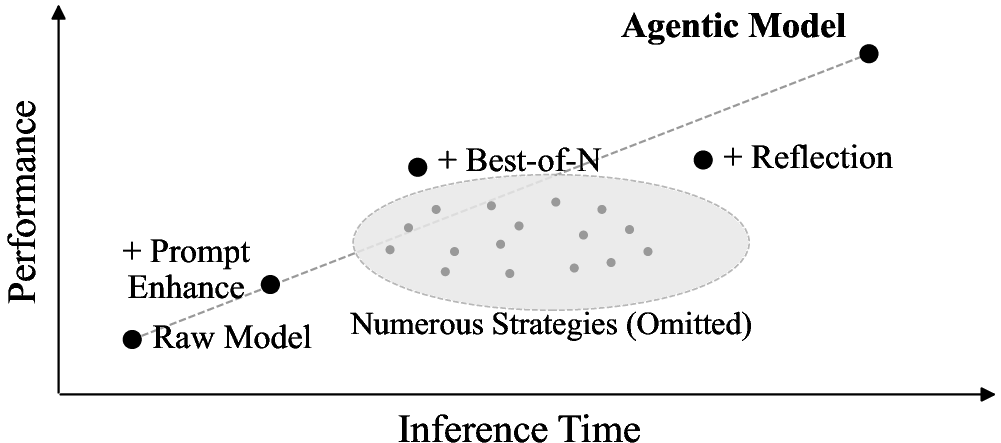
- Spend more “thinking time” when needed (this is called inference-time scaling). Just like taking more time on homework can improve your answers, giving the model more steps can improve image quality.
- Versions for different needs:
- Base and Turbo for text-to-image generation (Turbo is faster, Base is better for tough cases like dense text at high resolution).
- Edit and Edit-Turbo for instruction-based image editing.
- There are also “Thinking” variants that use extra reasoning at run time for even better results on tricky tasks.
- Smart, efficient training: They trained the model with about 208.62 million unique images (much less than many big projects) and a theoretical cost of about $400,000, by carefully picking high-quality data and fine-tuning the training process.
- Fair, human-centered evaluation:
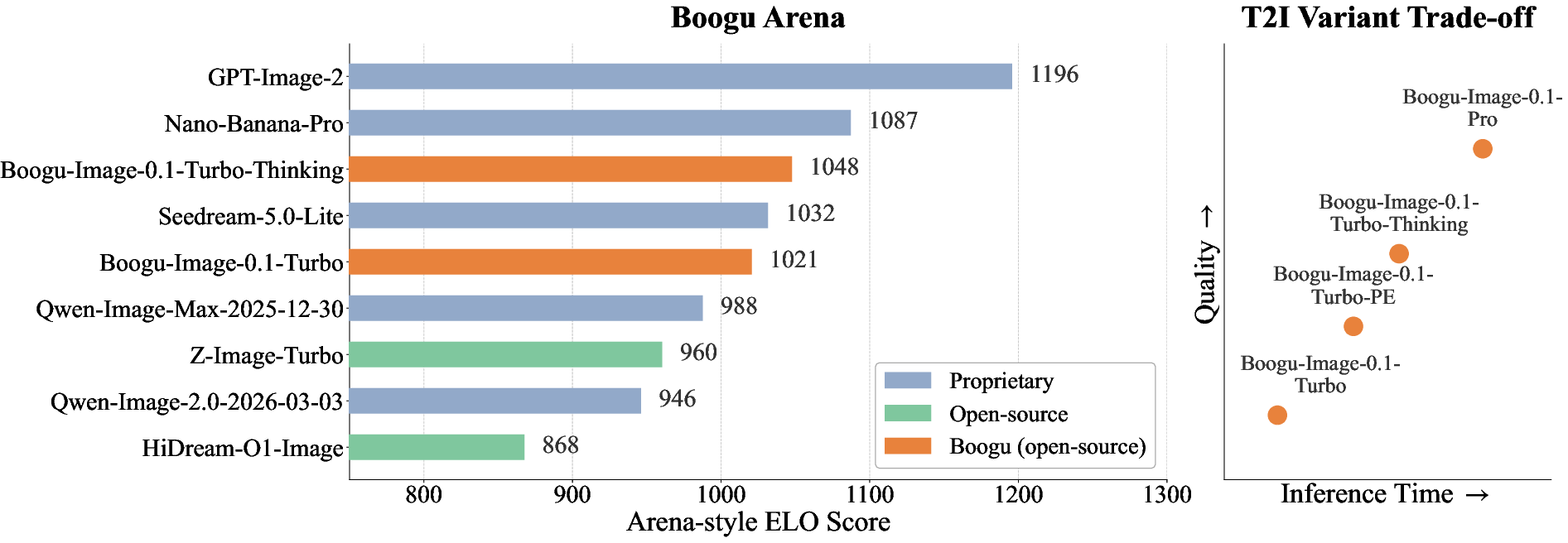
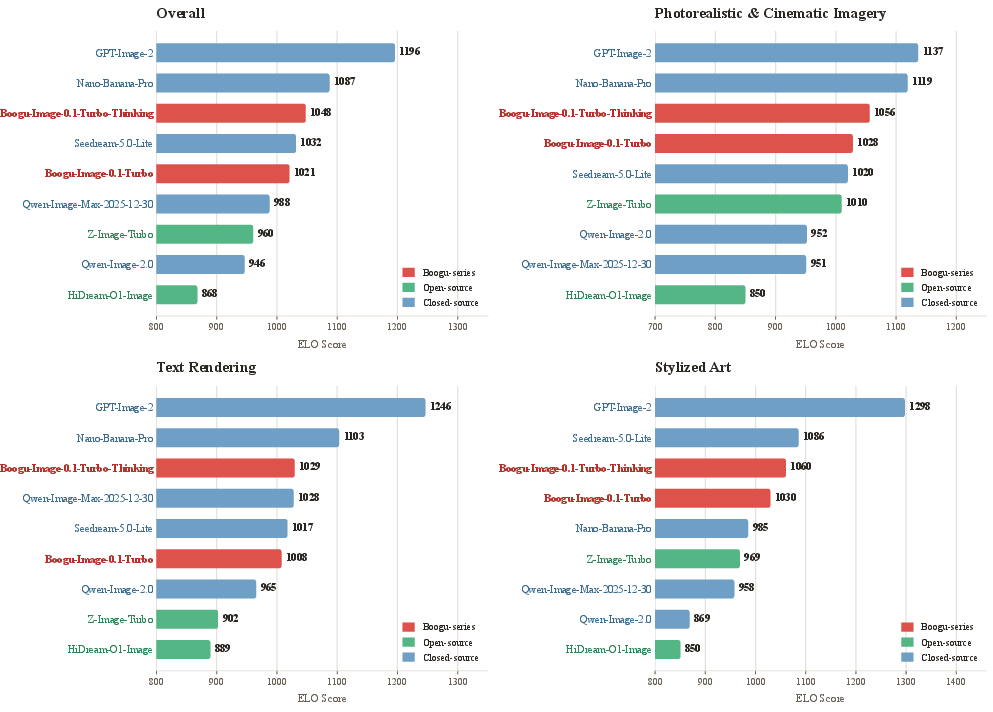
- They built “Boogu Arena,” a head-to-head contest where people compare images from different models without knowing which is which (like a blind taste test). Results are combined into Elo ratings (similar to how chess players are ranked).
- They also tested on newer benchmarks like Qwen-Image-Bench and LongText-Bench (for rendering long English and Chinese text inside images), plus ImgEdit-Bench for editing.
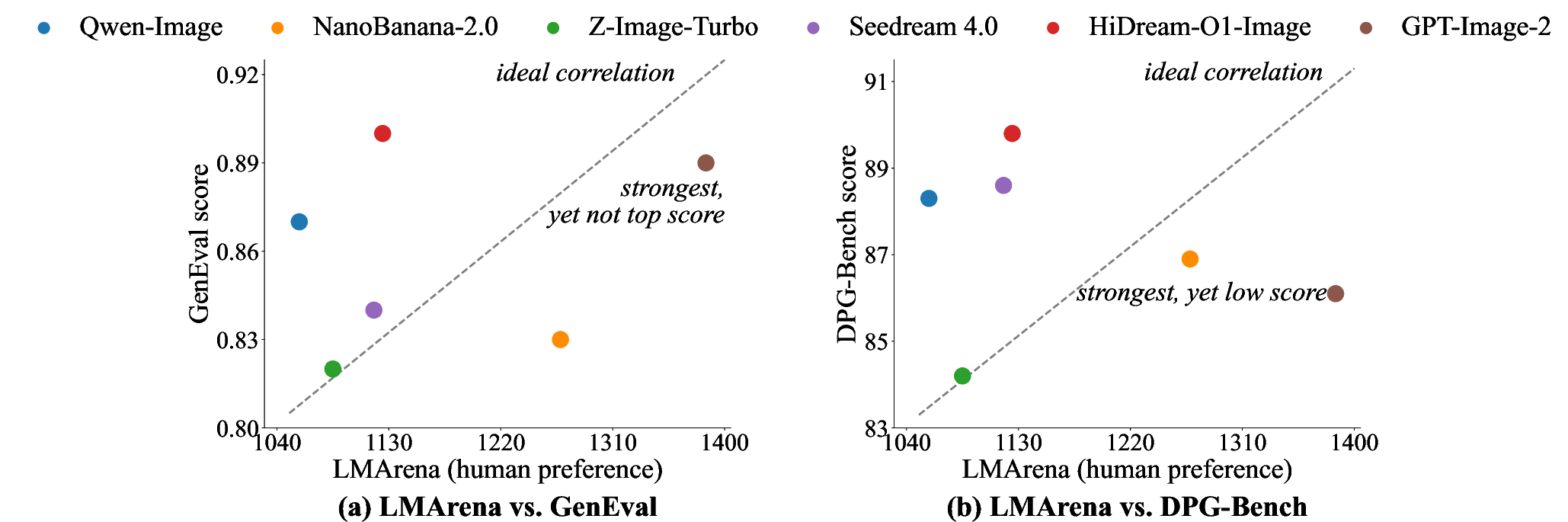
- They explain why some older benchmarks don’t match real user preferences anymore (scores are near the ceiling, contain leaked data, or don’t reflect real-world tasks).
What did they find?
Here are the main results and why they matter:
- Strong overall image generation:
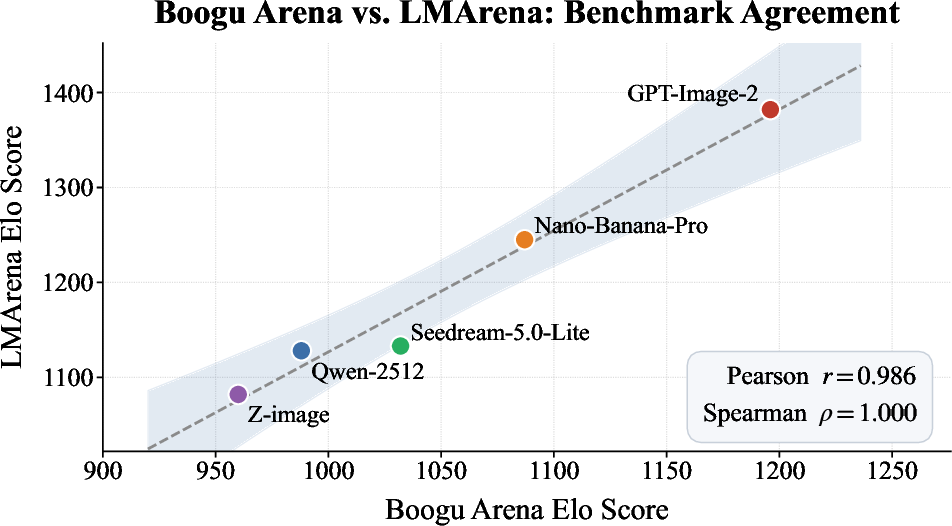
- In their Boogu Arena (which tracks public human-preference rankings very closely), Boogu-Image-0.1 ranks at the top among open-source models and gets close to strong closed-source systems.
- The “Thinking” versions do even better, especially on tasks that depend on careful instruction following (like precise text rendering).
- Excellent bilingual text-in-image:
- The model accurately renders both English and Chinese text in images, with neat layouts and typography.
- For very dense text at high resolution (like posters), the Base model is recommended because it keeps the text clean and readable.
- High-quality image editing:
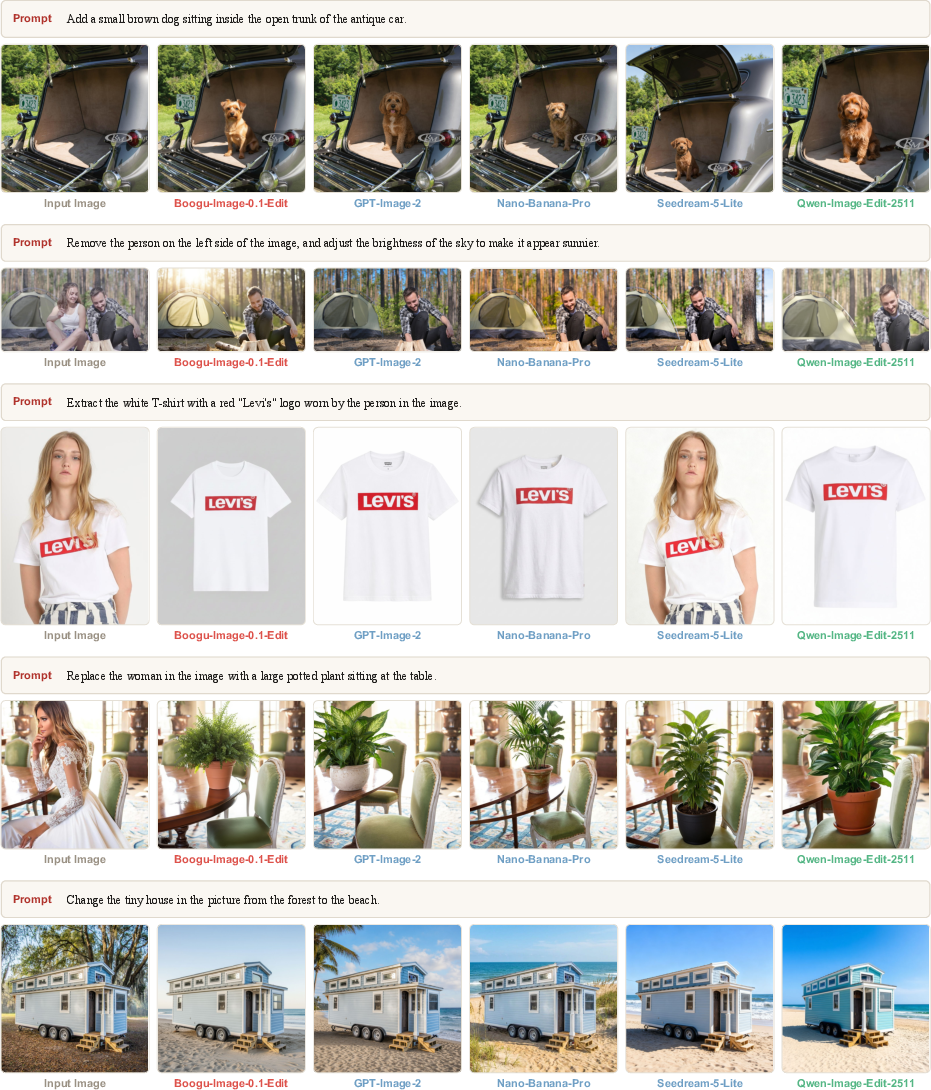
- On ImgEdit-Bench, the Edit-Thinking model achieved the best overall score among compared models (including several closed-source ones), especially on tasks like removing objects and handling mixed or action-style edits.
- The authors caution that automatic scoring can miss subtle visual issues, so human judgment still matters.
- More thinking time, better pictures:
- Spending extra steps at generation time (inference-time scaling) reliably boosts quality—just like taking more time to plan an answer leads to better work.
- Strong results on a tight budget:
- With carefully filtered data and training recipes, they reached near state-of-the-art performance using far fewer images and much less money than typical big-tech training runs.
- Better evaluations for real users:
- They show that some popular academic tests don’t match what people actually like. Their Boogu Arena aligns closely with large-scale human voting, making it more trustworthy for user-facing quality.
Why does this matter?
- Models that truly “get” you:
- The project pushes from simple “text-to-image” toward “requirement-to-image,” where the AI understands complex, real-world requests and turns them into images that match your intent.
- High-quality tools for everyone:
- Because Boogu-Image-0.1 is open-source (Apache 2.0 license), other researchers, startups, and creators can use and improve it—without needing huge budgets.
- Practical progress, not just bigger models:
- The paper shows that smarter understanding, better data, and helpful run-time strategies can beat brute force. That’s good news for innovation and for people who want to build useful AI without massive resources.
- Better ways to measure quality:
- By focusing on human preference and realistic tasks, the authors encourage the community to test models in ways that reflect what people actually want.
In short, Boogu-Image-0.1 is a step toward affordable, open, and genuinely helpful image AIs—ones that listen carefully, plan their work, and deliver images and edits that match your needs, in both English and Chinese.
Knowledge Gaps
Knowledge gaps, limitations, and open questions
Below is a concise, action-oriented list of what remains missing, uncertain, or unexplored in the paper.
- Quantitative ablations are missing to isolate the contribution of each component (stronger text encoder, data curation, training recipe, agentic prompt rewriting, reflection) on human preference and benchmark metrics.
- Training data transparency is limited: sources, licensing status, domain/language/script distribution, filtering criteria (quality, NSFW/PII), deduplication methods, and steps taken to avoid test-set leakage are not specified.
- Compute profile and efficiency are underreported: beyond a “~$400K” theoretical cost, there are no details on hardware (GPU types), GPU-hours, batch sizes, optimizer/schedule, training time, energy use, and carbon footprint—or how cost/quality scale with data/model size.
- Architecture specifics are sparse: parameter counts for Base/Turbo/Edit variants, backbone layers and widths, U-Net/Transformer configurations, VAE choice/final config, tokenizer–image latent coupling, and cross-attention designs are not fully documented.
- Inference-time scaling trade-offs are unquantified: latency, VRAM, throughput, and cost impacts of Base vs Turbo and of agentic steps (prompt rewriting, reflection) are not reported, nor are decision policies for routing under user latency/quality constraints.
- Failure modes of the agentic pipeline are unexamined: prompt drift, over-constraint, loss of style diversity, and cases where reflection harms quality or alignment are not analyzed.
- Safety implications of agentic prompt rewriting are unaddressed: how rewritten prompts are moderated, how safety filters operate, and whether rewriting can inadvertently introduce unsafe content are unclear.
- Boogu Arena generalization is uncertain: the 1,200-prompt, 3-category design may not cover domains such as infographics, charts/diagrams, UI, technical drawings, or highly compositional prompts; no OOD evaluation is provided.
- Statistical rigor of Boogu Arena is unclear: ~4,000 pairwise votes across 9 models may be underpowered; inter-rater reliability, annotator demographics/instructions, compensation, and test–retest repeatability are not reported.
- Seed variance is not controlled: each model is evaluated once per prompt with a single random seed, but no confidence intervals, seed-averaging, or sampling-parameter sensitivity analyses are given.
- Benchmarking gap remains unresolved: while the paper critiques GenEval/DPG and notes LongText-Bench saturation, it does not propose or validate a new automatic metric that better tracks human preference or typography quality.
- Dense text rendering is only partially assessed: there is no metric for typography fidelity (glyph naturalness, kerning, line-breaking, ligatures), font/style diversity, layout aesthetics, or performance vs text length/font size; qualitative claims lack systematic measurement.
- Multilingual scope is narrow: evaluation focuses on Chinese/English; no results for other scripts (Arabic, Devanagari, Cyrillic, Thai, etc.), mixed-script rendering, RTL or vertical text, or code-switched prompts.
- Editing evaluation lacks breadth and human validation: ImgEdit-Bench misses multi-step/multi-region workflows, precise text edits, identity/subject preservation, and reference-guided edits; there is no human preference study for editing despite concerns about VLM-based scoring.
- VLM-evaluator limitations are acknowledged but unaddressed: there is no strategy to calibrate evaluator VLMs to human judgments, reduce evaluator bias/variance, or combine automated and human assessments for more reliable editing/generation evaluation.
- Data governance and ethics are not discussed: PII removal, copyright compliance, dataset documentation (datasheets), and bias audits are absent; provenance tracking and watermarking policies are unspecified.
- Bias, fairness, and representational harms are unstudied: demographic, cultural, and linguistic biases in generated content (including typography) are not measured or mitigated.
- Factual grounding and knowledge integration are open: unlike some closed systems with retrieval/web search, Boogu’s pipeline lacks grounding; whether retrieval improves factual depiction or instruction adherence is unexplored.
- Resolution/aspect-ratio robustness is unclear: Base is optimized for 2K dense text, but behavior at 4K+, non-standard aspect ratios, and scaling laws for fidelity vs resolution are not reported.
- Routing policy for model variant selection is unspecified: the agent’s criteria for choosing Base vs Turbo (or Edit vs Edit-Turbo), features used for routing, and the cost of misrouting are not described or ablated.
- Robustness to challenging inputs is untested: typos, noisy/contradictory prompts, adversarial/jailbreak instructions, extremely long prompts, and ambiguous requirements; no stress tests or robustness metrics are provided.
- Reproducibility may be constrained by data access: code and weights are promised, but without public data or detailed data curation recipes, third parties may not be able to reproduce training or Boogu Arena outcomes.
- Downstream integration is not addressed: how the system interfaces with layout engines, OCR, or vector/text layers to produce editable design assets (raster–vector hybrids) remains open for practical pipelines.
- Environmental impact is unreported: energy accounting for training and agentic inference loops, and strategies for reducing environmental footprint under inference-time scaling, are not provided.
Practical Applications
Immediate Applications
Below are concrete, deployable-now uses that leverage Boogu-Image-0.1’s open weights (Apache 2.0), bilingual text-in-image capability, fast/quality variants (Turbo vs. Base), and agentic inference (prompt rewriting, variant selection, reflection).
- Healthcare
- Patient education materials and clinic signage (EN/ZH)
- Workflow: “Requirement-to-Image” brief → agentic prompt rewriting → Base variant at 2K for dense text posters (dosage, consent forms summaries) → OCR QA pass.
- Assumptions/dependencies: Human review for medical accuracy; content safety filtering; GPU for 2K output; OCR tool for verification.
- Hospital wayfinding and emergency notices
- Tools/products: Bilingual signage generator integrated with hospital CMS.
- Assumptions: Limited to non-diagnostic visuals; verified icon libraries; strict brand and color palettes enforced via templates.
- Education
- Classroom posters, worksheets, and bilingual learning aids
- Workflow: Teacher prompt → Turbo variant for quick ideation; switch to Base for dense text layouts; think-enabled prompt enhancement for precise text placement.
- Assumptions: District safety policies; low-cost GPU or hosted API; teacher approval loop.
- Lecture slides with readable embedded text and diagrams
- Tools/products: Slide add-ins (PowerPoint/Keynote) invoking agentic generation for layout-aware images.
- Assumptions: For critical technical diagrams, human validation remains essential.
- Retail and E‑commerce
- Product hero images and seasonal campaigns
- Workflow: Brand brief → agent rewrites/expands prompt → Turbo for fast variants/A‑B tests; Base for final typography-heavy banners.
- Tools/products: “Boogu Creative Ops” service integrated with DAM/CMS; automated A‑B creative pipeline.
- Assumptions: Brand compliance templates; human creative director sign-off.
- Localization of marketing images (EN/ZH)
- Workflow: Take existing creative → Edit/Thinking model to replace/insert translated text without artifacts.
- Assumptions: Translators provide approved copy; OCR-based regression check.
- Software and Developer Tools
- Design plugins for Figma/Adobe
- Products: “Boogu Design Assistant” plugin providing thinking-based prompt rewriting, model selection (speed vs. quality), and one-click text render QA.
- Assumptions: Plugin sandbox permissions; GPU-backed service or local CUDA device.
- Static site/CMS image generation at build time
- Workflow: CI step triggers Turbo for quick drafts; Base for final assets with text QA before publish.
- Assumptions: Build agents with GPUs; caching/CDN policies for generated assets.
- Media, Entertainment, and Gaming
- Concept art, moodboards, and cinematic frames
- Workflow: Brief → reflection cycles for creative refinement → Turbo for exploration → Base for finals.
- Assumptions: Styleguide constraints; IP/copyright review of prompts/outputs.
- Poster art and title cards with typography accuracy
- Tools/products: PosterBot that enforces typographic grids and renders EN/ZH titles cleanly.
- Assumptions: High-res output pipeline; proofing round.
- Public Sector and Policy Communications
- Rapid creation of bilingual public notices and safety posters
- Workflow: Standardized templates + agentic prompt rewriting to ensure clarity → Base for dense text.
- Assumptions: Accessibility standards (font size/contrast); public information officer approval.
- Open benchmarking for procurement
- Tools/products: “Boogu Arena”-style in-house blind pairwise tests for agency model evaluation aligned to real use prompts.
- Assumptions: Curated, domain-relevant prompt sets; annotator training.
- Manufacturing and Workplace Safety
- Safety signage and SOP posters (with dense text/labels)
- Workflow: Requirement-to-Image brief + Base variant at 2K; OCR check; batch generation for multi-site rollouts.
- Assumptions: Standards compliance (ANSI/ISO icons); EHS officer approval.
- Finance and Corporate Communications
- Investor decks, campaign visuals, and policy announcements
- Workflow: Turbo for ideation; Base for final slides with tight typography; edit model for last-minute copy changes in graphics.
- Assumptions: Compliance review; content archiving/audit logs.
- Daily Life and SMEs
- Small business flyers, menus, event posters (EN/ZH)
- Tools/products: Web app using Turbo for quick turnaround; “upgrade to Base” button for print-quality dense text.
- Assumptions: Basic GPU-backed hosting; built‑in spellcheck/OCR.
- Personal cards, invitations, and social posts
- Workflow: Natural-language editing (add/remove/replace text), style transfer, quick Turbo render.
- Assumptions: User education on prompt clarity; content safety.
- Research and Academia
- Reproducible multimodal research with low training cost
- Use: Baseline for studying text encoders as “language sensors,” inference-time agents (prompt rewriting, reflection), and data quality recipes.
- Assumptions: Access to released weights and recipes; standard GPU nodes.
- Human-preference-aligned evaluation
- Tools/products: Adopt/extend Boogu Arena prompts for course projects and lab evaluations that better correlate with user preference.
- Assumptions: Annotator pools; fairness protocols.
Long-Term Applications
These ideas require further research, scaling, additional languages, or tighter system integration, but are directly inspired by Boogu-Image-0.1’s “Requirement-to-Image” and agentic inference design.
- Healthcare
- Patient-specific visual instructions and multi-step procedural visuals
- Vision: Agent reads clinical brief, sequences multi-panel images with consistent style and accurate text.
- Dependencies: Robust multi-image consistency; domain datasets; strict safety/ethics review; medically verified content.
- Multilingual health communications beyond EN/ZH
- Dependencies: Training for new scripts (Arabic, Devanagari, etc.); OCR validation across languages; typography engines.
- Education
- Auto-generated, curriculum-aligned visual packs (diagrams, annotated images) from lesson plans
- Vision: LLM parses curriculum; image agent generates multi-page sets with per-page rubrics; teacher-in-the-loop.
- Dependencies: Better diagram fidelity and semantic consistency across pages; new evaluation metrics beyond OCR.
- Robotics and Autonomy
- Synthetic background and texture generation for perception training
- Vision: Generate photorealistic, diverse scenes to augment datasets via domain randomization.
- Dependencies: Ground-truth labels; integration with simulators; bias/coverage analysis.
- Software and Product Design
- Document-to-Visual pipeline for PRDs/briefs
- Vision: Read long requirements; generate full sets (hero images, feature callouts) with automatic model selection (Turbo for drafts, Base for finals).
- Dependencies: Strong long-context parsing; layout-aware constraints; brand governance engines.
- Layout-aware, constraint-driven generation
- Vision: Integrate a typographic/layout solver so agents satisfy grids, gutters, and brand tokens natively.
- Dependencies: Differentiable layout constraints; training with structured layout supervision.
- Media, Entertainment, and Gaming
- Consistent character/world style across large sets and iterations
- Vision: Reference-guided, multi-episode/level consistency with iterative reflection.
- Dependencies: Reference preservation; identity/consistency metrics; memory across sessions.
- Public Sector and Policy
- Benchmark standardization and auditability
- Vision: Open, human-preference-correlated evaluation suites replacing saturated benchmarks; procurement-ready protocols with leakage checks.
- Dependencies: Shared prompt banks; governance for annotator bias; transparent reporting standards.
- Authenticity and watermarking for generated public materials
- Vision: Built-in provenance metadata for all outputs.
- Dependencies: Standards alignment (e.g., C2PA); secure pipelines.
- Enterprise Creative Operations
- Autonomous creative agents that manage briefs end-to-end
- Vision: Agent negotiates constraints (budget, latency), schedules Turbo/Base usage, runs reflection, and self-QAs via OCR and brand checks.
- Dependencies: Ops orchestration, RBAC, cost tracking; robust failure modes and human escalation.
- Manufacturing and Technical Communications
- Step-by-step illustrated manuals generated from CAD/technical text
- Vision: Extract steps, render consistent diagrams with numbered callouts and dense captions.
- Dependencies: CAD integration; symbol libraries; higher-fidelity technical illustration capability.
- Finance and Legal
- Compliance-safe visual generation with rule-aware prompts
- Vision: Agent enforces mandated disclosures, font sizes, and risk statements in all visuals automatically.
- Dependencies: Rule engine integration; legal sign-off workflows; verifiable QA checkpoints.
- Multilingual and Accessibility Expansion
- Global signage and public information in many scripts with accessibility guarantees
- Vision: Generate images that satisfy WCAG contrast, minimum font sizes, and screen-reader-describable alt text.
- Dependencies: Script coverage; accessibility validators; new training data for non-Latin scripts.
- Evaluation and Safety Research
- Beyond-OCR metrics for text-in-image quality
- Vision: Benchmarks that capture typography naturalness, artifact detection, and dense layout perceptual quality.
- Dependencies: New perceptual metrics; curated human evaluations; community adoption.
- Cost-Efficient Training and Domain Adaptation
- Replicable, low-cost training in specialized domains (e.g., remote sensing, industrial visual QA)
- Vision: Apply quality-first data curation and training recipe to small domain datasets.
- Dependencies: Domain-specific high-quality data; adapted caption/design pipelines; safety filters per domain.
Notes on feasibility and dependencies across applications:
- Compute: Turbo enables fast iteration on modest GPUs; Base at 2K requires more VRAM. Hosted APIs can abstract this for SMEs.
- Language scope: Strong in English and Chinese; broader language support requires additional training and evaluation.
- Quality vs. speed: Agentic selection (Turbo vs. Base; reflection steps) is central; organizations should codify SLAs for each content class.
- QA and safety: For high-stakes or dense text, integrate OCR checks and human review. Add content safety filters and provenance metadata.
- Legal/IP: Ensure prompt/content compliance with brand and copyright policies; maintain audit logs for enterprise and public-sector uses.
Glossary
- Agentic Image Generation: An approach that wraps a generative model in an agent to interpret instructions and orchestrate generation steps. "We further employ Agentic Image Generation, which injects understanding into generation at inference time"
- agentic inference-time scaling: Spending additional, agent-driven computation at inference to improve output quality. "coupled with agentic inference-time scaling, can substantially enhance generation and editing performance"
- agentic prompt rewriting: Having an agent refine or rewrite the user’s prompt to better capture intent before generation. "First, the agent performs agentic prompt rewriting"
- blind pairwise evaluation: A human evaluation protocol where annotators compare anonymized outputs without knowing model identities. "We conduct a strictly blind pairwise evaluation."
- Bradley-Terry model: A probabilistic model for converting outcomes of pairwise comparisons into a global ranking. "and the collected votes are aggregated into Elo scores via a Bradley-Terry model."
- compositional reasoning: The ability to reason about combinations of objects/attributes and their relations to form coherent scenes. "illustrating compositional reasoning and spatial coherence"
- data contamination: The presence of evaluation items or close variants in training data, inflating reported performance. "Data contamination and test-set leakage are pervasive."
- data curation pipeline: A structured process for selecting, filtering, and preparing high-quality training data. "we design a data curation pipeline that prioritizes quality over quantity with various training optimization strategies."
- dense text rendering: Generating images with large amounts of tightly packed text while maintaining legibility and layout. "dense text rendering under 2K resolution."
- Elo ratings: A system that aggregates pairwise preferences into a numerical score reflecting relative strength. "Pairwise blind votes are aggregated into Elo ratings, where higher scores indicate stronger relative human preference."
- inference-time techniques: Methods applied during generation (not training) to improve results, such as iterative refinement. "Third, it incorporates inference-time techniques such as Reflection to further improve quality."
- instruction-guided image editing: Editing images according to natural-language instructions. "assess instruction-guided image editing across a diverse range of tasks."
- LMArena Elo: A human-preference leaderboard score (Elo-based) widely used to rank generative models. "Agreement between Boogu Arena and LMArena Elo ratings."
- long-form text rendering: Generating images that accurately render lengthy textual content with correct layout and readability. "a benchmark for evaluating long-form text rendering in image generation"
- multimodal understanding: The capability to jointly interpret and integrate information across modalities (e.g., text and images). "an open-source unified multimodal understanding and generation model family"
- OCR-level correctness: A measure of text rendering quality based on whether OCR can correctly read the generated text. "assesses not only OCR-level correctness, but also readability, layout consistency, and whether the generated image preserves the intended textual content and visual structure."
- Pearson correlation: A statistic measuring linear correlation between two variables. "with a Pearson correlation of and a perfect Spearman rank correlation of "
- perceptual metrics: Quantitative metrics aimed at approximating human judgments of visual quality. "we recommend complementing it with human evaluation or perceptual metrics when assessing the overall quality of long-form text rendering."
- prompt alignment: The degree to which a generated image faithfully follows the given prompt. "focusing on visual fidelity, prompt alignment, composition, and aesthetic quality."
- prompt sensitivity: The susceptibility of model outputs to changes in prompt wording or structure. "We attribute this to the high prompt sensitivity of text generation"
- Reflection: An inference-time self-critique/iteration technique used to refine generation outputs. "inference-time techniques such as Reflection to further improve quality."
- Requirement-to-Image Generation: A paradigm where models interpret complex user requirements (beyond simple prompts) to generate images. "evolving from Text-to-Image toward Requirement-to-Image Generation."
- SANA-VAE: A specific variational autoencoder-based configuration used in ablations and benchmarks. "on GenEval, a SANA-VAE configuration of our model reaches 0.92"
- Spearman rank correlation: A nonparametric statistic measuring monotonic rank relationships between variables. "and a perfect Spearman rank correlation of "
- SOTA: Acronym for “state of the art,” referring to the best-performing methods at a given time. "existing SOTA models on dense text rendering under 2K resolution."
- test-set leakage: Inclusion of test data (or close variants) in training, compromising evaluation validity. "Data contamination and test-set leakage are pervasive."
- text encoder: The component that converts textual input into representations suitable for conditioning the generator. "We regard the text encoder as the sensor for language"
- text-to-image (T2I) generation: Creating images conditioned on textual prompts. "Scaling the inference time leads to higher text-to-image (T2I) generation quality"
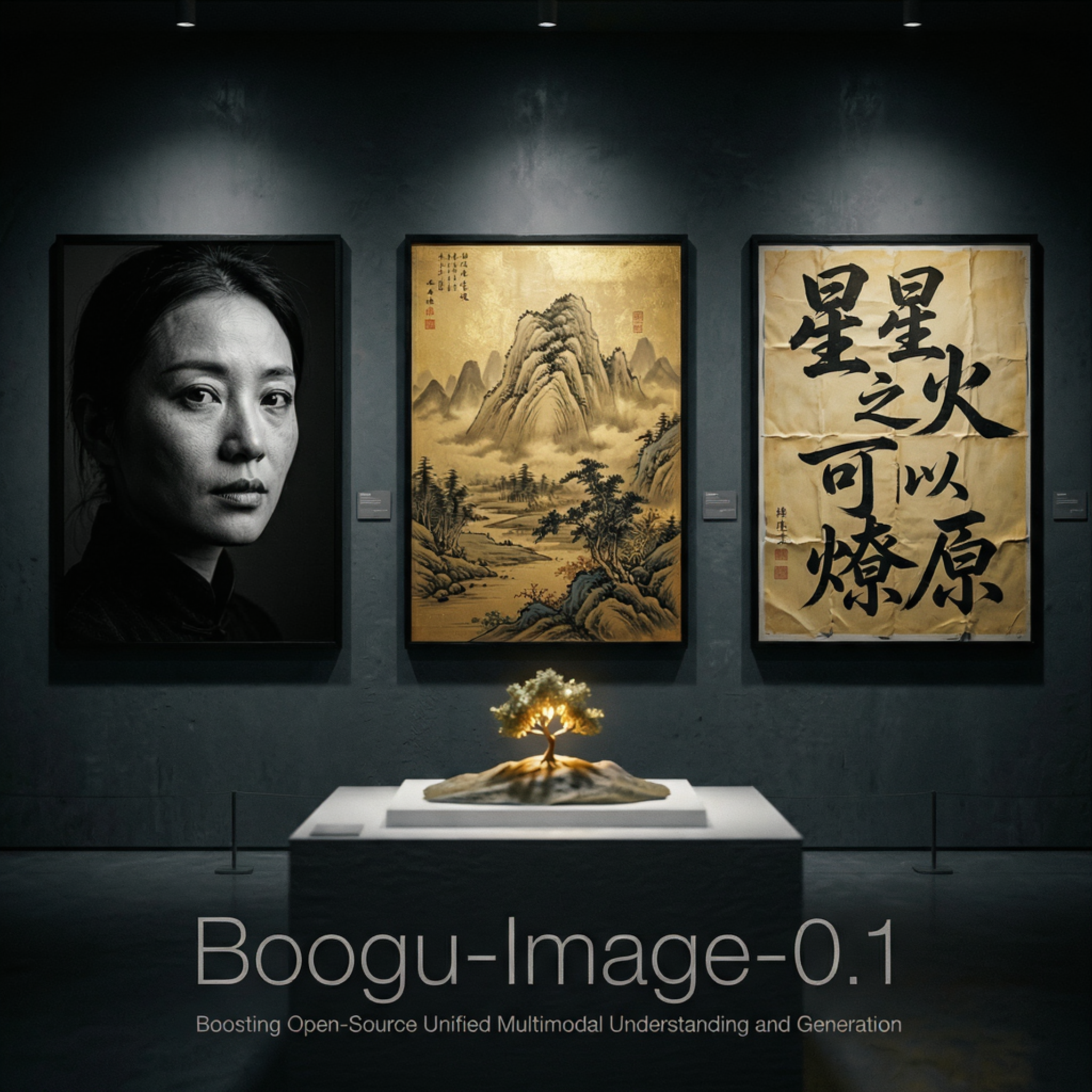
- typographic poster: A design emphasizing the aesthetic arrangement of text as the primary visual element. "a typographic poster rendering Chinese calligraphy ``A single spark can start a prairie fire'' with accurate stroke structure and layout"
- typography: The art and technique of arranging type to make text legible and visually appealing. "can accurately render English and Chinese texts with coherent typography and delicate layout design."
- user persona: A stylized user profile used to condition prompt style/complexity during evaluation or data generation. "The second is user persona, covering 27 roles across novice, intermediate, and professional tiers"
- Vision-LLMs (VLMs): Models that jointly process visual and textual inputs for understanding or evaluation. "relies primarily on Vision-LLMs (VLMs) as automated evaluators"