- The paper demonstrates that high-fidelity audio reconstruction is achieved via a continuous VAE that compresses 24 kHz signals to a 12.5 Hz latent sequence, yielding a 1920× reduction in temporal resolution.
- The model leverages causal convolutional encoders, windowed Transformer modules, and multi-discriminator adversarial losses to balance aggressive compression with practical quality across various audio domains.
- The optimized encoder throughput, with a 3.62× speedup, facilitates efficient integration in text-to-audio pipelines and larger training batches, setting a new operational standard for audio generation.
Qwen-Audio-VAE: Low-Bitrate, High-Fidelity, Fast Autoencoding for General Audio Generation
Model Design and Architectural Innovations
Qwen-Audio-VAE introduces a continuous VAE framework tailored for scalable general audio generation via three core objectives: high-fidelity reconstruction across diverse domains, extremely compact latent representation, and high-throughput encoding suitable for online training pipelines. The model’s architecture leverages a causal convolutional encoder-decoder, pre- and post-bottleneck windowed Transformer blocks, and multi-discriminator adversarial supervision, achieving substantial reductions in bitrate and latency without sacrificing reconstruction quality. The encoder downsamples 24 kHz waveforms first to 50 Hz and then to a 12.5 Hz latent sequence (128d Gaussian), enabling a 1920× reduction in temporal resolution compared to the original signal. This achieves significant latent compression, which directly benefits transformer-based diffusion pipelines, as DiT self-attention cost scales quadratically in sequence length.
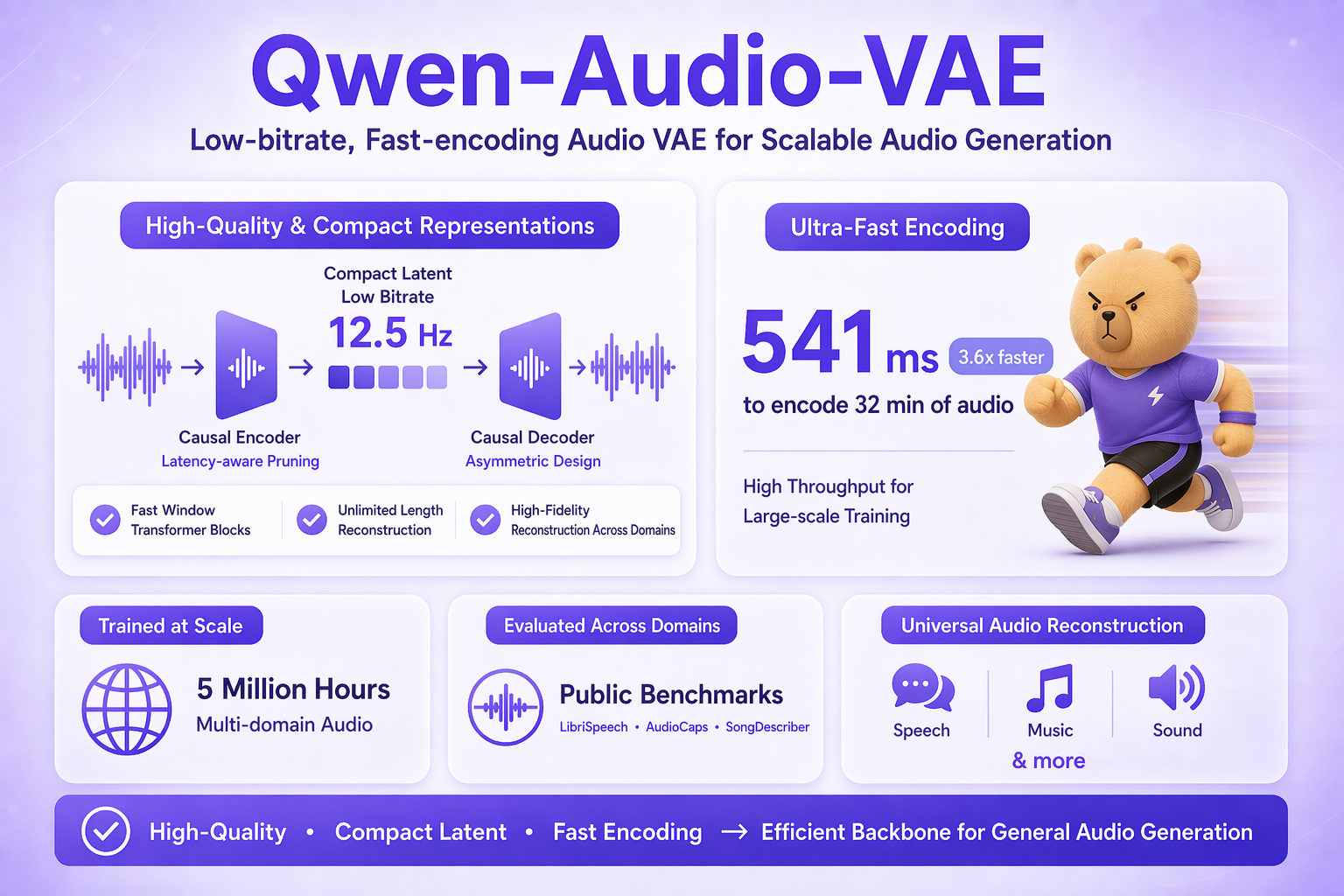
Figure 1: Qwen-Audio-VAE achieves low-bitrate, high-fidelity reconstruction and can encode 32 minutes of audio in 541 ms, supporting efficient general audio generation.
To ensure that extremely compressed representations do not lose critical audio content, Qwen-Audio-VAE employs two windowed Transformer modules (8 layers, 16 heads, window size 72) at the lowest frame rate (12.5 Hz). In addition, the asymmetric design dedicates more capacity to the decoder, leveraging the fact that decoding lies outside the critical path for large-scale latent extraction. Four discriminators (multi-period, multi-resolution STFT, multi-scale STFT, and sub-band CQT) jointly enforce realistic, artifact-free outputs across speech, music, and general environmental sounds.
Large-Scale Data Pipeline and Corpus Design
The model is trained on a five-million-hour corpus spanning speech (~3M h), music (~1.3M h), and sound (~0.8M h), ensuring robustness to diverse acoustic conditions and preventing overfitting to narrow domains. The data pipeline incorporates explicit validation stages: accessibility, duration, decode/sample-rate, and content-quality checks, with abnormal samples either filtered or down-weighted. This approach prevents silent contamination by corrupted or mislabeled data and maintains domain balance. Samples are packed into tar shards with offset-based reading, further improving I/O throughput for distributed GPU training.

Figure 2: The Qwen-Audio-VAE data pipeline organizes and filters multi-domain audio, increasing training throughput from 0.90 to 1.07 it/s, essential for large-scale learning.
Encoder Throughput Optimization
Encoder latency, not decoding, determines scalability in generative pipelines. Qwen-Audio-VAE optimizes latency through stride re-allocation, residual-unit pruning, and selective channel reduction of the highest-resolution encoder layer. Profiling identified the first convolution as the major latency contributor; reducing its channel count alone enabled a 3.62× speedup (1957 ms → 541 ms for 64×30 s clips) with negligible impact on objective fidelity metrics. These improvements allow 4× larger batches during text-to-audio training and substantially higher throughput without quality degradation, a practical advantage for large-scale generative model development.
Reconstruction Quality Across Benchmarks
Extensive evaluation on LibriSpeech (speech), AudioCaps (sound), and SongDescriber (music) demonstrates that Qwen-Audio-VAE is the strongest low-frame-rate system (12.5 Hz) on all metrics: Mel distance, MR-STFT, PESQ, and STOI. Latent sequence length is significantly reduced compared to prior VAEs and discrete codecs (20–75 Hz), directly benefiting downstream transformer training cost. Notably, high-frame-rate codecs achieve marginally higher raw fidelity, but require $4$–6× longer latent sequences—a crucial trade-off for practical generative task scaling.
A qualitative spectrogram analysis shows that Qwen-Audio-VAE preserves harmonic structure and high-frequency texture close to ground truth, even with lower latent frame rate, compared to prior baselines such as Stable Audio Open (20 Hz).
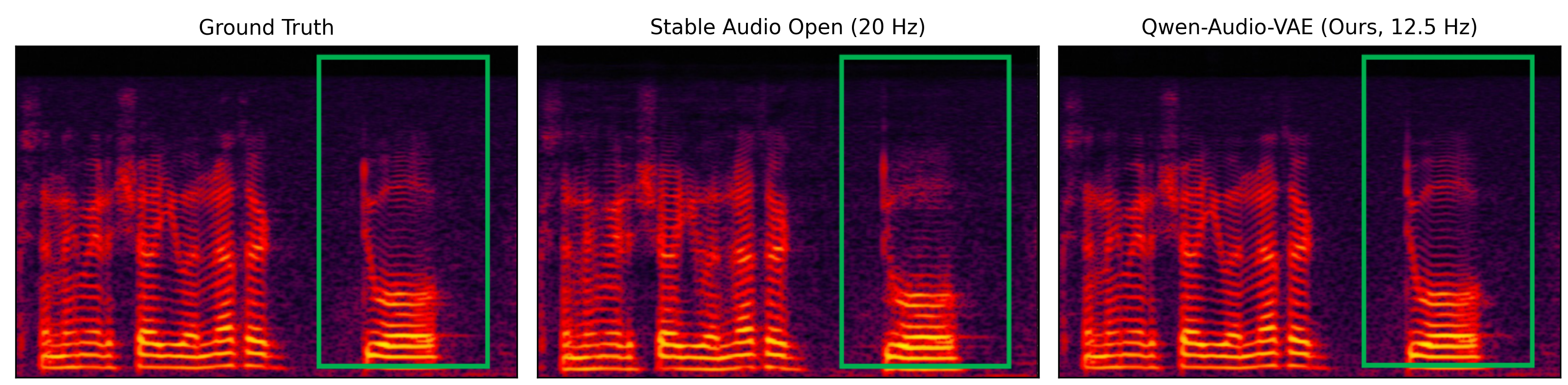
Figure 3: Qwen-Audio-VAE (12.5 Hz) preserves high-frequency harmonics and structure nearly as well as ground truth, outperforming Stable Audio Open (20 Hz) on detail retention.
Ablation reveals that the encoder-side window Transformer is critical under aggressive compression; removing it increases Mel distance and reduces intelligibility. Latent dimension reduction negatively affects reconstruction, and increased decoder capacity cannot fully compensate for reduced latent informativeness. A 50 Hz variant improves metric scores but increases downstream sequence length and cost, illustrating the efficiency–quality trade-off.
Integration with Text-to-Audio Pipelines
Fast encoding and low frame rate combine to allow larger training batches and reduce wall-clock time in transformer-based text-to-audio systems. Empirical results show that after encoder acceleration, the same diffusion transformer model achieves a higher CLAP score (0.33 vs. 0.29) on AudioCaps and processes 4× as much audio per step compared to the unoptimized variant. Comparisons with Stable Audio Open reveal that Qwen-Audio-VAE is not only faster but also yields higher downstream generation quality. Increased KL regularization degrades generative metrics (FD, IS, CLAP score), indicating that latent density and informativeness are essential for transformer learnability; aligning latents with pretrained representations (e.g., CLAP/Omni) is identified as a future path.
Theoretical and Practical Implications
Qwen-Audio-VAE demonstrates that practical autoencoder design for general audio generation requires simultaneous optimization across reconstruction quality, latent compression, encoding throughput, and data scalability. The model’s success validates aggressive temporal downsampling coupled with attention-based aggregation, domain-balanced training, explicit I/O optimization, and multi-domain adversarial objectives. The practical impact is seen both in benchmark fidelity and in the integration efficiency of large-scale text-to-audio pipelines, establishing an operational standard for representational backbones in multimodal generative systems.
Future directions include latent-pretrained audio representation alignment, further improvements in high-frequency and transient signal recovery, refined data stratification methodologies, and scaling validation on even larger generative datasets. The Qwen-Audio-VAE framework can serve as a baseline for future research in audio representation learning, compression, and multimodal generative modeling.
Conclusion
Qwen-Audio-VAE sets a new standard for continuous autoencoding in scalable audio generation. Through innovations in architecture, data pipeline design, and encoder latency optimization, it achieves high-fidelity reconstruction across speech, music, and sound domains at a compact 12.5 Hz latent frame rate. Its operational efficiency directly improves text-to-audio training throughput and autoregressive modeling cost, making it a foundational backbone for multimodal systems. The paper emphasizes that joint optimization of quality, compression, speed, and learnability is critical, and future development should extend these principles for broader generative tasks and improved representational capacity.
(2607.11738)