Gamma-World: Generative Multi-Agent World Modeling Beyond Two Players
Abstract: World models for interactive video generation have largely focused on single-agent settings, where future observations are generated from a single control signal. However, many generated environments require multi-agent interaction: multiple players, robots, or embodied agents act simultaneously within a shared space. Scaling world models to such settings requires a principled multi-agent design: agents should remain independently controllable, permutation-symmetric, and support efficient inference while maintaining consistency across time and perspectives. In this paper, we present our generative multi-agent world model for interactive simulation. It introduces Simplex Rotary Agent Encoding, a parameter-free extension of 3D RoPE that represents agents as vertices of a regular simplex in rotary angle space. This gives each agent a distinct phase while making all agents permutation-equivalent, enabling scalable agent identity without learned per-slot identities or a fixed agent ordering. To avoid dense all-to-all attention across agents, we further propose Sparse Hub Attention, where learnable hub tokens mediate token interaction across agents, reducing cross-agent attention cost from quadratic to linear in the number of agents. For real-time rollout, we distill a full-context diffusion teacher into a causal student that generates temporal blocks sequentially with KV caching, enabling action-responsive generation at 24 FPS. Experiments in multiplayer virtual environments show that our model improves video fidelity, action controllability, and inter-agent consistency over slot-based and dense-attention baselines, while generalizing from two to four players without additional training.
Paper Prompts
Sign up for free to create and run prompts on this paper using GPT-5.
Top Community Prompts
Explain it Like I'm 14
What is this paper about?
This paper introduces Gamma-World, a new kind of “world model” that can generate short videos of a shared world where several players or robots act at the same time. Think of it like an AI-powered game engine: you tell each player what they do next, and the model predicts what all players will see, keeping everything in sync and consistent from every viewpoint. The goal is to make this work not just for two players, but for many, and fast enough to feel real-time.
The big questions the researchers asked
- How can we give each player a unique identity without making any player “special” or tied to a fixed slot?
- How can players share information about the world with each other efficiently, without everyone talking to everyone all the time?
- Can the model run fast enough to react to new actions in real time (like a game), not just produce pretty videos offline?
- Will a model trained on two players still work well with more players (like four) without retraining?
- Can it keep the different camera views consistent, so everyone “sees” the same world changing together?
How the approach works (in everyday terms)
Gamma-World is built around three main ideas. You can think of them with simple analogies:
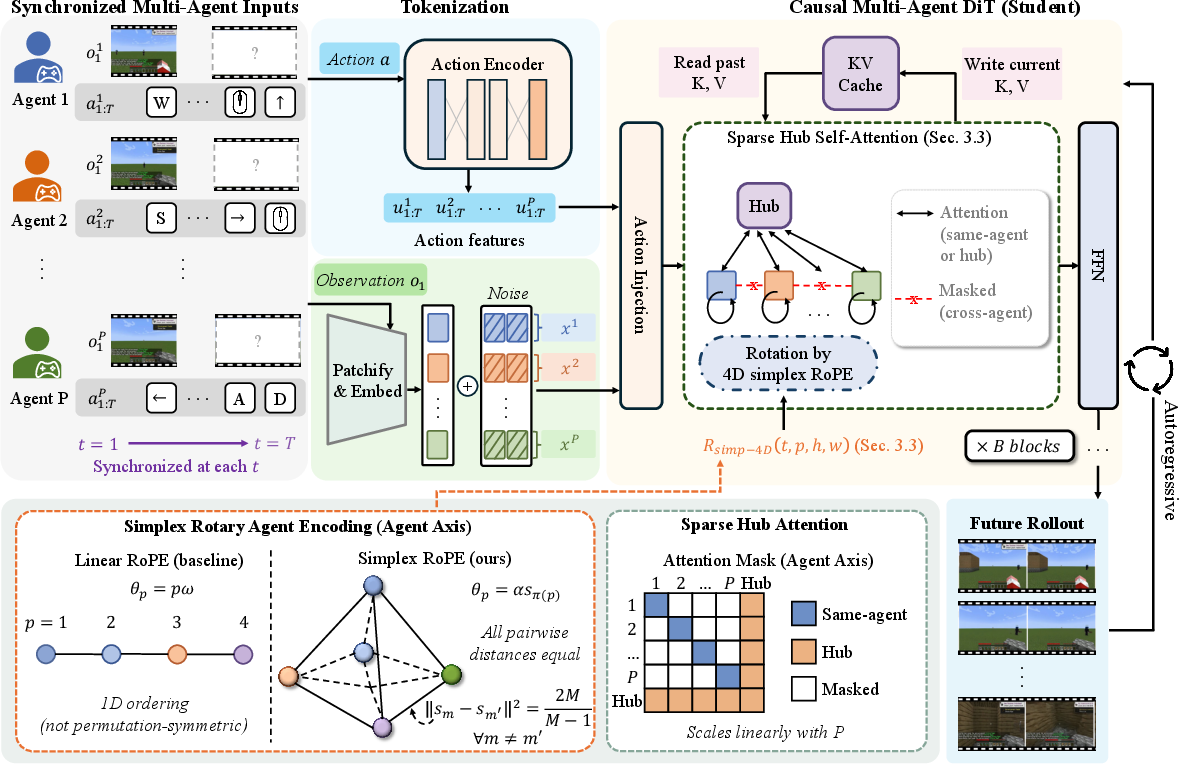
1) A shared “game engine” that watches actions and predicts the next frames
- The model takes in the recent video and the actions of each player (like move, jump, look around).
- It then predicts the next frames for every player’s camera view, keeping them synchronized, so what one player does shows up correctly in what others see.
2) Fair, slot-free player identities: Simplex Rotary Agent Encoding
- Problem: If you label players as “Player 1,” “Player 2,” etc., the model can accidentally learn that a certain slot always behaves a certain way. That makes it hard to add new players later.
- Solution: Imagine placing each player at a corner of a perfectly balanced shape (like the corners of a triangle, tetrahedron, etc.) so every player is equally distant from every other. This gives each player a unique “phase” (a kind of ID), but no one is special and the order doesn’t matter.
- Why this helps: The model treats players as interchangeable but distinct. It doesn’t memorize specific slots, so it can scale to more players without changing its architecture or relearning identities.
3) Efficient “group chat” instead of everyone talking to everyone: Sparse Hub Attention
- Problem: If every player’s video tokens (small pieces of the image) talk to every other player’s tokens, cost grows fast (it’s like every student calling every other student every time—very noisy and slow).
- Solution: Add a small set of “hub” tokens—think of them as a shared bulletin board. Each player talks to the hub, and the hub shares the important info back. This keeps everyone coordinated without massive chatter.
- Why this helps: Communication cost grows slowly as you add players, instead of exploding. It still keeps the world consistent across players.
4) Real-time speed via a teacher–student setup and memory
- A powerful but slower “teacher” model learns high-quality generation.
- A faster “student” model learns from the teacher and is trained to generate the world step-by-step, using memory (KV caching) to remember what already happened.
- Result: The student can react to new actions and generate video blocks at around 24 frames per second, like a smooth game.
What they found and why it matters
- Better quality and control: Compared to other methods (like ones that glue all views together or that use dense all-to-all attention), Gamma-World makes sharper, more consistent videos and follows player actions more reliably.
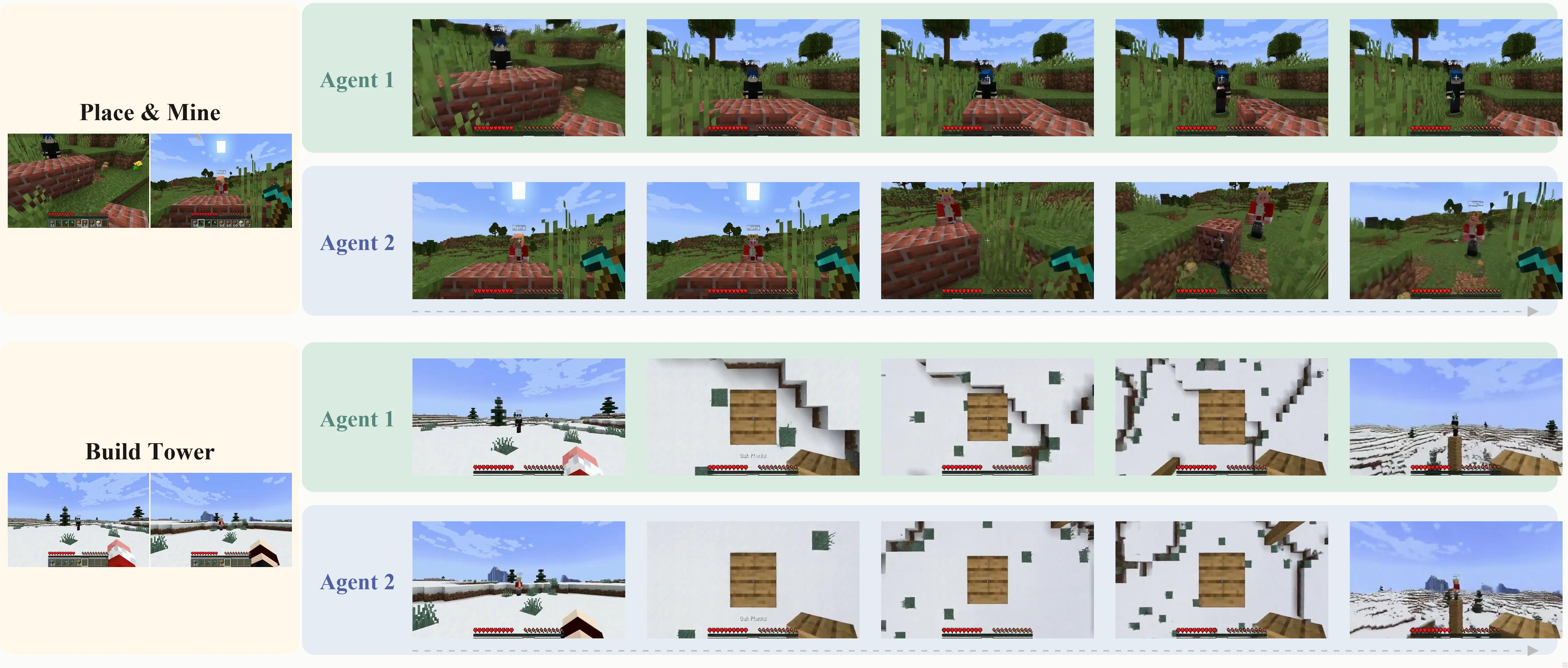
- Strong cross-view consistency: If one player moves or changes the world (like mining or building), the change shows up correctly in the other player’s view.
- Scales beyond two players: Even when trained on two-player data, the model can handle four players without extra training, thanks to the fair identity system.
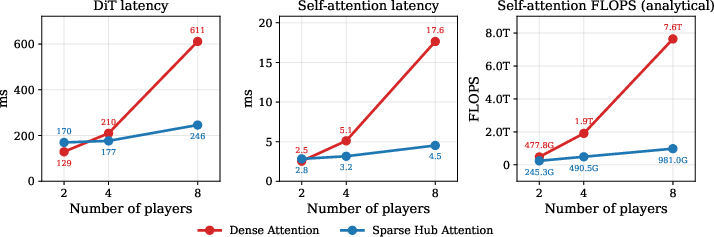
- Faster and more efficient: The hub-based communication cuts the cost of multi-player interaction, making it much more practical as the number of players grows.
- Not just games: The same ideas work for real-world robotics, like two robot arms coordinating—showing the approach can generalize beyond virtual worlds.
What this could mean in the future
- Multiplayer simulation: Tools that simulate many players in a shared world could help build and test games, create training environments for AI, or power interactive content creation.
- Robotics teamwork: Coordinated robots (like two arms working together) could be simulated and trained with realistic, synchronized views and actions.
- Easier scaling: Because player identities are fair and slot-free, developers could add more players without redesigning the model.
- Real-time interactivity: Being able to run at video frame rates means these models could power interactive demos, rapid prototyping, or live agent testing.
In short, Gamma-World shows how to fairly represent many players, let them communicate efficiently, and run fast—pushing beyond two-player setups toward richer, more practical multi-agent worlds.
Knowledge Gaps
Knowledge gaps, limitations, and open questions
Below is a consolidated list of concrete gaps and open questions that remain unresolved and could guide future research.
Modeling and representation
- Quantify how the number of hub tokens K must scale with the number of agents P, spatial token count L, and block length n to avoid information bottlenecks; derive or fit empirical scaling laws and failure thresholds.
- Study the limits of Simplex Rotary Agent Encoding with respect to the agent-band size d_p and simplex pool size V (since V ≤ d_p/2 + 1); characterize performance and identity separability as V increases, and identify when larger rotary bands or hierarchical schemes are necessary.
- Conduct sensitivity analyses of the simplex phase scale α and partitioning of RoPE bands (especially when reallocating temporal low-frequency dimensions via ReRoPE) on temporal coherence and identity disentanglement.
- Extend the representation to heterogeneous agents (different embodiments, action spaces, or roles) while preserving exchangeability within types; e.g., type-conditioned simplexes or mixtures of simplexes.
- Formalize and test identity persistence under dynamic roster changes (agents joining/leaving mid-rollout), including how vertices are allocated/freed and how persistent mapping π is maintained for long sessions.
- Provide end-to-end invariance tests to verify that permutation symmetry is actually preserved by the full architecture (including hubs and action conditioning), not just the agent encoding layer.
- Evaluate model behavior under partial observability and persistent occlusions; test whether the latent “shared world” remains consistent without direct cross-view evidence for long intervals.
Attention and communication topology
- Characterize when hub-mediated two-hop communication degrades coordination compared to dense pairwise attention (e.g., tight, fast inter-agent couplings); quantify the latency and fidelity of cross-agent signaling via hubs.
- Explore dynamic or adaptive hub capacity (e.g., per-layer/per-frame routing, learned K, or sparsity schedules) versus fixed K; compare to multi-hub hierarchies (global + local hubs) and spatially localized hubs.
- Analyze information content and interpretability of hub states (what do hubs aggregate and broadcast?); perform attention/representation probing and causal interventions on hub tokens.
- Compare the proposed Sparse Hub Attention to alternative permutation-equivariant or sparse topologies (e.g., Deep Sets-style pooling, graph/message-passing layers, or equivariant transformers) on the same benchmarks.
Training and distillation
- Quantify teacher–student mismatch due to replacing dense bidirectional cross-agent attention with hub-mediated causal attention; measure cross-agent consistency loss after distillation and assess mitigation strategies.
- Specify and ablate the number of denoising steps used in the few-step student; study quality/latency trade-offs and exposure bias over long rollouts.
- Evaluate curriculum strategies for training across varying agent counts (mixtures of P during training) versus training only on two agents; test whether this improves zero-shot scaling to P > 4.
- Provide training-time compute and memory profiles (vs dense cross-agent baselines) to clarify the total cost of the proposed design, not just inference efficiency.
- Investigate robustness of conditional distillation when actions are out-of-distribution (OOD), delayed, or contradictory across agents; test stability of self-rollouts under action perturbations.
Action conditioning and controllability
- Develop and report explicit action-controllability metrics: e.g., action-conditioned success rates, response latency (in frames) to action changes, and correlation/causal effect of actions on predicted outcomes.
- Compare the current additive action bias design to stronger conditioning mechanisms (cross-attention, FiLM-style modulation, or token-level conditioning) and measure effects on responsiveness and fidelity.
- Support asynchronous actions/observations across agents (variable frame rates, missing frames, or jitter) with an appropriate masking/sampling strategy; evaluate on datasets with unsynchronized streams.
Evaluation breadth and metrics
- Define and publish precise protocols for the “Memory,” “Grounding,” “Movement,” “Building,” and “Consistency” categories (currently ambiguous), including task specifications, metrics, and reproducible code.
- Introduce multi-view geometric consistency metrics (e.g., epipolar consistency, pose/depth agreement across views) and evaluate 3D coherence across agents’ perspectives.
- Evaluate long-horizon stability at scales beyond 24 frames/seconds (multi-minute rollouts): quantify drift, object identity switches, and temporal inconsistency accumulation; test loop-closure or corrective mechanisms.
- Validate on games and environments beyond Minecraft-style worlds (e.g., first-person shooters, driving simulators, physics sandboxes) to assess generality and domain shift robustness.
- Assess performance for larger populations (P ≥ 6–8) with quality metrics, not just FLOPs/latency, to determine the practical limits of hub-mediated scaling.
- For robotics, report task-centric metrics (e.g., contact realism, constraint satisfaction, bimanual coordination success) and closed-loop control performance when using the world model as a simulator.
Geometry and physics
- Incorporate explicit 3D inductive biases (camera calibration, multi-view geometry, or differentiable scene representations) and assess their impact on cross-view consistency and physical plausibility.
- Add physical constraints or differentiable physics priors to reduce long-horizon artifacts (e.g., momentum conservation, collision handling); measure improvements in stability and realism.
Scalability and deployment
- Characterize KV cache memory growth and latency over very long rollouts; explore cache compression, eviction, or segment-level summarization to bound memory while preserving context.
- Study failure modes and recovery in streaming settings (e.g., detect inconsistencies, reset/realign hubs, or recondition from recent observations) and measure recovery effectiveness.
- Investigate hierarchical or spatially partitioned hubs for dense-crowd scenes and large maps, where a single global hub may be insufficient.
Reproducibility and data
- Release detailed dataset generation scripts, splits, and preprocessing (synchronization, action alignment), or evaluate on public multi-agent datasets to enable reproducible comparisons.
- Provide ablations on data scale and diversity (sample efficiency), including performance curves under reduced data and synthetic-to-real generalization tests.
Ethics and safety
- Analyze potential safety issues in interactive simulation (e.g., harmful content, biased behavior across agent roles) and propose safeguards, filters, or auditing procedures for deployment contexts.
Practical Applications
Immediate Applications
Below are concrete, deployable use cases that can be stood up with moderate integration effort, leveraging the paper’s simplex rotary agent encoding, sparse hub attention, and the distilled 24-FPS causal world model.
- Multiplayer game QA and prototyping (Gaming/Software)
- Potential tools/workflows: Gamma-World SDK or Unreal/Unity plugin to load synchronized multi-player traces, perturb actions, and visually validate inter-agent consistency, occlusions, collisions, and scripted events.
- Assumptions/Dependencies: Access to synchronized multi-agent action/observation logs; per-title control/action mapping; GPU inference capacity; engine integration.
- Automated netcode and latency robustness testing (Gaming/Software)
- Potential tools/workflows: CI pipeline that replays recorded multi-player sessions through the real-time model with synthetic jitter/packet loss to probe desync, reconciliation, and lag-compensation edge cases.
- Assumptions/Dependencies: Accurate modeling of input latency/jitter; representative action traces; the video model’s lack of explicit physics may require complementary checks.
- Multi-agent RL rollouts and dataset augmentation (Academia/AI)
- Potential tools/workflows: Gym-like wrapper to generate action-conditioned multi-agent trajectories for offline RL, imitation learning, and model-based planning benchmarks with permutation-symmetric agents.
- Assumptions/Dependencies: Sim-to-real or sim-to-policy gap; careful off-policy evaluation; domain-specific reward/state extraction from generated videos.
- Bimanual robot teleoperation preview and training data (Robotics)
- Potential tools/workflows: ROS2 node providing near-term predictive frames conditioned on proposed left/right-arm commands; data engine to augment bimanual manipulation datasets with consistent multi-view rollouts.
- Assumptions/Dependencies: Camera/lens calibration and time sync; stable mapping from robot actions to visual observations; safety guardrails for operator-facing overlays.
- Small-team multi-robot “what-if” visualizations (Robotics/Warehousing/Manufacturing)
- Potential tools/workflows: Operations dashboard to visualize the next few seconds of coordinated maneuvers (2–4 robots) around shared objects/aisles, given planned action blocks.
- Assumptions/Dependencies: Site-specific datasets; alignment between robot state/action spaces and the model’s action encoder; physics-light predictions may need collision checks.
- Multi-camera short-horizon scene prediction (Automotive/Autonomy R&D)
- Potential tools/workflows: In-lab tool to predict synchronized multi-view camera feeds under alternative ego or agent actions during scenario triage and post-mortem analysis.
- Assumptions/Dependencies: Access to synchronized multi-camera, multi-agent datasets; safety-critical deployment not advised without physics and guarantees.
- Multi-character blocking and previs (Media/VFX/Virtual Production)
- Potential tools/workflows: DCC plugin to rapidly explore multi-character beats across consistent camera views; visualize choreography before costly motion capture.
- Assumptions/Dependencies: Domain stylization or fine-tuning; mapping from high-level action cues to per-agent control signals.
- Low-bandwidth spectator and replay tools (Gaming/Esports)
- Potential tools/workflows: Server streams compact action traces; client reconstructs multi-view spectator feeds via the real-time model for “what-if” and alternate-angle replays.
- Assumptions/Dependencies: Reliability of action-conditioned reconstruction; latency and compute budget on client devices; content IP/licensing constraints.
- Teaching labs for multi-agent dynamics (Education/Research)
- Potential tools/workflows: Interactive notebooks demonstrating exchangeability/permutation symmetry, hub-mediated communication, and controllability via actions.
- Assumptions/Dependencies: Modest GPU availability; curated demonstration datasets.
- Model components as reusable building blocks (Software/ML Tooling)
- Potential tools/workflows: Drop-in modules for Simplex Rotary Agent Encoding (order-free identity) and Sparse Hub Attention (linear-in-agents attention) in existing Transformer/DiT codebases.
- Assumptions/Dependencies: Proper rotary band partitioning; choice of hub-token count K and simplex-pool size V; backward compatibility with existing training setups.
Long-Term Applications
These opportunities require further research, scaling, or domain adaptation (e.g., more agents, stronger physics, safety assurances, or new datasets).
- Crowd-scale multi-agent world models (Urban Planning/Public Safety/Events)
- Potential tools/workflows: City/block-level digital twins with dozens to hundreds of exchangeable agents (pedestrians, micro-mobility) using hierarchical hubs and larger simplex pools.
- Assumptions/Dependencies: Scalable training data and compute; hierarchical attention; robust evaluation of emergent behavior; governance for public deployment.
- Fleet-level coordination and closed-loop planning (Robotics/Logistics/Factories)
- Potential tools/workflows: Planner-in-the-loop “lookahead” visual simulation for multi-robot fleets; coupling with task/trajectory optimizers to reduce conflicts and idle time.
- Assumptions/Dependencies: Tighter integration with physics, control, and safety monitors; closed-loop stability; certification requirements.
- Client-side predictive rendering for latency masking (Gaming/Consumer Devices)
- Potential tools/workflows: On-device few-step causal generator predicting near-term frames to hide network latency in co-op and PvP matches.
- Assumptions/Dependencies: Efficient mobile model distillation; power/thermal budgets; guardrails to prevent visual mispredictions from affecting gameplay fairness.
- Autonomous driving and ADAS certification aids (Automotive/Policy/Safety)
- Potential tools/workflows: Standardized multi-view, multi-agent scenario banks and predictive rollouts to stress-test perception/planning stacks before road testing.
- Assumptions/Dependencies: Regulator acceptance; physics-grounded validation; clear provenance and coverage metrics; liability considerations.
- Sports analytics and broadcast “predictive multicam replays” (Media/SportsTech)
- Potential tools/workflows: Action-conditioned reconstructions and short-horizon predictions across broadcast camera arrays for tactics exploration and storytelling.
- Assumptions/Dependencies: Training on multi-camera, player-tracked data; mapping from estimated actions/intent to model controls; athlete privacy.
- Multi-user AR/VR telepresence with action-stream transport (XR/Communications)
- Potential tools/workflows: Transmit per-user actions/poses and reconstruct synchronized multi-user views at the edge; shared hub state compresses cross-user context.
- Assumptions/Dependencies: Extremely low-latency edge inference; identity/appearance conditioning; privacy-preserving pipelines and consent.
- Surgical and industrial multi-arm assistance simulators (Healthcare/Robotics)
- Potential tools/workflows: Training and rehearsal with coordinated multi-arm predictions; what-if exploration of tool trajectories and handoffs.
- Assumptions/Dependencies: High-fidelity domain data; stringent safety and validation; integration with kinematics/force models.
- Multi-camera surveillance forecasting and incident triage (Public Safety/Operations)
- Potential tools/workflows: Consistent short-horizon predictions across camera network views to aid operator triage and resource allocation.
- Assumptions/Dependencies: Strong governance, auditing, and privacy guarantees; bias and misprediction risk management; legal compliance.
- Generative data engines for multi-agent training corpora (AI/Data Platforms)
- Potential tools/workflows: Scalable, controllable synthesis of multi-agent, multi-view episodes to pretrain perception and policy models.
- Assumptions/Dependencies: Distribution shift management; clear labeling of synthetic provenance; legal/IP clearance for downstream use.
- Standardized benchmarks and eval suites for multi-agent world models (Academia/Policy)
- Potential tools/workflows: Open datasets and metrics focused on cross-view consistency, permutation symmetry, controllability, and scaling beyond two agents.
- Assumptions/Dependencies: Community adoption; reproducible protocols; shared tooling for evaluation at scale.
Glossary
- 3D RoPE: A three-dimensional Rotary Position Embedding that injects relative temporal and spatial positions into attention by rotating queries and keys across time and space. "Video diffusion transformers commonly use 3D RoPE~\cite{rope} to inject relative position into self-attention by rotating query and key features along factorized temporal and spatial axes."
- AdaLN-LoRA: A lightweight adaptation mechanism combining adaptive layer normalization with low-rank adapters to efficiently fine-tune large transformers. "and AdaLN-LoRA of rank $256$."
- action-conditioned: A generative modeling setup where future observations are predicted in response to explicit action inputs. "We consider the problem of synchronized action-conditioned multi-agent video generation."
- autoregressive generation: A generation process where outputs are produced sequentially, each conditioned on previously generated content. "To enable autoregressive generation, Self-Forcing~\cite{huang2025self} combines Diffusion Forcing~\cite{chen2024diffusion} with block-causal attention."
- autoregressive self-rollout: Training or inference that feeds a model’s own generated outputs back as inputs over time to match deployment conditions. "We train the few-step student under autoregressive self-rollout: generated blocks are written to the KV cache and reused as history for subsequent blocks, matching the inference-time rollout distribution."
- bidirectional teacher: A training-time model that attends to both past and future tokens to provide high-quality supervision. "We first train a bidirectional teacher for high-quality conditional denoising."
- block-causal attention: An attention scheme where tokens attend bidirectionally within a block but only to past blocks overall, enabling streaming. "Self-Forcing~\cite{huang2025self} combines Diffusion Forcing~\cite{chen2024diffusion} with block-causal attention."
- Causal student: A deployment model restricted to causal (past-only) information flow for real-time generation, often distilled from a stronger teacher. "the causal student uses KV caches for past visual tokens and hub states to preserve block-causal generation while scaling efficiently with the number of agents (\S\ref{sec:causal-distillation})."
- DiT (Diffusion Transformer): A transformer architecture tailored to diffusion models for image/video synthesis in latent space. "$ takes synchronized observations and actions from multiple agents as input, tokenizes each agent stream with shared visual and action encoders, and generates future multi-agent rollouts with a causal multi-agent DiT."
- Diffusion Forcing: A training strategy that adapts teacher forcing to diffusion models by conditioning on mixtures of clean and noisy targets during block-causal training. "Self-Forcing~\cite{huang2025self} combines Diffusion Forcing~\cite{chen2024diffusion} with block-causal attention."
- Distribution Matching Distillation (DMD): A distillation method that aligns the student’s generated distribution with a teacher’s distribution, often enabling few-step sampling. "We apply distribution matching distillation (DMD)~\cite{yin2024one} with rollout-aware training, encouraging the few-step student to preserve quality not only within each block, but also over its own generated histories."
- FID (Fréchet Inception Distance): A metric for visual quality that compares feature distributions of generated and real videos/images; lower is better. "We evaluate generation quality with FVD and FID, and measure perceptual and pixel-level quality with LPIPS, PSNR, and SSIM."
- FLOPs (Floating Point Operations): A measure of computational cost indicating the number of arithmetic operations required by a model. "Sparse Hub Attention achieves significantly lower latency and FLOPs as the number of agents increases."
- flow-matching objective: A diffusion training objective where the model learns a velocity field to transport noise to data along a prescribed path. "We adopt the flow-matching objective~\cite{lipman2022flow}:"
- FVD (Fréchet Video Distance): A metric assessing generative video quality by comparing distributions of spatiotemporal features; lower is better. "We evaluate generation quality with FVD and FID, and measure perceptual and pixel-level quality with LPIPS, PSNR, and SSIM."
- hub-and-spoke topology: An attention routing pattern where all agents communicate via shared hub tokens rather than directly with each other. "The hub-and-spoke topology is defined by"
- hub tokens: Learnable tokens that aggregate and broadcast information to mediate cross-agent communication efficiently. "we further propose Sparse Hub Attention, where learnable hub tokens mediate token-interaction across agents, reducing cross-agent attention cost from quadratic to linear in the number of agents."
- KV caching: Storing past attention keys and values to enable efficient streaming autoregressive inference without recomputation. "with KV caching, enabling action-responsive generation at 24 FPS."
- KV-cached streaming inference: Real-time generation that uses cached attention states to incrementally produce outputs at low latency. "Together with conditional teacher--student distillation and KV-cached streaming inference, these components enable real-time action-responsive rollouts that remain consistent across time and agent perspectives."
- Latent video diffusion: Performing diffusion modeling in a compressed latent space for efficient high-quality video generation. "We build on DiT-based latent video diffusion transformers~\cite{peebles2023scalable,wan}."
- LPIPS (Learned Perceptual Image Patch Similarity): A perceptual metric that correlates with human judgments of visual similarity; lower is better. "We evaluate generation quality with FVD and FID, and measure perceptual and pixel-level quality with LPIPS, PSNR, and SSIM."
- Permutation symmetry: The property that swapping identities of otherwise identical agents should not change model behavior or outcomes. "We identify permutation symmetry as a fundamental property of multi-agent world models and propose Simplex Rotary Agent Encoding, a parameter-free rotary identity encoding that preserves permutation symmetry while maintaining distinct agent identities."
- PSNR (Peak Signal-to-Noise Ratio): A pixel-level fidelity metric comparing generated and reference frames; higher is better. "We evaluate generation quality with FVD and FID, and measure perceptual and pixel-level quality with LPIPS, PSNR, and SSIM."
- regular simplex: A geometric configuration of equally spaced points (vertices) on a hypersphere, used here to assign equidistant agent identities. "represents agents as vertices of a regular simplex in rotary angle space."
- ReRoPE: A method to reallocate or modify RoPE dimensions post hoc, used to introduce new positional/identity bands without retraining from scratch. "we follow ReRoPE~\cite{li2026rerope} and allocate dimensions from the low-frequency end of the temporal band, leaving the high-frequency temporal and spatial bands intact."
- Rotary Position Embedding (RoPE): A positional encoding technique that applies complex rotations to attention features to encode relative positions. "Rotary Position Embedding (RoPE)."
- Self-Forcing: A training approach that transfers knowledge from a bidirectional diffusion teacher to a causal model and mitigates exposure bias during rollout. "Inspired by Diffusion Forcing~\cite{chen2024diffusion} and Self-Forcing~\cite{huang2025self}, we therefore use a three-stage recipe tailored to interactive multi-agent simulation"
- Simplex Rotary Agent Encoding: A parameter-free agent identity scheme that assigns each agent a distinct rotary phase from vertices of a regular simplex, preserving permutation symmetry. "$ introduces Simplex Rotary Agent Encoding, a parameter-free extension of 3D RoPE that represents agents as vertices of a regular simplex in rotary angle space."
- Sparse Hub Attention: An attention mechanism where agents communicate through a small set of shared hub tokens, reducing cross-agent cost from quadratic to linear. "we further propose Sparse Hub Attention, where learnable hub tokens mediate token-interaction across agents, reducing cross-agent attention cost from quadratic to linear in the number of agents."
- SSIM (Structural Similarity Index Measure): A metric assessing structural similarity between generated and reference frames; higher is better. "We evaluate generation quality with FVD and FID, and measure perceptual and pixel-level quality with LPIPS, PSNR, and SSIM."
- teacher–student distillation: Training a smaller or constrained student model to mimic a stronger teacher’s distribution or outputs under the same conditions. "Together with conditional teacher--student distillation and KV-cached streaming inference, these components enable real-time action-responsive rollouts that remain consistent across time and agent perspectives."
- Zero-shot: Performing a task at test time (e.g., more agents) without additional training on that specific configuration. "Figure~\ref{fig:qualitative-scaling} shows zero-shot four-agent rollouts from a model trained only on two-agent data."
Collections
Sign up for free to add this paper to one or more collections.