Embodied.cpp: A Portable Inference Runtime of Embodied AI Models on Heterogeneous Robots
Abstract: Embodied AI models now span vision-language-action (VLA) models and world-action models (WAMs), but practical deployment remains fragmented across model-specific Python stacks, backend assumptions, and robot-side glue code, especially on heterogeneous edge devices. Existing inference runtimes are designed mainly for request-response serving and therefore do not satisfy the runtime contract of embodied deployment: multi-rate execution inside closed-loop control, latency-first batch-1 inference on heterogeneous hardware, and extensible embodied interfaces beyond fixed token I/O. We present Embodied.cpp, a portable C++ inference runtime for embodied models. Based on an architectural analysis of representative VLA models and WAMs, Embodied.cpp captures a shared execution path and organizes it into five layers: input adapters, sequence builders, backbone execution, head plugins, and deployment adapters. The runtime provides modular multi-rate execution, latency-first fused inference, and extensible operator and I/O support, enabling deployment across heterogeneous devices, robots, and simulators through one backend abstraction. We evaluate Embodied.cpp on two VLA models, HY-VLA and pi0.5, and on a preliminary WAM benchmark using a LingBot-VA Transformer block. The VLA deployments achieve successful closed-loop execution with 100.0% and 91.0% task success rates, respectively. The WAM benchmark reduces block memory from 312.2 MiB to 88.1 MiB. These results show that Embodied.cpp improves deployment efficiency while preserving high accuracy across diverse embodied model architectures.
Paper Prompts
Sign up for free to create and run prompts on this paper using GPT-5.
Top Community Prompts
Explain it Like I'm 14
What is this paper about?
Robots are starting to use powerful “AI brains” that can look, read, and move. But getting these brains to run smoothly on many different robots and small computers is still hard. Most current AI software is built for chat-like apps (you ask, it answers), not for robots that must keep sensing and acting many times per second.
This paper introduces Embodied.cpp, a C++ engine that makes it much easier to run many kinds of robot AI models on different hardware (from tiny boards to big PCs). It focuses on being fast, predictable, and easy to plug into real robots and simulators.
What questions does the paper try to answer?
The authors focus on three practical questions that matter when robots use AI in the real world:
- How can we run different parts of a robot’s brain at different speeds without everything getting out of sync? (They call this “multi‑rate execution.” For example, the camera might update 30 times a second, while the action module may update 100 times a second.)
- How can we keep delays very low and steady so the robot doesn’t wobble or react late? (Robots need “closed‑loop control”: see → think → act → repeat, very quickly.)
- How can one system handle many kinds of inputs (like images, text, touch) and outputs (like steering angles or action steps) on many types of hardware?
How did they approach the problem?
They first studied two big families of robot AI models to find what they have in common:
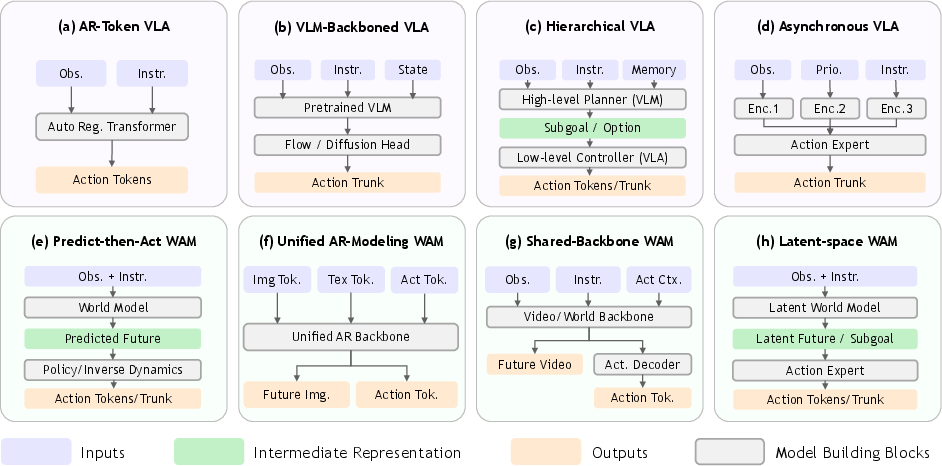
- Vision‑Language‑Action (VLA) models: these take in vision and possibly text, then directly produce actions (like moving a gripper).
- World‑Action Models (WAMs): these first “imagine” possible futures (predict what might happen) and then choose actions based on that.
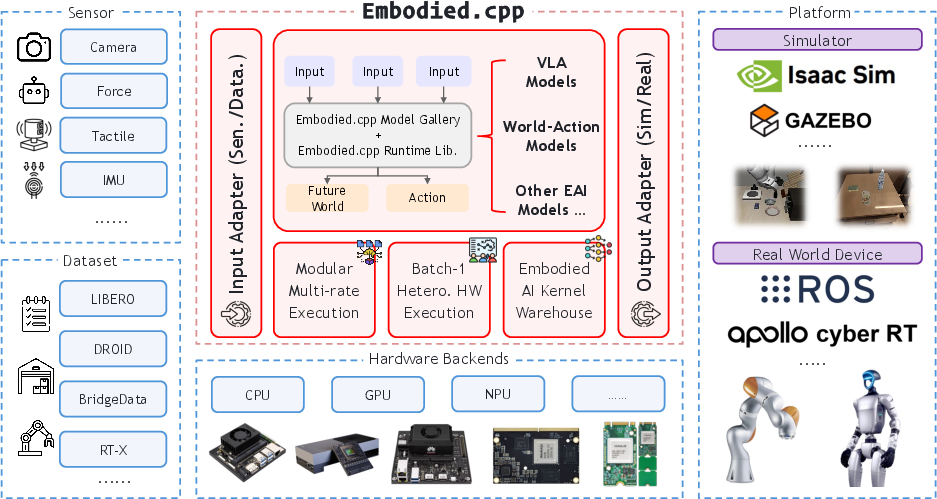
Even though these models can look different, the team found a shared flow they could support with one runtime. They built Embodied.cpp as a kind of factory line with five simple stations:
- Input adapters: turn raw sensor data (camera images, IMU, force, etc.) into the right format for the model.
- Sequence builders: organize data over time, like making a short clip or history the model can understand.
- Backbone execution: the main “brain” (often a transformer) that processes the information.
- Head plugins: specialized parts that turn the brain’s features into concrete things, like an action vector or a predicted future.
- Deployment adapters: connectors that send outputs to real robots or simulators and receive new sensor data.
To make this run well on many devices, they added:
- Modular multi‑rate scheduling: think of a robot with different parts running at different gears, all coordinated safely.
- Latency‑first fused execution: they combine steps and reuse buffers to cut delay and jitter so the robot responds quickly and consistently.
- Extensible operators and I/O: it’s easy to add new model pieces, custom math ops, or new sensor/action types.
Simple analogies for tricky terms:
- Closed‑loop control: like riding a bike—constantly looking and adjusting your balance, not just making a one‑time decision.
- Heterogeneous hardware: many kinds of “game consoles” (CPUs, GPUs, NPUs) that all need to run the same game.
- Quantization: compressing model numbers to take less memory, like saving a photo with fewer colors but keeping it looking similar.
What did they find?
They tested Embodied.cpp on both VLA and WAM scenarios:
- VLA models (full robot loops):
- HY‑VLA: ran a “place an empty cup” task and achieved a 100% success rate through the C++ runtime. It had higher delay because it uses a large vision backbone and multiple camera views.
- pi0.5: reached a 91% success rate with lower step time, helped by a lighter backbone and by producing actions in longer “chunks,” reducing per‑step work.
Why this matters: both very different VLA models worked well in the same C++ engine, keeping their accuracy while meeting real‑time needs.
- WAM component (microbenchmark):
- They took one transformer block from a WAM model (LingBot‑VA) and ran it quantized (Q4_K) in Embodied.cpp. Memory for that block dropped from about 312 MiB to 88 MiB, with almost no change to the outputs and similar speed.
Why this matters: it shows Embodied.cpp can host future‑predicting pieces efficiently, saving memory—great for small devices—without hurting results much.
Why does this matter?
- One engine for many robot models: Researchers and engineers can avoid rewriting lots of “glue code” for every new robot or model.
- Real‑time, real‑world ready: Low delay and steady timing help robots move smoothly and safely, not just in demos.
- Works across devices: From small edge boards to powerful PCs, the same system can deploy to different robots and simulators.
- Future‑proof: As new model ideas appear (new heads, new sensors, new prediction styles), they can be plugged in without rebuilding everything.
In short, Embodied.cpp is a practical step toward making advanced robot AI models easier to run anywhere, so more robots can be useful in everyday tasks sooner.
Knowledge Gaps
Knowledge gaps, limitations, and open questions
The paper introduces Embodied.cpp and presents limited evaluations. The following unresolved points identify concrete opportunities for future work:
- Full WAM validation is missing: no end-to-end, closed-loop results for complete WAMs (e.g., LingBot-VA, WorldVLA, UWM) across diverse tasks and environments; only a single block microbenchmark is reported.
- Breadth of model-family coverage is narrow: evaluations only include two VLA instances (HY-VLA, pi0.5); no tests on AR-token VLA (e.g., OpenVLA/RT-2), hierarchical VLA, asynchronous VLA, latent-space WAM, or predict-then-act WAM variants.
- Real-robot deployment evidence is absent: the runtime claims robot-side adapters, but there are no documented on-robot trials (e.g., ROS2 integration details, driver compatibility, control-loop stability, safety outcomes).
- Heterogeneous edge hardware is not empirically covered: no measurements on Jetson (Xavier/Orin), RK3588, Intel/AMD iGPUs, NPUs, or low-power CPUs; portability, acceleration-provider selection, and performance/jitter on these targets remain unknown.
- Multi-rate scheduling policy is unspecified and unevaluated: the runtime supports multi-rate execution, but there is no description or benchmarking of scheduling strategies (static vs dynamic rates, deadline-aware scheduling, rate adaptation under load).
- Closed-loop timing quality is uncharacterized: no jitter distributions, 95th/99th-percentile latencies, deadline miss rates, or stability margins under control-loop constraints; only average latencies are reported.
- Throughput–latency trade-offs and fused-execution effects are not ablated: the impact of operator fusion, buffer reuse, and graph replay on tail latency, jitter, and accuracy is not measured.
- Action chunking design is not analyzed: chunk length choices (e.g., 20 vs 50) and their effects on latency, control smoothness, failure modes, and success rate are not systematically evaluated.
- Memory reporting is incomplete: results show weight/VRAM figures, but no activation memory, allocator fragmentation, peak vs steady-state footprints, or memory behavior under multi-component pipelines.
- Operator/kernel coverage is not enumerated: the “kernel warehouse” lacks a concrete catalog of supported ops, data types, quantization schemes, and backend implementations required by varied VLA/WAM architectures.
- Backend abstraction details are unclear: supported execution providers (e.g., CUDA, ROCm, OpenCL, Vulkan, CPU, NPU) and their feature gaps (precision modes, tensor layouts, graph limits) are not documented or compared.
- Quantization is validated only at block level: Q4_K error metrics are provided for a single transformer block, but end-to-end model drift, control performance, and sensitivity to input distributions under quantization are untested.
- State-management semantics are underdefined: how intermediate subgoals, buffered context, predicted/latent futures are versioned, synchronized, serialized, and garbage-collected across multi-rate modules remains unspecified.
- Fault tolerance and safety are not addressed: behavior under sensor dropouts, backend errors, out-of-memory conditions, overrun deadlines, and recovery to safe actions is not described or evaluated.
- Power and thermal budgets on edge devices are unreported: energy per step/action, thermal throttling, and performance under sustained load are critical for deployability but absent.
- Comparative baselines are missing: there is no head-to-head against vla.cpp, ONNX Runtime, or general runtimes (e.g., llama.cpp/vLLM-Omni) on identical models/hardware to quantify Embodied.cpp’s advantages and trade-offs.
- Simulator integration quality is not measured: time synchronization, physics step alignment, sensor timestamping, and determinism when interfacing with Isaac Sim, ManiSkill, or LIBERO are not evaluated.
- Networked/remote inference scenarios are unexplored: performance and stability with on-robot sensors and offboard inference (network latency/jitter, compression, buffering strategies) are not studied.
- API/extension ergonomics are not demonstrated: concrete developer effort to author “head plugins,” “sequence builders,” or deployment adapters (templates, sample code, testing harnesses) is not shown.
- Reproducibility and statistical rigor are limited: success-rate intervals and trial counts are unclear; seeds, environment variability, and procedure for computing success (e.g., criteria for RoboTwin task completion) are not fully specified.
- Multimodal I/O beyond vision/language is unvalidated: while tactile/force/IMU/proprioception are claimed as inputs, there are no experiments quantifying their latency budgets, synchronization, and effects on control.
- Determinism and cross-device consistency are untested: output drift across different GPUs/CPUs/backends, precision modes, and tensor layout differences is not measured; no conformance tests are provided.
- Real-time OS and scheduling integration is unaddressed: interaction with RT kernels, ROS2 executor and QoS, priority inversion, and preemption control needed for strict real-time deployments remain unexplored.
- Hot-swapping and lifecycle management are unspecified: dynamic model loading/unloading, warmup, cache priming, version pinning, and rolling upgrades in persistent systems are not described.
- Telemetry and observability are missing: standardized logging, metrics, tracing (e.g., per-module timing, queue depths, buffer occupancy), and debugging tools for multi-rate pipelines are not provided.
- Interface standardization is incomplete: schemas for typed embodied data, unit conventions (frames, coordinate systems), message contracts, and compatibility with ROS msgs/FlatBuffers/Cap’n Proto are not formalized.
- Safety certification and compliance considerations are absent: requirements for functional safety (e.g., ISO 13849/IEC 61508), hazard analysis, and validation protocols for embodied deployments are not discussed.
Practical Applications
Overview
Based on the paper “Embodied.cpp: A Portable Inference Runtime of Embodied AI Models on Heterogeneous Robots,” the following lists distill practical, real-world applications that stem from the runtime’s findings, methods, and innovations (five-layer C++ architecture, modular multi-rate execution, latency-first fused inference, extensible operator/I/O, and heterogeneous hardware support). Each item includes sector alignment, potential tools/products/workflows, and feasibility notes.
Immediate Applications
Robotics and Industrial Automation
- Deploy VLA robot policies across heterogeneous hardware (Jetson, RK-based boards, x86 edge boxes, workstations) using one portable runtime
- Sectors: manufacturing, logistics/warehousing, agriculture, hospitality, retail
- Tools/products/workflows: Embodied.cpp deployment bundles; “head plugins” to map model outputs to robot-specific controllers; prebuilt Docker images per device class; ROS2 node adapters via deployment adapters
- Assumptions/dependencies: availability of compatible checkpoints (e.g., HY-VLA, pi0.5) with license; GPU/NPU/CPU drivers; ROS2 or vendor SDK integration; calibrated sensors; real-time constraints met for the robot’s dynamics
- Stable batch-1, low-latency control loops for on-robot inference with multi-rate scheduling
- Sectors: mobile manipulation, pick-and-place, autonomous forklifts, bin-picking cells
- Tools/products/workflows: multi-rate scheduler configuration (e.g., fast action heads at higher Hz, slower perception refresh); latency profilers and jitter monitors packaged with the runtime
- Assumptions/dependencies: careful action chunking and sensor frame rates; alignment with robot control loop timing; deterministic execution paths; tuned CPU/GPU affinity
- Unified sim-to-real loop for training, evaluation, and regression testing
- Sectors: robotics R&D, OEMs, integrators
- Tools/products/workflows: deployment adapters to Isaac Sim, ManiSkill, LIBERO; closed-loop test harnesses using the same C++ inference path as on-robot deployment; continuous integration for scenario regression
- Assumptions/dependencies: simulator plugins maintained; reproducible seed control; dataset I/O agreements (e.g., LeRobot/Open X-Embodiment formats)
- Fleet-standardization of policy execution across mixed hardware
- Sectors: 3PL/warehousing, last-mile delivery, cleaning robots
- Tools/products/workflows: runtime bundles signed and versioned; OTA update pipeline; fleet health telemetry (latency, VRAM, success rates) collected from the runtime
- Assumptions/dependencies: device management infrastructure; security updates; staged rollout with canary testing
- Memory-efficient deployment via quantized blocks for constrained devices
- Sectors: embedded robotics, consumer/hobbyist robots, drones
- Tools/products/workflows: GGUF Q4_K quantized components inside Embodied.cpp; per-block validation (MAE/cosine similarity thresholds); weight memory audits
- Assumptions/dependencies: acceptable accuracy drift for tasks; quantization-aware calibration sets; fallback to higher-precision weights for edge cases
Software and Tooling
- Cross-model portability for VLA variants in one C++ runtime
- Sectors: software, robotics platforms
- Tools/products/workflows: five-layer architecture (input adapters, sequence builders, backbone execution, head plugins, deployment adapters) as an SDK; operator “kernel warehouse” for reuse; CI templates for adding new models
- Assumptions/dependencies: operator coverage for model-specific layers; maintenance of backends (CUDA, ROCm, CPU, NPUs); licensing for model weights
- Heterogeneous-device orchestration inside a single runtime abstraction
- Sectors: edge AI platforms, OEMs
- Tools/products/workflows: backend abstraction to target CPU+GPU/NPU co-execution; buffer reuse and graph replay to minimize host-device transfers; device capability auto-detection
- Assumptions/dependencies: mature NPU SDKs; stable kernel APIs; predictable DMA paths and zero-copy sensor capture where possible
Academia and Education
- Reproducible embodied benchmarks using the same deployment path as real robots
- Sectors: academia, research labs, student robotics courses
- Tools/products/workflows: turnkey configurations for HY-VLA and pi0.5; classroom exercises integrating cameras/IMUs with input adapters; logging dashboards for latency/jitter/success-rate
- Assumptions/dependencies: lab hardware diversity; public model checkpoints; permissions for dataset and simulator use
Policy and Governance
- Operational safety improvements via latency-first, jitter-aware execution
- Sectors: industrial safety, compliance-heavy deployments
- Tools/products/workflows: per-step timing reports; SLA thresholds for actuation; alarms when timing violations occur; pre-deployment test suites
- Assumptions/dependencies: policy acceptance that predictable small-batch inference is a safety control; organizational adoption of runtime metrics in safety cases
Daily Life and Prosumer Robotics
- Hobbyist/home robots running VLA policies locally with minimal Python glue
- Sectors: consumer robotics, maker communities
- Tools/products/workflows: prebuilt binaries for common SBCs; plug-and-play camera/microphone/tactile adapters; example action-head mappings to hobby servo controllers
- Assumptions/dependencies: device power/thermals; simplified calibration; community-contributed adapters for niche sensors
Long-Term Applications
Robotics and Industrial Automation
- First-class WAM deployment (predictive world modeling + control) with coordinated scheduling
- Sectors: advanced manipulation, dexterous assembly, autonomous mobile robots with foresight
- Tools/products/workflows: predictive modules as pluggable “heads”; buffered latent futures/subgoals; scheduler that adapts predictive frequency to task difficulty
- Assumptions/dependencies: stable, performant WAM checkpoints; methods for bounding predictive drift; more mature memory/compute trade-offs under small-batch constraints
- Energy-aware, safety-certified runtime for mission-critical robots
- Sectors: healthcare (assistive/rehab robots), industrial cobots, field inspection (energy/utilities)
- Tools/products/workflows: energy-aware multi-rate policies; formal timing analysis and certification artifacts; runtime-level fail-safes
- Assumptions/dependencies: collaboration with standards bodies; deterministic scheduling modes; robust fallback behaviors
- Cloud–edge cooperative control with dynamic partitioning
- Sectors: large facilities, smart factories/campuses
- Tools/products/workflows: runtime extensions to offload heavier perception/planning to edge servers while maintaining on-robot low-latency control; bandwidth/jitter-aware migration policies
- Assumptions/dependencies: reliable networking; privacy/security guarantees; partitioning profiles per task
Software and Tooling
- Standardized embodied model bundle/export akin to ONNX for embodied control
- Sectors: tool vendors, model hubs, OEMs
- Tools/products/workflows: “Embodied Bundle” spec capturing inputs, timing policies, head types, and deployment adapters; converters from training stacks to Embodied.cpp bundles; conformance tests
- Assumptions/dependencies: community consensus; mapping of diverse operator sets; legal clarity for model redistribution
- Auto-tuning multi-rate scheduler and operator fusion for heterogeneous accelerators
- Sectors: edge AI platforms, silicon vendors
- Tools/products/workflows: hardware- and task-aware scheduling search; online adaptation to thermal throttling; learned policies for action chunking and perception refresh
- Assumptions/dependencies: robust profiling APIs; safe online adaptation bounds; acceptance of auto-tuned schedules in safety cases
- Ecosystem “plugin marketplace” for head plugins, input/deployment adapters, and kernels
- Sectors: robotics integrators, third-party ISVs
- Tools/products/workflows: signed plugins with versioned interfaces; compatibility matrix; revenue-sharing or open catalog
- Assumptions/dependencies: stable API governance; security sandboxing; automated regression against core runtime
Academia and Education
- Unified curricula and benchmarks spanning VLA and WAM under one deployable runtime
- Sectors: universities, robotics programs, MOOCs
- Tools/products/workflows: task suites that evaluate perception-to-action and predictive control; standardized latency/accuracy/energy metrics; reproducible lab-in-a-box kits
- Assumptions/dependencies: low-cost hardware availability; open checkpoints/datasets; sustained maintainer support
Policy and Governance
- Procurement and regulatory standards that reference embodied-runtime interfaces and timing guarantees
- Sectors: public sector robotics, healthcare, critical infrastructure
- Tools/products/workflows: policy templates specifying acceptable jitter/latency ranges and interface contracts; audit trails from runtime logs; security baselines for on-robot inference
- Assumptions/dependencies: engagement with regulators; long-term stability of APIs; integration with cybersecurity frameworks (e.g., SBOMs for plugins)
Daily Life and Prosumer Robotics
- “App-store” distribution for home/service robot behaviors (VLA/WAM policies) as pluggable bundles
- Sectors: consumer/home, hospitality
- Tools/products/workflows: curated behavior packs with device-specific adapters; safe testing sandboxes; user-friendly schedulers (profiles for quiet hours/energy-saving)
- Assumptions/dependencies: trust and safety vetting; robust rollback; simple calibration UX for non-experts
Notes on feasibility across items:
- Many Immediate Applications are enabled by demonstrated VLA deployments (HY-VLA, pi0.5) and quantized block evidence; real-world readiness still depends on per-robot integration, hardware drivers, and model licensing.
- Most Long-Term Applications hinge on maturing WAM checkpoints, stronger formal timing guarantees, heterogeneous accelerator support (including NPUs), and community standards for embodied model bundles and plugins.
Glossary
- Action chunk: A contiguous sequence of future actions emitted together by a policy to reduce per-step overhead. "pi0.5 uses a lighter PaliGemma backbone and a longer action chunk, which lowers the amortized step cost."
- Amortized environment-step latency: The average per-environment-step time cost when action chunking or other batching spreads inference overhead across multiple steps. "We report success rate, action chunk length, server-side inference latency, amortized environment-step latency, and peak GPU memory."
- AR-Token VLA: A vision-language-action model subtype where a single backbone autoregressively outputs discrete action tokens. "AR-Token VLA models such as RT-2 and OpenVLA use one shared backbone to autoregressively generate action tokens."
- Autoregressive generation: A modeling approach that produces outputs sequentially, conditioning each on prior outputs. "AR-Token VLA models such as RT-2 and OpenVLA use one shared backbone to autoregressively generate action tokens."
- Backbone: The core neural network that processes shared multimodal inputs before task-specific heads. "AR-Token VLA models such as RT-2 and OpenVLA use one shared backbone to autoregressively generate action tokens."
- Backend abstraction: A uniform interface that lets the runtime target different accelerators or devices without changing model code. "enabling deployment across heterogeneous devices, robots, and simulators through one backend abstraction."
- Batch-1 inference: Inference with a batch size of one, typical in real-time control on a single robot. "latency-first batch-1 inference on heterogeneous hardware"
- BF16: A 16-bit floating-point format (bfloat16) that reduces memory while retaining dynamic range for training/inference. "The Python baseline uses the original WanTransformerBlock with BF16 weights"
- C++ inference runtime: A deployment system implemented in C++ that executes trained models efficiently on devices. "We present Embodied.cpp, a portable C++ inference runtime for embodied models."
- Closed-loop control: A control setup where actions affect the environment and new observations immediately inform subsequent actions. "latency-first closed-loop control"
- Cosine similarity: A metric that measures the angular similarity between two vectors’ outputs to assess numerical drift. "We compare the C++ Q4_K block against the Python BF16 block with mean absolute error (MAE) and cosine similarity."
- Custom operators: Non-standard neural network operations or kernels required by specific models beyond common libraries. "Embodied deployment must go beyond fixed token I/O and absorb custom operators"
- Deployment adapters: Runtime modules that connect model outputs to robots or simulators and manage platform-specific I/O. "five layers: input adapters, sequence builders, backbone execution, head plugins, and deployment adapters."
- Edge devices: Resource-constrained compute platforms deployed near sensors/actuators (e.g., robots) for on-device inference. "especially on heterogeneous edge devices."
- Embodied AI kernel warehouse: A collection of reusable low-level operators and kernels specialized for embodied AI workloads. "and the embodied AI kernel warehouse collects reusable operators and model-specific kernels"
- Embodied interfaces: Input/output conventions tailored to robots and simulators (e.g., images, proprioception, action vectors). "Extensible embodied interfaces beyond fixed token I/O."
- Execution providers: Pluggable backend engines in ONNX Runtime that dispatch compute to different accelerators. "ONNX Runtime provides cross-platform acceleration through multiple execution providers"
- Fused inference: Combining multiple operations into larger kernels/graphs to reduce latency and memory traffic. "latency-first fused inference"
- GGUF: A compact model file format used in ggml-based runtimes for portable, quantized weights. "the corresponding GGUF Q4_K quantized block."
- Heterogeneous hardware: A mix of CPUs, GPUs, NPUs, and other accelerators with differing capabilities used together. "latency-first batch-1 inference on heterogeneous hardware"
- Hierarchical VLA: A VLA subtype where a high-level planner outputs subgoals that a low-level controller executes. "Hierarchical VLA models split semantic planning from low-level control, with a planner producing subgoals for a downstream controller"
- Input adapters: Runtime components that normalize and ingest sensor streams or dataset samples into the model. "five layers: input adapters, sequence builders, backbone execution, head plugins, and deployment adapters."
- Jitter: Variability in inference or control loop timing that can destabilize real-time systems. "which requires low latency, low jitter, and efficient batch-1 execution"
- Latency-first execution: An optimization focus that prioritizes minimal and predictable delay over throughput. "(2) Latency-first closed-loop control."
- Latent future: A compressed representation of predicted future states used to guide action generation. "A compact latent future or subgoal is predicted and then consumed by an action expert"
- LingBot-VA: A representative world-action model used in the paper’s WAM microbenchmark. "a preliminary WAM benchmark using a LingBot-VA Transformer block."
- Mean Absolute Error (MAE): An average absolute difference metric used to quantify output deviation after optimization. "We compare the C++ Q4_K block against the Python BF16 block with mean absolute error (MAE) and cosine similarity."
- Modular multi-rate execution: Scheduling different model components at different frequencies within the same control loop. "The runtime provides modular multi-rate execution"
- Monolithic inference graph: A single, tightly coupled model execution path without separately schedulable modules. "support or optimization for multi-component embodied models rather than only monolithic inference graphs."
- Operator fusion: Combining adjacent neural network operations into single kernels for efficiency. "operator fusion"
- Perception encoders: Front-end networks that transform raw sensor data (e.g., images) into feature embeddings. "perception encoders, transformer backbones, predictive branches, and action heads"
- Predict-then-Act WAM: A WAM subtype where a world model first predicts futures and an action expert acts on them. "Predict-then-Act WAMs such as UniPi keep the two stages explicit: a world model predicts future states, and a downstream action expert consumes them"
- Q4_K quantization: A 4-bit quantization scheme (from GGUF/ggml families) that reduces model memory while retaining accuracy. "the corresponding GGUF Q4_K quantized block."
- Request-response serving: A serving style where each client request triggers a synchronous inference response, typical for LLMs. "Existing inference runtimes are designed mainly for request-response serving"
- Runtime contract: The set of functional and performance requirements the runtime must satisfy for a given application. "therefore do not satisfy the runtime contract of embodied deployment"
- Sequence builders: Runtime components that assemble temporal or multimodal contexts into model-ready sequences. "five layers: input adapters, sequence builders, backbone execution, head plugins, and deployment adapters."
- Shared execution path: A common sequence of runtime steps that many model variants can follow with pluggable differences. "Embodied.cpp captures a shared execution path"
- Simulator: A virtual environment that emulates robot dynamics and sensors for testing and benchmarking. "robots, and simulators through one backend abstraction."
- Stateful orchestration: Coordinated scheduling that maintains and passes internal state across modules over time. "so a practical embodied inference runtime must support stateful multi-component orchestration"
- Subgoal: An intermediate objective produced by a planner to guide a lower-level controller. "a planner producing subgoals for a downstream controller"
- Transformer block: A modular unit in Transformer networks comprising attention and feed-forward sublayers. "we benchmark only its first Transformer block"
- Typed embodied interface: A strongly typed I/O boundary for multimodal embodied data (e.g., images, IMU, actions). "so cameras, force or tactile signals, IMU data, and benchmark datasets enter the runtime through one typed embodied interface."
- Vision-Language-Action (VLA): A class of models that map multimodal perceptions and language to robotic actions. "Embodied AI models now span vision-language-action (VLA) models"
- World model: A predictive model that forecasts future states of the environment. "a world model predicts future states"
- World-Action Models (WAMs): Models that jointly model future world states and actions for control. "and world-action models (WAMs)"
Collections
Sign up for free to add this paper to one or more collections.

