- The paper introduces vla.cpp, a unified C++ runtime that supports multimodal VLA policies with full cross-attention KV cache management.
- It leverages kernel-level optimizations and ternary quantization to achieve up to 4.6× latency reduction and robust behavioral parity in robotic tasks.
- Empirical results demonstrate deployment portability across GPUs and embedded devices by effectively managing the compute-memory split.
vla.cpp: A Portable Unified Inference Runtime for Vision-Language-Action Models
Motivation and Context
Deploying Vision-Language-Action (VLA) policies for robotic control presents a dichotomy: state-of-the-art policies are implemented in Python/PyTorch and optimized for workstation-class GPUs, yet robotic systems frequently operate on memory-constrained embedded devices such as NVIDIA Jetson Orin modules (8 GB unified memory). Existing inference stacks—llama.cpp for LLMs, specialized vendor compilers, ONNX/Torch-TRT—either lack support for the VLA inference pattern (multimodal prefix caching, iterative solver steps) or can serve only one model per device/vendor. vla.cpp addresses this gap with a single portable C++ runtime, built atop llama.cpp and ggml, which natively supports flow-matching and diffusion action heads, cross-attention KV cache lifecycle, and serves seven architectures spanning heterogeneous vision-language backbones and action-head families.
System Architecture and Engine Design
vla.cpp operates as a stateless C++ server interfacing with clients (typically Python for closed-loop control) via ZeroMQ and Protobuf. It loads a GGUF model bundle (including vision encoder, LLM, action head, normalization statistics), computes the multimodal prefix via bidirectional attention, and iterates the action head—with explicit cross-attention cache management—to produce denormalized action chunks suitable for robotic actuators.
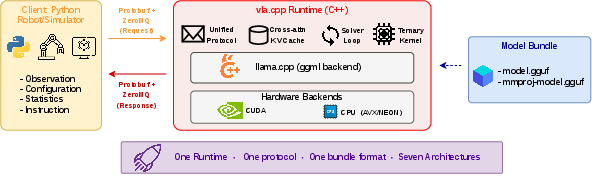
Figure 1: Architecture of vla.cpp, depicting the stateless server, client responsibility, and protocol over ZeroMQ.
The engine closes critical architectural gaps absent in text-generation runtimes: full hidden-state exposure for cross-attention, bidirectional prefix masking, explicit lifecycle for prefix KV caches reused across solver steps, and automated denormalization based on model-provided statistics.
Extensive empirical profiling reveals that a single observation inference on VLA models exhibits a distinct compute-memory split: the vision-language prefix encoding is compute-bound (high-weight reuse across hundreds of tokens), while the action expert (typically flow-matching/diffusion heads over relatively few tokens) is memory-bound. This split directly impacts deployment optimization—arithmetic-unit utilization and memory capacity are primary levers, rather than pure bandwidth.
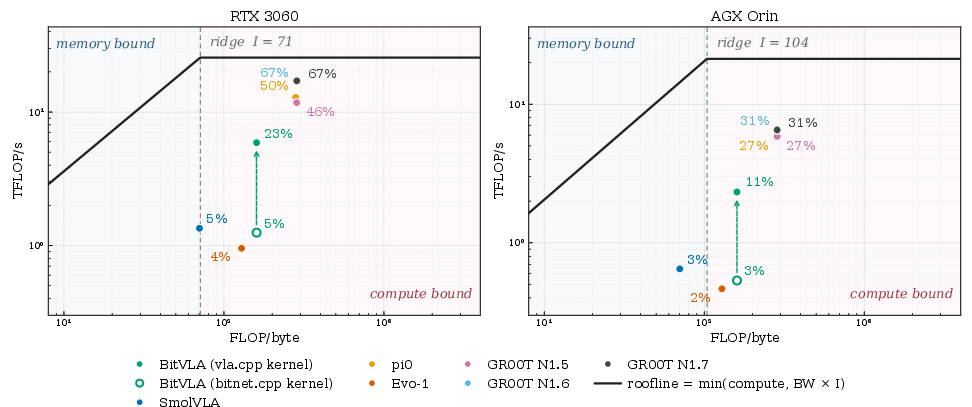
Figure 2: Roofline placement of single-request VLA inference across device tiers, quantifying operational intensity and utilization headroom.
Deployments demonstrate near-parity with reference PyTorch checkpoints: on LIBERO-Object tasks, vla.cpp matches BitVLA's reference to within one episode out of 200, and achieves 100% success on BitVLA in 1.3 GiB. The identical GGUF bundle runs unchanged across consumer GPUs and 8 GB embedded modules, demonstrating deployment portability and practical efficiency.
Kernel-Level Optimizations and Quantization
BitVLA’s ternary quantization shrinks model footprints drastically (5.6 GiB → 1.34 GiB disk; 11.1 GiB → 1.15 GiB in-memory) without inherent latency reduction. The runtime implements a portable IMMA tensor-core W2A8 GEMM kernel, achieving 4–4.6× per-step latency reduction compared to the CUDA dp4a intrinsic—BitVLA inference drops from 172.8 ms to 37.85 ms (RTX 3060), and 406.6 ms to 101.11 ms (AGX Orin), with full behavioral parity in action outputs. This optimization is realized as a universally portable ggml-class kernel, generalizable across hardware generations and architectures.
Fidelity, Precision Sensitivity, and Closed-Loop Deployment
Success rates and numerical fidelity are sustained across architectures with various chunking strategies and backbones. However, reduced precision in multimodal encoders propagates silent behavioral shifts. A single rounding difference in vision-tower position-embedding in FP16 versus FP32 can displace action predictions (∼2σ in robot command space), exacerbated by iterative flow-matching integration. Parity-gated, fail-loud deployments are necessary; index precision must be robustly managed, while continuous operations degrade gracefully.
Closed-loop evaluation on a real ALOHA arm highlights the impact of inference latency on workspace staleness. vla.cpp executes GR00T-N1.6 at 470 ms per chunk versus 620 ms for PyTorch, achieving 87.5% success (versus 40.0%), with substantially faster task completion times. The reduced latency allows replanning against fresher observations—the primary performance driver for long-horizon manipulation where action chunk aging is critical.
Behavioral Robustness and Replan Interval
Varying the action chunk replay interval (replan frequency versus chunk length) shows a wide stability plateau for task success, only collapsing when execution becomes fully open-loop (actions generated from stale observations). Throughput scales almost linearly with chunk size until this plateau is broken, demonstrating effective control of latency-staleness tradeoff in asynchronous deployments.
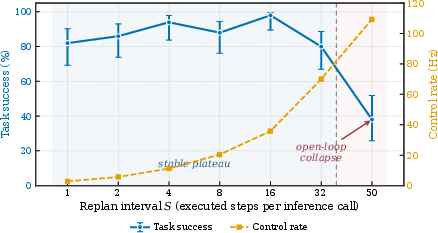
Figure 3: Task success and control rate as a function of replan interval, demonstrating stable performance until fully open-loop replay, where success collapses.
Empirical Comparison and Stack Complementarity
vla.cpp is benchmarked against both eager and graph-captured PyTorch implementations and vendor-optimized engines (TensorRT-LLM/Edge-LLM, ONNX/TRT, MLC-LLM). While some stacks offer per-model, per-device engineering for select architectures, none natively support the VLA inference pattern with full cross-attention KV cache management and action heads over heterogeneous edge devices. The system’s single portable binary architecture underlies its distinct advantage in deployment flexibility and fidelity.
Limitations and Practical Considerations
vla.cpp’s architectural breadth is limited by absence of dynamic weight staging—larger models exhaust unified memory pools on resource-constrained devices, potentially requiring simulator offloading. Low-bit quantization is currently implemented natively only for ternary (BitVLA). Strong precision sensitivity mandates strict build-time gating; discrete index operations in vision encoders are particularly fragile under reduced precision.
Implications and Future Directions
The separation of compute- and memory-bound inference phases, together with kernel-level optimizations, suggests architectural and hardware design avenues for future VLA accelerators and deployment stacks. Fidelity-gated deployment is critical for robotics, necessitating toolchains that enforce numerical parity and report failures at build time. As VLA policies expand in backbone size/fidelity and action head sophistication (speculative pruning, real-time chunking, pipelined execution), runtime and hardware co-design will be increasingly essential for edge deployment.
Conclusion
vla.cpp delivers a unified, portable C++ inference runtime for VLA policies, achieving behavioral parity and practical efficiency across diverse hardware tiers. Empirical findings elucidate the compute-memory split in VLA inference, inform deployment optimization, and underscore the fragility of reduced precision in real-world robot tasks. The system’s architectural generality, kernel-level acceleration, and deployment practicality lay groundwork for further research in VLA runtime and edge hardware co-design.