PhysiFormer: Learning to Simulate Mechanics in World Space
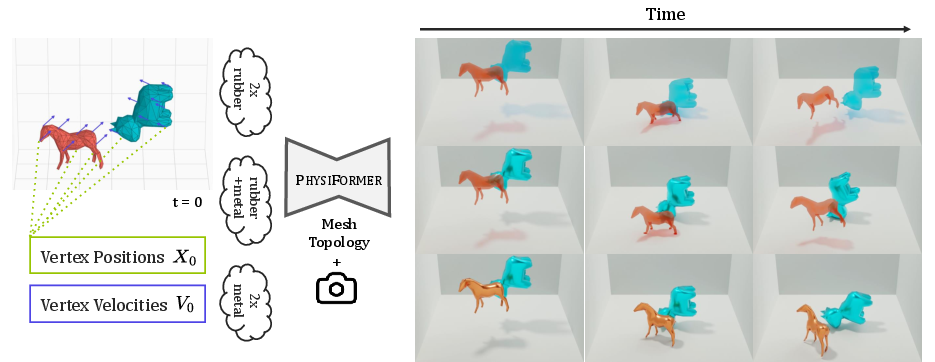
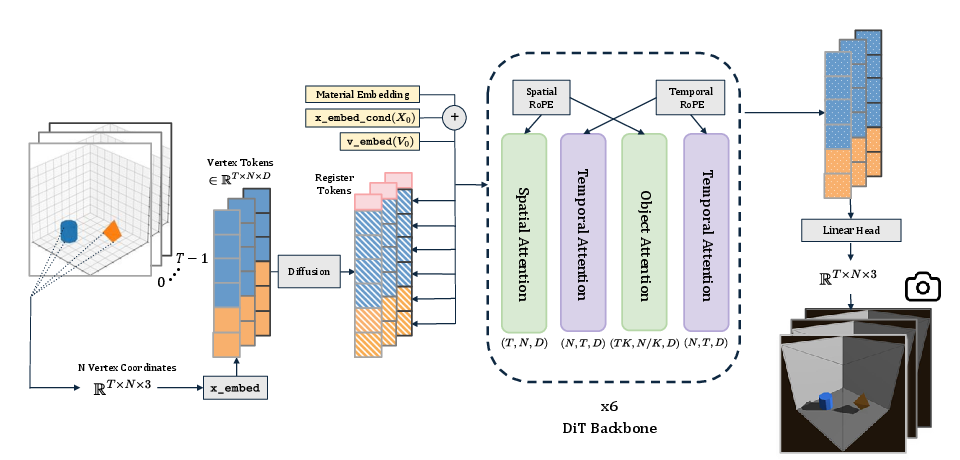
Abstract: We present PhysiFormer, a diffusion transformer for physically-plausible 3D object motion. Unlike video world models that operate in view-dependent pixel space, PhysiFormer represents objects as 3D meshes expressed in world coordinates. Given the initial vertex positions and velocities, as well as object material type, rigid or elastic, the model samples future vertex trajectories. While related neural physics approaches build on ad-hoc latent spaces or explicitly enforce rigidity and causality, PhysiFormer shows that excellent results can be obtained without any such inductive biases, by casting vertex trajectory prediction as a single denoising diffusion process directly in world coordinates. The probabilistic formulation captures uncertainty in the learned dynamics, enabling diverse plausible futures from initial conditions, making this framework potentially useful for applications with unobserved uncertainty. The model features attention factorised over time, space, and objects for efficiency, enabling permutation-invariant multi-object reasoning without needing explicit object encoding. Trained on over 100k simulated trajectories, PhysiFormer generates rigid and elastic mechanics, and generalises to mixed-material settings, unseen real-world geometries, and larger object counts. It substantially outperforms autoregressive baselines in trajectory accuracy, rigidity preservation, and momentum-based physical consistency. Our results position coordinate-space diffusion as a promising step toward view-invariant, geometry-aware world modelling for robotics, graphics, and physical design. Visualisations, code, and models are available at https://yimingc9.github.io/physiformer.
Paper Prompts
Sign up for free to create and run prompts on this paper using GPT-5.
Top Community Prompts
Explain it Like I'm 14
What this paper is about
This paper introduces a new AI model (called a diffusion transformer) that learns to predict how 3D objects move and interact in the real world. Instead of generating future videos (which depend on camera angles and lighting), the model works directly with the objects’ shapes in 3D space. It takes the objects’ starting positions and speeds, plus whether each object is rigid (like a bowling ball) or elastic (like a jelly), and then predicts how all the points on those objects will move over time in a physically believable way.
What questions the researchers asked
The paper explores simple, practical questions:
- Can a single AI model learn to simulate both rigid and squishy (elastic) objects moving and colliding in 3D?
- Is it better to predict the whole future motion at once, rather than step-by-step (which often builds up errors)?
- Can a model that works in world coordinates (true 3D positions) be more reliable and general than video-based models?
- Can the model handle uncertainty (like unknown friction) and still produce realistic, different possible futures?
How the researchers approached it (in everyday terms)
Think of a 3D object as a wireframe made of many points (called vertices) connected by tiny triangles (a mesh). If you know where every point is and how fast it’s moving at the beginning, you can describe the whole shape and its motion. Here’s the idea:
- Data format: The model reads the initial 3D positions and velocities of all mesh points for one or more objects, along with a simple tag for each object’s material: rigid or elastic.
- Predicting the future at once: Instead of predicting one tiny time step, then the next, then the next (which can drift off course), the model predicts the whole future motion in one go. This helps keep shapes rigid when they should be, and reduces errors piling up.
- Diffusion “denoising” process: The model uses a diffusion method, which is like starting with a noisy, messy guess of the future and then cleaning it up step by step until it looks physically realistic. You can imagine it as starting with a fuzzy animation and sharpening it into a clear, accurate motion.
- Transformer “attention”: The model uses attention (a way for the AI to focus on the most relevant information) across:
- Space (how nearby points affect each other),
- Time (how earlier and later moments relate),
- Objects (reasoning within each object and across objects).
- This helps it understand collisions, gravity-like behavior, and shape consistency without hand-coding rigid-body rules.
- Uncertainty and multiple futures: Because the model is probabilistic, it can produce several plausible outcomes from the same starting state (useful when some physical details like mass or surface friction aren’t known exactly).
- Training: The team trained the model on over 100,000 simulated examples of objects moving, falling, bouncing, and deforming, using a physics engine to generate training data. It included scenes with different numbers of objects, starting on the ground or in the air, rigid or elastic materials, and various shapes.
Key terms in simple words:
- Mesh: A 3D shape built from lots of tiny triangles.
- Vertex: One point in the mesh.
- Rigid: Keeps its shape (like a wooden block).
- Elastic: Can bend or squash (like a rubber toy).
- Diffusion model: An AI that learns to remove noise from a rough guess to create a realistic result.
- Transformer with attention: An AI architecture that learns what to “pay attention to” across space and time.
What they found and why it matters
The main results:
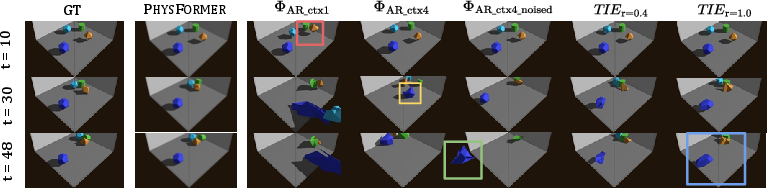
- More accurate and stable than step-by-step models: Their “all-at-once” method beats strong step-by-step (autoregressive) baselines on:
- Trajectory accuracy (points go where they should),
- Rigidity preservation (rigid objects keep their shape over time),
- Physical consistency (momentum behaves more realistically).
- Handles both rigid and elastic objects with one model: No special tricks like hard-coding rigid rules were needed.
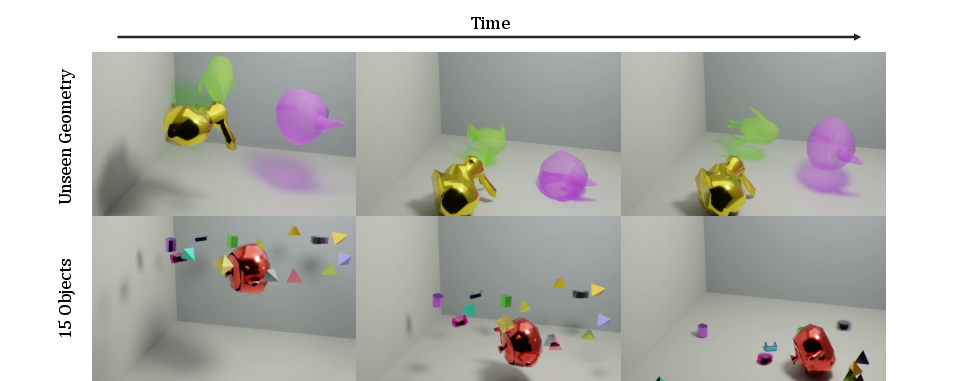
- Generalizes well: It works on:
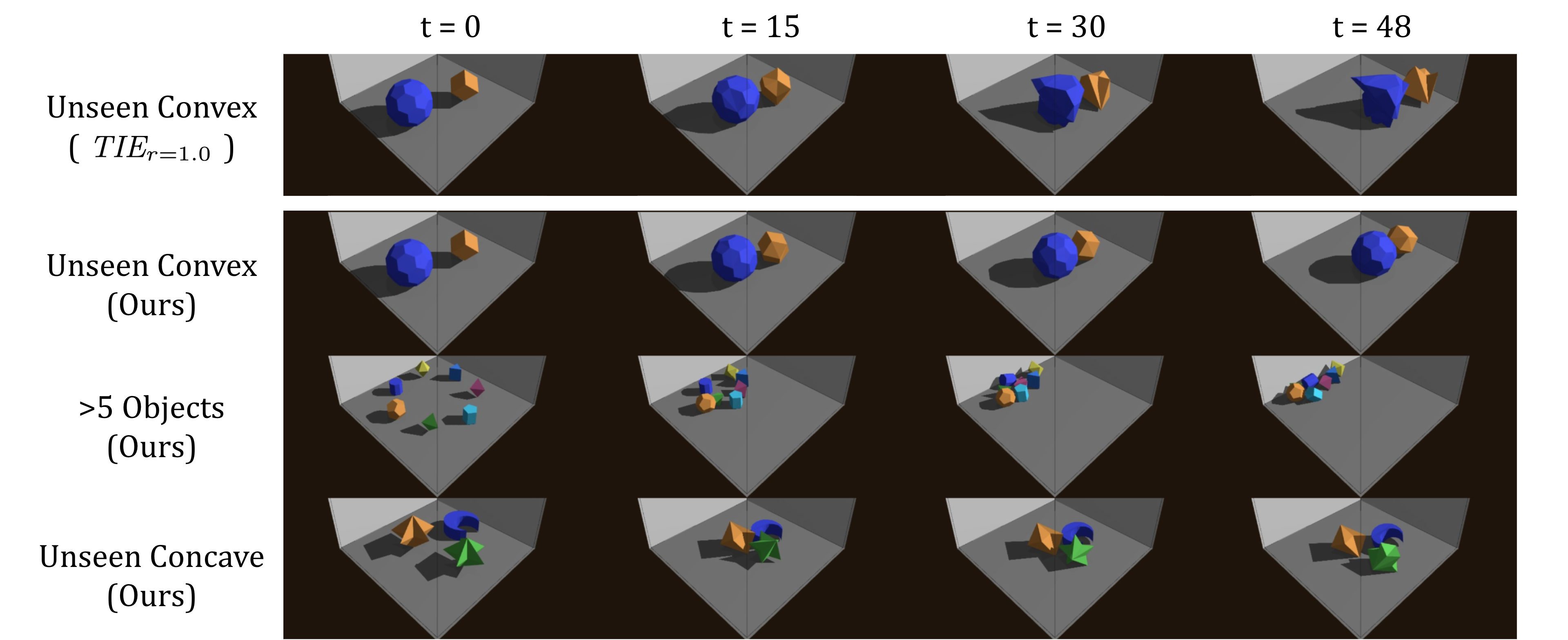
- New object shapes it wasn’t trained on (including more complex, real-world-like geometry),
- Scenes with more objects than it saw during training,
- Mixed-material scenes (rigid and elastic together), even though training scenes used one material type per scene.
- Generates diverse plausible futures: Because the model understands uncertainty (e.g., unknown friction), it can produce different realistic outcomes from the same start, which is useful when the exact conditions aren’t known.
- Efficient at run time: For hard cases (like deformable objects and many contacts), the learned model can be faster to run than a traditional physics simulator, since it needs a fixed number of “denoising” steps rather than doing heavy calculations per scene.
Why this matters:
- Working directly in 3D world space makes the model less confused by cameras and lighting, unlike video-based approaches.
- It’s a step toward “world models” that understand geometry and physics more like simulators, while keeping the flexibility and speed of learned AI.
What this could lead to
- Robotics: Safer, faster planning by predicting how objects move and interact, even when some details are unknown.
- Computer graphics and games: Quicker, believable motion and collisions for many objects, including squishy ones.
- Engineering and design: Fast previews of possible outcomes, helping test design ideas without full-length simulations.
- Better world models: Viewpoint- and geometry-aware models that could support future AI systems needing physical intuition.
Limitations and future work:
- The model currently predicts a fixed-length future and uses a fixed mesh resolution.
- Sometimes it shows minor artifacts (like objects briefly intersecting).
- Future improvements could target longer time horizons, better handling of contacts, and compact representations to speed things up further.
In short, the paper shows that teaching an AI to predict 3D motion directly on object shapes—using a “cleaning up noise” approach and smart attention across time, space, and objects—can produce physically believable results that beat common step-by-step methods. It’s a promising building block for smarter, physics-aware AI.
Knowledge Gaps
Knowledge gaps, limitations, and open questions
Below is a consolidated list of concrete limitations and open questions that remain unresolved and could guide future research.
- Fixed rollout horizon and mesh resolution: the model generates 49-frame trajectories at relatively low vertex counts; how to extend to minutes-long horizons and high-resolution meshes without loss of stability or prohibitive cost?
- Scalability limits of factorized attention: the O(TN2 + NT2) attention cost likely does not scale to thousands of vertices or long sequences; can hierarchical, multiresolution, or sparse attention schemes maintain accuracy while reducing complexity?
- No explicit contact or collision handling: occasional interpenetration and spurious contacts are observed; can differentiable contact constraints (e.g., SDF-based penalties, complementarity losses, signed-distance supervision) reduce violations without sacrificing generative flexibility?
- Limited physical invariants enforced/evaluated: only a proxy momentum-drift ratio is reported with constant mass assumptions; how to measure and enforce angular momentum, kinetic/potential energy consistency, non-penetration, and contact impulse fidelity?
- Simplified and narrow material modeling: conditioning is binary (rigid vs elastic) with a single fixed Young’s modulus for elastic objects; can the model condition on and accurately generalize across continuous material parameters (density, Young’s modulus, Poisson’s ratio, restitution, static/kinetic friction, damping)?
- Unmodeled phenomena: plasticity, fracture, permanent set, anisotropy, and rate-dependent effects are unsupported; what architectural or loss augmentations are needed to handle these regimes?
- Environment variability is minimal: training uses a single bounded box with gravity, minimized friction, and near-elastic impacts; how does performance change with high-friction sticking, rolling, rough/uneven terrain, ramps, compliant or moving boundaries, and varying gravity/force fields?
- No fluids, cloth, or thin-shell dynamics: extension beyond rigid/elastic solids (e.g., cloth, ropes, fluids, granular media) is untested; can the approach accommodate different continua without bespoke inductive biases?
- Mixed-material interactions only at inference: the model is trained on single-material scenes but tested on mixed-material ones; does mixed-material training improve fidelity and reduce artifacts in multi-material contact dynamics?
- Lack of control/force conditioning: the model cannot accept time-varying external forces, torques, or actuation; how to incorporate control inputs for planning, tracking, and closed-loop control in robotics?
- Hidden-parameter inference is implicit and uncontrolled: uncertainty over mass, friction, and restitution is “absorbed” into the generative dynamics; can the model be extended to perform system identification (estimating Y) or support explicit posterior inference over physical parameters?
- No robustness study to noisy or partial initial conditions: inputs assume precise X0 and V0; how sensitive is the model to sensor noise, misestimated velocities, partial geometry, or missing objects, and can training with corruption improve robustness?
- Dependence on consistent vertex indexing: trajectories are predicted per vertex with fixed correspondences; how to handle remeshing, vertex reordering, dynamic topology (e.g., fracture, merging), or point-cloud inputs without fixed indices?
- Limited evaluation set and metrics: MSE, rigidity loss, and momentum drift do not capture contact event timing, penetration depth, coefficient-of-restitution accuracy, or stable stacking; develop and report comprehensive, physics-grounded metrics and contact benchmarks.
- Calibration of generative uncertainty is unassessed: diversity is shown qualitatively, but probabilistic quality (e.g., NLL, CRPS, coverage, calibration error, multi-hypothesis recall) is not measured; is the model well-calibrated and does it capture the true multimodality of futures?
- Short-horizon comparisons and modest baselines: AR baselines degrade over 49 frames; comparisons to stronger long-horizon or constraint-aware learned simulators (e.g., MeshGraphNets variants, differentiable physics with contact) and to physics-informed Transformers are missing.
- Domain gap to real-world physics: training is entirely synthetic (Genesis) with simplified friction/damping; how well does the model transfer to real-world scenes with sensor noise, unmodeled effects, and imperfect geometry? Evaluate on real motion capture or video-tracked mesh trajectories.
- Per-object padding for object-level attention: grouping requires padding to equalize vertex counts; does this introduce inefficiency or bias? Explore ragged batching, set-based attention, or dynamic tokenization to better handle heterogeneous meshes.
- ODE sampling efficiency: inference uses Heun with 50 steps; can distillation, consistency models, higher-order solvers, or rectified flows reduce steps without degrading physical fidelity?
- Sliding-window or iterative refinement for long horizons: one-shot generation avoids AR drift but fixes length; can chunked generation with overlap, diffusion-in-diffusion, or reconditioning maintain coherence over very long sequences?
- Contact-rich stability and resting states: with minimized friction in training, stable stacking and long resting contacts are unproven; can training curricula and friction-rich datasets improve quasi-static contact fidelity?
- Integration with perception is absent: the pipeline assumes known meshes, X0, and V0; how to infer these from images/point clouds, and perform end-to-end video-to-physics with uncertainty over geometry and initial state?
- Safety and failure-mode characterization: when and how does the model fail (e.g., high-speed impacts, extreme concavities, dense clutter)? Provide stress tests, out-of-distribution diagnostics, and safeguards for robotics use.
- Data efficiency and scaling laws: the model is trained on >100k trajectories; what is the sample efficiency, how does performance scale with data/model size, and can pretraining on generic 3D motion or self-supervised objectives reduce data needs?
- Physical interpretability and control of learned dynamics: without explicit parameters, users cannot steer mass or friction; add disentangled conditioning or latent factorization to expose and control physically-meaningful properties.
- Benchmark standardization: results are shown on custom Genesis datasets; release standardized, diverse benchmarks and protocols (including high-friction and multi-material contact) to enable fair comparison across methods.
Practical Applications
Overview
The paper introduces a diffusion-transformer model that predicts physically plausible, multi-object 3D mesh trajectories directly in world coordinates. Given initial per-vertex positions and velocities, and object material type (rigid or elastic), it generates full future trajectories in a single pass. Key innovations include:
- One-shot trajectory generation (reduces error accumulation vs. autoregressive rollouts)
- Factorized attention across time, space, and objects (efficient, permutation-invariant multi-object reasoning)
- Generative uncertainty over unobserved dynamics (e.g., mass, friction)
- Operation in geometry space (viewpoint-agnostic, directly renderable 4D mesh motion)
Below are actionable applications and workflows across sectors, grouped by deployment readiness.
Immediate Applications
These can be prototyped or deployed now with moderate engineering, leveraging the released code/models and current capabilities/limits described in the paper.
- Fast previsualization for VFX and game development
- Sector: Media/entertainment, software (DCC tools)
- Use case: Rapidly iterate on rigid/soft-body interactions (drops, impacts, pile-ups) without heavy physics sim; generate multiple plausible outcomes by sampling seeds.
- Tools/workflows:
- Plugins for Blender/Maya/Houdini/Unreal/Unity that take a mesh, initial positions/velocities, and material tag, then export 4D mesh animation (e.g., Alembic/USD).
- “Look-dev physics” mode for quick shot blocking and previz.
- Assumptions/dependencies:
- Fixed trajectory window; occasional interpenetrations/spurious contacts; no force/actuation control.
- Best for near-elastic collisions, low friction (matching training domain).
- Requires mesh topology and initial velocities.
- Rapid elastic-body previews in design ideation
- Sector: Industrial design/CAD, consumer products
- Use case: Early-stage “sanity check” of how flexible parts deform under gravity/collisions before FEA, accelerating concept iteration.
- Tools/workflows:
- CAD viewer plugin to run drop/impact previews on simplified meshes.
- Batch “what-if” sampling for design variants.
- Assumptions/dependencies:
- Qualitative previews only; uncertain physical parameters are implicit; not a replacement for validation-grade FEA.
- Limited to short horizons unless chunked.
- Training data generation for vision models
- Sector: Computer vision/ML (academia/industry)
- Use case: Generate multi-view videos, depth, flow, and segmentations by rendering the 4D meshes; augment datasets for motion understanding, contact detection, or physics-aware perception.
- Tools/workflows:
- Pipeline: sample trajectories → render from random cameras → export ground-truth 3D per-frame annotations.
- Assumptions/dependencies:
- Domain gap from simulator-trained dynamics; rendering pipeline needed; ensure diversity by sampling seeds.
- Robotics perception and forecasting benchmarks
- Sector: Robotics (academia/industry)
- Use case: Create controlled, multi-object, contact-rich datasets to benchmark perception (scene flow, contact events) and short-horizon forecasting without the complexity of full simulators.
- Tools/workflows:
- Scenario libraries: bins/containers, tabletop clutter, bouncing objects; convert to synthetic sensor data.
- Assumptions/dependencies:
- Not action-conditioned (no robot actuation input); best suited for passive dynamics or pre-contact phases.
- Interactive AR/VR object dynamics (short horizon)
- Sector: AR/VR, mobile apps
- Use case: Lightweight, view-invariant object motion for short interactions (tosses, nudges) where exact determinism is not critical; sample variability to enhance realism.
- Tools/workflows:
- On-device or edge inference for short bursts; baked sequences for predictable UX with fixed seeds.
- Assumptions/dependencies:
- GPU/NPUs for real-time use; short window constraints; ensure collision tolerance in UX (guard against rare interpenetrations).
- Physics education demos
- Sector: Education
- Use case: Demonstrate rigid vs. elastic behavior, momentum effects, and uncertainty (multiple plausible outcomes) in an interactive setting.
- Tools/workflows:
- Classroom app: students adjust initial conditions/materials, then compare sampled outcomes and view from arbitrary perspectives.
- Assumptions/dependencies:
- Qualitative understanding; not a substitute for rigorous lab measurements.
- Simulation acceleration for exploratory studies
- Sector: R&D across engineering domains
- Use case: Quickly triage scenarios (e.g., impact orientations, object mixes) to identify cases worth high-fidelity simulation.
- Tools/workflows:
- Batch sampling front-end; rank by proxy metrics (rigidity preservation, momentum drift) to select candidates for detailed sim.
- Assumptions/dependencies:
- Heuristic screening; may miss edge cases with high friction or complex contacts.
- Multi-object, view-agnostic animation for web 3D
- Sector: Web/interactive media
- Use case: Procedural animations of interactive scenes (falling items, stacking, scattering) rendered client-side or server pre-baked.
- Tools/workflows:
- Server-side trajectory generation → glTF animations; or edge inference for on-the-fly sequences.
- Assumptions/dependencies:
- Mesh count/vertex budget affects latency; seed management for determinism.
Long-Term Applications
These will require additional research and engineering: action conditioning, longer horizons, better contact handling, broader material/parameter coverage, and validation.
- Learned physics engines for real-time games and XR
- Sector: Gaming, XR middleware
- Use case: Hybrid engine where learned dynamics handle soft-body and contact-rich cases for short intervals; fallback to classical solver otherwise.
- Tools/workflows:
- Engine integration layer for mesh-level learned rollouts; determinism via fixed seeds; constraint projection post-step to prevent interpenetrations.
- Assumptions/dependencies:
- Needs robust contact constraints, hard real-time performance, predictable determinism across platforms, and extended horizons.
- Action-conditioned world models for robot planning and control
- Sector: Robotics
- Use case: Closed-loop planning (MPC/RL) where the model predicts state evolution under actions/forces; sample multiple futures for risk-aware control in manipulation and navigation with clutter.
- Tools/workflows:
- Extend conditioning to forces/contacts; integrate with MPC cost functions; uncertainty-aware rollout to vet candidate plans.
- Assumptions/dependencies:
- Requires action inputs and calibration to real friction/mass distributions; strong penalties for interpenetration; longer horizons with reconditioning.
- Surrogate models for design optimization and digital twins
- Sector: Manufacturing, logistics, industrial digital twins
- Use case: Fast, learnable surrogates for soft/rigid object interactions (e.g., packaging drop tests, conveyor collisions) to accelerate scenario analysis.
- Tools/workflows:
- Coupling with design-of-experiments; gradient-informed search via differentiable sampling or score distillation.
- Assumptions/dependencies:
- Must cover broader materials and contact regimes; validated error bounds and calibration; long-horizon stability.
- Generative design and shape/material optimization
- Sector: CAD/CAE, product engineering
- Use case: Optimize object shapes and material assignments for target dynamic behavior (e.g., bounce paths, damping), using the model as a fast evaluator.
- Tools/workflows:
- Iterative loop: propose shape → sample trajectories → evaluate target metrics; optionally backprop through ODE solver if supported.
- Assumptions/dependencies:
- Requires differentiable pipeline and robust gradients; extended training on diverse material properties.
- Physics-aware video generation and simulation-to-video pipelines
- Sector: Graphics, media, simulation
- Use case: Generate videos from physically consistent 4D mesh motions; enforce dynamics priors in video diffusion via mesh-based guidance.
- Tools/workflows:
- Mesh-to-video rendering conditioned on camera paths; hybrid training where mesh dynamics regularize video generators.
- Assumptions/dependencies:
- Cross-domain training needed; align with photorealistic rendering; improve handling of occlusions/contacts in the visual domain.
- Safety analysis and risk assessment using uncertainty-aware dynamics
- Sector: Industrial safety, insurance, policy/standards bodies
- Use case: Stress-test layouts or handling procedures by sampling diverse plausible outcomes; quantify collision likelihoods when physical parameters are uncertain.
- Tools/workflows:
- Scenario generators for safety audits; reporting tools that aggregate sampled outcomes into risk metrics.
- Assumptions/dependencies:
- Requires calibrated uncertainty and domain adaptation; regulatory acceptance hinges on validation and documented limits.
- Biomechanics and medical device pretesting (elastic structures)
- Sector: Healthcare/biomechanics
- Use case: Early-stage approximations of soft-tissue/device interactions to guide experiment design.
- Tools/workflows:
- Coarse mesh surrogates for motion hypotheses; follow-up with specialized simulators for validation.
- Assumptions/dependencies:
- Significant domain shift; needs data from biomechanical regimes, realistic boundary conditions, and material models.
- Large-scale synthetic data factories for embodied AI
- Sector: AI/ML (industry/academia)
- Use case: Produce massive, physically plausible 4D mesh and rendered video datasets for training embodied agents and world models.
- Tools/workflows:
- Parameterized scene generators; curriculum over object counts/materials; multi-view rendering.
- Assumptions/dependencies:
- Must enrich physics diversity (friction, restitution, complex contacts); ensure distributional match to target tasks.
- Cloud “physics-as-a-service” for short-horizon, geometry-level rollouts
- Sector: Software platforms, developer tools
- Use case: REST or gRPC service where clients upload meshes + initial states and receive 4D trajectories for preview, QA, or content generation.
- Tools/workflows:
- Autoscaling inference; API contracts for materials and seeds; integration SDKs.
- Assumptions/dependencies:
- SLA and cost constraints; batching/quantization for throughput; clear communication of limits (window size, known failure modes).
Cross-cutting assumptions and dependencies
- Inputs and conditioning:
- Must provide mesh topology, initial per-vertex positions/velocities, and per-object material type (rigid/elastic). Unknown physical parameters (mass, friction) are inferred implicitly.
- Domain and fidelity:
- Trained on near-elastic, low-friction simulated data; performance may degrade in high-friction, highly dissipative, or complex contact regimes unless retrained.
- Stability and artifacts:
- Fixed trajectory length; occasional spurious contacts/interpenetrations/orientation discontinuities; no hard physics constraints yet.
- Scaling:
- Factorized attention scales better than full attention but very high vertex counts may require mesh simplification/hierarchical processing.
- Compute and deployment:
- Best latency with GPUs; determinism requires seed control; multi-sample variability should be managed in deterministic pipelines.
- Validation and governance (for policy/safety-critical uses):
- Requires calibration against high-fidelity sims/measurements; documented error bounds; acceptance criteria for regulatory use.
Glossary
- autoregressive (AR): A modeling approach that predicts the next state from the current state and rolls out sequentially over time. Example: "a departure from the autoregressive (AR) approach often used to model physics"
- center of mass: The average position of an object's mass; used here to compute momentum via the velocity of the center of mass. Example: "approximating the velocity of the center of mass"
- coordinate-conditioned RoPE: A variant of rotary positional encoding where rotation phases are derived from 3D coordinates so attention depends on relative spatial offsets. Example: "full and object-level spatial attention use coordinate-conditioned RoPE, following RenderFormer"
- coordinate-space diffusion: A diffusion process performed directly in raw 3D coordinate space rather than in a latent or pixel space. Example: "Our results position coordinate-space diffusion as a promising step toward view-invariant, geometry-aware world modelling"
- Diffusion Forcing: A training technique to reduce train-test mismatch in autoregressive models by introducing diffusion-inspired noise or objectives. Example: "mitigated but not removed entirely by Diffusion Forcing and Self Forcing"
- diffusion transformer (DiT): A transformer architecture used as the backbone for diffusion models. Example: "We build our model on top of a general-purpose Diffusion Transformer (DiT)"
- exposure bias: The discrepancy arising when a model is trained with ground-truth inputs (teacher forcing) but tested using its own predictions. Example: "avoid exposure bias due to the mismatch between teacher-forced training and autoregressive rollout at test time"
- finite difference: A numerical method to approximate derivatives by discrete differences over time steps. Example: "computed using finite difference"
- flow-matching schedule: The schedule that mixes data and noise for flow-matching-based diffusion training. Example: "diffused with noise according to the flow-matching schedule"
- flow velocity: The derivative of the interpolated variable with respect to the diffusion parameter in flow matching. Example: "The flow velocity v(z_\tau,x,\tau) = {d z_\tau / d\tau} = (x - z_\tau) / (1 - \tau)"
- Heun integrator: A second-order Runge–Kutta numerical method used to solve ODEs during sampling. Example: "we solve the ODE numerically with the Heun integrator with 50 steps"
- JiT (Just image Transformers): A diffusion training framework that uses x-prediction with v-loss without learning a latent space. Example: "following the Just image Transformers (JiT) framework"
- Kabsch algorithm: An algorithm to compute the best-fit rigid transformation aligning two point sets. Example: "We use the Kabsch algorithm to compute a best-fit rigid transform"
- logit-normal distribution: A probability distribution on (0,1) obtained by applying the logistic function to a normal variable; used to sample diffusion times. Example: "we sample τ from a logit-normal distribution"
- Manifold Assumption: The assumption that high-dimensional data lie near a lower-dimensional manifold, simplifying prediction. Example: "see the Manifold Assumption"
- Markovian system: A system where the future state depends only on the present state, not on the past beyond it. Example: "define a Markovian system"
- Momentum Drift Ratio: A metric comparing momentum drift of predicted trajectories to that of ground truth across time. Example: "Momentum Drift Ratio measures inference momentum drift from initial system momentum compared against that of GT"
- object-level attention: An attention mechanism applied within groups of tokens corresponding to individual objects. Example: "For object-level attention, padding the K objects so that they have an equal number of vertices"
- ordinary differential equation (ODE): An equation involving derivatives of a function; integrated to sample trajectories in diffusion. Example: "integrating the corresponding ordinary differential equation (ODE)"
- permutation-invariant: A property of a model whose outputs are unaffected by the ordering of inputs (e.g., objects). Example: "enabling permutation-invariant multi-object reasoning"
- register tokens: Learnable tokens prepended to the sequence to aggregate and broadcast global context. Example: "We use 16 prepended global register tokens to aggregate context"
- rotary positional encodings (RoPE): A positional encoding technique that rotates query/key vectors by position-dependent phases to encode relative positions. Example: "We inject spatio-temporal position information into the transformer blocks with rotary positional encodings (RoPE)"
- SE(3): The group of 3D rigid transformations (rotations and translations). Example: "min_{(R, b) \in SE(3)}"
- SO(3): The group of 3D rotations (special orthogonal group in three dimensions). Example: "rotation matrix R ∈ SO(3)"
- spatio-temporal attention: An attention scheme alternating between spatial and temporal dimensions for efficiency and structure. Example: "we employ alternating spatio-temporal attention"
- stochastic process: A collection of random variables indexed by time, representing probabilistic evolution. Example: "draw a sample from a stochastic process (X(t))_{t > 0}"
- TIE (Transformer with Implicit Edges): A transformer architecture that models interactions via attention-defined implicit edges for dynamics prediction. Example: "Transformer with Implicit Edges (TIE)"
- Young's modulus: A material property measuring stiffness, used to parameterize elastic behavior. Example: "the elastic material is defined to have a fixed Young's modulus"
Collections
Sign up for free to add this paper to one or more collections.