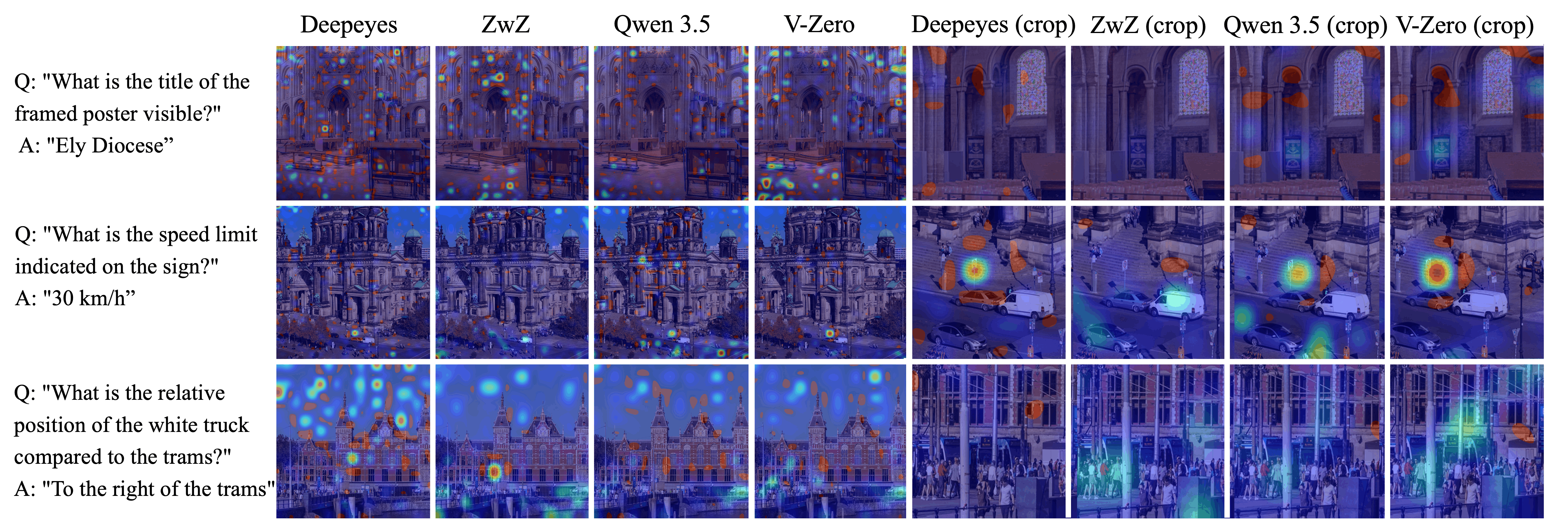
- The paper introduces contrastive evidence gating that modulates token-level distillation by comparing positive and negative visual evidence.
- It achieves a 3.1-point average improvement on fine-grained benchmarks with training speeds over 5× faster than SFT and 10× faster than RL methods.
- The method eliminates reliance on explicit answer labels and RL signals by leveraging teacher-side privileged visual views.
V-Zero: Answer-Label-Free On-Policy Distillation with Contrastive Evidence Gating for Fine-Grained Visual Reasoning
Motivation and Problem Setting
Fine-grained visual reasoning tasks demand MLLMs to accurately localize and exploit task-relevant evidence within specific image regions, surpassing generic visual understanding benchmarks. Prior agentic approaches, including RL-driven visual search or SFT on large annotated datasets, have shown efficacy but suffer from inefficiencies, costly exploration, heavy dependence on reward signals or annotated reasoning traces, and risks of catastrophic forgetting. V-Zero interrogates whether visual reasoning can be improved without explicit answer labels, RL reward signals, or severe disruption of general MLLM capabilities.
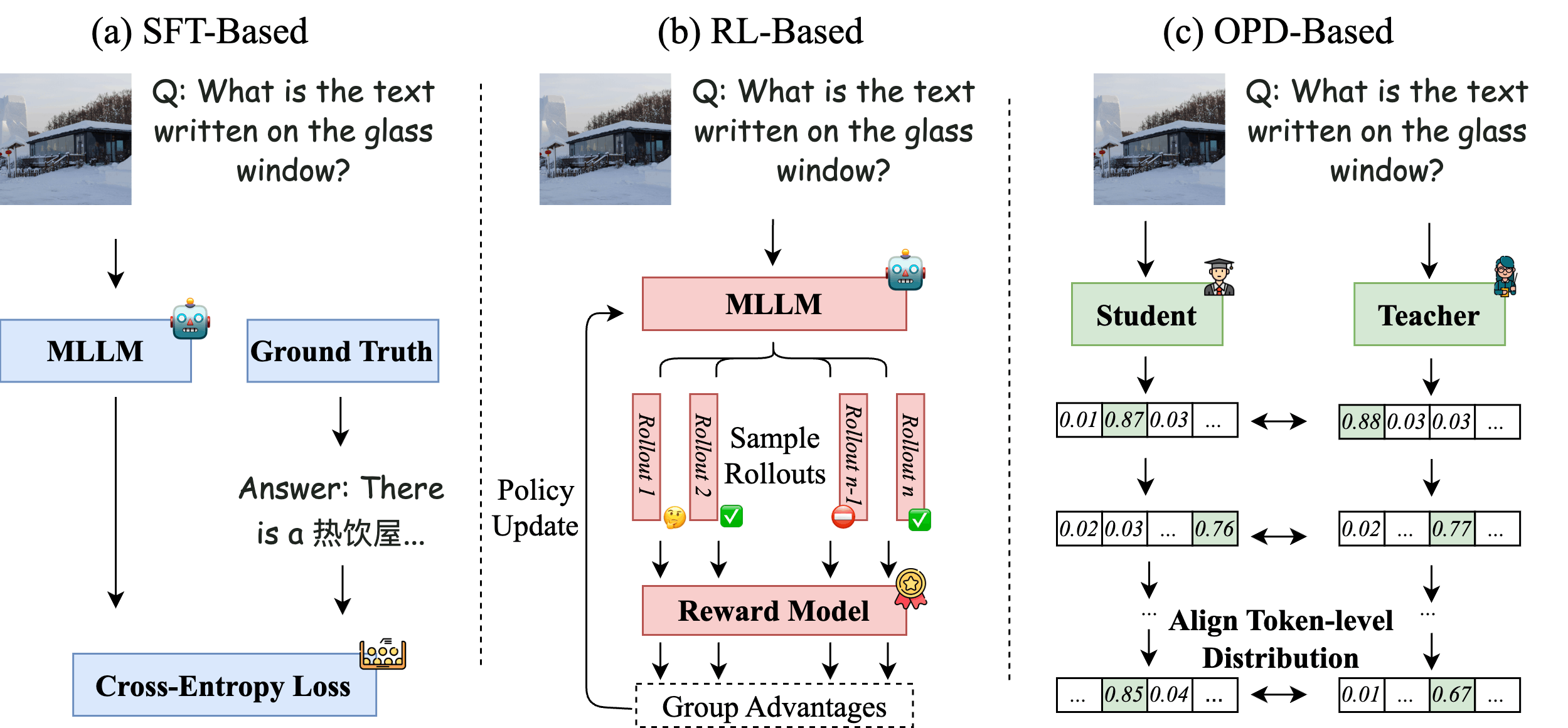
Figure 1: Distillation, reinforcement learning, and on-policy distillation differ in their reliance on answer labels and reward signals.
A pivotal insight is the revisit of OPD: while OPD provides dense token-level corrections on student-induced trajectories, it lacks explicit trajectory-level discrimination, leading to local corrections even along globally erroneous reasoning paths. V-Zero addresses this by leveraging contrastive evidence gating—the teacher evaluates student trajectories under both positive (target-region crop) and negative (irrelevant crop) visual views, producing trajectory-level signals that modulate token-level distillation.
Methodology
Negative-Free Stop-Gradient Alignment and Teacher-Side Evidence
OPD is formulated as a negative-free stop-gradient alignment on student-generated states, optimizing student predictions to match the teacher's output conditioned on identical prefixes. Extending to privileged teacher-side views, the teacher's context includes additional visual evidence unavailable to the student, such as a region crop.
Contrastive Evidence Gating
V-Zero introduces trajectory-level discrimination via contrastive evidence gating:
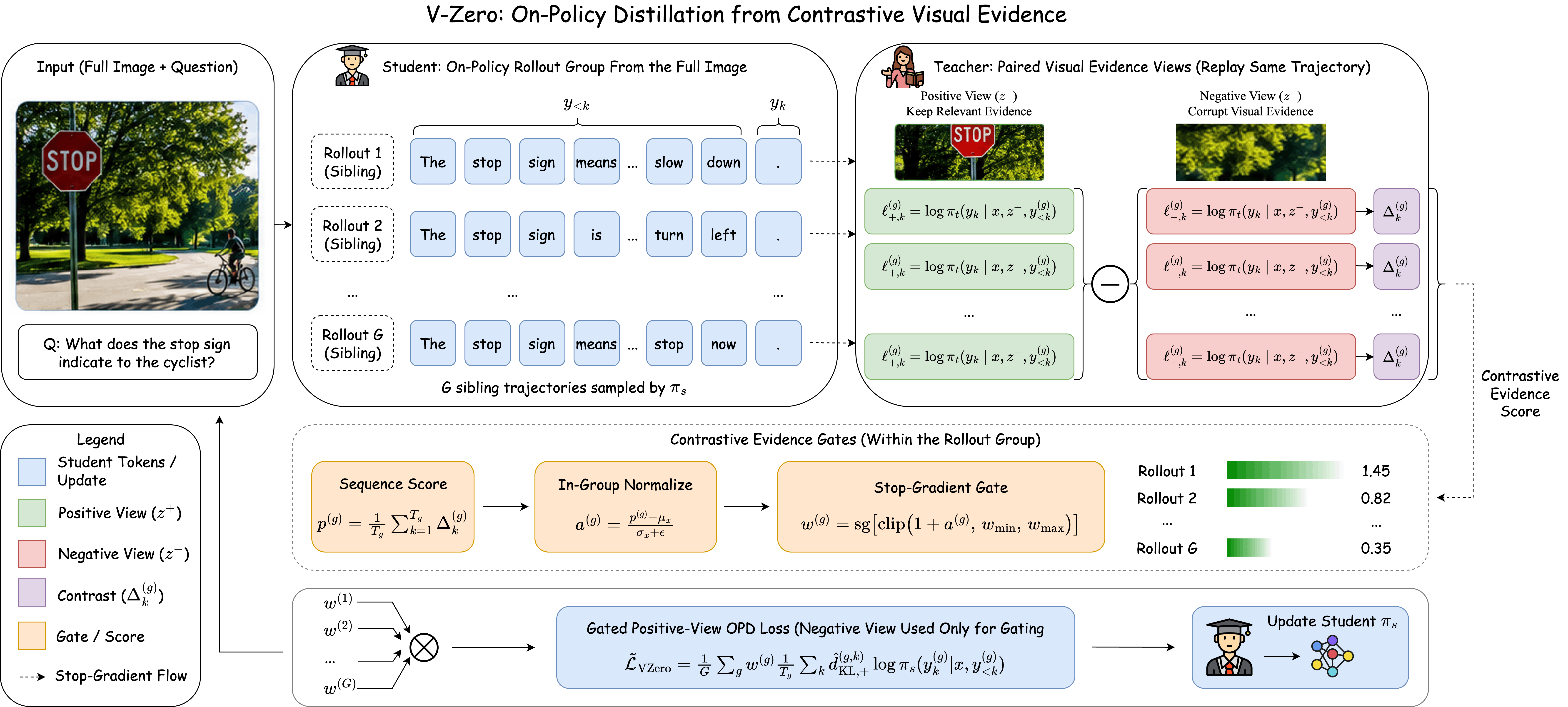
Figure 2: V-Zero workflow: student rollouts from the full image, teacher-side evidence comparison between positive and negative views, and trajectory-level evidence gating.
- The student samples multiple sibling rollouts per prompt; the teacher evaluates each trajectory with both a positive view (relevant region crop) and a negative view (random equal-size crop, downsampled from outside the relevant region).
- The difference in teacher log-probabilities across views computes a visual evidence gap per token; these gaps are aggregated to produce a normalized trajectory-level evidence advantage.
- The evidence gate w(g) amplifies OPD updates for trajectories strongly supported by the positive visual evidence and suppresses those ungrounded under the negative view, with clipping for numerical stability.
After gating, token-level distillation proceeds from the positive teacher view only, ensuring that dense supervision is restricted to trajectories reliably supported by task-relevant evidence—without explicit answer labels or external reward signals.
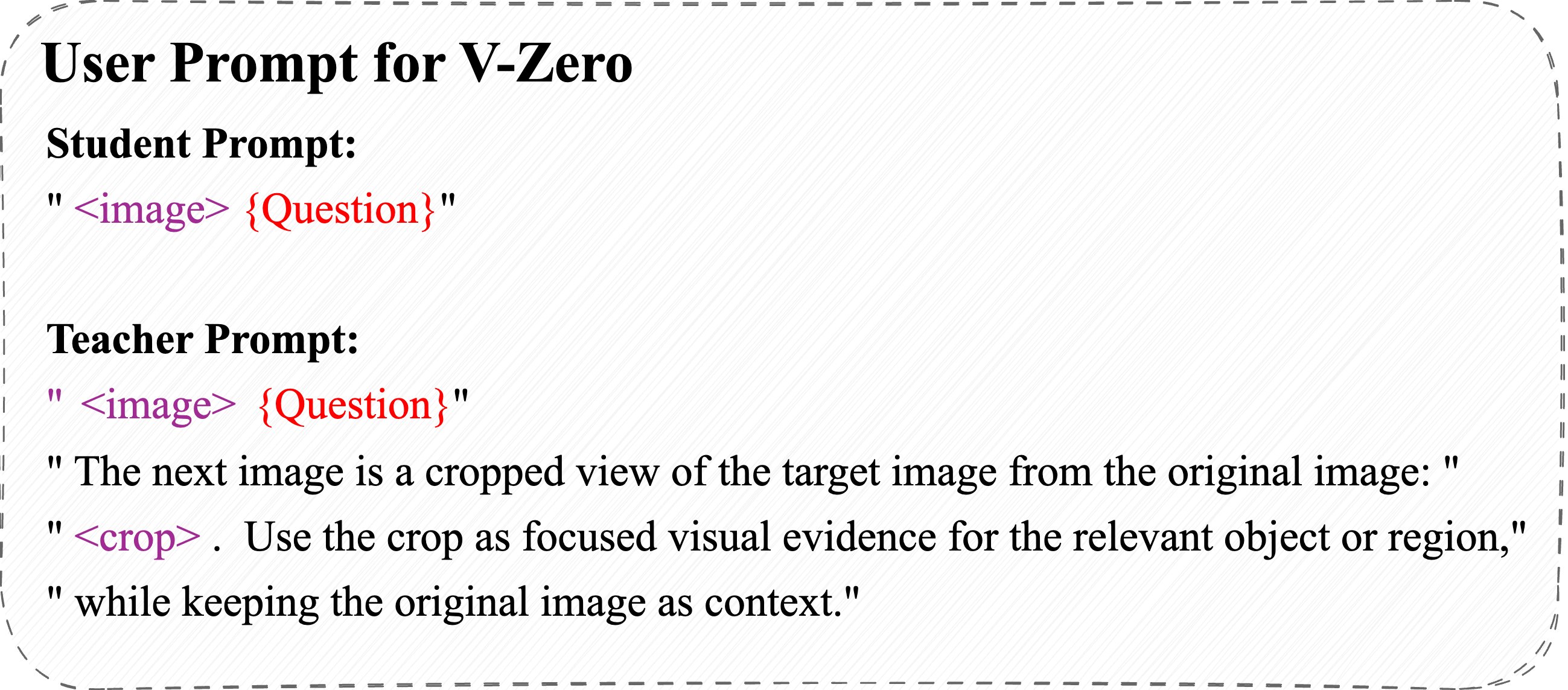
Figure 3: V-Zero prompt format with full image/question to student and additional region crop for teacher during training.
Experimental Evaluation
V-Zero is evaluated on multiple benchmarks for fine-grained visual reasoning, high-resolution perception, and OOD generalization, utilizing Qwen3.5-4B as student and Qwen3.5-27B as teacher. The dataset contains full images, questions, and region crops; negative crops are generated via random sampling post-downsampling.
Key results:
Attention visualizations reveal that V-Zero consistently activates the correct regions correlating to the reasoning subtask (e.g., text on poster, traffic sign, spatial relationships between vehicles), surpassing rival MLLMs and agentic baselines in visual grounding intensity and coverage.
Implications and Future Directions
V-Zero establishes that dense on-policy distillation from teacher-side paired evidence views, modulated by normalized trajectory-level contrastive gating, enables answer-label-free training for fine-grained visual reasoning with strong performance and efficiency. This approach circumvents RL reward engineering, reduces annotation demands, and avoids catastrophic forgetting typical of broad SFT.
Theoretical implications span hybrid distillation objectives; combining trajectory-level signals with token-level correction addresses weaknesses related to globally erroneous trajectories in classical OPD. Practically, V-Zero's inference setup remains unchanged—full-image input with no specialized visual search or tools—offering direct applicability to MLLM deployment.
Future developments could encompass richer evidence view generation, self-distillation paradigms (e.g., teacher-student swapping under different evidence sets), integration with tool-based agentic search, and extensions to temporal/video-based reasoning scenarios. The approach also offers insights into continual learning schemes where OPD and contrastive gating mitigate forgetting and improve grounding.
Conclusion
V-Zero advances the methodological landscape for fine-grained visual reasoning in MLLMs by eliminating reliance on answer labels, reward signals, and heavy annotation. Contrastive evidence gating from paired teacher visual views boosts trajectory-level discrimination, supporting efficient and consistent performance improvements across benchmarks. The paradigm demonstrates the power of teacher-side privileged supervision for multimodal distillation, opening avenues for scalable and generalizable visual reasoning models without intrusive modifications to inference protocols (2606.25319).