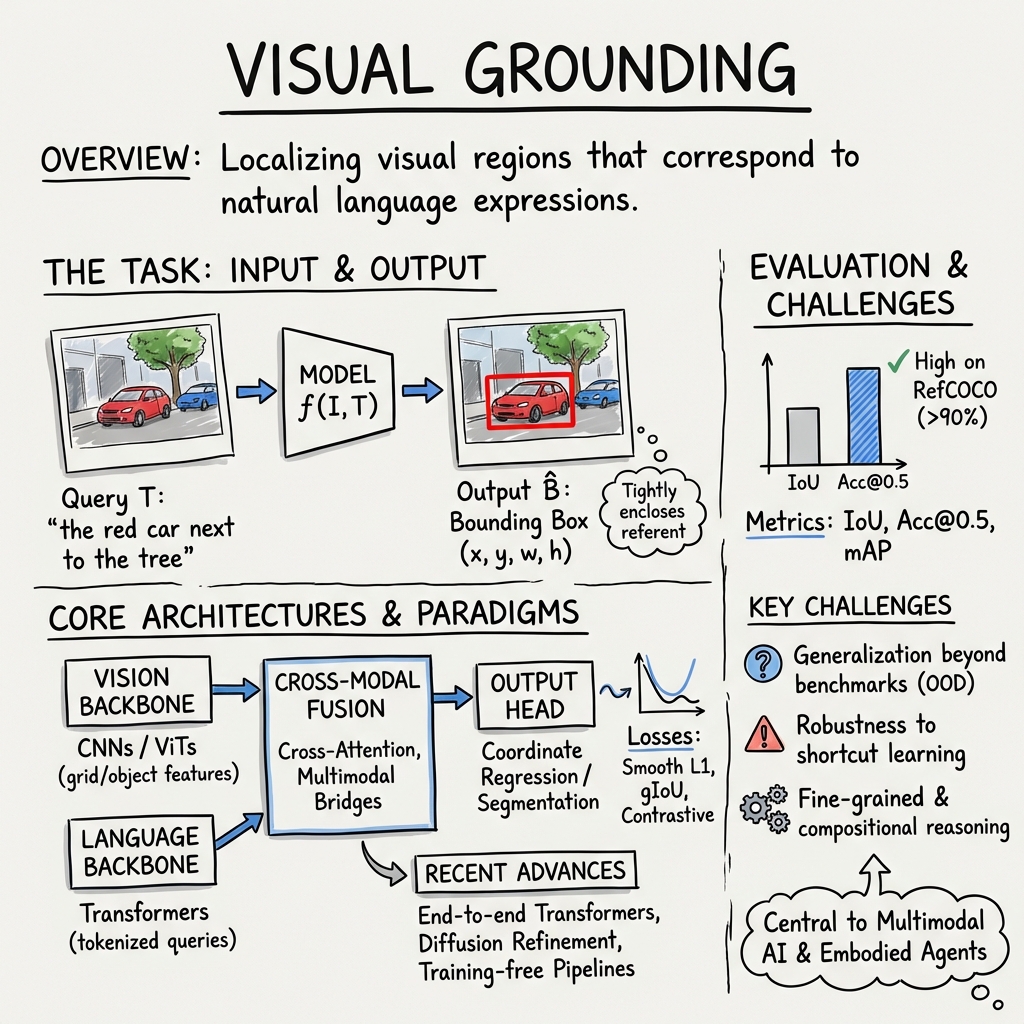
Visual Grounding: Aligning Vision & Language
- Visual Grounding is a cross-modal task that maps natural language queries to precise image regions using bounding boxes, masks, or object proposals.
- Modern approaches utilize CNNs, Transformers, and cross-modal fusion techniques, employing metrics like IoU and mAP to evaluate performance.
- Applications include referring expression comprehension, multimodal dialogue, and interactive agent instruction, driving robust advances in vision–language AI.
Visual grounding is the task of localizing regions in visual data (typically images or videos) that correspond semantically to free-form natural language expressions. It underpins a wide array of vision-language applications, including referring expression comprehension, fine-grained question answering, multimodal dialogue, and instruction following in embodied or interactive agents. Modern research frames visual grounding as a canonical problem of cross-modal alignment: learning to map between linguistic queries of arbitrary structure and spatially precise visual representations such as bounding boxes, segmentation masks, or object proposals. This article details foundational definitions, methodological advances, evaluation strategies, and recent directions in the technical development of visual grounding.
1. Formal Definitions and Problem Scope
The visual grounding task is formally specified as follows: Given an image (or video), and a natural language expression , the model seeks to predict a spatial localization such that tightly encloses the visual entity or entities referred to by (Xiao et al., 2024, Pantazopoulos et al., 12 Sep 2025). The spatial localization can take forms:
- Bounding box:
- Segmentation mask:
- Multiple regions: generalized visual grounding supports , including zero objects (for expressions with no referent)
Mathematically,
with trained to maximize a compatibility score 0, often decomposed as a fusion network over visual and linguistic features. Models are typically supervised with box-level or mask-level labels and use loss functions such as intersection-over-union (IoU), generalized IoU (gIoU), and cross-entropy over region proposals (Pantazopoulos et al., 12 Sep 2025, Xiao et al., 2024).
2. Core Architectures and Training Paradigms
Recent architectures for visual grounding exhibit several canonical patterns (Pantazopoulos et al., 12 Sep 2025, Xiao et al., 2024):
- Vision backbone: Convolutional Neural Networks (CNNs; e.g., ResNet) or Vision Transformers (ViT/DETR-style) extract grid or object-centric visual features. Multilevel token outputs, as in CLIP ViT, are increasingly leveraged.
- Language backbone: Transformer-based encoders (BERT, ALBERT, LLMs) process tokenized queries, with or without explicit parsing of structure (e.g., language scene graphs (Liu et al., 2019)).
- Cross-modal fusion: Cross-attention modules, multimodal bridges, or hierarchical fusions integrate visual and textual features. Examples include text-guided self-attention within the visual encoder (Du et al., 2021) and explicit cross-modal bridge modules (Xiao et al., 2024).
- Conditional adaptation: Some models perform query-dependent adaptation of visual weights, either via low-rank adapters (HiLoRA (Xiao et al., 2024)), dynamic weight generation (MMCA (Yao et al., 2024)), or agentic reasoning using prompt-based LLMs (Luo et al., 24 Nov 2025).
- End-to-end transformers: Recent proposal-free approaches (VGTR, HiVG) regress coordinates directly without explicit region proposals or object detectors (Xiao et al., 2024, Du et al., 2021).
- Diffusion-based iterative refinement: LG-DVG formulates grounding as a sequential denoising process over box parameters, progressively aligning noisy candidates toward the referent (Chen et al., 2023).
The prevalent objective function includes smooth L1 loss on coordinates, gIoU loss, region–text alignment (contrastive losses), and, in hierarchical or graphical models, message passing with belief propagation or scene graph reasoning (Liu et al., 2019).
3. Evaluation Benchmarks, Metrics, and Empirical Results
Evaluation of visual grounding employs datasets and metrics that probe both generic and specialized capabilities (Xiao et al., 2024, Pantazopoulos et al., 12 Sep 2025). Core datasets include:
- RefCOCO, RefCOCO+, RefCOCOg: MS-COCO images annotated with referring expressions; varying in length and use of location words.
- ReferItGame, Flickr30k Entities: Phrase grounding with multiple noun-phrase–to–region associations per image.
- Generalized datasets: gRefCOCO, GigaGround for large-scale, multi-object, or open-domain grounding.
Standard evaluation metrics:
| Metric | Definition | Typical Use |
|---|---|---|
| IoU (Intersection/Union) | 1 | Localization accuracy |
| [email protected] | Fraction with 2 | Box accuracy |
| mAP | Mean average precision (often over IoU thresholds) | Multiple predictions |
| F1, Recall@K | Generalized/multi-object settings | Multi-instance |
State-of-the-art accuracy on RefCOCO testA ([email protected]) now reaches 94%, with advanced Transformer-based and CLIP-fine-tuned models dominating (Xiao et al., 2024). Specialized subfields, such as remote sensing or GUI grounding, introduce domain-specific metrics (e.g., precision at fine IoUs, central point validation) (Zhang et al., 2 Dec 2025, Dardouri et al., 2024).
4. Methodological Advances and Specialized Scenarios
The field has diversified across several fronts:
a) Multimodal Pre-training and Adaptation
Contrastively pre-trained image–text models (e.g., CLIP, SigLIP) deliver strong global alignment but are not inherently region-aware. Methods including adaptive cross-modal bridges and hierarchical fine-tuning (e.g., HiVG) address the gap between global pre-training and fine-grained grounding, achieving high accuracy with limited parameter updates (Xiao et al., 2024).
b) Joint Reasoning and Scene Graphs
Approaches such as JVGN exploit the compositional structure of referring expressions by forming language scene graphs and aligning them via probabilistic graphical models to visual candidates (Liu et al., 2019). This enables joint grounding of entities and relations, critical for longer or more ambiguous expressions.
c) Policy and RL-based Exploration
Progressive geospatial reasoning models (GeoViS) formulate search as a Markov Decision Process (MDP) with reward signals that jointly optimize semantic and geometric alignment, boosting performance on remote sensing tasks where targets are sparse and queries are relational (Zhang et al., 2 Dec 2025).
d) Zero-shot and Training-free Pipelines
Frameworks such as GroundingAgent compose open-vocabulary detectors, image captioners, and LLM reasoning in a modular instruction-following pipeline, achieving 65.1% zero-shot accuracy on RefCOCO without any task-specific finetuning (Luo et al., 24 Nov 2025).
e) Debiasing and Causality
Analysis of language–location confounds leads to debiasing strategies (Referring Expression Deconfounder, RED), injecting substitute confounders to recover causal effects of queries and mitigating shortcut learning (Huang et al., 2021). Theoretical work on “Visually Grounded Reasoning” (VGR) formalizes grounding as an axiomatic requirement for answer correctness in VQA, with OOD evaluations rigorously testing shortcut avoidance (Reich et al., 2024).
5. Extensions: Domains, Modalities, and Cross-linguality
Visual grounding extends beyond generic natural scenes:
a) Art, Remote Sensing, and Synthetic Domains
CIGAr adapts grounding pipelines to art images via context-infusion of metadata and scene descriptions, improving performance on artwork-centric datasets (e.g., Ukiyo-eVG) far beyond natural-image–trained models (Khan et al., 2024). GeoViS introduces reward-guided global-to-local search for remote sensing, handling tiny targets and intricate geospatial language (Zhang et al., 2 Dec 2025). Instruction Visual Grounding (IVG) targets GUI screens, jointly integrating OCR, object detection, and foundation models (Dardouri et al., 2024).
b) Egocentric and Intention Grounding
EgoIntention benchmarks visual intention grounding—localizing objects referenced by implicit affordances or intentions in egocentric video. Reason-to-Ground (RoG) instruction tuning disentangles intention reasoning from object selection, enabling robust handling of both explicit and implicit queries (Sun et al., 18 Apr 2025).
c) Video and Relation Grounding
vRGV extends grounding to the spatio-temporal domain, requiring identification of subject–predicate–object tuples over time, and leveraging hierarchical graphs plus attention-shifting message passing for relation localization in video (Xiao et al., 2020).
d) Multilingual and Interlingual Grounding
Linear alignment of word embeddings to vision spaces has demonstrated cross-lingual gains, especially when resource-rich and typologically similar languages co-train (e.g., English–German), though transfer is limited by morphological divergence as in Arabic (Mohammed et al., 2022).
6. Challenges, Limitations, and Future Directions
Despite rapid methodological progress, several principal challenges remain (Xiao et al., 2024, Pantazopoulos et al., 12 Sep 2025):
- Generalization beyond benchmarks: Most REC metrics saturate on core datasets; there is a need for multi-object, no-object, and higher ambiguity datasets with real-world referential variety and ecological validity.
- Robustness to shortcut learning: OOD test design (e.g., GQA-AUG) is critical for validating that models ground answers in the correct regions rather than exploiting dataset priors (Reich et al., 2024).
- Fine-grained, compositional, and numeric reasoning: Pixel-level or raw-coordinate grounding, open-set symbol grounding, and compositional tasks remain open.
- Joint reasoning and chain-of-thought: Integrating stepwise, interpretable chain-of-thought traces tied explicitly to image regions, especially in multimodal LLMs (Pantazopoulos et al., 12 Sep 2025).
- Efficient adaptation and scaling: Minimizing adaptation cost (HiLoRA, LoRA, MMCA), supporting gigapixel images, and crossing domain boundaries efficiently.
- Evaluation limitations: Reliance on IoU > 0.5 as the sole correctness measure ignores qualitative aspects of grounding (e.g., supporting-object accuracy, ambiguity handling, interpretable paths).
Active research directions include self-supervised region–text pre-training at massive scales, interactive and multimodal dialogue grounding, integration with embodied agents and real-world navigation, extending to video streams, and comprehensive cross-lingual pre-training (Xiao et al., 2024, Pantazopoulos et al., 12 Sep 2025).
7. Broader Context and Applications
Visual grounding is central to a spectrum of vision–language technologies:
- Referring expression comprehension and generation
- Instruction-following for artificial agents and UI automation
- Interactive multimodal dialogue and VQA
- Autonomous navigation and robotics (human–robot interaction)
- Medical and scientific imagery, remote sensing, and GIS applications
- Cross-lingual and multicultural multimodal information processing
Advanced architectures now routinely support multimodal chain-of-thought reasoning, fine-grained attribute localization, and strong cross-domain transfer. The integration of visual grounding into large multimodal LLMs underlies the shift toward more robust, generalist, and human-aligned AI systems (Pantazopoulos et al., 12 Sep 2025).