The Role of Feedback Alignment in Self-Distillation
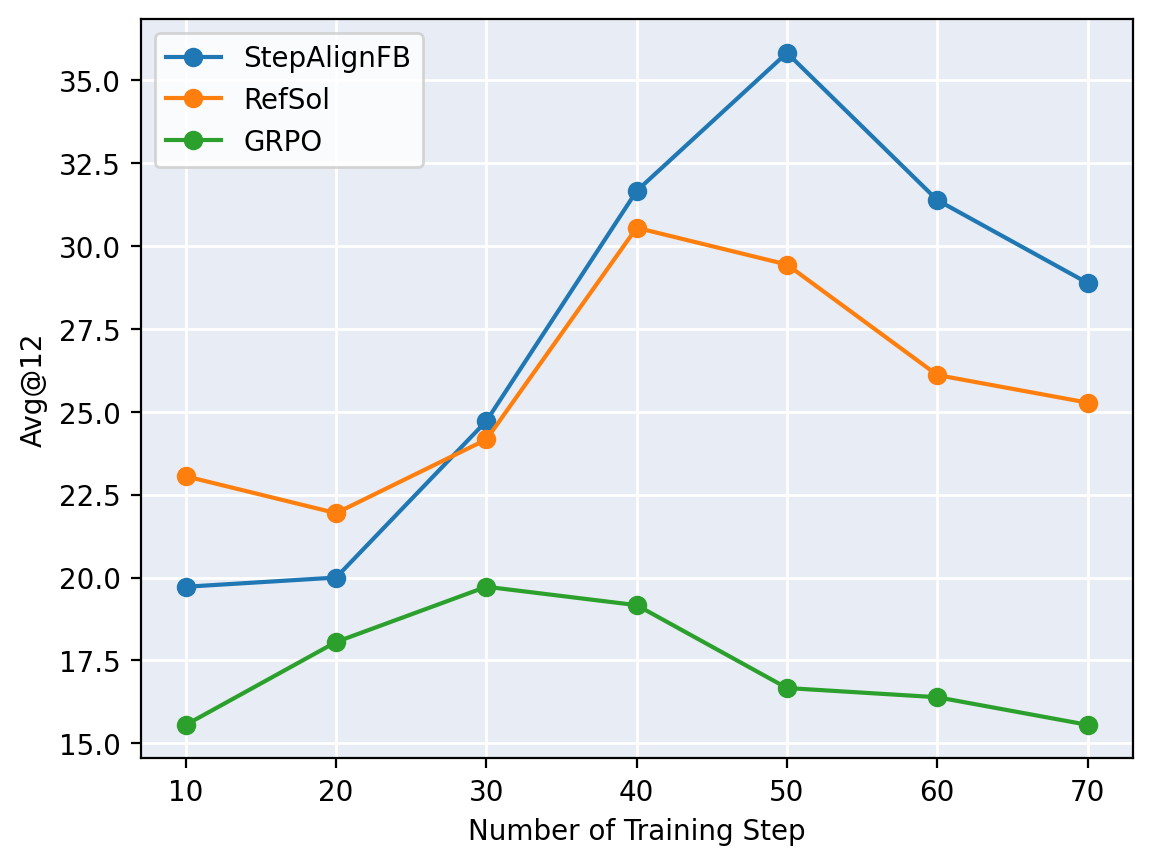
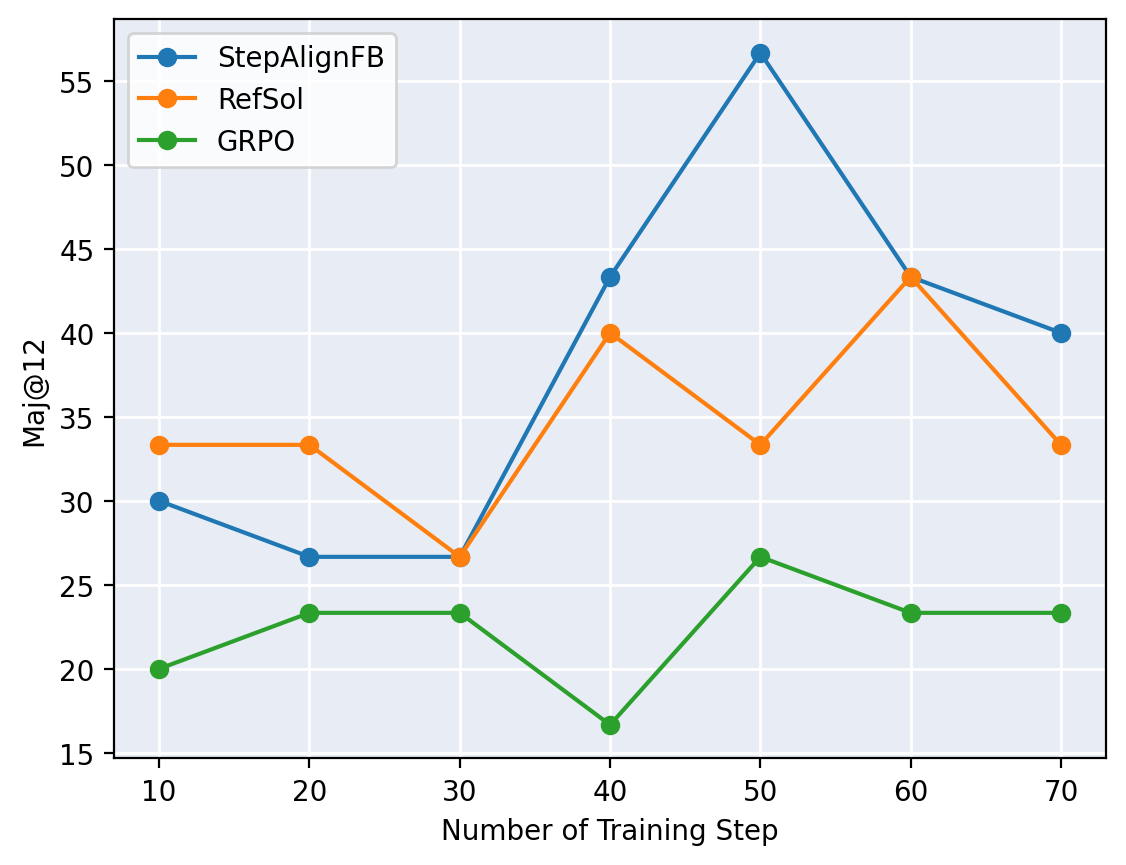
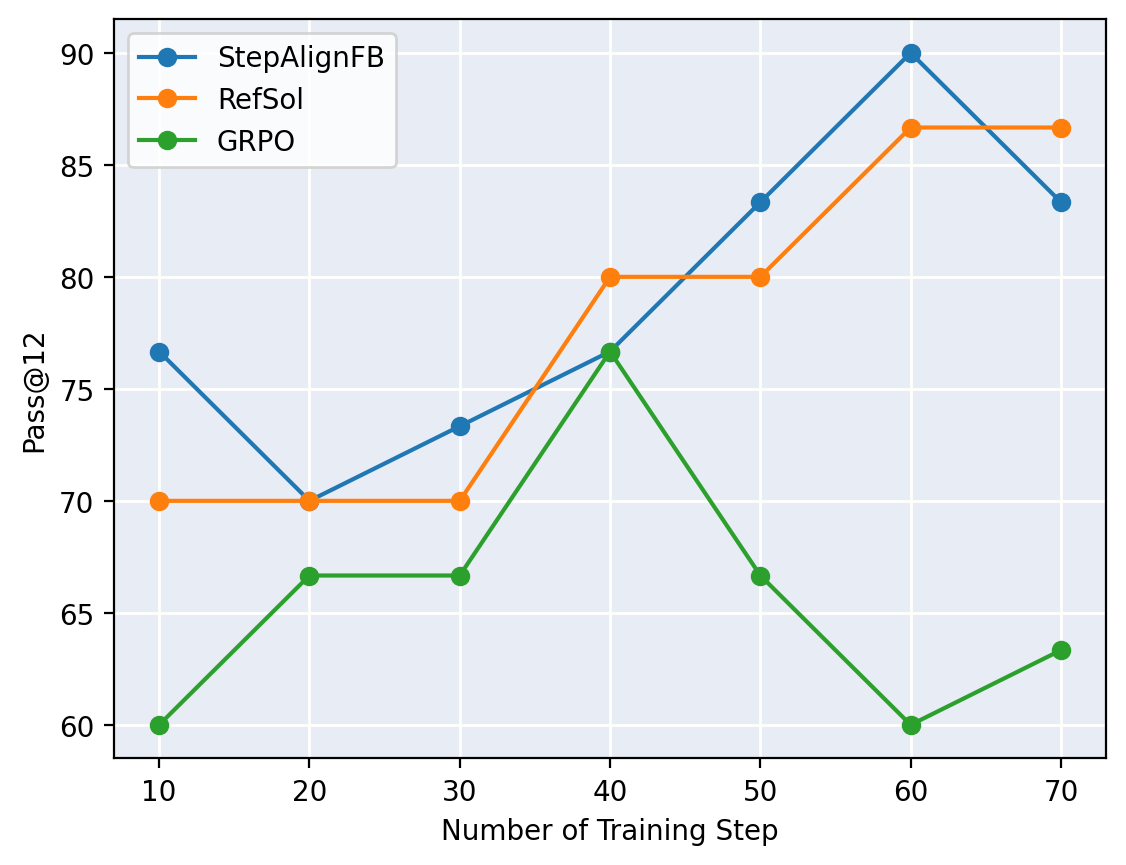
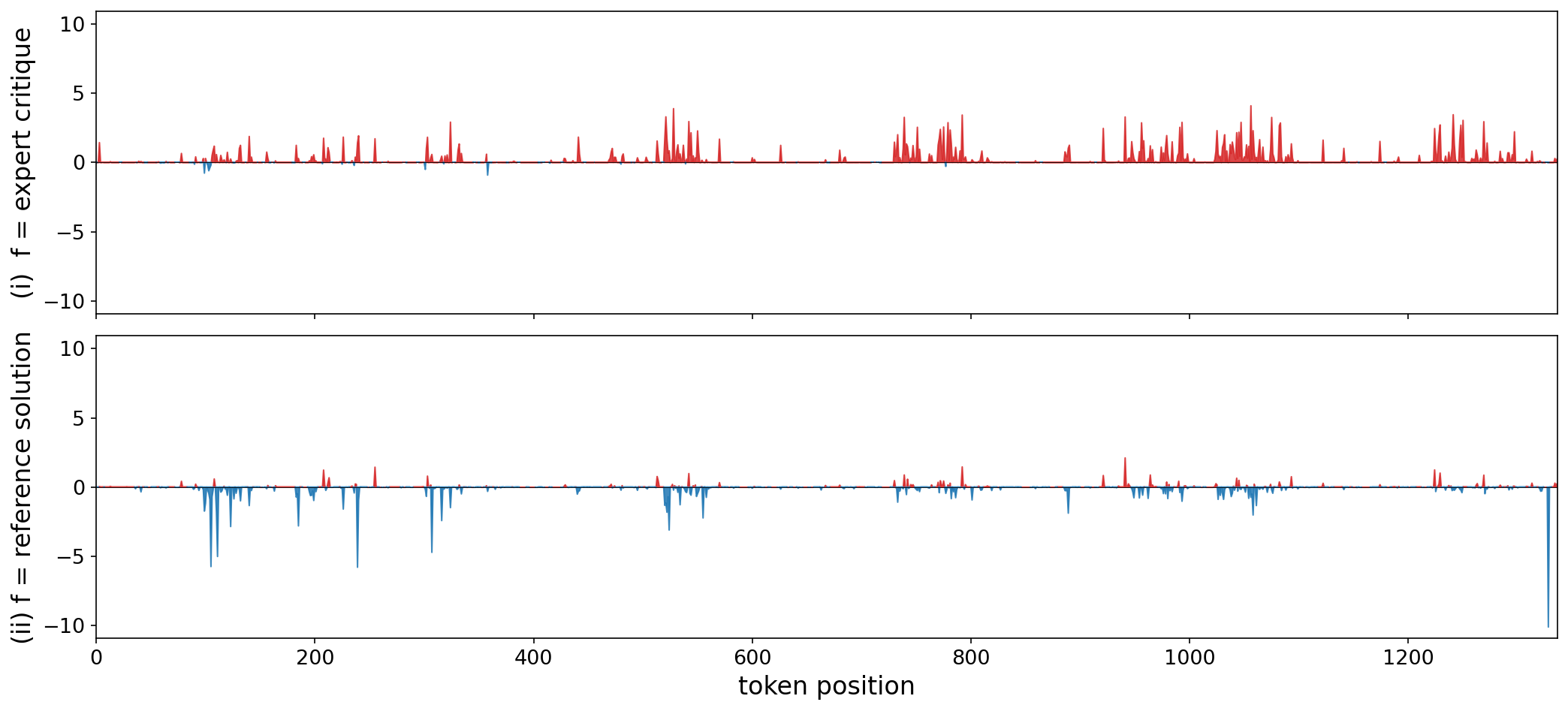
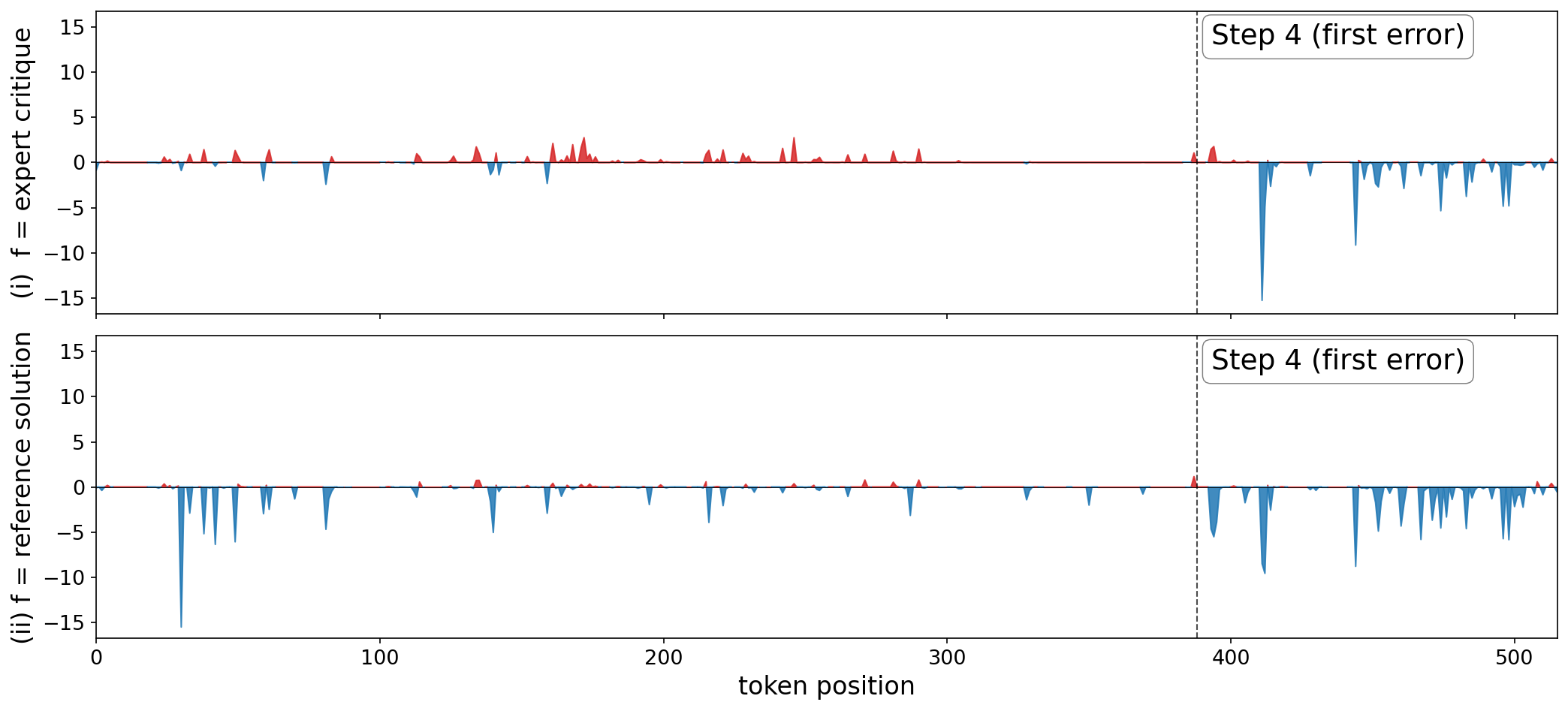
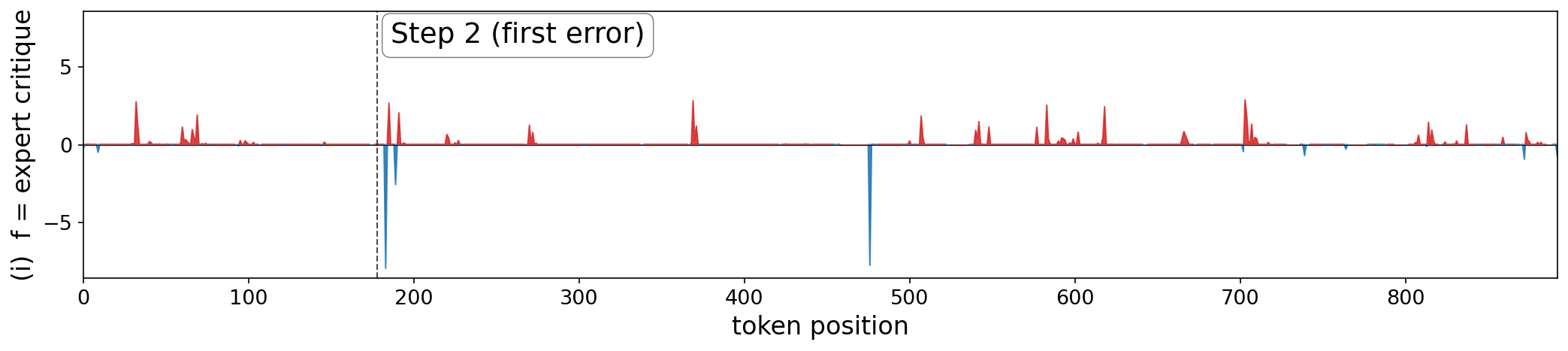
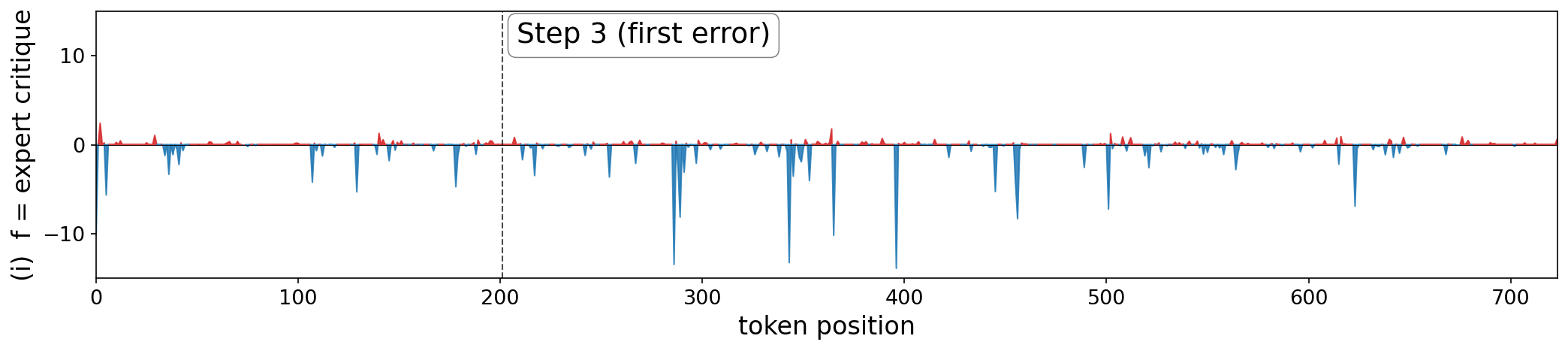
Abstract: Conditioning a LLM on additional context, such as feedback on a previous attempt, typically improves its response. Self-distillation trains the model to retain this improvement when the context is not present. The method works by matching the model's output distribution under two settings: a student that sees only the question, and a self-teacher that also sees the context. What the model learns therefore depends on what context the self-teacher receives, yet the design of this context remains largely unexplored. We study context design for self-distillation by training a solver on feedback from a frozen critic. We compare three conditions: (i) a binary reward (GRPO), (ii) the reference solution, and (iii) a step-by-step critique aligned to the solver's reasoning trace. Step-aligned critique yields the largest gains, outperforming GRPO by 16.11 points and reference-solution-conditioned self-distillation by 5.27 points (Avg@12). Per-token advantage analysis reveals why: step-aligned feedback targets only the tokens where reasoning fails, leaving correct behavior intact. Conditioning on the reference solution, by contrast, pressures the model to change its behavior at every token (even correct steps) because an alternative derivation inevitably differs in phrasing and approach. This suggests that structural alignment between feedback and the solver's reasoning is a key driver of self-distillation effectiveness.
Paper Prompts
Sign up for free to create and run prompts on this paper using GPT-5.
Top Community Prompts
Explain it Like I'm 14
Overview
This paper studies a simple question: if an AI gets helpful feedback while solving a problem, how can we train it to keep those improvements even when the feedback isn’t there next time?
The authors look at “self-distillation,” a training trick where the same AI plays two roles:
- Student: solves the problem normally.
- Self-teacher: solves the same problem but with extra hints (feedback).
By training the student to match what the self-teacher would do, the AI learns to improve its reasoning without always needing hints at test time.
Key Questions
The paper asks:
- What kind of feedback works best for self-distillation?
- Is it better to give a simple score, a full worked-out solution, or comments that line up step-by-step with the AI’s own work?
- Why does one type of feedback help more than the others?
Methods (Explained Simply)
Think of an AI “solver” as a student doing math problems. There’s also a fixed “critic” (like a teacher who doesn’t change) that reads the student’s work and returns feedback. The researchers tried three kinds of feedback:
- They compared these three setups while keeping everything else the same, to fairly test just the effect of feedback type.
Here’s what each feedback type looks like, in everyday terms:
- GRPO (grade only): The student gets an overall score like “right” or “wrong” at the end. No details on where it went wrong.
- Reference solution (full worked example): The student is shown a correct, complete solution written by someone else. It’s correct, but it may use different steps and wording than the student’s attempt.
- Step-aligned critique (comments on your own steps): The critic reads the student’s steps and gives targeted comments that match each step, copying correct steps exactly and fixing only the wrong parts. This keeps the good parts and points out exactly where and how to improve.
How training works:
- The student solves the problem.
- The critic gives feedback (one of the three types).
- The “self-teacher” is the same AI, but it solves the problem with the feedback in view.
- The student is trained to act more like the self-teacher would. In plain terms: “learn to do what you do when you have the helpful hints.”
A technical idea (in simple words):
- The authors look at how much each word the AI writes changes when it has the feedback. If a hint only changes the words right after a mistake, that’s a clean, focused learning signal. If the hint pressures the AI to change every word (even in already-correct steps), that’s a messy, noisy signal.
Main Findings
- The step-aligned critique worked best. It beat:
- The grade-only method by about 16 points on their main accuracy score (Avg@12).
- The full reference solution method by about 5 points (Avg@12).
- Why it works:
- Step-aligned feedback focuses on the exact steps that are wrong and leaves correct steps alone. That gives a precise “fix this part, keep that part” signal.
- Full reference solutions, while correct, often look different from the student’s solution (different words, order, or style). So the student feels pressure to rewrite everything—even the parts it got right—just to match the style. That blurs the learning signal.
- Bonus insight about copying:
- LLMs often copy patterns they see earlier in the text. If the critic repeats a student’s wrong step word-for-word, the model can get “stuck” copying the mistake. The authors found a smart rule: copy the student’s correct steps exactly, but rewrite the wrong steps. This uses the model’s copying behavior to reinforce what’s right and fix what’s wrong.
Why This Matters
- For training smarter reasoning AIs, the structure of feedback is as important as the quality of feedback.
- Step-by-step comments, aligned to the student’s own steps, help the model learn where it actually tripped up—like a good math teacher marking the exact line with the error and praising the correct parts.
- This approach gives the benefits of “process supervision” (rewarding good steps, not just final answers) without building a separate scoring model for each step.
Practical trade-offs:
- Step-aligned critiques require a strong critic model to write good, targeted feedback, which can cost more compute and setup.
- Reference solutions are easier to reuse but give noisier learning signals.
- Still, if you want the biggest accuracy gains from self-distillation, step-aligned feedback is the best bet in this study.
Takeaways and Future Impact
- Main takeaway: Align feedback to the student’s own steps. It teaches the model to fix mistakes without breaking what already works.
- Potential impact: Better training recipes for math and other multi-step reasoning tasks (like coding or science problems).
- What’s next: Test this approach on more datasets, model sizes, and tasks, and explore cheaper ways to generate high-quality, step-aligned critiques.
Knowledge Gaps
Knowledge gaps, limitations, and open questions
Below is a concise list of concrete gaps and open questions the paper leaves unresolved, aimed to guide future research:
- External validity beyond math: results are limited to a small, curated subset of OpenMathReasoning; it is unknown whether step-aligned feedback (StepAlignFB) transfers to other math benchmarks (e.g., MATH, GSM8K), code, scientific reasoning, multi-hop QA, or non-English tasks.
- Model scale sensitivity: only a 1.7B solver and a 32B critic are evaluated; how effects scale to larger/smaller solvers and different critic sizes remains untested.
- Critic quality ablation: no study of robustness to weaker, noisier, or partially incorrect critics; sensitivity curves versus critic accuracy, temperature, and decoding settings are missing.
- Dependence on reference solutions: StepAlignFB requires the critic to see a dataset reference solution; feasibility and effectiveness without ground-truth derivations (e.g., in real-world settings) are unexplored.
- Cost and latency accounting: the runtime, token, and dollar costs of generating step-aligned critiques (long prompts, vLLM prefix caching) versus GRPO and RefSol are not quantified; throughput and hardware utilization are unreported.
- Compute parity with GRPO: the “equal compute” claim is ambiguous (GRPO uses G=8 vs G=1 for self-distillation) and omits wall-clock/tokenized-cost comparisons; a rigorous, apples-to-apples compute/cost-accuracy trade-off is missing.
- Statistical power and stability: evaluation uses only 30 problems with no confidence intervals, variance across seeds, or repeated runs; statistical significance and result stability are unknown.
- Early stopping and checkpoint selection: best checkpoints are selected per metric over the test split; potential test-set leakage or selection bias is not ruled out; a proper validation set and fixed evaluation protocol are needed.
- Baseline coverage: comparisons exclude strong alternatives (e.g., PRM-trained RL, RLTF, DPO/IPO-style preference optimization, off-policy distillation from stronger teachers, verifier-guided bootstrapping); relative advantage remains uncertain.
- Divergence choices: only forward KL is used; reverse KL, JS divergence, or mixed objectives could alter advantage localization—no ablations are provided.
- Advantage weighting/masking: the method does not explore masking or reweighting per-token advantages (e.g., focusing on error-adjacent tokens); effect on credit assignment sharpness is unknown.
- Teacher design choices: the teacher is the same base model with “thinking-mode on” and adapters disabled; no ablation of using an external teacher, updating the teacher over training, or varying student/teacher temperatures.
- Step tagging dependence: StepAlignFB assumes step-tagged solver traces; whether it works with free-form rationales or automatically inferred steps (and how to align them robustly) is untested.
- Feedback-format ablation: the “faithful-scribe” convention is justified qualitatively; quantitative ablations on how much verbatim copying to include, where to truncate, and granularity of corrections are missing.
- Mechanistic validation: the induction-head copying hypothesis is not empirically tested (e.g., attention pattern analysis, causal interventions, controlled synthetic tasks) to confirm the proposed mechanism.
- Failure-mode handling: incomplete or low-quality student traces lead the critic to output full alternative solutions (diffuse signal); strategies to detect and mitigate this (e.g., hinting, partial rewrites, or budget-aware feedback) are not developed or evaluated.
- Data filtering bias: training data are filtered to ensure critic solvability and partial solver tractability; this may inflate gains; performance on unfiltered or harder distributions is unknown.
- Generalization under distribution shift: robustness when problem style, notation, or step granularity changes (including different sources of reference solutions or critic prompts) is not assessed.
- Interaction with PRMs and RL: combining StepAlignFB with process reward models, verifier consistency checks, or RLVR is not explored; potential complementarities and scheduling (e.g., interleaving phases) remain open.
- Noisy/adversarial feedback robustness: the method’s sensitivity to biased, off-topic, or adversarial critiques (and defenses such as consensus critics or confidence calibration) is unmeasured.
- Token budget and long-horizon scaling: experiments cap sequences at 2048 tokens; it’s unclear how step-aligned critiques scale to longer proofs/programs or multi-turn settings.
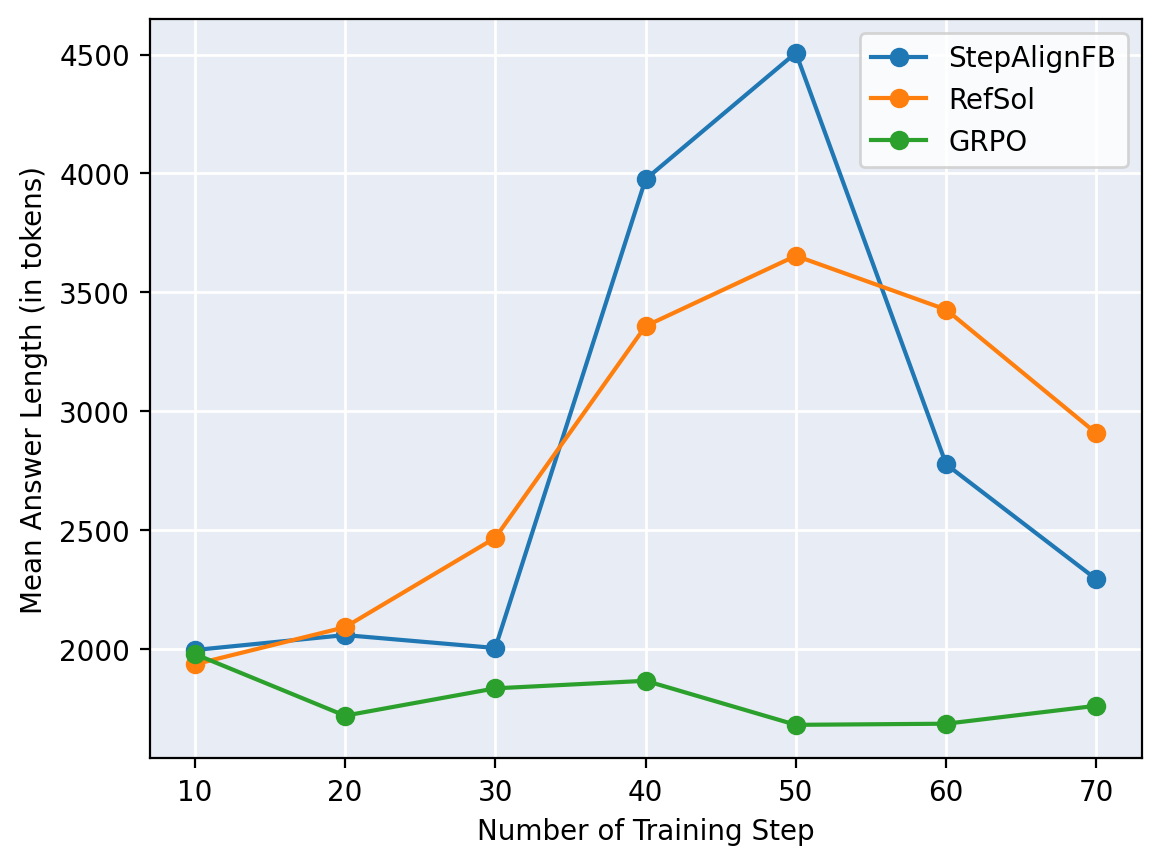
- Style drift and verbosity: self-distillation increases answer length; trade-offs between verbosity, cost, and accuracy (compute-accuracy curves, single-shot vs best-of-N) are not systematically characterized.
- Reusability/amortization of critiques: generating critique per rollout is costly; caching, retrieval, or training a lightweight “critic distillate” to amortize feedback is not investigated.
- Automatic error localization: StepAlignFB relies on the critic to locate and rewrite errors; methods for automatic, model-internal error-spotting to guide selective feedback are not studied.
- Reproducibility artifacts: while appendices are referenced, code, prompts, and checkpoints are not clearly released; exact seeds, run-to-run variability, and reproducibility guarantees are unspecified.
Practical Applications
Immediate Applications
The following applications can be deployed with current models, tooling, and datasets, leveraging the paper’s core result: step-aligned feedback (critique that mirrors the solver’s steps, copying correct steps verbatim and only rewriting incorrect ones) produces sharper, token-level learning signals than binary rewards or unaligned reference solutions.
- Self-distillation training upgrades for LLM teams
- Sector: software/AI, enterprise ML
- Use case: Replace or augment GRPO/RLHF with step-aligned self-distillation to improve small/medium models’ reasoning without access to stronger teachers’ logits or massive human labels.
- Tools/workflows: “StepAlign Critique Generator” (LLM-as-judge prompts implementing the faithful-scribe convention), on-policy self-distillation with forward KL, LoRA/QLoRA adapters, vLLM prefix caching, “Advantage Heatmap Explorer” to monitor per-token advantages and localize errors.
- Assumptions/dependencies: Access to a reasonably strong critic model; tasks with step-tagged reasoning traces; verifiable tasks or reliable reference solutions; guardrails for chain-of-thought handling and privacy.
- Math tutoring platforms with targeted, step-aligned feedback
- Sector: education
- Use case: Deliver hints that acknowledge correct steps verbatim and correct only erroneous steps; teacher dashboards that visualize where a student’s reasoning goes off-track.
- Tools/workflows: Step-aligned critique prompts; per-step correctness tagging; student-facing hint templates that avoid quoting the incorrect step verbatim; fine-tuned tutor models via self-distillation.
- Assumptions/dependencies: High-quality problem sets with reference solutions; content moderation and privacy; human oversight for young learners.
- Code assistants trained with trace-aligned critique
- Sector: software engineering
- Use case: Train/fine-tune code LLMs using step-aligned feedback derived from failing unit tests, linters, compiler errors, and static analysis—mapping failures to exact lines/edits and leaving correct code intact.
- Tools/workflows: Instrumented test runners and analyzers producing step-level diagnostics; hybrid critic (rules + LLM) that copies correct code spans verbatim and rewrites only faulty sections; self-distillation pipeline.
- Assumptions/dependencies: Good test coverage and diagnostics-to-step alignment; secure code handling; license compliance for training data.
- Inference-time self-correction loops
- Sector: cross-industry (helpdesks, analytics, research)
- Use case: For a single hard query, run a solver → step-aligned critic → corrected solver pass once or twice to improve accuracy without full retraining.
- Tools/workflows: One-round solver–critic prompting template with “faithful-scribe” rules; caching to control latency; aggregation strategies (e.g., majority vote).
- Assumptions/dependencies: Sufficient latency/compute budget; careful prompt design to avoid re-anchoring erroneous steps.
- Data curation: step-aligned rationale cleaning
- Sector: academia, data vendors, open-source
- Use case: Use a critic to repair and align community-collected chain-of-thought data so that correct reasoning is preserved verbatim and only errors are rewritten; filter diffuse or stylistically divergent rationales.
- Tools/workflows: Batch critique generation with prefix caching; QC sampling; deduplication; metadata tagging for step boundaries.
- Assumptions/dependencies: Availability of base rationales or reference solutions; cost to run critiques at scale.
- Process-aligned compliance checks for internal documents
- Sector: enterprise, finance, regulated industries (non-clinical use initially)
- Use case: Drafting/policy assistants that give step-by-step compliance feedback aligned to authors’ procedures, preserving correct steps and pinpointing violations.
- Tools/workflows: Policy-to-step mapping; LLM judge tuned to internal policy; self-distillation on curated internal corpora.
- Assumptions/dependencies: Access to up-to-date policies; PII and confidentiality controls; human review loops.
- Research diagnostics and evaluation
- Sector: academia, ML research/ops
- Use case: Use per-token advantage plots to diagnose where training pushes or suppresses behavior; detect diffuse suppression (a known failure mode of reference-solution conditioning) and verify concentrated signals from step-aligned critique.
- Tools/workflows: Logging of token-level logprobs; interactive advantage visualizer; triggers to halt training when advantages become diffuse.
- Assumptions/dependencies: Probabilities/logits accessible during training; storage budget for traces; privacy-preserving logging.
Long-Term Applications
These opportunities require additional research, domain adaptation, scalable pipelines, or regulatory clearance beyond today’s math-centric evaluation.
- Safety-critical decision support with process-aligned feedback
- Sector: healthcare, legal, aviation, finance risk
- Use case: Critics grounded in clinical guidelines or legal precedents provide step-aligned oversight on diagnostic differentials, treatment rationales, or legal argumentation; training via self-distillation yields process-consistent models.
- Tools/workflows: Domain-specific critics with retrieval-augmented grounding; human-in-the-loop verification; audit trails of step-level corrections.
- Assumptions/dependencies: Rigorous validation, calibration, and regulatory approval; robust grounding and hallucination controls; expert-curated step schemas.
- Robotics and planning with simulator-aligned critique
- Sector: robotics, logistics, autonomous systems
- Use case: Convert plan execution traces into step-level critiques using simulators to identify the first failing action; self-distill to improve planning policies while preserving correct action prefixes.
- Tools/workflows: Trace segmentation from tokens to actions; simulator-based validators; action-level advantage visualization.
- Assumptions/dependencies: Accurate step/action mapping; sim2real transfer; safety constraints and recovery.
- Tool-using autonomous agents with action-aligned self-distillation
- Sector: software automation, IT Ops, data engineering
- Use case: Agents that sequence tool calls (SQL queries, API requests) receive step-aligned feedback on failing calls (e.g., schema mismatch), improving reliability without training a separate PRM.
- Tools/workflows: Telemetry that links errors to exact tool calls; critics that propose minimal corrections; hybrid symbolic-LLM judges.
- Assumptions/dependencies: High-fidelity logs; robust sandboxing; standardized tool schemas.
- Low-resource and on-device models with process-aware training
- Sector: mobile, edge AI, embedded
- Use case: Use step-aligned self-distillation to compress reasoning improvements into small models without teacher logits, enabling on-device reasoning tutors/coders.
- Tools/workflows: QLoRA/quantization; distilled critics; curriculum that maximizes critique quality per token budget.
- Assumptions/dependencies: Efficient critics or cached critique corpora; memory/latency constraints; domain-specific step schemas.
- PRM-less reinforcement learning via textual process feedback
- Sector: AI research and platforms
- Use case: Replace expensive PRM training with step-aligned textual critics across domains; unify RL and self-distillation objectives that exploit per-token advantages from feedback-aligned teachers.
- Tools/workflows: Hybrid KL–RL objectives; critic quality estimation; stability controls for large-scale runs.
- Assumptions/dependencies: Reliable critic quality signals; convergence analyses; scaling-friendly system design.
- Multimodal step-aligned feedback (vision, diagrams, tables)
- Sector: education, engineering design, medical imaging
- Use case: Visual critics reference regions (e.g., bounding boxes) and provide step-aligned textual corrections; self-distill multimodal models to follow visual reasoning steps.
- Tools/workflows: VLM critics with region grounding; multimodal step tagging; datasets with aligned visual steps.
- Assumptions/dependencies: New datasets and annotation tools; robust grounding to avoid spurious attributions.
- Standardization and policy for process-aligned training and auditing
- Sector: policy/regulation, procurement, compliance
- Use case: Procurement checklists and standards that favor process-aligned feedback for training and mandate step-level audit artifacts (“process evidence records”) for high-stakes deployments.
- Tools/workflows: Evaluation benchmarks that score step localization, not just final accuracy; model cards documenting feedback structures and advantage diagnostics.
- Assumptions/dependencies: Community and regulator buy-in; privacy-safe handling of chain-of-thought; harmonization with IP/licensing norms.
- Scalable critique corpora and cheaper critics
- Sector: data platforms, foundation model labs
- Use case: Large, diverse repositories of step-aligned critiques (math, logic, coding, reasoning over documents) that can be reused across training runs; research into lighter critics that approximate strong judges at lower cost.
- Tools/workflows: Data generation pipelines, deduplication, automatic QC; student–critic co-training to distill judges.
- Assumptions/dependencies: Cost control, IP/attribution management; measures of critic faithfulness and bias.
- Mechanistic control of copying vs. correction
- Sector: AI safety/interpretability
- Use case: Use advantage heatmaps and induction-head probes to control when models copy prefixes vs. follow corrections, reducing error reinforcement and improving credit assignment.
- Tools/workflows: Circuit-level probes; training-time regularizers that penalize harmful copying; interventions for context placement.
- Assumptions/dependencies: Stable interpretability methods; transferability across architectures.
- Enterprise knowledge workflows with step-preserving transformation
- Sector: knowledge management, documentation, SOP authoring
- Use case: Systems that transform procedures while preserving verified steps verbatim and only rewriting errors/gaps; continuous self-distillation with step-aligned critics to keep SOPs consistent and auditable.
- Tools/workflows: SOP step extractors; change-trackers linked to advantage signals; approval workflows.
- Assumptions/dependencies: Up-to-date knowledge bases; governance for edits; versioning and access control.
Glossary
- AdamW: An optimizer that decouples weight decay from the gradient update, improving generalization during training. "with AdamW"
- Advantage (per-token): In self-distillation/RL-style training, the token-level signal measuring how much context shifts the model’s next-token prediction. "Per-token advantage analysis reveals why:"
- Avg@12: The mean fraction of correct answers across 12 sampled generations per problem. "Avg@12 (mean fraction of correct samples)"
- bf16 precision: A 16-bit floating-point format (bfloat16) used to reduce memory and improve throughput in training. "bf16 precision"
- Chain-of-thought (CoT): Step-by-step natural-language reasoning included with solutions to guide or supervise models. "A chain-of-thought reference solution produced by a stronger model"
- Credit assignment: The problem of attributing success or failure to specific steps/tokens in a sequence, crucial for learning from long reasoning traces. "making credit assignment difficult."
- DeepSpeed ZeRO-2: A distributed training optimization that partitions optimizer states/gradients to reduce memory footprint. "Distributed training uses DeepSpeed ZeRO-2 with CPU optimizer offload"
- Flash Attention 2: A memory- and compute-efficient attention algorithm that accelerates transformer training/inference. "Flash Attention 2"
- Forward KL: The forward Kullback–Leibler divergence D_KL(p||q) used here as the per-token distillation objective. "Divergence measure is forward KL."
- Gradient checkpointing: A memory-saving technique that recomputes activations during backpropagation. "gradient checkpointing"
- GRPO: Group Relative Policy Optimization, an RL method that uses group-normalized, rollout-level rewards for policy updates. "GRPO estimates per-rollout advantages via group normalization:"
- Group normalization (of rewards): Normalizing rewards within a group to compute relative advantages and stabilize learning. "estimates per-rollout advantages via group normalization:"
- Group-relative advantage estimate: An advantage computed by comparing a rollout’s reward to others in the same group. "group-relative advantage estimate"
- Induction heads: Attention heads that learn to copy continuations when a prior prefix reappears in context. "prefix-matching-and-copying behavior of induction heads"
- In-context copying: A model behavior where it reproduces tokens that follow a previously seen prefix in the context. "in-context copying behavior"
- Janson-Shannon divergence: The (intended) Jensen–Shannon divergence; a symmetric measure used to compare probability distributions. "per-token divergence (forward KL, reverse KL, or Janson-Shannon divergence)"
- KL clipping: Capping the per-token KL contribution to prevent extreme gradients during distillation. "no per-token KL clipping"
- Knowledge distillation: Training a student to match a teacher’s output distribution, typically via KL divergence. "Knowledge distillation trains a student model"
- Logits: Pre-softmax scores over the vocabulary used to compute predicted token probabilities. "requires access to the logits of a strong teacher"
- LoRA: Low-Rank Adaptation; fine-tuning by injecting low-rank updates into weight matrices. "LoRA adapters are trained on all attention and MLP projections"
- Majority-Vote@12: Whether the majority answer among 12 samples is correct. "Majority-Vote@12 (correctness of the majority answer)"
- Off-policy: Training on trajectories generated by a different policy than the current one, which can cause drift. "Standard distillation is also off-policy:"
- On-policy: Training on trajectories sampled from the current policy, reducing distribution mismatch. "All rollouts are sampled on-policy,"
- On-policy distillation: Distillation where the student generates its own rollouts and is trained with token-level signals from a teacher. "On-policy distillation addresses this by having the student generate its own rollouts"
- Outcome supervision: Supervision that evaluates only the final answer, not intermediate reasoning steps. "consistently outperform outcome supervision"
- Pass@12: Whether at least one of 12 samples for a problem is correct. "Pass@12 (fraction of problems with at least one correct sample)"
- Process Reward Model (PRM): A model that assigns rewards to individual reasoning steps rather than only outcomes. "The localization mirrors what a PRM provides"
- Process supervision: Supervision that evaluates intermediate reasoning steps to localize and correct errors. "provides richer-than-scalar process supervision"
- Reference solution (RefSol): A canonical or ground-truth derivation used as teacher context for supervision. "RefSol (reference solution)."
- Reinforcement learning from verifiable rewards (RLVR): RL using automatically checkable rewards (e.g., answer correctness) instead of a teacher. "reinforcement learning from verifiable rewards (RLVR)"
- Reverse KL: The reverse Kullback–Leibler divergence D_KL(q||p), often used in on-policy distillation/RL-style objectives. "reverse KL"
- Rollout: A complete model response sampled to a prompt, treated as one trajectory. "a rollout is the model's complete response to a prompt."
- Self-distillation: Using the same model as both student and teacher under different contexts, minimizing divergence between their token distributions. "Self-distillation trains the model to retain this improvement when the context is not present."
- Solver–critic setup: A two-agent scheme where a solver produces answers and a critic supplies feedback used as context. "Solver--critic training loop."
- Step-aligned feedback (StepAlignFB): Per-step critique aligned to the solver’s own reasoning trace to localize corrective signals. "StepAlignFB outperforms GRPO and RefSol."
- Step-tagged reasoning traces: Reasoning outputs with explicit step markers to structure and align critiques. "generates step-tagged reasoning traces"
- Stop-gradient: An operation that prevents gradients from flowing through a variable during backpropagation. "denotes stop-gradient."
- Token budget: The maximum token cap allowed for generation, after which decoding stops. "exhausted the token budget without producing a final answer."
- Token-level supervision: Supervision applied at each token (dense), rather than only at sequence level (sparse). "dense, token-level supervision"
- vLLM: A high-throughput LLM serving engine used for fast on-policy generation during training. "served in-process by vLLM"
Collections
Sign up for free to add this paper to one or more collections.

