- The paper introduces a frequency-domain regularization strategy that aligns wavelet subband statistics, overcoming oversmoothing in 3D Gaussian Splatting.
- It integrates multi-scale wavelet alignment, supervised kurtosis concentration, and cross-band covariance penalties to preserve fine structural details.
- Experimental results demonstrate up to a 9.48% improvement in perceptual metrics, validating robustness even with sparse-view inputs.
Kurtosis-Constrained 3D Gaussian Splatting for High-Fidelity View Synthesis
Introduction
3D Gaussian Splatting (3DGS) has become an essential approach for real-time novel view synthesis (NVS), leveraging explicit scene representation via anisotropic Gaussians and differentiable rasterization. Standard pipelines employ pixel-space reconstruction losses (L1, SSIM), which, while optimizing global distortion measures, are insufficient for enforcing high-frequency and structural fidelity—especially in underconstrained sparse-view regimes. These limitations result in oversmoothing, floaters, and spatially incoherent artifacts, as pixel-based objectives permit “error redistribution” across frequency bands, ignoring the statistical regularities of natural images.
KC-3DGS introduces wavelet-domain regularization to 3DGS, explicitly constraining rendered images to match the kurtosis statistics and cross-band relationships characteristic of natural scenes. The methodology integrates multi-scale, frequency-aware losses directly into existing 3DGS architectures without architectural modifications, providing a plug-and-play solution for enhanced perceptual quality and robustness, even under challenging, real-world sparse-view settings.
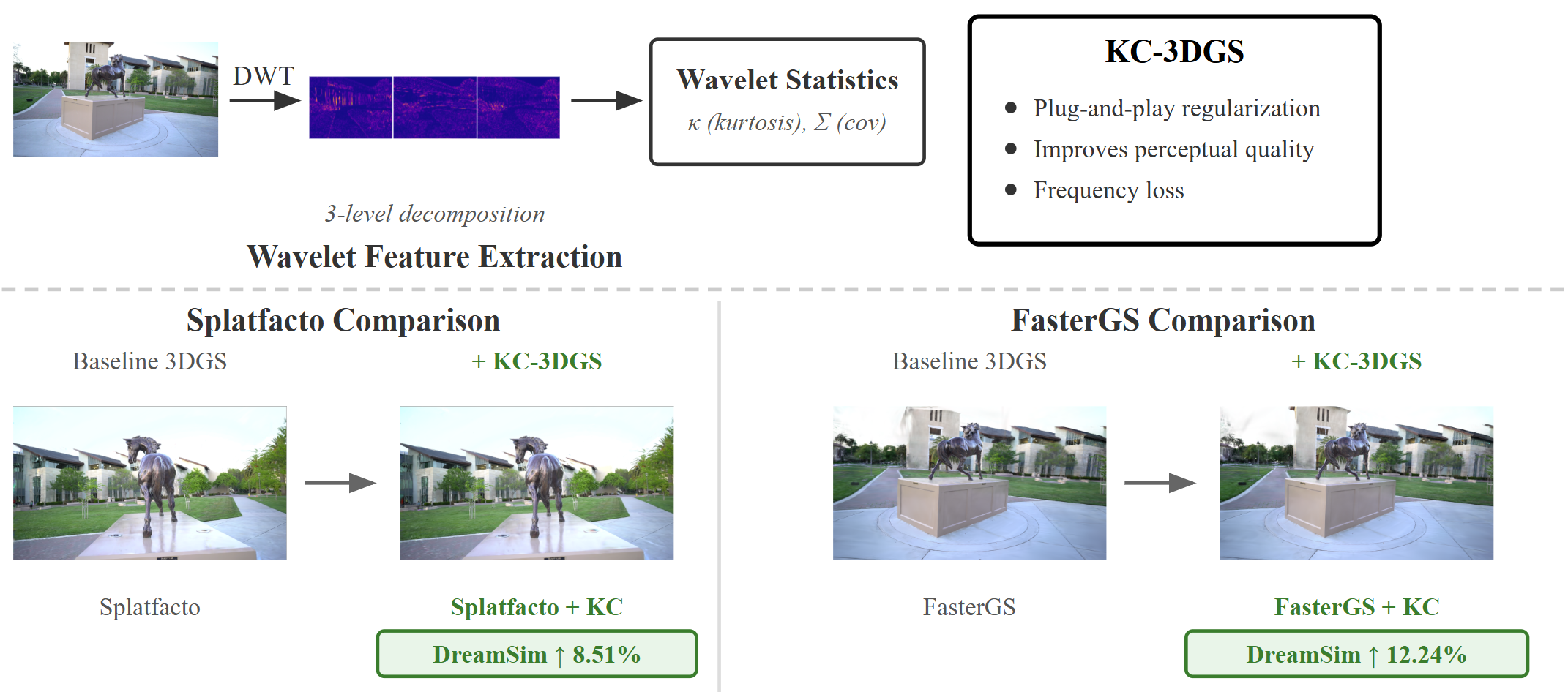
Figure 1: Overview of KC-3DGS; wavelet features are extracted via a 3-level DWT, and frequency-domain loss terms regularize the Gaussian splatting process to enhance perceptual realism.
Methodology
KC-3DGS augments the 3DGS training objective with three orthogonal wavelet-domain mechanisms:
- Multi-Scale Wavelet Alignment Loss: The rendered and ground-truth images are decomposed into detail subbands using a 3-level Daubechies-3 DWT. An L1 loss, up-weighted for fine scales, aligns the subband coefficients, directly penalizing the omission of high-frequency structures and sharp transitions inadequately constrained by pixel-space objectives.
- Supervised Kurtosis Concentration Loss: Drawing on established natural image statistics, KC-3DGS measures and matches the kurtosis (tailedness) of the wavelet subbands between rendered and reference images. This goes beyond mere second-moment alignment, enforcing heavy-tailed distributions consistent with natural images and suppressing degenerate, over-smoothed solutions.
- Cross-Band Covariance Penalty: Statistical independence (decorrelation) across detail subbands is encouraged, enforcing orthogonality in feature specialization (e.g., textures, edges in different orientations) and suppressing frequency leakage or redundancy.
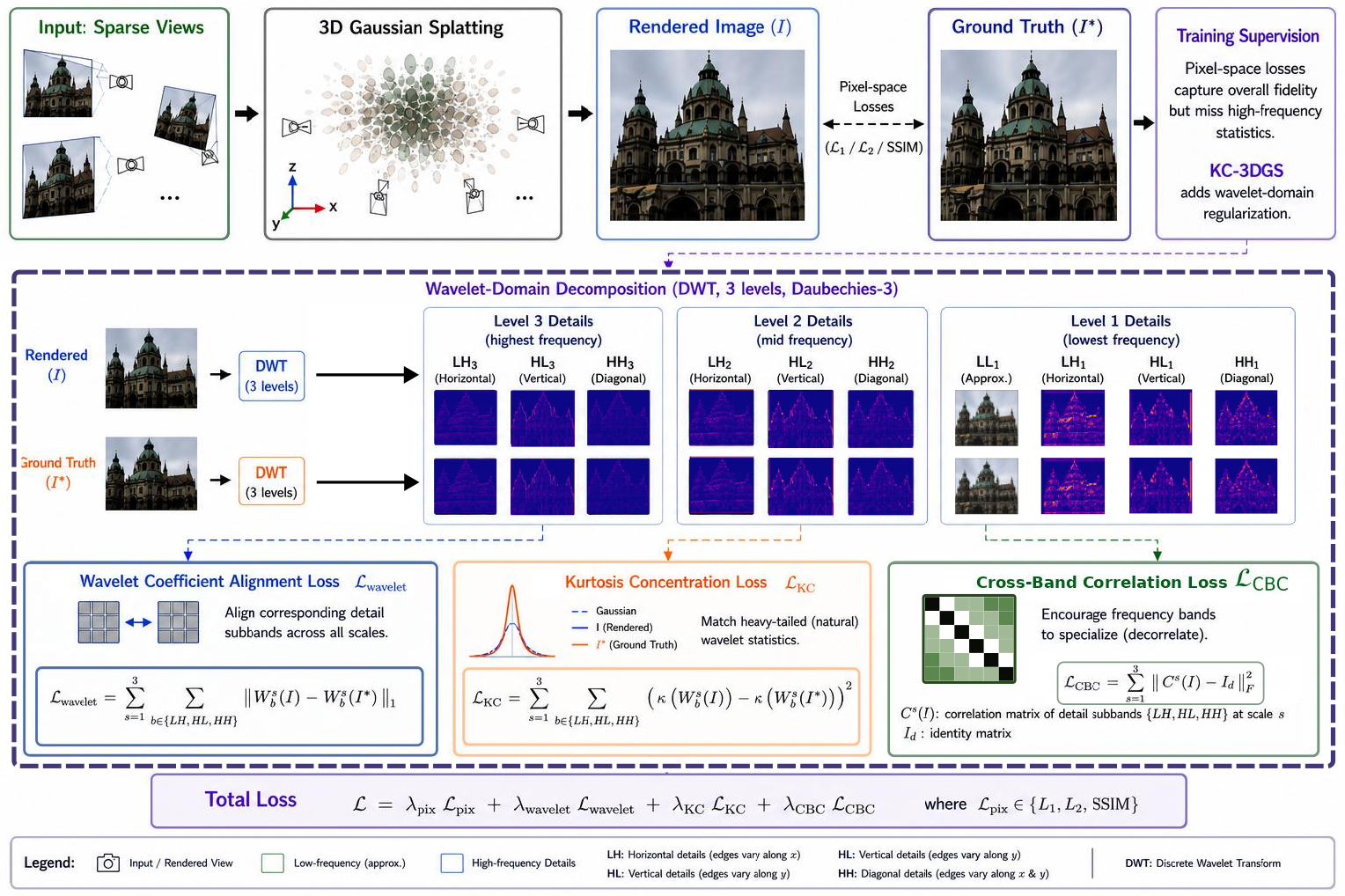
Figure 2: KC-3DGS training pipeline; rendered and ground-truth images undergo multi-level DWT, after which distinct loss terms supervise detail subband statistics.
Supervision is applied in a targeted, scale-aware manner. Finer subbands, representing high-frequency content with lower intrinsic energy, are up-weighted to ensure nontrivial gradient signals. The kurtosis concentration objective is formulated to avoid trivial minimization, which would otherwise encourage Gaussianization or global blurring. Instead, ground-truth anchored alignment ensures nondegenerate, perceptually optimal solutions.

Figure 3: Multi-scale wavelet decomposition of a natural image and illustration of heavy-tailed detail subband distributions exploited by the kurtosis concentration loss.
The theoretical foundation is formalized via rigorous results: while pixel-space losses are invariant under intra-frequency error redistribution, subband and higher-order statistics supervision closes this loophole. The alignment of kurtosis across subbands, combined with per-band coefficient loss, ensures both scale consistency and faithful recovery of high-detail geometry and appearance characteristics.
Experimental Validation
KC-3DGS is evaluated extensively on diverse and challenging benchmarks, including MipNeRF360, Tanks and Temples, MVImgNet, DeepBlending, and the unconstrained WRIVA-ULTRRA outdoor dataset. Both sparse-view and dense-view training regimes are examined.
Quantitative results indicate robust, significant improvements in perceptual metrics (e.g., DreamSim, LPIPS), with up to 9.48% DreamSim reduction on WRIVA-ULTRRA and consistent or improved PSNR/SSIM in highly underconstrained scenarios. Notably, in sparse-view setups (e.g., 12 training images), KC-3DGS maintains or improves PSNR while delivering substantial perceptual gains, directly addressing the main weakness of standard 3DGS.
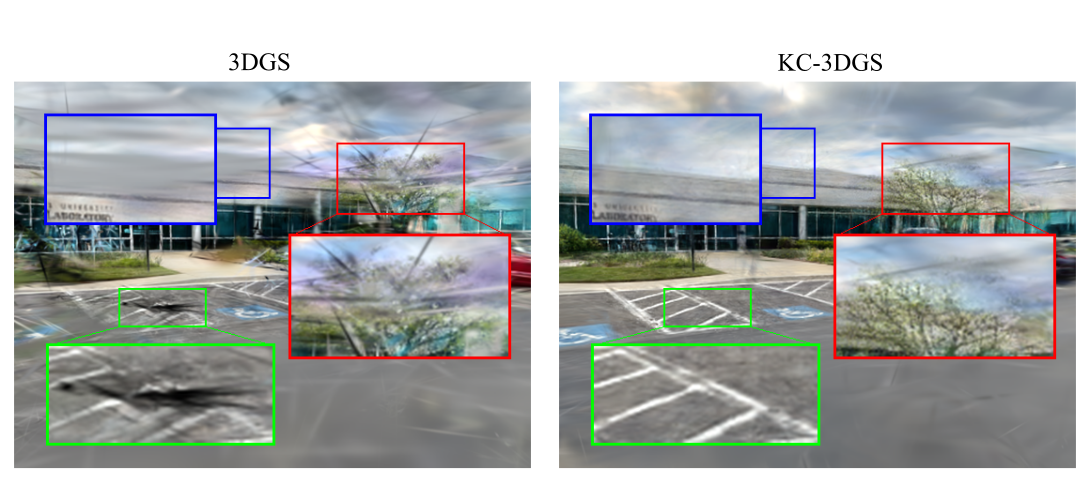
Figure 4: Qualitative comparison on WRIVA-ULTRRA; left: baseline, right: KC-3DGS—facade reconstruction and fine textures are preserved, with reduction of streaking and oversmoothing.
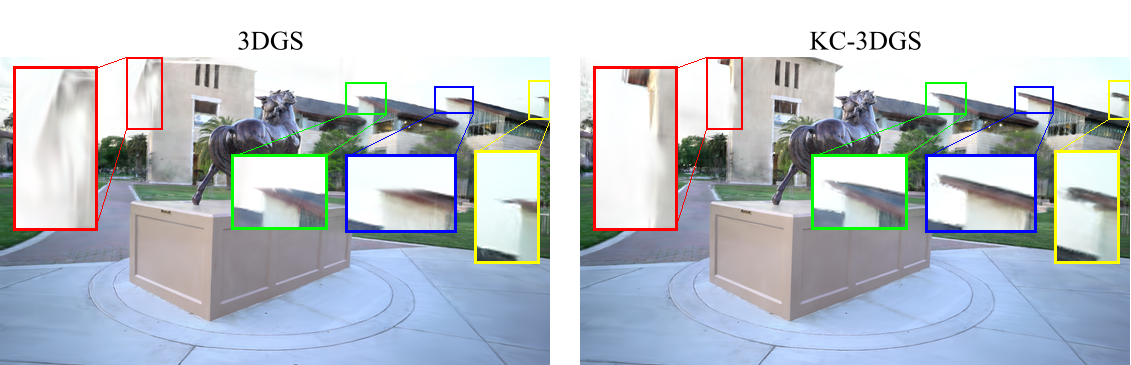
Figure 5: Tanks and Temples scene; baseline (left) exhibits floaters and oversmoothing, while KC-3DGS (right) delivers sharper boundaries and more plausible detail preservation.
The approach is generalizable: evaluated with multiple 3DGS variants (e.g., Splatfacto, FasterGS), KC-3DGS reliably offers quality enhancement without bespoke tuning or dependency on scene class.
Analysis of Frequency Supervision and Training Dynamics
Wavelet-domain supervision directly addresses the gradient starvation problem for fine scales observed in standard pixel-space-optimized 3DGS. As visualized in training dynamics, wavelet L1 errors remain responsive and dominant in fine structural and textural regions throughout the optimization process, mitigating the tendency toward oversmoothing.
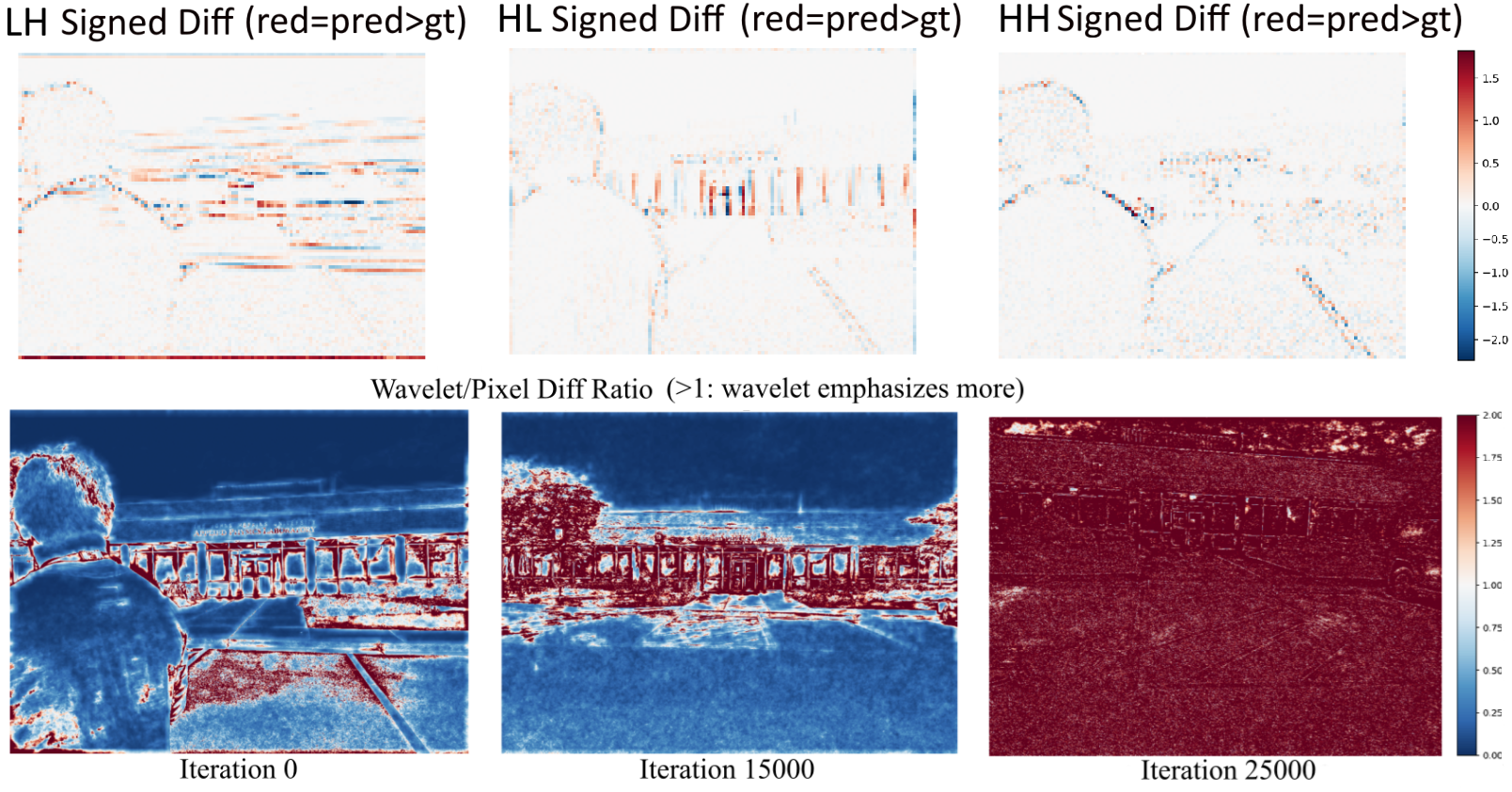
Figure 6: Visualization of wavelet subband errors throughout training; red regions indicate persistent high-frequency error, which KC-3DGS continues to suppress where pixel-based supervision underweights the loss.
Convergence analysis demonstrates that kurtosis concentration and cross-band decorrelation terms rapidly decrease in the early training phase and remain stably anchored to ground-truth statistics. The controlled reduction in kurtosis spread and cross-band covariance improves structural coherence without sacrificing photorealism, as reflected in both absolute metrics and qualitative results.
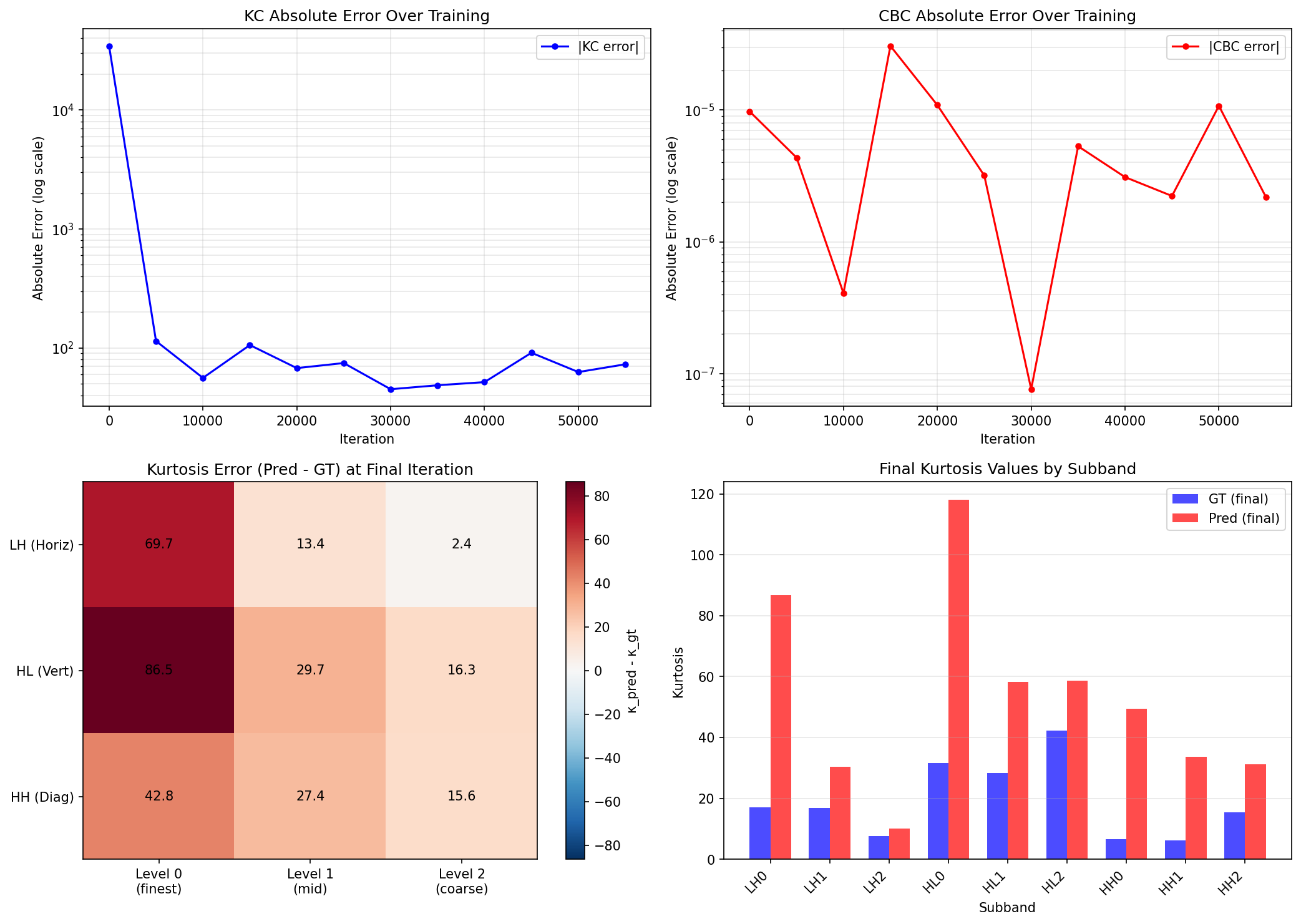
Figure 7: Training-time evolution of kurtosis error, cross-band correlation, and per-subband alignment demonstrate strong early-stage regularization and persistent supervision on fine-scale details.
Implications and Future Directions
KC-3DGS concretely demonstrates that leveraging natural image statistics—specifically, the heavy-tailed, structured behavior of multi-scale wavelet subbands—yields substantial gains in explicit radiance field rendering. The capability to plug in frequency-domain priors addresses the intrinsic limitations of pixel-based losses, especially for sparse or irregular captures where standard 3DGS fails to generalize or maintain detail.
Practically, this means 3DGS-based NVS can be more reliably deployed in unconstrained environments (e.g., VR/AR capture, site modeling, robotics), where full geometric supervision is unavailable. The approach makes minimal assumptions about the scene content and is complementary to geometric, semantic, and generative regularization strategies, with direct compatibility for future enhancements (e.g., adaptive scale weighting, integration with diffusion priors).
Theoretically, KC-3DGS motivates broader investigation into higher-order statistical supervision for explicit and neural scene representations, potentially extending beyond wavelets to alternative multi-resolution and frequency-domain frameworks. The demonstrated stability and optimality properties support the further development of rigorous, frequency-aware inductive biases in 3D visual learning.
Limitations
While the method adds significant value in sparse-view and generalization-critical settings, increased computational overhead from the wavelet-domain losses is currently a bottleneck, especially in highly optimized pipelines. In dense-view or highly redundant capture, over-regularization can occur, indicating the need for adaptive or data-driven loss balancing.
Conclusion
KC-3DGS presents a rigorous, frequency-domain regularization strategy for 3D Gaussian Splatting, replacing pixel-centric objectives with multi-scale, higher-order statistical alignment. The result is enhanced structural fidelity, reduced artifacts, and robust perceptual quality, validated across diverse benchmarks. The methodology is general, principled, and compatible with ongoing advances in explicit and neural scene understanding, setting a precedent for future research in statistically grounded NVS regularization.