- The paper presents 3DSGS, replacing symmetric kernels with learnable skew normal distributions to capture sharp boundaries and anisotropies.
- It employs adaptive densification using 2D screen-space and depth gradients to allocate fewer yet more precise primitives at occlusion boundaries.
- The integration with a Blender-based visualization engine enables zero-latency, real-time exploratory analysis under arbitrary camera trajectories.
3D Skew Gaussian Splatting with Any Camera Trajectory Visualization Engine
Introduction and Motivation
The paper "3D Skew Gaussian Splatting with Any Camera Trajectory Visualization Engine" (2605.18334) introduces a significant extension of the 3D Gaussian Splatting (3DGS) paradigm by generalizing the core primitive from a symmetric Gaussian to a Skew Normal distribution. The motivation is rooted in the empirical shortcomings observed in symmetric kernels: they are structurally limited in representing abrupt spatial discontinuities, anisotropic reflectance, and complex transparency which frequently occur at geometric boundaries, reflective surfaces, and occlusion regions in real-world 3D scenes. As a result, standard 3DGS methods require redundant, overlapping, or diminutive primitives to approximate such details, introducing undesirable artifacts such as blurring and inefficiency in memory and computation. The presented framework, termed 3D Skew Gaussian Splatting (3DSGS), augments the flexibility of explicit radiance fields while retaining the analytic rasterization and interactive rates foundational to 3DGS.
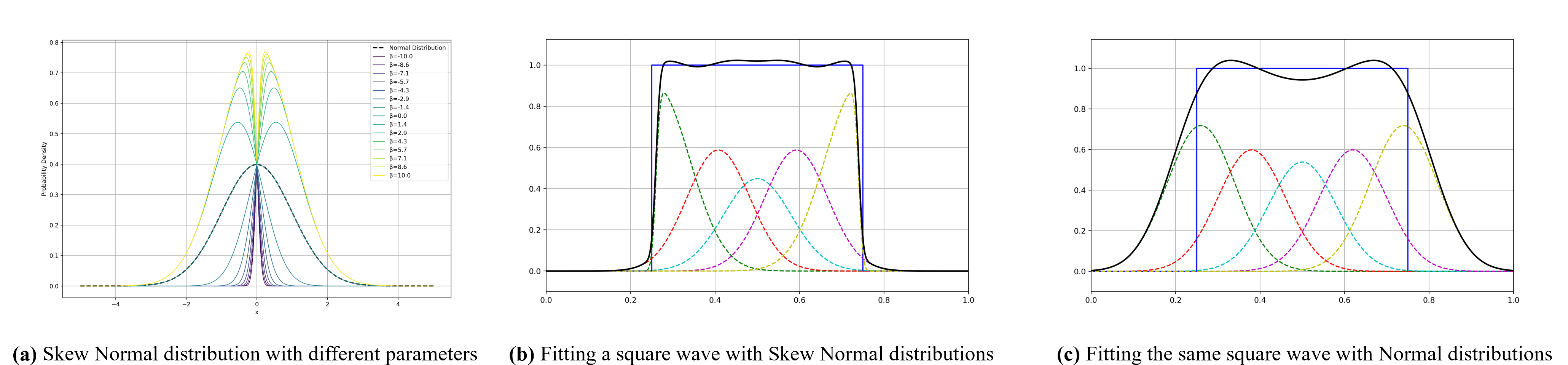
Figure 1: Skew Normal kernels produce sharper edge approximations than isotropic Normal kernels, with the special case (zero skew) reducing to the standard Gaussian.
At the core of 3DSGS is the adoption of the multivariate Skew Normal distribution, in which a learnable skewness vector β modulates the density function’s asymmetry:
S(x)=2G(x;μ,Σ)Φ(βT(x−μ))
Here, G denotes the standard multivariate Gaussian, and Φ(⋅) is the univariate normal CDF. The introduction of nonzero β directly corresponds to the kernel’s capacity to align with asymmetric, high-frequency structures in spatial data—affording improved fits to sharp boundaries, discontinuities, and view-dependent effects with substantially fewer primitives. The framework is analytically differentiable and backwards-compatible: β=0 reduces the model to the standard 3DGS kernel. The paper provides closed-form derivatives, backward pass integration, and optimized CUDA kernels for efficient rasterization and learning.
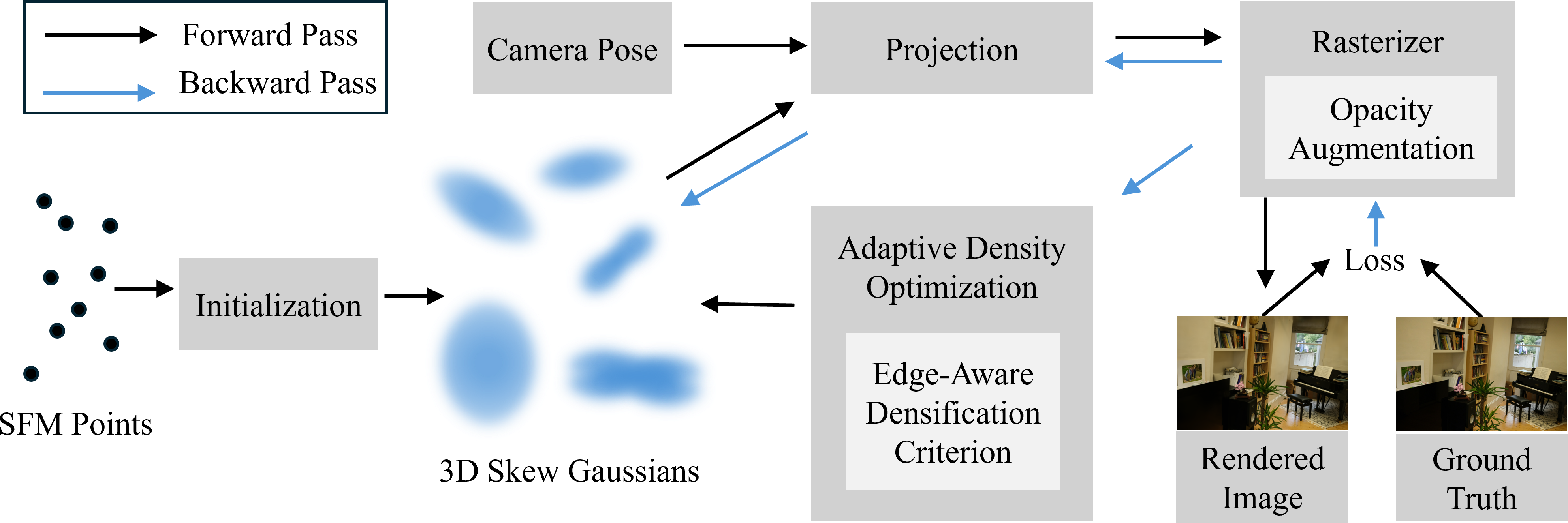
Figure 2: Pipeline overview showing replacement of standard symmetric Gaussians with Skew Gaussians, analytic handling in forward/backward passes, and scene export to the Blender-based VisEngine.
Pipeline Architecture and Densification
The 3DSGS pipeline extends standard tile-based rasterization to support directional, spatially-varying opacity, and depth-aware primitive adaptivity. Notably, primitive densification—a critical component for geometric compactness—is guided not only by 2D screen-space gradient norms but also by the explicit depth gradient ∥∇zLi∥2. This adjustment enables superior allocation of representational capacity particularly at occlusion boundaries or regions of depth ambiguity, which are typically under-constrained in prior approaches. The splitting and pruning of skewed primitives further leverage the directionality encoded in β, improving structural correspondence to scene geometry.
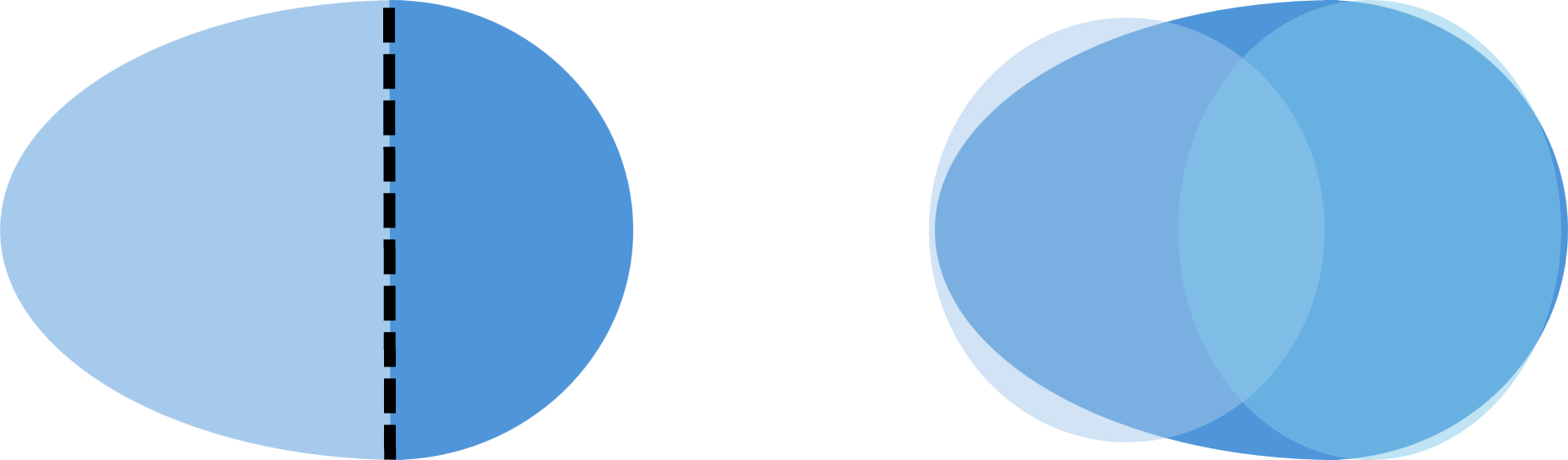
Figure 3: Effect of enhanced opacity parameter on kernel shape (left) and splitting along maximum scale direction (right), resulting in more adaptive and accurate primitive allocation.
Blender-Based Visualization and Trajectory Standardization
A distinguishing contribution is the integration of the optimized 3DSGS CUDA backend with a Blender-based interactive frontend, VisEngine. This design fundamentally decouples the interaction/UI loop from heavy rendering, ensuring zero-latency exploratory analysis under arbitrary camera trajectories. Comprehensive alignment between OpenCV/Structure-from-Motion (SfM) and OpenGL/Blender coordinate conventions is embedded, automatically handling extrinsic and intrinsic parameter conversion, and thereby negating a common pain-point in pipeline interoperability. Analysts can freely author, edit, and export camera trajectories, interactively probe scenes, and receive real-time photorealistic visual feedback.
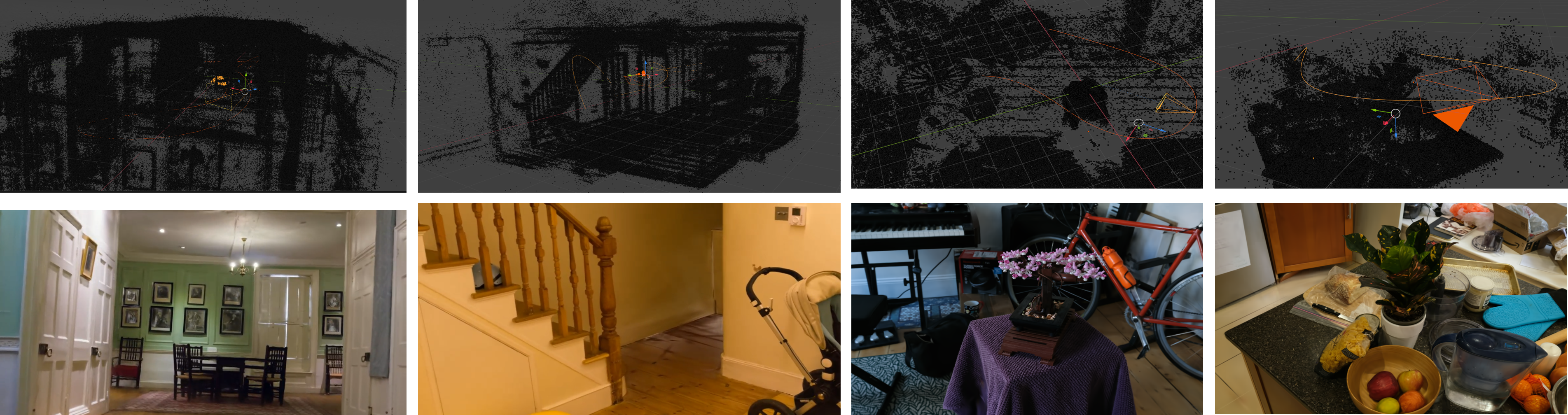
Figure 4: Free camera trajectory in Blender frontend (top) and corresponding novel views rendered in real-time via the CUDA rasterizer (bottom).
Empirical Evaluation
Extensive quantitative and qualitative evaluations on Mip-NeRF 360, Tanks & Temples, and Deep Blending datasets demonstrate the effectiveness of 3DSGS. Across all benchmarks, 3DSGS achieves maximal PSNR, SSIM, and minimal LPIPS on held-out view synthesis, particularly excelling in regions containing thin structures, sharp specularities, and detail transitions. Visual insets consistently highlight improved edge fidelity and reduced aliasing compared to standard 3DGS and recent extensions (e.g., 2DGS, Scaffold-GS, 3DHGS).
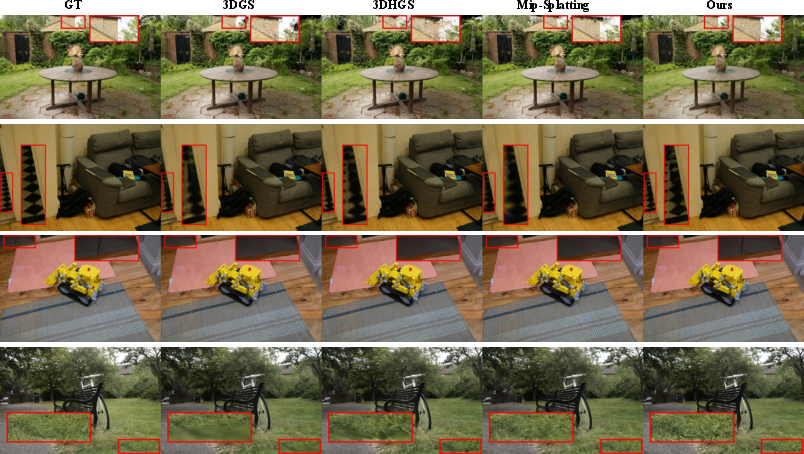
Figure 5: Qualitative comparison on Mip-NeRF 360; 3DSGS delivers crisper edges and more faithful detail than competing methods.
Ablation studies further confirm that both the skew kernel parameterization and the depth-aware densification criterion independently contribute to improved rendering accuracy; their combination is strictly necessary to achieve the reported results.
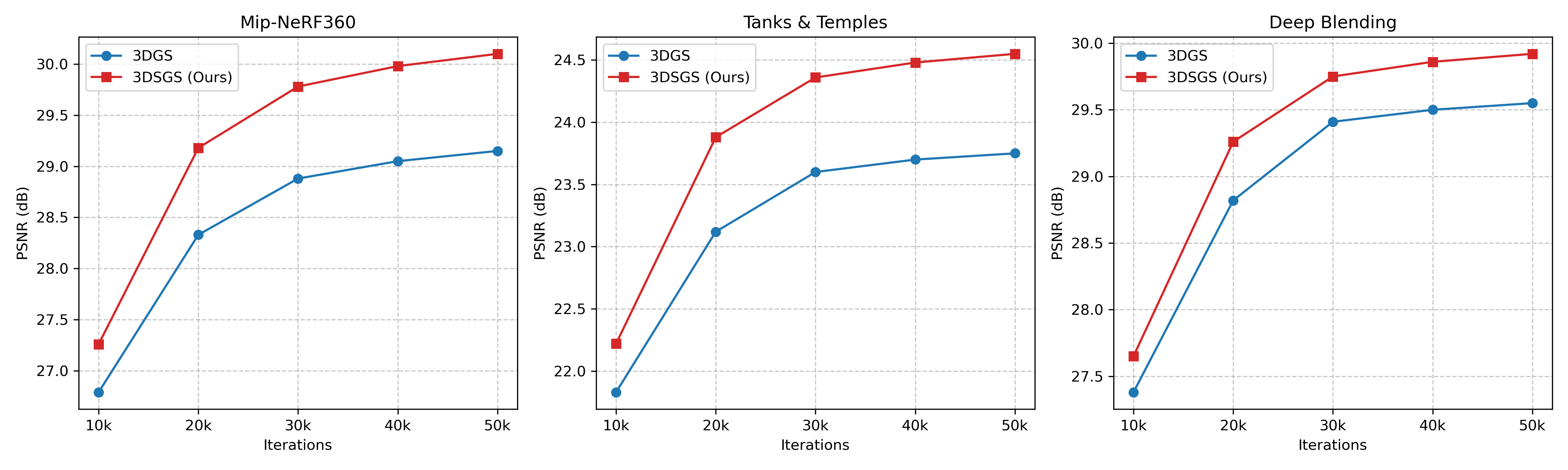
Figure 6: Ablation analysis demonstrating consistent outperformance of 3DSGS over 3DGS at various optimization stages.
Error map analysis (Figure 7) reveals materially lower reconstruction error and more uniform error distribution in 3DSGS relative to standard 3DGS, especially at occlusion and geometric boundaries.

Figure 7: Normalized error maps and per-pixel error profile; 3DSGS reduces errors at high-frequency regions compared to standard 3DGS.
Notably, 3DSGS achieves these improvements with slightly fewer primitives in most settings, reflecting greater compactness. The computational overhead—primarily due to the evaluation of erf in the opacity term—is modest: real-time performance (90–100 FPS) is retained on high-end GPUs, with a manageable increase in training time.
Practical and Theoretical Implications
Practically, 3DSGS obviates the need for excessive primitive counts or complicated mixture strategies, opening the route to more efficient and interpretable explicit radiance fields suitable for spatial analytics, robotics, and AR/VR systems where latency, visual reliability, and analytic robustness are critical. The analytic derivation supports integration of additional physical priors or hierarchies (e.g., wavelet or convex splatting extensions).
Theoretically, the use of the Skew Normal kernel marks a step towards full parametric control of the local radiance distribution, unifying prior ad hoc kernel modifications (half-Gaussians, Student’s t, directional splats, etc.) under a compact, mathematically principled umbrella. The decoupled pipeline architecture and standardized camera handling provide a transferable template for the synthesis, exploration, and analysis of 3D radiance fields across vision and graphics workflows.
Future Developments
Potential future directions include further optimizing the skew-kernel rasterizer (e.g., via more efficient error function approximations), extension to temporally dynamic or non-rigid scenes, and exploration of task-adaptive kernel parameterizations. Integrating 3DSGS with neural field techniques or leveraging hybrid generative models may yield additional benefits in unsupervised structure discovery and real-time scene understanding.
Conclusion
3DSGS presents a rigorously engineered extension of explicit Gaussian splatting for real-time view synthesis and exploratory visualization. Its analytic foundation, superior empirical performance, interactive tooling, and extensibility position it as a strong candidate for next-generation explicit radiance field modeling in both research and application contexts.