- The paper presents a dual-domain calibration framework that leverages continuous depth-guided dropout and dark channel prior methods to enhance Gaussian reliability in sparse-view settings.
- The optimization-domain module (CDGD) dynamically suppresses weak Gaussian primitives using a depth-aware dropout function, leading to significant improvements in PSNR compared to discrete regularization alternatives.
- The observation-domain module (DCP-GP) prunes artifact-producing Gaussians by analyzing dark channel statistics, resulting in cleaner renderings and improved geometric fidelity.
Dual-Domain Observation and Calibration for Sparse-View Gaussian Splatting
Sparse-view reconstruction via 3D Gaussian Splatting (3DGS) is inherently ill-posed due to limited geometric constraints, leading to overfitting and emergence of translucent “floater” artifacts. Prior dropout-based regularization methods provide stochastic perturbations but lack rigorous modeling of artifact formation or explicit reliability estimation for Gaussian primitives, resulting in limited efficacy especially under sparse-view conditions.
This paper identifies the primary challenge as the unobservability of Gaussian reliability: unreliable primitives persist due to ambiguous constraints during optimization, manifesting as haze-like artifacts in rendered images. The authors reformulate the problem as a dual-domain reliability inference task, jointly aggregating signals from the optimization domain and observation domain to calibrate and prune unreliable Gaussians.
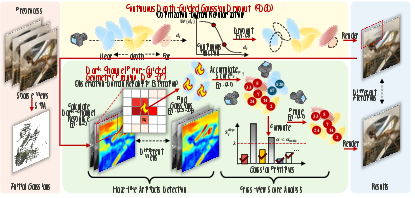
Figure 1: Overview of DOC-GS, illustrating iterative dual-domain calibration for Gaussian reliability and haze suppression.
Methodology
Optimization-Domain Calibration: Continuous Depth-Guided Dropout (CDGD)
In the optimization domain, Gaussian reliability is inferred via constraints imposed during training. The proposed CDGD mechanism replaces prior discrete masking with a continuous, depth-aware dropout probability function:
Pi=Di⋅W(di)
where Di is a normalized importance score and W(di) is a smooth attenuation weight parameterized by depth, ensuring differentiability and stability in optimization. This suppresses weakly constrained Gaussians without disrupting spatial coherence, eliminating abrupt binning transitions seen in earlier approaches [D2GS, (Song et al., 9 Oct 2025)]. Ablation studies demonstrate PSNR improvement with CDGD compared to discrete alternatives.
Observation-Domain Calibration: Dark Channel Prior-Guided Pruning (DCP-GP)
Observation-domain evidence is extracted by establishing an atmospheric scattering analogy for floater artifacts. Artifact regions display abnormal responses in the dark channel statistics of rendered images, akin to haze in ASM [dcp, CVPR 2009]. The framework aggregates pixel-wise DCP anomaly scores across views, marking Gaussians whose persistent presence correlates with structural inconsistencies:
- Multi-view accumulation ensures robustness over direct pixel-Gaussian correspondences, minimizing false positives from naturally dark regions.
- Periodic pruning removes Gaussians with high anomaly scores and low opacity, calibrated by dynamic thresholds.
This dual-domain fusion iteratively refines the underlying primitives, progressively suppressing haze and structural distortions while retaining valid geometry.
Empirical Evaluation
Quantitative Results
DOC-GS is validated on LLFF, MipNeRF360, and Blender benchmarks under severe sparse-view regimes. Performance is measured via PSNR, SSIM, and LPIPS. DOC-GS achieves:
- PSNR of 21.38 dB on LLFF 3-view, outperforming NexusGS and DropGaussian by a statistically significant margin.
- Consistent improvements across all sparsity levels and datasets, maintaining high fidelity even when integrated (“plug-and-play”) into FSGS, CoR-GS, and DropGaussian baselines.
Qualitative Results
DOC-GS produces visually cleaner reconstructions, eliminating floater artifacts and maintaining coherent geometry absent in DropGaussian, DropoutGS, and vanilla 3DGS.
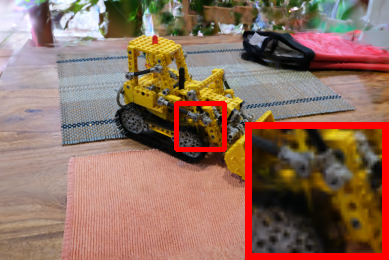
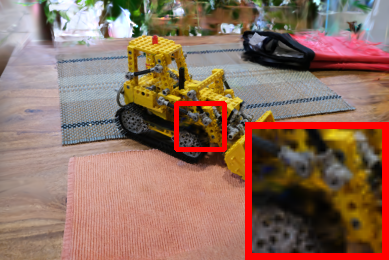
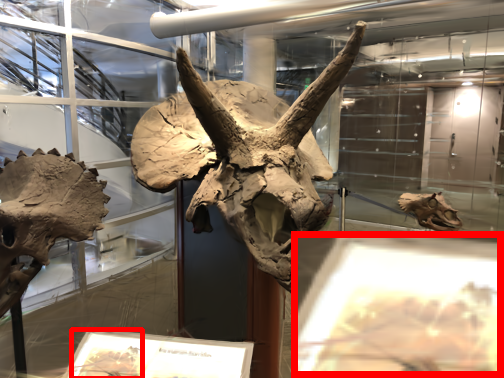
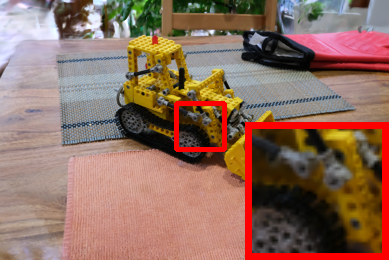
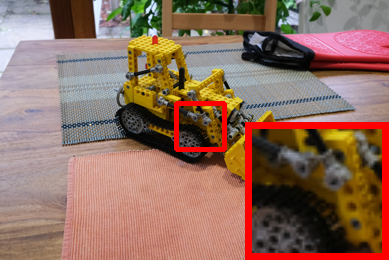
Figure 2: Qualitative comparison on LLFF under 3-view settings, highlighting artifact suppression and structural coherence from DOC-GS.
Figure 3: Qualitative comparison on MipNeRF360 (12 views), demonstrating improved artifact suppression and geometric fidelity.
Compatibility and Ablation
DOC-GS integrates seamlessly with existing 3DGS variants, improving their performance under all tested conditions. Ablation confirms the complementary effect: optimization-domain (CDGD) and observation-domain (DCP-GP) modules yield incremental improvements, their combination leading to maximal gains.
Theoretical and Practical Implications
By providing a unified dual-domain framework, the paper advances the principled modeling of artifact formation in sparse-view 3DGS. Optimization-domain regularization ensures stable training dynamics; observation-domain priors allow artifact detection beyond heuristics, leveraging statistical cues characteristic of haze. The plug-and-play modularity facilitates adoption in broader 3DGS pipelines, improving reliability in practical NVS tasks subject to limited observation.
Practically, DOC-GS enhances sparse-view view synthesis, enabling more robust deployment in real-world settings (e.g., SLAM, scene editing, autonomous navigation) where dense supervision is infeasible. Theoretically, the dual-domain paradigm encourages further exploration: integrating richer image-space priors, advanced reliability modeling, and extending to non-Gaussian explicit representations or general radiance field models.
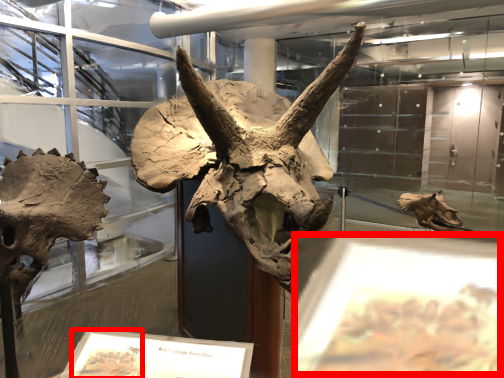
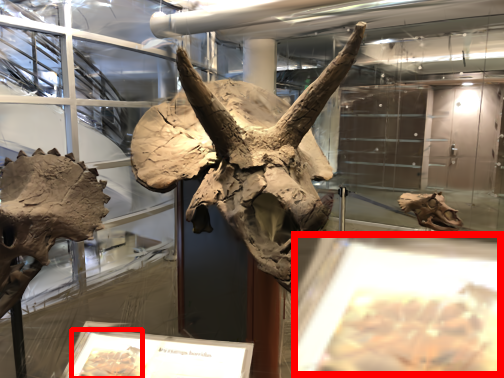
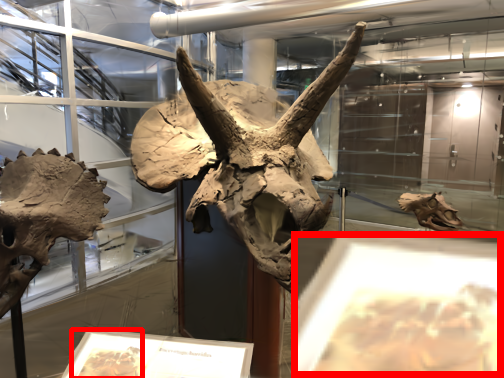
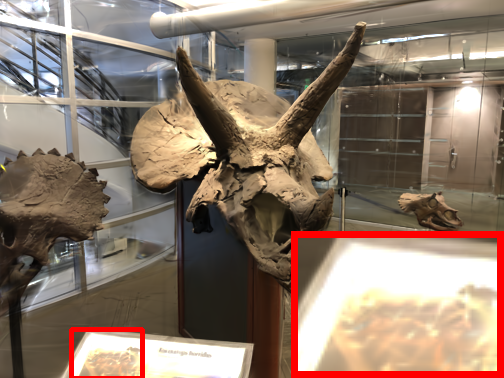
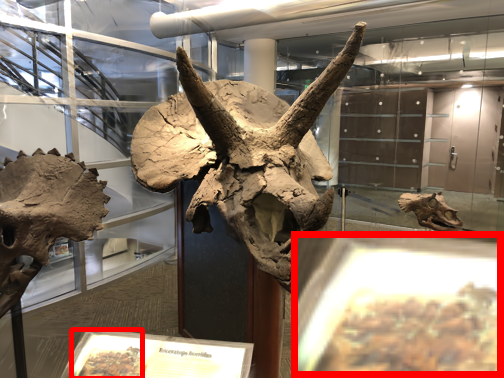
Figure 4: FSGS results further demonstrating the compatibility and robustness of DOC-GS for few-shot view synthesis.
Conclusion
DOC-GS introduces a dual-domain calibration framework for sparse-view Gaussian Splatting, where Gaussian primitive reliability is jointly inferred and pruned via optimization-domain depth-guided dropout and observation-domain DCP cues. The methodology effectively suppresses haze-like artifacts, improving geometric fidelity and rendering quality across multiple benchmarks and integration scenarios. The dual-domain inference model represents a substantial refinement over stochastic regularization, suggesting broad implications for future explicit scene modeling and sparse-view reconstruction research in NVS and 3D vision (2604.06739).