From Simulation to Enaction: Post-trained language models recognize and react to their own generations
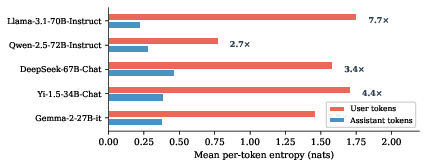
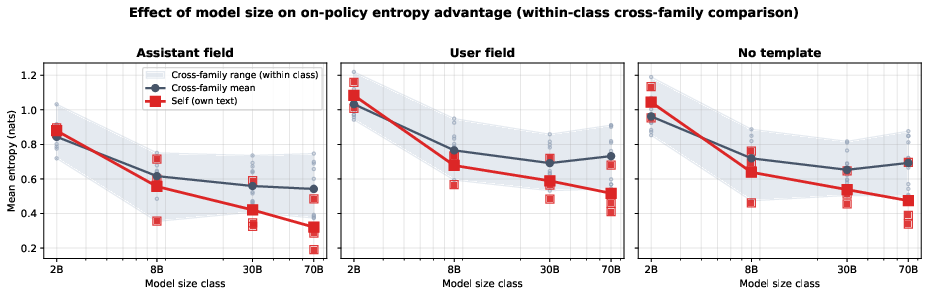
Abstract: LLMs are pretrained as passive predictors with no incentive to model the consequences of their own outputs. Post-training changes this: a model producing its own responses can benefit from recognizing that it is on-policy. We present evidence that post-trained models recognize their on-policy generations, and this recognition is implicitly encoded in their output distributions. In particular, on-policy output distribution entropy is 3--4$\times$ lower than off-policy entropy, across model families and size classes. We trace part of this effect to an internal representation of input surprise, tracking the unlikeliness of the most recent input token according to the model's prior predictions, that causally modulates output entropy. One example of these phenomena can be observed in response to open-ended prompts; post-trained models (unlike pretrained models) collapse their uncertainty over the topic of their upcoming response before the first output token; violating this cached intention with a different-topic prefill results in higher output entropy. We also tested whether models can distinguish on-policy contexts from prefills via explicit verbal report. We find that they can, but that interestingly, this explicit recognition routes through a different mechanism than implicit recognition.
Paper Prompts
Sign up for free to create and run prompts on this paper using GPT-5.
Top Community Prompts
Explain it Like I'm 14
A simple explanation of “From Simulation to Enaction: Post-trained LLMs Recognize and React to their own Generations”
1. What is this paper about?
This paper studies how today’s chatbots (LLMs) change after the extra training they get to become helpful assistants. The big idea: after this “post‑training,” the models don’t just guess the next word like a passive observer. They start to notice when they are continuing their own earlier words and, in those moments, they act more decisively and confidently. The authors call this a shift from “simulation” (pretending to be many possible speakers) to “enaction” (acting as the Assistant with a plan).
2. What questions did the researchers ask?
The authors asked a few simple, kid-friendly questions:
- Do chatbots act more confident when they keep writing after their own earlier messages, compared to when they continue someone else’s text?
- Does the chat “role” matter (Assistant vs. User)?
- Does a bigger model show this effect more strongly? What about different post‑training methods?
- Do models plan their answers’ topic before they start typing the first word?
- Can models say, in plain words, “this beginning was prefilled” (pasted in) and does that use the same or a different mechanism from the quiet, automatic confidence shift?
3. How did they test it? (Everyday explanations of the methods)
- Measuring confidence with entropy: Think of “entropy” as how spread out a model’s guesses are. Low entropy = the model is focused and confident (like being sure the next word is “cat”). High entropy = it’s unsure and spreads its bets (it might be “cat,” “dog,” “bird,” etc.). The team measured this for each next-word prediction.
- On‑policy vs. off‑policy: “On‑policy” means the model is reading and continuing words it previously wrote in the same conversation. “Off‑policy” means it’s continuing someone else’s text (like random web pages or another model’s answer).
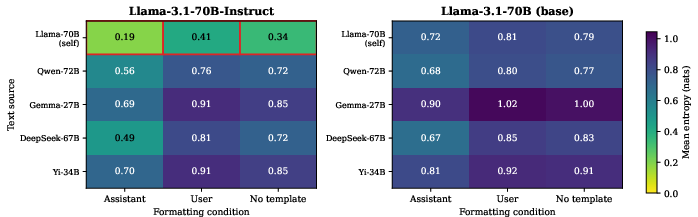
- Roles and formatting: They compared when the model was in the Assistant role (the usual helpful chatbot) versus other roles, because chat formatting often tells the model who is speaking.
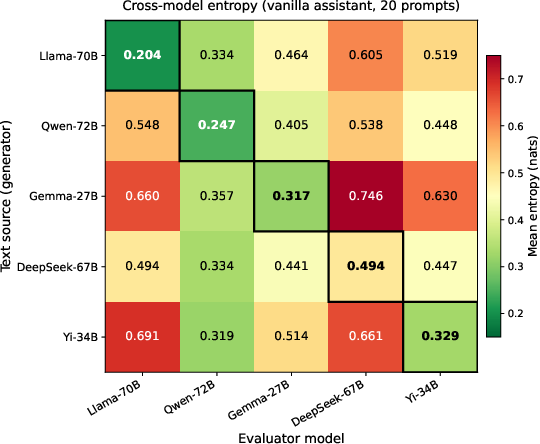
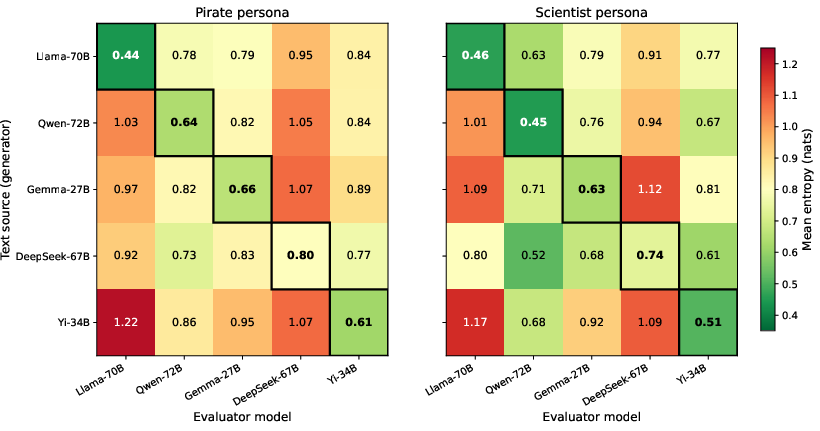
- Cross‑model swaps: They fed a model its own earlier answer, and also fed it answers written by other models, to see if it recognizes and prefers its own style.
- Size and training steps: They looked at small and big models, and at different post‑training stages: SFT (supervised finetuning), DPO (a preference‑based method), and RL (reinforcement learning). These are just different ways of polishing the Assistant.
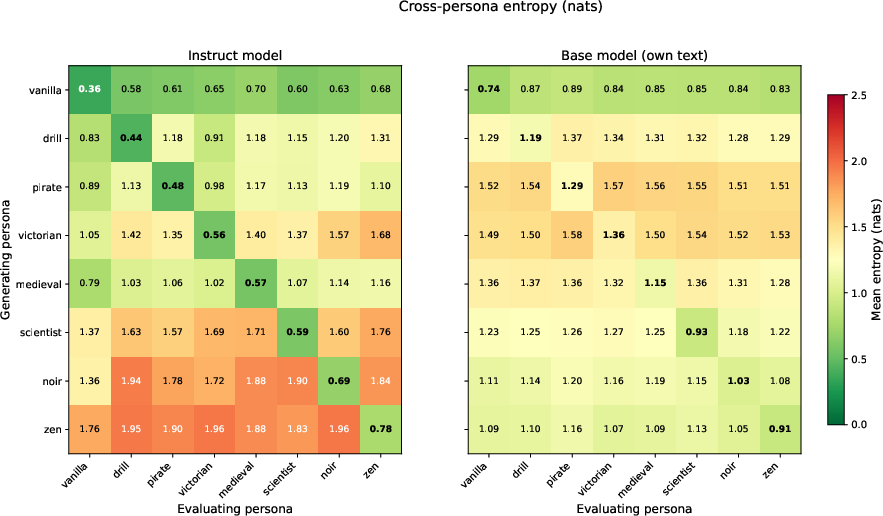
- Personas: They asked the models to speak like different characters (like a “pirate” or “scientist”) to see if “self‑recognition” depends on the persona.
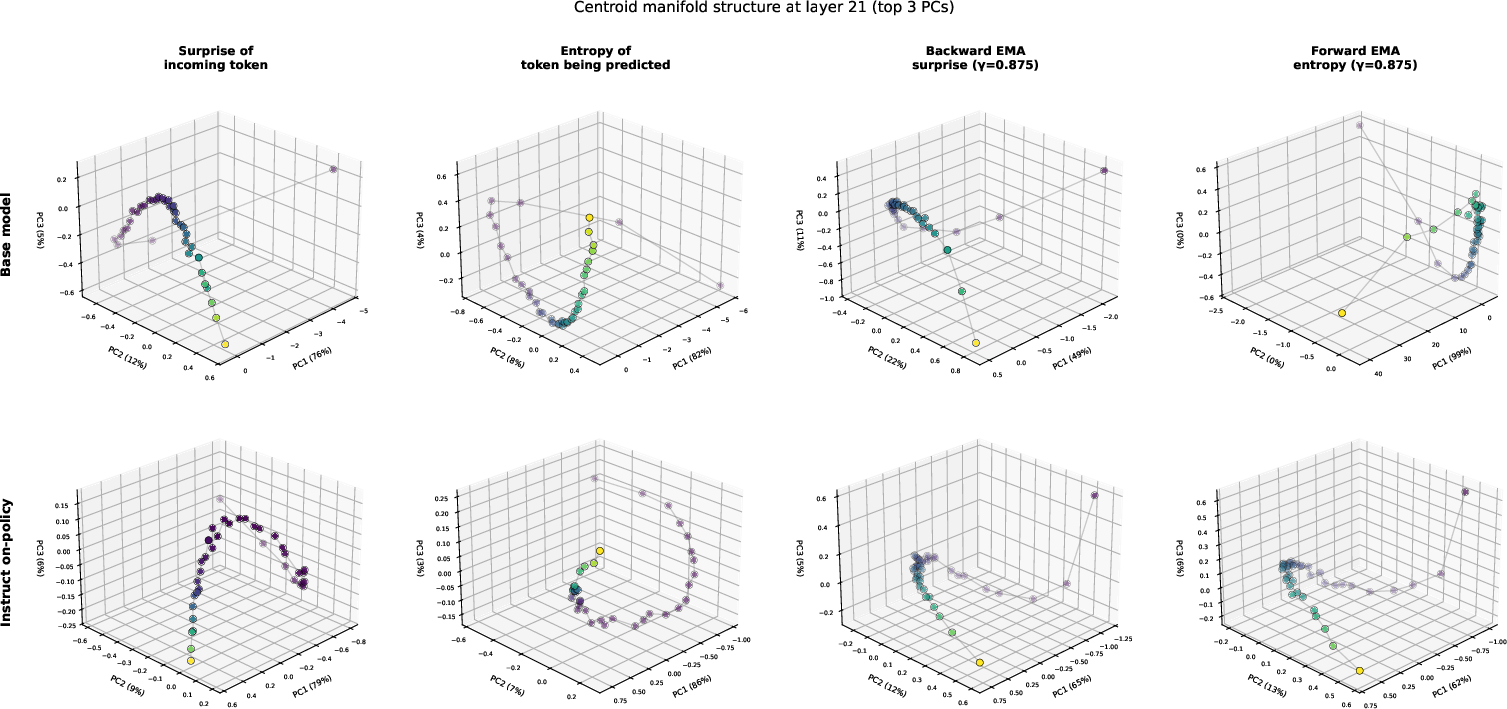
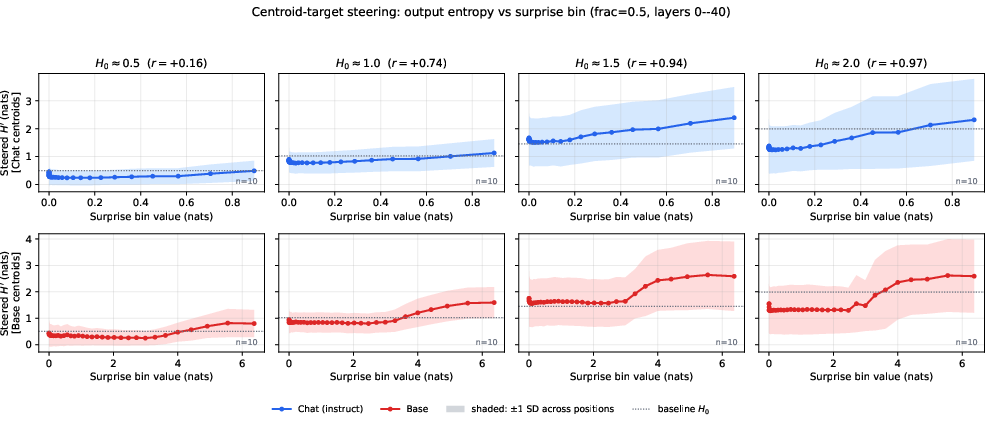
- Looking inside the model: They searched for internal signals that track “surprise” (how unexpected an input word was) and “entropy” (confidence). They also nudged these signals to see if that causally changes confidence.
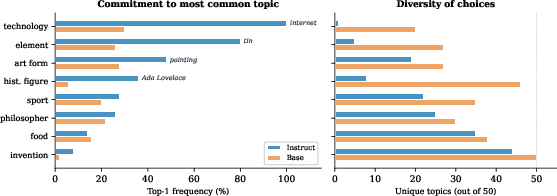
- Semantic entropy (topic choice): They gave vague prompts like “Think of a food and explain why it’s interesting.” If the model already commits to, say, “haggis” before typing its first word, its topic uncertainty is low. They also tested “prefills” (inserting “Haggis is …” as if the model had started with that) to see if that clashes with the model’s own plan.
- KV cache patching: The model’s short‑term memory during a chat (the KV cache) stores what it’s paying attention to. The team swapped parts of that memory to test whether the model’s explicit claim (“this was prefilled” or “not prefilled”) comes from comparing its planned intent to what appears in the answer.
4. What did they find, and why is it important?
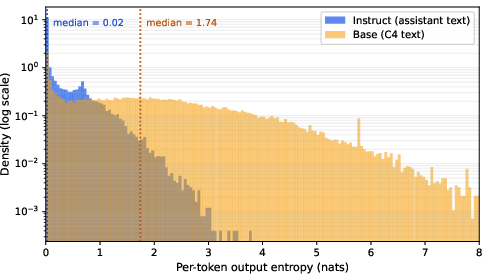
- Strong self‑recognition through confidence: After post‑training, models are about three to four times more confident (lower entropy) when continuing their own earlier text, especially in the Assistant role. This doesn’t happen in plain, un‑tuned base models.
- It’s not just style; it’s widespread and grows with size: Every model tested was most confident on its own text (compared to others’), and this effect gets stronger in bigger models.
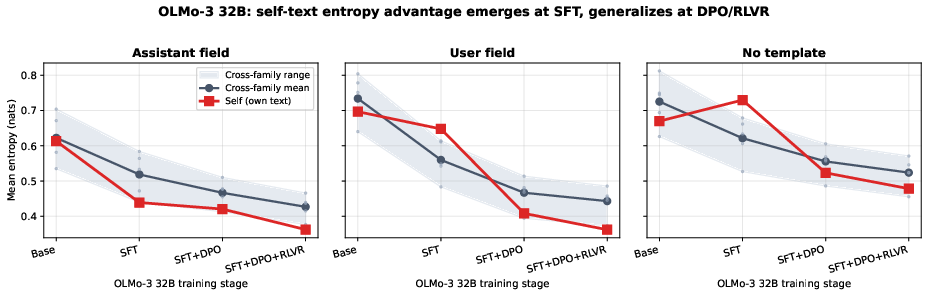
- Training steps matter:
- SFT starts the effect, but mostly when the model is in the Assistant role.
- DPO spreads the effect beyond just the Assistant role.
- RL strengthens it further.
- Persona effects: The lowest entropy happens when the same model both wrote the text and is reading it again in the same persona, with the default Assistant persona being the strongest. Mismatched personas raise entropy (less confidence).
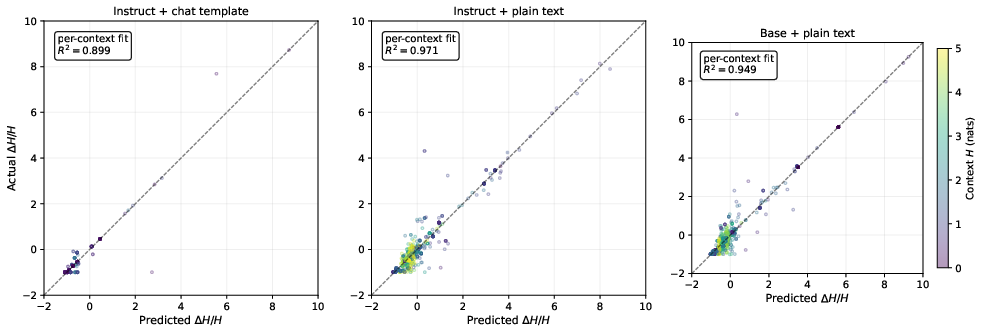
- A real internal “surprise” signal drives confidence: The model tracks how surprising each input word is compared to what it expected. Less surprise → lower output entropy (more confidence). More surprise → higher entropy. When they nudged the internal “surprise” pattern, the model’s confidence changed in the predicted direction. In chat mode, the model’s entropy tends to drop even when surprise is “as expected,” making it extra decisive.
- Pre‑response planning (topic commitment): Post‑trained models pick a topic in their head before typing the first word and stick to it, so their “semantic entropy” (topic uncertainty) is low. If you force a different topic at the start with a prefill, their word‑by‑word entropy goes up—they get less sure, as if their plan was bumped off track. Base models don’t show this planning in the same way.
- Two ways of recognizing prefills: Models can also explicitly say “this was prefilled.” That conscious, verbal check uses a different mechanism from the quiet, entropy‑based one. By swapping parts of the model’s short‑term memory (KV cache), the researchers could flip the model’s verdict—showing it compares a stored “intent” from the user’s question with the answer content right before deciding.
Why it matters: These results suggest modern chatbots aren’t just passively predicting text. In Assistant mode, they recognize when they are “in control,” plan ahead, and try to keep their outputs steady and focused. That looks more like an actor with a role and a plan than a neutral simulator.
5. What’s the bigger picture?
- Understanding agency and awareness: The findings hint at early forms of “situational awareness”—the model knows when it’s following its own policy and reacts by being more decisive. This helps researchers reason about when a model is just imitating versus when it’s actively enacting a role.
- Better training and safer behavior: Knowing that confidence depends on role, persona, and surprise can guide how we design prompts, system messages, and training data to get steadier, less noisy answers when needed—or to keep diversity when creativity matters.
- Measuring and controlling commitment: Entropy (both token‑by‑token and topic‑level) is a useful dial to see whether a model is over‑confident or appropriately flexible. It can flag when a forced prefill clashes with the model’s plan.
- Handling self‑bias: Since models prefer their own text, evaluations that let models judge answers might be skewed. Designers should account for this “self‑preference” when comparing systems.
Overall, the paper shows that post‑training doesn’t just make models nicer helpers; it changes how they act. They start recognizing their own voice, commit to plans earlier, and adjust their confidence accordingly. This shift from “simulation” to “enaction” could shape how we build and trust future AI assistants.
Knowledge Gaps
Knowledge gaps, limitations, and open questions
Below is a focused list of what remains missing, uncertain, or unexplored in the paper, framed as concrete, actionable gaps for future work:
- Scope of models and data
- Verify generalization beyond the specific open‑source families evaluated (Llama, Qwen, Gemma, Yi, DeepSeek, OLMo) by testing closed-source frontier models and other training pipelines (e.g., PPO/GRPO variants, RLHF with different reward model designs).
- Assess cross-lingual and cross-domain generalization (non‑English, code, math, multimodal inputs) to determine whether self-recognition and entropy effects hold outside English chat.
- Quantify how representative the prompt sets are (20 prompts; 8 domains for semantic entropy) and increase coverage with standardized, diverse, and out‑of‑distribution evaluations to rule out prompt selection bias.
- Control for potential training-data overlap (memorization) by evaluating on fully held‑out synthetic corpora and verified unseen distributions; quantify how much the self-entropy advantage persists when memorization is impossible.
- Measurement design and confounds
- Disentangle stylistic similarity from true “on-policy” recognition by constructing style-matched decoy texts (e.g., via style transfer or fine‑tuned imitators) and measuring whether self-entropy remains uniquely lower when content/style are controlled.
- Systematically ablate chat template components (role tokens, separators, system prompt wording, tokenization artifacts) to isolate which elements drive the negative intercept β and the assistant‑specific entropy reduction.
- Examine decoding-dependence: replicate entropy trajectories and surprise–entropy feedback under varying sampling schemes (temperature, top‑k/p, typical decoding, deterministic decoding) and during live sampling rather than only teacher‑forced evaluation.
- Control for length, punctuation, and formatting effects by normalizing for token class, sentence boundaries, and context length; quantify how these factors modulate entropy dynamics.
- Mechanistic explanations and causal structure
- Localize the circuitry for implicit recognition: identify attention heads/MLPs that compute input surprise and drive entropy changes using causal tracing, sparse probing, and head/MLP ablations; test layer specificity beyond example layers (e.g., layer 21).
- Explain the origin of the negative intercept β in chat contexts: determine whether role markers, system instruction, or assistant‑turn specialization gate a global entropy‑control circuit; ablate or randomize role markers to confirm gating mechanisms.
- Characterize the representational “orthogonality” between on‑ and off‑policy manifolds: which components (attention vs MLP) rotate the subspaces; is the rotation consistent across layers; can it be reversed via targeted finetuning?
- Bridge implicit vs explicit recognition: map whether the circuits for entropy‑mediated effects and KV‑mediated prefill detection share features; test selective disruption (e.g., layer‑localized KV patching, head knockout) to show double dissociation.
- Move beyond centroid steering to stronger causal tests: perform path patching and feature steering along identified directions and quantify large‑effect interventions on entropy, not just marginal shifts.
- Training pipeline and data provenance
- Pin down which aspects of post‑training install self-recognition: vary SFT data composition (persona diversity, assistant‑only vs mixed roles, stylistic spread), DPO preference labels, and RL reward shaping to identify minimal conditions for the effect.
- Test whether explicit on‑policy training is truly unnecessary: compare SFT/DPO trained purely on off‑policy data vs blends that include on‑policy rollouts; measure how much on‑policy data shortens the “ramp‑up” to strong self-recognition.
- Assess scale thresholds and data requirements: estimate the parameter/data regime where the self‑entropy advantage first emerges; quantify sensitivity to pretraining mix and instruction‑tuning dataset size/quality.
- Semantic commitment and its consequences
- Replace coarse “semantic entropy” proxies (topic counts across samples) with rigorous topic-distribution estimates (e.g., MI-based metrics, semantic clustering with robust annotators) to better quantify pre‑response commitment.
- Link semantic violations to behavior: measure whether entropy spikes from off‑plan prefills predict degraded faithfulness, higher refusal/hallucination rates, or changes in solution quality across tasks (reasoning, coding, retrieval‑augmented QA).
- Probe timecourse and hysteresis: how many self‑generated tokens are needed before the low‑entropy regime stabilizes; how quickly does the model recover after an off‑policy perturbation; does the effect accumulate over long dialogues?
- Persona and role effects
- Quantify how much the “Assistant persona is privileged” owes to training frequency and reward shaping: correlate entropy shifts with log‑prob gains on role tokens and with observed assistant‑turn sampling during post‑training.
- Generalize persona results beyond two non‑default personas; vary persona granularity (style, politeness, expertise) and test whether self‑entropy advantage scales with persona similarity/familiarity rather than persona identity.
- Robustness and security
- Characterize false positive/negative profiles for explicit prefill detection: vary prefill length, paraphrase level, stylistic closeness, and topic distance; report ROC curves and calibration of the verbal detection signal.
- Stress‑test KV‑patch robustness: patch keys vs values vs both; patch at specific layer ranges; introduce noise; measure the minimal intervention that flips detection; identify layers most responsible for intent storage and comparison.
- Examine adversarial control of entropy: can malicious prefills or prompt patterns systematically raise/lower entropy to destabilize planning or induce undesired determinism; develop mitigations or detectors for such manipulations.
- Practical impact and evaluation gaps
- Connect entropy reduction to utility: quantify trade‑offs between lower entropy and generation diversity, task accuracy, calibration (ECE/Brier), safety (toxicity/harms), and user‑perceived quality across benchmarks.
- Evaluate downstream implications for self‑preference bias (LLM‑as‑judge): does the self‑entropy advantage predict scoring bias; can training interventions reduce bias without sacrificing on‑policy competence?
- Test in tool‑use and function‑calling settings: measure whether self‑recognition/entropy effects carry over to agentic tool invocation, program synthesis, and retrieval contexts, and whether they affect tool‑selection stability.
- Replicability and reporting
- Provide full statistical reporting (effect sizes, confidence intervals, corrections for multiple comparisons) and release code/contexts to enable exact replication and sensitivity analysis.
- Standardize per‑token entropy computation details (tokenization, BOS/EOS handling, teacher‑forcing vs sampled contexts) to avoid discrepancies across reproductions.
These gaps outline where additional experiments, ablations, and mechanistic analyses could substantively strengthen the claims and clarify the origins, scope, and implications of “self-recognition” and entropy modulation in post‑trained LLMs.
Practical Applications
Immediate Applications
The paper’s findings on entropy-based self-recognition, surprise-sensitive decoding, and intent continuity can be used today to harden systems, stabilize outputs, and improve evaluation. Below are deployable use cases, linked to sectors, with suggested tools/workflows and feasibility notes.
- Bold: On-policy recognition monitor for prompt-injection and tamper detection (software security, enterprise platforms)
- Description: Use per-token output entropy and its sharp drop in Assistant-role contexts as a real-time signal to flag off-policy contexts (e.g., user-prefilled assistant text, prompt injections, or cross-model prefills). Sudden entropy spikes after an “intended” start indicate inconsistency with cached plans; unusually high entropy in Assistant role suggests off-policy or adversarial prefill.
- Tools/workflows: Logprobs/entropy telemetry; thresholds on “assistant-turn entropy” vs “user-turn entropy”; alerting when relative excess surprise causes positive ΔH/H; A/B with different templates to isolate formatting effects.
- Assumptions/dependencies: Access to token-level logprobs; strongest on 30B–70B instruct models; depends on chat formatting and default Assistant persona; may require calibration per model/version to manage false positives.
- Bold: Surprise-aware temperature scheduling to stabilize generations (software, content ops, healthcare, finance)
- Description: Dynamically adjust decoding temperature as a function of relative excess surprise (S−H)/H so entropy decays during on-policy runs and increases only when warranted by high surprise. Reduces variance, off-plan rambles, and hallucinations in long responses.
- Tools/workflows: Closed-loop decoding policy implementing a linear controller like ΔH/H ≈ a·((S−H)/H)+β (paper’s fit); low-temperature ramp when β<0 in Assistant contexts.
- Assumptions/dependencies: Requires logprobs each step; controller gains need tuning by domain; impact larger on post-trained models in Assistant format.
- Bold: Persona consistency checker and “persona lock” (customer support, education, enterprise assistants)
- Description: Enforce matched persona between history and current turn; detect persona mismatches via entropy increases and semantic entropy cues. Locking to the default Assistant persona yields the lowest-entropy, most stable behavior.
- Tools/workflows: System-prompt normalization; persona-match linting; block or replan when generator/evaluator persona mismatch is detected.
- Assumptions/dependencies: Persona effects are post-training specific and strongest for the default Assistant; depends on consistent templating.
- Bold: Model provenance heuristic for “who wrote this?” (evaluation, platform integrity)
- Description: Use the self-entropy gap (model reads its own text at lower entropy than others’) as a lightweight heuristic to infer whether a segment was authored by the same model (alternative or complement to watermarking).
- Tools/workflows: Cross-model entropy matrix for models in a fleet; fast “identity score” = entropy(other) − entropy(self) on candidate segments; gate LLM-as-judge pipelines to mitigate self-preference bias.
- Assumptions/dependencies: Heuristic (not cryptographic); sensitive to style and persona; needs held-out prompts; access to logprobs; weaker on small models.
- Bold: RAG and context-poisoning guardrail (software, enterprise knowledge management)
- Description: Treat large positive ΔH after retrieved inserts or user edits as “off-plan”; trigger clarification or plan recomputation instead of continuing with high-entropy sampling.
- Tools/workflows: “Intent-before-output” routine: compute top-k candidate topics/plans; if retrieved/prefilled content conflicts (entropy spike), ask a disambiguating question.
- Assumptions/dependencies: Works best where underspecified prompts are common; requires minimal latency budget for a short resolve step.
- Bold: Production observability: role-aware entropy dashboards (MLOps)
- Description: Monitor assistant vs user per-token entropy distributions, entropy trajectories over token positions, and semantic entropy spread across topics to detect drift, regressions, or broken templates.
- Tools/workflows: Telemetry collectors for logprobs; role-segmented histograms; alerts on median assistant-entropy rising beyond baseline bands.
- Assumptions/dependencies: Requires standardized chat templates and consistent logging; baseline establishment per model/version.
- Bold: Topic-commitment previews in UX (“intent peeks”) (education, productivity, consumer assistants)
- Description: For ambiguous prompts, precompute and briefly surface the model’s top intended topics before emitting the first token; let users select or adjust to reduce off-plan starts.
- Tools/workflows: Beam over “topic heads” without emitting tokens; small UI chip with 2–3 likely topics; proceed with chosen intent.
- Assumptions/dependencies: Relies on model’s reduced semantic entropy post-training; minor latency overhead.
- Bold: Training data curation and post-training diagnostics (ML research/engineering)
- Description: Use entropy gaps across roles/personas to select high-signal Assistant turns for SFT; stage-check (Base → SFT → DPO → RL) with a “self-recognition score” as a quick alignment diagnostic.
- Tools/workflows: Per-stage evaluation on own vs cross-model generations; prefer samples that induce low on-policy entropy and clear persona lock-in.
- Assumptions/dependencies: Correlational, not causal; needs model-size awareness (effects grow with scale).
- Bold: “Was my start prefilled?” self-check step (security, platform integrity)
- Description: Prompt the model to explicitly assess whether its opening tokens were prefilled or mismatched with its cached intent, and replan if so. Although the paper’s KV-patch shows the mechanism, a plain self-analysis prompt can already help catch tampering.
- Tools/workflows: Post-response self-check rubric triggered by entropy spikes; if “prefilled” likely, restart from a clarified plan.
- Assumptions/dependencies: No KV access needed for deployment; detection quality varies by domain and prefill length; avoid over-triggering on benign edits.
- Bold: Multi-agent orchestration hygiene (multi-agent systems, tooling)
- Description: Ensure each agent continues its own prior outputs; use entropy rises to detect cross-agent contamination or off-policy handoffs; reassign turns appropriately.
- Tools/workflows: Router that checks “self-entropy advantage” before assigning the next turn; reject contexts that yield low self-identity scores.
- Assumptions/dependencies: Requires logprobs for each agent; tuned thresholds per agent family.
Long-Term Applications
These opportunities build on the paper’s mechanisms (entropy/surprise coupling, internal intent representations, and explicit recognition circuits) and likely need further research, scaling, or platform support.
- Bold: Robust provenance and identity signatures (security, policy, platforms)
- Description: Move from heuristic self-entropy gaps to train-time “identity/intent signatures” embedded in hidden states that can be verified post hoc, enabling strong authorship attestation across models and toolchains.
- Tools/products: Cryptographic or model-internal watermarking tied to Assistant-role dynamics; fleet-level attestation services.
- Assumptions/dependencies: Requires architectural or objective changes; must be resilient to paraphrasing and compression; careful privacy design.
- Bold: Enactive agent architectures with explicit intent modules (software agents, robotics)
- Description: Architect agents with an explicit, queryable “plan cache” that commits topics before emission and continuously reconciles surprise vs intent, separating plan/act/monitor loops.
- Tools/products: Intent buffers, “intent continuity contracts,” APIs to read/write intent state; plan repair when off-plan prefills occur.
- Assumptions/dependencies: Needs access to or supervision of internal representations; risk of over-commitment and mode collapse if not balanced.
- Bold: Training objectives that couple surprise and entropy (ML methods, safety)
- Description: Incorporate loss terms approximating ΔH/H ≈ a·((S−H)/H)+β in Assistant contexts to get the beneficial low-entropy drift on-policy without global diversity collapse.
- Tools/products: Surprise-aware regularizers; role-gated entropy penalties; curriculum that spans Base → SFT → DPO → RL with targeted β shaping.
- Assumptions/dependencies: Requires careful tuning to avoid degeneration; domain- and size-dependent.
- Bold: Situational-awareness and deception monitors (AI safety, auditing)
- Description: Use the self-recognition entropy gap, persona-gated effects, and surprise traces as diagnostic signals for when models “know they are acting,” helping auditors assess risks of strategic behavior or hidden mode switches.
- Tools/products: “Self-recognition scorecards,” persona-entanglement metrics, entropy/surprise probes during eval suites.
- Assumptions/dependencies: Interpretability limits; signals are proxies, not proofs; can be gamed if optimized against.
- Bold: Persona-scoped capability control (governance, enterprise security)
- Description: Bind tool access and high-risk actions to verified persona/intent matches; deny execution when persona mismatch or high semantic entropy indicates off-policy simulation.
- Tools/products: Policy engines checking persona match plus entropy bounds; “capability by persona” configuration.
- Assumptions/dependencies: Requires reliable persona detection; risk of usability friction; needs exemptions for creative use cases.
- Bold: Standardized benchmarks and reporting for “enaction” (policy, industry consortia)
- Description: Establish cross-lab benchmarks for on-policy entropy collapse, self-entropy advantage, and intent continuity; require reporting in model cards and compliance filings.
- Tools/products: Public leaderboards; reference prompts; sector-specific thresholds (e.g., healthcare assistants must meet stability criteria).
- Assumptions/dependencies: Agreement on metrics; normalization across sizes and languages; governance buy-in.
- Bold: Identity-aware multi-model ecosystems (ensembles, toolchains)
- Description: Orchestration frameworks where models detect off-policy text and hand back contexts to the likely origin model, improving coherence and reducing stitching artifacts.
- Tools/products: “Author-aware routers,” cross-model entropy matrices, cooperative decoding policies.
- Assumptions/dependencies: Fleet access to logprobs; coordination protocols; latency budgeting.
- Bold: Intent-aware RAG/editing with plan renegotiation (productivity, documentation)
- Description: Editors that surface the model’s planned topic and automatically renegotiate plan when users inject off-plan sentences, preventing jarring shifts and incoherence.
- Tools/products: Co-writing panes that show “planned outline”; automatic replan prompts on entropy spikes.
- Assumptions/dependencies: UX integration; mild overhead; domain adaptation for creative writing vs procedural text.
- Bold: Hidden-state steering for surprise and stability (interpretability tooling)
- Description: Build dev tools that read and steer along the model’s surprise manifolds to proactively lower entropy when needed and raise it for brainstorming.
- Tools/products: Activation steering libraries exposing surprise/entropy centroids, with safe, layer-limited interventions.
- Assumptions/dependencies: Paper notes entropy steering via entropy-manifold centroids had marginal effect, while surprise steering was causal—tooling should target surprise, not entropy directly; requires model internals.
- Bold: KV-cache API standards for integrity checks (platform infra, research)
- Description: Standardize secure, limited KV-cache APIs enabling integrity audits (e.g., “intent snapshot” reads) without exposing full internals, supporting explicit prefill detection.
- Tools/products: Sandboxed KV-introspection endpoints; audit logs for persona/intent states.
- Assumptions/dependencies: Vendor cooperation; privacy and security safeguards; additional compute.
- Bold: Compliance thresholds for high-stakes sectors (healthcare, finance, legal)
- Description: Define minimum assistant-role stability (low token/semantic entropy under on-policy) and maximum tolerated entropy spikes before requiring clarification, as part of deployment standards.
- Tools/products: Sector-specific conformance tests; runtime policies that enforce “clarify on spike.”
- Assumptions/dependencies: Regulatory adoption; careful calibration to avoid over-blocking urgent workflows.
Notes on cross-cutting assumptions
- Access to logprobs and per-token entropy is critical for most immediate applications; many hosted APIs already expose this at extra cost, but not all do.
- Effects are strongest on post-trained, larger models (≈30B–70B) and in properly formatted Assistant turns; calibrate per model family, size, and language.
- Heuristic signals (entropy gaps, surprise) improve reliability but are not foolproof; combine with other detectors and human-in-the-loop escalation in high-stakes settings.
- KV-level methods require internal access; near-term production variants should rely on promptable self-checks and observable entropy/surprise dynamics.
Glossary
- Assistant field: The designated portion of chat formatting marking the model’s assistant role, which modulates behavior. "the chat formatting, and especially the assistant field, strongly mediate the low entropy mode."
- Assistant persona: The default assistant identity induced by system prompts, which the model treats as privileged. "empirically, the default Assistant persona appears privileged to an extent."
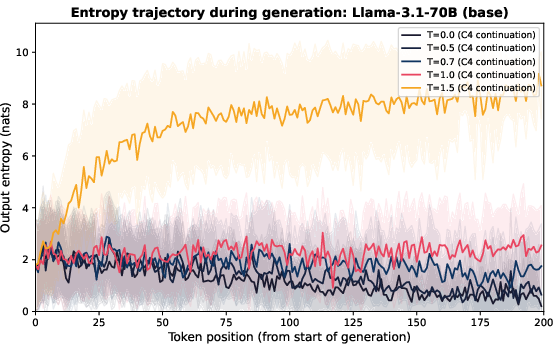
- autoregressive generation: Generating text token by token where each token depends on previous outputs. "Per-position output entropy during autoregressive generation from Llama-3.1-70B base"
- autoregressive sampling: Sampling next tokens from the model’s conditional distribution in a step-by-step fashion. "to minimize the noise from auto-regressive sampling."
- C4: A large English-language web text dataset used for pretraining and evaluation. "off-policy C4 data (English-language web text"
- centered kernel alignment (CKA): A similarity metric for comparing representation spaces across models or conditions. "Linear centered kernel alignment (CKA) yielded modest values of 0.2--0.5"
- chat formatting: Wrapper tokens/structure specifying roles (system/user/assistant) that affect the model’s behavior. "strongly negative with chat formatting"
- chat template: The specific tokenization/format used to represent chat roles in input text. "on C4 web text with no chat template"
- clipping mechanisms: Policy update constraints in RL algorithms that limit parameter changes and can reduce entropy. "The clipping mechanisms in PPO and GRPO drive entropy down even with random rewards"
- cosine similarity: A measure of angular similarity between vectors, used here for comparing activations. "Mean cosine similarity of centered centroids at matched nat values hovered near zero"
- cross-entropy: A loss measuring divergence between predicted and true token distributions during training. "The training aims to minimize the cross-entropy"
- direct policy optimization (DPO): A post-training method that optimizes a policy directly from preferences without explicit reward modeling. "then DPO (direct policy optimization)"
- enaction: A paradigm where the model “enacts” a role by recognizing and leveraging the consequences of its own actions. "from simulation to something more like enaction"
- entropy collapse: A reduction in generation diversity typically observed after alignment/post-training. "Prior work has characterized this as entropy collapse"
- exponential moving average (EMA): A smoothed statistic giving more weight to recent values, used here for entropy traces. "backward and forward exponential moving average (EMA) of entropy"
- GRPO: A reinforcement learning algorithm variant that, like PPO, uses clipping; noted to reduce entropy. "The clipping mechanisms in PPO and GRPO drive entropy down even with random rewards"
- KV cache: The cached attention keys and values for previously processed tokens used to speed and guide decoding. "we patched the KV cache at the user tokens"
- KV patching: Overwriting parts of the KV cache to test causal roles of stored representations. "KV-patching protocol for testing explicit prefill detection."
- LLM-as-judge: An evaluation setup where LLMs assess responses, often revealing biases. "self-preference bias documented in LLM-as-judge evaluations"
- nats: Units of information (natural logarithm base) used to report entropy. "on its own chat outputs (blue, median 0.02 nats)"
- off-policy: Data or contexts not generated by the current model’s own policy. "off-policy C4 data"
- on-policy: Data or contexts generated by the same model following its own policy. "recognize their on-policy generations"
- prefill: Pre-appended model output inserted into the context to influence or test generation behavior. "violating this cached intention with a different-topic prefill results in higher output entropy."
- principal components: Directions of maximal variance used to visualize/model activation spaces. "projected onto their top three principal components."
- PPO: Proximal Policy Optimization, an RL algorithm with clipping that can reduce generation entropy. "The clipping mechanisms in PPO and GRPO drive entropy down even with random rewards"
- RLVR: Reinforcement learning with verifiable rewards, a post-training stage that further sharpens effects. "RLVR (reinforcement learning with verifiable rewards)"
- role-gated: A behavior or mechanism activated only under certain role markers (e.g., assistant). "SFT thus installs a role-gated form of on-policy recognition"
- self-preference bias: A model’s tendency to favor or better handle its own outputs over others’. "self-preference bias documented in LLM-as-judge evaluations"
- self-recognition: The model’s ability to implicitly or explicitly recognize its own generations. "We investigate this “self-recognition” effect in depth in the paper."
- semantic entropy: Uncertainty over the high-level topic or plan of a response, beyond token-level entropy. "“semantic entropy”—as measured by the spread over the topic the model will discuss in response to an ambiguous prompt"
- SFT: Supervised finetuning, a post-training method aligning models to desired behaviors using exemplars. "SFT (supervised finetuning)"
- surprise: The unlikelihood of an observed token under the model’s prior, often quantified as negative log-probability. "internal representation of input surprise"
- system-prompted persona: A role or character specified by the system prompt that constrains style and behavior. "system-prompted as “pirate” or “scientist”"
- temperature: A sampling parameter that scales logits to control randomness and entropy of outputs. "when sampling with low temperatures"
Collections
Sign up for free to add this paper to one or more collections.

