FrontierSmith: Synthesizing Open-Ended Coding Problems at Scale
Abstract: Many real-world coding challenges are open-ended and admit no known optimal solution. Yet, recent progress in LLM coding has focused on well-defined tasks such as feature implementation, bug fixing, and competitive programming. Open-ended coding remains a weak spot for LLMs, largely because open-ended training problems are scarce and expensive to construct. Our goal is to synthesize open-ended coding problems at scale to train stronger LLM coders. We introduce FrontierSmith, an automated system for iteratively evolving open-ended problems from existing closed-ended coding tasks. Starting from competitive programming problems, FrontierSmith generates candidate open-ended variants by changing the problems'goals, restricting outputs, and generalizing inputs. It then uses a quantitative idea divergence metric to select problems that elicit genuinely diverse approaches from different solvers. Agents then generate test cases and verifiers for the surviving candidates. On two open-ended coding benchmarks, training on our synthesized data yields substantial gains over the base models: Qwen3.5-9B improves by +8.82 score on FrontierCS and +306.36 (Elo-rating-based performance) on ALE-bench; Qwen3.5-27B improves by +12.12 and +309.12, respectively. The synthesized problems also make agents take more turns and use more tokens, similar to human-curated ones, suggesting that closed-ended seeds can be a practical starting point for long-horizon coding data.
First 10 authors:
Paper Prompts
Sign up for free to create and run prompts on this paper.
Top Community Prompts
Explain it Like I'm 14
What this paper is about (the big idea)
The paper introduces FrontierSmith, a system that automatically turns simple, puzzle-like coding problems (with one right answer) into open-ended challenges (with many possible good answers). The goal is to create lots of realistic, creative coding tasks so AI coders can learn to solve messier, real-world problems—not just pass/fail puzzles.
What questions the paper asks
In plain terms, the authors ask:
- Can we automatically “remix” closed-ended coding problems into open-ended ones that encourage different creative approaches?
- Can we tell which new problems truly inspire different ideas (rather than all solvers using the same trick)?
- If we train AI models on these new open-ended problems, do they actually get better at open-ended coding challenges?
How FrontierSmith works (the approach, with simple analogies)
Think of a closed-ended coding problem like a multiple-choice question: there’s one correct answer and it’s easy to check if you’re right. Open-ended problems are more like design challenges: there’s no single best answer, and entries are scored on quality (like “shortest time,” “lowest cost,” or “best score”).
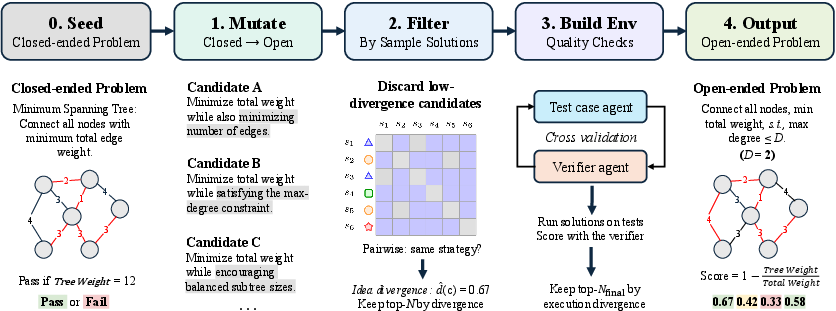
FrontierSmith takes regular coding puzzles and “mutates” them into open-ended challenges, then filters the best ones. Here’s the process:
- Step 1: Start from simple puzzles
- The system begins with many existing competitive programming problems as “seeds.”
- Step 2: Mutate the problems to make them open-ended
- It transforms each seed in three main ways:
- Change the goal: Instead of “find the exact answer,” ask “do as well as you can.” Example: Change “Is this condition true?” into “Find a solution that minimizes cost.”
- Add tighter rules for outputs: Extra constraints make the problem harder so there’s no quick perfect solution, pushing people (and AIs) to try different strategies.
- Broaden inputs: Make the inputs more general or complex so simple one-size-fits-all solutions no longer work.
- Analogy: It’s like turning “solve this exact maze” into “design the best path rules for many types of mazes with new obstacles.”
- Step 3: Keep only genuinely open-ended problems using idea divergence
- The system checks whether different solvers naturally try different core strategies. If everyone uses the same idea, the problem isn’t truly open-ended.
- It measures this “idea divergence” in two ways:
- By reading solutions: An AI “judge” compares solution write-ups and decides if they use different strategies (like greedy vs. dynamic programming).
- By running solutions: It runs each solution on many test cases and compares the pattern of scores. If score patterns differ a lot, the strategies likely differ too.
- Analogy: If five students solve a challenge using clearly different plans, the challenge inspires creativity. If they all use the same plan, it doesn’t.
- Step 4: Build tests and scoring for each problem
- A test-case agent creates many input examples that stress different strategies (e.g., small vs. large, sparse vs. dense graphs).
- A verifier agent builds a scoring program that gives a continuous score (0 to 1), not just pass/fail.
- The two agents cross-check each other to catch mistakes (e.g., broken tests or unfair scoring) and iterate until things look consistent.
- Step 5: Train AI coders on the new problems
- The authors train existing AI coding models using reinforcement learning (RL)—basically, the model tries solutions, gets a score as feedback, and learns from it. Because scores are continuous, the model can learn to improve step-by-step rather than only “right/wrong.”
What they found (main results and why they matter)
- Training on FrontierSmith problems helps AI coders perform much better on open-ended benchmarks (FrontierCS and ALE-bench).
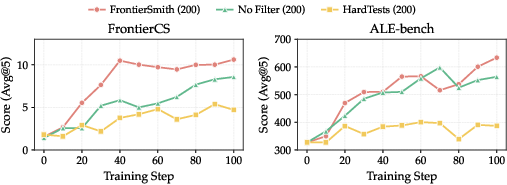
- The improvements are larger than training on regular closed-ended problems, and in many cases match or beat training on human-made open-ended problems. This suggests the synthetic problems are high quality.
- The “idea divergence” filter is crucial: when they skipped it, performance dropped. That means selecting problems that spark different strategies really matters.
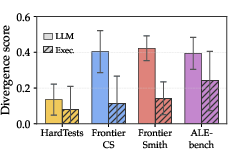
- The idea divergence score also separates open-ended problems from closed-ended ones nicely—so it’s a useful signal for deciding which problems are truly open-ended.
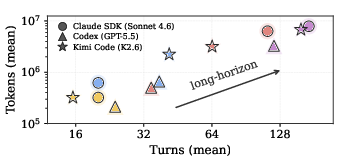
- On these synthetic problems, code agents tend to take more turns and use more tokens (more “thinking”)—just like with human-curated open-ended tasks. This is a sign that the problems naturally lead to longer, deeper problem solving, not quick one-shot answers.
Why this matters:
- Open-ended coding tasks are closer to real-world engineering: there’s rarely one perfect answer.
- Human-made open-ended problems are expensive and slow to create. FrontierSmith can make lots of them automatically, which is great for training future AI coders.
What this could lead to (implications)
- Scalable training data: We can produce large, diverse, realistic coding challenges without needing huge amounts of expert labor.
- Better AI problem-solving: AI coders trained on these tasks learn to explore different strategies, not just memorize patterns—making them more useful on complex, real-world problems.
- Stronger evaluation tools: The idea divergence metric offers a simple way to tell if a problem truly encourages creative approaches.
- Future directions: Today, FrontierSmith focuses on self-contained algorithmic tasks (no external systems). In the future, similar methods could create open-ended problems for big software projects, GPU kernels, or cloud systems—pushing AI towards even more realistic engineering work.
In short, FrontierSmith shows we can mass-produce meaningful, creativity-demanding coding problems and use them to train AI models that perform better on open-ended challenges. It’s a step toward AI that can tackle harder, more open, and more realistic coding tasks.
Knowledge Gaps
Knowledge gaps, limitations, and open questions
Below is a consolidated, actionable list of what remains uncertain, missing, or unexplored in the paper.
- Reliability of LLM-as-a-judge for “strategy” detection remains unvalidated against human annotations; quantify inter-annotator agreement with expert labels and assess judge bias across models and prompts.
- Sensitivity of the idea-divergence metric to the choice of solver distribution (e.g., Claude vs. other LLMs, ensembles, temperature settings) is not studied; evaluate robustness across solvers and decoding strategies.
- Statistical properties of divergence estimates are uncharacterized (variance, confidence intervals, sample complexity vs. n); conduct sensitivity analyses on n, batching schemes, and pairwise sampling.
- The link between high idea divergence and desirable “open-endedness” is only suggestive; establish formal or empirical correlations with human-perceived problem diversity and downstream training gains.
- Potential for selecting ill-posed or ambiguous problems that artificially inflate divergence is not ruled out; add diagnostics to detect ambiguity-induced divergence vs. genuine algorithmic diversity.
- Execution-grounded divergence depends on test-case design derived from a small set of sampled solutions; measure overfitting of test generators to these solutions and validate on withheld, independently generated inputs.
- Absence of human-in-the-loop verification of verifiers and test cases; introduce targeted human audits or meta-tests to catch reward misspecification and invalid scoring.
- Verifier robustness and reward hacking risks are not systematically probed; perform adversarial stress tests (e.g., pathological outputs, timing manipulations, formatting hacks) and analyze exploitability.
- Reward normalization design (baseline choice, clipping, offset assumptions) is ad hoc; compare alternative normalizations (e.g., z-scoring, quantile normalization, Pareto-scalarization) and study cross-task comparability.
- Assumption that and the proposed normalization may collapse signal or distort gradients; evaluate real objective distributions and define principled handling of zero/negative or heavy-tailed values.
- No ablation on each mutation axis (goal change, output restriction, input generalization); quantify their individual and combined contributions to open-endedness, divergence, and training gains.
- Theoretical grounding that mutations reliably remove known optima and induce graded performance is limited; formalize conditions under which each mutation type yields genuinely open-ended objectives.
- Diversity vs. learnability trade-off is unexamined; investigate whether very high divergence correlates with unstable RL or poor sample efficiency and identify an optimal divergence range for training.
- Dependence on proprietary frontier models (GPT-5.4 Thinking, Claude Sonnet 4.6) impedes reproducibility; report sensitivity to model choice, release reproducible open-source variants, and provide seeds/prompts.
- Scaling limits are unclear: only 200 problems synthesized and 4 iterations; test throughput, success rates, and cost when targeting thousands of problems and more rounds.
- Pipeline success/failure modes (only ~10% survival at test/verifier stage) are not analyzed; categorize typical failure cases and add targeted fixes to improve yield.
- Generalization beyond self-contained algorithmic tasks is unaddressed beyond a brief limitation note; concretely prototype repo-level, multi-file, or hardware-dependent tasks with environment synthesis and sandboxing.
- Multi-objective and constrained optimization (e.g., makespan vs. energy vs. latency) are not explored; design and evaluate tasks with principled scalarization or Pareto evaluation protocols.
- Long-horizon “agentic” RL is identified as future work but not attempted; integrate multi-turn interaction loops and measure whether synthetic tasks improve planning, tool use, and iterative refinement capabilities.
- Validation that synthetic tasks mirror human-curated difficulty and diversity is limited; add human difficulty ratings and analyze correlations with divergence and performance.
- Possible training–evaluation leakage via format or thematic similarity is not checked; perform de-duplication and semantic similarity screening between synthesized tasks and benchmarks.
- ALE-bench reporting lacks detail on how continuous scores map to Elo-like ratings and how Avg@5/Best@5 aggregate across tasks; provide exact conversion, uncertainty, and statistical significance tests.
- Best-checkpoint selection without variance estimates or confidence intervals risks cherry-picking; report means, standard deviations, and significance across seeds/runs.
- The coarse LLM filter’s 9% false-positive and 19% false-negative rates are measured but not improved; explore thresholding, calibration, and multi-judge consensus to reduce misclassification.
- Interaction between divergence filtering and RL stability is not studied; measure reward variance, gradient norms, and training stability vs. divergence thresholds.
- Test-case generation guidelines are underspecified; introduce coverage metrics (e.g., input distribution diversity, structural coverage) and automated checks for distribution shift and mode collapse.
- Choice of budgets (B, N_div, N_final) lacks justification; sweep these hyperparameters to characterize pipeline efficiency, quality, and compute cost trade-offs.
- Cross-solver consistency of verifiers and tests is not measured; verify that different compilers/languages/runtimes yield consistent scores and define portability requirements.
- Language and ecosystem diversity (Python vs. C++/Rust/Java) are not explored; generate multi-language tasks and assess whether synthesized problems remain well-posed across toolchains.
- Safety, licensing, and provenance of mutated tasks derived from competitive programming datasets are not discussed; clarify licensing, attribution, and redistribution policies.
- Dataset and artifact release details (full prompts, test generators, verifiers, seeds) are not fully specified; release comprehensive artifacts for replication and external auditing.
- Correlation between long-horizon behavior (turns/tokens) and actual solution quality is not analyzed; quantify whether “more turns” causally improves outcomes or just increases compute.
- Comparative evaluation against other open-ended synthesis efforts (e.g., NP-Engine, domain-specific generators) is missing; run head-to-head benchmarks controlling for compute and model capacity.
- Applicability to domains where open-endedness is not tied to NP-hardness (e.g., code quality, readability, maintainability) is untested; synthesize and score such tasks with human-validated metrics.
- Ethical considerations (e.g., generating tasks that may encode biases or unsafe practices) are not addressed; implement content filters and ethical reviews for synthesized problem statements.
Practical Applications
Practical, Real-World Applications of FrontierSmith
Below are actionable applications derived from the paper’s methods and findings, grouped by deployment timeline. Each item notes relevant sectors, potential tools/products/workflows, and key assumptions or dependencies that affect feasibility.
Immediate Applications
- Training data augmentation for LLM coding models
- Sector: Software/AI, DevTools
- What: Use FrontierSmith to synthesize open-ended coding tasks with continuous rewards to fine-tune code LLMs via RL (e.g., GRPO), improving performance on heuristic/optimization-style problems.
- Tools/products/workflows:
- “Open-ended RL data pack” generation for internal model training
- Integration with existing RL pipelines (veRL, GRPO) and evaluation harnesses
- Assumptions/dependencies:
- Access to strong LLMs for mutation, judging, and test/verifier generation
- Compute budget for data synthesis and RL
- Sandboxed execution for running candidate solutions and verifiers
- Curating high-quality open-ended problem sets with the idea divergence metric
- Sector: AI research, Benchmarking, DevTools
- What: Use the paper’s idea-divergence filter to select problems that elicit distinct strategies, preventing degenerate tasks that collapse to one approach.
- Tools/products/workflows:
- “Problem curation” services/modules for benchmark maintainers
- Dataset cleaning pipelines that classify and filter closed-ended vs. open-ended tasks
- Assumptions/dependencies:
- Reliability of LLM-as-a-judge and execution-grounded divergence
- Representative sampling of solutions for robust divergence estimation
- Long-horizon agent evaluation harnesses
- Sector: Agent platforms, Enterprise AI
- What: Deploy FrontierSmith problems to test multi-turn, tool-using code agents (turns/tokens as behavioral proxies), complementing pass/fail coding tests.
- Tools/products/workflows:
- “Long-horizon readiness” gates in model evaluation
- Agent red-teaming suites using synthetic open-ended tasks
- Assumptions/dependencies:
- Stable execution environments and timeouts for long runs
- Token/compute controls and budget planning
- Education: open-ended programming assignments with continuous scoring
- Sector: Education/EdTech
- What: Generate diverse, graded (0–1 or 0–100) assignments that accept multiple valid strategies and give fine-grained feedback, promoting creativity and heuristic thinking.
- Tools/products/workflows:
- LMS plugins for assignment generation and auto-grading
- Instructor dashboards that display strategy diversity and student solution clusters
- Assumptions/dependencies:
- Alignment with course outcomes and academic integrity controls
- Instructor review of verifiers for fairness and noise
- Hiring and skills assessment with strategy-aware scoring
- Sector: HR/Recruiting, Technical assessment
- What: Replace binary coding tests with continuous-scored, open-ended challenges that capture solution quality and diversity of approach.
- Tools/products/workflows:
- Candidate evaluation reports with idea-divergence profiles
- Calibrated leaderboards across cohorts
- Assumptions/dependencies:
- Legal/HR acceptance of novel assessments
- Transparent scoring criteria and anti-cheating measures
- Benchmark expansion and maintenance
- Sector: AI benchmarking, Competitions
- What: Rapidly generate new open-ended tasks to expand/refresh benchmarks (e.g., ALE-like contests) without heavy expert curation.
- Tools/products/workflows:
- Leaderboard backends that ingest FrontierSmith-formatted tasks and verifiers
- Rotating challenge pools for regular competitions/hackathons
- Assumptions/dependencies:
- Governance to avoid task leakage and overfitting
- Continuous auditing of verifiers for validity and stability
- Domain-agnostic test-case and verifier agent pattern
- Sector: Software engineering (testing), QA
- What: Apply the paper’s cross-validated agent pattern to build stress-test inputs and normalized scoring functions that differentiate competing heuristics.
- Tools/products/workflows:
- “Scoring-verifier as a service” for internal optimization tasks
- Regression dashboards tracking solution-quality distributions
- Assumptions/dependencies:
- Baseline heuristics for normalization
- Robustness checks to prevent reward hacking
- Internal R&D on heuristic design (rapid prototyping)
- Sector: OR/optimization teams within firms
- What: Use synthesized problem variants to explore and compare heuristics (e.g., greedy vs. local search), accelerating algorithm prototyping.
- Tools/products/workflows:
- Labs that auto-generate adversarial instances for internal heuristics
- Comparative reports driven by execution-grounded score vectors
- Assumptions/dependencies:
- Fidelity of synthetic instances to production distributions
- Domain expert oversight in objective and constraint design
Long-Term Applications
- Sector-specific open-ended training and evaluation for real systems
- Cloud & Systems (e.g., cluster scheduling), Databases (e.g., join ordering), Compilers, GPU kernels, Robotics/Planning, Energy, Finance, Healthcare operations
- What: Extend FrontierSmith to synthesize domain-specific, repository- or infrastructure-level tasks with realistic simulators and verifiers, training agents that discover and refine heuristics at production scale.
- Tools/products/workflows:
- “Auto-curriculum generators” that mutate live workloads into graded optimization challenges
- Autotuning studios (e.g., kernel tuning, compiler pass scheduling) with continuous feedback
- Assumptions/dependencies:
- High-fidelity simulators and cost functions aligned with real KPIs (latency, cost, safety)
- Secure, reproducible execution environments (containers, GPUs, cluster sandboxes)
- Strong guardrails to prevent reward hacking or unsafe strategies
- Agentic RL for long-horizon coding and engineering workflows
- Sector: Agent platforms, DevOps/CI
- What: Move from single-turn RL to multi-turn, tool-using RL where agents iteratively propose, test, and refine solutions on open-ended tasks.
- Tools/products/workflows:
- CI-integrated “agent training lanes” with stepwise rewards and verifier feedback
- Tool-orchestration policies that learn to balance exploration and refinement
- Assumptions/dependencies:
- Stable, scalable interfaces for tool use (compilers, profilers, simulators)
- Credit assignment and anti-deception mechanisms for agentic RL
- Enterprise “Open-Ended RL Data-as-a-Service”
- Sector: AI vendors, Platform providers
- What: Commercial services that deliver domain-tailored open-ended problem packs, verifiers, and divergence-based curation for continuous model improvement.
- Tools/products/workflows:
- Hosted problem synthesis pipelines with governance and audit trails
- SLAs for verifier validity and dataset refresh cadence
- Assumptions/dependencies:
- IP/licensing clarity for seed tasks and generated content
- Cost-effective LLM and compute provisioning
- Standards and policy for open-ended AI evaluation
- Sector: Policy/Standards bodies, Public sector procurement
- What: Develop guidance on continuous-scoring benchmarks, divergence metrics, and long-horizon evaluation to complement binary pass/fail standards.
- Tools/products/workflows:
- Public, rotating challenge banks with transparent verifiers
- Procurement checklists emphasizing open-ended capability and robustness
- Assumptions/dependencies:
- Stakeholder consensus on metrics and governance
- Funding and stewardship for open, community-run evaluation assets
- Education at scale: creativity- and strategy-focused curricula
- Sector: Education/EdTech
- What: Personalized, adaptive curricula where tasks are synthesized to elicit diverse strategies; students receive feedback on quality and originality (via divergence).
- Tools/products/workflows:
- Tutor systems that generate, grade, and explain multiple solution paths
- Cohort analytics that track strategy diversity and progression
- Assumptions/dependencies:
- Reliable, fair verifiers across student populations
- Effective pedagogy for open-ended assessment and feedback
- Hiring and professional development with longitudinal, project-like challenges
- Sector: HR/Recruiting, L&D
- What: Multi-day open-ended “build & optimize” exercises that mimic real work (e.g., performance tuning, algorithmic design), scored by robust verifiers with diversity metrics.
- Tools/products/workflows:
- Candidate dashboards showing improvement trajectories and strategy shifts
- Internal upskilling programs using auto-generated challenge sets
- Assumptions/dependencies:
- Transparent scoring and fairness safeguards
- Acceptance by hiring managers and alignment with job requirements
- Cross-domain research on quality-diversity and automated discovery
- Sector: Academia/Research
- What: Use idea divergence and execution-grounded signals to drive automated discovery in algorithms, program synthesis, and heuristic search across domains (e.g., math, operations research).
- Tools/products/workflows:
- Open-source benchmarks and pipelines seeded by FrontierSmith
- Comparative studies of diversity-driven curricula vs. reward-only curricula
- Assumptions/dependencies:
- Continued progress in LLM reasoning and tool-use
- Community standards for reporting and reproducibility
Notes on General Dependencies and Risks
- LLM availability and quality: The synthesis pipeline currently relies on strong proprietary models for mutation, judging, and agenting (e.g., GPT-5.x/Claude), affecting cost and reproducibility.
- Execution safety and reproducibility: Requires robust sandboxing, timeouts, and deterministic environments (containers, pinned dependencies).
- Reward design and verifier validity: Continuous scoring depends on baselines and normalization; mis-specified verifiers can induce reward hacking or misleading optimization.
- Domain shift: Synthetic tasks must approximate real data distributions to transfer; domain experts should review objectives/constraints in high-stakes settings.
- Governance: For education/hiring/policy use, fairness, transparency, and anti-cheating controls are essential.
Glossary
- 2-SAT: A special case of the Boolean satisfiability problem where each clause has two literals, solvable in polynomial time. "2-SAT~\citep{aspvall1979linear} decides whether a Boolean formula with two-literal clauses is satisfiable;"
- ALE-bench: An open-ended coding benchmark derived from AtCoder Heuristic Contests, using performance-based ratings. "ALE-bench~\citep{alebench} draws tasks from AtCoder Heuristic Contests and evaluates submissions using performance-based ratings."
- approximation ratio: A measure of how close a heuristic or approximate solution is to the optimal solution, often used to define rewards in optimization RL. "training via RLVR with approximation-ratio rewards;"
- AtCoder Heuristic Contest: A competitive programming series focused on heuristic optimization problems that admit graded solution quality. "The AtCoder Heuristic Contest~\citep{alebench} and the database join-ordering problem~\citep{steinbrunn1997joinorder} illustrate this:"
- certificate of optimality: A proof or efficiently checkable witness that a solution is globally optimal. "lack tractable certificates of optimality at the target scale"
- database join-ordering problem: The problem of choosing the sequence of joins in a database query plan, a classic combinatorial optimization task with diverse solution strategies. "the database join-ordering problem~\citep{steinbrunn1997joinorder} illustrate this:"
- degree-constrained spanning tree: A spanning tree optimization where each node’s degree is bounded, making the problem NP-hard. "Adding per-vertex degree bounds yields the NP-hard degree-constrained spanning tree~\citep{narula1980degree}."
- Elo rating: A rating system for comparing relative performance, often used to aggregate competitive outcomes. "(Elo-rating-based performance)"
- execution-grounded estimate: An estimation method that measures solution diversity by comparing per-test-case score vectors from running code, rather than just textual analysis. "Execution-grounded estimate."
- GRPO: Group Relative Policy Optimization, an RL method that uses group-based relative rewards to stabilize training. "with GRPO~\citep{shao2024deepseekmath}."
- Harbor evaluation framework: A framework for orchestrating and measuring code agents’ multi-turn interactions and tool use. "via the Harbor evaluation framework~\citep{harbor2026}:"
- idea divergence: A metric estimating the probability that two independently generated solutions use different core algorithmic strategies. "We then quantify the open-endedness of the remaining candidates with a novel idea divergence metric"
- K\H{o}nig's theorem: A result relating matchings and vertex covers in bipartite graphs, implying polynomial-time solvability for certain problems. "via K\H{o}nig's theorem~\citep{konig1990theory},"
- LLM-as-a-judge: The practice of using a LLM to evaluate or compare solutions, e.g., to determine if they use different strategies. "An LLM-as-a-judge labels each pair as same- or different-strategy:"
- long-horizon: Refers to tasks or agent behaviors requiring many iterative steps, turns, or tokens to solve effectively. "open-ended problems have recently shown to elicit distinctive long-horizon behavior in code agents,"
- makespan: The total time to complete a set of jobs (e.g., in scheduling), often an objective to minimize. "they differ continuously in makespan, tail latency, energy use, and utilization;"
- Min-True 2-SAT: A variant of 2-SAT seeking a satisfying assignment that minimizes the number of true variables (optimization version). "Min-True 2-SAT~\citep{gusfield1992bounded}, which keeps the same input and output but asks for a satisfying assignment that minimizes the number of true variables."
- NP-complete: A class of decision problems that are both NP-hard and in NP, widely believed not to have polynomial-time solutions. "it becomes one of Karp's original NP-complete problems~\citep{karp2009reducibility}"
- NP-hard: Problems at least as hard as the hardest problems in NP; they may not have efficient algorithms or verifiable certificates of optimality at scale. "Adding per-vertex degree bounds yields the NP-hard degree-constrained spanning tree~\citep{narula1980degree}."
- novelty search: An evolutionary or search strategy that rewards behavioral or structural novelty rather than objective performance to promote diversity. "quality-diversity and novelty search~\citep{lehman2011novelty, mouret2015mapelites, wang2019poet, bradley2023qdaif, faldor2024omni, aces},"
- quality-diversity: A family of algorithms aiming to discover a diverse set of high-performing solutions across behavior space. "quality-diversity and novelty search~\citep{lehman2011novelty, mouret2015mapelites, wang2019poet, bradley2023qdaif, faldor2024omni, aces},"
- RLVR: Reinforcement learning from verifier rewards, where a programmatic verifier supplies continuous, task-specific feedback. "training via RLVR with approximation-ratio rewards;"
- spurious reward: A non-informative or random reward signal used as a control to test whether learning gains are genuine. "this is a spurious reward control:"
- test-case generator: A program that synthesizes diverse input instances (often adversarial or structurally varied) to stress different strategies. "we prompt the agent to write test-case generator programs"
- verifier: A scoring or evaluation program that maps outputs to continuous scores (rather than binary pass/fail), enabling open-ended assessment. "a verifier that produces continuous scores rather than binary judgments,"
- veRL: An RL training framework/tooling used to implement policy optimization setups for LLMs. "We use veRL~\citep{sheng2024hybridflow} with GRPO,"