- The paper introduces a bidirectional framework that synergizes text and graph retrieval to overcome isolated retrieval limitations in RAG.
- It employs global voting re-ranking and memory-based orphan entity bridging to recover reasoning paths and enhance factual consistency.
- Empirical evaluations on MuSiQue and HotpotQA demonstrate significant performance gains and computational efficiency over baseline hybrid RAG methods.
Bidirectional Synergy in RAG: The TGS-RAG Framework
Motivation and Problematic Aspects of Isolated Retrieval
Despite the wide adoption of Retrieval-Augmented Generation (RAG) for enhancing factuality and multi-hop reasoning in LLMs, existing paradigms—text-based and graph-based retrieval—remain fundamentally siloed. Text-based RAG commonly retrieves pseudo-evidence due to overreliance on semantic similarity, leading to logical irrelevance. Conversely, graph-based RAG excels at logical interpretability but is constrained by search-time pruning, often overlooking valid reasoning paths (the "Information Island" problem). Hybrid and unidirectional methods have attempted to combine these strengths, but their lack of mutual verification and closed-loop integration leaves a critical performance ceiling.
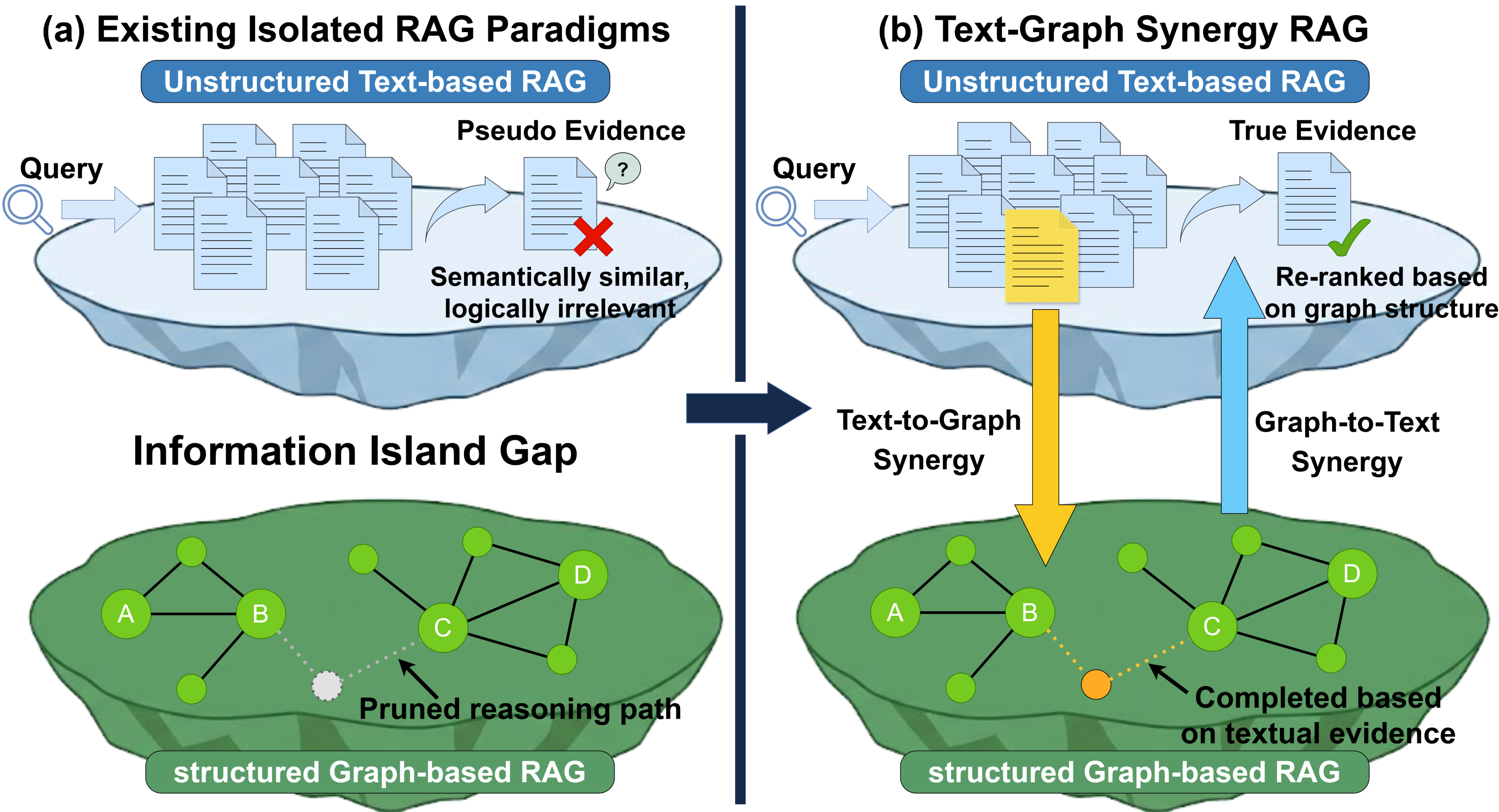
Figure 1: Comparison illustrating how traditional text-based and graph-based retrieval paradigms create "Information Islands," whereas TGS-RAG introduces a bidirectional synergy to bridge semantic gaps.
Architecture of TGS-RAG
TGS-RAG introduces a bidirectional enhancement framework that tightly couples unstructured text and structured knowledge graphs at both evidence retrieval and reasoning stages. The architecture involves three main phases:
- Knowledge Base Construction: Extraction of entities and relations from documents produces a unified knowledge base where text chunks are cross-referenced with a knowledge graph.
- Bidirectional Synergistic Retrieval: A dual-retrieval process generates both candidate textual evidence and structured graph reasoning paths. Semantic Beam Search accumulates a Visited Memory including both active and pruned nodes.
- Generation: Selected paths and chunks are synthesized into a coherent answer.
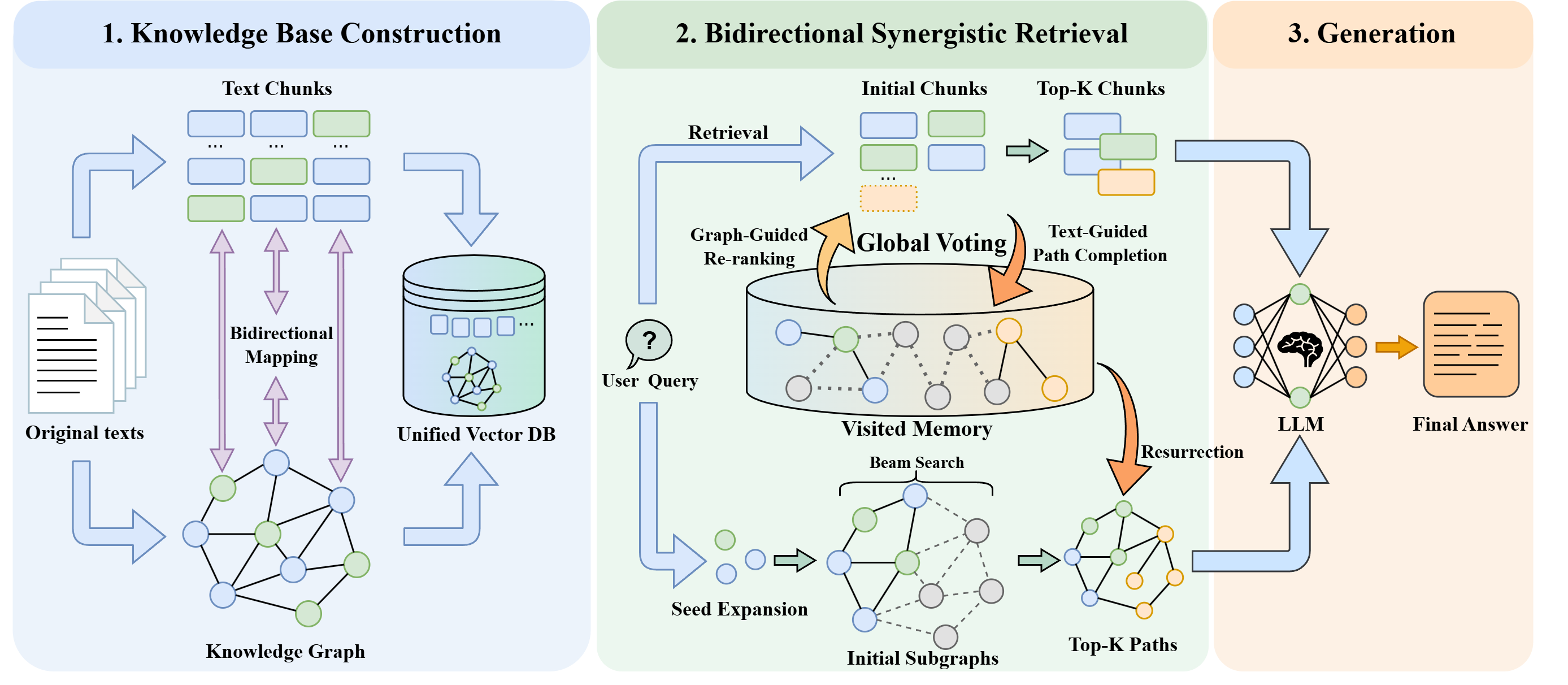
Figure 2: The TGS-RAG architecture highlighting the knowledge base, bidirectional retrieval with Visited Memory, and orchestrated answer generation.
Bidirectional Synergistic Mechanisms
The core innovation of TGS-RAG is the closed-loop interaction between the text and graph channels:
Graph-to-Text (Global Voting and Re-ranking)
All graph entities visited—including those in pruned paths—serve as recommenders, guiding the re-ranking of text chunks through a voting mechanism. The final score for each text chunk is a weighted combination of embedding similarity and graph-driven votes, with a tunable synergy weight (α). This enables TGS-RAG to recall text that may be structurally relevant but low in surface similarity, thus overcoming the pseudo-evidence problem prevalent in dense retrieval.
Text-to-Graph (Memory-based Orphan Entity Bridging)
To recover reasoning paths discarded by greedy graph pruning, TGS-RAG introduces the Memory-based Orphan Entity Bridging algorithm. Textual context is scanned to identify key entities present in retrieved text but absent from active graph paths. If these "orphan entities" were previously visited and pruned during beam search, their reasoning paths are resurrected, reconstructing logical chains with zero overhead and avoiding the combinatorial explosion of iterative graph expansion.
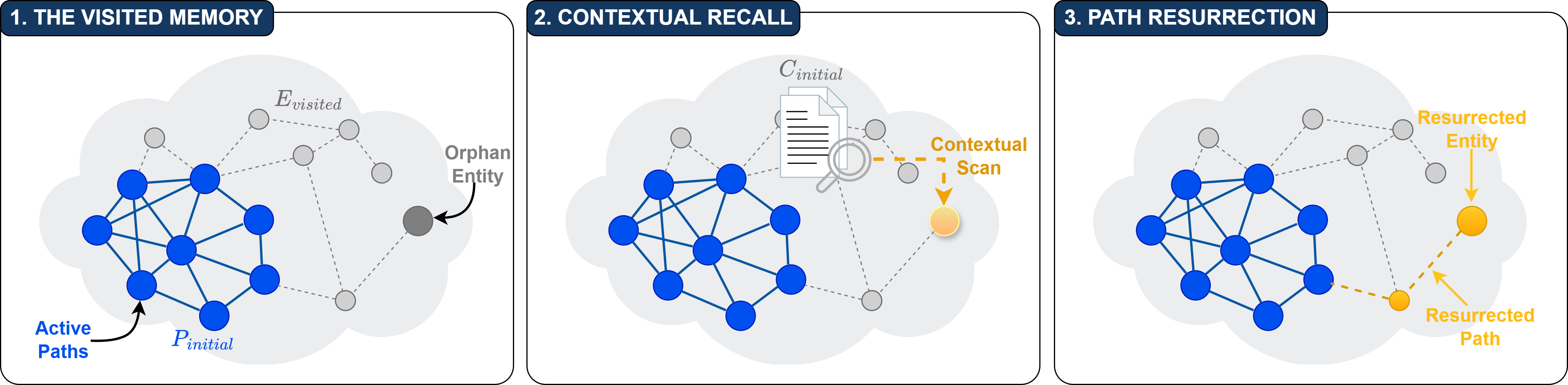
Figure 3: The Orphan Entity Bridging process: semantic beam search generates a Visited Memory; text cues recall relevant but pruned entities, triggering resurrection of lost reasoning chains.
Empirical Evaluation
Experiments on MuSiQue and HotpotQA demonstrate several robust quantitative findings.
- On MuSiQue, TGS-RAG achieves a Strict Hit Rate of 34.84% and LLM Judge Accuracy of 41.37%, more than doubling baseline hybrid RAG's performance.
- On HotpotQA, it attains 62.00% Strict Hit Rate and 79.99% Judge Accuracy, setting a new performance state-of-the-art among evaluated systems.
These improvements are attributed specifically to the bidirectional synergy: removal of Graph-to-Text or Text-to-Graph components in ablation studies produces sharp performance drops (e.g., strict hit rate falls to 47.82% without Bridging).
Furthermore, TGS-RAG exhibits a Pareto-efficient computational profile. While methods such as GraphRAG and LightRAG incur exorbitant token usage (e.g., LightRAG uses 757M tokens on HotpotQA), TGS-RAG delivers superior accuracy/recall with 3–5× less computational overhead.
Theoretical and Practical Implications
TGS-RAG’s bidirectional framework directly addresses the core brittleness of hybrid and pipeline retrieval, proving that independent channels are insufficient for robust multi-hop reasoning across disconnected or sparsified evidence. The global voting and memory-based bridging mechanisms establish mutual verification, which is vital not only for factual retrieval but also for robust and interpretable reasoning in LLMs.
In practical terms, the on-demand resurrection of orphan paths enables efficient retrieval from large or dynamically updated knowledge bases, avoiding the scaling bottlenecks of exhaustive graph indexing. This positions TGS-RAG as a scalable, cost-effective solution for deployed knowledge-intensive systems.
Broader Impact and Future Directions
The TGS-RAG approach signals a new direction for RAG systems: beyond shallow hybridization, effective factual reasoning in LLMs demands bidirectional, memory-augmented synergy between symbolic structure and neural evidence. Anticipated advances include tighter integration with graph construction (e.g., continual knowledge extraction) and adaptive retrieval policies that learn optimal synergy parameters in-situ. Furthermore, the memory-based bridging principle is likely extensible to multi-modal RAG, where structured evidence bridges textual, tabular, and visual domains.
Conclusion
TGS-RAG establishes a rigorous, bidirectional methodology for integrating unstructured and structured retrieval in multi-hop reasoning tasks. Via global voting re-ranking and orphan entity bridging, it achieves both higher retrieval fidelity and efficiency compared to prevailing RAG paradigms. These findings substantiate the necessity of deep, closed-loop synergy for robust LLM factual reasoning, providing a scalable blueprint for future cross-modal retrieval and generation frameworks.

