PySCo-EFT and ECOSMOG-EFT: a tandem of N-body simulation codes for the Effective Field Theory of Dark Energy
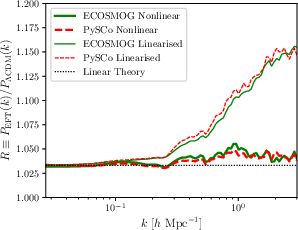
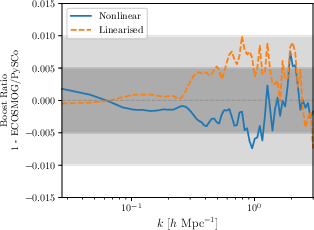
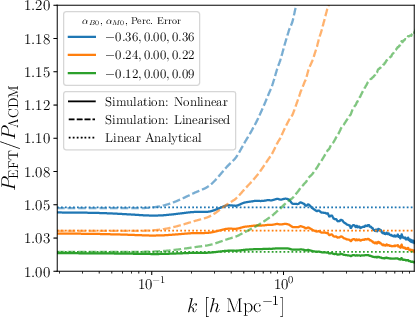
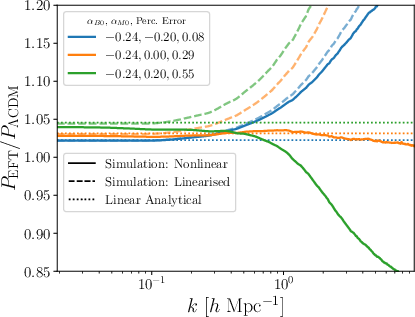
Abstract: Modified gravity theories constitute viable alternatives to the standard cosmological model for explaining the observed late-time accelerated expansion of the Universe. The Effective Field Theory of Dark Energy (EFTofDE) is an efficient framework to describe a wide range of such theories with a limited number of parameters. To robustly constrain them by comparison with clustering and weak lensing data from upcoming large-scale structure surveys, high-resolution cosmological N-body simulations are required to obtain accurate predictions for the matter distribution on non-linear scales. We introduce two new N-body simulation codes for EFTofDE cosmologies: PySCo-EFT, a Python-based particle mesh code, and ECOSMOG-EFT, a RAMSES-based code with adaptive mesh refinement. We consider Horndeski models with a luminal gravitational wave speed. We use iterative solvers and multigrid schemes to solve for the additional scalar field equation in both codes, incorporating the non-linear Vainshtein screening mechanism. We present validation and convergence tests of the codes. We obtain a sub-0.5 percent agreement with linear theory on large scales and a similar agreement between the two codes on non-linear scales. The dominant numerical effects on the matter-power-spectrum boost are mass resolution, finite-volume effects, refinement threshold, and starting redshift, but they are limited to below 2% at the largest wavenumbers (k=10 h/Mpc) for the range of tested values. We investigate the impact of the EFTofDE parameters on the matter-power-spectrum ratios between EFTofDE and $Λ$CDM cases. Depending on the EFTofDE parameters, the screening plays a negligible or dominant role compared to the linearised field equations. Our codes provide tools for generating fast and accurate predictions of the impact of the EFTofDE on the clustering of matter, incorporating non-linear screening.
Paper Prompts
Sign up for free to create and run prompts on this paper using GPT-5.
Top Community Prompts
Explain it Like I'm 14
Overview
This paper is about building and testing two new computer programs that simulate how the Universe’s matter clumps together when gravity might be a bit different from Einstein’s usual rules. These differences are part of ideas called “modified gravity,” which try to explain why the Universe’s expansion is speeding up (often linked to “dark energy”). The authors use a powerful language called the Effective Field Theory of Dark Energy (EFTofDE) to describe many of these ideas with just a few adjustable settings.
What were they trying to find out?
In simple terms, the authors wanted to:
- Create fast and accurate simulation tools that show how galaxies and cosmic structures grow if gravity is slightly modified.
- Include a feature called “screening,” which makes any extra gravity-like force turn off in crowded places (so we still match Solar System tests).
- Check how changing the EFTofDE settings (“knobs”) changes how clumpy the Universe becomes at different sizes.
- Make sure the two codes agree with each other and with known predictions.
How did they do it?
Think of the Universe like a huge 3D grid filled with many tiny particles that stand in for matter. The particles pull on each other with gravity and form cosmic structures over time.
The authors built two simulation codes:
- PySCo-EFT: a fast Python code (like a quick sketch) that uses a fixed grid (“particle-mesh” method) to explore ideas quickly.
- ECOSMOG-EFT: a high-precision code built on RAMSES that can “zoom in” where things get dense using adaptive mesh refinement (AMR), like swapping a low-zoom camera for a high-zoom lens in crowded regions.
What makes this special is that they added an extra “invisible” force, created by a new field (a “scalar field”), on top of normal gravity. This extra force can speed up structure growth. But to stay consistent with real-world tests (like in the Solar System), it must switch off in very dense regions. That switch-off is called Vainshtein screening. You can think of it like noise-cancelling headphones: the extra force “cancels itself” where matter is crowded, so regular gravity takes over.
Key technical ideas explained simply:
- Effective Field Theory (EFT): a shared language that describes many modified gravity models using only a few time-changing controls (like knobs on a stereo). In this paper, two important “knobs” affect how strongly the extra force mixes with gravity and how the strength of gravity may change over time.
- Horndeski models with “luminal” waves: they focus on a family of theories where gravitational waves travel at the speed of light, matching the famous neutron-star collision observation in 2017. This choice keeps things realistic.
- Solving tough equations on a grid: the extra field’s equation is non-linear (not a straight line relationship), so you can’t just use simple tricks. The codes use iterative methods and multigrid schemes—like solving a puzzle first at low resolution, then refining the details—for speed and stability.
- Lensing vs. clustering: matter moves due to one gravity potential (called Ψ), while light bending (gravitational lensing) depends on a combination of two potentials (Ψ + Φ). The AMR code can compute both very accurately in dense regions, which is helpful for lensing predictions.
What did they find?
The authors ran many tests to make sure their codes are reliable and to see how the EFTofDE “knobs” change the Universe’s clumpiness.
Main results:
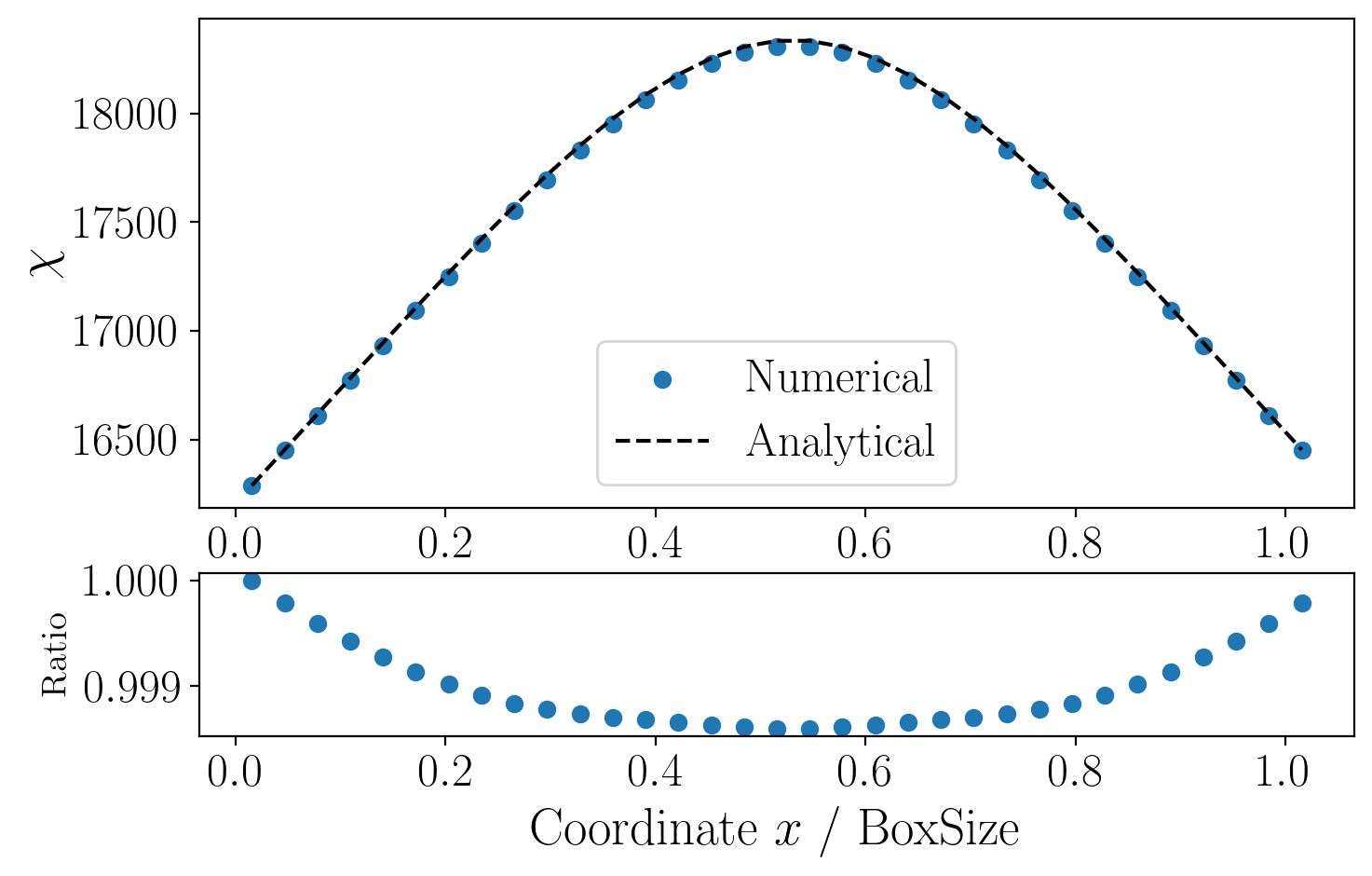
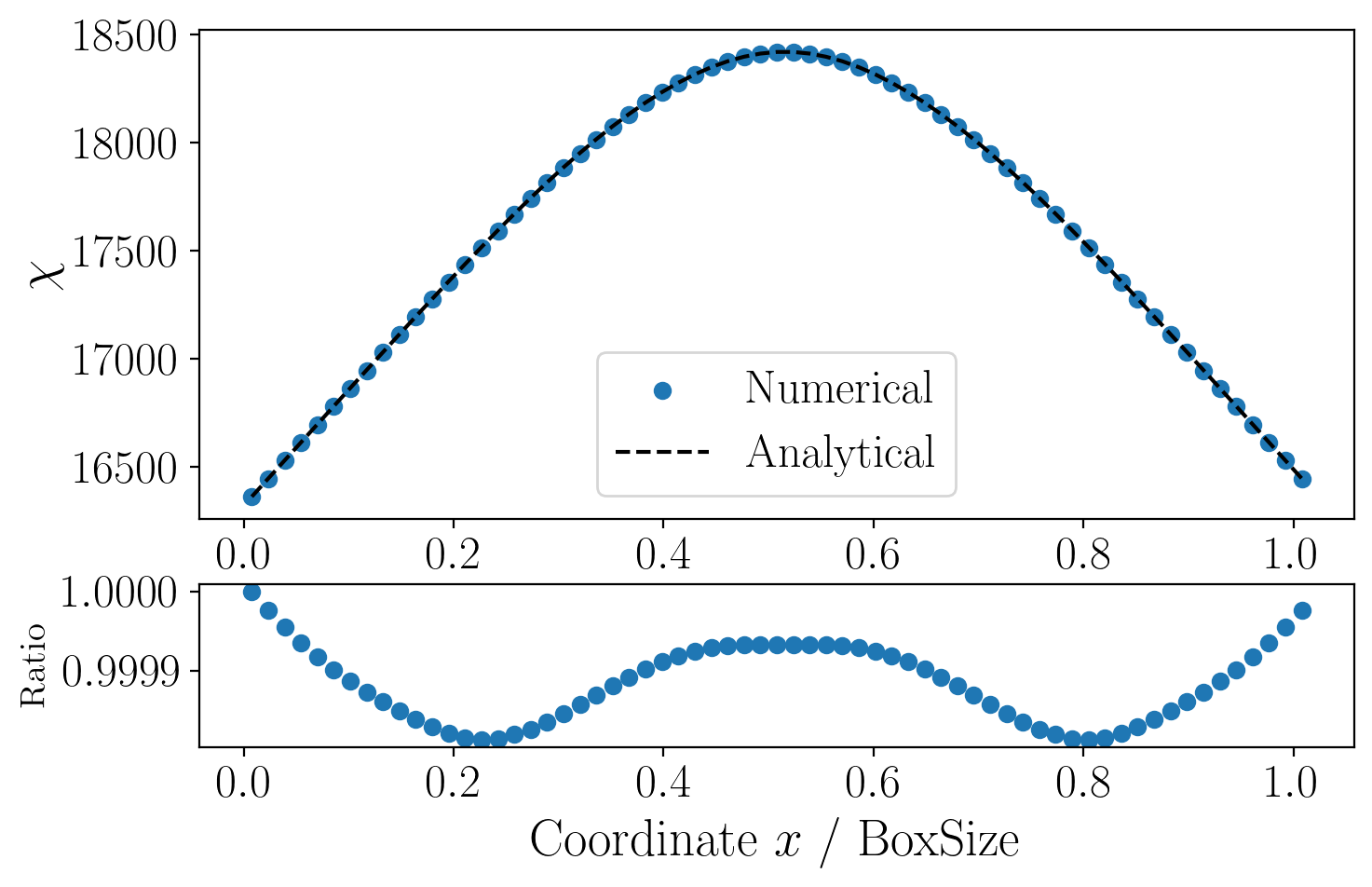
- Accuracy on large scales: The simulations match standard “linear theory” predictions at big sizes to better than 0.5%. That means the codes are doing the right thing when structures are still gently growing.
- Agreement in the non-linear regime: Even when structures get very clumpy (small scales), the two codes—with different solving methods—agree very well.
- Small numerical effects: Usual simulation issues (like limited resolution, box size, when you start the simulation, and AMR settings) change the results only by up to about 2% even at very small scales (down to sizes corresponding to wavenumbers k = 10 h/Mpc). That’s good news for precision.
- Screening can matter a lot—or a little: Depending on the EFTofDE settings, the screening effect can be almost irrelevant or absolutely crucial. Ignoring screening could give the wrong answer for how strong structure growth is at small scales.
- Practical note on very empty regions: In some extreme, very empty parts of space (voids), the math for the extra field can misbehave in these simplified models. The authors use a standard, careful fix that doesn’t affect the main science results (since small-scale clustering is dominated by dense areas).
Why this is important:
- The codes can predict how much more (or less) clumpy matter becomes compared to the usual model (ΛCDM). This “clumpiness curve” (the matter power spectrum) is exactly what big galaxy surveys measure.
- By matching simulations to data from projects like Euclid, DESI, and LSST, scientists can test which versions of modified gravity are allowed and how dark energy might really work.
What’s the impact?
These two new tools, PySCo-EFT (fast) and ECOSMOG-EFT (high-precision), let researchers:
- Explore many modified gravity options quickly, then zoom in for detailed, realistic runs.
- Include Vainshtein screening properly, which is essential for trustworthy small-scale predictions.
- Make predictions not just for how matter moves (clustering) but also for how light bends (lensing), helping connect theory directly to observations.
In short, this work builds the “wind tunnel” we need to test modern ideas about dark energy and gravity against the incredibly precise maps of the Universe that are arriving now and in the next few years.
Knowledge Gaps
Knowledge gaps, limitations, and open questions
Below is a concise, actionable list of what remains missing, uncertain, or unexplored in the paper.
- Scope of theory explored
- Only a restricted subset of Horndeski models is implemented (luminal ) with cubic screening and effectively two active functions (, ). The roles of (kinetic term), broader beyond-Horndeski/DHOST operators, and higher-order non-linear operators (quartic terms) are not included; the impact of these neglected terms on non-linear structure formation and screening remains unquantified.
- The chosen time-dependence is not tested against alternative parameterizations or specific covariant models; sensitivity of non-linear observables to different -function shapes is not explored.
- The background expansion is effectively taken as CDM (with a time-varying effective Planck mass); the impact of self-consistently varying (from EFT background equations) on non-linear predictions is not assessed.
- Validity of approximations
- The quasi-static (QS), sub-horizon, non-relativistic approximations are assumed throughout; the regime of validity (in and ) is not quantified, and possible breakdowns (especially at late times, large scales, or in voids) are not tested against non-QS calculations.
- Time-derivative terms (ignored under QS) that could regularize or modify dynamics in underdensities are not included; their effect on stability and evolution of voids remains an open question.
- Void pathologies and ad hoc fixes
- The scalar-field equation yields no real solution in sufficiently underdense regions for some ; the paper uses an ad hoc “discriminant saturation” to a small positive value in those cells. The physical legitimacy of this fix, its parameter-dependence, and its impact on void-related observables (e.g., void lensing, void-galaxy correlations) are not quantified.
- No systematic mapping of the EFT parameter space for which real solutions exist (beyond ) is provided; practical guidelines to avoid unphysical regions are not finalized.
- Numerical and solver limitations
- Discretization relies on second-order finite differences for cross-derivatives; potential grid anisotropies in the non-linear term and their impact on halo shapes, force isotropy, and small-scale clustering are not characterized.
- Convergence and stability of the iterative/multigrid solvers are not stress-tested across the full parameter space, especially in highly clustered regions or deeply underdense cells where the quadratic formulation may be stiff.
- The operator-splitting method (with ) is adopted in ECOSMOG-EFT but not compared systematically with alternative solvers/preconditioners; potential solver-induced biases in the non-linear power spectrum are not bounded.
- Performance scaling (runtime, memory, parallel efficiency) with resolution, refinement, and parameter choices is not documented, limiting planning for survey-scale production runs.
- Initial conditions and transients
- The generation of initial conditions (ICs) in MG is not fully specified beyond linear growth; the use of GR-based 2LPT vs MG-consistent 2LPT (or higher) and its impact on transients and starting-redshift dependence is not thoroughly assessed.
- The effect of time-varying on IC normalization and growth-history consistency checks is not fully explored.
- Missing physics
- Baryonic physics, massive neutrinos, and radiation effects are not included; their degeneracies with EFT parameters and their interplay with screening on small scales are unquantified.
- Only the matter power spectrum boost is studied; higher-order statistics (bispectrum), halo/void statistics, halo profiles and concentrations, and redshift-space distortions are not analyzed, limiting the observable space to test EFTofDE.
- Although the code framework can compute both and , the implementation currently evolves only for dynamics; predictions for lensing observables (which require ) are not produced or validated.
- Light-cone outputs and forward modeling for survey observables (shear, galaxy clustering, ISW, etc.) are not implemented, leaving the connection to data incomplete.
- Validation and cross-checks
- Validation is limited to agreement with linear theory and inter-code comparisons; cross-validation against other MG -body solvers (e.g., MG-Gadget/ISIS/RAMSES variants) and exact/controlled test problems beyond spherical symmetry is missing.
- No comparison is made to alternative non-linear modeling (e.g., EFT-of-LSS perturbative predictions or halo-model implementations) to identify scale-dependent regimes of agreement/disagreement and to refine hybrid modeling strategies.
- Parameter constraints and viability
- Theoretical viability conditions (ghost/gradient stability beyond , positivity of scalar sound speed, absence of superluminality) are not systematically enforced over time; a public parameter-prior map compatible with stability and real-field solutions is not provided.
- The extent to which the measured percent-level numerical systematics (≈2% at ) are small enough for Stage-IV survey requirements when combined with baryonic and other systematics is not discussed.
- Predictivity and emulation
- No emulator or surrogate model is built for the EFT power-spectrum boost across ; the coverage of parameter space and interpolation accuracy for inference pipelines remain open.
- Sensitivity analyses quantifying parameter degeneracies, Fisher forecasts, or likelihood-readiness are not performed; guidelines for integrating these predictions into cosmological analyses are not provided.
- Small-scale and halo-level impact of screening
- The mass, redshift, and environmental dependence of Vainshtein screening at the halo level (e.g., forces within/around halos, concentration–mass relation, splashback features) is not studied; diagnostics linking screening to halo observables are missing.
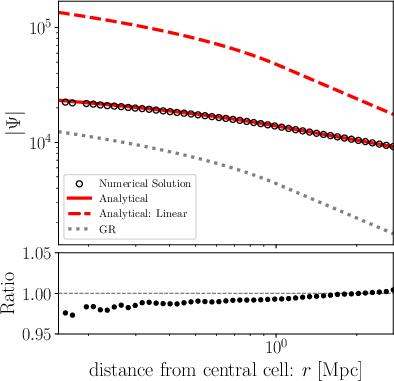
- The transition scale where screening suppresses modifications (Vainshtein radius) is not empirically extracted from simulations in generic environments beyond the spherical test, limiting physical interpretation.
- Generalization to broader models
- The pathway to include other screening mechanisms (e.g., chameleon, k-mouflage, symmetron) or non-luminal cases (subject to constraints) within the same EFT framework is not outlined, limiting the generality of the tool for MG testing.
These gaps suggest clear next steps: relax QS where needed; implement and validate and lensing pipelines; adopt MG-consistent ICs; include baryons/neutrinos; map the stable/real-solution parameter space; quantify solver/systematic errors; analyze higher-order and halo/void statistics; and build emulators for survey applications.
Practical Applications
Immediate Applications
The paper delivers two open-source N-body codes (PySCo-EFT and ECOSMOG-EFT) that implement the Effective Field Theory of Dark Energy (EFTofDE) with non-linear Vainshtein screening, enabling fast exploration and high-accuracy predictions for modified-gravity cosmologies. The following applications can be pursued right away:
- Sector: Academia (cosmology, astrophysics); Software
- Use case: Rapid parameter-space scans for EFTofDE (Horndeski with luminal GW speed) using PySCo-EFT to identify promising regions of α-parameters that affect structure growth and the matter power spectrum.
- Tools/workflows: Two-stage workflow—(1) PySCo-EFT PM-only runs for broad, fast scans; (2) ECOSMOG-EFT AMR follow-ups for selected models to achieve high-resolution, small-scale accuracy.
- Assumptions/dependencies: Quasi-static approximation; cubic screening subset (αV1=αV2=αV3=0 due to αT=0); ΛCDM background for examples; no baryonic physics/hydrodynamics; underdensity “void fix” applied where the scalar discriminant becomes negative.
- Sector: Academia (LSS survey science); Policy (survey readiness)
- Use case: Generation of modified-gravity mock catalogs (clustering and weak-lensing proxies) for Euclid, DESI, and Rubin/LSST pipeline development, validation, and systematics studies.
- Tools/workflows: Integrate ECOSMOG-EFT outputs with halo finders and lightcone builders; produce P(k) boosts and matter maps; compute lensing-relevant quantities (Ψ and, with minor code additions, Φ for Ψ+Φ) to create shear/convergence mocks.
- Assumptions/dependencies: Accurate on non-linear scales when screening is included; current implementation solves Ψ for dynamics; Φ computation and ray-tracing pipeline integration may require minor extensions; baryons and massive neutrinos not yet included.
- Sector: Academia (theory–data interface); Software
- Use case: Emulator training for MG effects—train ML emulators on ratios P_EFTofDE/P_ΛCDM as a function of α-parameters to accelerate inference on survey data.
- Tools/workflows: Design sparse grids in α-parameter space using PySCo-EFT for coverage; refine with ECOSMOG-EFT at nodes; fit Gaussian-process/NN emulators; plug into CosmoSIS/Cobaya/MontePython likelihoods.
- Assumptions/dependencies: Emulator validity limited to the cubic-screening Horndeski subset and to the quasi-static regime; requires consistent treatment of galaxy bias and baryonic feedback separately.
- Sector: Academia (cosmological theory)
- Use case: Testing the role of Vainshtein screening in the non-linear regime—quantify when linearized field equations suffice vs. when screening dominates.
- Tools/workflows: Differential runs with and without screening terms; comparison of matter power spectrum boosts, halo statistics, and environmental dependencies.
- Assumptions/dependencies: Numerical convergence established at sub-percent (linear scales) and ≤2% (k≈10 h Mpc⁻¹ for tested setups); sensitivity to mass resolution, volume, refinement thresholds, and starting redshift.
- Sector: Academia (gravitational physics); Policy (funding decisions)
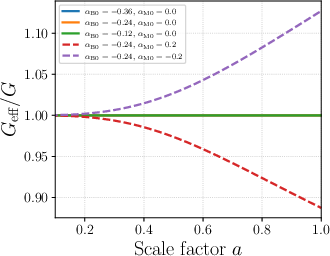
- Use case: Forecasts of constraints on αB(a), αM(a) and effective G(a) from Stage-IV surveys combining galaxy clustering and cosmic shear.
- Tools/workflows: Compute modified linear growth D+(a) and non-linear boosts; propagate to Fisher/MCMC forecasts for survey strategies and instrument requirements; identify redshift and scale leverage for α-parameter sensitivity.
- Assumptions/dependencies: Background expansion and α(a) parameterizations chosen by user; need to fold in survey systematics and covariances; degeneracies with baryonic feedback and massive neutrinos must be addressed.
- Sector: Software (scientific computing); Education
- Use case: Reuse of non-linear elliptic PDE solver patterns (operator splitting + multigrid) in other physics domains.
- Tools/workflows: Port the operator-splitting approach and multigrid acceleration for robust solutions of non-linear Poisson-like equations (e.g., in geophysics, plasma physics, or materials modeling); pedagogical modules for computational physics courses.
- Assumptions/dependencies: Methodological transfer requires PDEs with similar structure; performance depends on stencil discretization and boundary conditions.
- Sector: Education; Public outreach
- Use case: Classroom and outreach demos with PySCo-EFT to visualize how modified gravity alters cosmic web formation.
- Tools/workflows: Notebooks/interactive apps that vary αB0, αM0 to illustrate changes in growth and power spectra; museum/planetarium visuals of cosmic structures under different MG scenarios.
- Assumptions/dependencies: Qualitative fidelity is high for growth and clustering trends; not intended for precision cosmology without high-resolution follow-up.
- Sector: Industry (cloud/HPC services); Software
- Use case: “Simulation-as-a-service” for modified-gravity cosmologies.
- Tools/workflows: Containerize PySCo-EFT for rapid, on-demand parameter scans; schedule ECOSMOG-EFT AMR runs on HPC/cloud; provide APIs for generating MG P(k) ratios and density fields for downstream analytics.
- Assumptions/dependencies: Requires compute provisioning and job orchestration; quality control around quasi-static/void pathologies.
Long-Term Applications
Several impactful applications require further development, scaling, or integration with additional physics and data pipelines:
- Sector: Academia (precision cosmology); Policy (mission science enablement)
- Use case: End-to-end Stage-IV analyses of modified gravity combining clustering, lensing, redshift-space distortions, and multi-tracer statistics, with full non-linear modeling.
- Tools/workflows: Couple ECOSMOG-EFT with hydrodynamical/baryonic-correction models and massive neutrinos; generate joint mocks; deliver covariance-aware likelihoods for α-parameters and derived quantities such as G_eff(a).
- Assumptions/dependencies: Need validated baryonic models in MG; accurate galaxy–halo connection in MG; extended validity beyond quasi-static approximations in some regimes.
- Sector: Academia (gravitational physics); Policy (theory constraints)
- Use case: Voids as precision tests of MG—operational constraints using scalar-field breakdown in underdensities.
- Tools/workflows: Replace ad-hoc void “discriminant saturation” with physically consistent extensions (beyond-quasi-static or broader EFT terms); build void-focused summary statistics for survey pipelines.
- Assumptions/dependencies: Requires theoretical progress on well-posedness in voids and possibly time-derivative terms; robust pipeline to separate astrophysical systematics.
- Sector: Academia (observational cosmology); Software
- Use case: High-fidelity lensing predictions at galaxy and group scales with screening, leveraging AMR to compute Ψ and Φ and perform ray tracing through non-linear structures.
- Tools/workflows: Implement Φ on-grid and lensing integrators; generate maps of κ and γ; compare to galaxy–galaxy lensing and strong lensing residuals for MG signatures.
- Assumptions/dependencies: Must include baryons and feedback to match small-scale lensing; requires calibration against high-resolution hydro simulations or baryon-correction schemes.
- Sector: Software (numerical methods); Industry (energy, geoscience)
- Use case: Generalized multigrid+operator-splitting solvers for non-linear elliptic PDEs at scale, adopted in subsurface modeling, electromagnetics, or materials design.
- Tools/workflows: Abstract and package solver components; expose stencils, boundary-condition handlers, and convergence monitors; integrate with existing PDE frameworks.
- Assumptions/dependencies: Cross-domain validation needed; performance tuning for problem-specific non-linearities and anisotropies.
- Sector: AI/ML for science; Software
- Use case: Foundation models trained on MG simulation data for fast surrogate inference and real-time cosmology.
- Tools/workflows: Curate large synthetic datasets spanning α-parameter space; train diffusion/transformer models to emulate density fields and P(k) ratios; integrate with amortized inference for survey analyses.
- Assumptions/dependencies: Requires careful uncertainty quantification and guardrails against extrapolation beyond trained regimes; strong coupling with domain-informed priors.
- Sector: Academia (multi-messenger cosmology)
- Use case: Joint constraints with gravitational-wave sirens (cT=1 enforced) and EM LSS—test Planck mass evolution and braiding effects on large-scale structure alongside GW propagation constraints.
- Tools/workflows: Consistent modeling of αM(a), αB(a) with G_eff(a) from simulations; combine with standard-siren distance measurements and LSS growth constraints.
- Assumptions/dependencies: Dependence on future GW datasets and calibration of selection effects; theory consistency across background and perturbations.
- Sector: Policy (research infrastructure)
- Use case: National/international MG simulation suites for FAIR data sharing and reproducibility.
- Tools/workflows: Standardized parameter grids, initial conditions, and outputs; long-term archiving; APIs for community use; benchmarks for survey data challenges focused on MG.
- Assumptions/dependencies: Sustained funding for HPC and curation; community consensus on benchmark scenarios and metrics.
- Sector: Education; Public outreach
- Use case: Scalable public-facing MG simulators and VR/AR experiences demonstrating screening and structure formation differences.
- Tools/workflows: Web-based frontends powered by PySCo-EFT backends; curated modules for secondary and tertiary education; collaboration with science museums and media.
- Assumptions/dependencies: Need to balance visual impact with scientific accuracy; ongoing maintenance and cloud costs.
Notes on feasibility and limitations common across applications
- Model scope: Implemented subset of Horndeski with αT=0 (luminal GWs), cubic screening; beyond-Horndeski/DHOST not yet included.
- Approximations: Quasi-static limit assumed; time derivatives of perturbations neglected relative to spatial derivatives; validated for sub-horizon scales but may break down in some regimes (e.g., deep voids or largest scales).
- Numerical caveats: Void pathologies addressed with an ad-hoc saturation; users may pre-filter α-parameter choices with analytic criteria to avoid unstable regions.
- Physics coverage: Current codes evolve collisionless matter; baryonic physics and neutrinos must be modeled or corrected for to compare with data at small scales.
- Validation range: Reported sub-percent agreement with linear theory on large scales and ≤2% numerical effects at k≈10 h Mpc⁻¹ within tested setups; users should re-validate for different resolutions, volumes, and α-parameters.
Glossary
- Adaptive mesh refinement (AMR): A numerical technique that dynamically increases grid resolution in regions requiring higher accuracy to resolve small-scale structures. "an accurate RAMSES-based code with adaptive mesh refinement."
- α-basis: A parameterization of the EFTofDE where deviations from GR are encoded in a small set of time-dependent α-functions. "we parameterised the Horndeski Lagrangian in the -basis"
- Bardeen potentials: The gauge-invariant scalar gravitational potentials, typically denoted by Ψ and Φ, describing scalar perturbations in cosmology. "where and are the two Bardeen potentials"
- Beyond-Horndeski: A class of scalar-tensor gravitational theories extending Horndeski with additional operators and functions. "generalizations to beyond-Horndeski \citep{Zumalacarregui:2013pma,Gleyzes:2014qga,Gleyzes:2014rba}"
- Braiding (): The kinetic mixing between the scalar field and the metric that modifies cosmological perturbations. "the kinetic mixing between the scalar field and the metric, or the braiding ()"
- Cosmic microwave background (CMB): Relic radiation from the early universe used to constrain cosmological models. "While useful for cosmic microwave background (CMB) analysis"
- Cubic screening: A screening regime where leading nonlinear interactions arise at cubic order, suppressing modifications to gravity in dense regions. "In the cubic screening case"
- DHOST: Degenerate Higher-Order Scalar-Tensor theories, an extension of scalar-tensor gravity avoiding Ostrogradsky instabilities. "and DHOST \citep{Langlois:2015cwa,Langlois:2017mxy,Langlois:2018dxi} theories have been studied"
- Diffeomorphisms: Smooth coordinate transformations; invariance under these (spatial, time-dependent) constrains the EFT action. "invariant under time-dependent spatial diffeomorphisms"
- Einstein--Boltzmann solvers: Codes that solve cosmological linear perturbations by integrating Einstein and Boltzmann equations. "Einstein--Boltzmann solvers for the EFTofDE"
- Effective Field Theory of Dark Energy (EFTofDE): A framework to describe deviations from GR and dark energy effects in cosmology via a small set of parameters. "The Effective Field Theory of Dark Energy (EFTofDE) is an efficient framework"
- Effective Planck mass running rate (): The time variation rate of the (effective) gravitational coupling strength in scalar-tensor theories. "effective Planck mass running rate ()"
- Fifth force: An additional force mediated by a scalar field that modifies gravitational interactions. "The standard gravitational force is augmented by a fifth force from the scalar field."
- Fourier-based solvers: Numerical methods solving PDEs in Fourier space; here unsuitable due to nonlinear, non-separable operators. "Fourier-based solvers and tree methods cannot be used"
- Friedmann--Lema^{i}tre--Robertson--Walker (FLRW) background: The homogeneous and isotropic cosmological background metric. "perturbations around a Friedmann--Lema^{i}tre--Robertson--Walker (FLRW) background"
- Gauss--Seidel method: An iterative scheme for solving linear/nonlinear systems by updating grid points using the latest neighbor values. "the Gauss--Seidel method updates the value of each cell"
- Galileon models: Scalar-tensor theories with Galilean symmetry in field gradients that exhibit screening (e.g., Vainshtein). "the cubic and quartic Galileon models"
- Horndeski gravity (Horndeski models): The most general scalar-tensor theory with second-order equations of motion, avoiding ghosts. "We consider Horndeski models with a luminal gravitational wave speed."
- Jacobi iteration method: An iterative solver updating each grid point using values from the previous iteration across the grid. "The Jacobi iteration method updates the value of the field"
- Kronecker delta: The discrete identity tensor used in index contractions, δij = 1 if i=j and 0 otherwise. "and is the Kronecker delta."
- Large-scale structure (LSS): The distribution of matter on large cosmological scales (galaxies, clusters, filaments, voids). "Observations of the large-scale structure (LSS) in the next decade"
- Levi-Civita symbol: The antisymmetric tensor εijk used in vector and tensor calculus identities. "and is the Levi-Civita symbol."
- Linear growth factor: The scale-independent growth function describing the evolution of small density perturbations in linear theory. "here we derive the linear growth factor for perturbation modes"
- Luminal gravitational wave speed: Gravitational waves propagate at the speed of light, imposing strong constraints on MG parameters. "Horndeski models with a luminal gravitational wave speed."
- Matter power spectrum: The Fourier-space statistic P(k) quantifying the variance of matter density fluctuations as a function of scale. "the impact of the EFTofDE parameters on the matter-power-spectrum ratios"
- Multigrid schemes: Hierarchical solvers that accelerate convergence by cycling between fine and coarse grids. "we use iterative solvers and multigrid schemes"
- Newtonian gauge: A coordinate choice for scalar perturbations where the metric potentials are Ψ and Φ without off-diagonal scalar terms. "we will work in Newtonian gauge"
- Newton{--}Gauss{--}Seidel iterative solver: A nonlinear relaxation method combining Newton updates with Gauss–Seidel sweeps. "a Newton{--}Gauss{--}Seidel iterative solver is utilised."
- Operator splitting: A numerical technique that restructures nonlinear PDEs to improve solver stability and convergence. "the operator splitting method \citep{llinares} can address these convergence issues."
- Particle mesh (PM) code: An N-body approach computing forces on a grid (mesh) to accelerate large-scale gravity calculations. "a fast Python-based particle mesh code"
- Planck mass (time-dependent): The (effective) gravitational coupling scale, allowed to vary in time in scalar-tensor EFTs. " is the time-dependent Planck mass"
- Poisson equation: The elliptic equation relating gravitational potential to matter density in Newtonian and modified cosmologies. "the standard Poisson equation becomes"
- Quasi-linear regime: Intermediate scales where perturbations are neither fully linear nor deeply nonlinear and require advanced modeling. "the linear predictions have also been extended to the quasi-linear regime"
- Quasi-static approximation: Assumes spatial derivatives dominate over time derivatives for sub-horizon perturbations, simplifying equations. "we can assume the quasi-static approximation"
- RAMSES: A widely used adaptive mesh refinement code for cosmological and astrophysical simulations. "a RAMSES-based code"
- Scalar-tensor theories: Theories of gravity involving both a metric (tensor) and scalar field influencing gravitational dynamics. "encompasses a wide class of scalar-tensor theories"
- Spherically symmetric mass distribution: A system where density depends only on radius, enabling analytic or simplified solutions. "Static spherically symmetric mass distribution"
- Stage-IV (LSS surveys): The next generation of very large, high-precision cosmological surveys. "Stage-IV LSS surveys like Euclid"
- Supercomoving units: A rescaled coordinate system that absorbs cosmological expansion factors to simplify N-body integration. "use supercomoving units"
- Tensor modes: Gravitational wave (transverse, traceless) perturbations in the metric. "govern the dynamics of both scalar and tensor modes"
- Vainshtein screening mechanism: A nonlinear effect that suppresses deviations from GR in high-density/small-scale regions. "including the non-linear Vainshtein screening mechanism."
- Wavenumber: The Fourier-space variable k corresponding to inverse length scale used in power spectra. "wavenumbers "
- Weak gravitational lensing: The subtle distortion of background galaxy shapes by large-scale structures’ gravitational potentials. "weak gravitational lensing measurements"
- Tree methods: Hierarchical N-body algorithms (e.g., Barnes–Hut) for approximate force calculations; unsuitable here due to nonlinearity. "Fourier-based solvers and tree methods cannot be used"
Collections
Sign up for free to add this paper to one or more collections.

