- The paper demonstrates that combining power spectrum and bispectrum analyses significantly reduces error on fₙₗ, improving constraints by up to 53% compared to single-probe estimates.
- It employs advanced EFTofLSS modeling, rigorous redshift-space and bias treatments, and synthetic galaxy mocks to validate methodology across multiple redshift bins.
- The study underscores the importance of physically motivated priors and scale cuts, laying groundwork for robust multi-field inflation tests in future Stage-IV spectroscopic surveys.
Joint Power Spectrum and Bispectrum Analysis for Local-type Primordial Non-Gaussianity with Euclid: Validation, Systematics, and Parameter Constraints
Introduction and Motivation
Primordial non-Gaussianity (PNG) provides a critical window into the physics of the early universe, especially the dynamics of inflation. Local-type PNG, encapsulated by the parameter fNL, is especially sensitive to multi-field inflation models, with the single-field consistency relation predicting a nearly vanishing amplitude for this shape. Current constraints from the CMB are cosmic variance limited, making the three-dimensional large-scale structure (LSS) from future spectroscopic surveys like Euclid a compelling avenue for improved sensitivity.
While the power spectrum has been the primary observable for constraining fNL via its scale-dependent bias signature, the bispectrum offers complementary information due to its sensitivity to multiple biasing and primordial operators, and the different triangle configurations that can be probed. The challenge lies in the proper modeling (including redshift-space distortions and bias), robust treatment of analysis systematics (priors, scale cuts), and joint likelihood inference given high-dimensional data vectors. Addressing these, the authors validate a redshift-space pipeline for the joint analysis of the galaxy power spectrum and bispectrum, focusing on Euclid-like synthetic mocks from N-body simulations.
Theoretical Modelling: Power Spectrum and Bispectrum in Redshift Space with PNG
The perturbative modelling is based on the EFTofLSS formalism. For the power spectrum, a one-loop model is employed, extended to include the impact of local PNG. The bispectrum is modeled at tree-level but incorporates a counterterm motivated by the velocity-difference generator (VDG) to improve modeling of nonlinear redshift-space effects and extend the perturbative reach.
Redshift-space distortions (RSDs) are modeled via the velocity-moment expansion, retaining velocity contributions up to fourth order. The galaxy bias expansion is built to include not only operators of the matter density and tidal field but additional terms sourced by the primordial potential, per the requirements of PNG bias theory. PNG influences both the galaxy power spectrum, primarily through the scale-dependent bias from bϕ, and the bispectrum via contributions from fNL, fNLbϕ, and fNLbϕδ.
Synthetic Galaxy Catalogs and Likelihood Analysis
Galaxy mocks are constructed from the Abacus N-body simulation suite, spanning both Gaussian and local-PNG initial conditions (with fNL=30 as the primary non-Gaussian case). Halo occupation distribution (HOD) parameters are calibrated to the Euclid Flagship 2 (FS2) mock, then applied after abundance matching the halo mass function to minimize discrepancies arising from different halo finders between simulations.
The analysis pipeline builds a Gaussian likelihood for a data vector including the three lowest multipoles of the power spectrum and bispectrum (ℓ=0,2,4 for Pℓ and up to ℓ=2 for fNL0 in practice, due to noise in the bispectrum hexadecapole), with analytic marginalisation of linear nuisance parameters for computational efficiency. The adopted scale cuts and priors are extensively validated to avoid bias. Gaussian covariances are assumed, noting that in real survey applications, non-Gaussian covariance and cross-statistic correlations need further treatment.
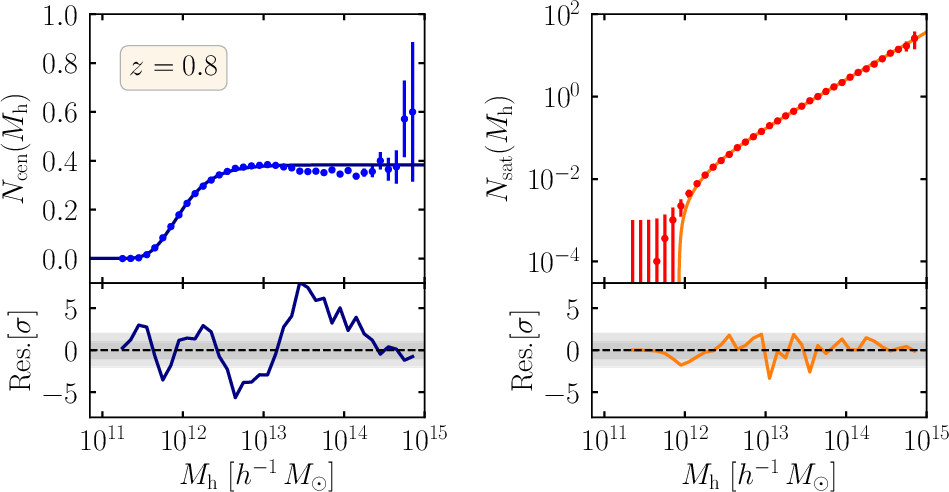
Figure 1: Measured HOD from the Euclid FS2 simulation and its fit at fNL1, showcasing central and satellite occupation fits crucial for accurate HOD-based mock galaxy assignment.
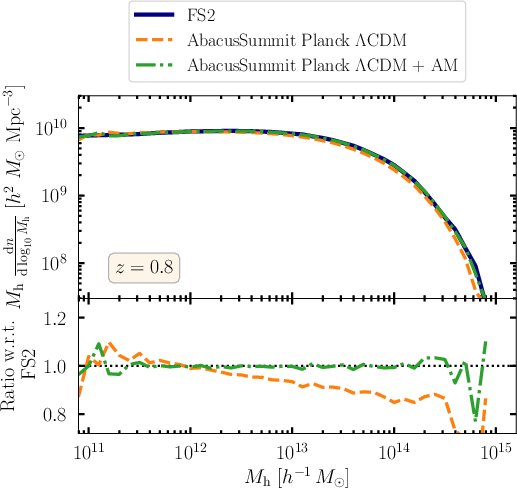
Figure 2: Abundance matching process bringing the AbacusSummit halo mass function into agreement with the Flagship 2 reference for robust bias calibration.
Prior Choices and Systematic Impact on fNL2 Inference
A key systematic is the prior on fNL3, the bias parameter entering the leading fNL4 signal in the power spectrum. The authors show that a broad, uninformative prior results in biased estimates, effectively defaulting to prior-volume effects that drive the marginalized posterior of fNL5 toward zero. The shape and degeneracy structure in fNL6 make informative, physically motivated priors essential.
Two competing theoretical models are tested for the mapping fNL7: the universal halo mass function (UHMF, fNL8) and a galaxy formation motivated value (GFM, fNL9) inspired by results from hydrodynamical simulations. A Gaussian prior with mean bϕ0 and width bϕ1 encompasses both, suppressing projection biases and leading to accurate and stable bϕ2 inference across redshift bins.
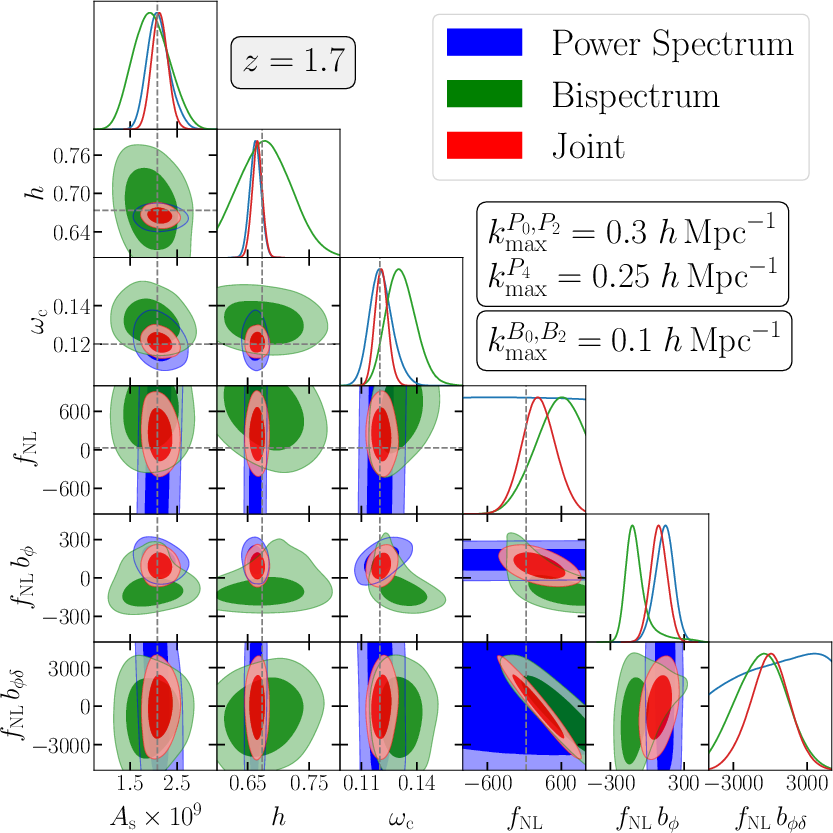
Figure 3: Posterior distributions for power spectrum and bispectrum from a prior-agnostic analysis, illustrating the dominant degeneracy directions and the limitation of unconstrained bϕ3.
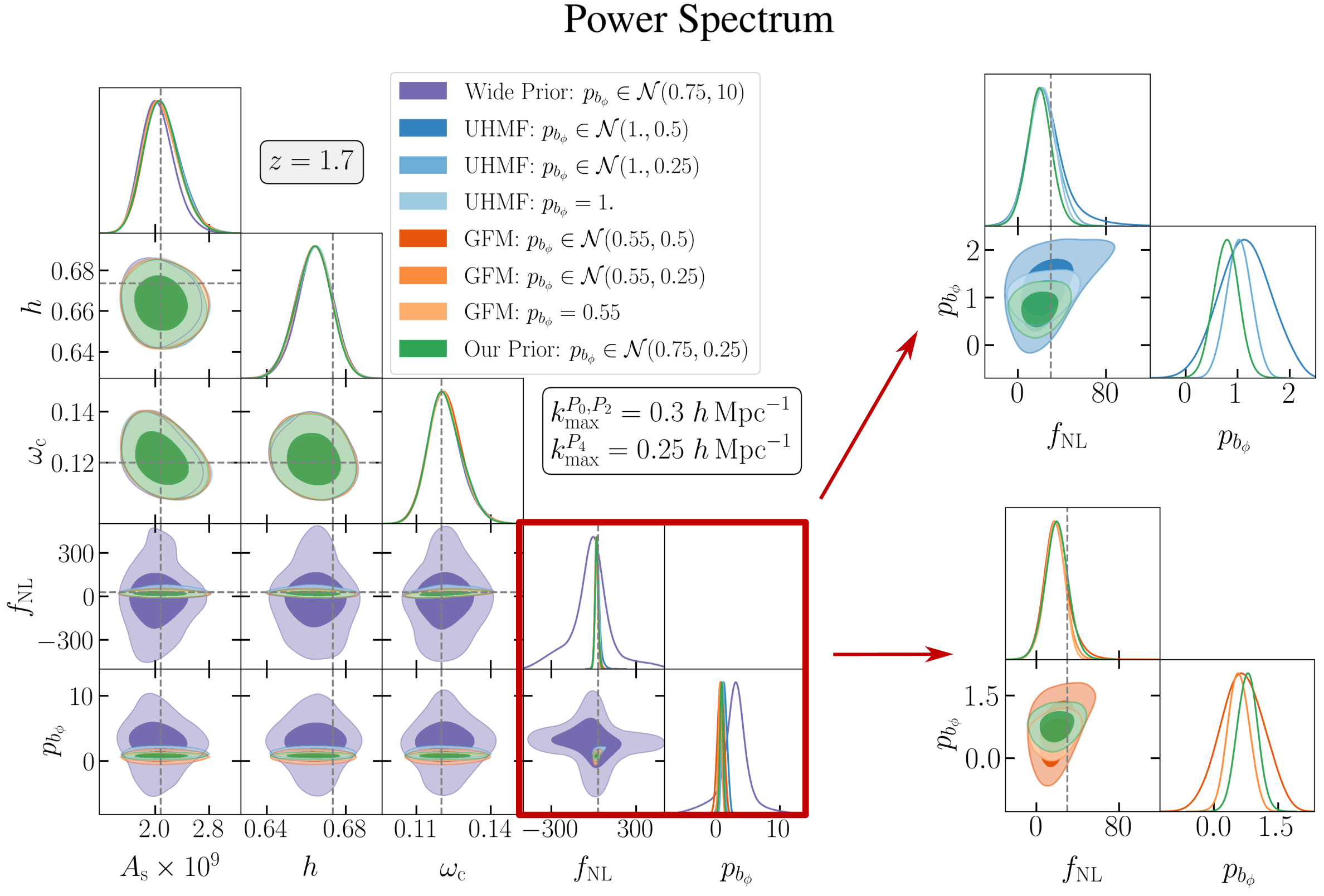
Figure 4: Sensitivity of bϕ4 posterior to the prior on bϕ5, exemplifying the necessity of physically informed prior choices.
Measurements of bϕ6 using separate-universe simulations further validate the chosen prior's adequacy over the redshift range considered.
Scale Cut Selections and Robustness
Extensive scale-cut tests demonstrate that one-loop power spectrum modeling is unbiased up to bϕ7Mpc at bϕ8–bϕ9, while the tree-level bispectrum with VDG counterterm is valid to fNL0Mpc at fNL1 and fNL2Mpc at fNL3. The information content (FoM) and bias metrics (FoB) confirm that these choices are efficient and conservative. Removing large-scale modes (fNL4) quickly degrades fNL5 constraints, particularly for the bispectrum, underscoring the necessity of maximal volumetric coverage for PNG science.
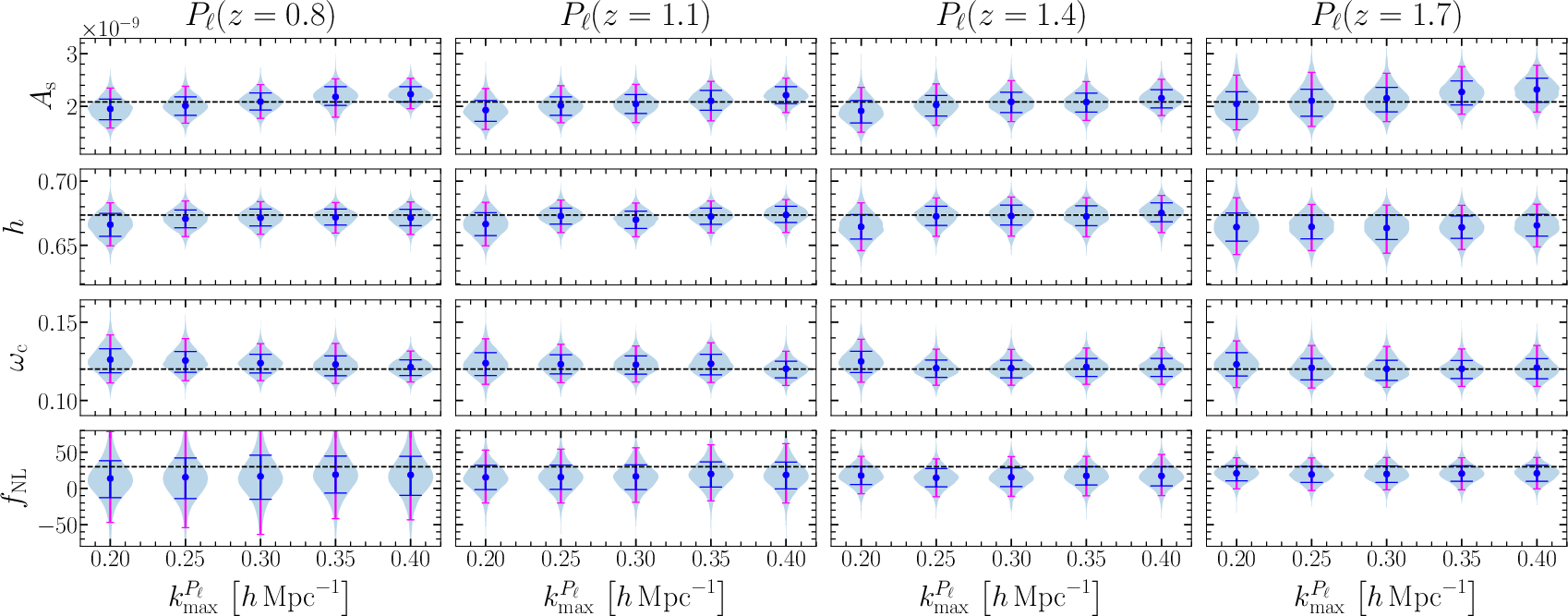
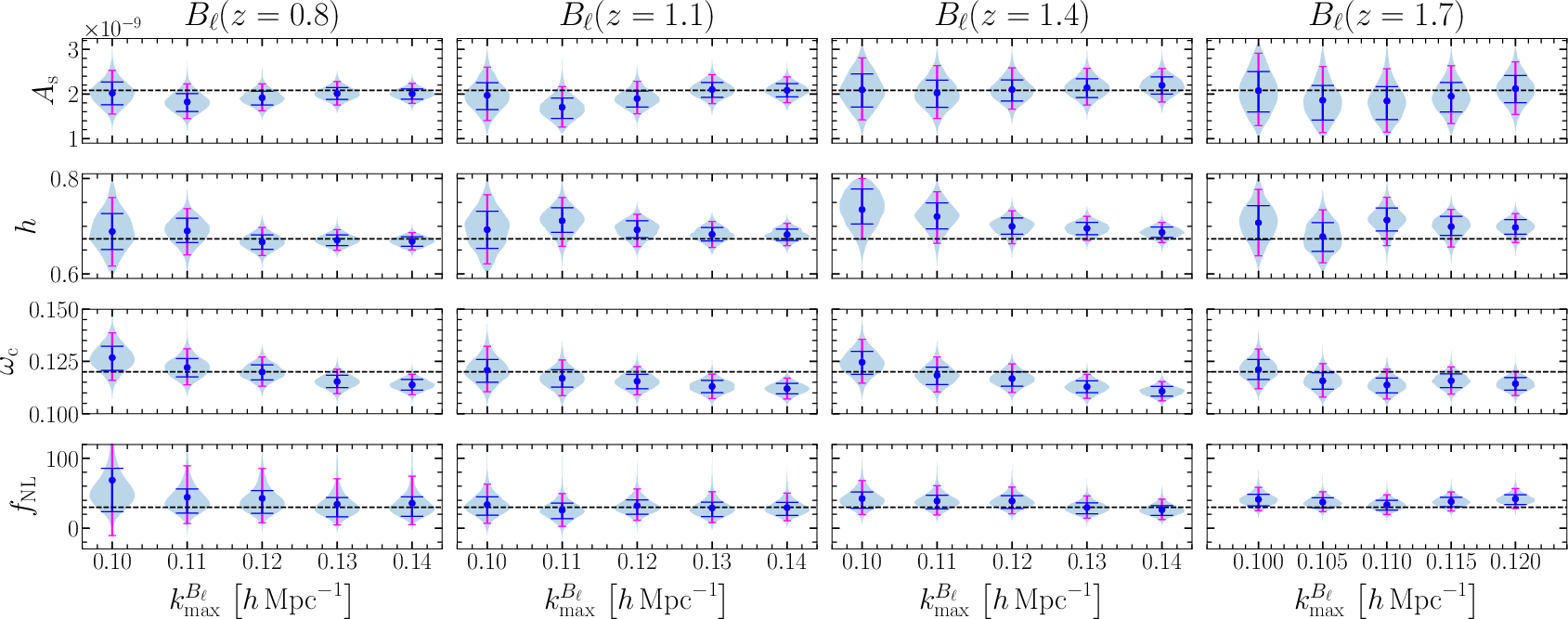
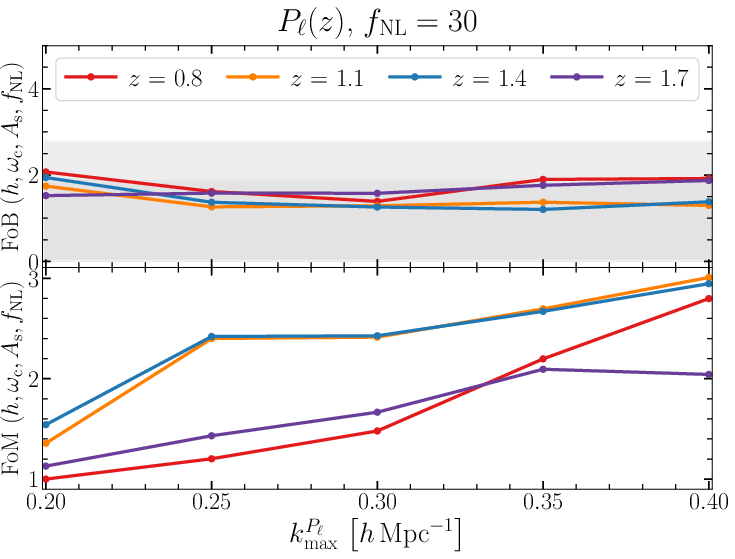
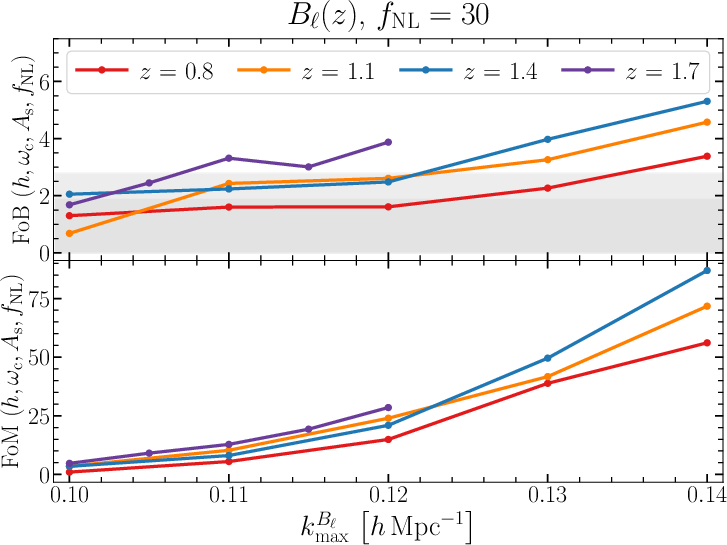
Figure 5: Marginal posterior distributions across redshifts and scale cuts for key cosmological parameters, mapping the bias and variance trade-off.
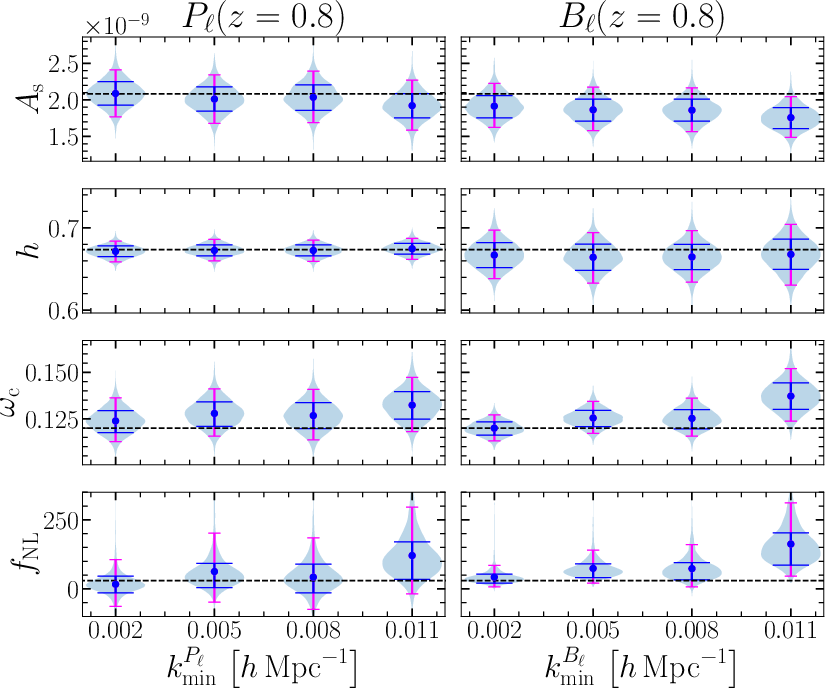
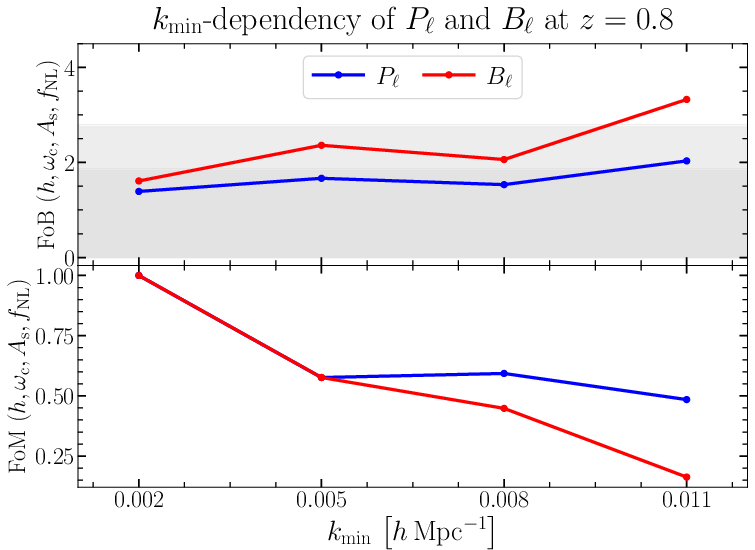
Figure 6: Impact of removing large-scale modes on fNL6 error and bias, demonstrating the disproportionate role of the largest accessible scales.
Main Numerical Results: Joint Constraints on fNL7
Application of the validated pipeline yields unbiased fNL8 recovery in PNG simulations (fiducial fNL9), with null tests on Gaussian initial conditions accurately returning fNLbϕ0 within fNLbϕ1. For singly-analyzed redshift bins with fNLbϕ2, the joint power spectrum-bispectrum analysis reduces the marginalized fNLbϕ3 error by fNLbϕ4, fNLbϕ5, fNLbϕ6, and fNLbϕ7 at fNLbϕ8, fNLbϕ9, fNLbϕδ0, and fNLbϕδ1 respectively compared to power spectrum alone; bispectrum alone accounts for fNLbϕδ2–fNLbϕδ3 of the gain over fNLbϕδ4. The detection significance for fNLbϕδ5 rises from fNLbϕδ6 at fNLbϕδ7 to fNLbϕδ8 at fNLbϕδ9.
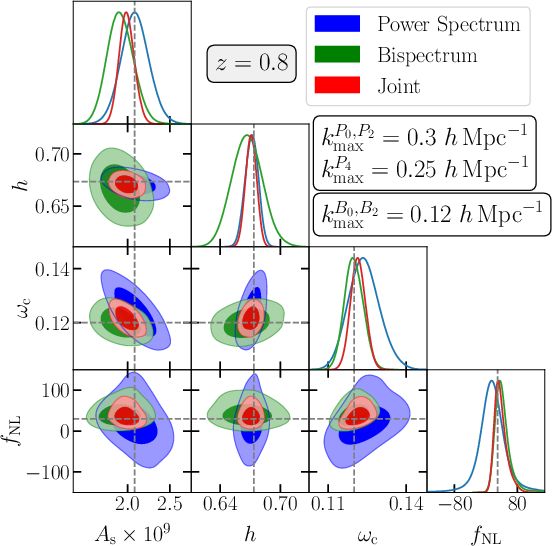
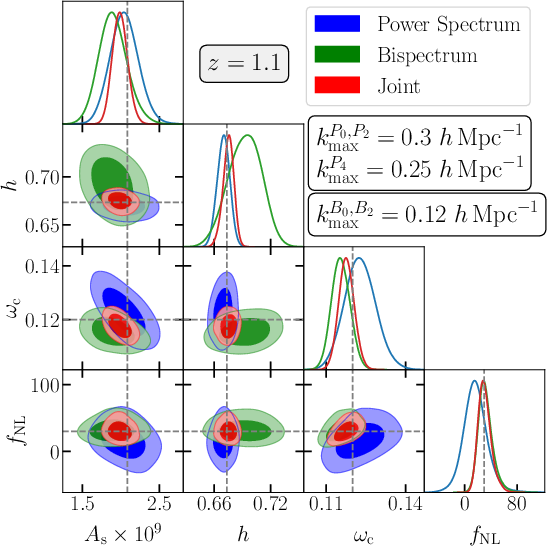
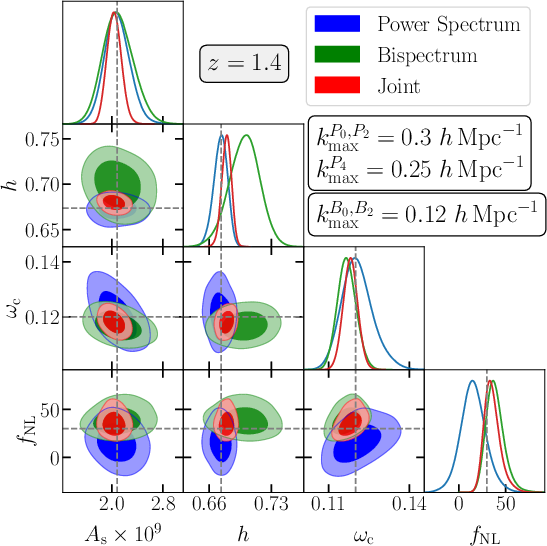
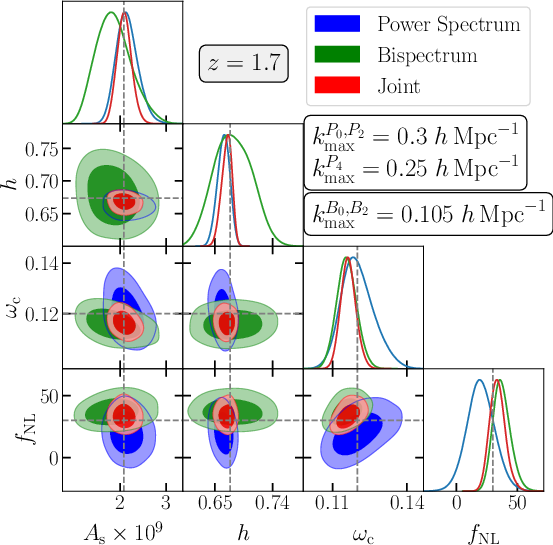
Figure 7: Marginalized posterior distributions for fNL=300 and cosmological parameters for power spectrum (blue), bispectrum (green), and combined (red) analyses for each redshift bin.
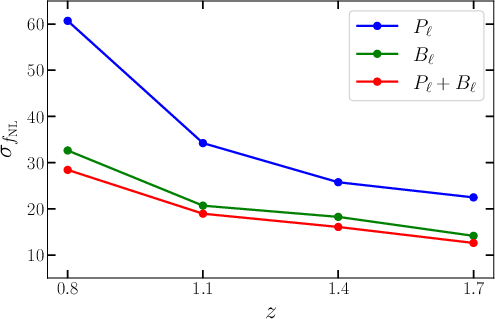
Figure 8: fNL=301 error on fNL=302 for fiducial fNL=303 comparing power spectrum, bispectrum, and joint constraints at each redshift.
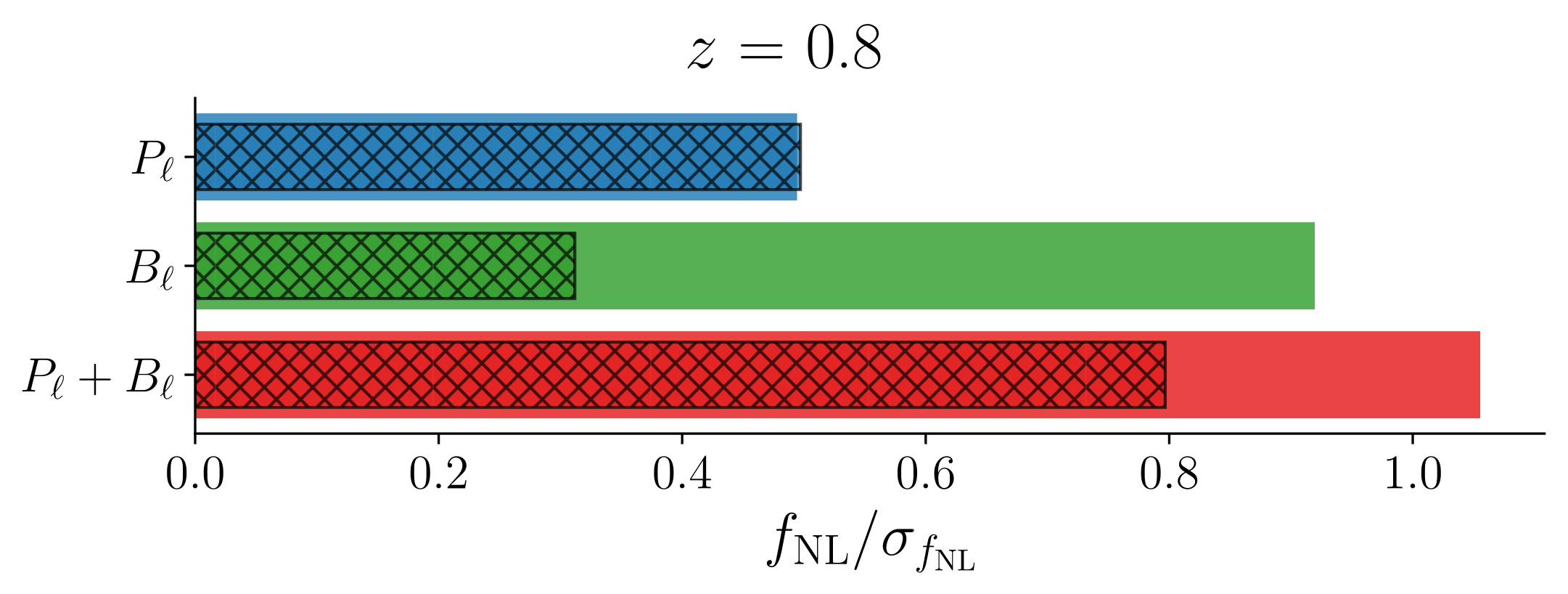
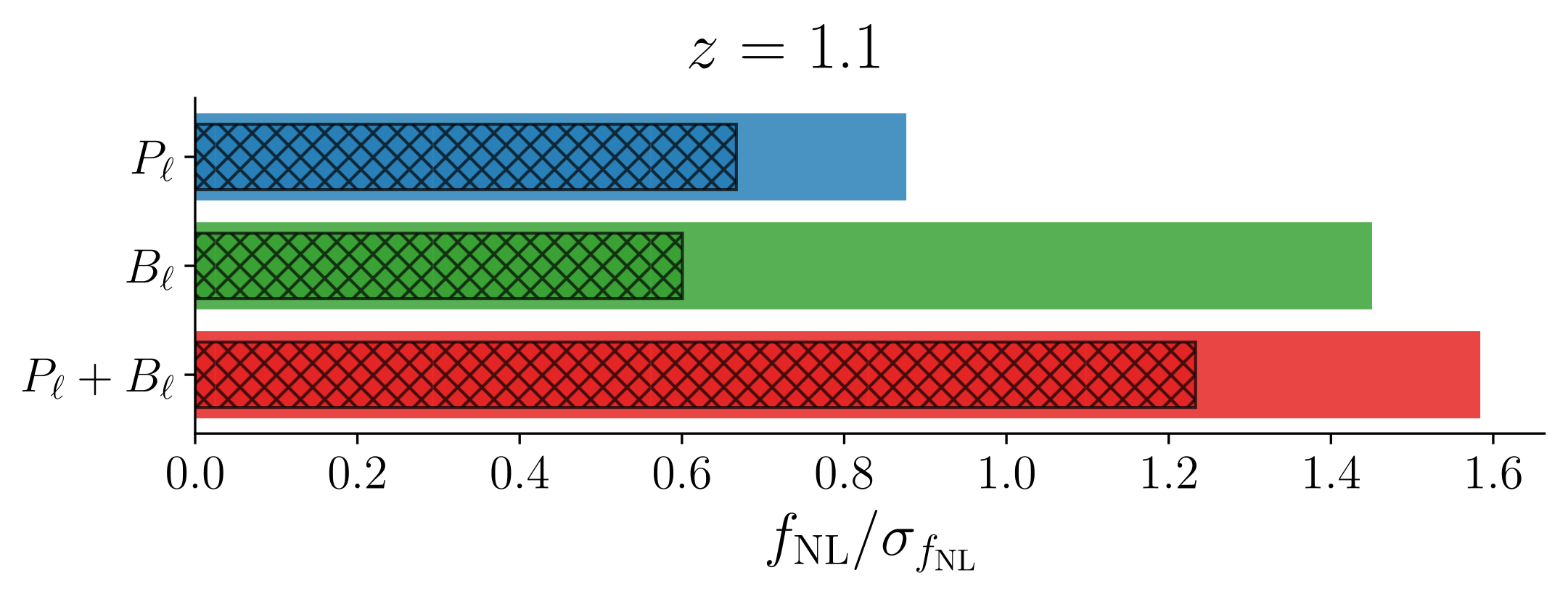
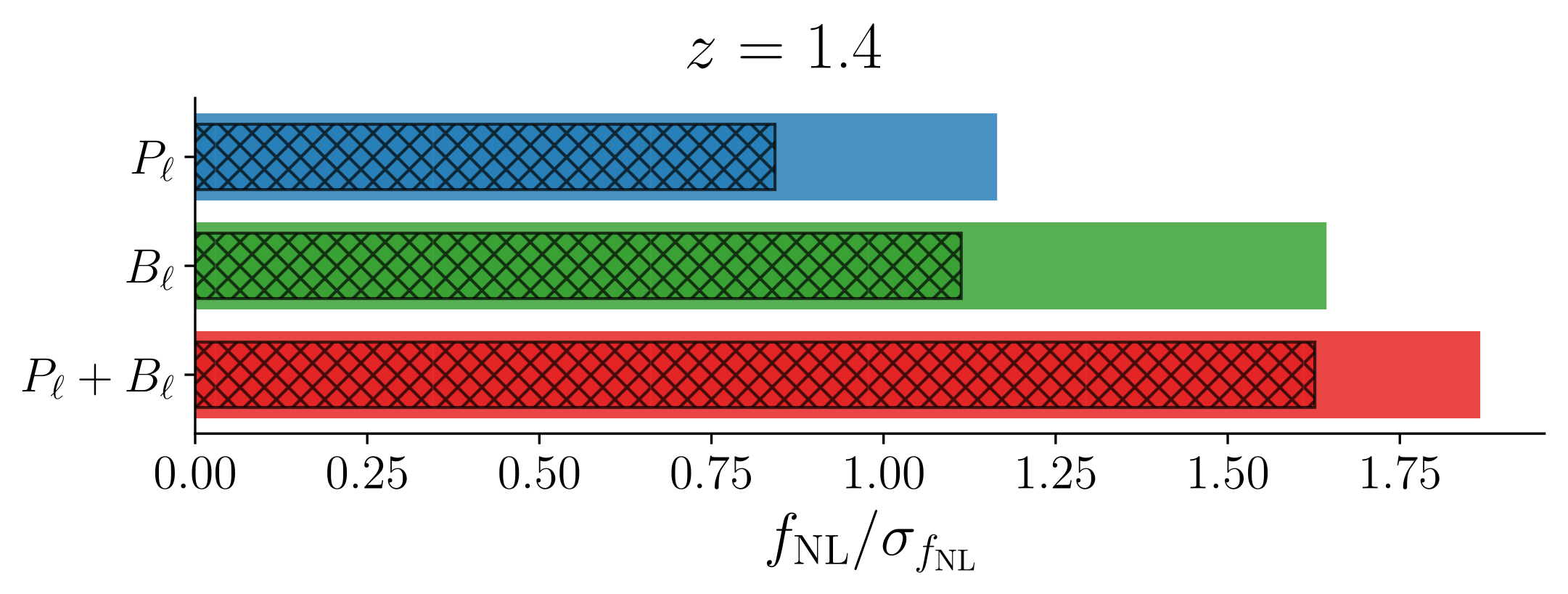
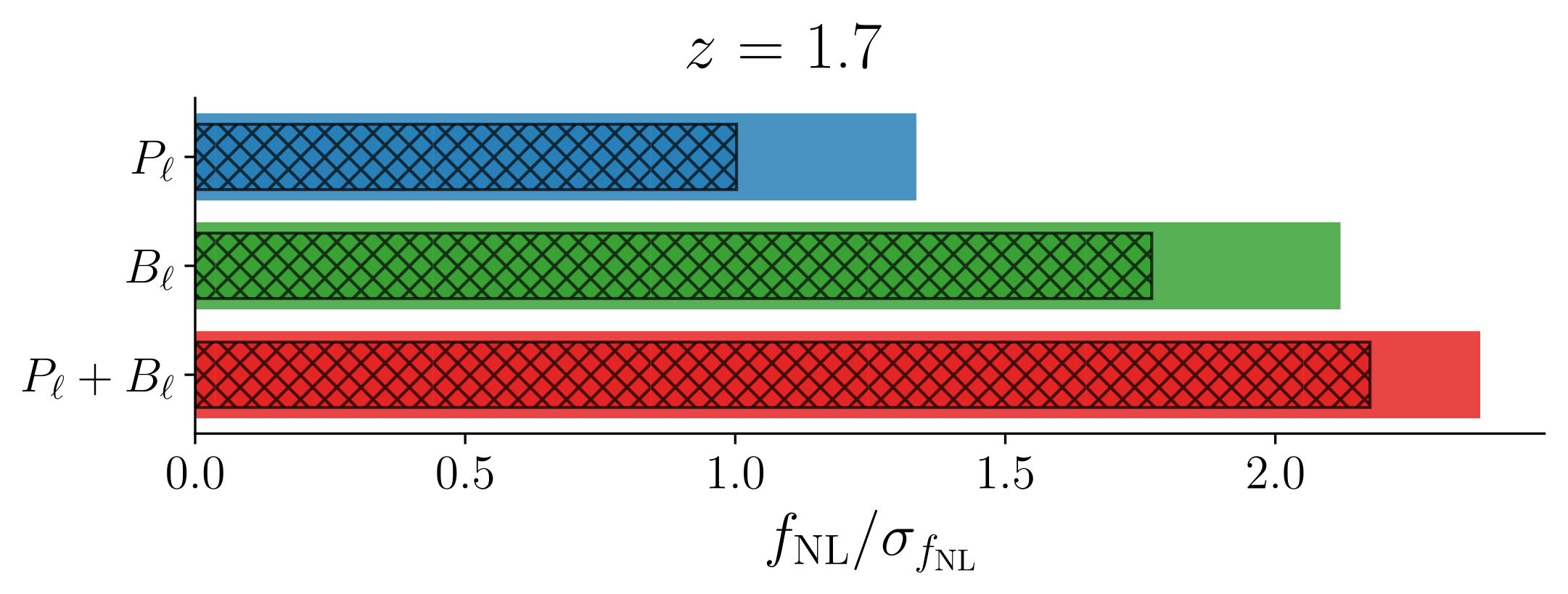
Figure 9: Relative information content of various multipole combinations for fNL=304, highlighting the key added value of the bispectrum quadrupole.
Higher-order multipoles, particularly the bispectrum quadrupole, substantially improve constraints by breaking degeneracies with bias and amplitude parameters and by providing sensitivity to RSD-modulated primordial structures.
Implications and Outlook
The results demonstrate that Stage-IV spectroscopic surveys can meaningfully constrain local-type PNG and, by extension, multi-field inflation scenarios, provided that theoretical modeling, prior selection, and data analysis practices are rigorously validated. The bispectrum, especially its quadrupole, is essential for realizing these gains—not just as an auxiliary observable, but as the primary driver of fNL=305 precision improvement.
While these results are obtained in periodic-box simulations with idealized selection, several steps are necessary for application to real survey data:
- Extension beyond tree-level bispectrum and comprehensive non-Gaussian covariance modeling.
- Full survey geometry, selection, and observational systematic effects (e.g., completeness, fiber collisions).
- Joint analyses across all redshift bins, with optimal weighting or multi-tracer strategies to maximize available information.
- Incorporation of cross-observables (CMB lensing, photometric samples) and field-level analyses to reduce sample variance.
Rapid advancements in theoretical modeling (e.g., fast loop algorithms, emulator-based inference), observational techniques, and high-performance computing are making high-fidelity joint LSS analyses feasible for upcoming data releases.
Conclusion
The study provides a comprehensive, end-to-end validation of joint galaxy power spectrum and bispectrum analyses for constraining local-type PNG in the context of Euclid. It demonstrates that the bispectrum, properly modeled and combined with the power spectrum, can reduce the error bar on fNL=306 by up to a factor of two relative to traditional analyses, with essential sensitivity residing in the bispectrum quadrupole. Robustness to prior and scale selection is ensured through exhaustive validation on synthetic data. These results lay essential groundwork for extracting the maximal inflationary information from future Stage-IV spectroscopic survey data and present a clear methodology for systematic, bias-free inference of primordial statistics in LSS.
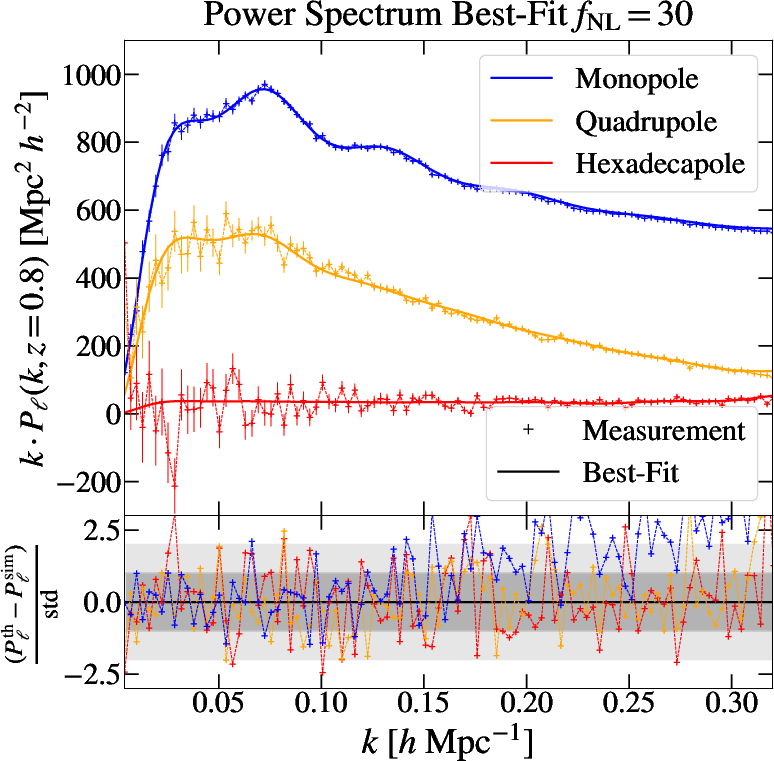
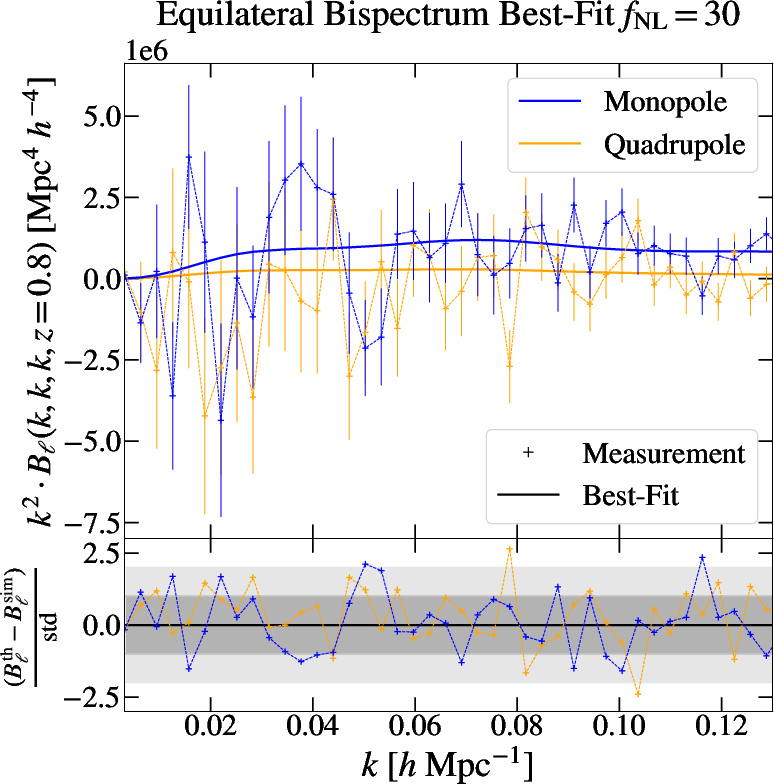
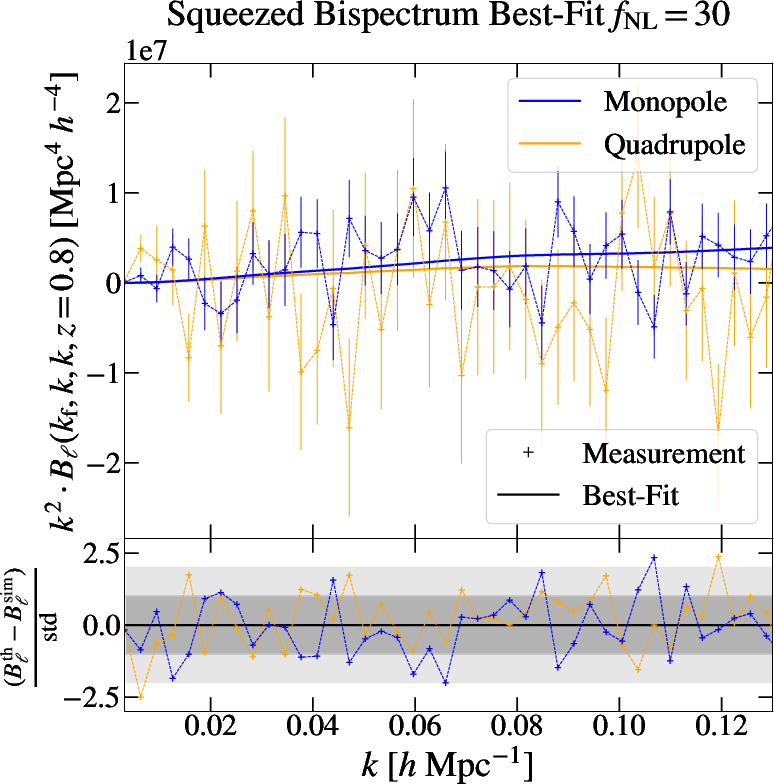
Figure 10: Comparison of best-fit models with measured spectra for power spectrum and bispectrum multipoles, with residuals indicating model fidelity across scales and configurations.

