Addressing the DESI DR2 Phantom-Crossing Anomaly and Enhanced $H_0$ Tension with Reconstructed Scalar-Tensor Gravity
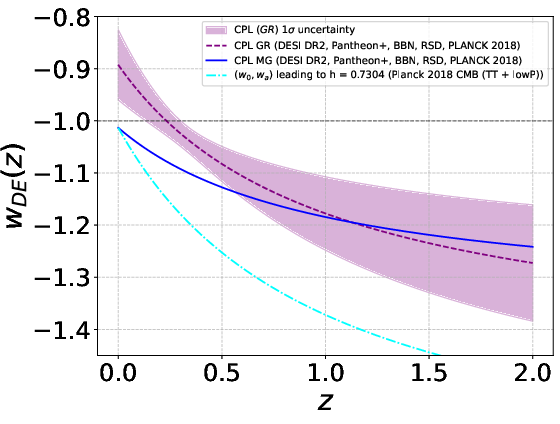
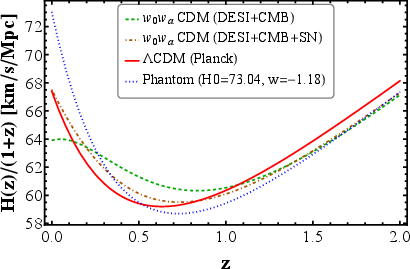
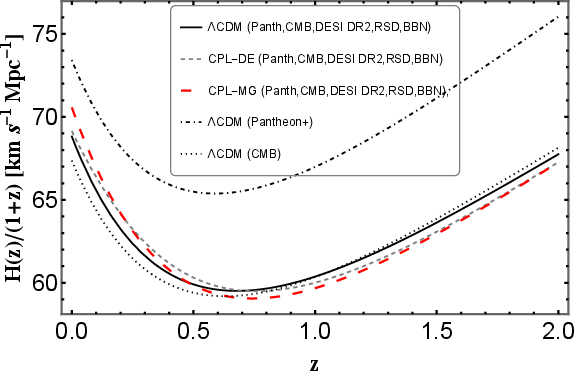
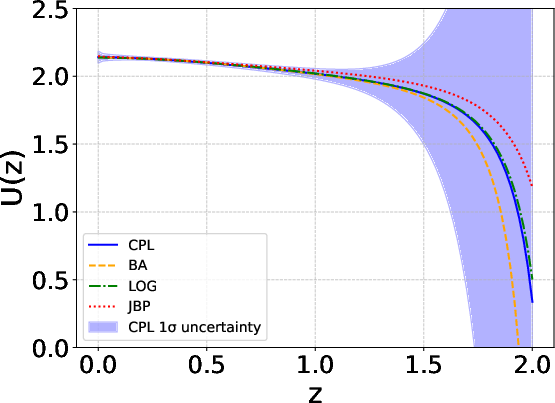
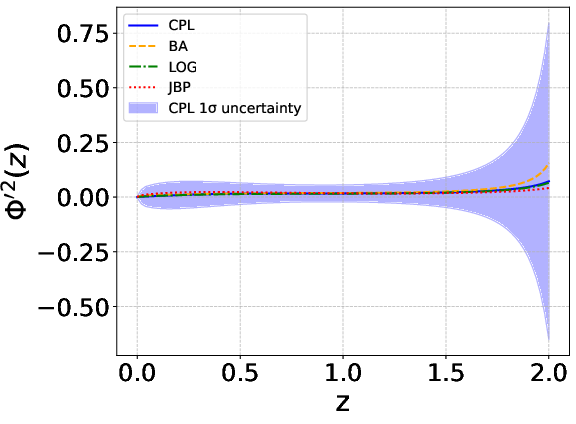
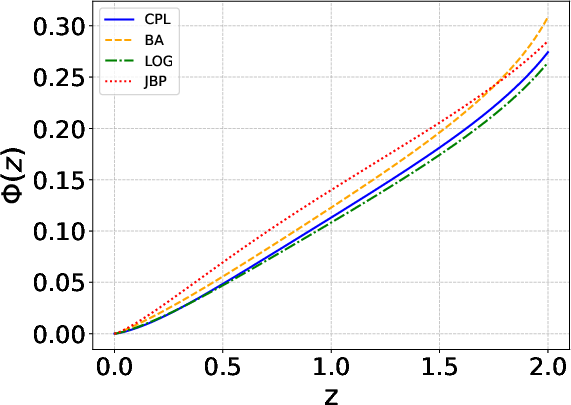
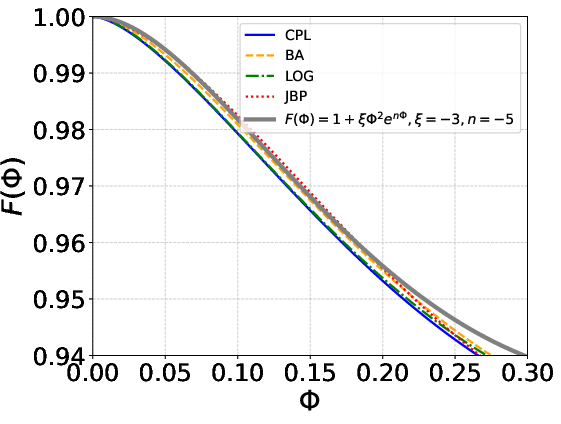
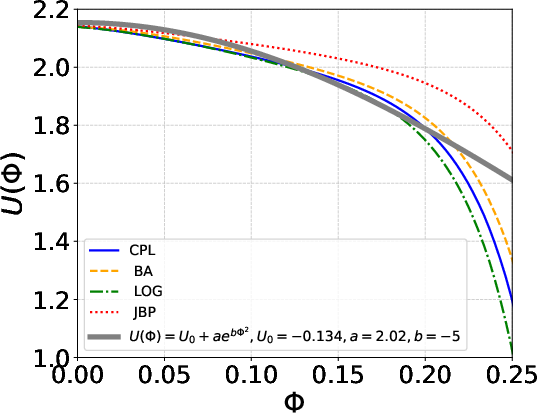
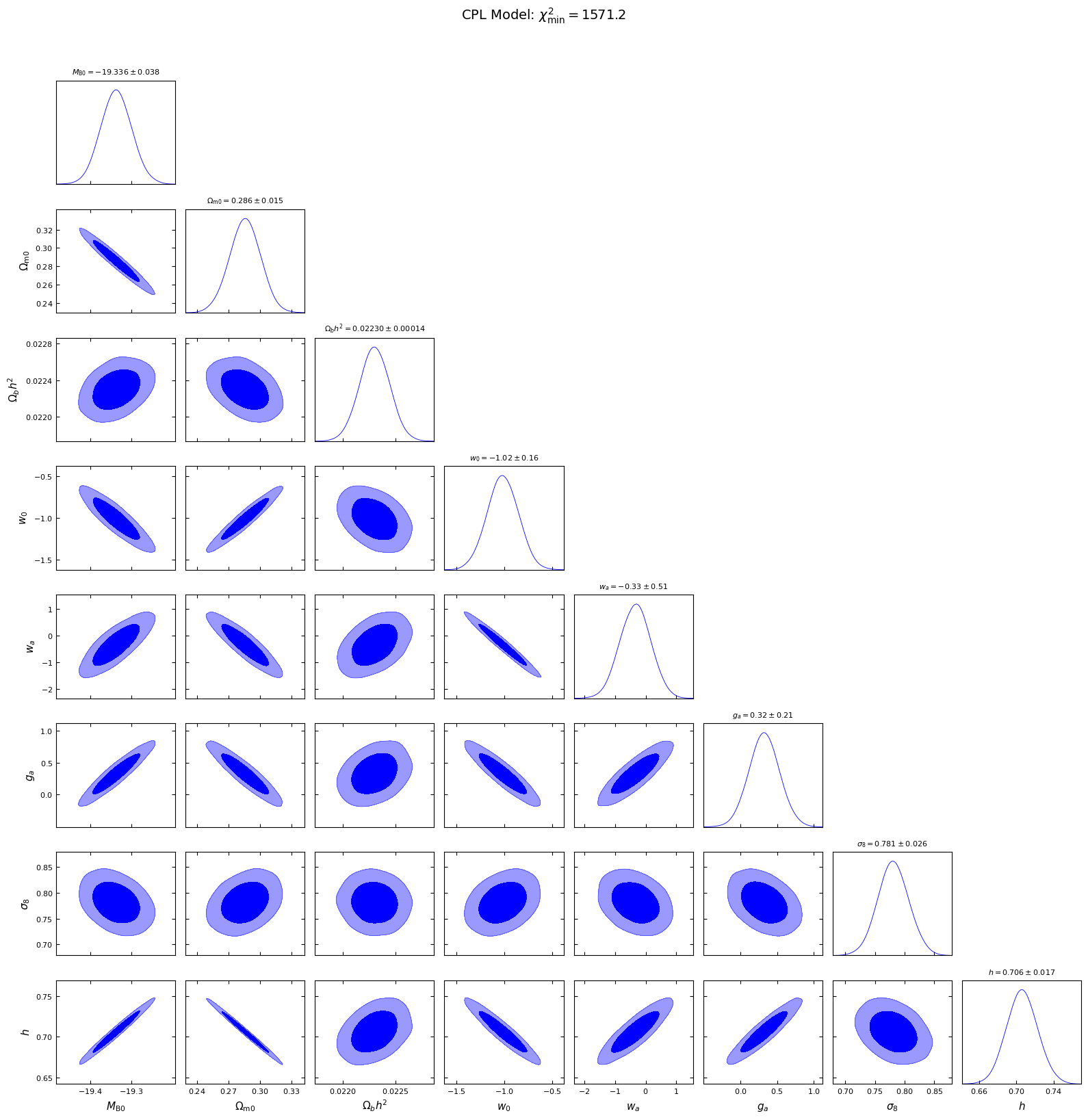
Abstract: Recent cosmological data, including DESI DR2, highlight significant tensions within the $\Lambda$CDM paradigm. When analyzed in the context of General Relativity (GR), the latest DESI data favor a dynamical dark energy (DDE) equation of state, $w(z)$, that crosses the phantom divide line $w=-1$. However, this framework prefers a lower Hubble constant, $H_0$, than Planck 2018, thereby worsening the tension with local measurements. This phantom crossing is a key feature that cannot be achieved by minimally coupled scalar fields (quintessence) within GR. This suggests the need for a new degree of freedom that can simultaneously: (A) increase the best-fit value of $H_0$ in the context of the DESI DR2 data, and (B) allow the crossing of the $w=-1$ line within a new theoretical approach. We argue that both of these goals may be achieved in the context of Modified Gravity (MG), and in particular, Scalar-Tensor (ST) theories, where phantom crossing is a natural and viable feature. We demonstrate these facts by analyzing a joint dataset including DESI DR2, Pantheon+, CMB, and growth-rate (RSD) data in the context of simple parametrizations for the effective gravitational constant, $\mu_G(z) \equiv G_{eff}/G_N$, and the DDE equation of state, $w(z)$. This MG framework significantly alleviates the tension, leading to a higher inferred value of $H_0 = 70.6 \pm 1.7 \, \text{km s}{-1} \text{Mpc}{-1}$. We also present a systematic, data-driven reconstruction of the required underlying ST Lagrangian and provide simple, generic analytical expressions for both the non-minimal coupling $F(\Phi) = 1+\xi\Phi{2}e{n\Phi}$ and the scalar potential $U(\Phi) = U_{0}+ae{b\Phi{2}}$, which well-describe the reconstructed functions.
Paper Prompts
Sign up for free to create and run prompts on this paper using GPT-5.
Top Community Prompts
Explain it Like I'm 14
What is this paper about?
This paper tries to solve two puzzles about our universe using a new idea about gravity.
- Puzzle 1 (the Hubble tension): Different ways of measuring how fast the universe is expanding today (the Hubble constant, H0) don’t agree. Early‑universe data (like the Cosmic Microwave Background, or CMB) say H0 is about 67, while nearby measurements (like with special exploding stars called Type Ia supernovae) say it’s about 73. That’s a big mismatch.
- Puzzle 2 (phantom crossing): New results from the DESI survey suggest dark energy—the mysterious “stuff” making the universe’s expansion accelerate—might have changed over time in a way that crosses a special line called the “phantom divide,” where a parameter named w goes below −1. In standard gravity (Einstein’s General Relativity) with simple dark energy, crossing w = −1 isn’t possible without problems.
The authors show that by slightly modifying how gravity works on cosmic scales—using a class of theories called scalar‑tensor gravity—both puzzles can be addressed at the same time.
What questions are the authors asking?
They focus on three simple, big questions:
- Can a modified gravity model raise the best‑fit H0 (closer to local measurements) when analyzing DESI DR2 and other data together?
- Can this model naturally let dark energy’s w(z) cross the phantom line (w = −1) in a stable, sensible way?
- If yes, can we reconstruct the actual math (the underlying functions in the theory) that make this happen—directly from the data?
How did they study it? (Methods explained simply)
Think of the universe as a giant machine whose expansion rate changes over time. Scientists model this with a few ingredients:
- Expansion history: H(z) tells how fast the universe expands at different times (z is “redshift,” a way to measure how far back in time we’re looking).
- Dark energy “personality”: w(z) describes how dark energy behaves. If w = −1, dark energy looks like a cosmological constant. If w > −1 or w < −1, it acts differently—like different types of fuel changing how expansion behaves.
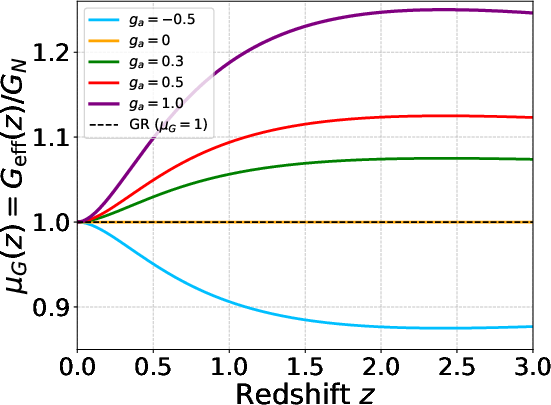
- Gravity strength: Normally gravity’s “strength” (Newton’s G) is fixed. Here, they let the “gravity dial” vary slightly over time as G_eff(z) (they call the ratio μ_G = G_eff/G_N). Picture gravity getting a tiny bit stronger or weaker at certain past times.
They combined several top datasets:
- DESI DR2 (precise distance measurements using a cosmic “standard ruler” called BAO),
- Pantheon+ (many Type Ia supernovae used as “standard candles”),
- CMB (the baby picture of the universe),
- Growth-rate data (RSD: how quickly cosmic structures like galaxies grow over time—this depends on gravity’s strength).
Then they:
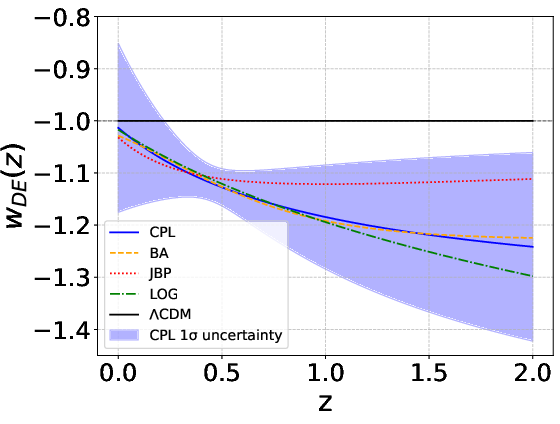
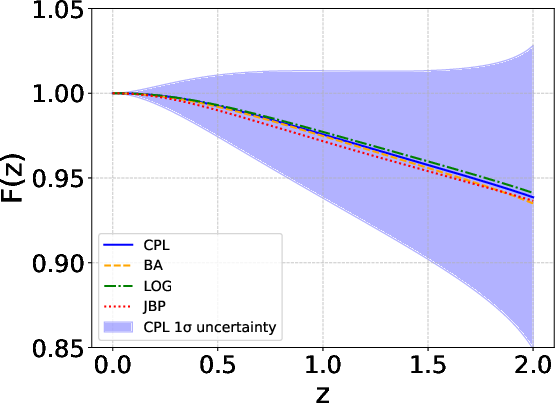
- Tested several simple shapes for w(z) (CPL, BA, Log, JBP—just different smooth ways to let w change with time).
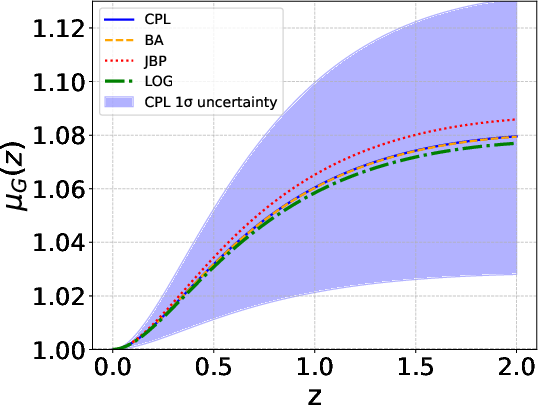
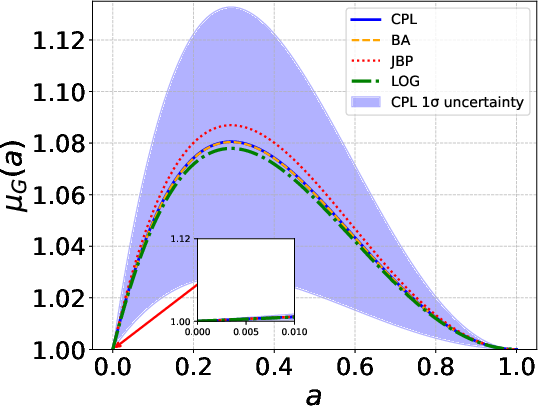
- Used a gentle, temporary change in gravity (μ_G) that peaks around z ~ 2 and goes back to normal today. This keeps the early universe and local gravity tests safe.
- Fit everything by adjusting the model to minimize the mismatch with the data (a statistical method called chi‑square).
- Finally, they “reverse engineered” the scalar‑tensor theory: they reconstructed the coupling F(Φ) (how the new scalar field Φ changes gravity) and the potential U(Φ) (how the field’s energy behaves) from the best‑fit cosmic history.
Everyday analogy:
- w(z) is like the recipe for dark energy—what kind of “fuel” it is at different times.
- μ_G(z) is like a dimmer switch for gravity—just a small, temporary nudge in brightness at the right moment.
- The data fit is like tuning a radio: they turn the knobs until static disappears and the signal (the universe’s story) comes through clearly.
What did they find, and why does it matter?
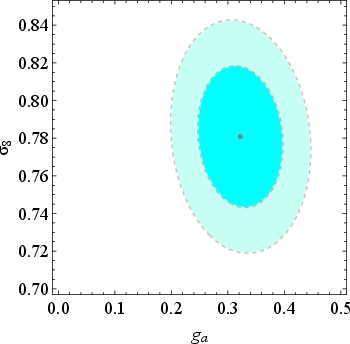
- A higher H0 from the combined data in modified gravity: The best‑fit H0 is 70.6 ± 1.7 km/s/Mpc. That’s higher than the CMB‑only value (~67) and closer to local measurements (~73). So, the tension gets smaller.
- Phantom crossing happens naturally: In scalar‑tensor gravity, w(z) crossing −1 is allowed without the usual instabilities that plague simple dark energy in standard GR. This matches what DESI hints at.
- Gravity modification is mild and well‑timed: The effective gravity (μ_G) only deviates a bit from normal and mainly around z ~ 2, then returns to today’s value. That keeps the early universe (like Big Bang Nucleosynthesis) and Solar System tests happy.
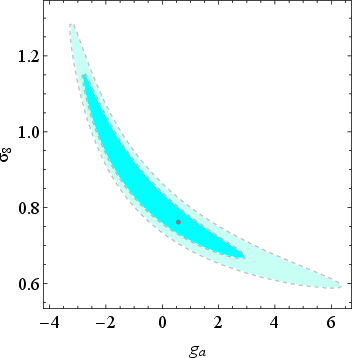
- Good overall fits: The models fit BAO, supernovae, CMB, and growth‑rate data at the same time. The inferred matter clustering level (σ8) is around 0.78, which is in the ballpark of many late‑time measurements.
- Reconstructed theory pieces: They provide simple analytic forms that describe the theory the data prefer:
- Non‑minimal coupling (how the scalar field tweaks gravity): F(Φ) ≈ 1 + ξ Φ² e{nΦ}
- Scalar potential (the energy landscape for the field): U(Φ) ≈ U0 + a e{bΦ²}
- These are compact, usable expressions for future tests.
Why it’s important:
- It shows a consistent path to easing the H0 tension without breaking other well‑tested parts of cosmology.
- It explains DESI’s “phantom‑crossing” hint in a theory that makes physical sense.
- It offers concrete functions for the underlying physics, not just a curve fit.
What does this mean for the future?
If gravity is slightly different on huge cosmic scales—because of an extra field that gently adjusts its strength—then:
- We might need to go beyond standard General Relativity to fully describe the universe.
- Upcoming surveys (more DESI, Euclid, Rubin/LSST, future CMB missions) can test these time‑dependent gravity tweaks and the phantom crossing more precisely.
- A well‑behaved scalar‑tensor model could become a leading alternative to the standard ΛCDM picture, especially if it keeps improving the fit to H0 and dark energy behavior.
In short: This work suggests a simple, data‑driven modified gravity model can both allow dark energy to cross w = −1 and bring the Hubble constant closer to local measurements—while staying consistent with many kinds of observations. It gives a clear, testable blueprint for how gravity and dark energy might really work on the largest scales.
Knowledge Gaps
Knowledge gaps, limitations, and open questions
Below is a single, concrete list of what remains missing, uncertain, or unexplored in the paper, framed to be actionable for future research:
- Quantify theoretical stability: derive and check ghost/gradient-stability and no-tachyon conditions for the reconstructed scalar–tensor (ST) model (e.g., positivity of kinetic and effective mass terms), especially across the phantom-crossing epoch.
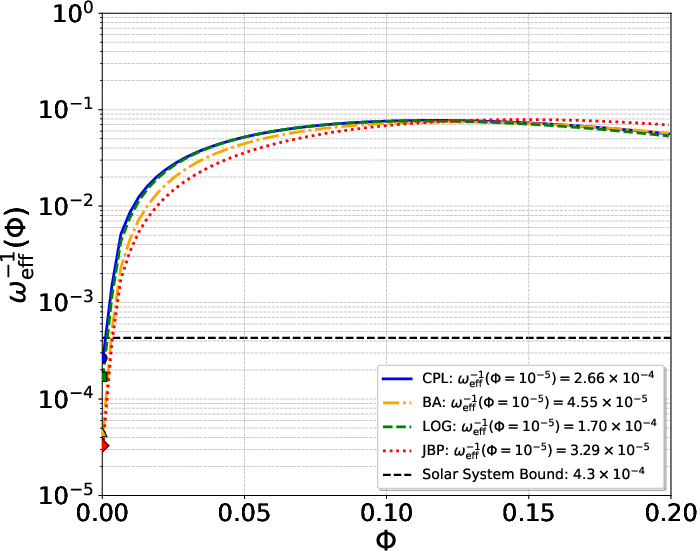
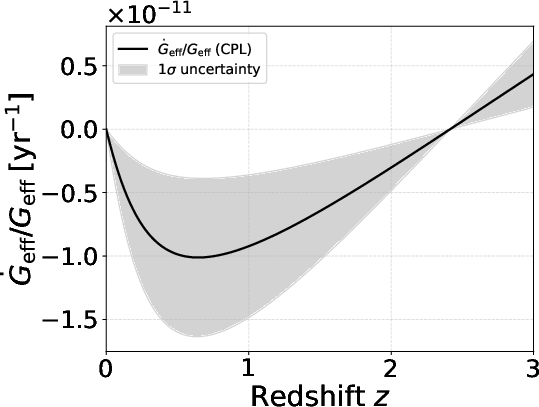
- Local gravity and PPN viability: compute the post-Newtonian parameters (γ, β), the time variation of Newton’s constant
Ḡ/G, and screening requirements for the reconstructedF(Φ)andU(Φ); confront Cassini, Lunar Laser Ranging, binary pulsar, and Solar System constraints. - Gravitational-wave constraints: evaluate the running of the Planck mass (α_M) and its impact on GW amplitudes and propagation; test consistency with GW170817/GRB170817A (c_T ≃ 1), GW standard siren H₀ measurements, and future network constraints on α_M.
- Scale dependence in growth: the analysis assumes a scale-independent
μ_G(z); extend toμ_G(k,z)and include gravitational slip (η) and lensing response (Σ) to test consistency with RSD, galaxy–galaxy lensing, and E_G measurements. - Lensing and S₈ tension: directly confront predictions with cosmic shear datasets (KiDS-Legacy, DES Y3, HSC) and CMB lensing (Planck, ACT, SPT), including a dedicated likelihood for Σ and η, to evaluate whether the model truly alleviates the S₈ tension.
- Full CMB likelihood: replace compressed CMB (R, ℓ_a, Ω_b h²) with the full Planck/ACT/SPT likelihood (TT/TE/EE+lensing) to robustly assess early–late consistency and avoid biases from compression.
- Early-time robustness of BAO calibrations: verify that ΛCDM-based fitting formulas for
z_drag,z_*, andr_s(z_d)remain valid in the reconstructed ST model (even if μ_G→1 at early times); if not, recompute these quantities self-consistently. - Curvature freedom: relax flatness and assess sensitivity of H₀ and w(z) crossing to small but non-zero Ω_k given known degeneracies in BAO+CMB+SNe.
- Non-uniqueness of reconstruction: quantify the degeneracy space of
F(Φ)andU(Φ)consistent with the sameH(z)andμ_G(z); propagate data uncertainties to posteriors forF(Φ)andU(Φ)and report their credible intervals. - Parametrization dependence: test robustness of conclusions to alternative forms of
μ_G(z)(vary n, add terms, splines/binned reconstructions) and to non-parametric or piecewise w(z), avoiding CPL/BA/JBP/Log biases in phantom-crossing inference. - Model comparison metrics: provide AIC/BIC/Bayes evidence to assess whether χ² improvements justify the added MG degrees of freedom versus GR+DDE or ΛCDM baselines.
- H₀ calibration systematics: repeat the analysis with alternate SNe absolute magnitude calibrations (e.g., TRGB-only, mixed Cepheid/TRGB, or JWST-based updates) to check sensitivity of the inferred
h ≈ 0.706to local calibration choices. - Cross-dataset covariances: explicitly model potential correlations/systematics between DESI BAO, Pantheon+, and growth datasets (e.g., overlapping sky volumes, calibration pipelines), ensuring the joint χ² does not double-count or misweight information.
- Cosmic chronometers: include direct
H(z)measurements (cosmic chronometers) to independently validate the reconstructed expansion history and phantom-crossing behavior without relying on w(z) parametrizations. - Nonlinear structure formation: test the model against cluster abundance, halo mass functions, redshift-space multipoles, and small-scale lensing with MG-specific N-body or emulator predictions to ensure consistency beyond linear RSD.
- Time and redshift of crossing: report the redshift range, amplitude, and statistical significance of the w = −1 crossing (with uncertainties), and check for consistency across parametrizations and datasets.
- Late-time fate of the universe: analyze whether the reconstructed ST dynamics imply a transient crossing or sustained
w < −1leading to pathologies (e.g., Big Rip); map future attractors of the reconstructed potential. - Microphysical interpretation: provide a theoretical rationale for the empirical forms
F(Φ) = 1 + ξ Φ² e^{nΦ}andU(Φ) = U₀ + a e^{bΦ²}(e.g., UV completions, symmetry arguments), and clarify parameter ranges that avoidF(Φ) ≤ 0. - Screening mechanisms: despite claims of avoiding screening, evaluate whether fifth-force constraints in galaxies and the Solar System necessitate chameleon/Vainshtein-type screening given the reconstructed coupling, or otherwise quantify why screening is not required.
- GW–EM consistency tests: predict and confront the model with integrated Sachs–Wolfe cross-correlations, Shapiro time-delay constraints, and strong-lensing time-delay
H₀measurements (TDCOSMO/H0LiCOW) to broaden late-universe validation. - Neutrino sector and other degeneracies: explore interplay with Σm_ν, N_eff, and baryonic feedback systematics, which can mimic or mask MG signatures in growth and lensing observables.
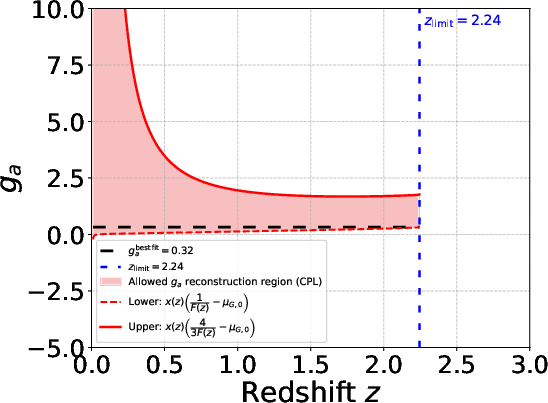
- Reproducibility of Pantheon+ reanalysis: the paper references equations for luminosity scaling not included in the excerpt; provide the explicit methodology, code, and data products to enable independent replication of the “degeneracy breaking” between
g_aandσ₈. - Forecasts: deliver Euclid/LSST/CSST/DESI final forecasts for constraints on
μ_G(z), α_M, and w(z) crossing, including which observables (RSD multipoles, E_G, cosmic shear tomographics) most efficiently distinguish ST from GR+DDE.
Practical Applications
Immediate Applications
Below are concrete ways the paper’s findings, methods, and innovations can be used now, along with sectors, potential tools/workflows, and key assumptions/dependencies.
- Robust multi-probe pipeline for late-time modified gravity inference (academia, software)
- Action: Integrate the paper’s joint-likelihood workflow (DESI DR2 BAO, Pantheon+ with Cepheid anchors, compressed CMB, RSD fσ8, BBN prior) into existing cosmology analysis stacks to test late-time scalar–tensor (ST) gravity against GR/quintessence.
- Tools/workflows: Plugins for Cobaya/MontePython; likelihood modules for DESI DR2 block-diagonal covariance; RSD growth likelihood with WiggleZ covariance handling; compressed CMB (R, ℓA, Ωbh²) support.
- Assumptions/dependencies: Validity of compressed CMB likelihood for the explored parameter space; Pantheon+ calibration systematics; DESI DR2 covariance fidelity; homogeneous ST background sufficiency for current constraints.
- Drop-in parametrization for G_eff and w(z) in Boltzmann and growth codes (academia, software)
- Action: Add μG(a)=Geff/GN with the transient “g_a” parametrization (n=2) and a flexible w(z) (CPL/BA/JBP/Log) to CAMB/CLASS or growth-only solvers to propagate modified gravity into fσ8, lensing kernels, and distances.
- Tools/workflows: Code patches and emulators for H(z), μG(z), and fσ8(a); validation notebooks reproducing Table-level fits.
- Assumptions/dependencies: μG parametrization peaks at z≈2 and returns to GR at z=0 and high z; no explicit screening invoked; stability and causality respected in the chosen ST subclass.
- Data-driven reconstruction toolkit for scalar–tensor Lagrangians (academia, software)
- Action: Implement the reconstruction map {H(z), μG(z)} → {F(z), U(z), Φ(z)} and fit analytical templates F(Φ)=1+ξΦ² e{nΦ} and U(Φ)=U0 + a e{b Φ²} to produce theory-space posteriors consistent with data.
- Tools/products: Open-source “ST-Recon” module that ingests multi-probe posteriors and outputs F(Φ), U(Φ) samples with viability flags (F>0, Z=1, cT=1).
- Assumptions/dependencies: Jordan-frame analysis with minimal matter coupling; Z(Φ)=1; viability/positivity constraints; compatibility with gravitational-wave speed constraints.
- Degeneracy-breaking workflows for SNe Ia calibration with Cepheid anchors (academia, astronomy)
- Action: Use the paper’s reanalysis logic to break the M–H0 degeneracy in Pantheon+ via Cepheid host distances, stabilizing H0 inference under non-GR late-time physics.
- Tools/workflows: Reusable Cepheid-anchored SN vectors within Pantheon+ pipelines; sensitivity diagnostics to host and zero-point systematics.
- Assumptions/dependencies: Accuracy and representativeness of Cepheid calibrations (including JWST/HST cross-consistency); treatment of SN systematics.
- Survey targeting guidance for late-time MG signals (astronomy, survey design)
- Action: Emphasize redshift 0.5≲z≲2 in BAO/RSD and lensing strategies (Euclid, Rubin/LSST, Roman) where μG(a) deviations peak; prioritize tracers and spectroscopic depth accordingly.
- Tools/workflows: Quick-look forecast modules using the μG(z) template; redshift-efficiency maps for BAO/RSD/lensing yield under MG.
- Assumptions/dependencies: Stability of the preferred μG shape; robustness of growth measurements at z≈1–2 to non-linear/systematic effects.
- Updated cross-check priors for standard sirens and lensing time delays (astronomy)
- Action: Use the inferred H0 = 70.6 ± 1.7 km s⁻¹ Mpc⁻¹ as an interim prior or cross-validation target in standard-siren and strong-lensing pipelines exploring late-time MG.
- Tools/workflows: Interoperable prior files and posterior-predictive checks across distance-ladder, sirens, and time-delay codes.
- Assumptions/dependencies: Applicability of late-time MG to GW amplitude propagation and lensing potentials is model-dependent; priors should be optional/for comparison.
- Education and method transfer: multi-dataset covariance handling (education, software)
- Action: Adopt the paper’s block-diagonal DESI BAO covariance and WiggleZ correlation treatment as exemplars in graduate training and method repositories for multi-probe inference.
- Tools/workflows: Teaching notebooks; template likelihood construction with documented covariance assembly and validation.
- Assumptions/dependencies: Covariance stationarity across data releases; reproducibility requirements.
- Programmatic prioritization of late-time modified gravity tests (policy, funding, survey strategy)
- Action: Use the phantom-crossing–in-GR no-go and alleviated H0 tension in ST as motivation to fund late-time MG analyses alongside early-time models (EDE) in survey science cases.
- Tools/workflows: Decision briefs contrasting fit improvements (Δχ², Bayes factors), redshift leverage, and systematics risks.
- Assumptions/dependencies: Continued evidence for phantom crossing from DESI and future BAO/SN; community standards for MG model comparison.
Long-Term Applications
These opportunities require further theory development, data, or computing at scale before deployment.
- End-to-end ST N-body and lensing simulations (academia, software, HPC)
- Action: Build hybrid N-body plus scalar-field solvers consistent with reconstructed F(Φ), U(Φ) to predict non-linear structure, halo statistics, weak lensing, and galaxy bias under MG.
- Tools/products: ST-aware simulation suites; fast emulators for summary statistics; mock catalogs for DESI/Euclid/Rubin/Roman.
- Assumptions/dependencies: Well-posedness (no ghosts/gradients instabilities), screening where necessary, baryonic feedback modeling under MG, performance-portable HPC.
- Gravitational-wave propagation tests of Planck-mass running (astronomy, GW)
- Action: Use standard sirens (A+, ET/CE, LISA) at 0.5≲z≲2 to probe MG-induced amplitude damping (effective friction) correlated with μG(z) and F(Φ) evolution.
- Tools/workflows: Joint siren–EM cosmology pipelines with MG waveform propagation; cross-correlation with BAO/RSD constraints.
- Assumptions/dependencies: Consistent ST subclass with cT=1; accurate distance–inclination disentanglement; population systematics under control.
- Unified multi-probe constraints on time variation of G and post-Newtonian bounds (academia, astronomy)
- Action: Synthesize BBN, CMB, stellar evolution, pulsar timing, and lunar laser ranging with the reconstructed μG(z) to pressure-test viable parameter space.
- Tools/workflows: Global constraint engine combining early/late-universe G constraints with local PPN limits.
- Assumptions/dependencies: Mapping between cosmological μG and local gravitational coupling under screening; careful model dependence.
- 21-cm intensity mapping to target μG peak epoch (astronomy, instrumentation)
- Action: Design IM surveys (e.g., SKA pathfinders) optimized for z≈1–3 to sharpen growth and expansion constraints where MG deviations are maximal.
- Tools/workflows: MG-aware survey simulators; calibration strategies robust to foregrounds in the target z-range.
- Assumptions/dependencies: Foreground mitigation at scale; cross-correlation with optical spectroscopic samples.
- Standards and benchmarks for MG parametrizations and reporting (policy, community standards)
- Action: Establish community guidelines for reporting μG(z), w(z), and reconstructed F(Φ), U(Φ) (priors, viability conditions, stability checks, cT=1) across analyses.
- Tools/workflows: Reference datasets, likelihoods, and validation challenges akin to DESC/LSST standards but MG-focused.
- Assumptions/dependencies: Broad community buy-in; alignment with survey collaboration policies.
- Machine-learning emulators for fast MG forecasts and inference (software, HPC)
- Action: Train neural operators/GP emulators to map from μG and w(z) to observables (H(z), fσ8, lensing spectra) and back to F(Φ), U(Φ) posteriors.
- Tools/products: Public emulators with uncertainty quantification; differentiable likelihoods for gradient-based samplers.
- Assumptions/dependencies: Training coverage of parameter space; guarding against extrapolation errors; method interpretability for theory viability.
- Cross-ladder reconciliation frameworks (astronomy)
- Action: Jointly fit distance ladders (Cepheid/TRGB/SBF), time delays, sirens, and BAO/SN with ST late-time physics to diagnose residual H0 tensions and systematics.
- Tools/workflows: Modular inference hubs allowing GR/MG toggles and robust model comparison (e.g., RJ-MCMC, Bayesian evidence).
- Assumptions/dependencies: Shared data models across ladders; well-characterized systematics and selection effects.
- Productization of “ST-Recon” as a community platform (software, sustainability)
- Action: Mature the reconstruction toolkit into a supported platform with APIs to survey pipelines, documentation, and archival of reconstructed Lagrangians over data releases.
- Tools/products: Versioned releases, continuous integration tests, benchmark datasets, citation-ready archives.
- Assumptions/dependencies: Long-term maintenance funding; permissive licensing and governance model.
Notes on Global Assumptions and Dependencies
- The phantom crossing in w(z) is not achievable with single-field minimally coupled quintessence in GR; the paper leverages scalar–tensor gravity to enable it without invoking ghosts in specific subclasses.
- The μG(a) parametrization is transient and tuned to satisfy BBN and local GR at z≈0; results depend on this shape and on adopting Z(Φ)=1, F>0 in the Jordan frame.
- Compressed CMB likelihoods are assumed adequate; full Planck/SPT/ACT likelihoods could slightly shift constraints.
- Viability requires compliance with gravitational-wave speed constraints (cT=1), stability, and local gravity tests; additional screening may be needed in fully realistic models.
- Inference quality depends on control of survey systematics (BAO reconstruction, SN calibration, growth modeling, non-linearities).
Glossary
- Acoustic scale: The characteristic angular scale in the CMB set by the ratio of the comoving distance to last scattering to the sound horizon. "we consider three key observables: the CMB shift parameter (), the acoustic scale (), and the physical baryon density ()."
- AdS--EDE: A class of Early Dark Energy models featuring an anti–de Sitter-like phase to alter pre-recombination physics. "AdS--EDE~\cite{Ye:2020btb,Ye:2020oix,Ye:2021iwa}"
- BA (Barboza–Alcaniz) parametrization: A two-parameter model for the dark energy equation of state designed to remain well-behaved across redshift. "BA (BarbozaâAlcaniz)\cite{Barboza:2008rh,Barboza:2011gd}:"
- BAO (Baryon Acoustic Oscillations): Imprints of early-universe sound waves in the matter distribution that serve as a standard ruler. "baryon acoustic oscillation (BAO) measurements"
- Big Bang Nucleosynthesis (BBN): The formation of light nuclei in the early universe, providing strong constraints on cosmological parameters. "The Big Bang Nucleosynthesis provides a Gaussian prior on the baryon density"
- Brans–Dicke theory: A scalar–tensor theory of gravity with a varying gravitational coupling mediated by a scalar field. "Such theories include Brans-Dicke theory and its generalizations"
- CMB (Cosmic Microwave Background): Relic radiation from the early universe used to infer cosmological parameters. "cosmic microwave background (CMB)"
- Chandrasekhar limit: The maximum mass (~1.4 solar masses) a white dwarf can have before collapsing, central to Type Ia supernova physics. "surpasses the Chandrasekhar limit due to gas accretion from a companion star."
- Cosmic shear: Weak lensing distortions of galaxy shapes by large-scale structure, sensitive to the matter distribution. "Cosmic shear measures the weak lensing signal from LSS imprinted on galaxy shapes"
- CPL (Chevallier–Polarski–Linder) parametrization: A widely used two-parameter model for dark energy’s equation of state w(z) that avoids high-z divergences. "CPL (ChevallierâPolarskiâLinder)\cite{Chevallier:2000qy,Linder:2002et}:"
- Dark Energy Spectroscopic Instrument (DESI) DR2: A major spectroscopic survey release providing precise BAO data across redshift. "The recent Data Release 2 (DR2) from the Dark Energy Spectroscopic Instrument (DESI)"
- Distance modulus: The difference between apparent and absolute magnitude used to infer cosmological distances. "Here, represents the distance modulus"
- Drag epoch: The time after recombination when baryons decouple from photons and BAO propagation ceases. "The redshift $z_{\text{drag}$ denotes the period of the drag epoch"
- Einstein frame: A conformal frame where the gravitational action takes Einstein–Hilbert form and scalar–matter couplings become explicit. "Although a transformation to the Einstein frame diagonalizes the kinetic terms"
- Effective gravitational constant (G_eff) / μ_G: A phenomenological modification of Newton’s constant affecting growth of structure. "the effective gravitational constant, ,"
- Equivalence principle (Weak Equivalence Principle): The universality of free fall; matter follows Jordan-frame geodesics independently of composition. "The weak equivalence principle establishes the existence of a Jordan-frame metric with universal matter coupling"
- f(R) gravity: A modified gravity theory generalizing the Einstein–Hilbert action to a function of the Ricci scalar. " gravity in its scalar-tensor representation"
- fσ8 (growth-rate parameter): A bias-independent observable combining the linear growth rate with the matter fluctuation amplitude. "the parameter serves as an important observable"
- Horndeski theories: The most general scalar–tensor theories with second-order equations of motion, avoiding Ostrogradsky instabilities. "as well as by Horndeski theories and their generalizations"
- Hubble distance: A characteristic cosmological length scale equal to c divided by the Hubble parameter at redshift z. "The Hubble distance, denoted by , is a characteristic length scale"
- Hubble tension (H0 tension): The significant discrepancy between early- and late-universe determinations of the Hubble constant. "The so-called tension~\cite{Perivolaropoulos:2021jda,Abdalla:2022yfr,DiValentino:2021izs,Hu:2023jqc,CosmoVerseNetwork:2025alb,Freedman:2017yms,DiValentino:2020zio,Verde:2019ivm,Shah:2021onj,Schoneberg:2021qvd,Verde:2023lmm} remains one of the most significant challenges in modern cosmology."
- JBP (Jassal–Bagla–Padmanabhan) parametrization: A w(z) model peaking around z≈1 and reverting to w0 at early and late times. "JBP (JassalâBaglaâPadmanabhan)\cite{Jassal:2004ej}:"
- Jordan frame: The frame where matter is minimally coupled and physical measurements are directly interpreted. "We work in the Jordan frame, where physical observables correspond directly to measurements"
- k-essence: Dark energy models with non-canonical kinetic terms allowing richer dynamics than canonical scalar fields. "even generalized k-essence models with a Lagrangian of the form"
- Lagrangian density: The function defining a field theory’s dynamics; for scalar–tensor gravity it includes F(Φ)R and kinetic/potential terms. "The Lagrangian density considered in this work is given by:"
- Linear galaxy bias: The proportionality relating galaxy clustering to underlying matter fluctuations on large scales. "where is the linear galaxy bias parameter"
- Linear matter power spectrum: The variance of matter fluctuations as a function of scale in linear theory. "The quantity denotes the linear matter power spectrum"
- Luminosity distance: A distance measure inferred from observed flux assuming a known absolute luminosity. "The luminosity distance can be expressed as:"
- Modified Gravity (MG): Theories extending or altering GR to explain cosmic acceleration or tensions without dark energy alone. "We argue that both of these goals may be achieved in the context of Modified Gravity (MG)"
- Non-minimal coupling: A scalar field coupling to curvature (e.g., via F(Φ)R) modifying the effective gravitational interaction. "the non-minimal coupling permitting a broader class of viable potentials than quintessence models"
- Pantheon+ dataset: A large, homogenized collection of SNe Ia light curves used for precision cosmology. "The Pantheon+ dataset comprises a collection of $1550$ type Ia supernovae"
- Phantom crossing: A transition of the dark energy equation of state across w=−1. "This phantom crossing is a key feature that cannot be achieved by minimally coupled scalar fields (quintessence) within GR."
- Phantom divide line: The boundary w=−1 separating quintessence-like and phantom-like dark energy. "phantom divide line "
- Phantom field: A scalar field with negative kinetic energy density yielding w<−1. "and the minus sign a phantom field ()."
- Proper motion distance: The comoving angular diameter distance used in cosmological distance relations. "the angular diameter distance, , and the proper motion distance, "
- Quintessence: A minimally coupled canonical scalar field model for dark energy with −1<w<−1/3. "minimally coupled scalar fields (quintessence) within GR."
- Redshift-space distortions (RSD): Anisotropies in galaxy clustering from peculiar velocities, used to measure growth. "growth-rate (RSD) data"
- Ricci scalar: A curvature scalar contracting the Ricci tensor, appearing in gravitational actions. "couples non-minimally to the metric or to the Ricci scalar via a coupling function"
- Scalar–tensor (ST) theories: Gravity theories with an extra scalar degree of freedom coupled to curvature or matter. "Scalar-Tensor (ST) theories"
- Shift parameter (R): A compressed CMB distance measure encapsulating the position of acoustic peaks. "The shift parameter, denoted as , is a dimensionless parameter"
- Sound horizon: The comoving distance a sound wave travels in the photon–baryon fluid before decoupling. "If we denote as the sound horizon, i.e., the comoving distance traveled by a sound wave"
- Strong equivalence principle (SEP): Extension of WEP stating that gravitational self-energy also falls universally. "The strong equivalence principle extends this universality to include gravitational binding energy"
- Type Ia supernovae (SNe Ia): Thermonuclear supernovae serving as standardizable candles for cosmology. "Type Ia supernovae, characterized by the absence of a spectral line of hydrogen"
- Weak lensing: The small deflection of light by large-scale structure, statistically measured via shape distortions. "Cosmic shear measures the weak lensing signal from LSS"
- Weighted amplitude of matter fluctuations (S_8): A parameter combining σ8 and Ω_m to reduce degeneracies in lensing. "weighted amplitude of matter fluctuations, defined as ."
Collections
Sign up for free to add this paper to one or more collections.