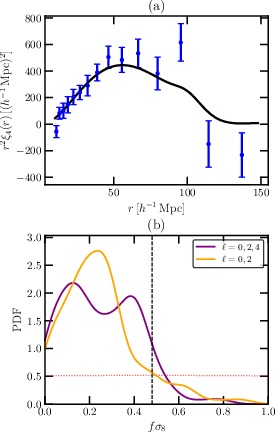
- The paper demonstrates that for scales ≥10 h⁻¹ Mpc, the dispersion model yields unbiased fσ₈ inference under DR1-like conditions.
- It employs simulated PINOCCHIO lightcones to systematically compare dispersion, Scoccimarro, and TNS models under varying photometric redshift uncertainties.
- The study provides clear pipeline recommendations for Euclid DR1 and outlines limitations at higher redshift and multipoles that require improved nonlinear bias modeling.
Template Fitting for Multipole Clustering Analysis of Galaxy Clusters in Euclid DR1
Introduction and Context
The accurate modeling of the two-point correlation function (2PCF) of galaxy clusters in redshift space is critical for constraining the growth of structure and extracting robust cosmological information in forthcoming Stage-IV surveys such as Euclid. The work "Testing template-fitting models for the multipoles of the two-point clustering of galaxy clusters" (2604.25762) addresses the problem of model validation for template-based inference on the multipoles of 2PCFs, focusing on the practicalities required by the Euclid DR1 cluster sample. The study employs a suite of simulated catalogues from the PINOCCHIO code to systematically test different redshift-space clustering models, evaluate the impact of photometric redshift uncertainties and nonlinear/nonlocal corrections, and define statistical criteria for cut-off scales required in cosmological inference.
The analysis uses 1000 lightcones generated with third-order Lagrangian perturbation theory as implemented by the PINOCCHIO algorithm, ensuring comprehensive statistical coverage while maintaining computational efficiency. The adopted mock DR1 footprint comprises 500 deg2 in the Northern Galactic hemisphere and 1400 deg2 in the Southern, selecting halo masses Mvir>1014 h−1M⊙ and extending up to z=2. Completeness and purity are, for this baseline study, idealized to 100% in all relevant bins, optimizing statistical power for model discrimination.
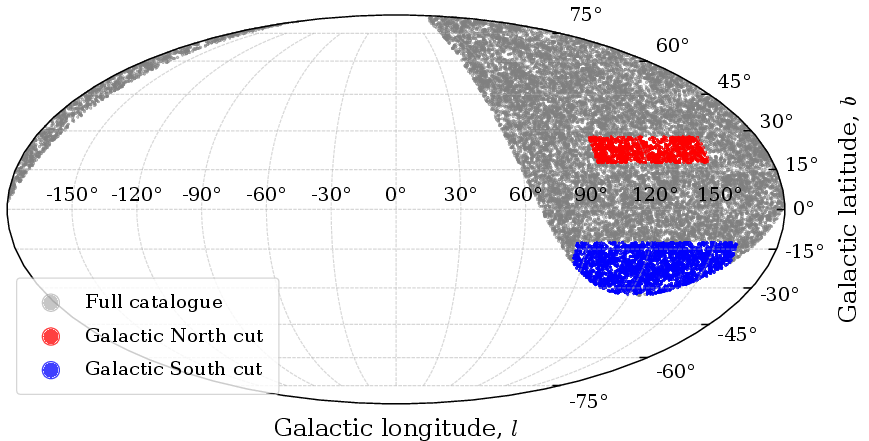
Figure 1: Footprint of the PINOCCHIO cluster mock catalogue before and after DR1-like angular cuts.
2PCF Multipole Estimation and Redshift-Space Modeling
The 2PCF multipoles—monopole, quadrupole, and, for specialized analysis, the hexadecapole—are estimated in bins from $10$ to 150 h−1Mpc, using a Landy–Szalay-type estimator sampled across 1000 independent realizations. Statistical covariances are determined empirically, justifying by Kolmogorov-Smirnov tests the use of Gaussian likelihoods for parameter inference.
The paper tests three classes of template fitting models for the redshift-space power spectrum:
- Dispersion Model \citep{1994MNRAS.267.1020P}: Extends the linear Kaiser model by introducing an empirical Gaussian (or Lorentzian) damping factor parameterized by the velocity dispersion scale σv. For clusters, with low internal velocity dispersions, the dominant source of this damping is photometric redshift uncertainty.
- Scoccimarro Model \citep{2004PhRvD..70h3007S}: Incorporates cross terms between the matter and velocity divergence fields, improving accuracy at mildly nonlinear scales.
- TNS Model \citep{2010PhRvD..82f3522T}: Employs a perturbative expansion including higher-order corrections, calibrated for the galaxy case.
All models are linear in bias and share the matter power spectrum (fixed to Planck 2013 ΛCDM) as input. Photometric redshift uncertainties are modeled as Gaussian, parameterized as σz=σ0(1+z), with both optimistic (σ0=0.005) and realistic (1400 deg20) scenarios explored.
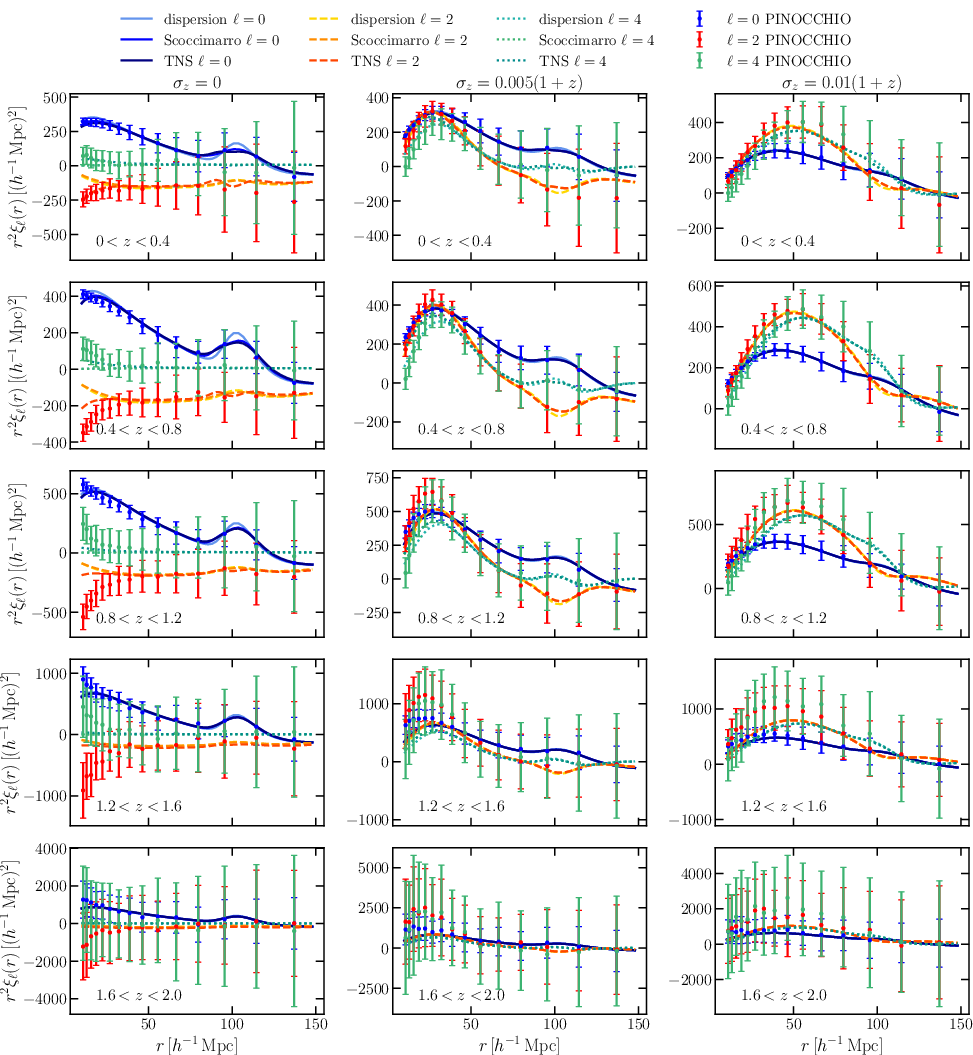
Figure 2: Performance comparison of the dispersion, Scoccimarro, and TNS models at ground-truth parameters, under varying photometric redshift uncertainties.
Model Validation and Cut-off Scale Statistical Criteria
The principal goal is to determine the smallest scale (largest wavenumber) at which the models provide unbiased inference for 1400 deg21, the key parameter encoding the linear growth rate and power spectrum normalization. The authors introduce two sets of statistical criteria:
- Permissive Tests:
- Model is accepted if the reduced 1400 deg22 of fits is consistent with unity within statistical fluctuations.
- Ensures the model provides an adequate fit to DR1-like data but does not strictly test for statistical consistency of posteriors.
- Conservative Tests:
- Additional constraints on posterior bias and coverage in ensembles of mocks (using metrics such as 1400 deg23 and highest posterior density (HPD) coverage), monotonicity conditions, and catalog-level robustness.
- These stricter requirements are intended to serve as baseline for higher-fidelity DR2/3 analyses, where increased S/N will render systematics more prominent.
The grid search in minimum scale cut-offs for both monopole and quadrupole is performed in each bin, and posterior distributions for 1400 deg24 are rigorously characterized.
Main Results
- Model Performance: All three tested models (dispersion, Scoccimarro, TNS) are statistically indistinguishable in the presence of DR1-like photometric redshift uncertainties; the simple dispersion model is sufficient at scales 1400 deg25 for both monopole and quadrupole.
- Bias Characterization: For informative bins (i.e., ones where posteriors are not strongly prior-dominated), the inferred 1400 deg26 bias is 1400 deg27 for all tested scenarios, supporting the statistical adequacy of the dispersion model at the adopted scale cuts.
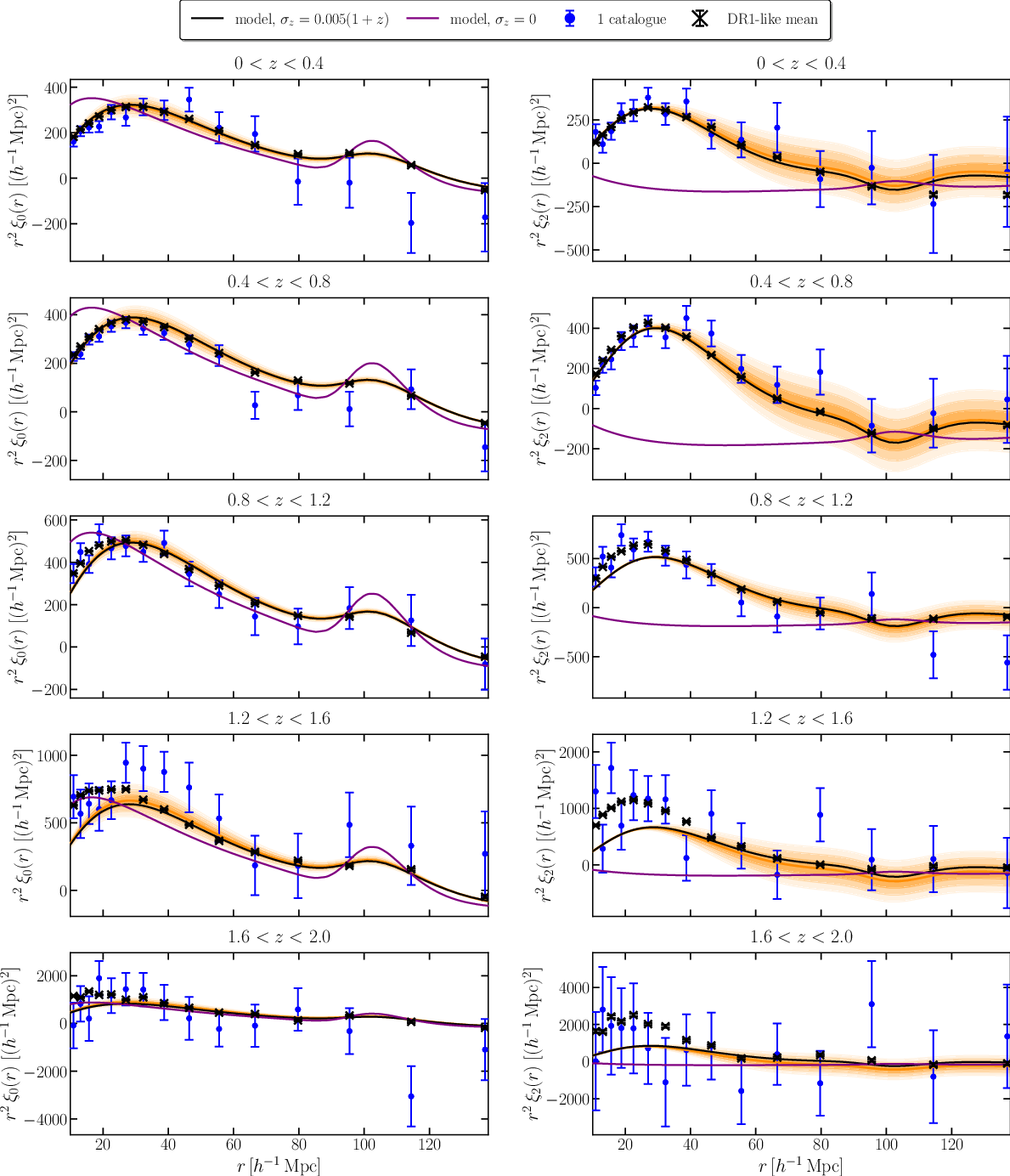
Figure 3: Monopole and quadrupole measurements in \code{PINOCCHIO} mocks versus redshift-space model predictions under DR1-like redshift uncertainties, with ensemble error analysis.
- Redshift and Multipole Dependence: The scale at which model deviations become significant increases with redshift and multipole order, an effect traced to increasing halo bias and nonlinearity—not merely failures of redshift-space modeling, but also the limitations of the linear bias assumption, particularly significant at 1400 deg28.
- Hexadecapole: The inclusion of the 1400 deg29 term (hexadecapole) in DR1-like analyses provides negligible improvement to Mvir>1014 h−1M⊙0 constraints; this could change for future DRs with improved S/N.
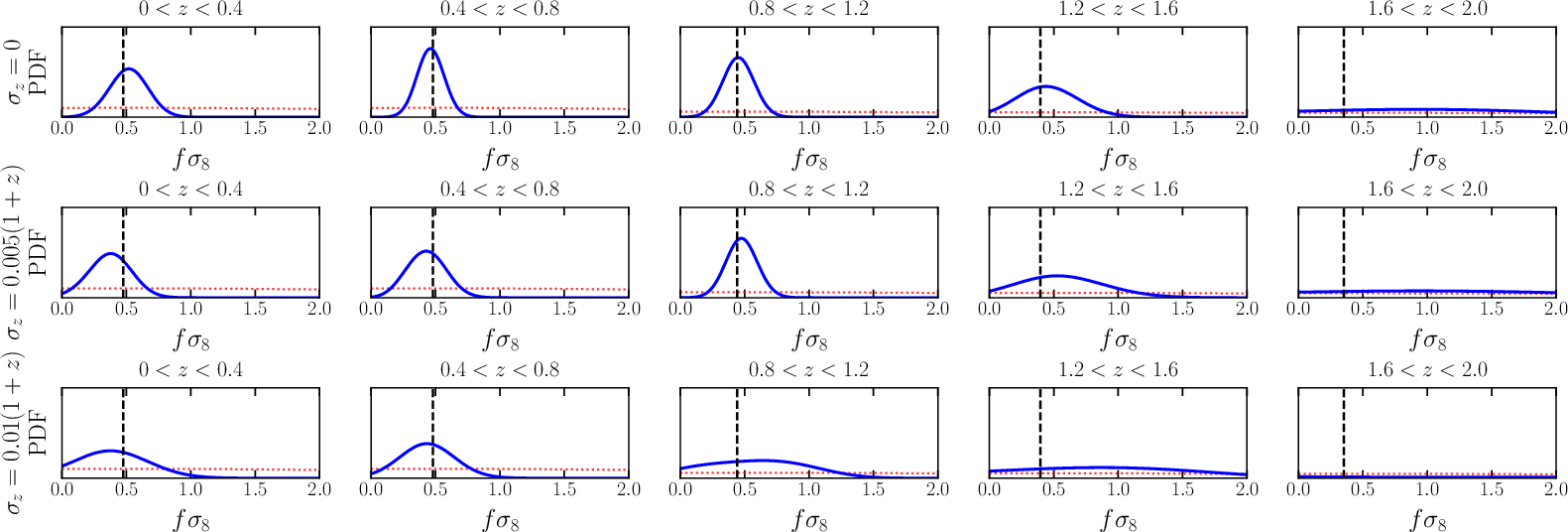
Figure 4: Posterior distributions for Mvir>1014 h−1M⊙1 as a function of redshift bin and photometric redshift error; dashed line is ground truth, dotted line the prior.
Implications for Euclid and Cosmological Inference
Theoretical and Practical Impact
This study establishes a robust, statistically calibrated framework for the use of template-fitting models in cluster 2PCF multipole analysis in the photometric regime, forming the foundation for the cosmological likelihood infrastructure for the Euclid survey. The defined scale cuts and statistical testing protocols will directly shape the implementation of cluster clustering cosmology pipelines and error budgets. The results emphasize the current sufficiency of the simplest analytic models in the photo-z dominated regime, but also highlight the necessity of improved theory, particularly for the cluster bias function, to fully exploit the cosmological constraining power of future, larger cluster samples and improved data.
Conclusion
The research provides a comprehensive validation of 2PCF multipole template-fitting procedures for photometric galaxy cluster surveys in the context of Euclid DR1. The key findings are that the dispersion model suffices for robust inference on Mvir>1014 h−1M⊙6 down to Mvir>1014 h−1M⊙7 under DR1-like conditions, with minimal bias in the informative regime. Extending cosmological analysis to higher redshift or smaller scales requires both improved modeling of nonlinear bias and the use of simulations with Mvir>1014 h−1M⊙8-body accuracy. This work is pertinent for the architecture of large-scale structure analysis pipelines in next-generation cosmological surveys (2604.25762).