- The paper presents a master screening equation that unifies Vainshtein, Chameleon, and novel Phaedrus mechanisms within luminal Horndeski gravity.
- It employs a rigorous perturbative scheme and numerical diagnostics to derive second-order cosmological perturbation equations and quantify screening efficiency.
- The research bridges theory and observation by providing tools for fast simulations to test modified gravity in both cosmological and Solar System contexts.
Unified Screening in Luminal Horndeski Gravity: A Master Equation Perspective
This essay provides an in-depth analysis of "A Master Equation for Screening in Luminal Horndeski Gravity" (2605.04154), emphasizing the formal derivation, classification, and implications of scalar field screening mechanisms within the context of luminal Horndeski theories. The discussion is structured to highlight theoretical advances, robust numerical diagnostics, and future research trajectories relevant to modified gravity and cosmology.
Framework and Perturbative Dynamics
The paper rigorously develops a unified perturbative scheme for luminal Horndeski theories, relying exclusively on the α-basis parameterization on a flat FLRW background. The Horndeski class is constrained to satisfy luminality (cGW=c), imposing αT=0, and thus significantly simplifying the action to combinations of K(ϕ,X), G3(ϕ,X), and G4(ϕ) operators. A major contribution is delivering the full set of unapproximated second-order cosmological perturbation equations in this class, explicitly organized in terms of αM (Planck-mass running), αK (kineticity), and αB (braiding). Notably, second-order nonlinearities affect only the scalar field perturbation equation, while the metric equations remain linear under the quasi-static and weak-field limits.
The suite of nonlinear perturbative terms is systematically reduced by imposing weak-field and QSA, retaining only those nonlinearities that are essential for capturing relevant screening operators. This is a critical step for tractability and for connecting with observable features in large-scale structure and lensing.
The Master Screening Equation and Operator Taxonomy
A central achievement is the derivation of a quadratic master screening equation (Eq. (4.14) in the paper), applicable in static, spherically symmetric backgrounds: Γ∇2Q−a2Q[M2+Mnl2Q]+κ−Q∇2Q+κ+(∂iQ)2−H−2(αB+αM)DijQ∂i∂jQ=−21(αB+2αM)a2ρ~mδ
This equation simultaneously encapsulates the canonical mechanisms of Vainshtein (cGW=c0), Chameleon (cGW=c1), and introduces the Phaedrus mechanism (cGW=c2 and cGW=c3), providing explicit operator-level identification and mapping to Lagrangian terms.
Vainshtein, Chameleon, and Phaedrus: Analytical and Numerical Diagnostics
Vainshtein Mechanism
Vainshtein screening emerges from the cubic Galileon (cGW=c4) sector, producing nonlinear derivative interactions that restore GR at small scales. The analysis yields an analytic profile for the screened field gradient, with a characteristic screening radius cGW=c5. The field profile and force suppression are validated by numerical solutions that recover the cGW=c6 efficiency plateau within screened regions.
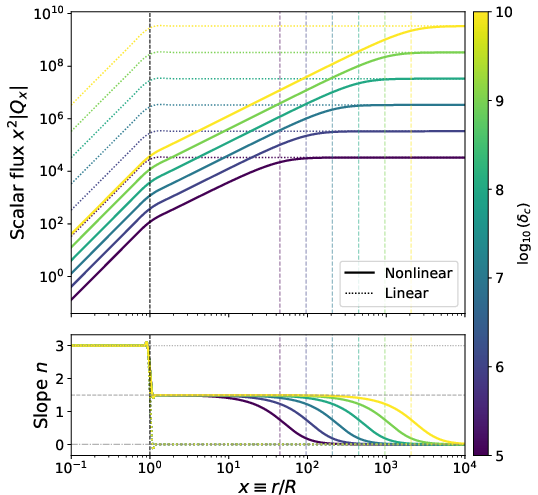
Figure 1: Numerical solutions of the Vainshtein mechanism, displaying the scalar flux and screening efficiency cGW=c7 across the spherical top-hat source.
Chameleon Mechanism
In contrast, Chameleon screening is sourced by nonlinear mass terms that generate a density-dependent effective mass, cGW=c8, pinning the scalar to its potential minimum in high-density environments and creating a thin-shell effect. The formalism accurately models the transition between screened and unscreened regimes, despite the perturbative truncation, and the analytic and full numerical solutions for the field and cGW=c9 coincide in the relevant limits.
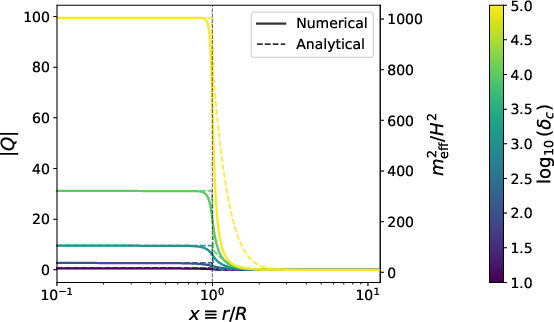
Figure 2: Scalar field magnitude αT=00 and effective Chameleon mass αT=01 with radial coordinate, revealing the thin-shell structure and its density dependence.
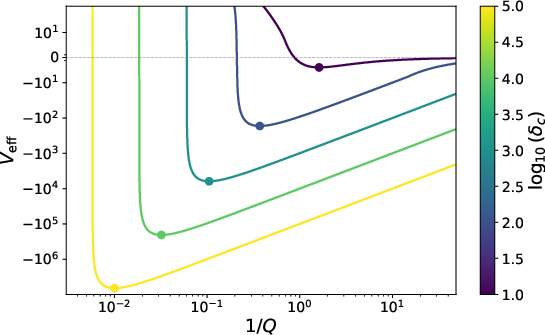
Figure 3: Chameleon effective potential αT=02 as a function of αT=03, demonstrating the density-driven shift of the potential minimum.
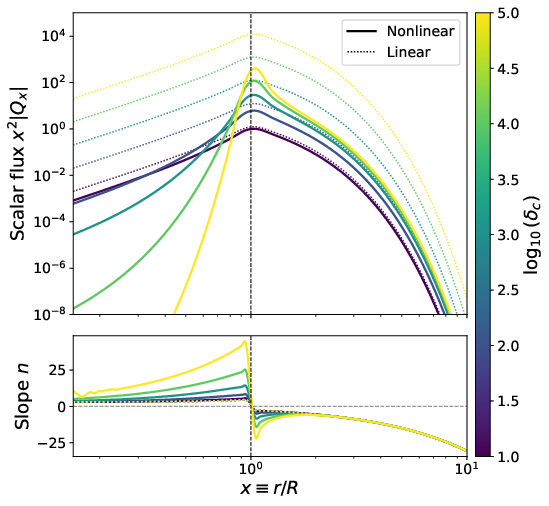
Figure 4: Chameleon regime screening diagnostics, showing suppressed scalar flux inside the thin-shell region and the corresponding αT=04 profile.
Phaedrus Mechanism: Novelty and Physical Viability
A novel regime, Phaedrus screening, is identified and analyzed for the first time in this formalism. It is driven by quadratic spatial operators—specifically αT=05 and αT=06—and produces a screening radius αT=07, such that the screened volume grows as αT=08. The screening efficiency is non-universal and depends on αT=09 coefficients. Distinct from canonical kinetic (K-mouflage) or Vainshtein regimes, Phaedrus dominance requires a suppressed linear kinetic term (small spatial sound speed). This yields a broader screening envelope, particularly for massive sources:
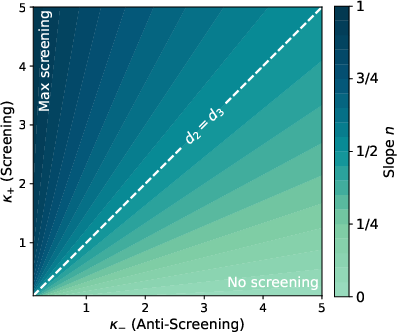
Figure 5: Dependence of the screening efficiency K(ϕ,X)0 on the ratio of K(ϕ,X)1 to K(ϕ,X)2 for Phaedrus screening.
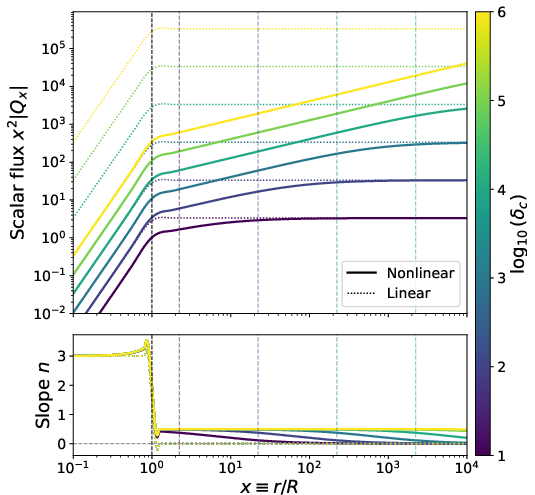
Figure 6: Numerical demonstration of Phaedrus screening for K(ϕ,X)3, highlighting the radial flux and screening slope K(ϕ,X)4.
Notably, Phaedrus may manifest as an intermediate shell between the unscreened Newtonian regime and deep-interior K-mouflage or Chameleon-dominated regions, providing a multi-layered screening envelope structure.
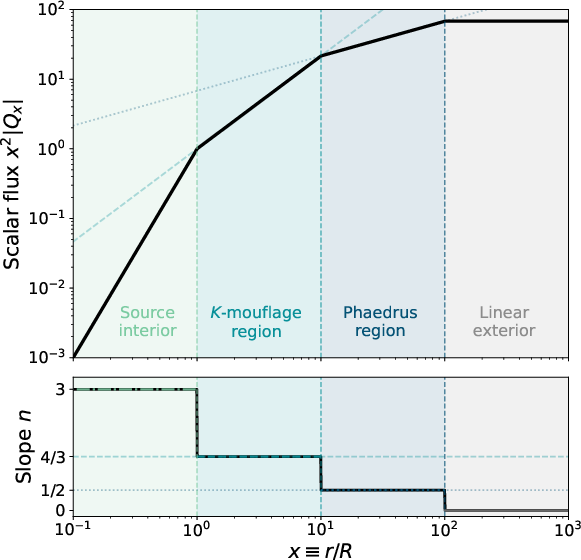
Figure 7: Illustration of hierarchical screening shells where K-mouflage and Phaedrus screening operate at different radii.
Numerical Validation
The paper introduces and employs open-source numerical tools for robust computation and convergence validation in the nonlinear regime:
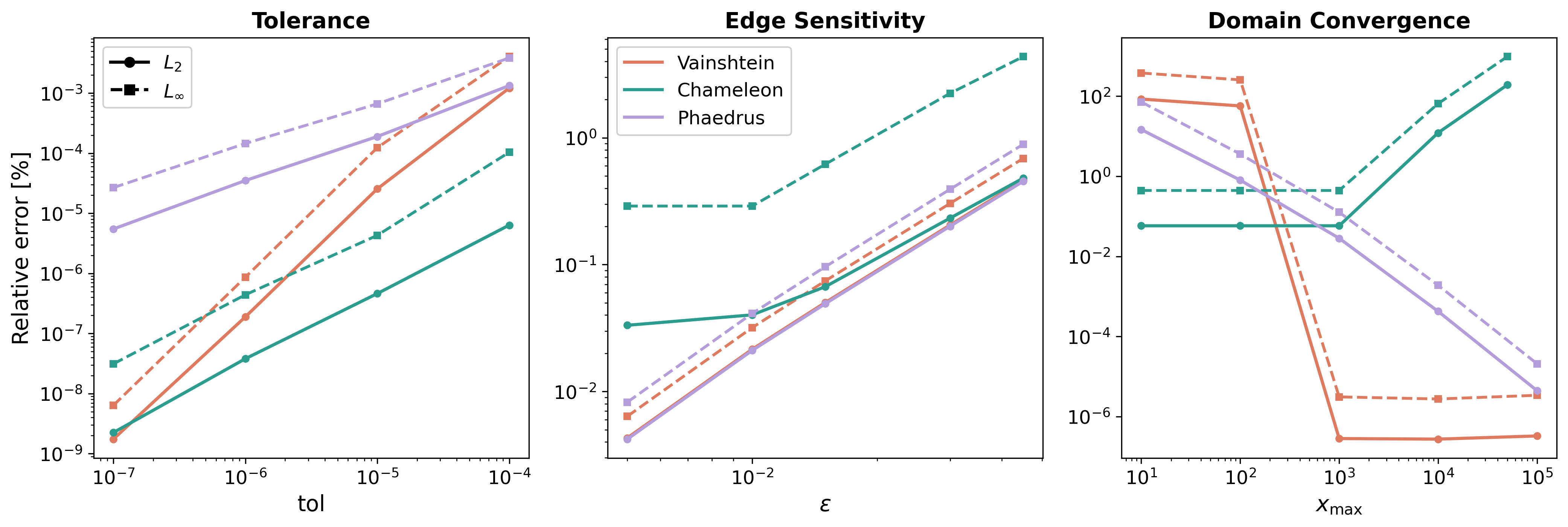
Figure 8: Relative error convergence analysis for Vainshtein, Chameleon, and Phaedrus screening solutions, demonstrating percent-level accuracy and stability under mesh, tolerance, and domain variations.
Implications and Prospects for Theory and Observation
The master screening formalism bridges the gap between abstract scalar-tensor operator structure and phenomenological consequences in cosmological and Solar System-scale experiments. Mapping the pattern of nonlinearities directly to a Lagrangian provides a starting point for systematic, theory-agnostic constraint pipelines for Stage IV surveys (Euclid, LSST). Especially, the identification of the activation condition K(ϕ,X)5 for decoupling the scalar from matter directly informs model selection.
Phaedrus screening's parameter dependence presents nontrivial prospects: If realized, its screening envelope could alter lensing, large-scale structure, and halo profiles, particularly in the outskirts of massive clusters. However, its existence is contingent on dynamical stability—specifically, the suppression of the linear spatial kinetic term does not induce gradient or ghost instabilities. This underscores the necessity of a rigorous time-dependent analysis beyond the QSA and opens vistas for further theoretical scrutiny.
On the computational side, the paper's tools are intended to seed fast approximate simulation engines (e.g., Hi-COLA) with nonlinear, Lagrangian-derived corrections, thus enabling rapid cosmological inference in complex parameter spaces.
Conclusion
This work provides a technically comprehensive, operator-level framework for identifying, analyzing, and classifying screening in scalar-tensor modified gravity, explicitly within the luminal Horndeski sector. The derivation and implementation of the master screening equation and the recognition of the novel Phaedrus mechanism significantly extend the practical and conceptual toolkit for confronting gravity theories with cosmological data. Key future directions include third-order perturbative extensions to capture additional screening mechanisms, detailed dynamical stability analyses of Phaedrus screening, and integration into high-throughput K(ϕ,X)6-body and semi-analytical cosmological pipelines.
References
- "A Master Equation for Screening in Luminal Horndeski Gravity" (2605.04154)

