- The paper provides a comprehensive multiprobe analysis combining CMB, LSS, and SN observations to constrain evolving dark energy and Horndeski-type modifications to gravity.
- The methodology integrates full-shape clustering, bispectrum, and beyond-Limber angular analyses to break parameter degeneracies and improve constraints by up to 50%.
- Results reveal a significant preference for evolving dark energy over ΛCDM with tightened EFT parameters, establishing a new benchmark for cosmological inference.
Multiprobe Constraints on Modified Gravity and Evolving Dark Energy
Introduction
This work provides a multiprobe cosmological analysis targeting the phenomenology of evolving dark energy (DE) and modifications of general relativity (GR), as parameterized within effective field theory (EFT) frameworks. By incorporating a comprehensive suite of cosmological observables—CMB temperature and polarization, CMB lensing, galaxy clustering in 3D and angular projections, integrated Sachs-Wolfe (ISW) cross-correlations, baryon acoustic oscillations (BAO), and SN Ia distances—the authors constrain both the Chevallier–Polarski–Linder (CPL) dark energy equation of state, w(z)=w0+wa(1−a), and the EFT parameters characterizing Horndeski-type deviations from GR: the Planck-mass running cM (αM) and the braiding parameter cB (αB). They emphasize the utility of full-shape clustering—including bispectrum information—and exploit cross-correlations among large scale structure (LSS), CMB temperature, and lensing, surpassing limitations of the Limber approximation in low-ℓ angular clustering.
Modeling Framework: Dark Energy and Modified Gravity
The analysis explores two primary classes of perturbative cosmological models. At the background level, DE is treated via the CPL ansatz, allowing a linear evolution in w(z). For perturbations, two mechanisms are contrasted: the phenomenological parametrized post-Friedmann (PPF) description, which is sufficiently agnostic to permit w=−1 crossing, and the physically motivated EFT of Dark Energy (EFTofDE) formulation. The latter is specialized to scalar-tensor (Horndeski) models after GW170817 constraints on cT, and parameterizes linear deviations from GR using a set of α-functions. This analysis restricts to time-dependent scalings of the form αi(a)=ci⋅ΩDE(a) for i=B,M.
The EFT parameters control the Poisson coupling μ (modifying growth of structure) and the Weyl rescaling Σ (impacting light deflection and ISW effect).
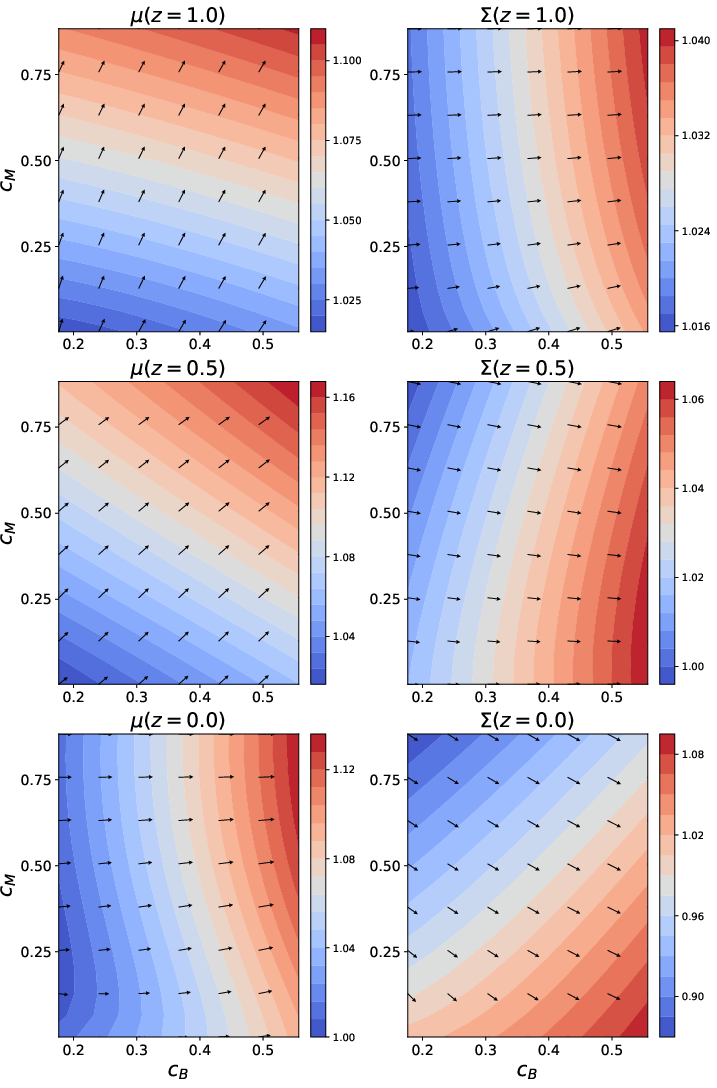
Figure 1: The response of μ and Σ to variations in cM and cB at different redshifts, with directional sensitivity switching between high and low redshifts for the two parameters.
Data Combinations and Cosmological Inference
Observational Probes
- CMB Primary and Lensing: Planck PR4 temperature, polarization, and lensing spectra, with integrated treatment of statistical covariance and systematics across spectrum and lensing likelihoods.
- Full-shape 3D Clustering: EFTofLSS-based modeling of BOSS Luminous Red Galaxies' power spectrum and bispectrum, with one-loop corrections, IR resummation, and analytic marginalization of nuisance parameters.
- Tomographic Angular Spectra: Cℓgg, Cℓκg, CℓTg, and CℓTκ, combining DESI DR9 LRGs, Planck PR4 CMB lensing, and temperature. These are computed without the Limber approximation using SwiftCℓ, which is important for leveraging multipoles ℓ<80 where Limber fails.
- Distance Probes: DESI DR2 and ext-BAO, Pantheon+ and DES Y5 supernovae.
- Cross-correlations between probes are explicitly accounted for, with rigorous treatment of covariance, removal of overlapping multipoles, and (where justified) neglect of ≲8% correlations.
Statistical Approach
MCMC inference using MontePython (and validated against Cobaya) samples cosmological and EFTofDE parameters, employing well-justified priors. All analyses account for nontrivial parameter degeneracies, especially between late-time Ωm, w0, wa, and the EFT functions, with robust convergence (Gelman-Rubin R−1<0.05).
Sensitivity of Observables to EFT Parameters
EFTofDE physics propagates non-trivially into LSS and CMB observables. μ and Σ—which mediate the modifications to growth and lensing, respectively—exhibit redshift-dependent sensitivity to cM and cB. At high z, galaxy clustering and lensing respond more to cM, while at low z cB dominates. The opposite is true for Σ, shifting the regime of maximal ISW and CMB lensing sensitivity to particular parameter subspaces.
Quantitative effects on observables are illustrated by residuals in full-shape power spectra and BAO modes under variations in cM and cB relative to ΛCDM.
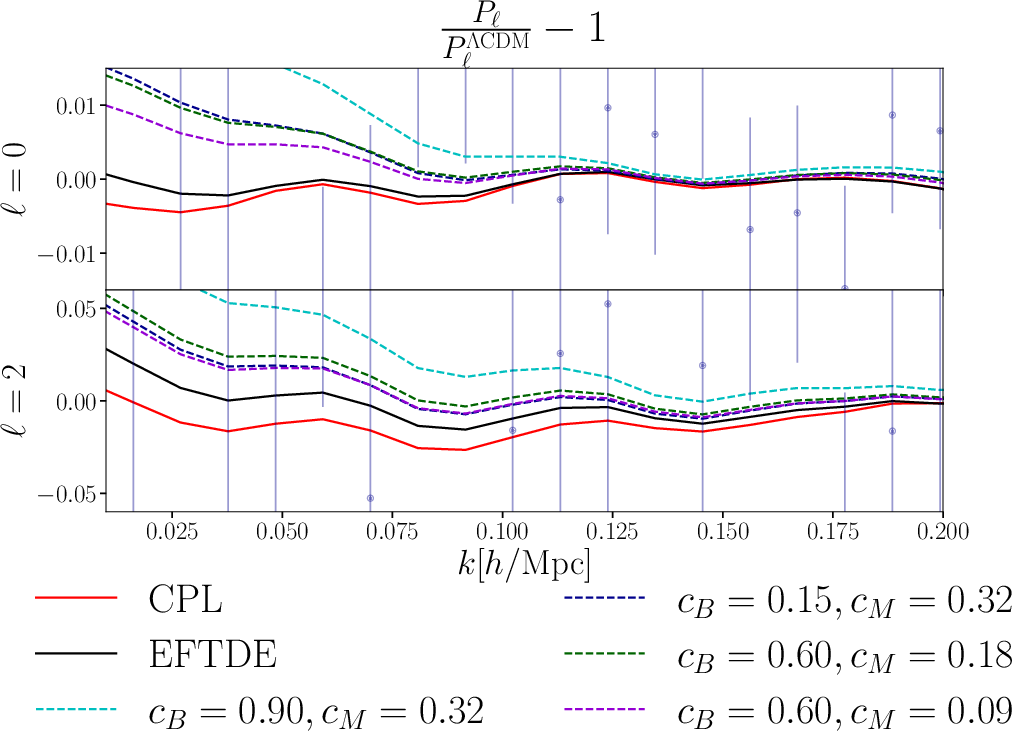
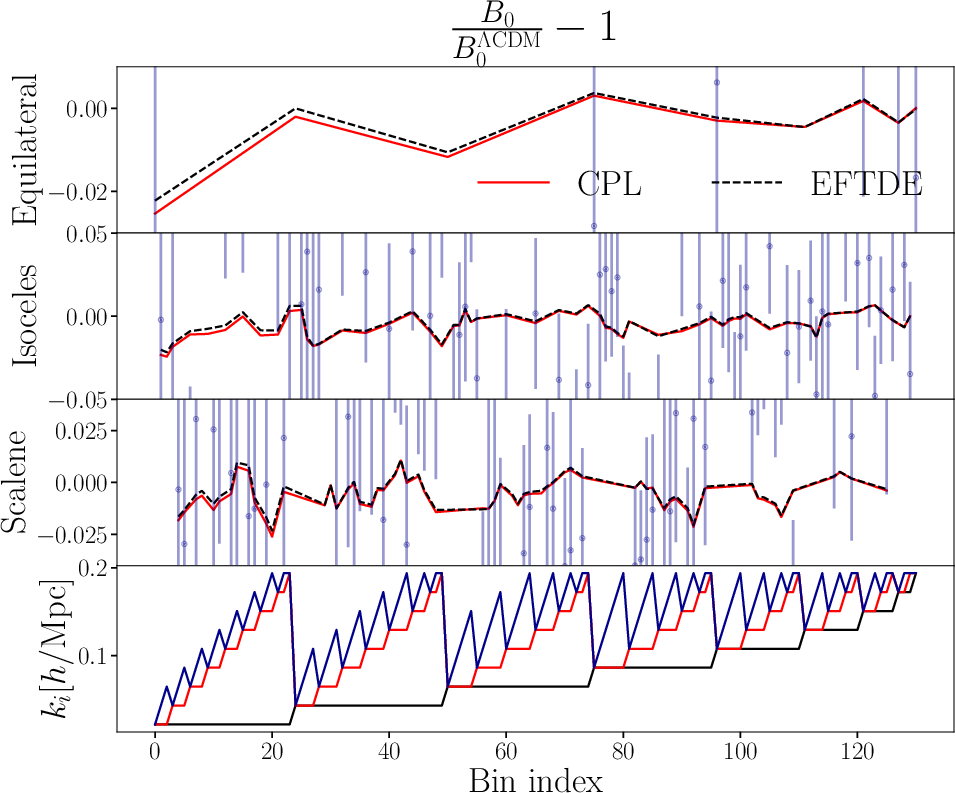
Figure 2: Residuals in BOSS power spectrum multipoles for varying cB and cM, showing amplitude modulations dependent on EFT parameters.
Multiprobe Results and Parameter Constraints
Improvements Over Baseline
The combination of probes yields several enhancements relative to vanilla CMB+BAO+SN cosmology:
- The {w0,wa} constraints improve by approximately 50% when all clustering-based and cross-correlation data are included.
- The statistical preference for evolving dark energy over Λ is elevated to 4.6σ when all probes are included, up from 3.8σ from the baseline (CMB+BAO+SN).
- Constraints on the EFT parameters cB and cM are tightened by factors of $1.4$–$1.5$; the final posteriors are cB=0.46−0.22+0.16 and cM=0.31−0.49+0.39, consistent with GR at <2σ.
- Notably, neither BAO nor SN likelihood variations—nor their removal—significantly degrade constraints on cB or cM, demonstrating that current LSS probes provide largely orthogonal information to the geometric/expansion probes for these parameters.
Degeneracy Structure and Probe Complementarity
Each probe targets a different projection of (cB,cM) space:
- EFTofLSS (BOSS): Negatively correlates cB and cM, strongly constrains cM due to cumulative growth history sensitivity.
- ISW-Lensing: Positively correlates cB and cM, sensitive to low-z Σ, imposing upper limits on cB.
- DESIcross Angular Spectra: Primarily constrains cM (through Cℓgg and Cℓκg), with CℓTg also contributing via Σ.
Only their union is capable of fully breaking parameter degeneracies endemic to EFT analyses.
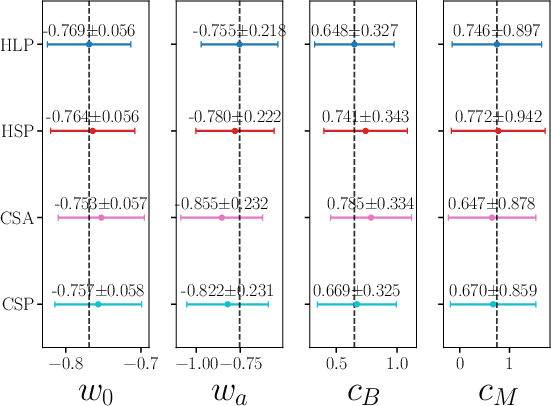
Figure 3: Constraints in the multidimensional parameter space showing degeneracy breaking and the combined tightness afforded by joint analysis.
Effect of Low-ℓ Angular Clustering
Including full integrals for angular power spectra (instead of the Limber approximation) enables the exploitation of large-scale modes. This is critical for cross-correlation observables—CℓTg in particular newly measured with SNR ~ 2—which are directly sensitive to ISW and modified lensing effects, yielding improved constraints on Σ and consequently on cB and cM.
Robustness and Tension Analysis
Different CMB power spectrum (Hillipop vs Camspec), lensing (Planck PR4 vs ACT DR6), and low-ℓ likelihoods induce small but non-negligible shifts (up to 0.4σ in w0 or cB), but the multiprobe conclusions hold under all combinations. The preference for evolving dark energy persists (reduced to 2.3σ) even in the absence of BAO and SN data, and the combination of all multiprobe data better accommodates the recent DESI DR2 BAO measurements compared to Planck ΛCDM.
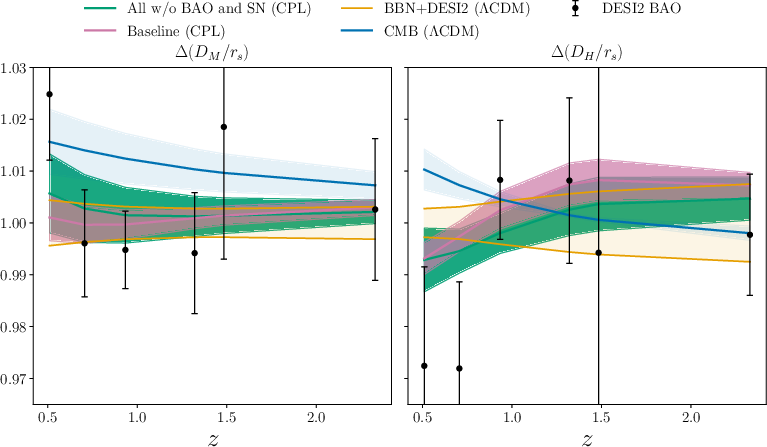
Figure 4: BAO residuals for various model and data combinations, showing the improved fit of multiprobe CPL inference over Planck ΛCDM to DESI DR2 BAO.
Conclusion
This work establishes a new benchmark for multiprobe cosmological analyses of evolving dark energy and modifications of gravity. Through careful integration of nonlinear clustering (EFTofLSS, including the bispectrum), low-ℓ angular power, cross-correlations, and classical distance measures, it demonstrates that current data deliver tight, multidimensional constraints on Horndeski-type deviations. Evolving dark energy is favored over Λ at significant confidence, and the remaining allowed space for modifications to GR, as parameterized by cB and cM, is now orthogonal to and largely independent of background expansion measurements. Results are robust under data splits, methodology choices (e.g., beyond-Limber angular analysis), and alternative BAO/SN samples.
Future extensions, including nonlinear galaxy bias modeling for angular clustering, self-consistent low-ℓ lensing covariance, and higher signal-to-noise from next-generation LSS and CMB experiments (Euclid, LSST, CMB-S4), will further improve upon the systematic and statistical precision demonstrated here. This methodology will be decisive for the next decade of parameter inference in theories beyond ΛCDM.