- The paper develops guaranteed, locally efficient a posteriori error estimators for mixed finite element discretizations, ensuring reliable error control in neutron transport simulations.
- The methodology utilizes Raviart-Thomas–Nédélec elements and advanced post-processed reconstructions to quantify residual, flux, and Robin boundary discrepancies.
- Domain decomposition and adaptive mesh refinement results demonstrate significant computational gains with reduced mesh elements in reactor core models.
A Posteriori Error Estimates for Mixed Finite Element Discretizations of Multigroup Neutron Simplified Transport Equations with Robin Boundary Condition
Overview and Motivation
The paper "A posteriori error estimates for mixed finite element discretization of the multigroup Neutron Simplified Transport equations with Robin boundary condition" (2604.02890) addresses the development of guaranteed and locally efficient a posteriori error estimators for mixed finite element discretizations of multigroup neutron simplified transport (SPN) equations. In practical neutron transport applications—particularly those concerning reactor core simulations—the SPN approximation is widely adopted due to its favorable computational properties despite lacking strict convergence to the full transport equation.
Under Robin boundary conditions (corresponding to vacuum boundaries), the analysis extends prior work on a posteriori error estimators for simpler neutron diffusion models with Dirichlet boundaries, tackling a pressing issue for reliable error control in realistic neutronics settings. The framework further generalizes to mixed boundary conditions and multi-domain (domain decomposition) settings, reflecting operational geometries in reactor simulations.
The SPN equations are derived as moment approximations to the full neutron transport equation, accommodating multigroup energy discretizations. The resulting system is a set of coupled elliptic PDEs parameterized by odd/even moments and group-dependent cross-sections. The physical coefficients are typically piecewise polynomials, reflecting heterogeneous materials in the reactor core.
The mixed formulation is introduced by augmenting the neutron flux unknowns ϕ with auxiliary vector fields q related through constitutive relations. Existence, uniqueness, and T-coercivity for the variational formulations (both continuous and discrete) are demonstrated, ensuring robust mixed finite element implementation.
Discretization employs Raviart-Thomas–Nédélec (RTN) elements, compatible with both simplicial and Cartesian meshes. The mesh structure is tailored for reactor geometries, with piecewise polynomial coefficients mapped to underlying cells.
A Posteriori Error Estimation Theory
The centerpiece is the construction of a family of variational error estimators leveraging post-processed reconstructions (either via averaging or RTN hybrid methods) of the discrete solution. Three estimator components are defined for each mesh cell and boundary facet:
- Residual Estimator: Measures non-equilibrium of reconstructed post-processed scalar fields with respect to the source term.
- Flux Estimator: Quantifies local balance errors in the vector field formulation.
- Robin Boundary Condition Estimator: Encapsulates discrepancy in Robin boundary enforcement, crucial for vacuum boundary modeling.
Reliability and efficiency of the estimators are rigorously established. Specifically, the estimators provide computable upper and lower bounds (modulo mesh shape constants and polynomial degrees) for localized error norms, confirming their suitability for adaptive mesh refinement (AMR).
Domain Decomposition and Mixed Boundary Extensions
The framework generalizes to multi-domain settings via the DD+L2 jumps method. Here, the global domain is partitioned into subdomains mapped to material interfaces, with the solution and estimators constructed per subdomain and aggregated. Necessary conditions and discrete projection operators ensure well-posedness and estimator validity in the presence of non-matching meshes and Lagrange multipliers at interfaces.
Mixed boundary conditions (Robin, Dirichlet, Neumann) are integrated into the theory, adapting the reconstruction and error norm definitions to the physical problem, ensuring comprehensive error assessment even on boundaries with heterogeneous prescriptions.
Numerical Experiments: Adaptive Mesh Refinement
Numerical investigations focus on an AMR strategy applied to a relevant 3D reactor core model inspired by benchmark scenarios. Comparative study of uniform refinement versus adaptive refinement (both mono-domain and domain decomposition) demonstrates the practical efficacy of the a posteriori estimators in guiding mesh adaptation.
Key findings are:
- Error Convergence: Domain decomposition AMR achieves significantly lower error with fewer elements compared to uniform refinement and mono-domain AMR alone.
- Estimator Decomposition: The Robin boundary estimator is shown to be non-dominant relative to interior estimators, indicating that AMR is primarily driven by solution features at material interfaces.
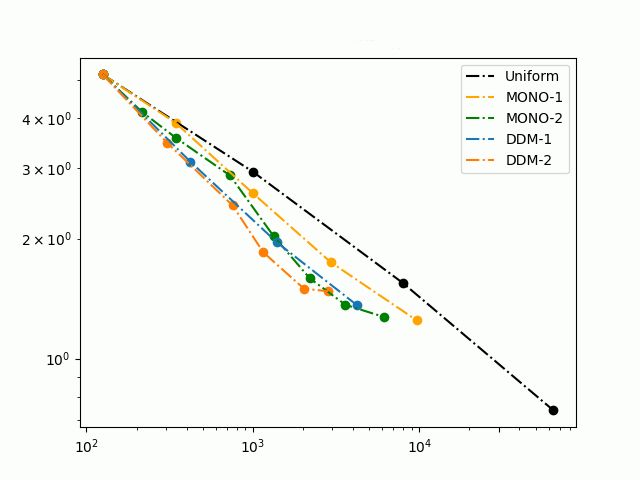
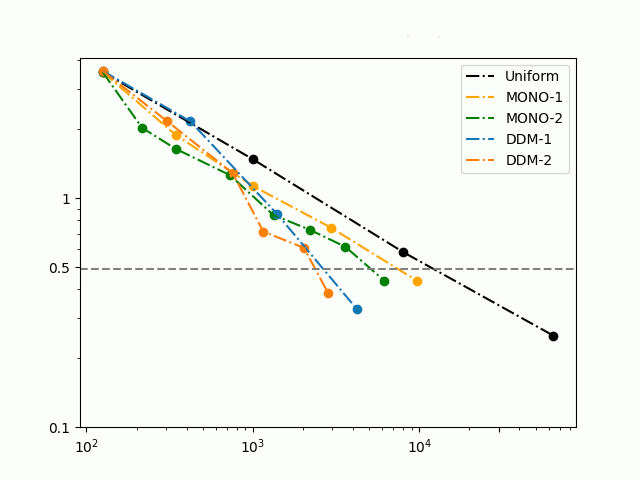
Figure 1: Relative error in the ∥⋅∥S norm (left) and maximum of the total estimator (right) as a function of the total number of mesh elements.
Mesh refinement patterns confirm that the estimators localize error near material interfaces, leveraging the physical structure for efficient resolution.
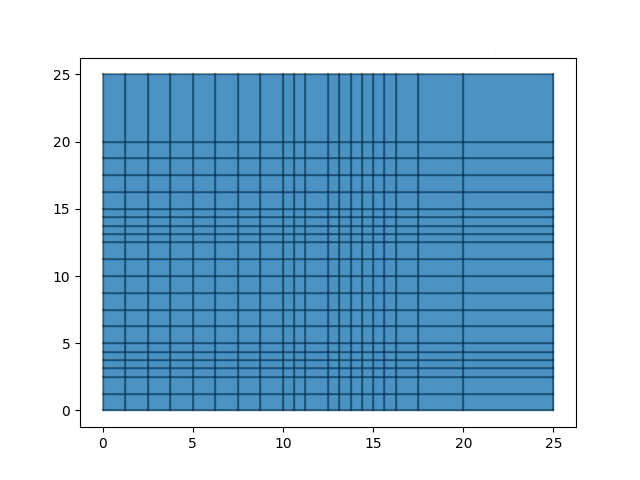
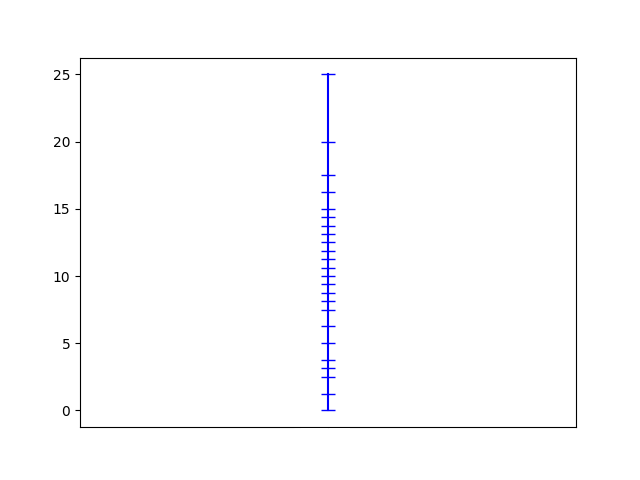
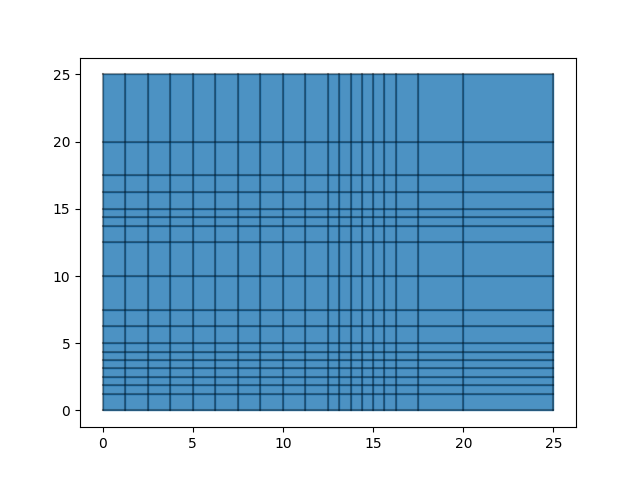
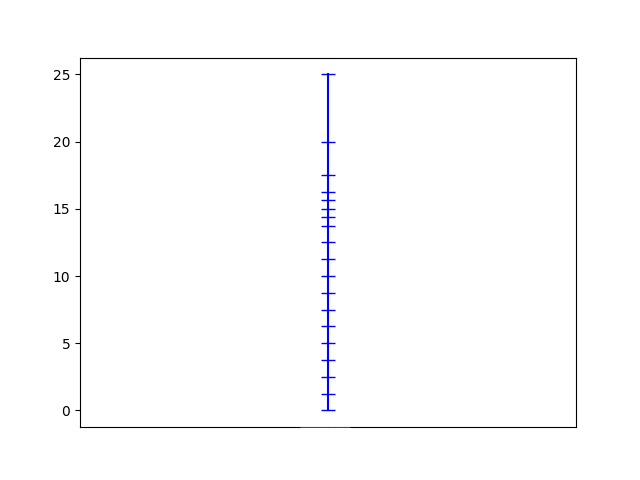
Figure 2: MONO-1: Radial mesh, illustrating localized refinement near material boundaries.
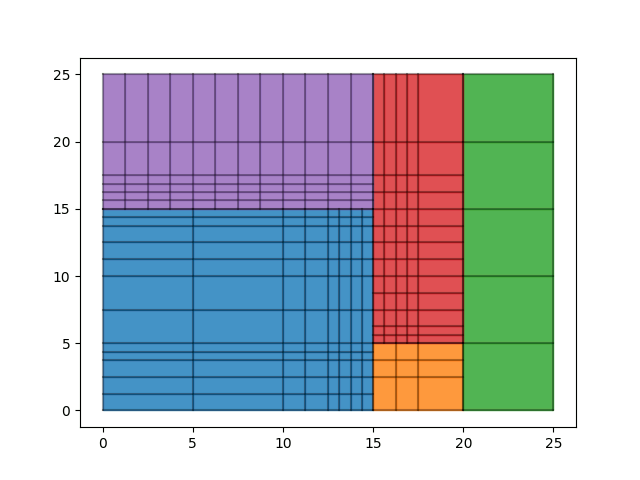
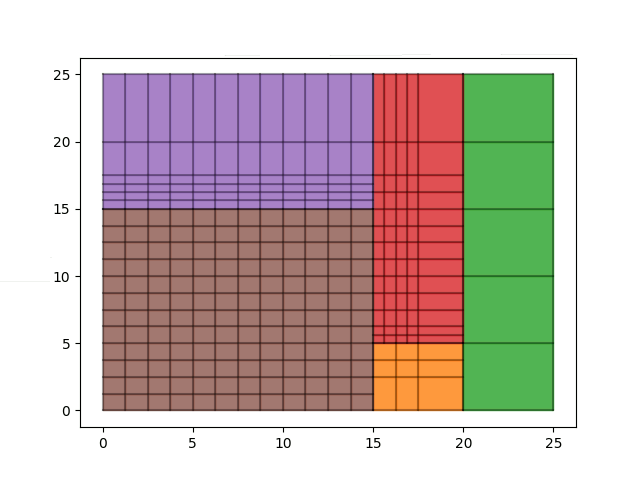
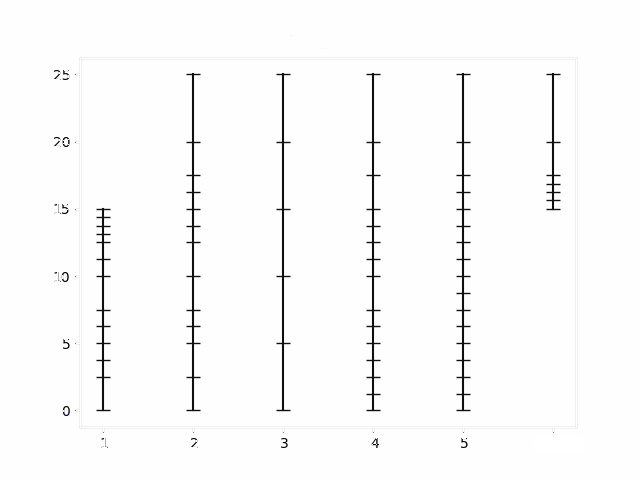
Figure 3: Radial mesh at $0 < z < 15$, domain decomposition accelerates interface-focused adaptation.
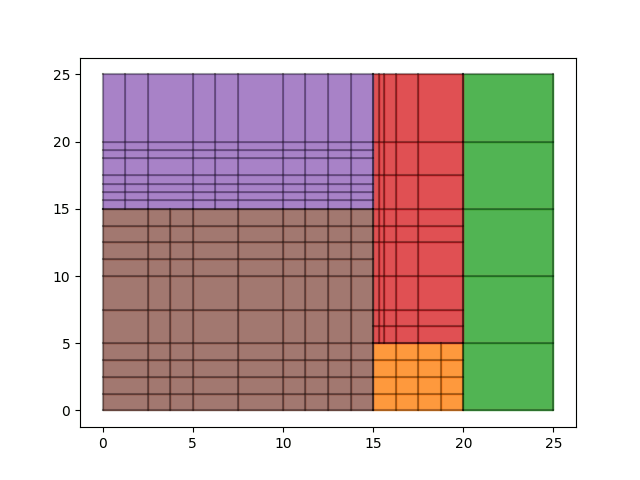
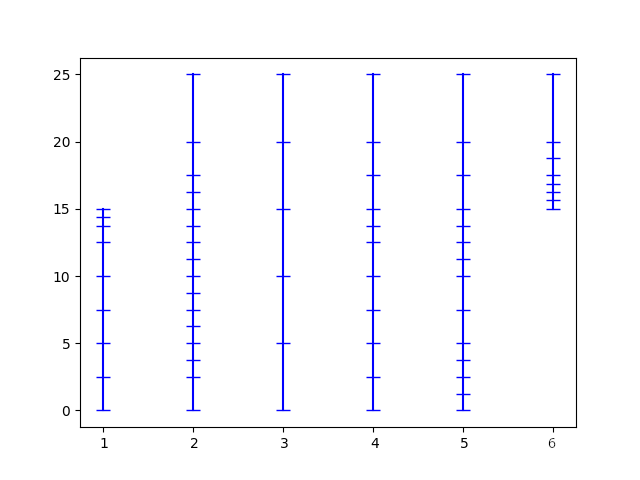
Figure 4: Radial mesh at $0 < z < 15$, further highlighting material interface-driven refinement in multi-domain AMR.
The strong numerical results exhibit:
- Reduction of mesh elements by a factor of 3–6 compared to uniform refinement for similar accuracy.
- Clear dependence of refinement intensity and convergence rate on AMR parameters (SPN0), corroborated by estimator sensitivity studies.
- Subdomain-wise convergence metrics in multi-domain AMR, confirming targeted refinement in critical core regions.
Implications and Future Directions
Practically, the developed estimator framework enables robust, cost-efficient mesh adaptivity in high-fidelity reactor simulations under realistic boundary conditions. The modular estimator design and domain decomposition compatibility augur well for scalable parallel implementations.
Theoretically, the rigorous reliability and efficiency results set a foundation for further generalizations, including more complex transport models and uncertainty quantification under heterogeneous, possibly random, material properties.
Anticipated developments include:
- Integration with higher-order RTN elements for enhanced accuracy.
- Incorporation of eigenvalue solvers for criticality analysis.
- Advanced AMR strategies leveraging estimator hierarchy for multi-physics problems.
Conclusion
This work articulates a comprehensive theory of locally efficient, reliable a posteriori error estimation for mixed finite element discretizations of multigroup neutron simplified transport equations with Robin boundary conditions. Adaptation to multi-domain and mixed boundary problems ensures wide applicability in nuclear engineering. Numerical validation confirms significant computational gains and estimator-driven refinements. The methodology is readily extensible and will inform future advances in reactor modeling, parallel adaptivity, and multi-physics error control.

