- The paper establishes a novel adaptive algorithm that unifies mesh refinement with GMRES iteration for non-symmetric elliptic PDEs.
- It proves full, unconditional R-linear convergence of a computable quasi-error, ensuring robust performance independent of mesh size and polynomial degree.
- The method achieves optimal computational complexity, with numerical experiments validating near-linear cost scaling relative to degrees of freedom.
Introduction
The paper "Adaptive finite element methods with optimally preconditioned GMRES guarantee optimal complexity" (2604.17947) establishes a rigorous theoretical foundation for the combination of adaptive finite element methods (AFEMs) with preconditioned Generalized Minimal Residual (GMRES) algorithms, specifically for the efficient and reliable solution of general, possibly non-symmetric, second-order linear elliptic partial differential equations (PDEs) within the Lax–Milgram setting. The methodology addresses a major challenge in AFEM complexity theory: the necessity for robust, mesh- and polynomial-degree-independent algebraic solvers ensuring convergence and optimal computational scaling, beyond the symmetric problem class addressed in prior literature.
Key contributions of the paper include the development of a new adaptive algorithm unifying mesh refinement and iterative linear algebra, proof of full, unconditional R-linear convergence of a computable quasi-error, and demonstration of optimal convergence rates relative to computational complexity, subject to pragmatic and computable parameter selection. The algorithmic structure incorporates a posteriori feedback mechanisms controlling both mesh adaptivity and algebraic iteration, and is validated numerically for convection-dominated, non-symmetric model problems.
Theoretical and Algorithmic Framework
Variational and Discretization Setting
A prototypical convection-diffusion-reaction problem on a polyhedral Lipschitz domain is considered, with arbitrary space dimension d. The variational formulation employs the space X=H01(Ω), and the core bilinear form includes arbitrary (possibly non-selfadjoint) drift and reaction terms, ensuring coercivity and boundedness under standard conditions on the coefficients. The finite element discretization is set within a standard, nested, piecewise polynomial framework on adaptively refined meshes, constructed by newest vertex bisection (NVB).
Residual-Based A Posteriori Estimation
The formulation employs standard element- and facet-based residual estimators, with proven satisfaction of the adaptivity axioms: stability (A1), error reduction (A2), global and local reliability (A3, A3+), and quasi-monotonicity (QM). These estimator properties are critical for ensuring the theoretical validity of adaptive marking and mesh-refinement strategies.
Preconditioned GMRES for Non-Symmetric Systems
For the non-symmetric, discretized linear systems, the authors deploy a left-preconditioned GMRES scheme with optimal additive Schwarz or symmetric multigrid preconditioners. These preconditioners are proven to yield mesh- and degree-robust norm equivalence to the continuous energy norm and enable linear-complexity application. The preconditioned system is solved using a restarted GMRES with an a posteriori termination criterion, measuring the preconditioned residual norm. The authors rigorously establish a contraction estimate for the preconditioned GMRES in the preconditioner-weighted norm, independent of h and p (polynomial degree), via spectral equivalence bounds.
Main Results: R-linear Convergence and Optimal Complexity
Adaptive Algorithm with Algebraic Feedback Control
A central innovation is the adaptive algorithm that steers both the local mesh refinement and the GMRES solver termination threshold via a-posteriori error control. The solver-termination parameter is adaptively updated to balance discretization and algebraic errors, monitored through a computable quasi-error (the sum of the estimator and the preconditioned residual norm). This is a significant departure from prior approaches that used nested iterations or parameter settings that could, in pathological cases, fail to guarantee convergence.
Unconditional Full R-Linear Convergence
Through analytic reduction to a summability problem for the quasi-error sequence, and by leveraging estimator properties, quasi-orthogonality, and GMRES contraction, the paper proves the unconditional, full R-linear convergence of the computed solution. In particular, the quasi-error decays at a geometric rate independent of mesh-resolution and adaptivity parameters, thus ensuring numerical robustness and solver scalability.
Optimal Complexity Relative to Degrees of Freedom and Cost
The authors rigorously connect R-linear convergence to the optimality class framework familiar in adaptive approximation theory. They demonstrate that, under a sufficiently small marking parameter and algebraic tolerance, the adaptive algorithm achieves the best possible (instance-optimal) convergence rate with respect to both the number of degrees of freedom and the total computational cost, as measured by the cumulative number of unknowns solved across all refinement and solver steps.
Numerical Rates and Complexity
The theoretical results are directly validated by computational experiments:
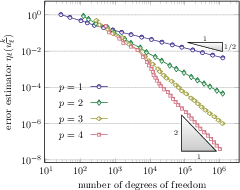
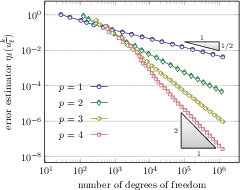
Figure 1: Rate-optimality of the adaptive algorithm in terms of degrees of freedom for various PGMRES restart lengths.
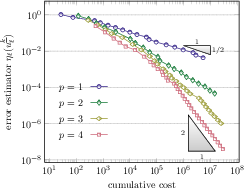
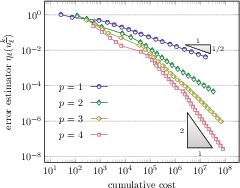
Figure 2: Cost-optimality with respect to global computational effort matches the admissible nonlinear approximation rates.
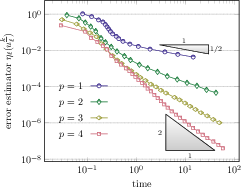
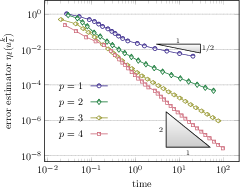
Figure 3: Measured wall-clock time displays near-linear cost scaling with optimal convergence in the adaptive loop.
The experiments also illustrate robustness to the number of GMRES restarts, demonstrating minimal degradation in convergence even when using single-step restarts (kmax=1).
Adaptive Parameter Control and Solver Behavior
A salient methodological feature is the algorithmic feedback for the solver tolerance and estimator constants, ensuring finite adaptation and enabling practical initialization without sensitivity to parameter mis-selection. Numerical results confirm that the adaptive parameter update is stable and requires only a bounded number of corrections, independent of mesh size or polynomial degree.
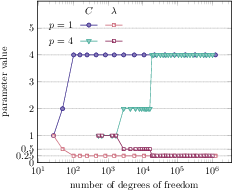
Figure 4: Evolution of solver and marking parameters across refinement levels for various polynomial degrees, exhibiting robust and finite adaptation.
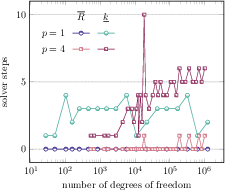
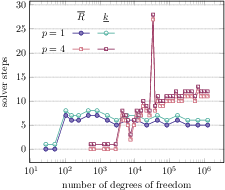
Figure 5: Relationship between number of GMRES steps and restarts, highlighting the trade-off in restart length versus total algebraic effort.
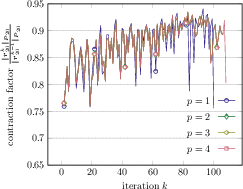
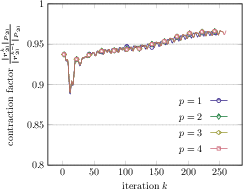
Figure 6: Contraction factors of the preconditioned residual as a function of iteration and restart, demonstrating robust decay across polynomial degrees.
Furthermore, the contraction analysis extends to the continuous energy norm, with numerical evidence showing that algebraic error reduction remains effective and even surpasses theoretical contraction bounds in practice, especially under longer Arnoldi iterations.
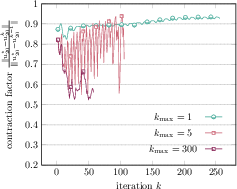
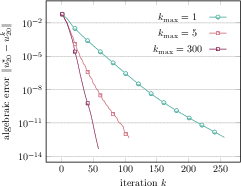
Figure 7: Algebraic error decay in the energy norm for high-order polynomial approximations under different restart strategies.
Implications and Future Directions
The framework provides a unified and fully rigorous justification for the integration of AFEM with preconditioned GMRES (and, by extension, other Krylov methods) for general, non-symmetric, second-order elliptic PDEs. Notably, the unconditional convergence and optimal complexity results encompass the nonsymmetric setting without requiring nested nonlinear solvers or delicate parameter tuning, extending the scope of provably optimal AFEM to a much broader class of practical problems.
From a practical standpoint, the adaptive feedback mechanism ensures operational robustness, removes the burden of manual error balancing, and enables efficient, scalable implementations suitable for high-performance and parallel computing environments.
On the theoretical front, the authors’ methodology could inform further research into nonlinear and time-dependent PDEs, the treatment of indefinite or nearly singular problems, and the extension to non-Hilbertian settings (e.g., saddle-point problems or systems of PDEs with structure beyond Lax–Milgram). Moreover, the interleaving of adaptive mesh refinement with advanced iterative linear solvers may serve as a template for future developments in multilevel and domain decomposition algorithms.
Conclusion
The paper presents a comprehensive and rigorous analysis of adaptive finite element methods coupled with optimally preconditioned GMRES for the solution of general second-order linear elliptic PDEs, guaranteeing unconditional convergence and optimal computational complexity. The theoretical advancements—particularly in a-posteriori-driven solver control and robust complexity bounds—significantly expand the versatility and reliability of AFEMs for challenging, non-symmetric problems.
The presented algorithms and theoretical insight provide a clear pathway for both practical implementation in large-scale simulation codes and further methodological advances in adaptive numerical PDE methods.