- The paper's main contribution is the development and analysis of a Hybrid Mixed Domain Decomposition method that uses stabilization terms to enable explicit domain coupling.
- It rigorously proves well-posedness and establishes uniform error bounds in τ, with optimal convergence rates of order h^(q+1) for the primal and hybrid variables.
- Numerical experiments validate the approach on Poisson’s equation, demonstrating robust performance on both matching and non-matching meshes with variable coefficients.
Hybrid Mixed Domain Decomposition: A Variational and Numerical Analysis
Problem Setting and Motivation
The paper "On a Hybrid Mixed Domain Decomposition Method" (2604.22543) develops and analyzes a finite element domain decomposition approach for elliptic PDEs, leveraging advances from hybridized discontinuous Galerkin (HDG) methods. The central motivation lies in the interface treatment between non-overlapping subdomains—but instead of classical approaches, the Hybrid Mixed Domain Decomposition (HMDD) method incorporates stabilization terms à la Lehrenfeld-Schöberl, extending the classical mixed formulation by enabling explicit domain coupling. This allows for both optimal convergence and the possibility of applying the method to matching or non-matching meshes and variable coefficients.
The work's focus is on Poisson’s equation with homogeneous Dirichlet boundary data, re-cast in a mixed form using a flux variable. The formulation aims to combine the reduced global coupling, positive definiteness, and efficient Schur-complement properties of hybridized schemes with the flexibility and rigor of mixed finite elements.
The computational domain Ω is partitioned into non-overlapping subdomains. The interface Γ between neighboring subdomains (the skeleton) plays a key role. The hybrid variable μ represents the trace of the primal variable u on Γ (Figure 1).
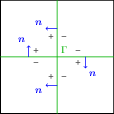
Figure 1: Exemplary depiction of the domain Ω decomposed into four disjoint subdomains. Green lines denote the interface Γ; blue arrows are arbitrary but fixed normal directions.
Inside each patch, a standard mixed formulation is used: find (q,u,μ) such that
κ−1q−∇u=0 in Ω∖Γ, −div q=f in Ω∖Γ,
and coupling on Γ is imposed weakly via stabilization and hybrid variables.
A key feature is the use of stabilization parameter Γ0, controlling the strength of penalty on primal trace jumps across Γ1. This recovers classical methods (e.g., Raviart-Thomas hybrid mixed as Γ2 and CG as Γ3), but for Γ4, it enables non-conforming meshing.
Variational and Discrete Setting
The authors provide a rigorous variational formulation, using duality products and carefully constructed function spaces (notably, Γ5 for the primal variable, and Γ6 for the flux). These spaces allow for Γ7-based distributions both in the subdomain interiors and on the skeleton, weighted appropriately by Γ8. The norm and decomposition structure ensure robust inf-sup stability independent of the choice of Γ9.
In the finite element setting, subdomain spaces use Raviart-Thomas elements for the flux, standard polynomials for μ0 and the hybrid variable, and approximate traces on μ1 are handled via μ2 projection.
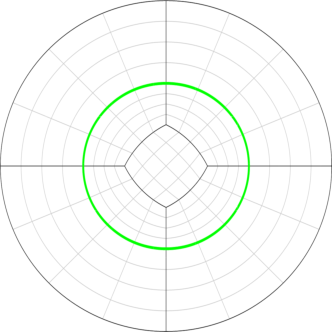
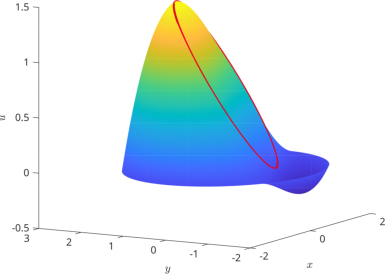
Figure 2: Computational domain μ3 and reference solution component μ4.
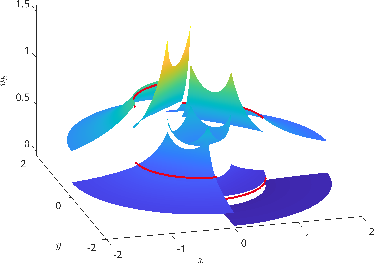
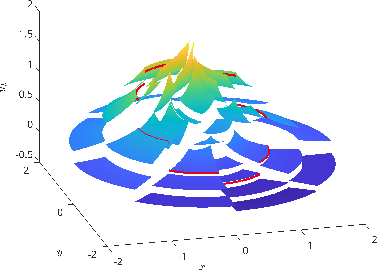
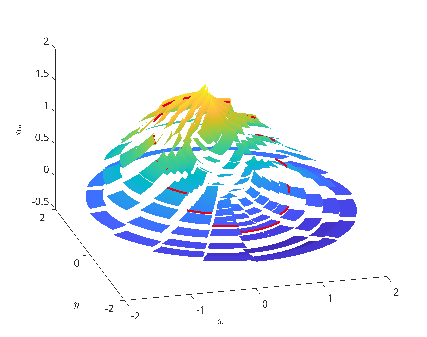
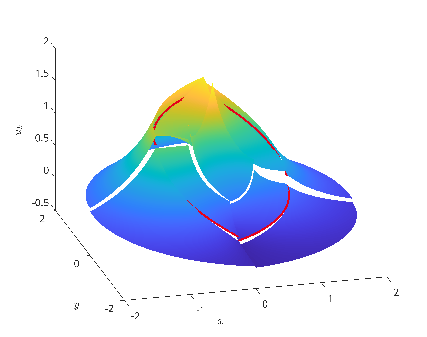
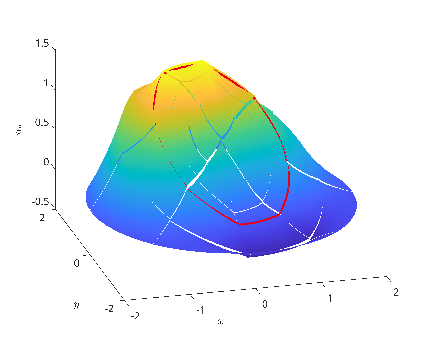
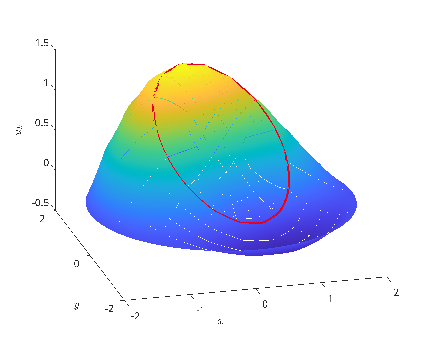
Figure 3: Numerical solution μ5 and μ6 (red lines) at polynomial order μ7 (upper) and μ8 (lower) for increasing mesh refinement.
Theoretical Analysis
Well-Posedness
A major theoretical achievement is the proof of well-posedness uniformly in μ9. Through a detailed inf-sup theory, the authors show that the coupled system is stable for all u0, matching mixed finite element stability arguments. The analysis extends naturally to high-order finite elements and curved meshes.
Error Analysis
The discretization error is bounded explicitly in terms of u1 (mesh size), u2 (polynomial order), u3, and solution regularity: u4
for sufficiently regular u5. Similar error bounds are established for flux and divergence errors, demonstrating that for moderate u6, optimal u7 convergence rates are observed—independent of the stabilization.
Notably, the error is uniformly bounded in u8, and observed rates for the primal and hybrid variables remain u9 even for large Γ0. For the flux variable, the rate is Γ1 asymptotically as Γ2 or Γ3 varies.
Numerical Experiments
A comprehensive numerical study validates the theoretical predictions. The test case features a radially symmetric domain with an interface at the unit circle and material jump. Polynomial orders Γ4 and Γ5 were tested across several mesh resolutions and a wide range of stabilization parameters Γ6.
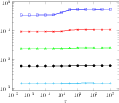
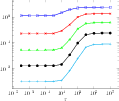
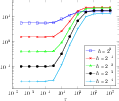
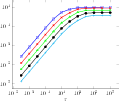
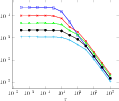
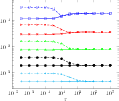
Figure 4: Γ7 error in Γ8 as a function of Γ9 for order Ω0.
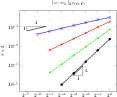
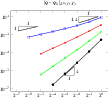
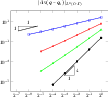
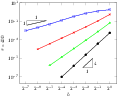
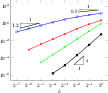
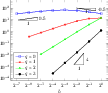
Figure 5: Error plots for Ω1, Ω2, and Ω3 across Ω4, as Ω5 varies for Ω6.
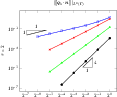
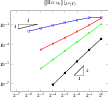
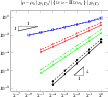
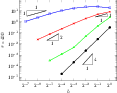
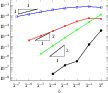
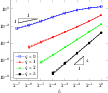
Figure 6: Error plots for the flux variable on Ω7: normal component Ω8, primal jump Ω9, and hybrid error, for Γ0 and different Γ1.
Key empirical findings:
- For fixed Γ2, all error measures remain bounded for large Γ3, confirming independence from stabilization magnitude.
- Both Γ4 and Γ5 consistently show optimal convergence rates of Γ6 with respect to Γ7, robust to Γ8.
- The flux and its divergence show intermediate rates that transition depending on Γ9 and (q,u,μ)0—matching analysis.
The authors systematically investigate both (q,u,μ)1- and (q,u,μ)2-asymptotic regimes, clarifying convergence behavior in all relevant parameter limits.
Implications and Future Directions
This work establishes a robust theoretical and numerical foundation for HMDD as a versatile domain decomposition approach for mixed formulations. The flexibility of (q,u,μ)3 enables straightforward application to non-matching grids (mortar methods), higher dimensions, and more general PDEs (e.g., Maxwell or Helmholtz equations).
Potential directions include:
- Extending the variational analysis to general non-matching grids and multipatch isogeometric discretizations.
- Exploiting the positive-definite, sparsified Schur complement structure for efficient solver design.
- Applying the framework to more complex coupled field problems and time-dependent PDEs.
The variational underpinning also opens the door to rigorous mortar-like coupling of multi-physics and multi-mesh simulations.
Conclusion
The HMDD method represents a theoretically well-founded, high-order accurate approach to domain decomposition for mixed formulations of elliptic problems, unifying and extending previous hybrid and hybridized Galerkin ideas. Its robustness with respect to stabilization, rigorous error analysis, and empirical validation set the stage for broad applicability in large-scale and geometrically complex PDE simulations.

