A robust a posteriori error estimator for the Oseen problem
Published 25 Apr 2026 in math.NA | (2604.23453v1)
Abstract: A residual-based a posteriori error estimator is proposed for the incompressible Oseen problem in the convection-dominated regime. The SUPG/PSPG/grad-div stabilized finite element method is used as discretization. The error estimator estimates the global error in a norm that is used in the a priori error analysis of the method. Based on several hypotheses concerning the error and interpolation errors, the robustness of the estimator in the convection-dominated regime is proved. Numerical studies support the analytic results. Finally, the extension of the a posteriori error estimator to the steady-state Navier--Stokes equations is discussed.
The paper introduces a novel residual-based error estimator that guarantees robustness for the convection-dominated Oseen problem.
It employs SUPG/PSPG/grad-div stabilized finite element methods to precisely control spurious oscillations and enforce mass conservation.
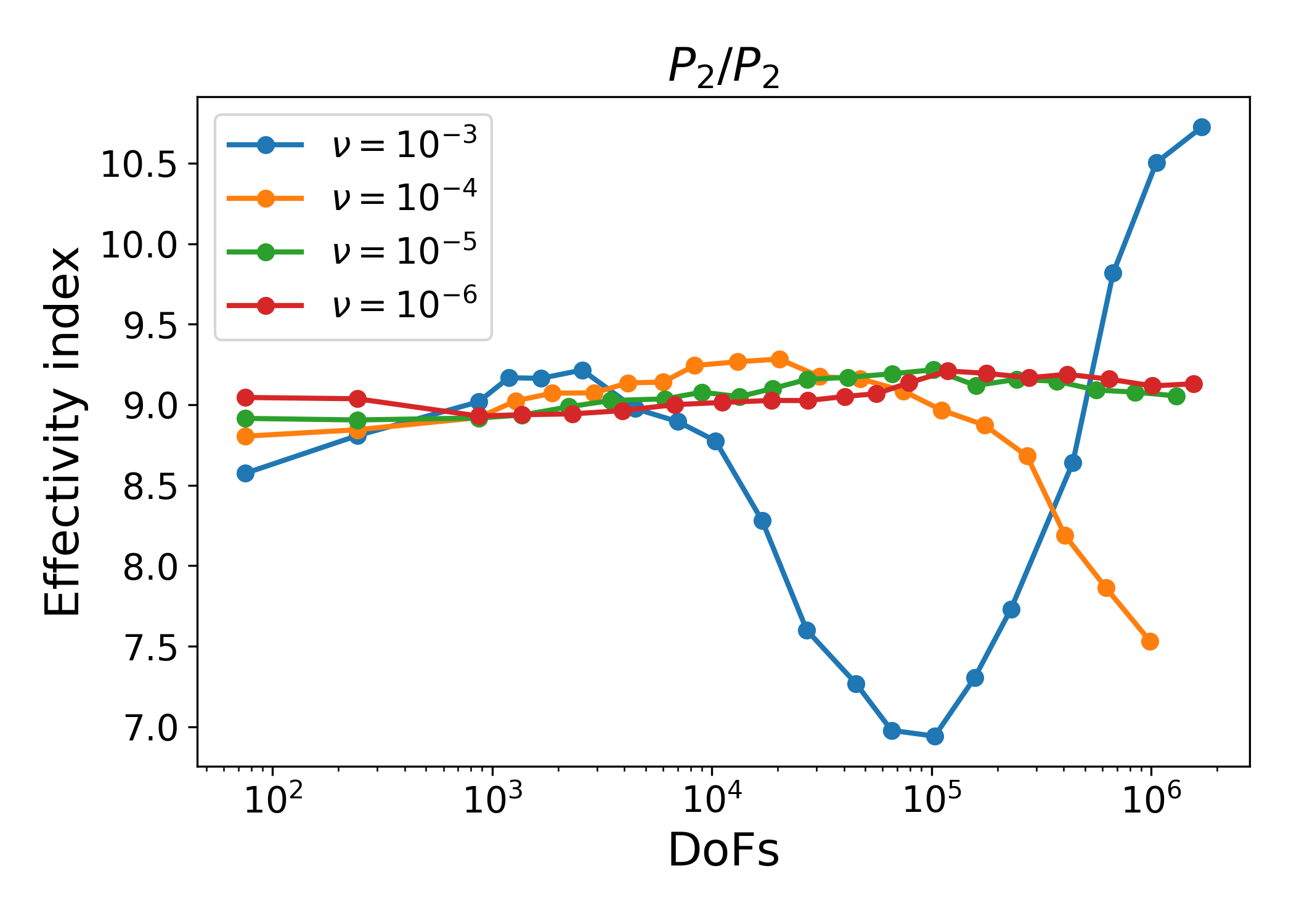
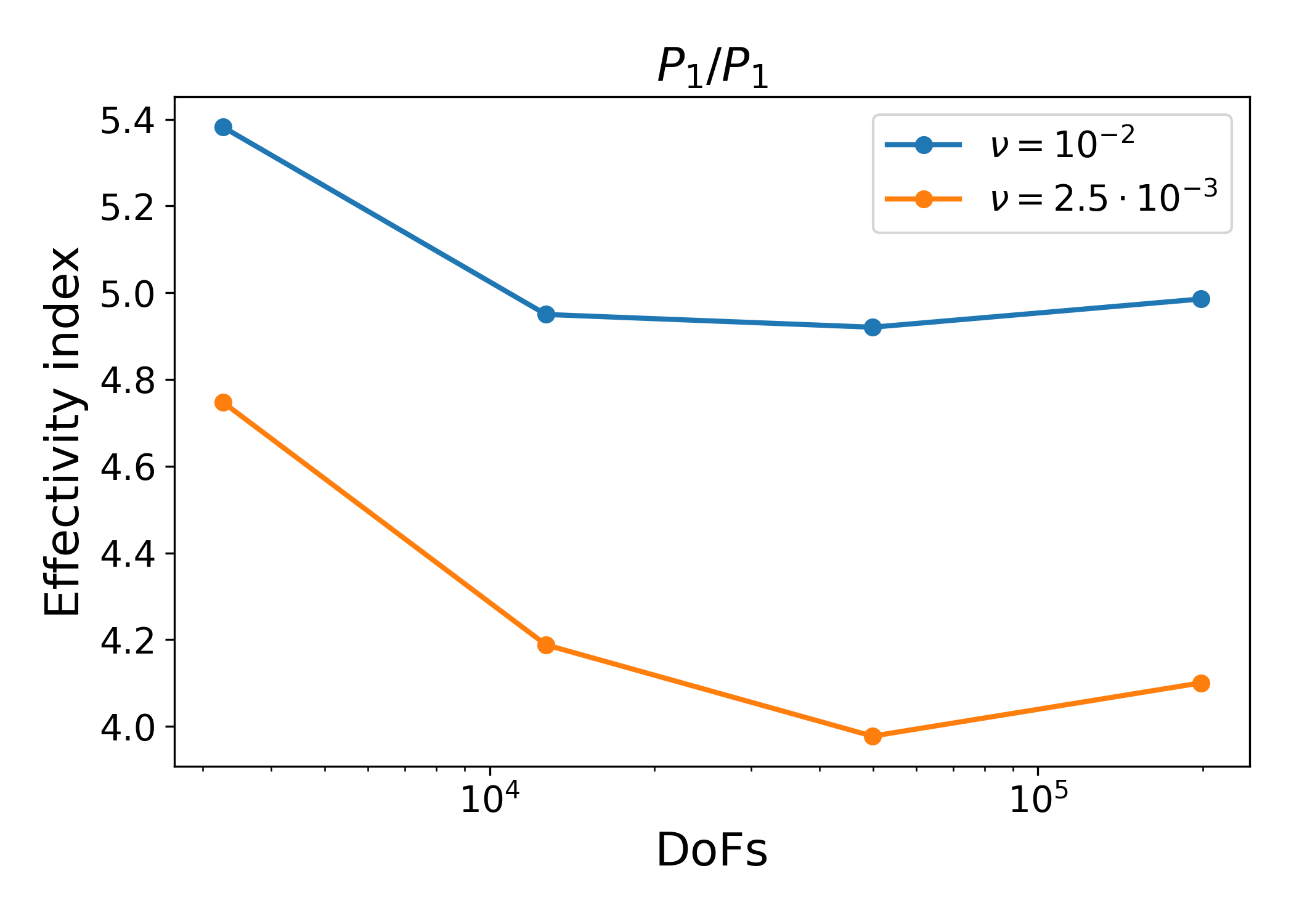
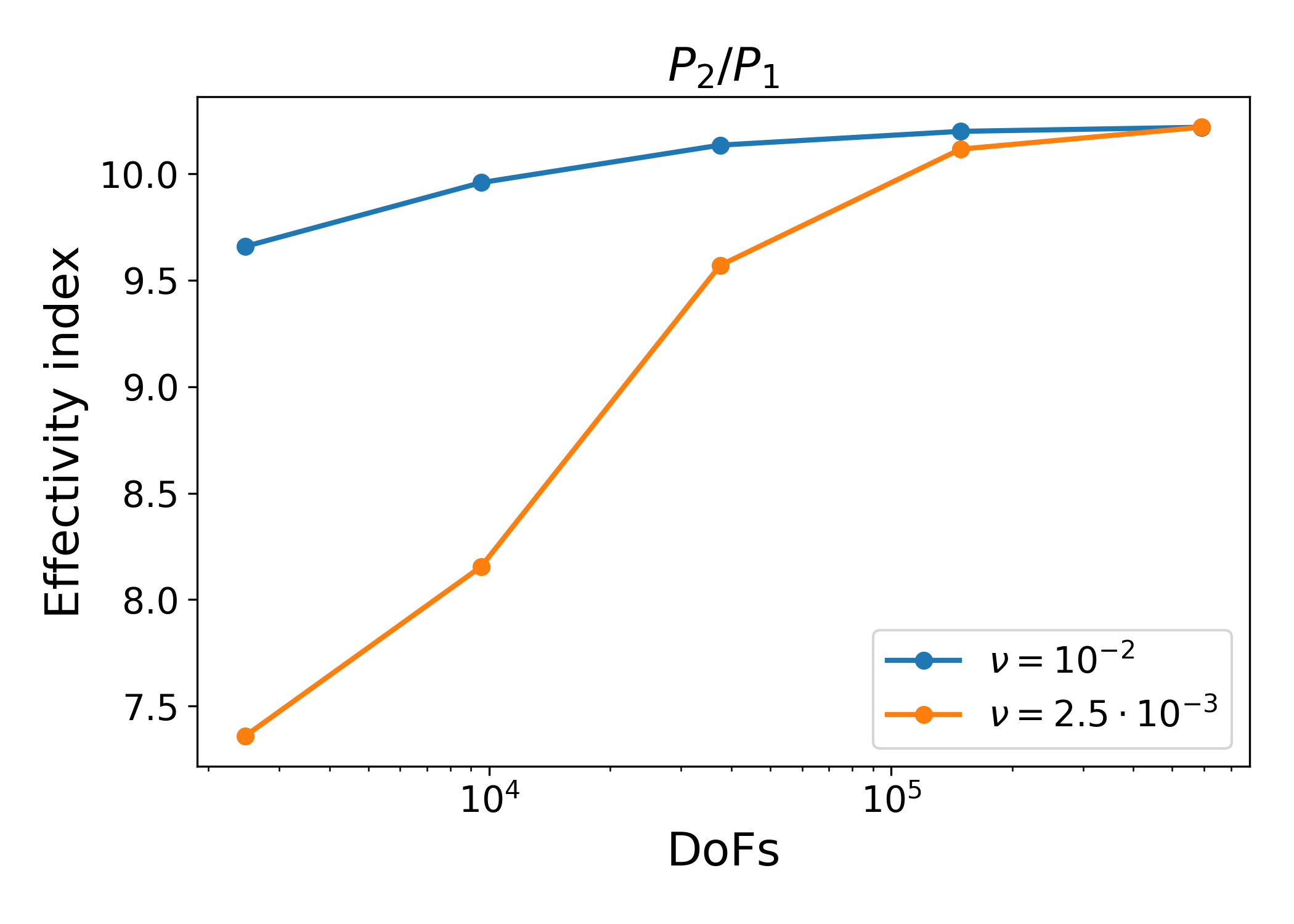
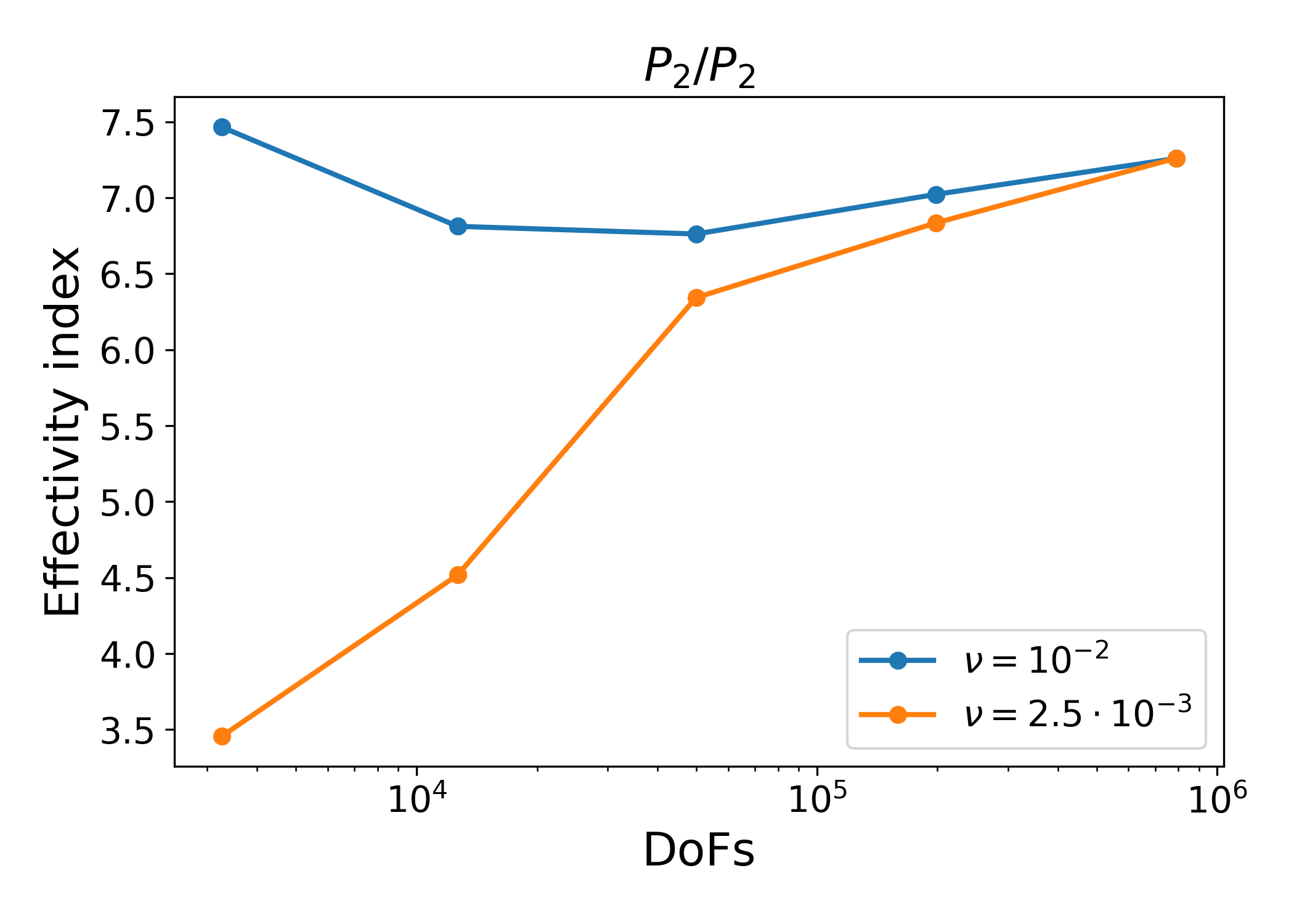
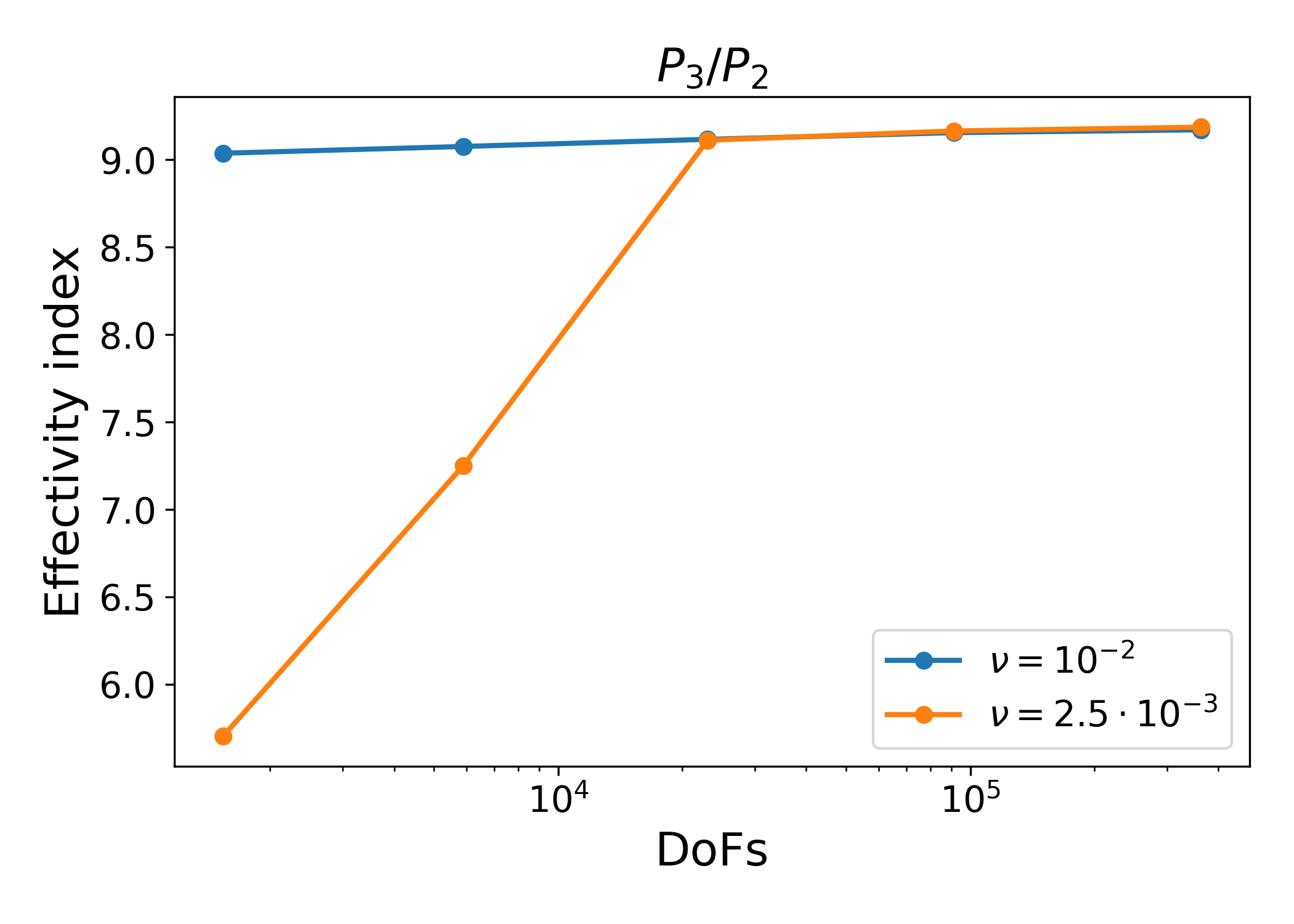
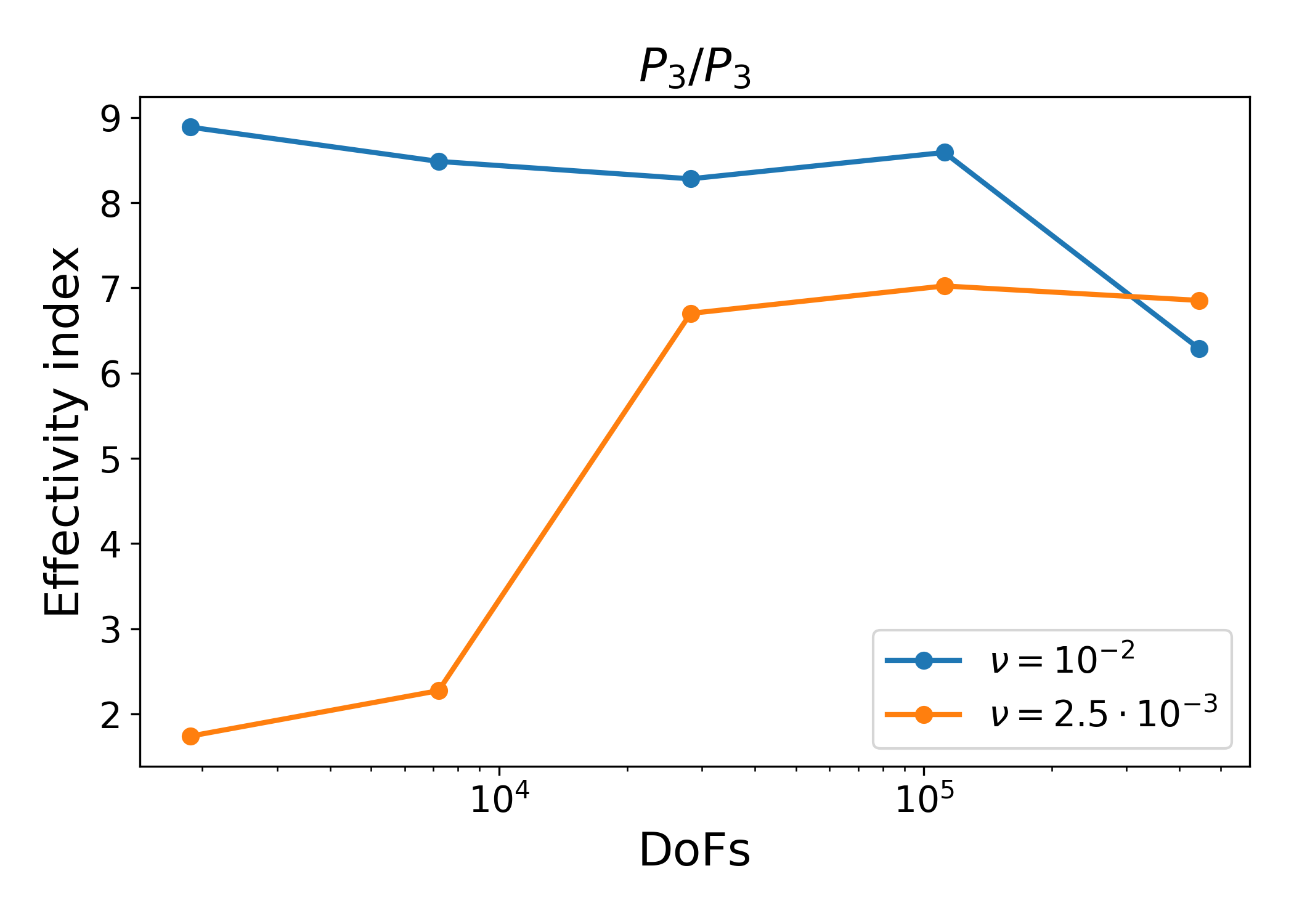
Numerical tests reveal an effectivity index near 9, confirming the estimator’s reliability across varying viscosities and discretizations.
Robust Residual-Based A Posteriori Error Estimation for the Oseen Problem
Introduction and Motivation
This paper establishes a rigorous framework for the construction and analysis of a robust residual-based a posteriori error estimator for the stationary (incompressible) Oseen problem. The Oseen equations serve as a linearized model for incompressible Navier–Stokes equations and are foundational in computational fluid dynamics, particularly in iterative solvers for time-dependent flows. The focus is the convection-dominated regime (ν≪∥β∥L∞), where conventional discretizations often fail due to unresolved multiscale features and boundary layers.
To address these challenges, the SUPG/PSPG/grad-div stabilized finite element method is employed. Stabilization is necessary to suppress spurious oscillations and enforce mass conservation, especially at high Reynolds numbers. The paper targets the derivation of a posteriori error bounds in a mesh-dependent norm utilized in the a priori analyses of the underlying stabilized methods, guaranteeing robustness with respect to vanishing viscosity. The extension to the steady-state Navier–Stokes equations is also discussed.
Methodology and Theoretical Foundations
The weak formulation and discretization are specified for the Oseen problem, where the velocity and pressure are approximated in conforming finite element spaces. Stabilization parameters for SUPG, PSPG, and grad-div terms are chosen according to established asymptotic rules, with distinctions drawn between inf-sup stable pairs (e.g., Taylor–Hood spaces) and equal-order pairs.
A new residual-based error estimator is constructed:
The global error is measured in a combined "spg" norm, which accounts for standard energy terms (ν∥∇⋅∥), stabilization contributions, and pressure regularization.
Mesh cell and facet residuals are rigorously defined, and the estimator aggregates their contributions according to minimax scaling dictated by the PDE coefficients and stabilization parameters.
Key technical hypotheses relate interpolation errors to the finite element error, ensuring the estimator's reliability even when discrete pressure jumps are eliminated by using continuous pressure spaces. The estimator targets the same mesh-dependent norm underpinning robust a priori results—ensuring the constant in the error bound is independent of viscosity—and detailed upper bounds are furnished for all contributions.
Numerical Verification
Two model problems are considered: a smooth solution lacking layers, and a solution with boundary layers as viscosity approaches zero.
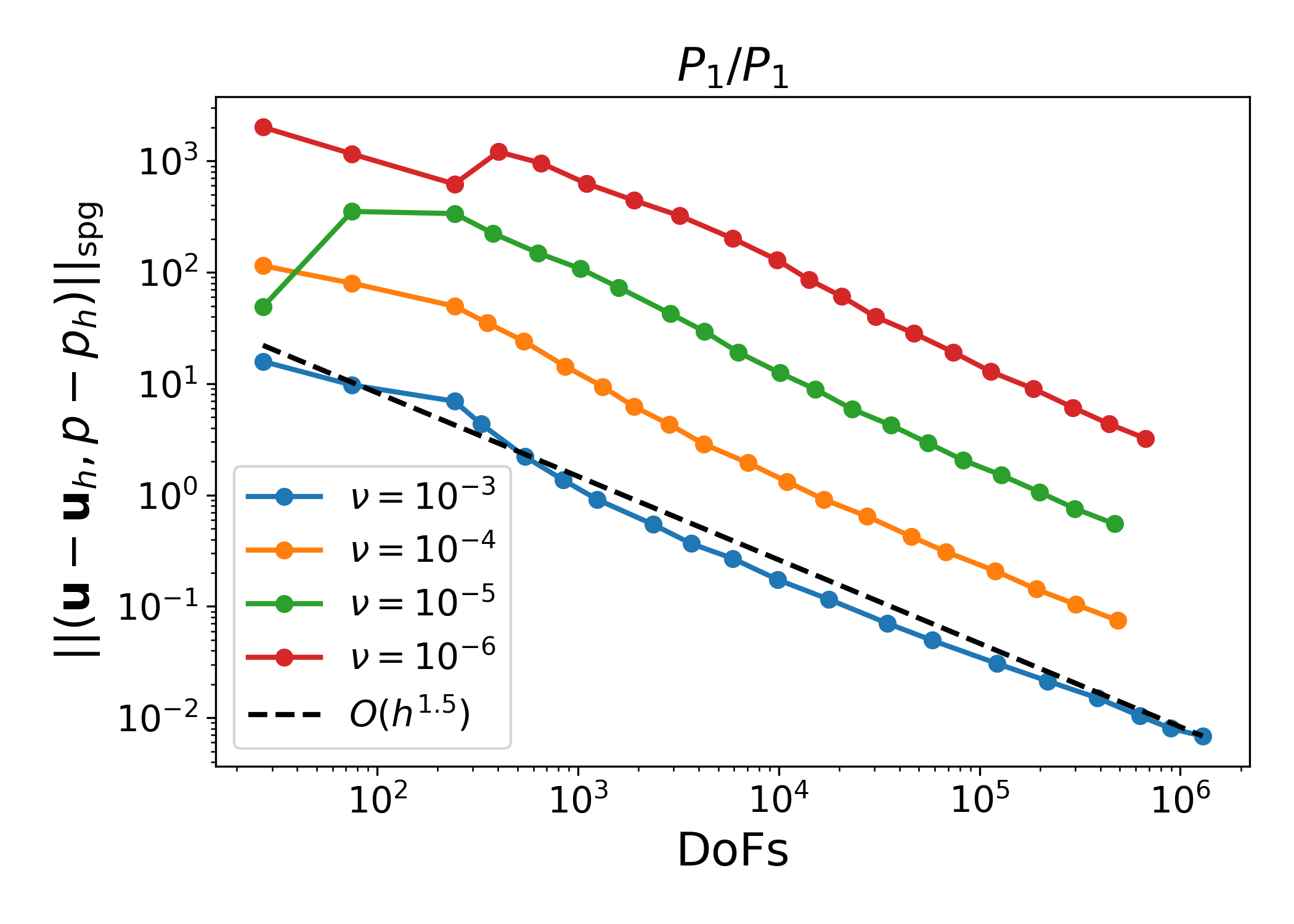
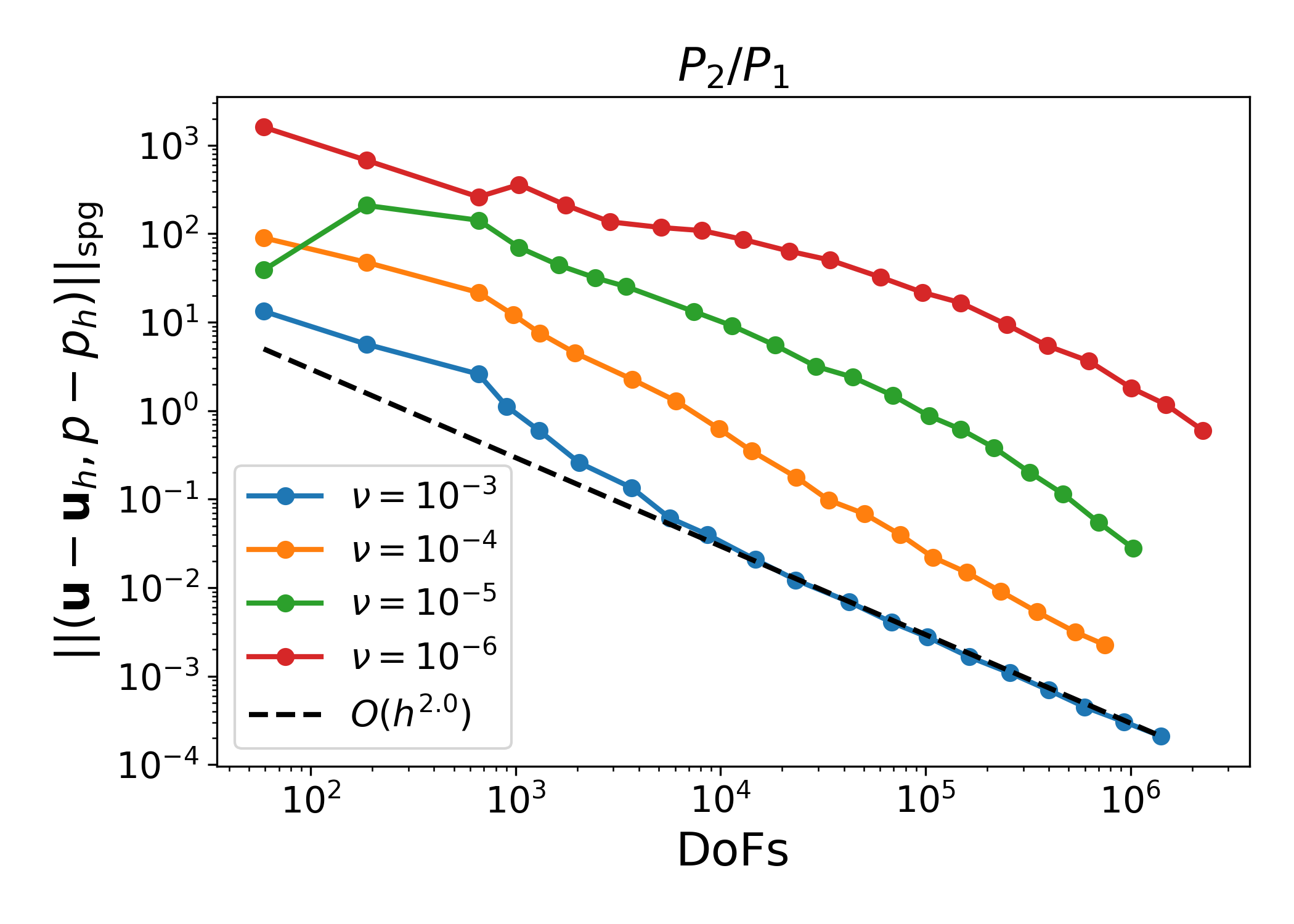
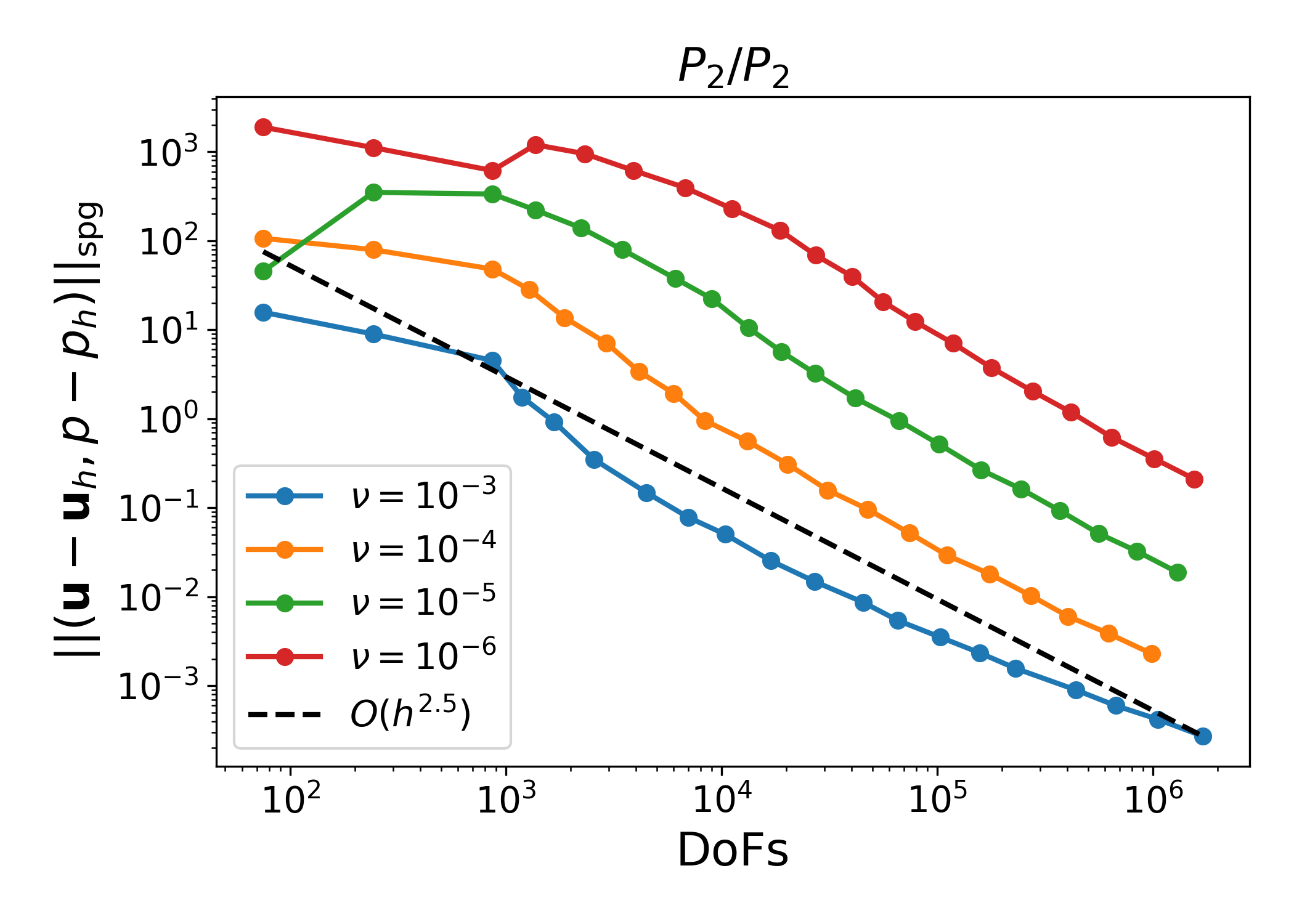
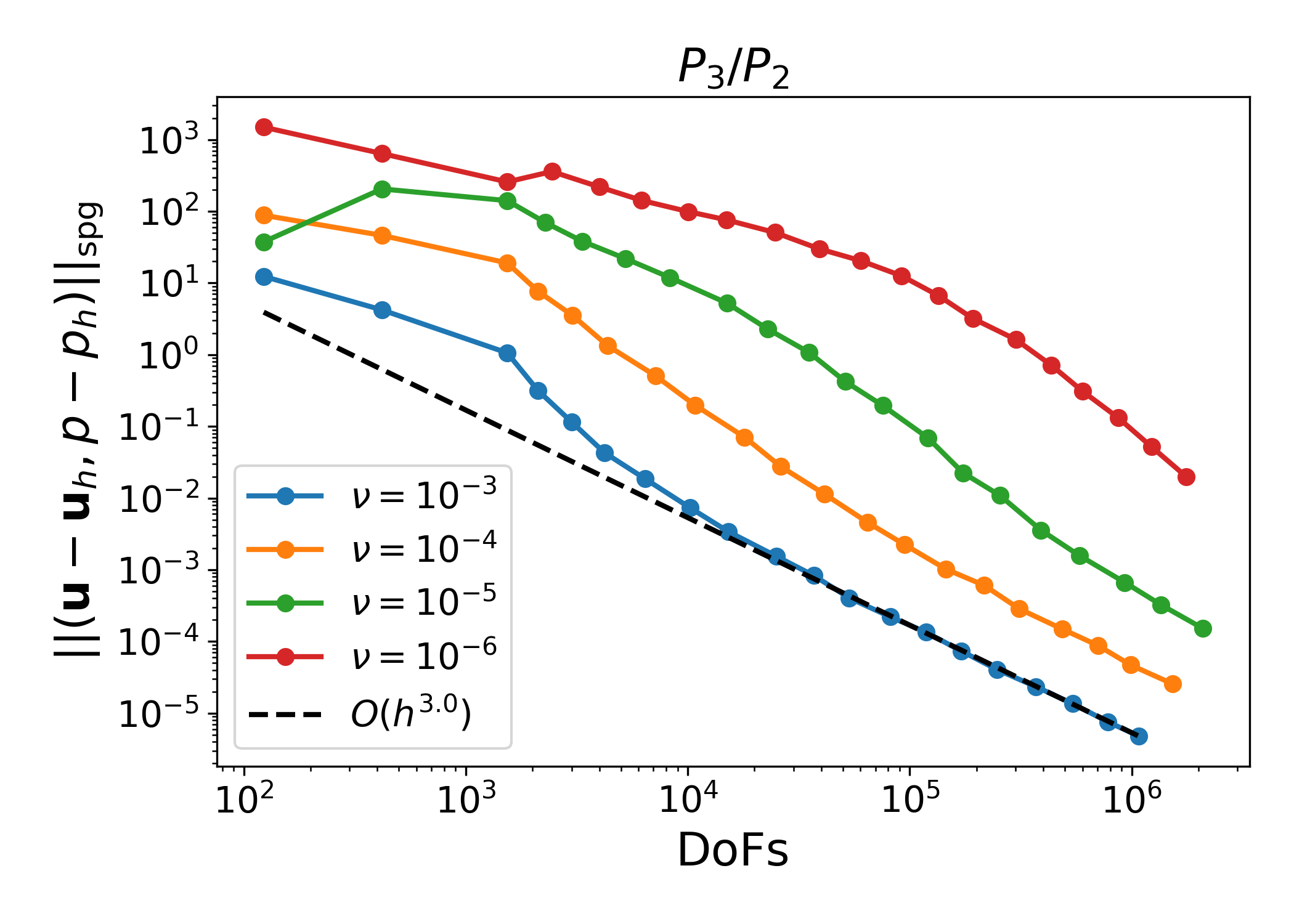
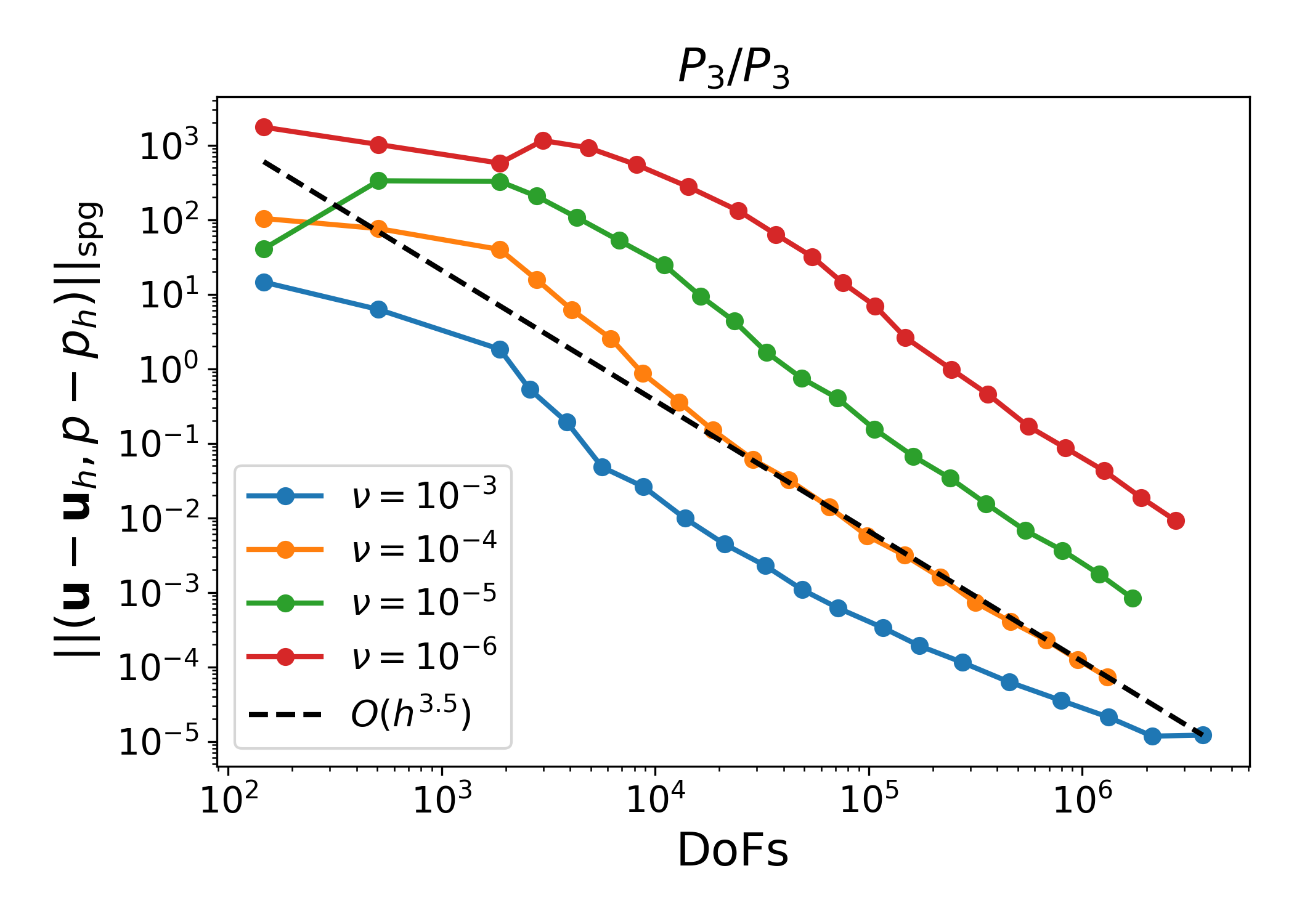
Figure 1: Errors ∥(u−uh,p−ph)∥spg for various pairs of finite element spaces and viscosity values, exemplifying independence from ν in layer-free scenarios.
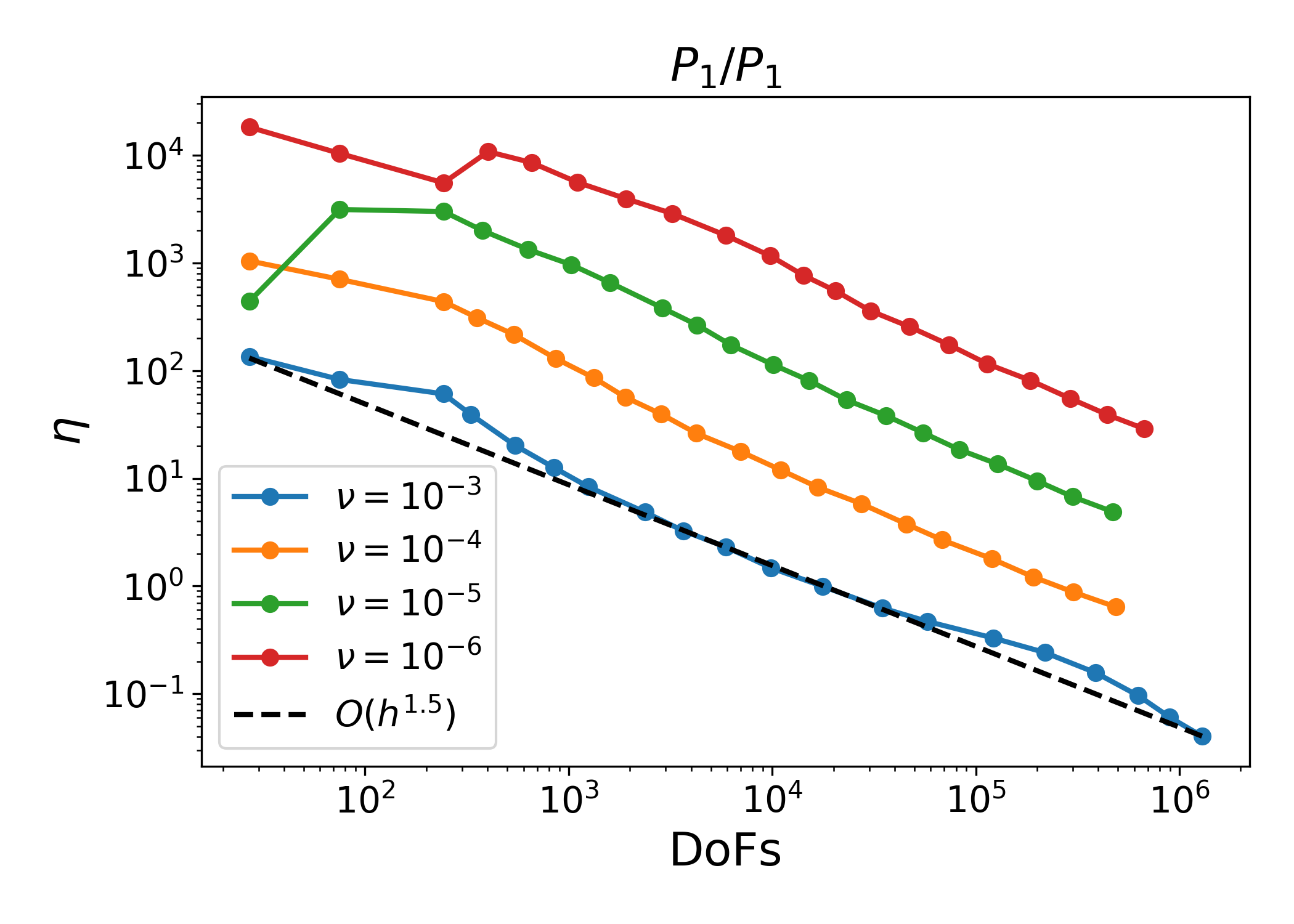
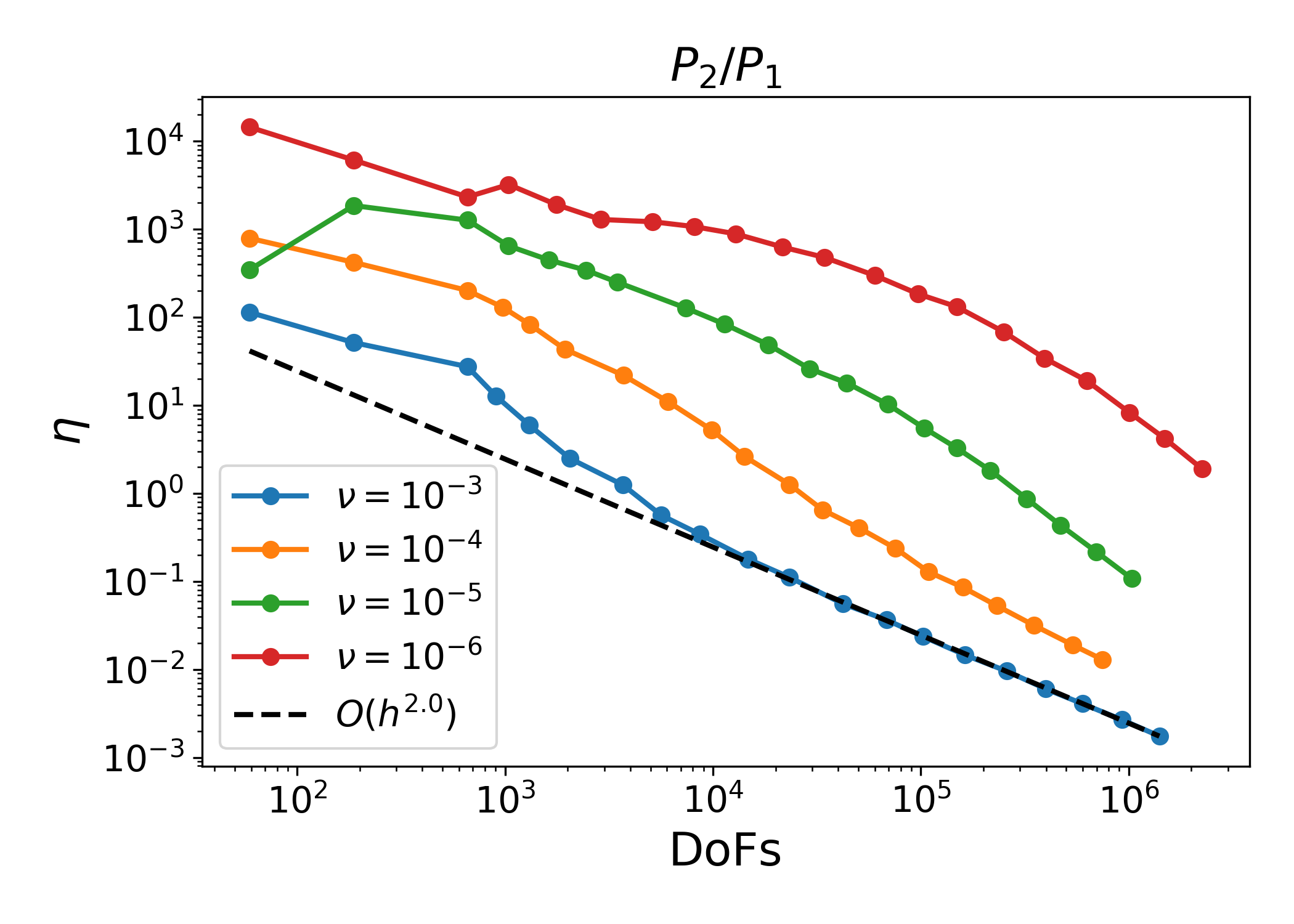
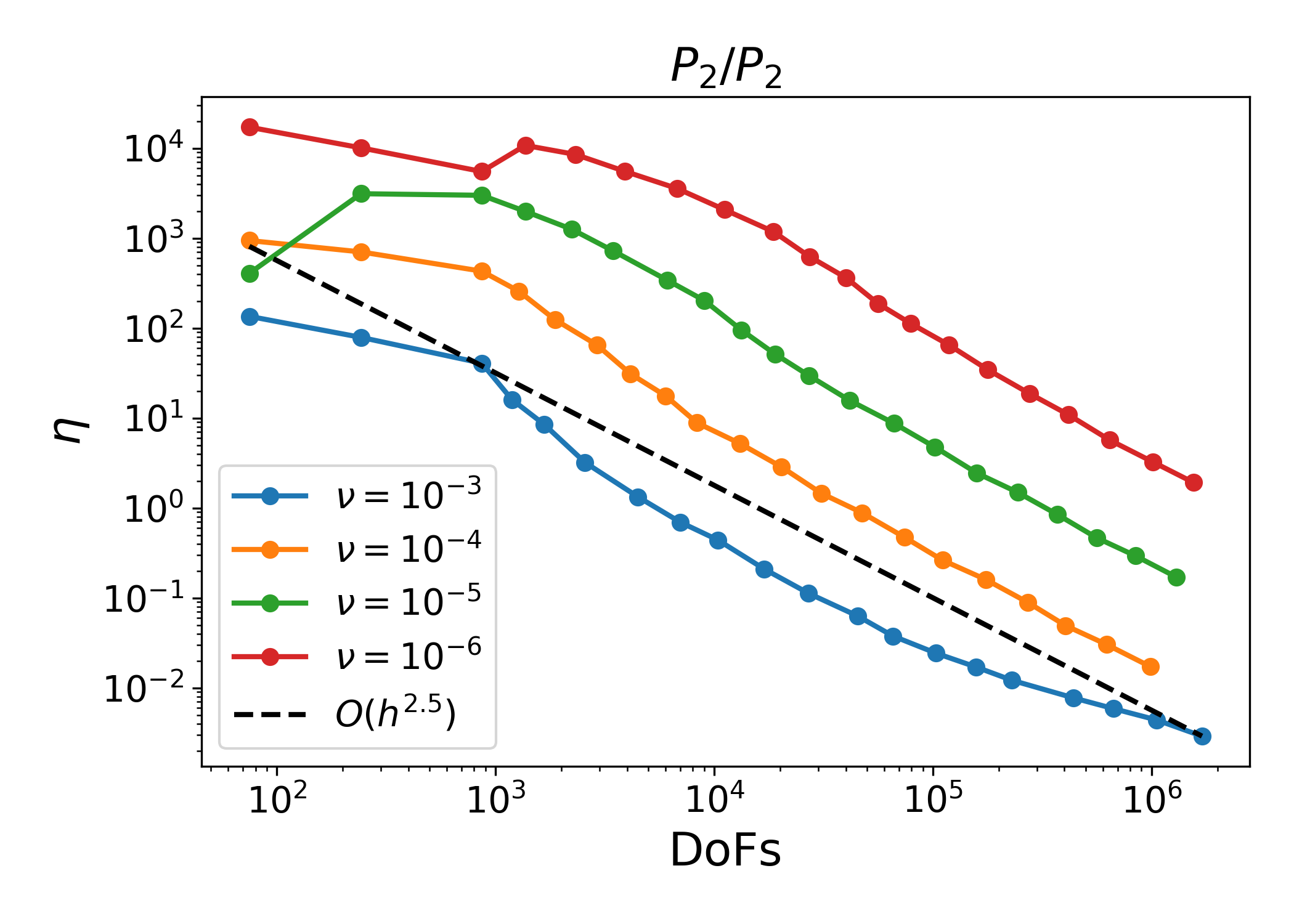
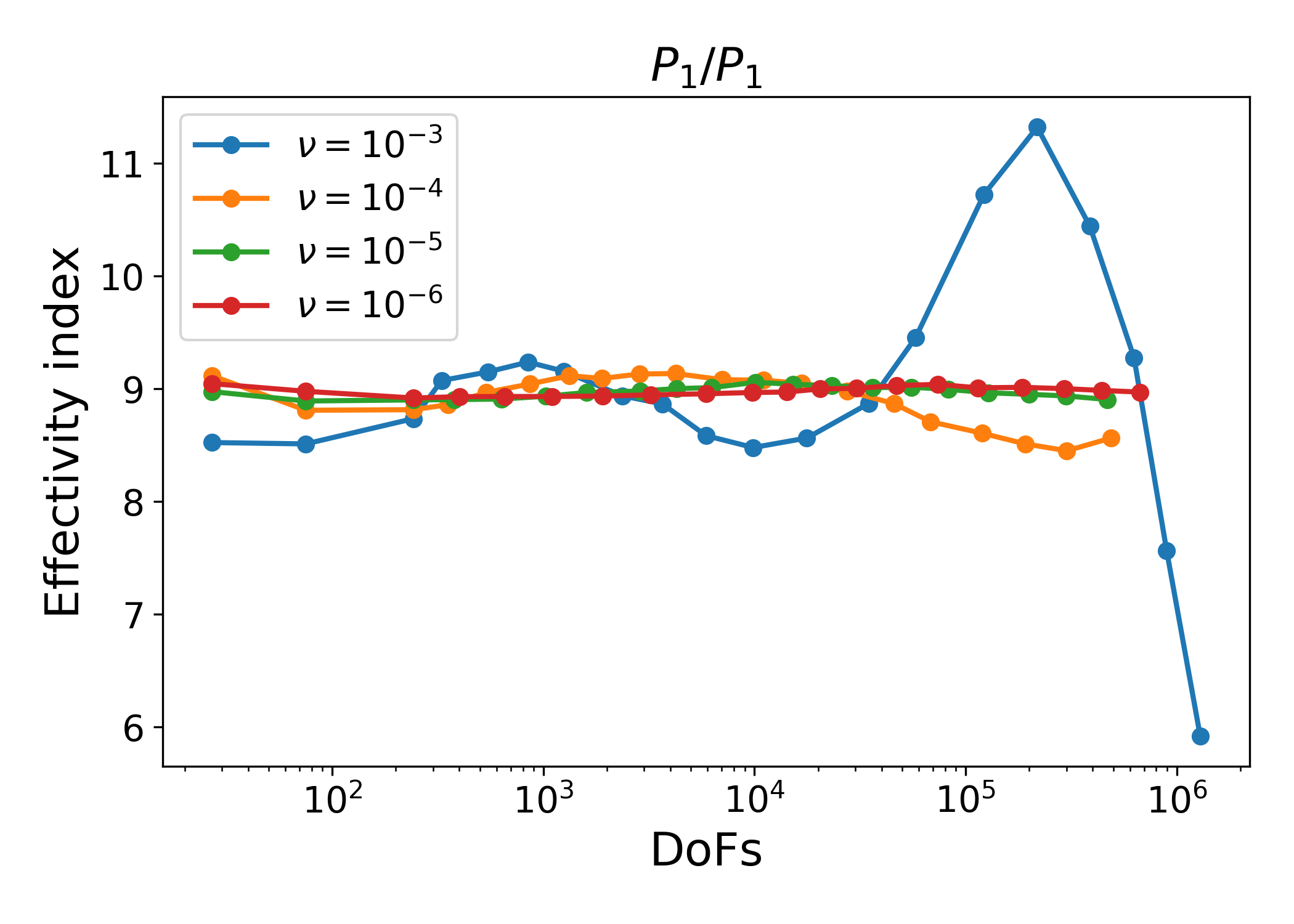
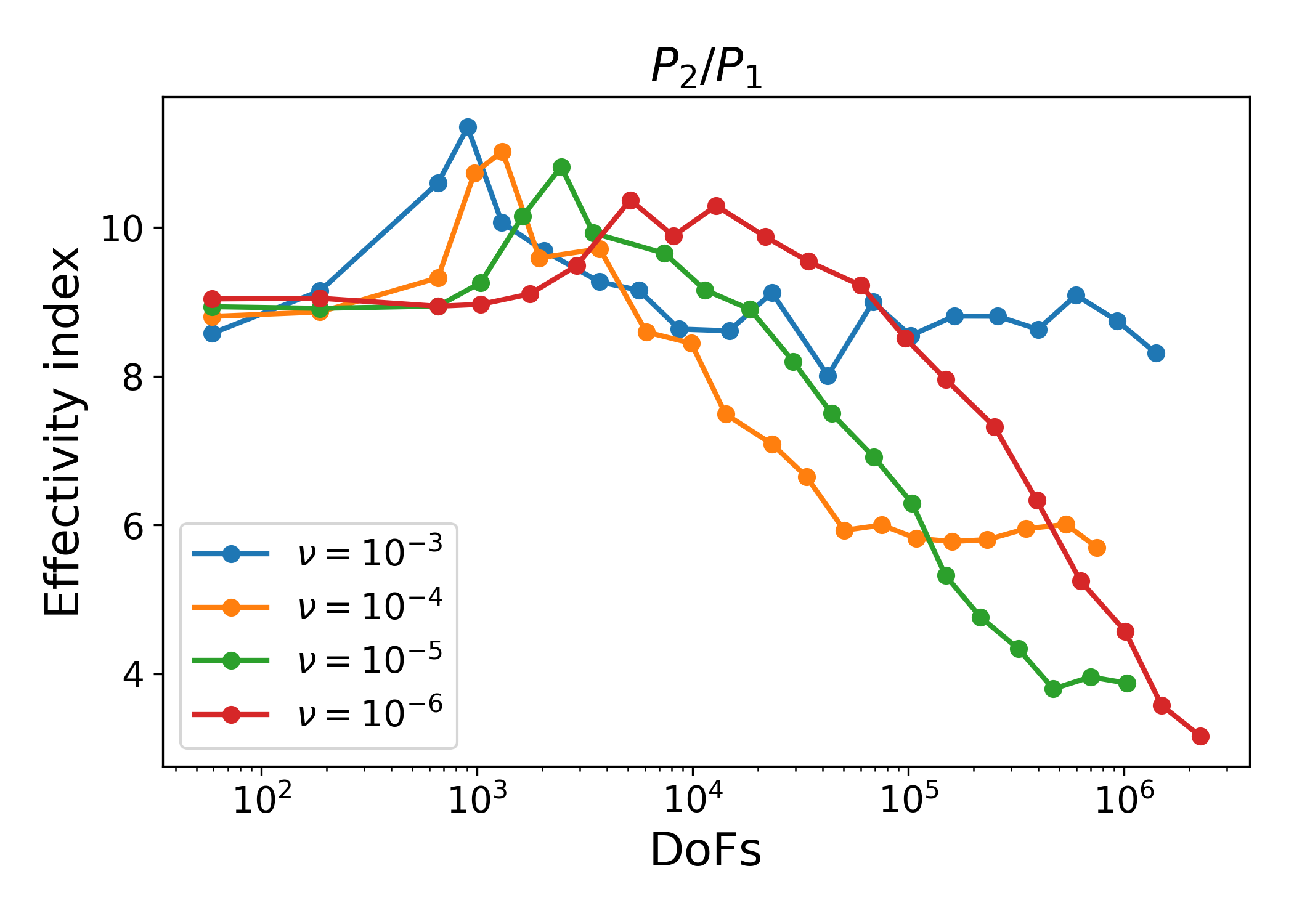
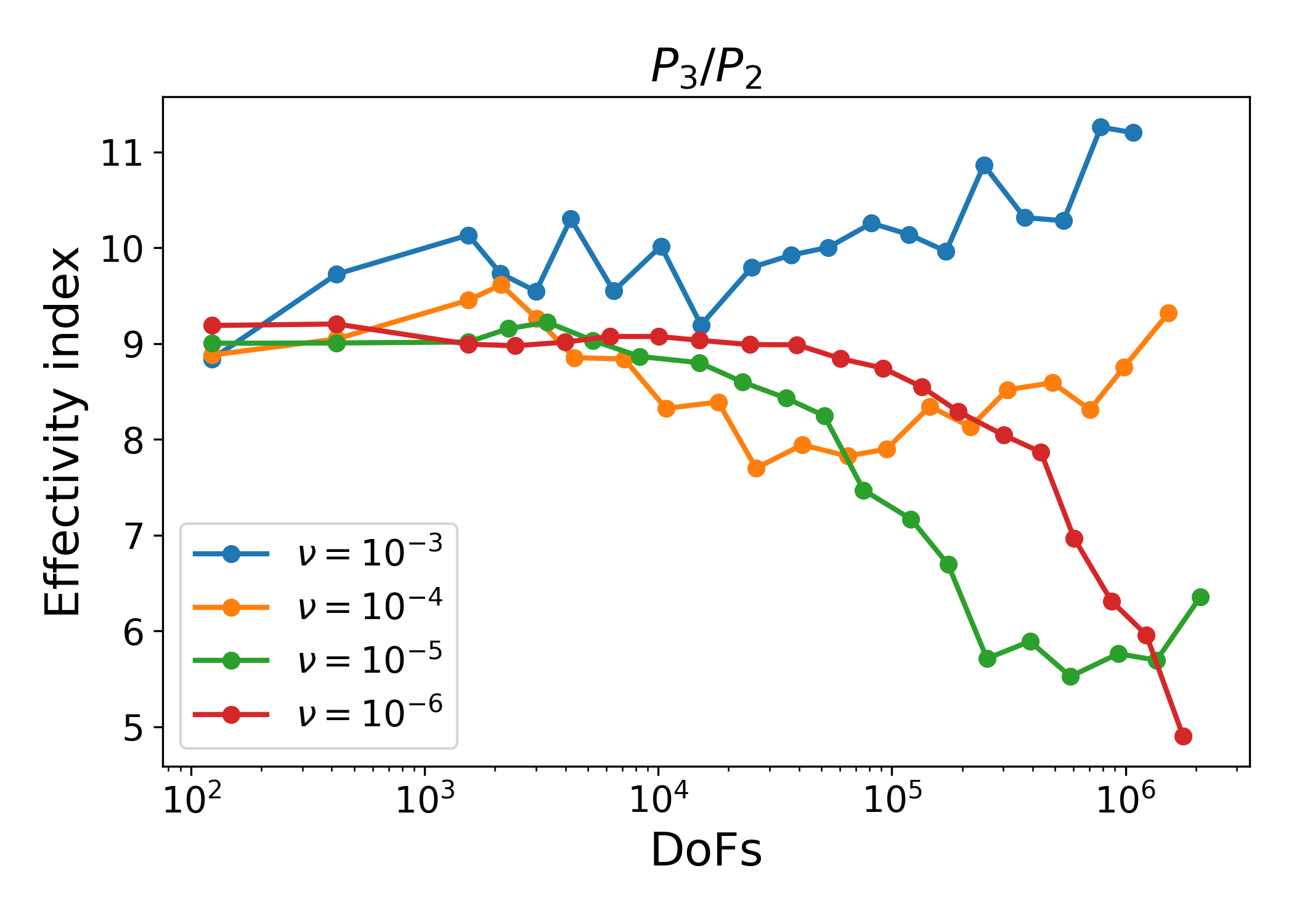
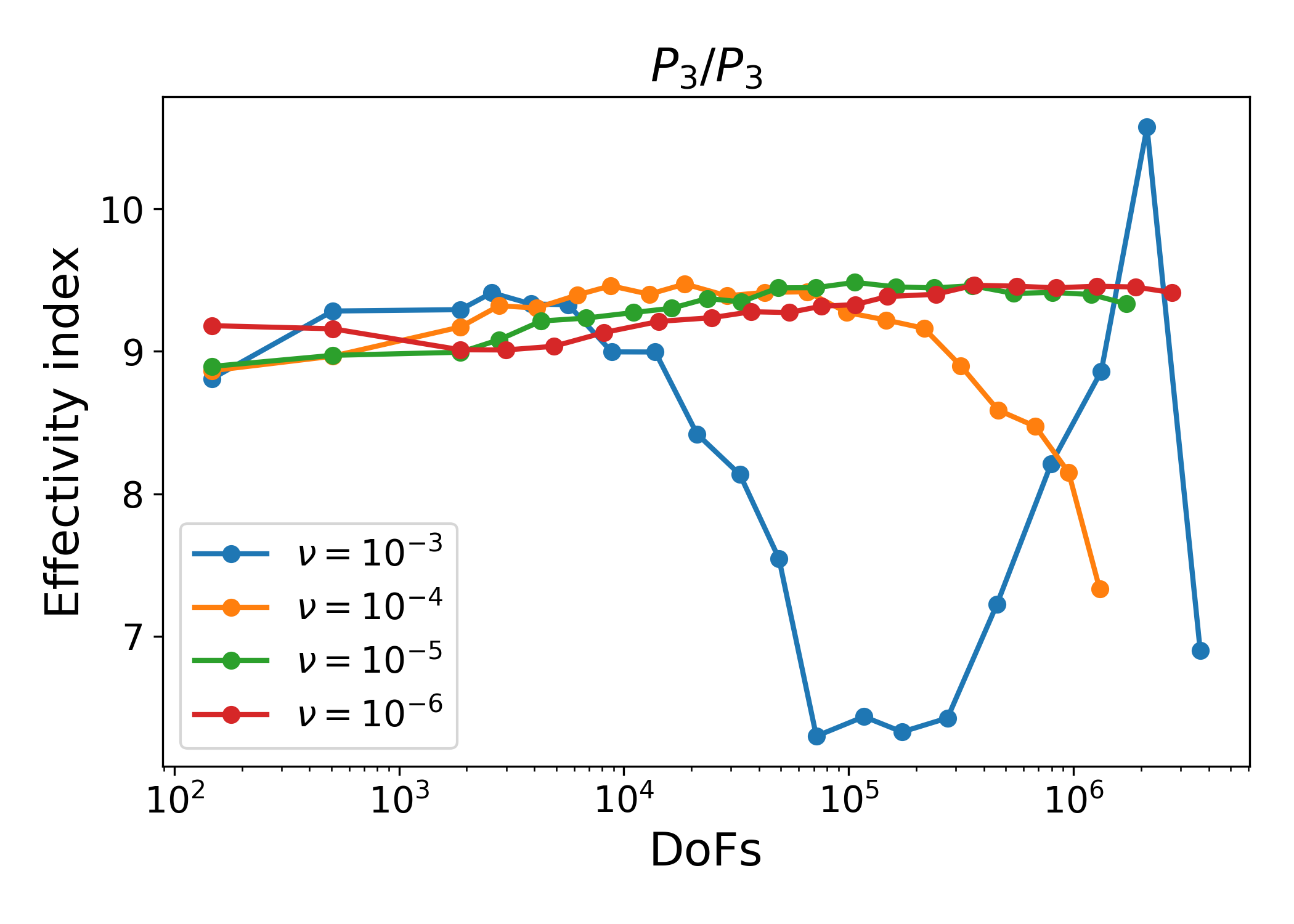
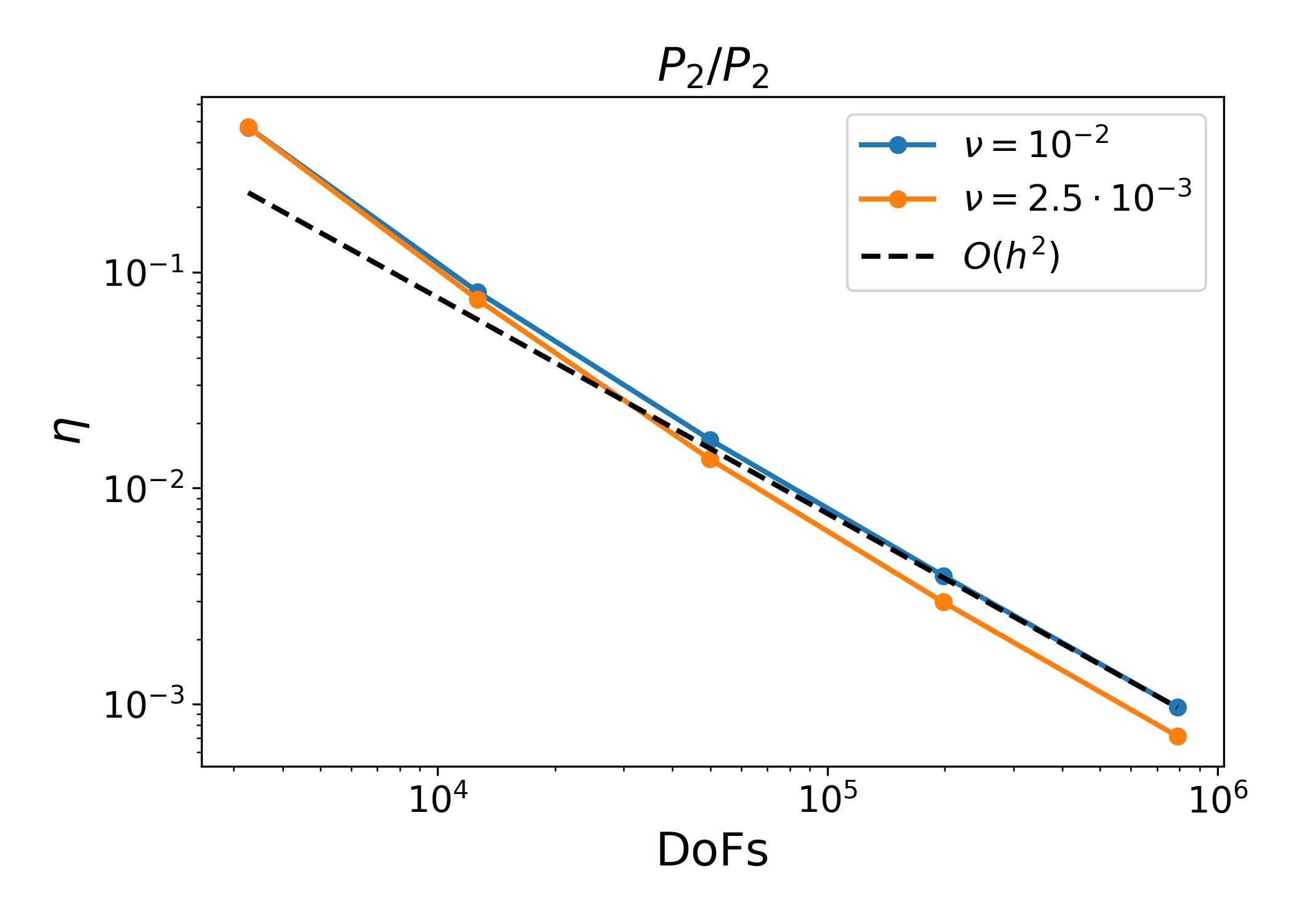
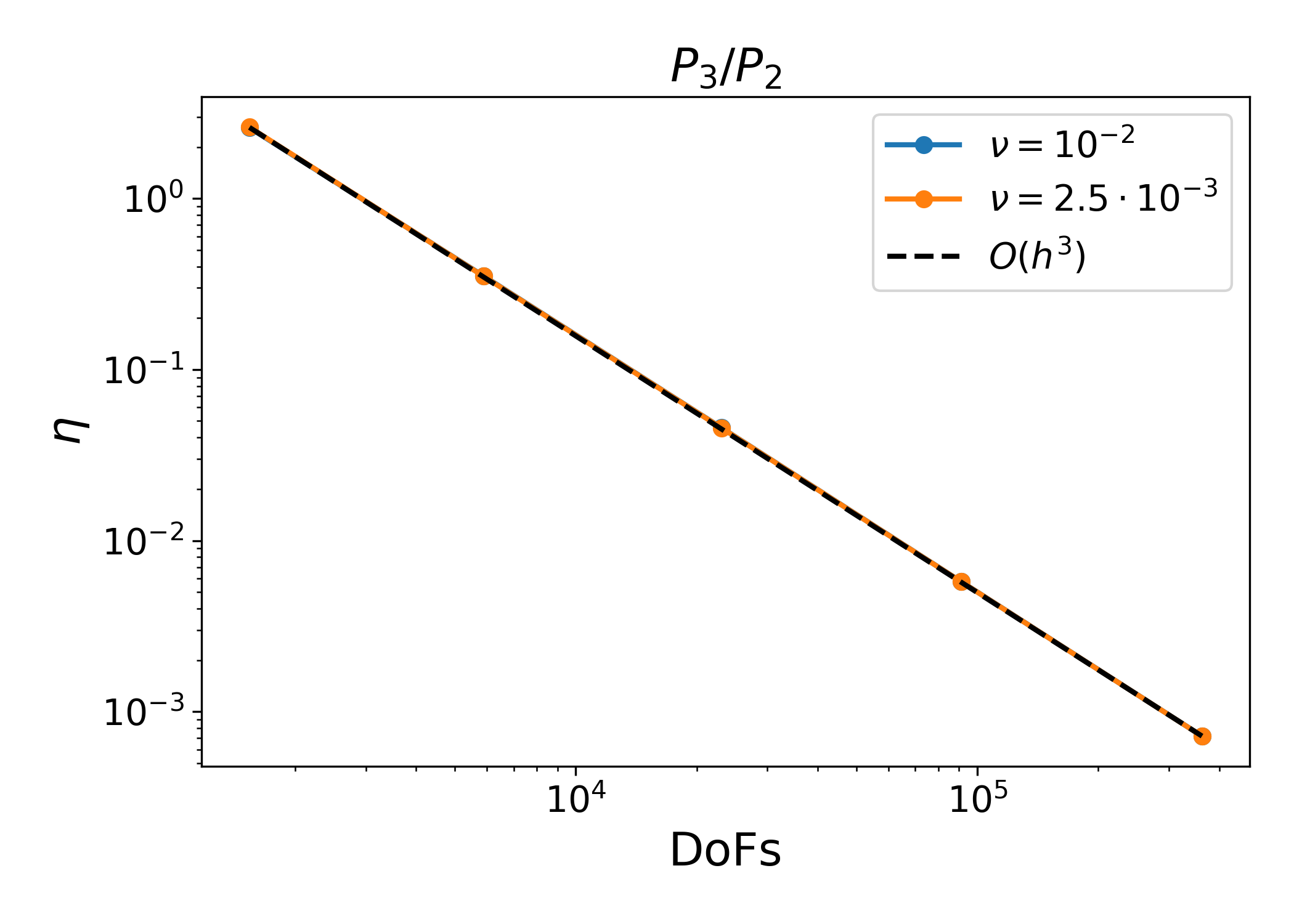
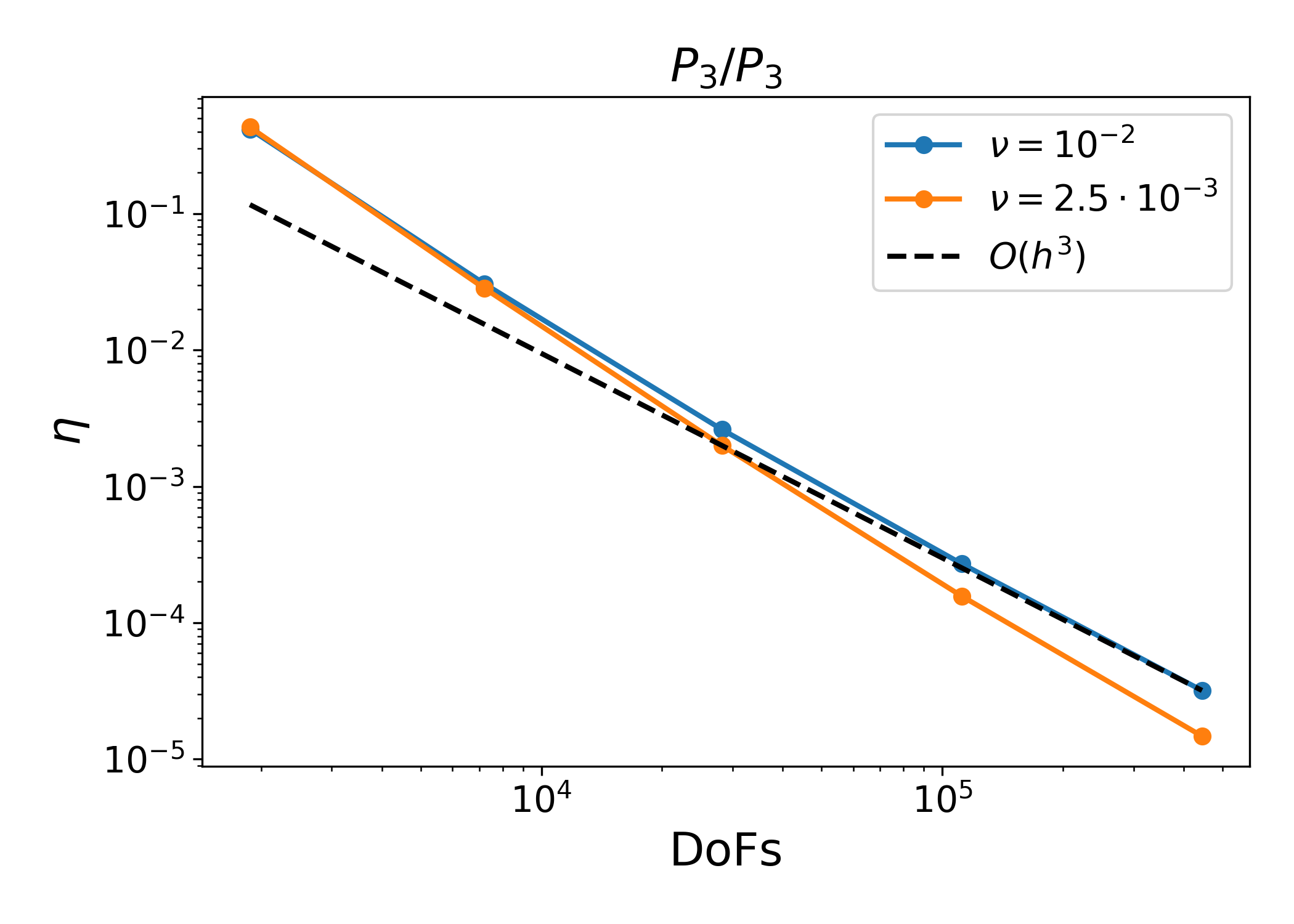
Numerical studies confirm that the effectivity index (ratio of estimator to true error) consistently lies near 9, across all finite element pairs and viscosity values. This indicates robust overestimation by a constant—independent of mesh refinement, stabilization regime, or problem data. For layer-free solutions, convergence rates match theoretical expectations; for layer-dominated cases, the error increases with decreasing viscosity as anticipated by semi-robust a priori theory.
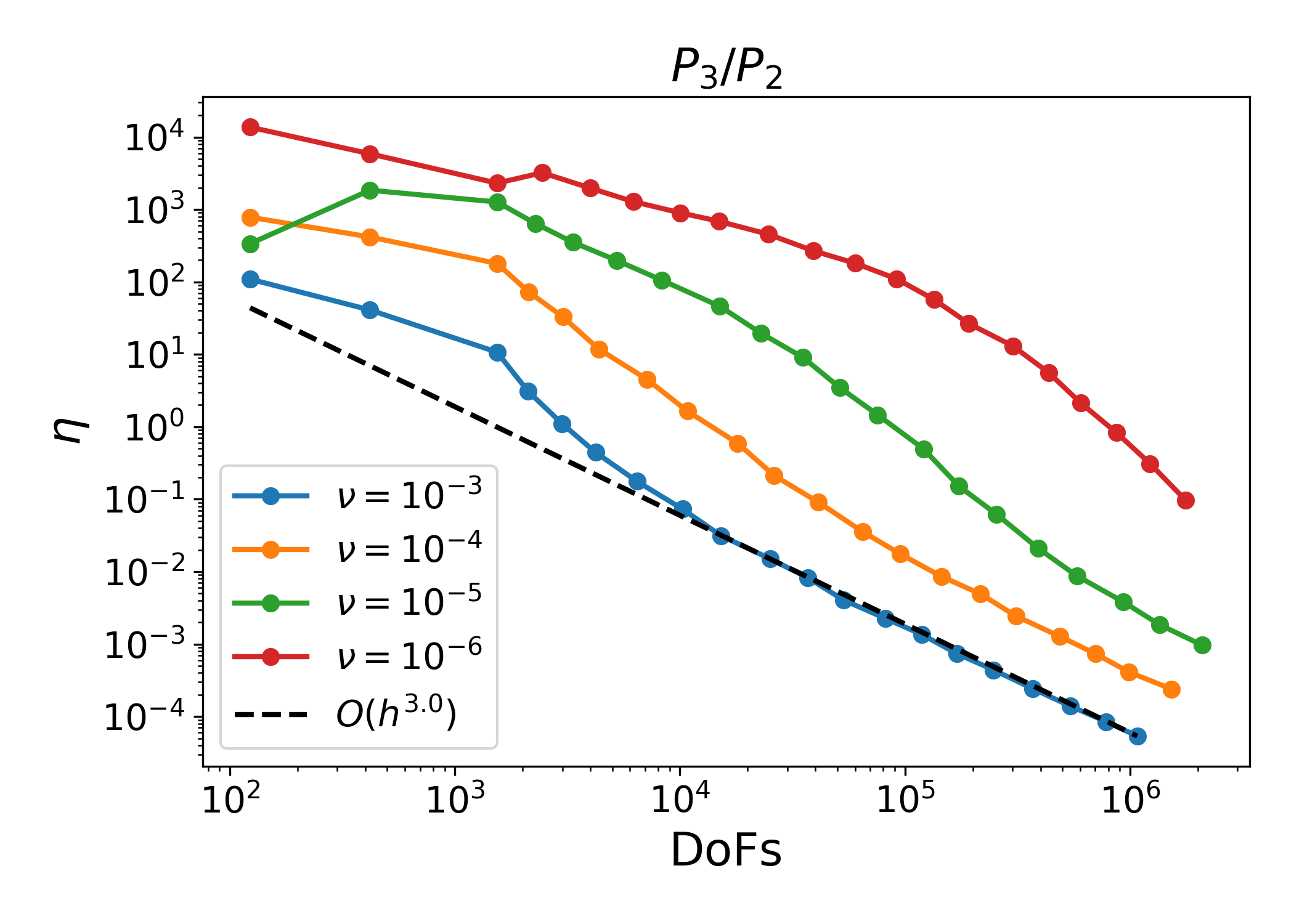
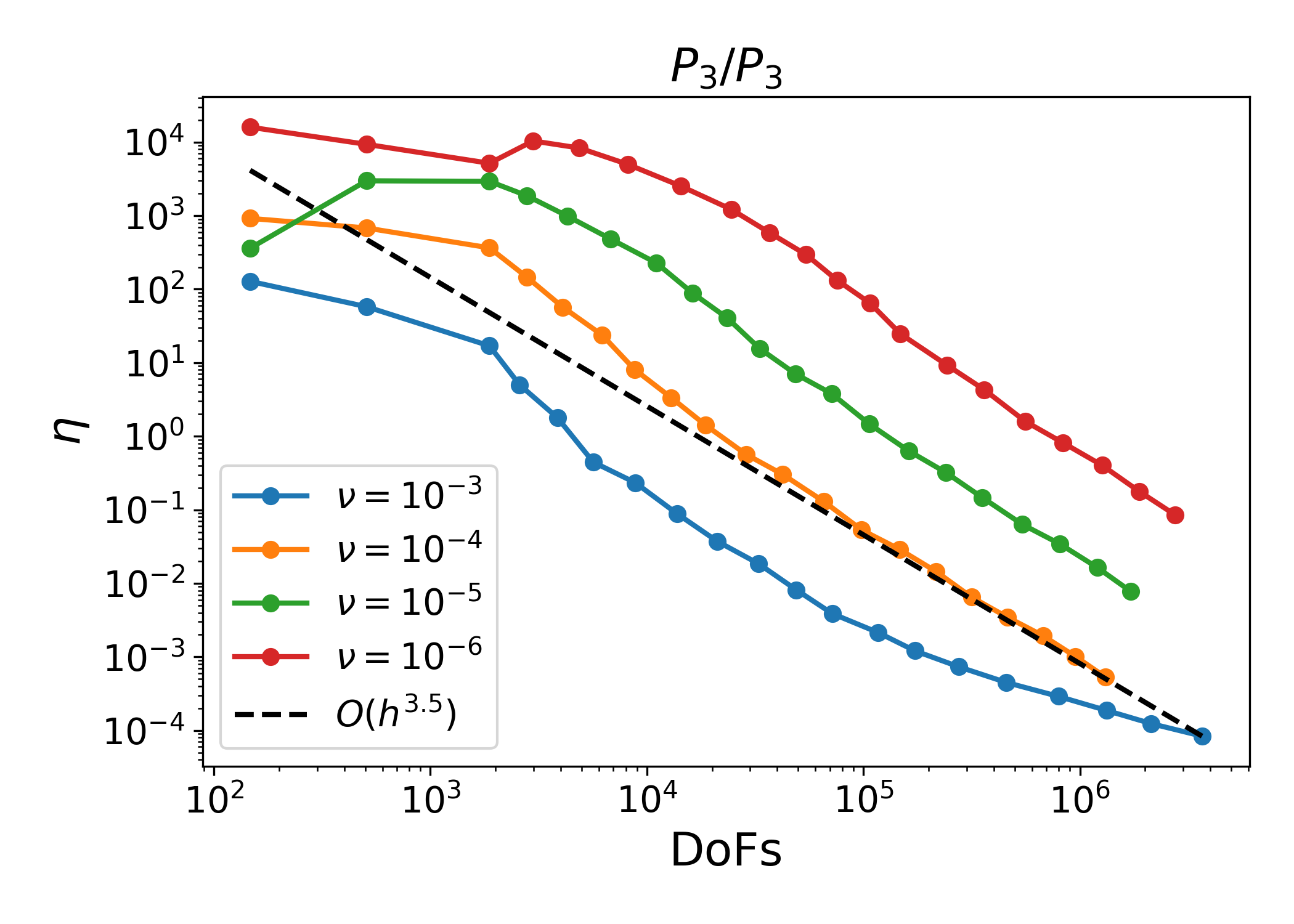
Figure 2: The a posteriori error estimator η for different finite element pairs demonstrating qualitative agreement with true error curves in the convection-dominated regime.
Figure 3: Effectivity indices for various discretizations and viscosity values, showing stable overestimation factor, empirical confirmation of robustness.
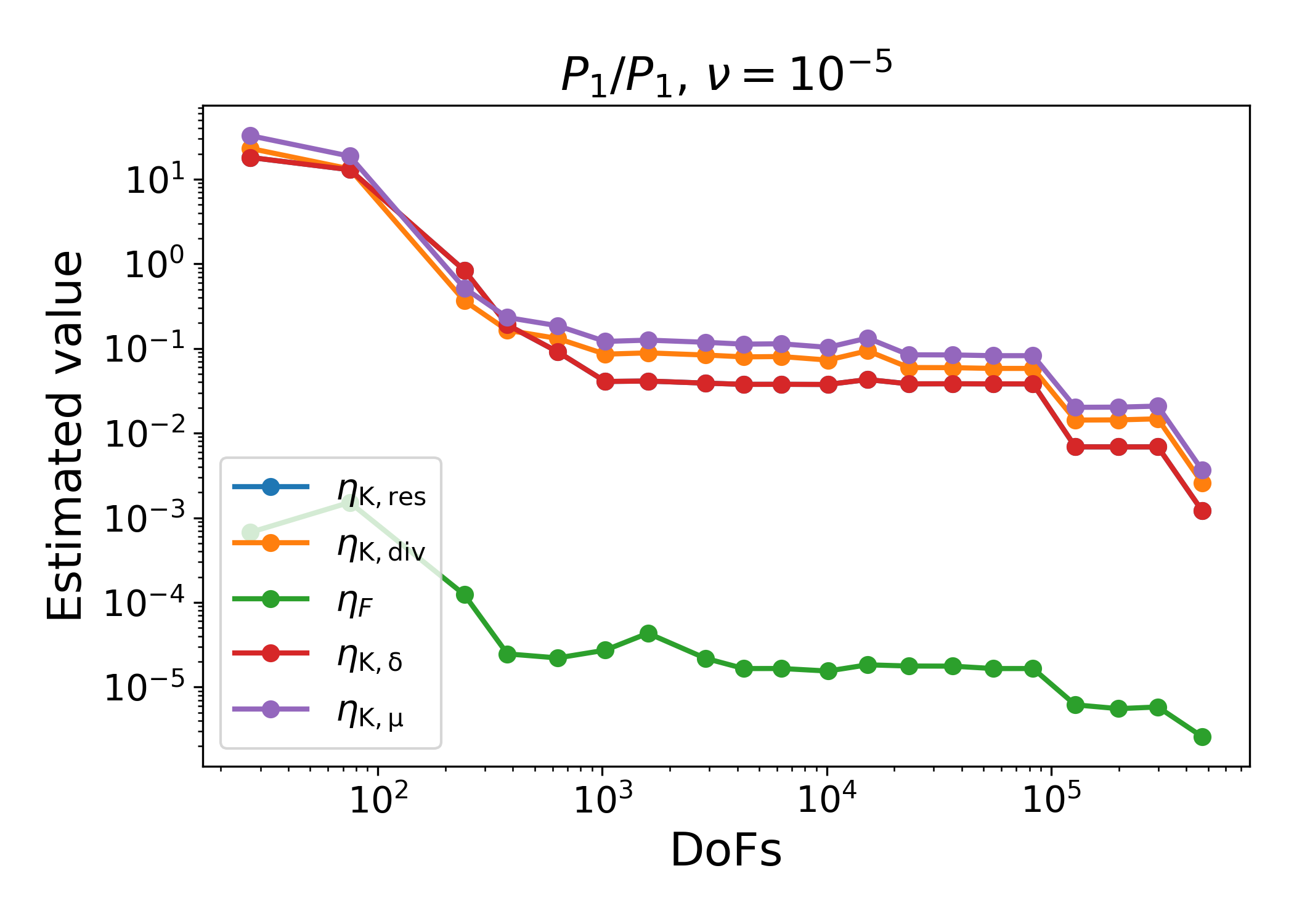
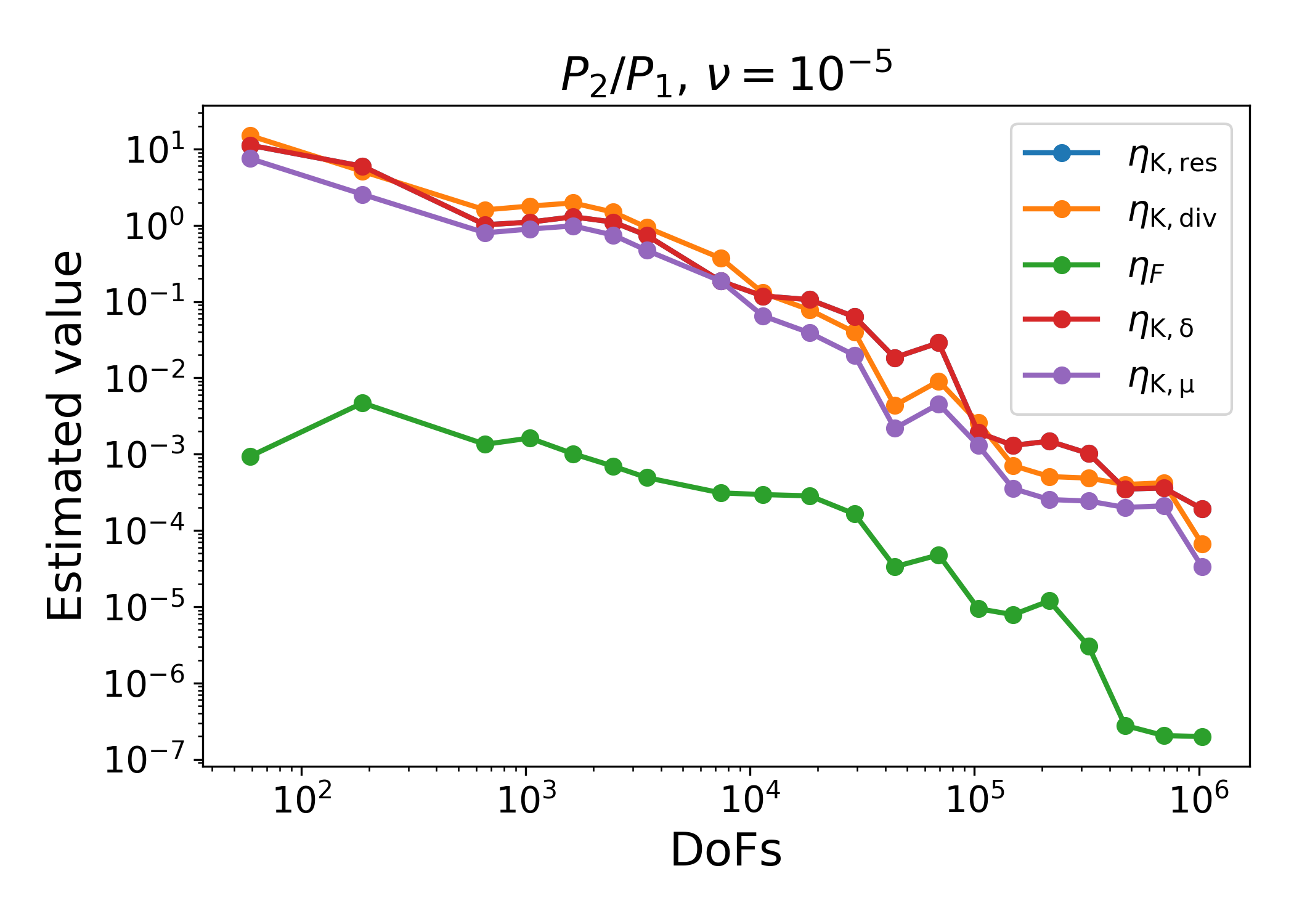
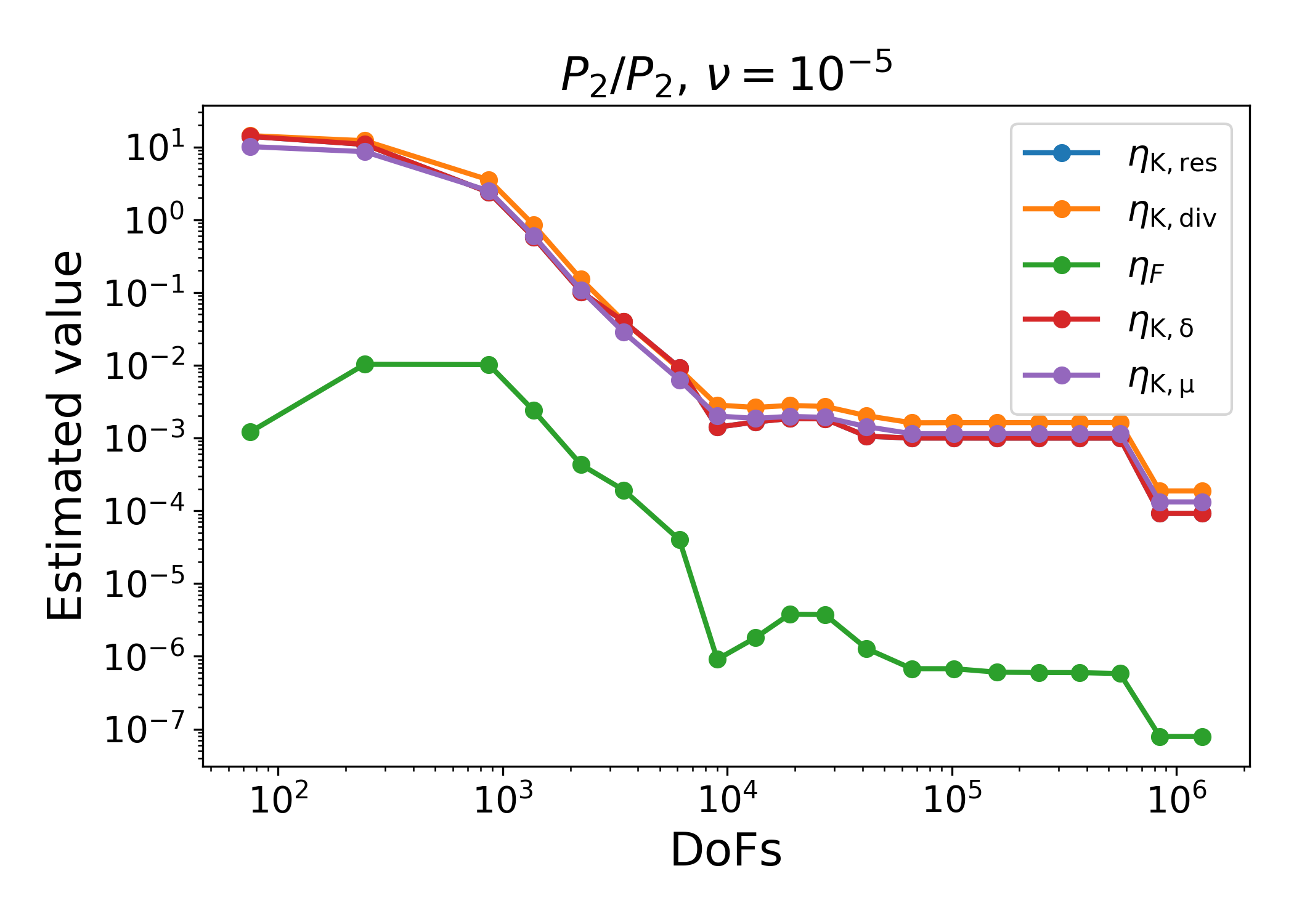
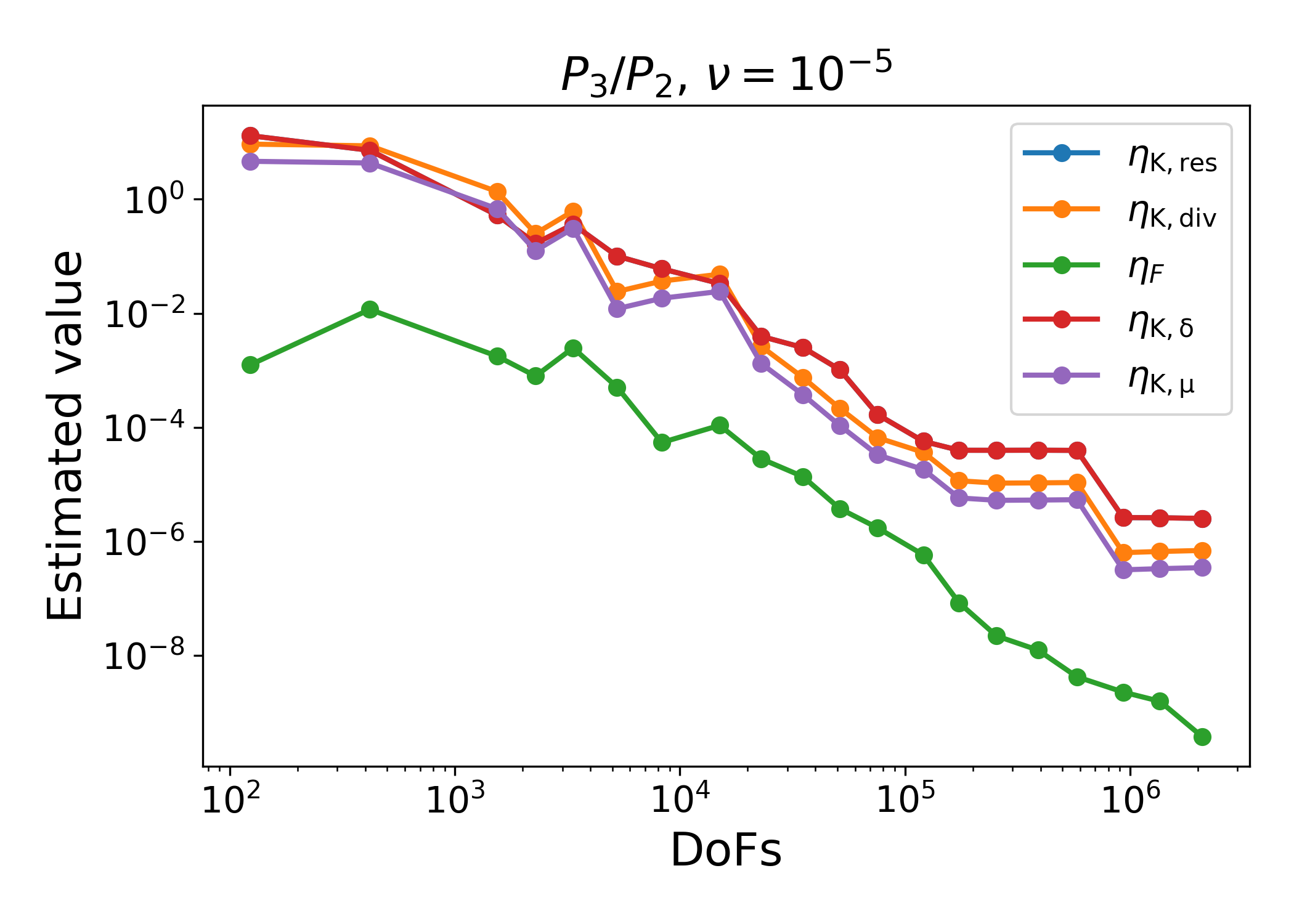
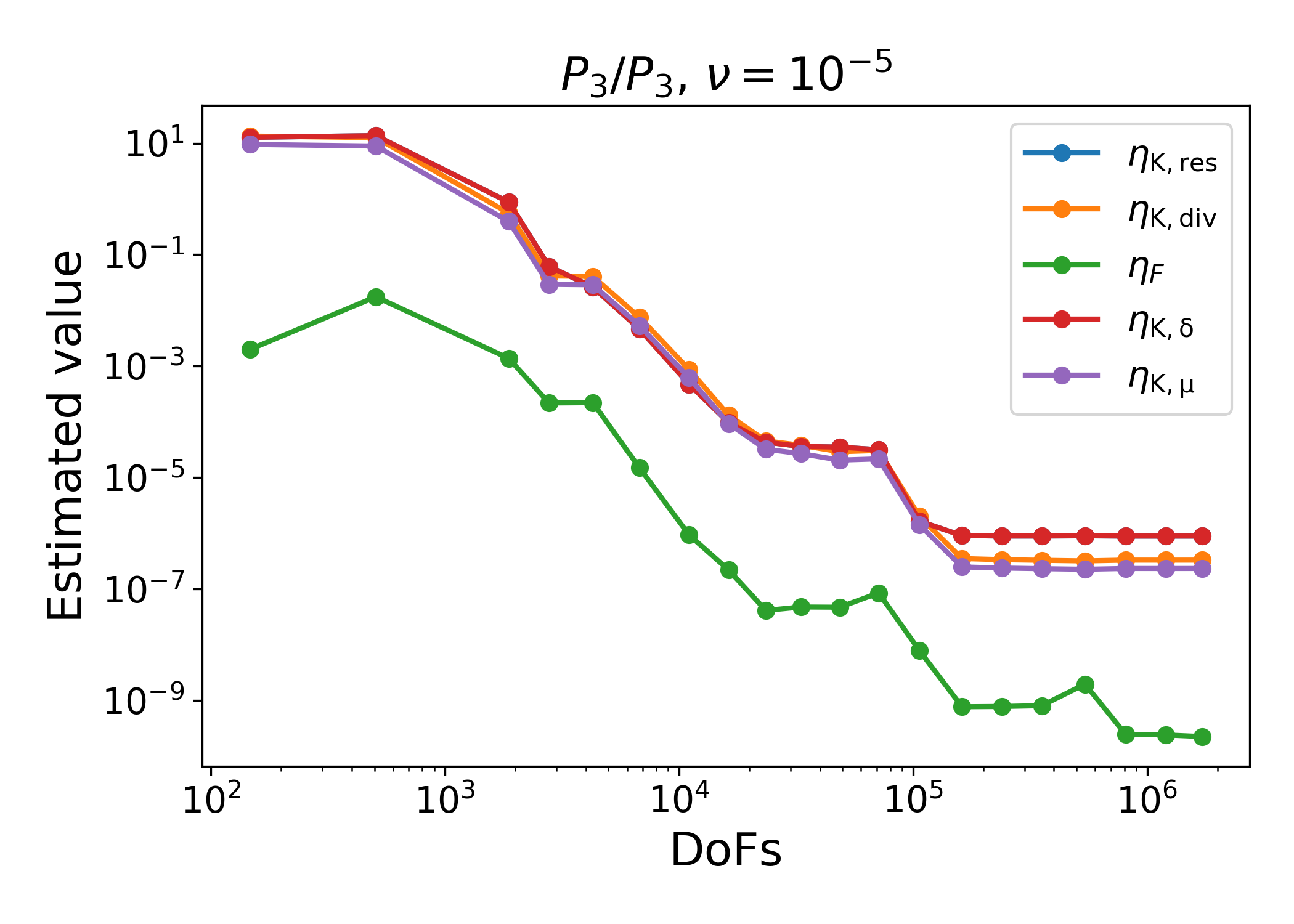
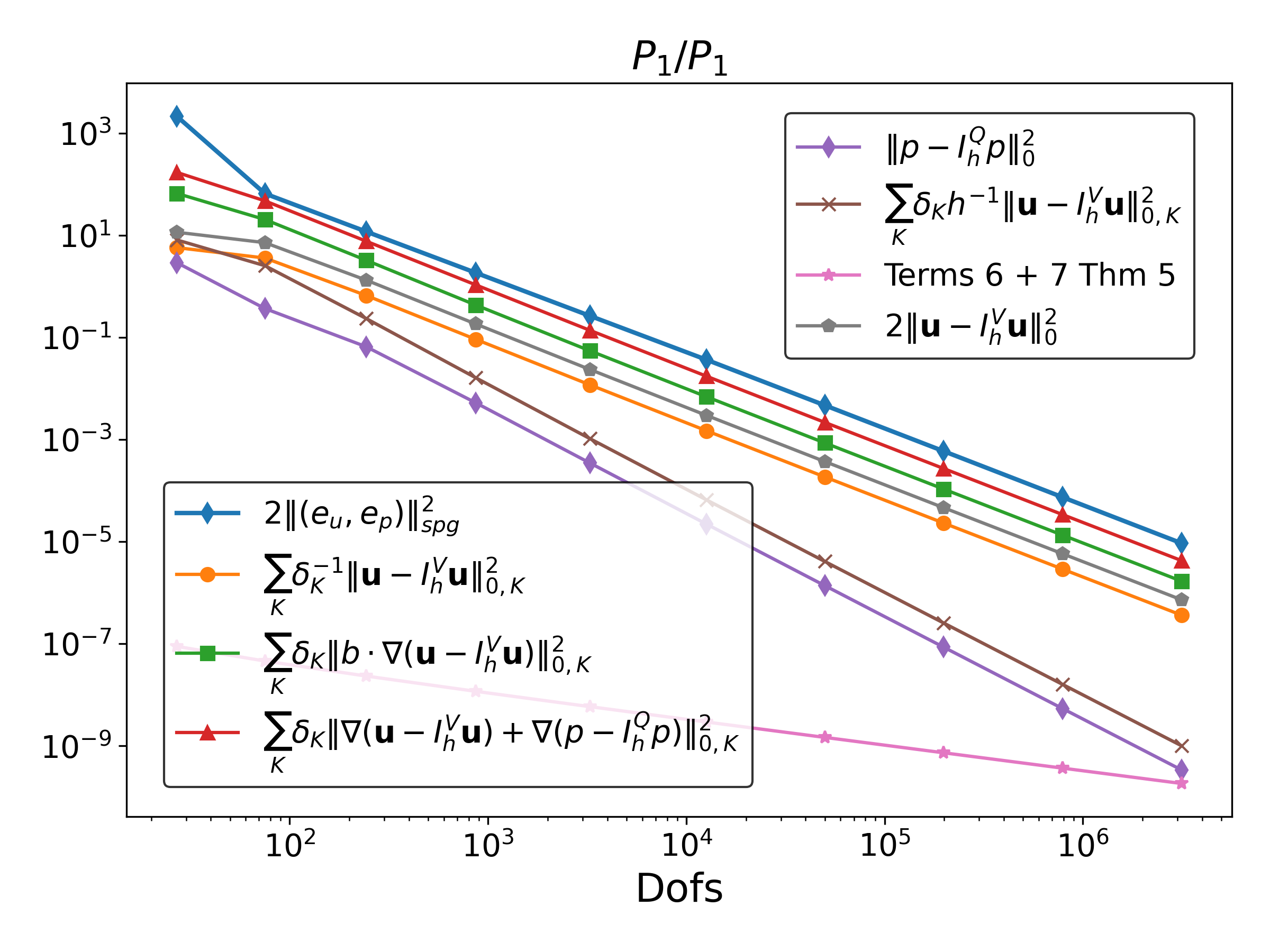
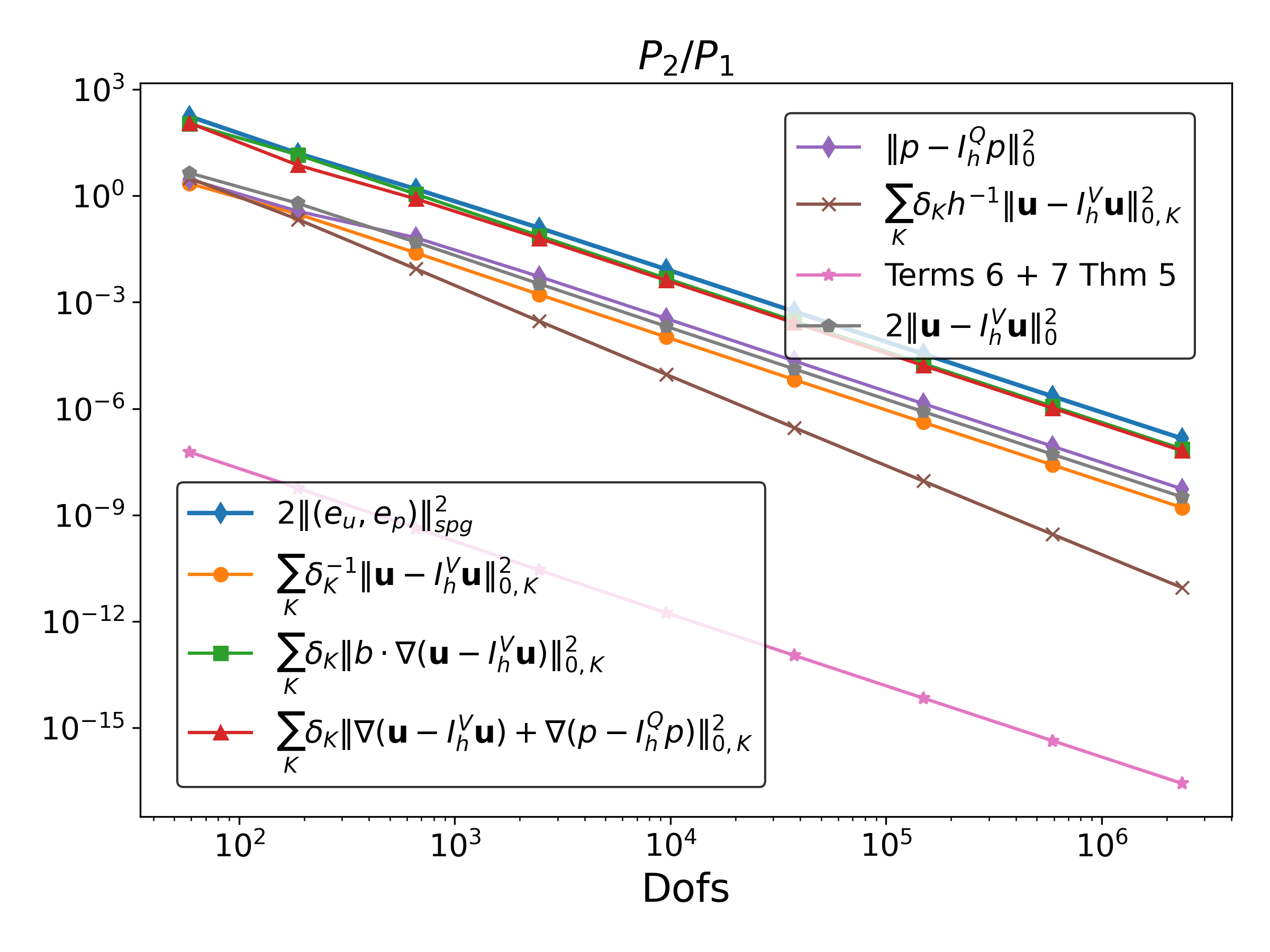
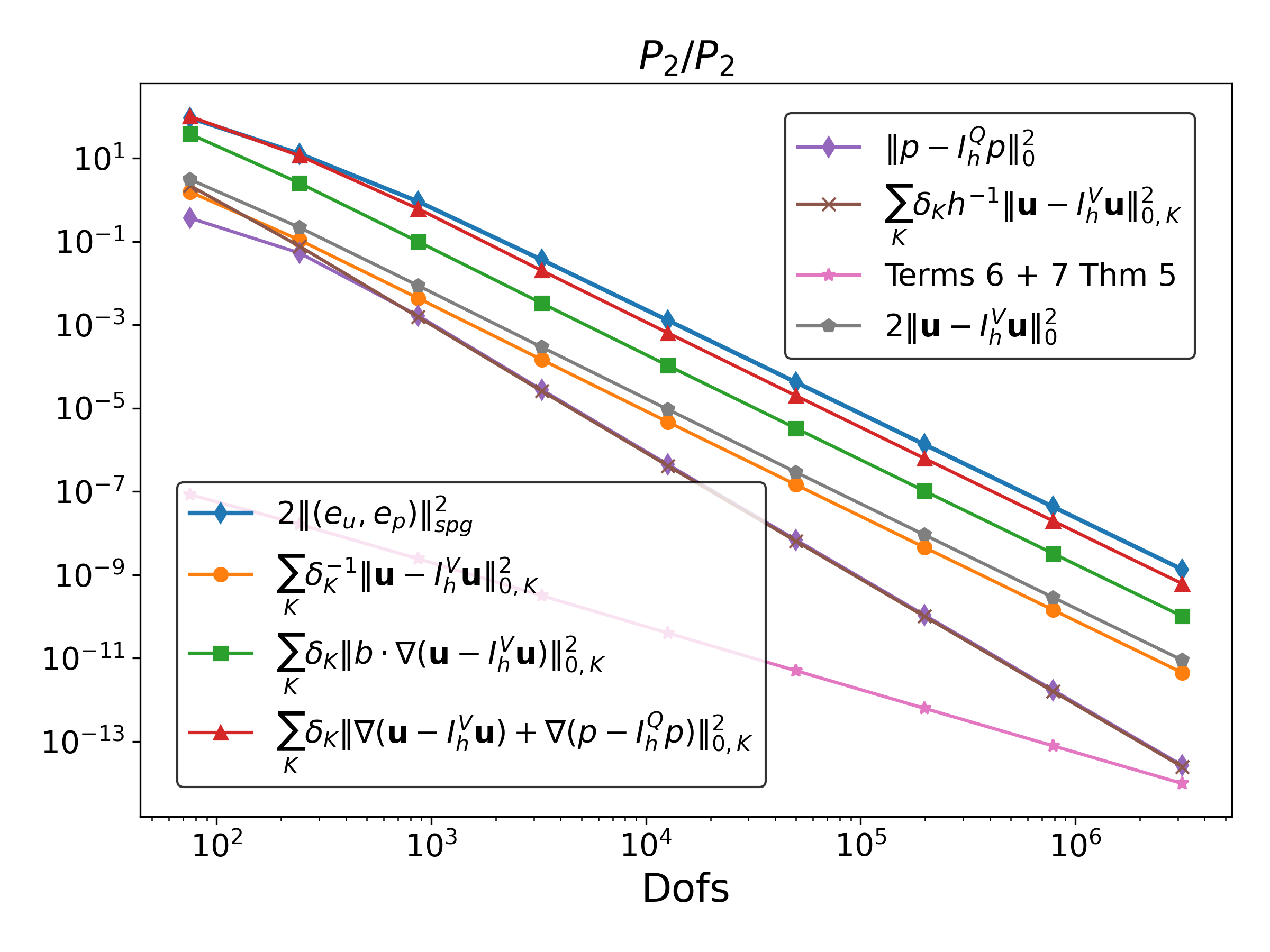
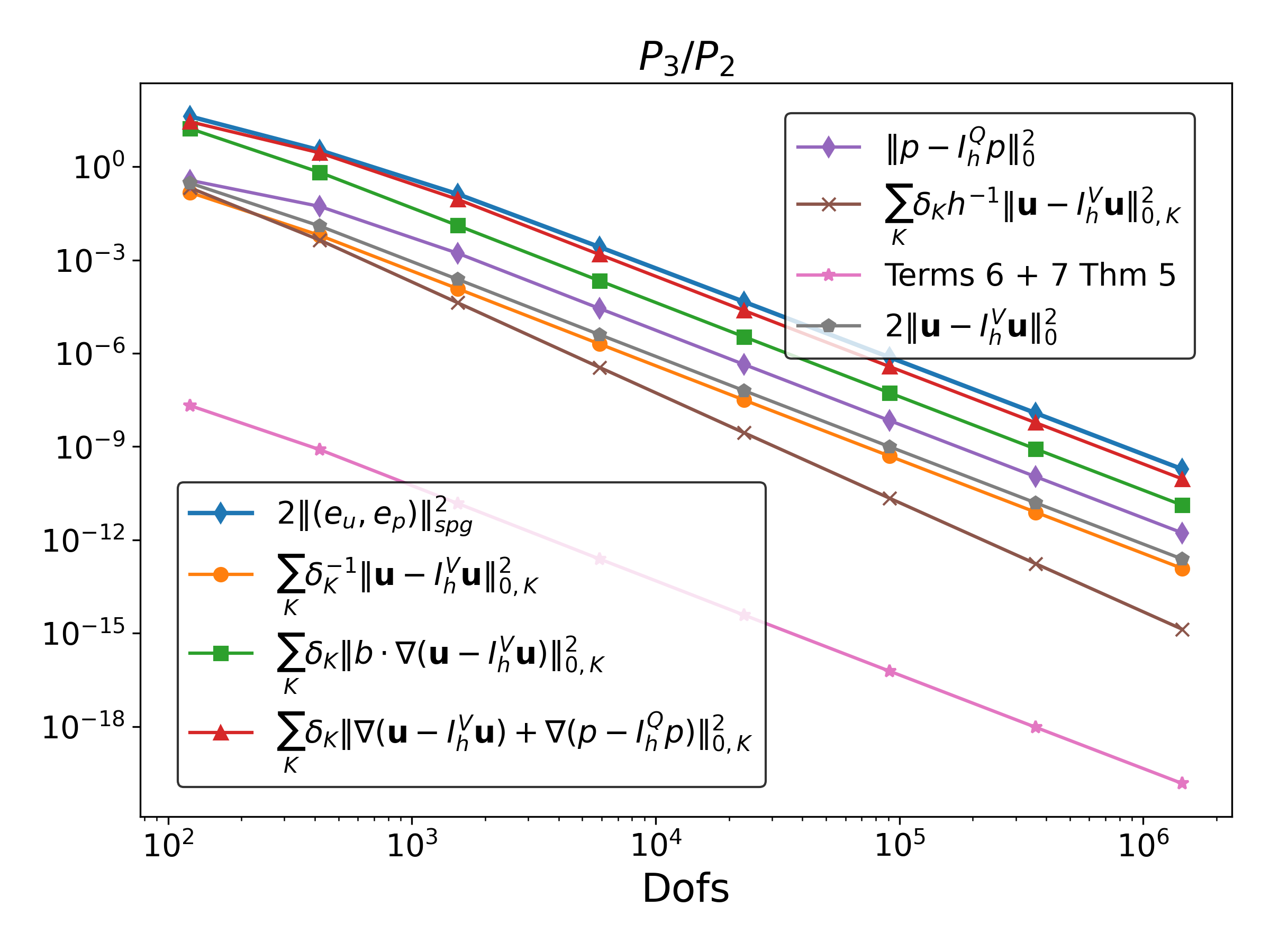
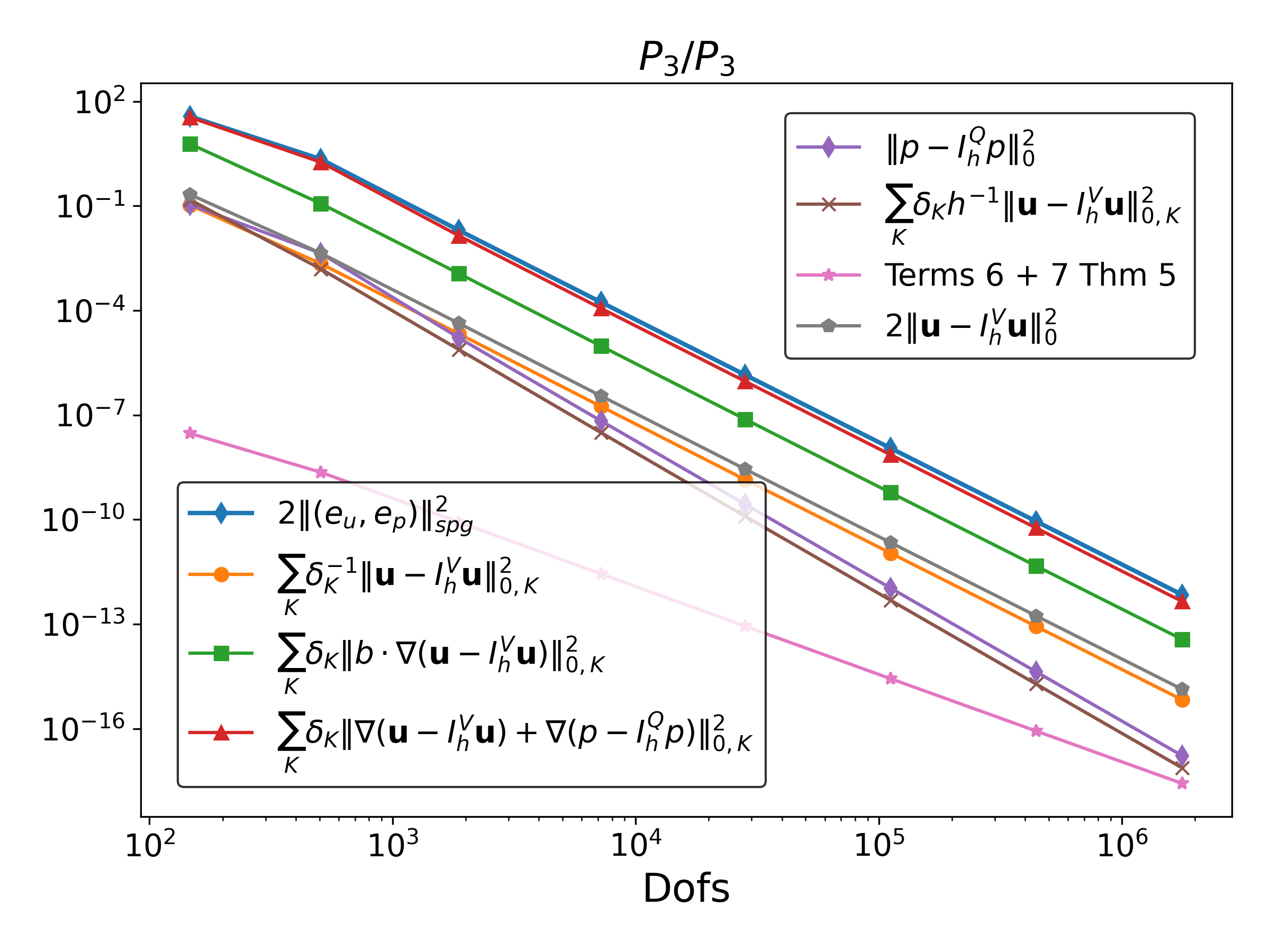
Detailed analyses of estimator components reveal non-negligible impact from grad-div and SUPG contributions, with facet residuals dominated by small viscosity factors when pressure is continuous.
Figure 4: Component-wise breakdown of the estimator η, showing comparative magnitudes across error sources at small ν.
The adopted hypotheses relating interpolation and discretization errors are empirically validated for the test cases, and the negligible nature of terms associated with high-order interpolation derivatives at low viscosity is established.
Adaptive Mesh Refinement and Boundary Layers
For solutions with boundary layers, adaptive refinement driven by the local error estimator yields effective mesh concentration near high-gradient regions, evidencing the estimator's utility in practical mesh adaptivity.
Figure 5: Adaptively refined meshes at increasing levels for ν=10−6, confirming effective resolution of boundary layers via error-driven refinement.
Global error and estimator again scale appropriately with decreasing viscosity; the effectivity index remains stable, validating the estimator's robustness in multiscale contexts.
Extension to Steady-State Navier–Stokes Problem
The estimator is generalized to the nonlinear Navier–Stokes equations by modifying residual definitions and mesh-dependent norms, to account for the nonlinear convective term and associated stabilization. Numerical results confirm that the estimator retains its robustness and reliability for small viscosity and a range of discretizations.
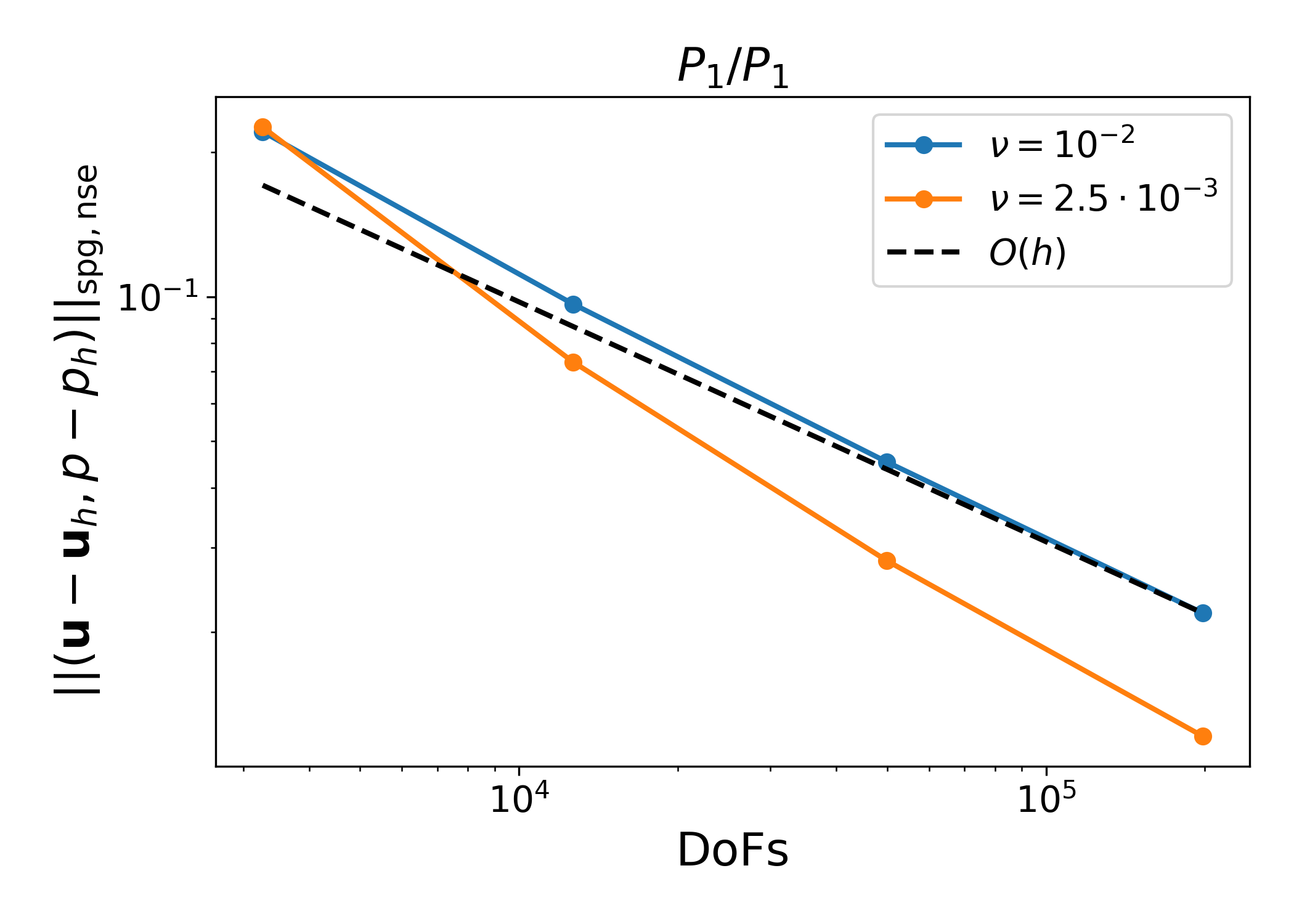
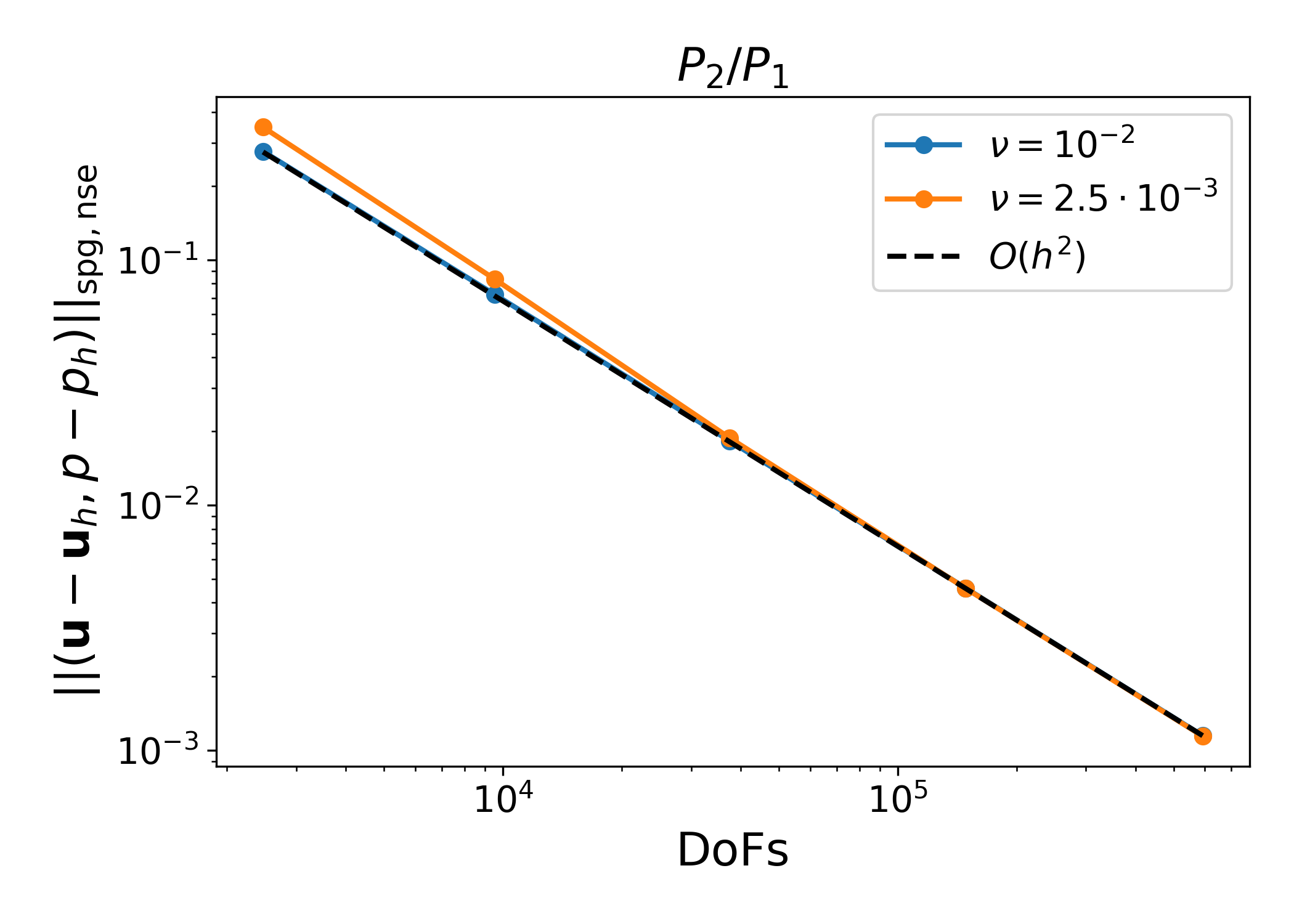
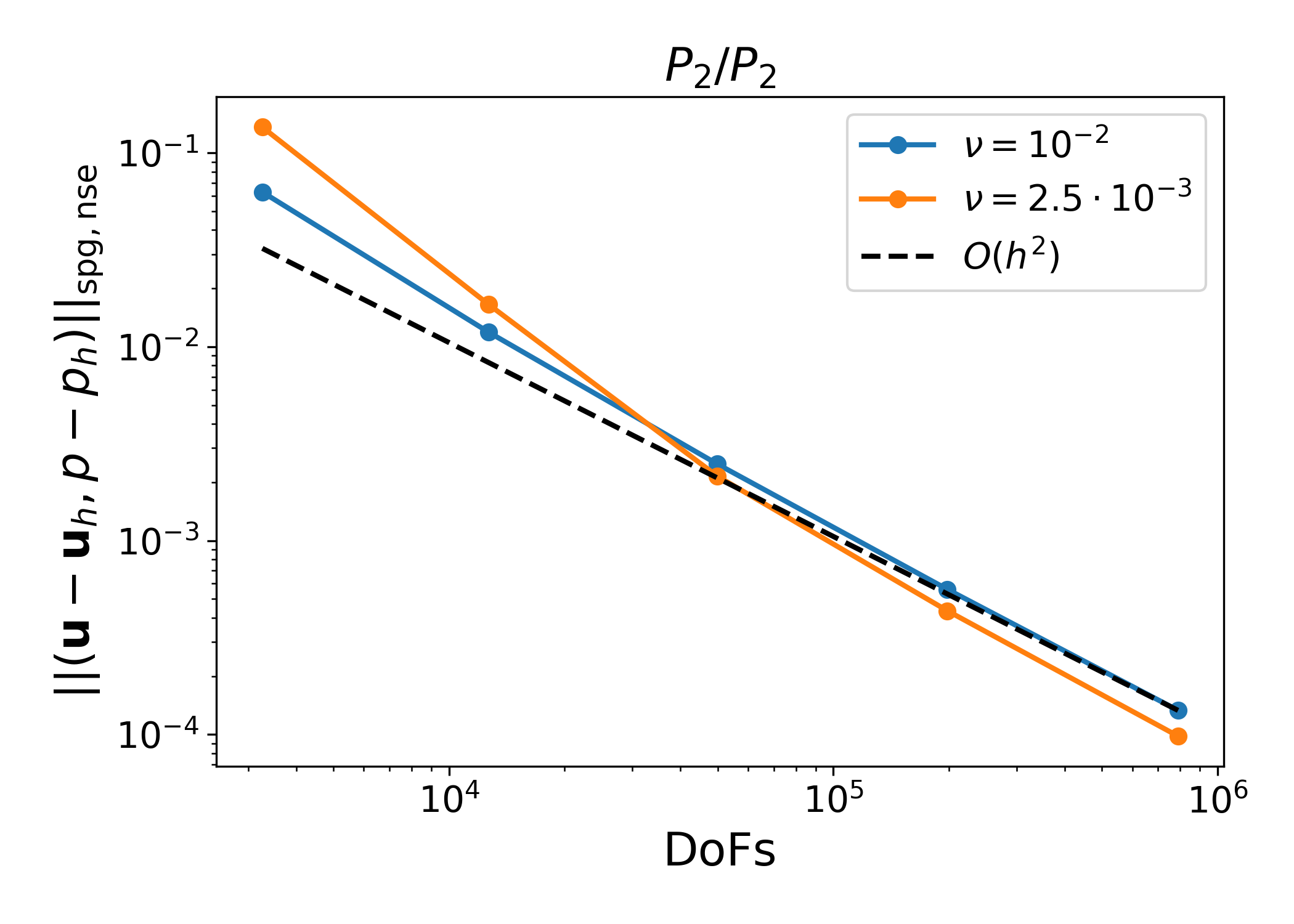
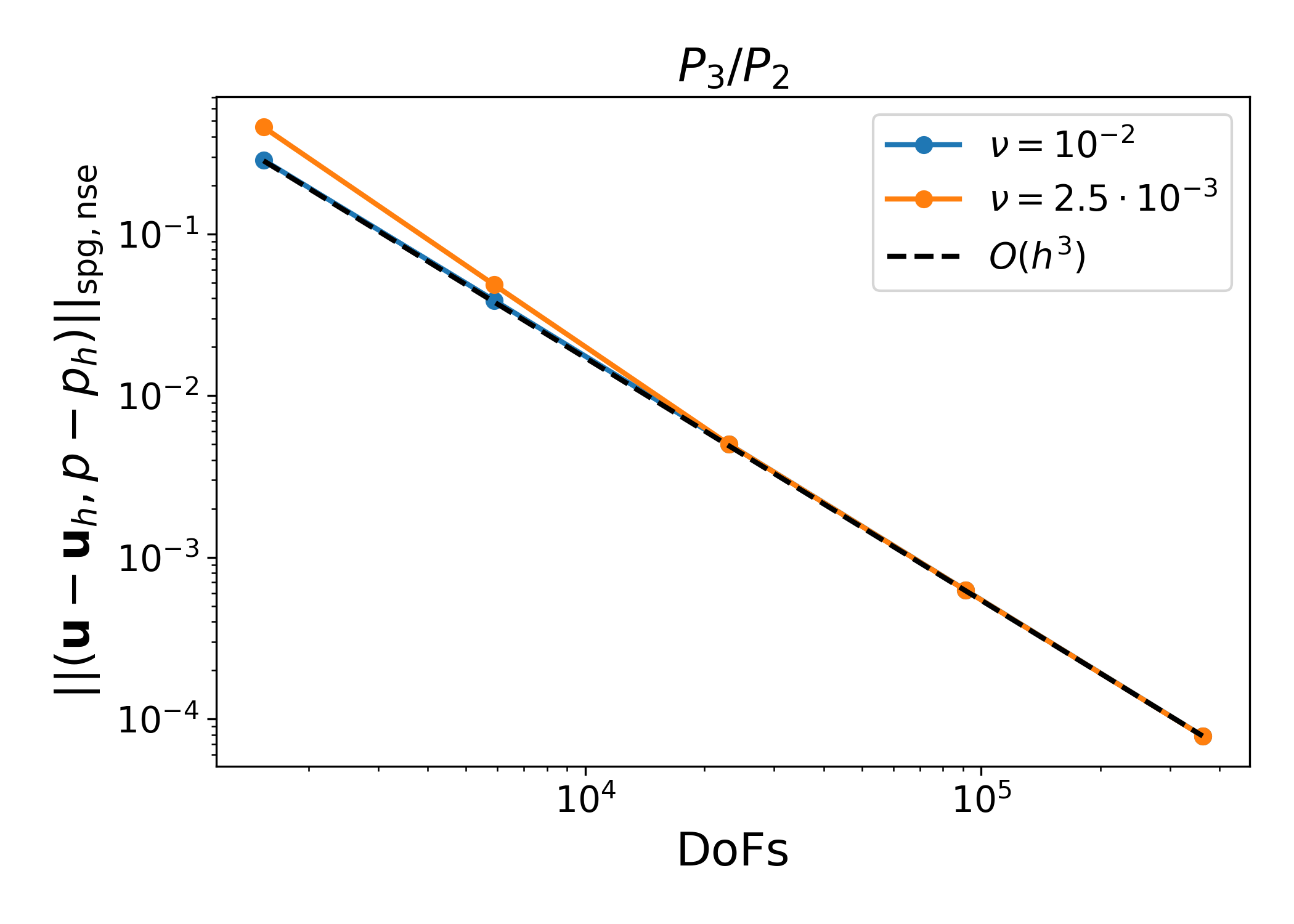
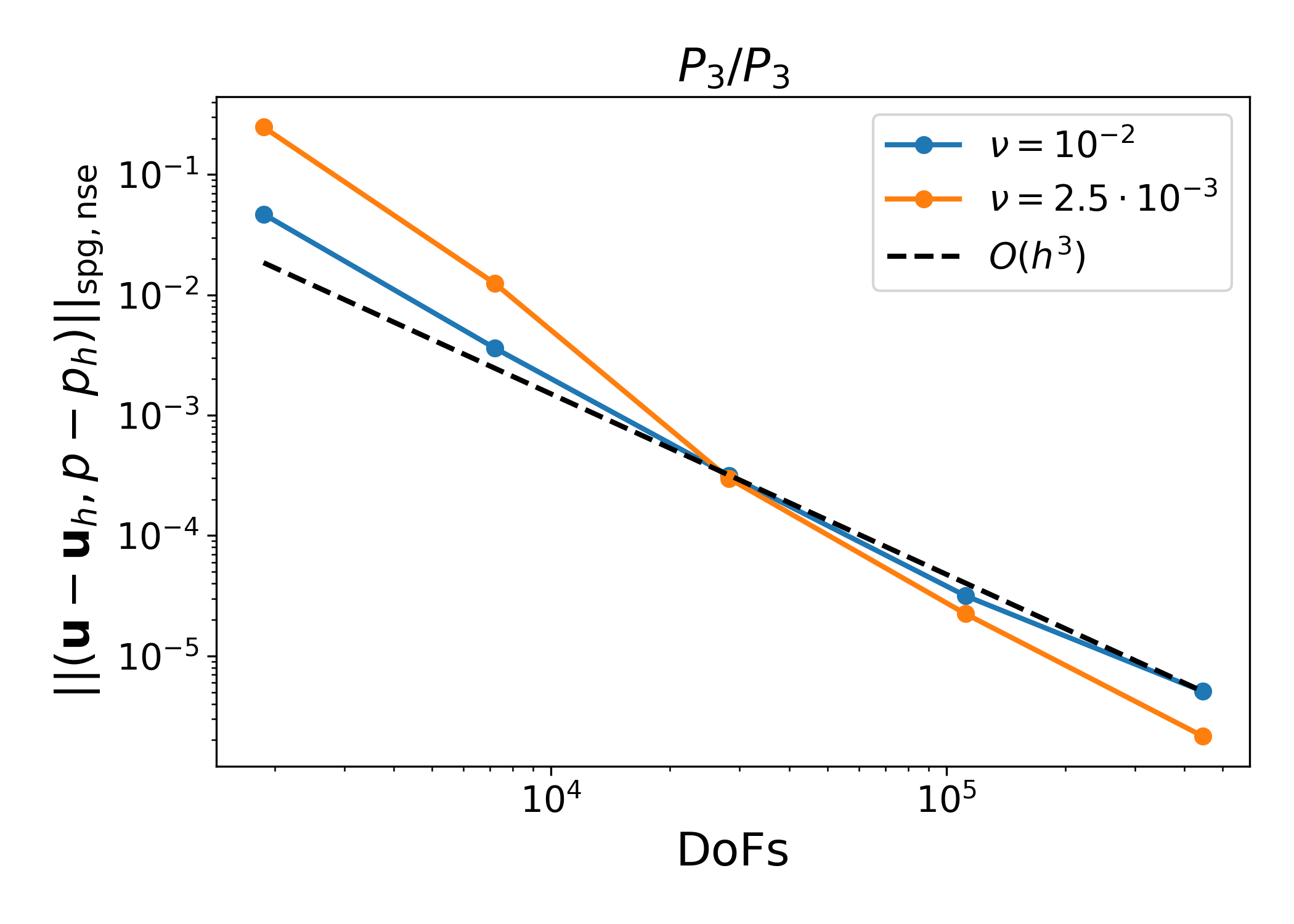
Figure 6: Errors ∥(u−uh,p−ph)∥spg,nse for the Navier–Stokes problem across different pairs and viscosity.
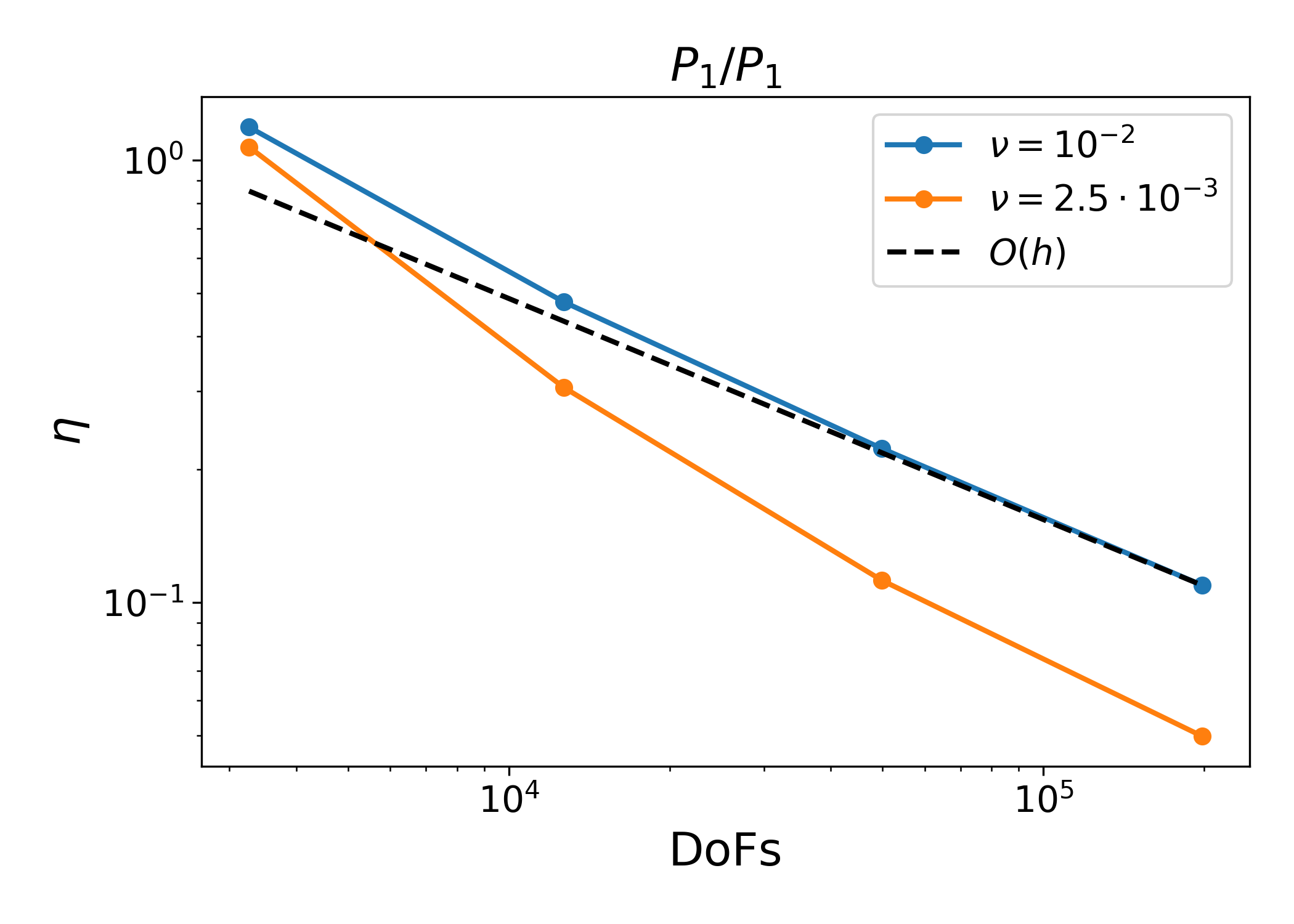
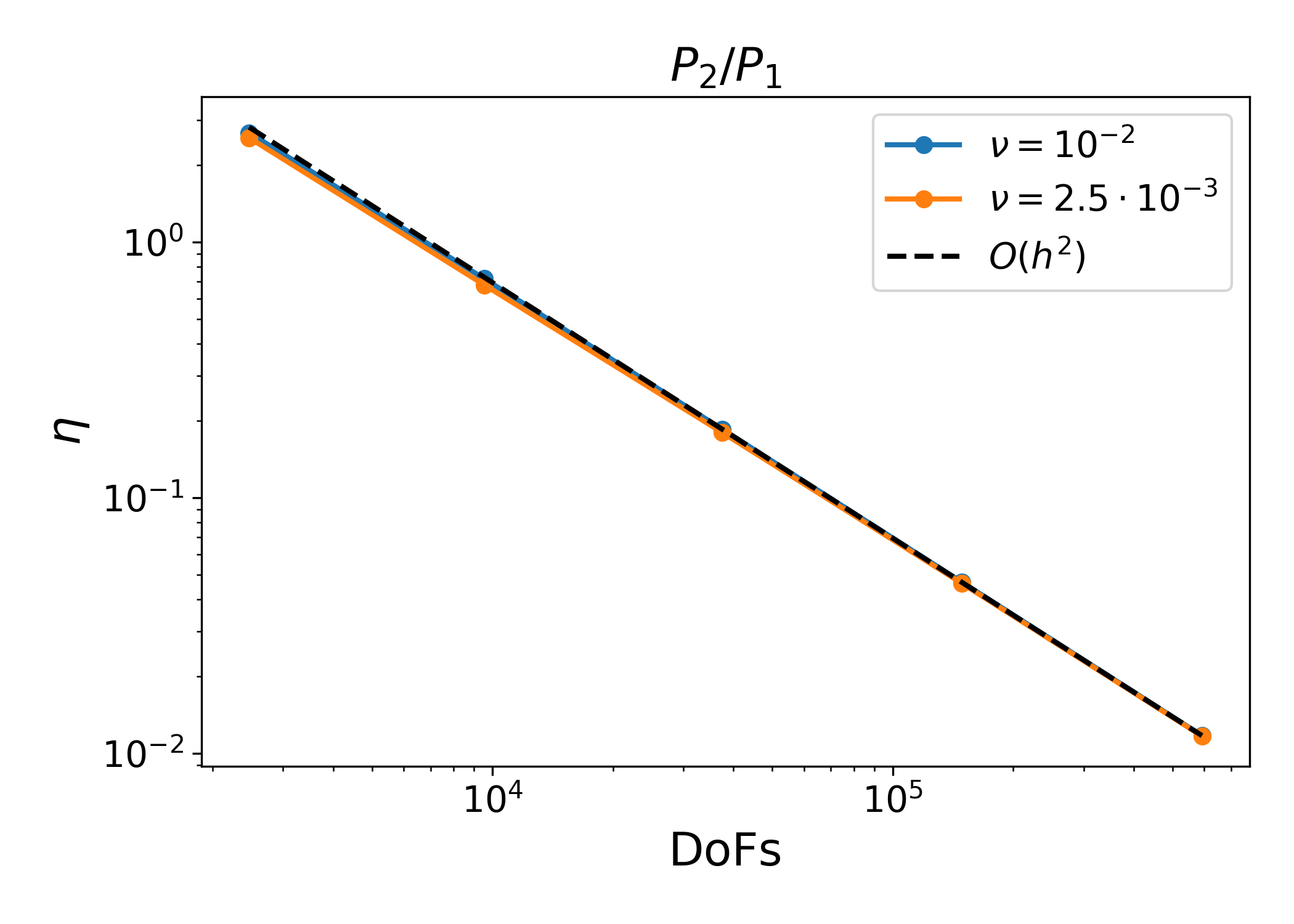
Figure 7: A posteriori error estimator for Navier–Stokes, consistent with error trends and robust effectivity.
Figure 8: Effectivity indices for Navier–Stokes simulations, matching those observed in the Oseen context.
Implications and Future Directions
The proposed estimator achieves robust global error control in convection-dominated flows without sensitivity to viscosity in the norm and error bound. Its effectiveness across stabilization regimes and mesh types facilitates reliable mesh adaptation and error quantification in practical simulations, especially for high Reynolds numbers.
The theoretical framework established here can be extended to more complex geometries, time-dependent problems, and further nonlinearities. Anticipated future developments include the design of localized error estimates for adaptive mesh refinement, investigation of estimator behavior for discontinuous pressure spaces, and refinement of interpolation error hypotheses in challenging solution regimes.
Conclusion
This work rigorously addresses the challenge of robust a posteriori error estimation for the convection-dominated Oseen problem (and its extension to Navier–Stokes), employing stabilized finite element discretizations tailored to multiscale flow features. The residual-based estimator demonstrates stable, parameter-independent overestimation, validated by extensive numerical tests. Its practical implications for error control and mesh adaptivity are broad, and the theoretical tools developed here are expected to inform further advances in numerical analysis for incompressible flows.
“Emergent Mind helps me see which AI papers have caught fire online.”
Philip
Creator, AI Explained on YouTube
Sign up for free to explore the frontiers of research
Discover trending papers, chat with arXiv, and track the latest research shaping the future of science and technology.Discover trending papers, chat with arXiv, and more.