- The paper introduces a unified framework that provides unconditional, guaranteed lower and upper eigenvalue bounds for the Schrödinger problem.
- It demonstrates the efficacy of extra-stabilised nonconforming methods to overcome limitations in adaptive mesh settings, crucial for eigenfunction localisation.
- Extensive numerical experiments validate that direct GLB techniques and efficient GUB computations yield certified spectral approximations under diverse potentials.
Advances in Guaranteed Schrödinger Eigenvalue Bounds: Theory and Practice
Introduction
This paper, "Old and new Schrödinger eigenvalue localisation" (2604.21074), offers a comprehensive analysis of unconditional guaranteed lower and upper eigenvalue bounds (GLB and GUB) for the Schrödinger eigenproblem under Dirichlet boundary conditions. The work systematically unifies classical nonconforming post-processing approaches with recent advances in direct lower bound computation, and highlights the impact of local mesh adaptation, especially in the context of eigenfunction localisation phenomena (e.g., Anderson localisation). It further contributes a novel extra-stabilised nonconforming finite element scheme that circumvents limitations of purely post-processed bounds, achieving practical superiority in adaptive-mesh scenarios.
Theoretical Framework for Two-Sided Spectral Bounds
The Schrödinger operator −Δu+Vu=λu on polyhedral domains Ω⊂Rn with trapping potential V is considered in variational form. Upper bounds for eigenvalues follow immediately from the Rayleigh-Ritz min-max principle applied to conforming discretizations. The computation of a guaranteed lower eigenvalue bound, however, is intricate and closely tied to the discretisation's conformity and associated mesh parameters.
The classic approach for GLB uses nonconforming (NC) methods (e.g., Crouzeix-Raviart (CR), enriched CR (eCR), and Raviart-Thomas (RT) schemes), generating lower eigenvalue estimates by a posteriori post-processing of NC solutions. These bounds are unconditionally valid but typically depend on the maximal mesh size hmax for the triangulation. This dependence can render the lower bounds overly pessimistic, particularly when strong spatial localisation of eigenmodes—common in high-contrast or disordered potentials—drives highly graded adaptive meshes.
Post-Processed Guaranteed Lower Bounds: Limitations and Analysis
The paper develops a unified, rigorous analysis of four distinct post-processed GLB schemes:
- Crouzeix-Raviart (CR): Classical piecewise linear NC elements, processed to obtain GLB via explicit rational functions of the computed eigenvalue and mesh parameters.
- Enriched CR (eCR): Incorporates bubble functions for enhanced approximation and post-processing fidelity.
- Raviart-Thomas (RT): A mixed method framework for piecewise constant potentials, leveraging equivalence with specific NC formulations.
- Modified Crouzeix-Raviart (mCR): Modifies the CR approach by integrating L2 projection post-processing, with improved theoretical bounds over composite eCR (CECR).
The theoretical results characterise GLB in the canonical form
GLB=1+γhλh≤λ
wherein γh is a computable, mesh- and solution-dependent correction, converging as O(hmax2). The bounds are sharp for uniform mesh refinement and piecewise constant potentials, with precise expressions derived for a variety of NC discretizations.
However, when eigenfunctions are strongly localised (as for Anderson-type potentials), local mesh refinement leads to very large hmax (on much of the domain), making γh large and trivialising the GLB—even as the actual error is small. This is evidenced across various benchmarks, both in synthetic harmonic potentials and highly disordered, random settings.
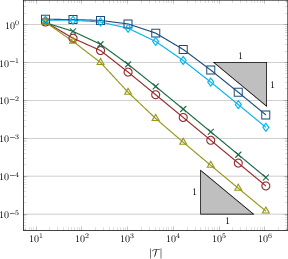
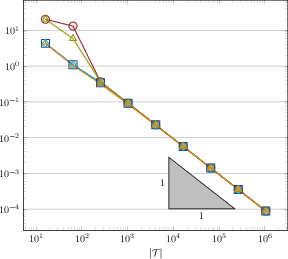
Figure 1: Convergence history plot for Ω⊂Rn0 (left) and Ω⊂Rn1 (right) on uniform meshes of Ω⊂Rn2 for Ω⊂Rn3.
To overcome the intrinsic limitations of post-processed GLB under adaptivity, the authors introduce an extra-stabilised modified Crouzeix-Raviart (sCR) eigenvalue problem. This augmented formulation incorporates an explicit penalty for the deviation between nonconforming and piecewise polynomial spaces, creating a saddle-point problem whose smallest positive eigenvalue constitutes a direct lower bound for the Schrödinger eigenvalue. Critically, the extra-stabilisation term adapts to local mesh parameters, enabling robust performance under highly graded meshes appropriate for localised eigenforms.
The core result is that, for piecewise constant Ω⊂Rn4, the Ω⊂Rn5-th sCR eigenvalue Ω⊂Rn6 yields
Ω⊂Rn7
where Ω⊂Rn8 depends on the local mesh metric and constants from the NC interpolation. This formulation eliminates explicit dependence on Ω⊂Rn9 outside regimes where the computed eigenvalue is sufficiently large relative to the mesh.
On uniformly refined meshes, the mCR and sCR schemes are comparable; however, under adaptive mesh refinement, extra-stabilised sCR is uniquely effective, producing nontrivial GLBs matching the actual rate of eigenvalue convergence. Numerical experiments confirm these effects across model problems, including those with geometric singularities and Anderson-type random potentials.
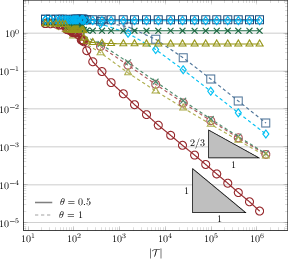
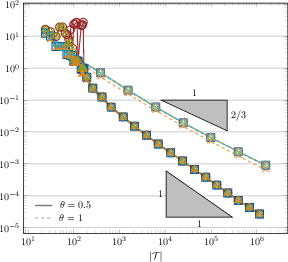
Figure 2: Convergence history plot for V0 (left) and V1 (right) on uniform (dashed) and adaptive (solid) meshes of V2 for V3.
Efficient Computation of Upper Eigenvalue Bounds
The paper also elaborates on cost-effective computation of guaranteed upper bounds (GUB) for the eigenvalues, without recourse to higher-order conforming solves. The key is to post-process the computed (NC) eigenfunctions via averaging into a conforming finite element space, and solve a small generalized eigenproblem in the image space. This method provides upper bounds with accuracy matching that of standard conforming FEM, even when using NC trial spaces, all at much reduced computational complexity.

Figure 3: Methods for GLB/GUB in the computational benchmarks, indicating the relationship between discretisation schemes and their corresponding spectral bounds.
Computational Benchmarks and Eigenfunction Localisation
The work includes a broad suite of numerical experiments that highlight both the strengths and limitations of each GLB and GUB scheme across different spectral regimes. In particular:
- In smooth, uniformly-refined contexts, the traditional post-processed bounds are reliable and converge optimally with mesh refinement and eigenvalue index.
- For domains exhibiting singularities (e.g., L-shaped geometries) or random/disordered (Anderson) potentials, the extra-stabilised sCR scheme uniquely maintains the sharpness of both GLB and GUB under aggressive adaptive refinement.
The experiments underscore the phenomenon of eigenfunction localisation, where adaptive meshes cluster resolution in small spatial regions critical to accurate solution, and demonstrate the dramatic superiority of direct, locally sensitive GLB techniques in such settings.
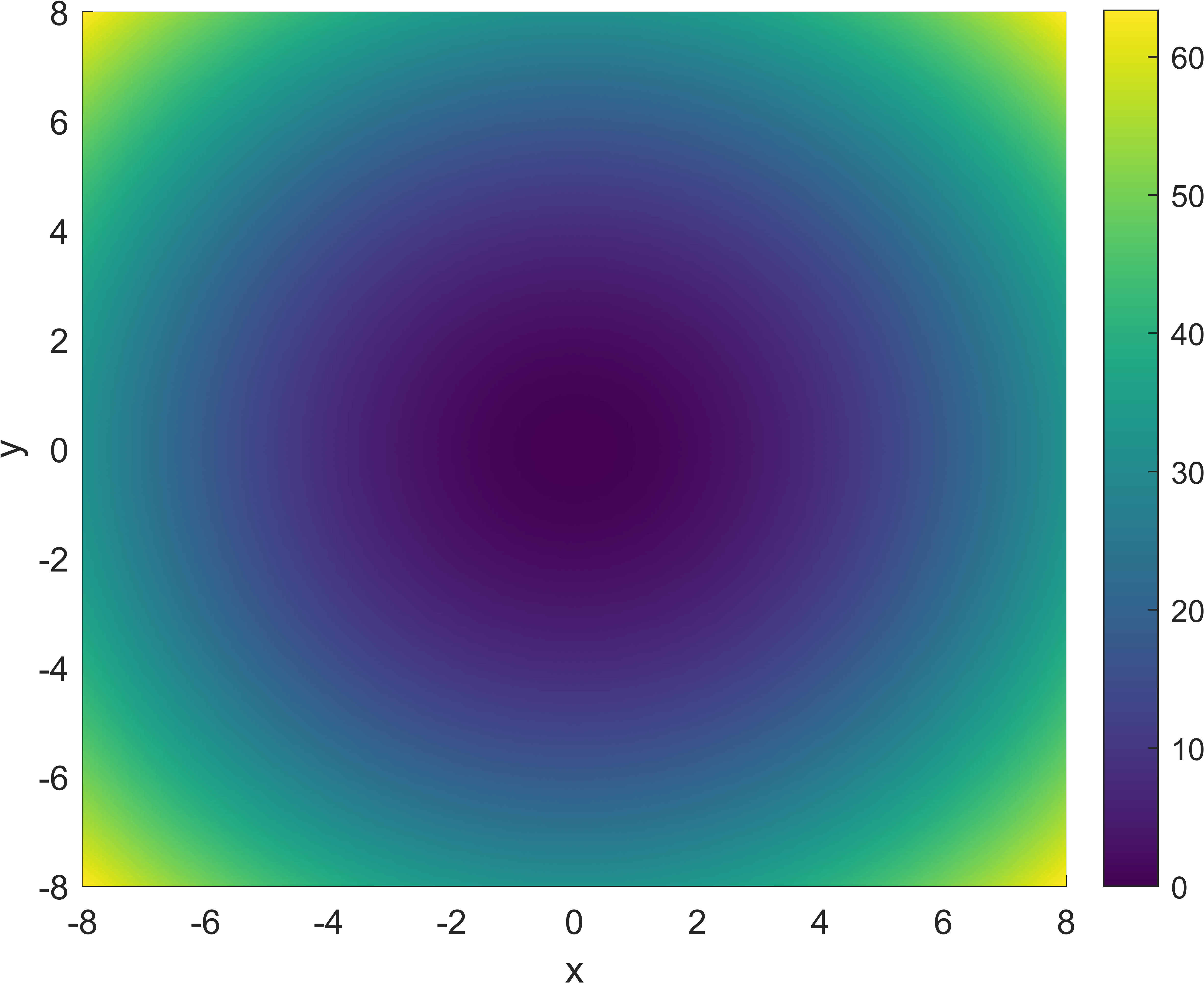
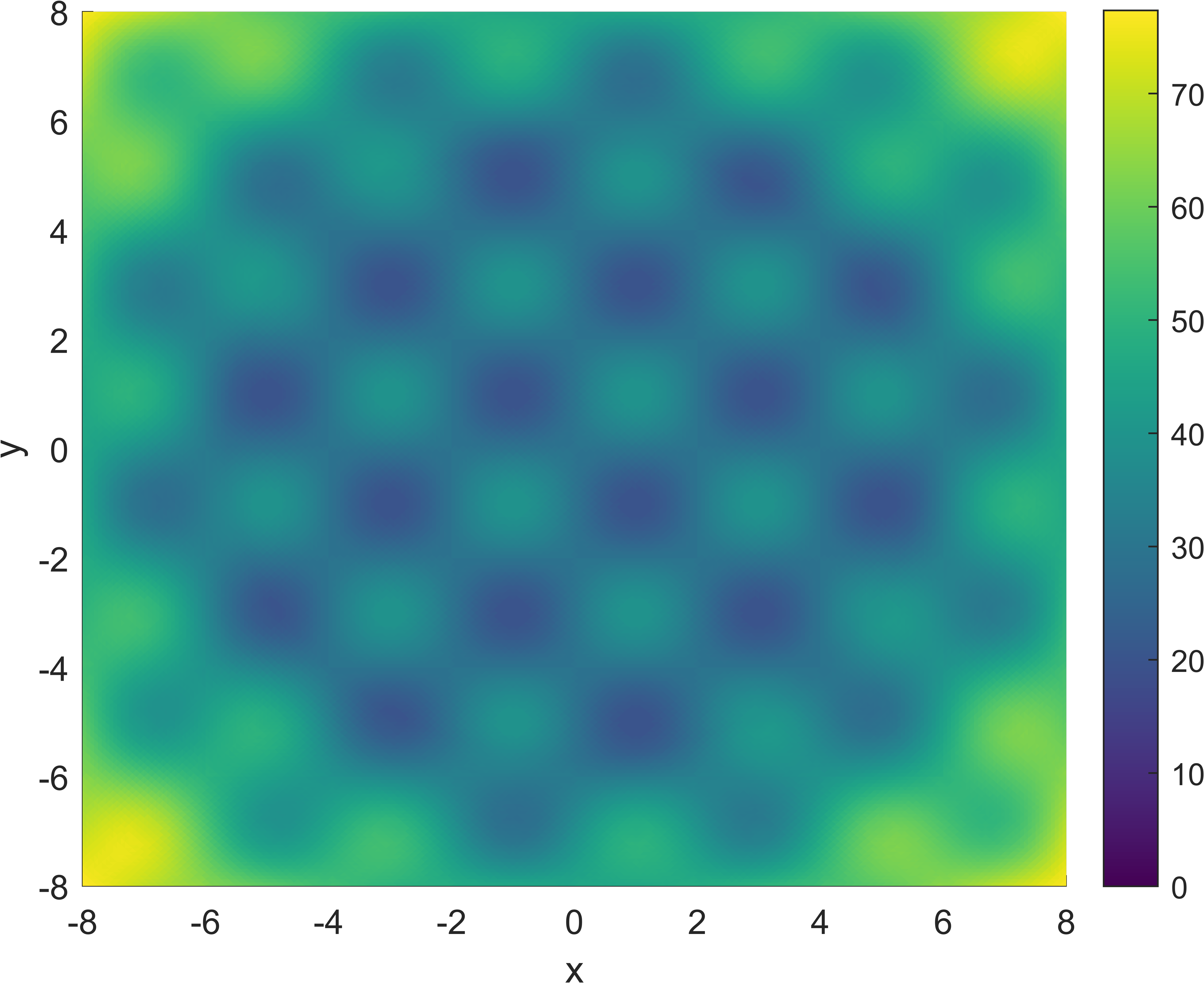
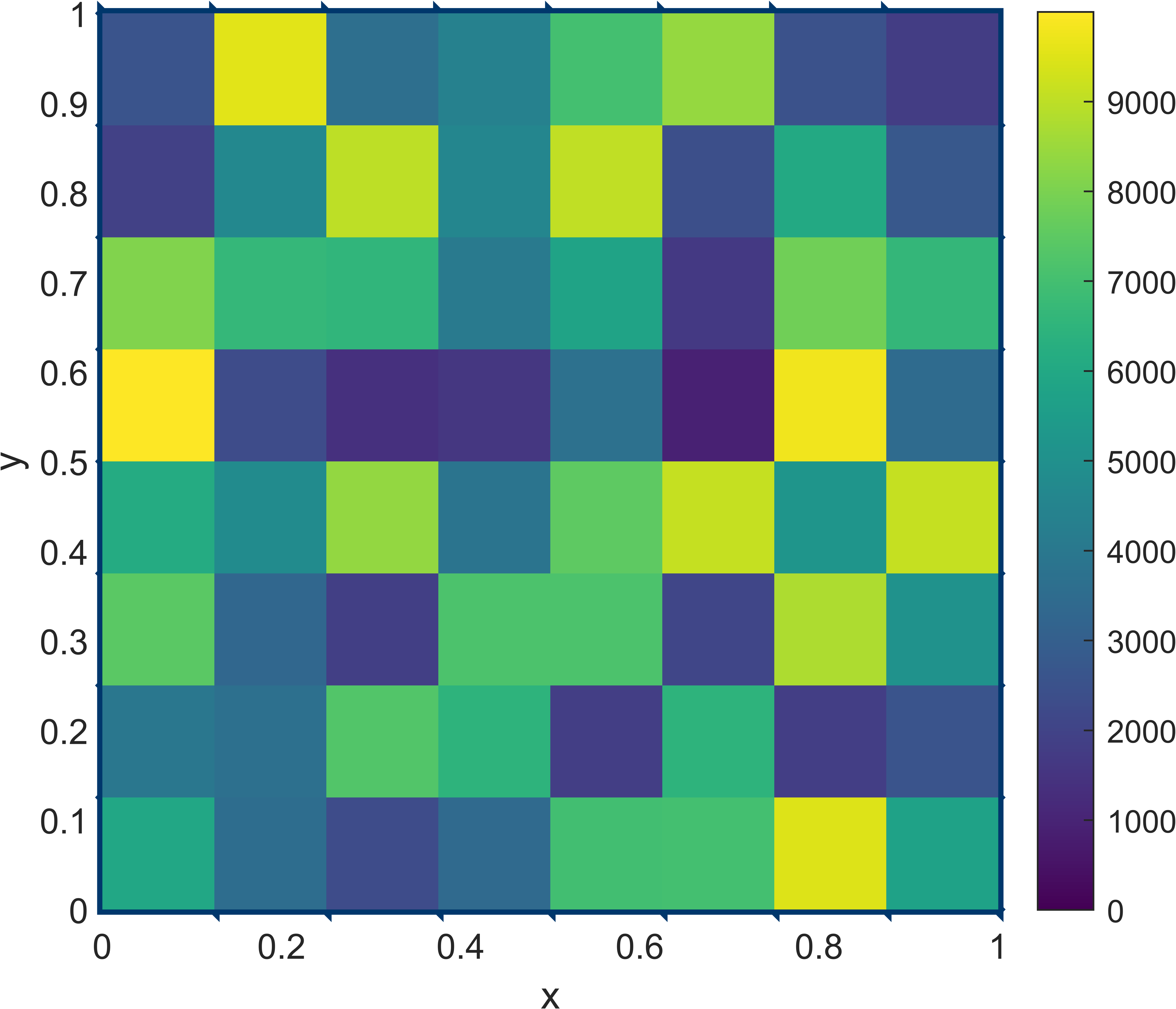
Figure 4: Projection onto piecewise constants of V4 (first row) and CR approximations of the corresponding ground states (second row), visualising eigenfunction localisation effects for different potentials.
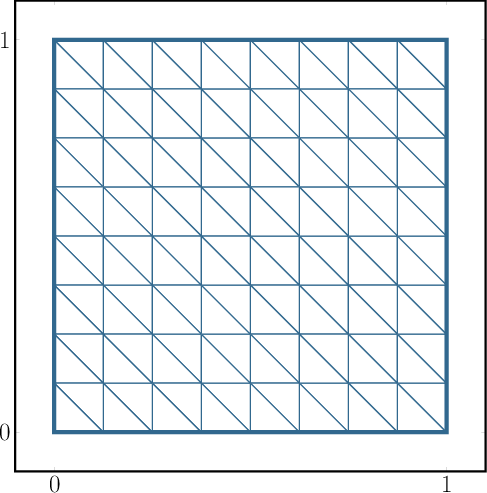
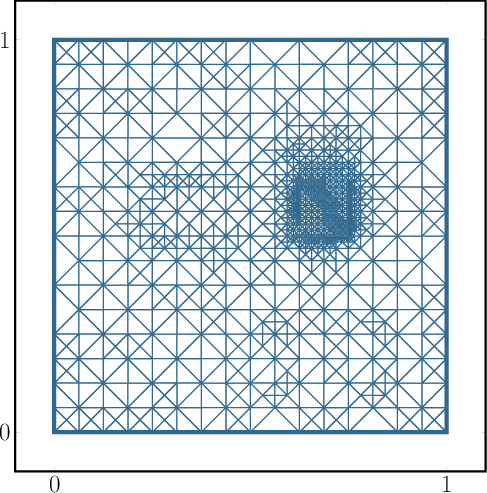
Figure 5: Initial (left) and adaptively refined (right) triangulations for Anderson potential, demonstrating mesh concentration near the support of the localised ground state.
Implications and Future Directions
The theoretical insights and numerical results presented demonstrate that reliable two-sided spectral containment for the Schrödinger problem—particularly in applications involving localising potentials or complex geometries—requires careful mesh-dependent treatment, such as the advocated extra-stabilisation strategy. The direct GLB method is robust to mesh grading and adaptation, overcoming inherent limits of classical post-processing approaches.
Practically, this has significant consequences for eigenvalue problems arising in quantum mechanics, photonic crystals, disordered systems, and for the design of high-fidelity computational eigenvalue solvers with fully certified error bounds. Theoretically, the general stability and convergence framework for direct GLB paves the way for extension to other classes of operators, including higher-order and non-selfadjoint problems, and for rigorous adaptive algorithms with automatic mesh control.
Prospective research directions include generalisation to non-piecewise constant diffusion coefficients, rigorous a priori and a posteriori convergence theory in the most general settings, coupling with stochastic multilevel solvers for random potentials, and algorithmic optimisation for very high-index spectral computations.
Conclusion
This work establishes a unified theoretical and practical framework for guaranteed lower and upper spectral bounds for the Schrödinger operator. Through critical analysis of both classical and new mesh-adaptive strategies, it demonstrates that direct, locally stabilised NC finite element methods circumvent the fundamental mesh-size limitations of post-processed bounds, particularly in adaptive, localising, or high-contrast regimes. The extra-stabilised approach provides an effective basis for certified spectral computations in both smooth and highly complex quantum systems.