- The paper introduces a local high-order space-time adaptive MLSDC method that combines DG-SEM with semi-implicit MLSDC to solve nonlinear conservation laws.
- It employs a novel error estimator that integrates spatial spectral decay and temporal extrapolation to drive local h/p and p adaptivity.
- Numerical experiments on Burgers’ and Euler equations demonstrate substantial runtime savings and improved accuracy compared to uniform discretizations.
High-Order Local Space-Time Adaptive MLSDC for Conservation Laws
Overview and Context
The paper "Local high order space-time apdaptive MLSDC" (2606.14369) introduces a highly technical hybridization of discontinuous Galerkin spectral element space discretization with semi-implicit Multilevel Spectral Deferred Correction (MLSDC) time integration, equipped with genuine local space-time adaptivity. This framework incorporates arbitrary-order h- and p-refinement in space, together with multilevel p-refinement in time, and leverages a novel error estimator to trigger local adaptivity. The method targets nonlinear conservation laws, with numerical experiments spanning Burgers' equation and the Euler equations, including classical benchmark cases.
Methodological Foundations
The method builds on semi-implicit MLSDC [MG_Pfister2025], extending it to local adaptive refinement. The space-time discretization employs DG-SEM, partitioning the domain into spectral elements (spatial) and time slabs (temporal), with polynomial representations in both. The MLSDC framework iteratively solves collocation equations at Radau-Right nodes, facilitating high-order accuracy (2Ml−1 in time for Ml nodes).
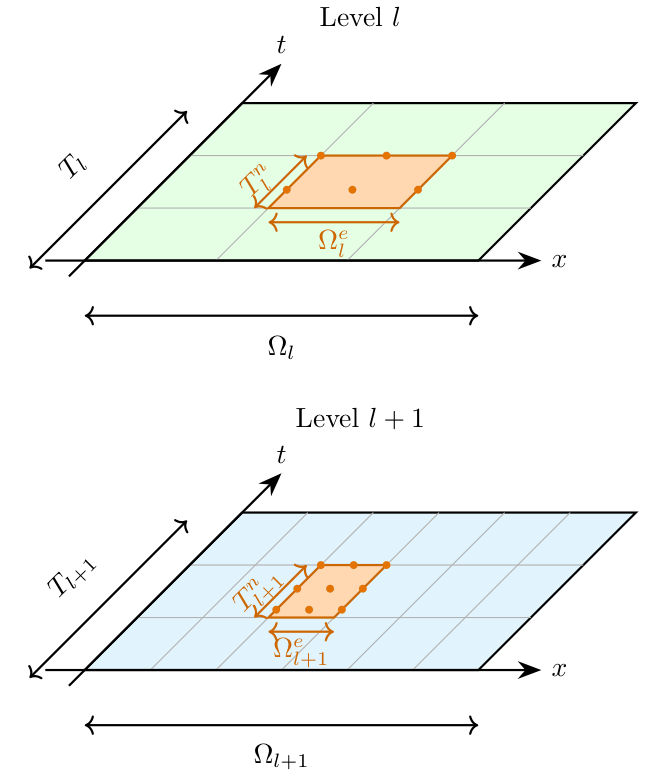
Figure 1: Multilevel space-time discretization illustration; level l+1 exemplifies increased spatial resolution (h-refinement) and temporal nodes (p-refinement) over level l. Orange points mark space-time coefficients Qle,n.
A genuinely space-time adaptive mesh routine is introduced. Elements are categorized as active (twig or leaf), frozen (interpolated from coarser levels), with refinement and activity markers managed by the error estimator. Refinement in time is restricted to p0-adjustment (collocation nodes), while spatial refinement admits arbitrary p1/p2.
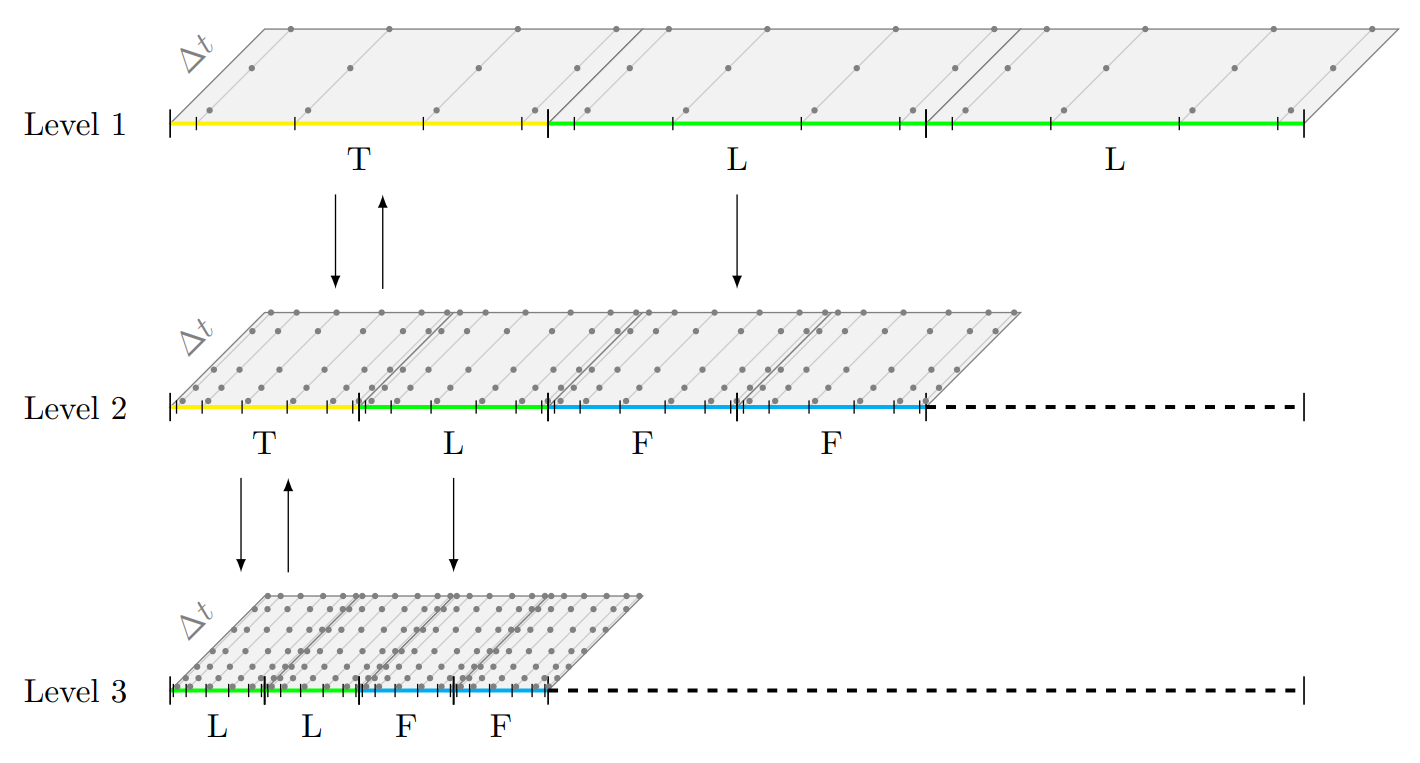
Figure 2: Adaptivity workflow: local p3/p4 refinement in space, p5 refinement in time, element classes, and mesh evolution.
Transfer operators (interpolation, restriction, projection) are realized as algebraic matrices acting on the coefficient vectors; fine-to-coarse mechanisms aggregate residuals and prolongate corrections, strictly within active regions.
Brandt's FAS multigrid paradigm is invoked: on each adaptive level, collocation equations are solved on active elements, with FAS right-hand side contributions (computed from finer level projections and restricted residuals) present only on non-finest levels. The adaptive MLSDC algorithm integrates pre-/post-smoothing, correction prolongation, and FAS right-hand side assembly, strictly restricted to active mesh regions.
Error Estimation and Adaptivity
A key innovation is a unified local space-time error estimator. For spatial error, the spectral estimator [EE_MavriplisDiss1989] models truncation and quadrature/interpolation error via the modal decay of Legendre coefficients, extended and fit across the polynomial basis. The temporal estimator, novel to this work, constructs a dual-part indicator: (i) extrapolation error from difference between successive SDC iterates at the final collocation node (Richardson-style), and (ii) a superconvergent truncation error leveraging SDC's endpoint accuracy (p6), integrating spectral coefficients beyond this order.
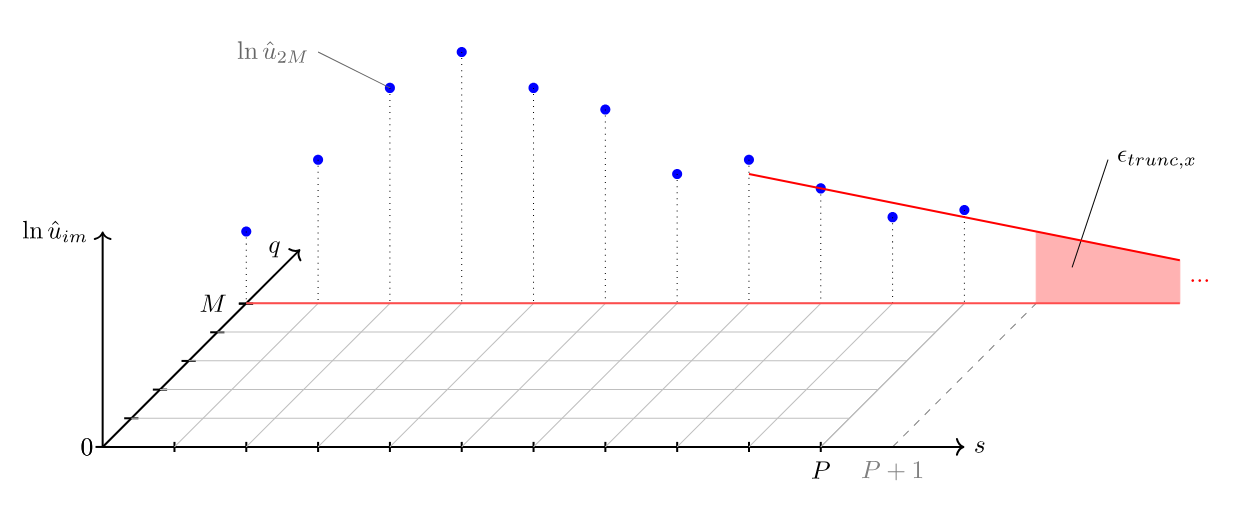
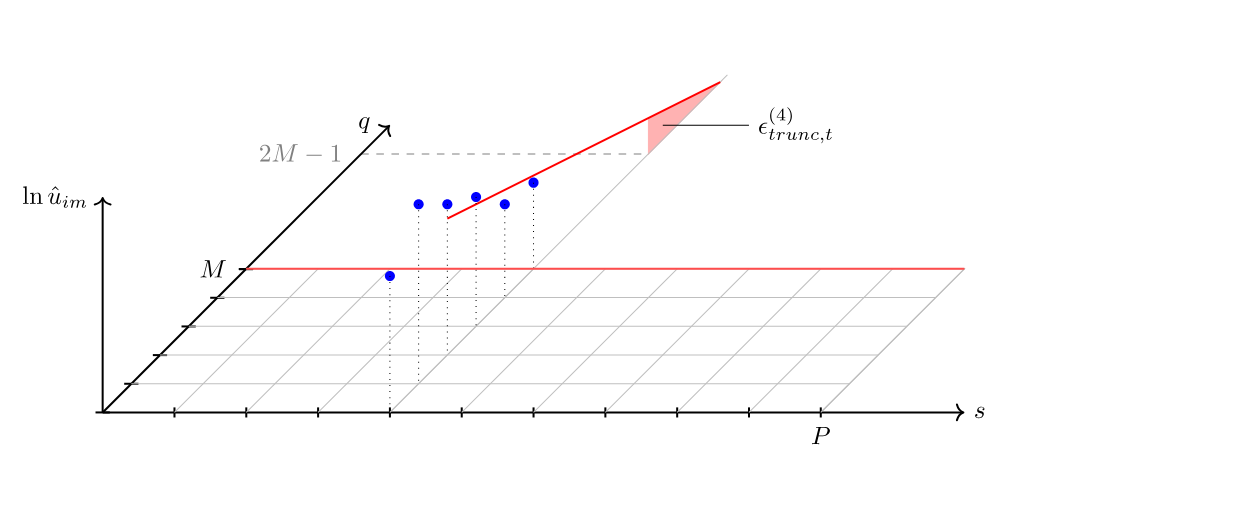
Figure 3: Process for spatial truncation error estimation at the final temporal node p7.
Both estimators are individually calibrated and filtered for numerical noise. Their sum—conservative by construction—guides local mesh refinement; the estimator is validated against measured p8 error in controlled experiments, consistently providing a reliable refinement indication.
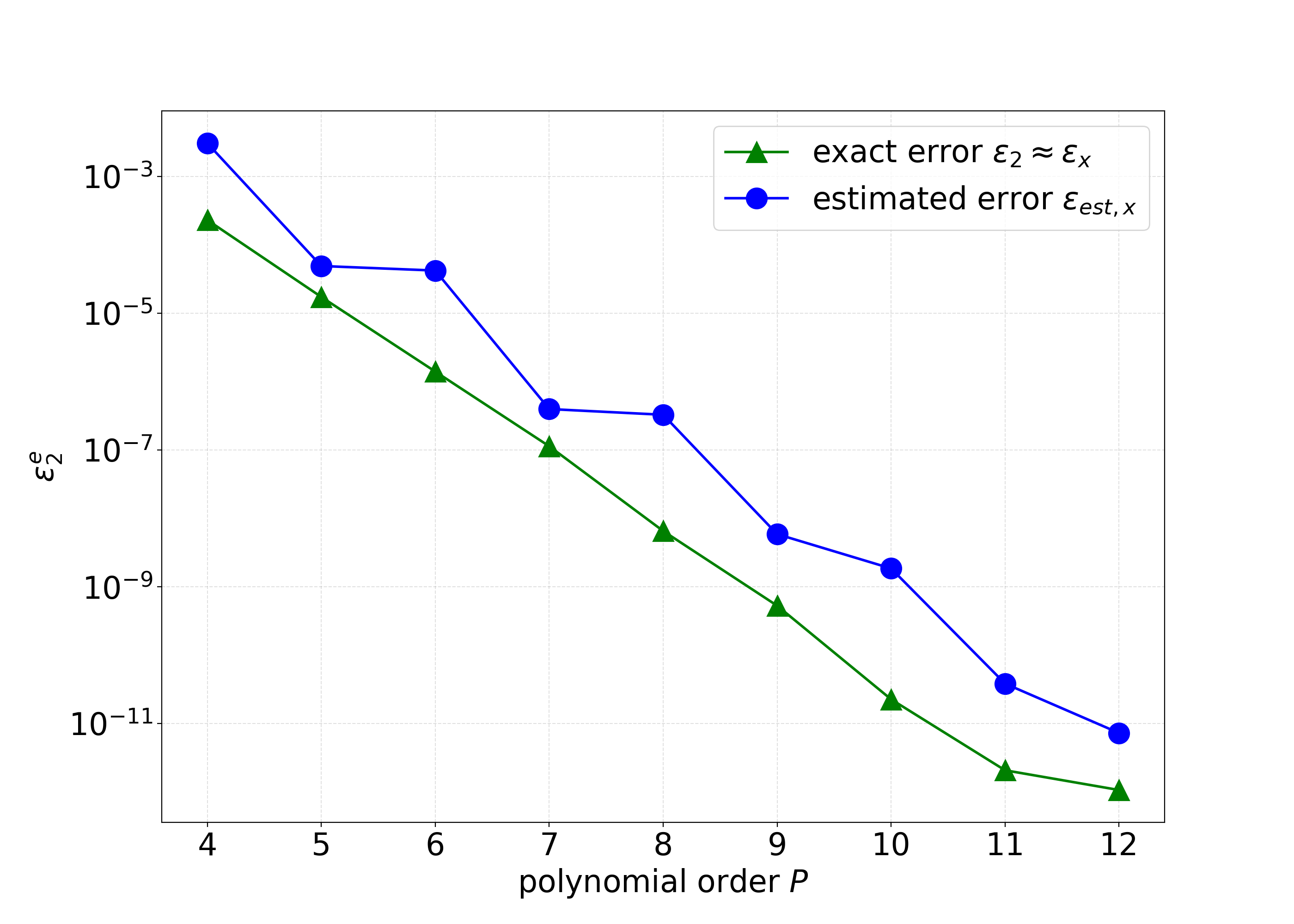
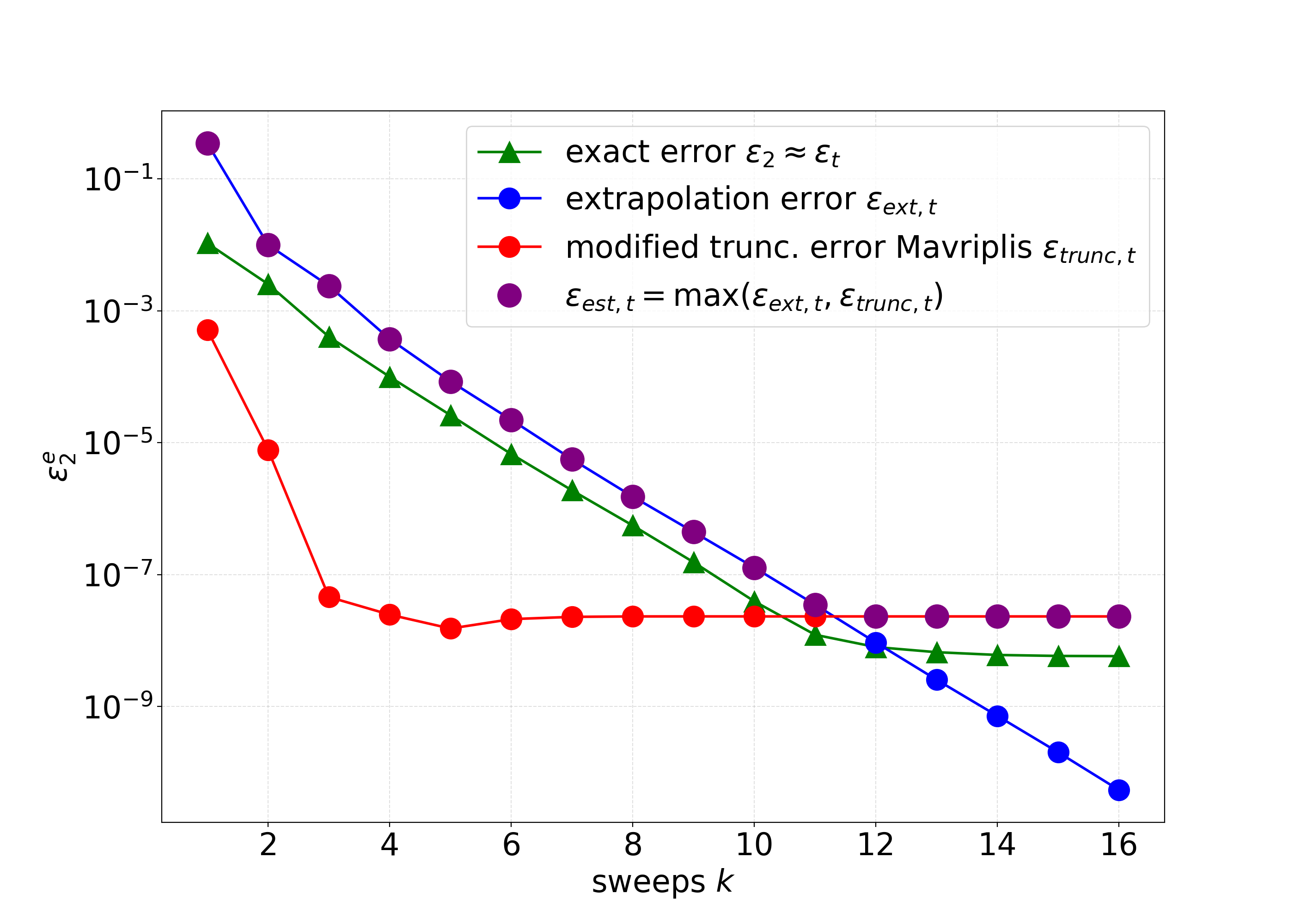
Figure 4: Spatially dominated error regime—comparison of estimated (overpredictive) vs actual error across polynomial orders.
Numerical Analysis and Benchmark Results
Burgers' Equation Moving Front
The adaptive MLSDCp9 method is applied to the Burgers’ equation with a moving shock front (p0, p1). Adaptive refinement, governed by stringent thresholding of the error estimator, dynamically tracks the propagation of the shock, refining only where needed and coarsening in its wake.
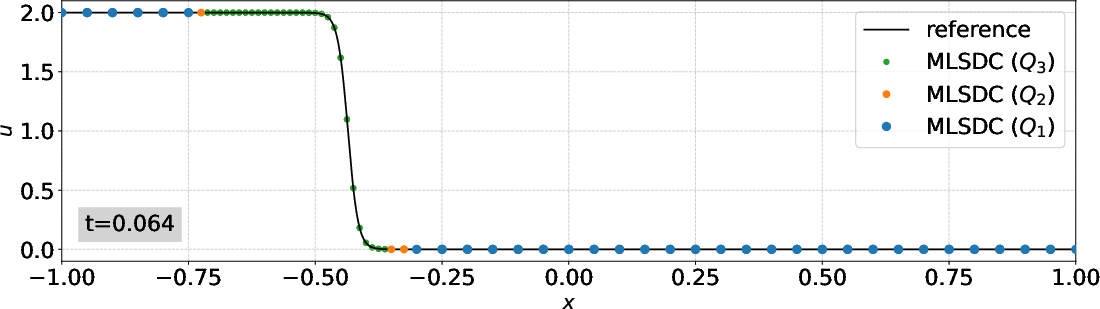
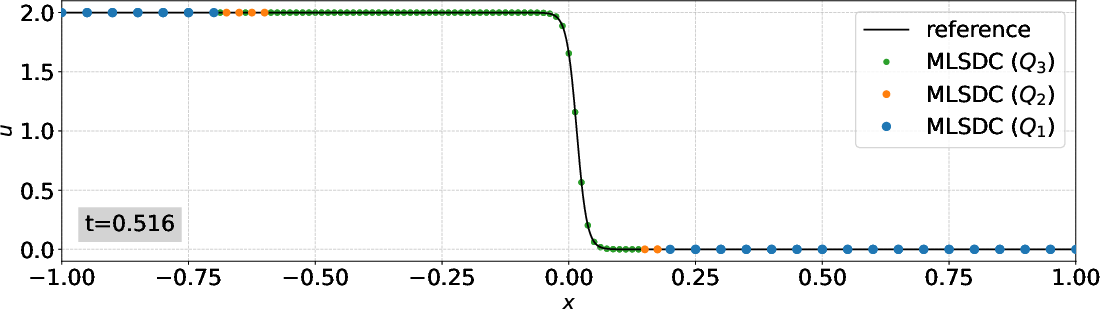
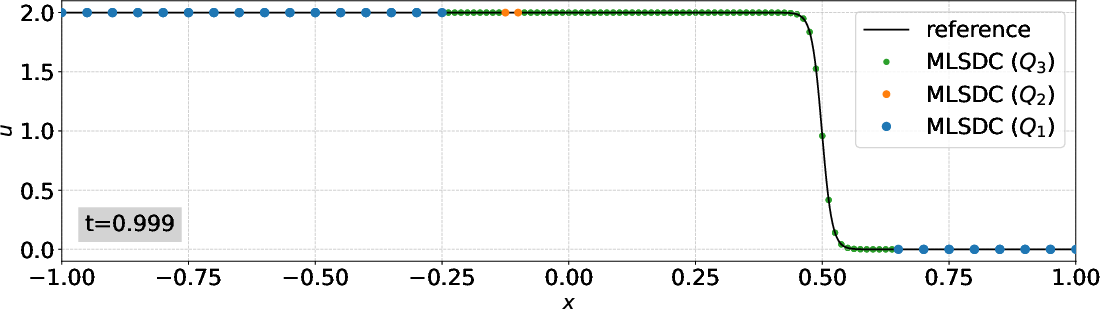
Figure 5: Solution of Burgers' moving front at p2, element boundaries visualize refinement locally around the shock.
Comparisons show that runtime is reduced to p3 of that required by an equivalent globally refined discretization. Error-runtime diagrams establish that adaptive MLSDC outperforms both classical TVD-RK3 and single-level SDC/MLSDC at the same accuracy, with increased proportional gains as error thresholds decrease.
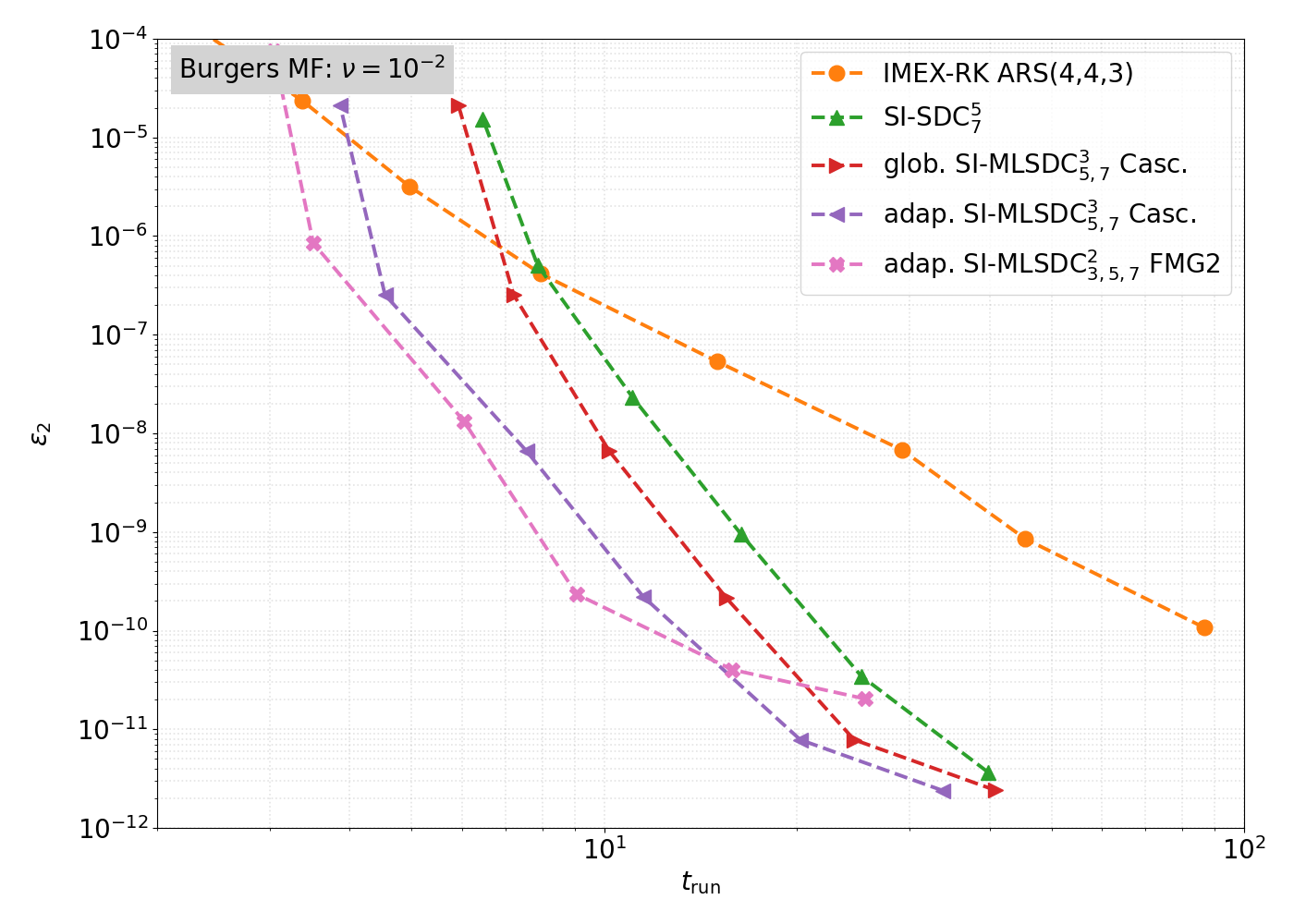
Figure 6: Error versus runtime for IMEX RK, SDC, globally and locally adaptive MLSDC on Burgers’ moving front (p4).
Refinement Criteria Comparative Study
The space-time error estimator is contrasted with alternative criteria (exact p5 error, Henderson’s indicator [EE_Henderson1999], Persson’s artificial diffusivity [SE_Persson2006a]). The spectral estimator and exact error lead to highly localized refinement zones and the lowest runtimes at fixed accuracy; artificial diffusivity over-refines and is suboptimal; Henderson’s estimator proves quantitatively efficient, but fails on tests with discontinuities.
Shu-Osher Shock-Fluctuation Benchmark
For the 1D Euler Shu-Osher problem [TI_Shu1989a], adaptive MLSDCp6 achieves the accuracy of the finest uniform SDC discretization while incurring p7 lower computational cost. The error estimator robustly captures both the shock front and oscillatory regions, ensuring compact, dynamically evolving refinement regions.
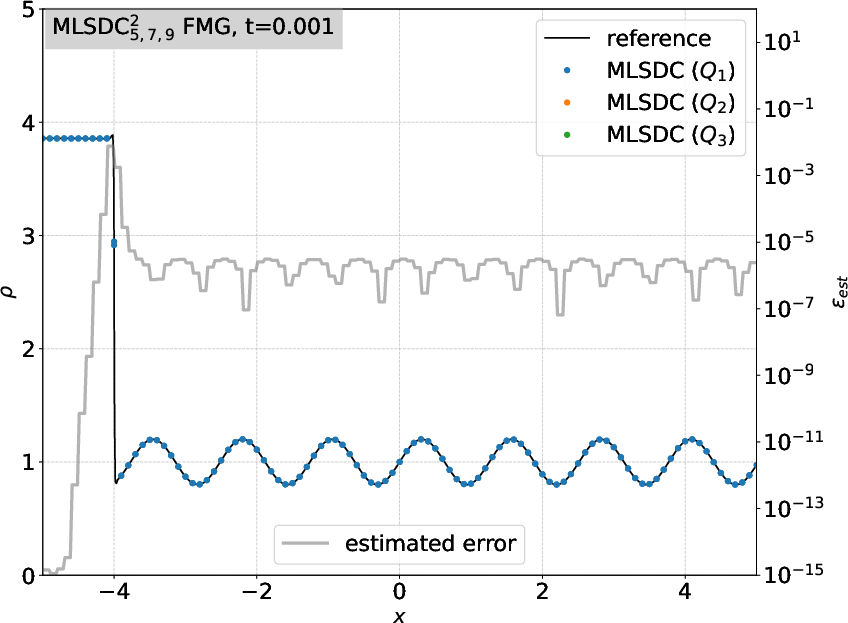
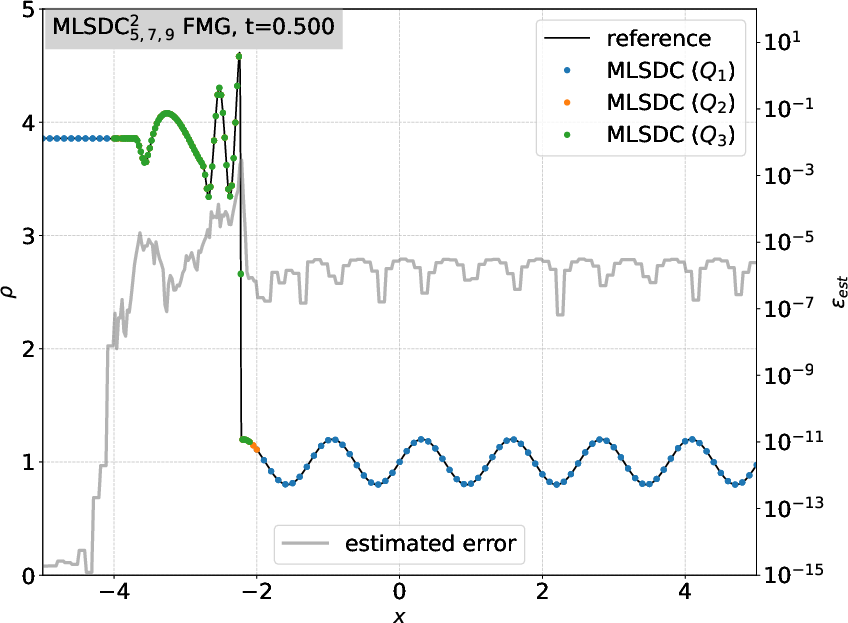
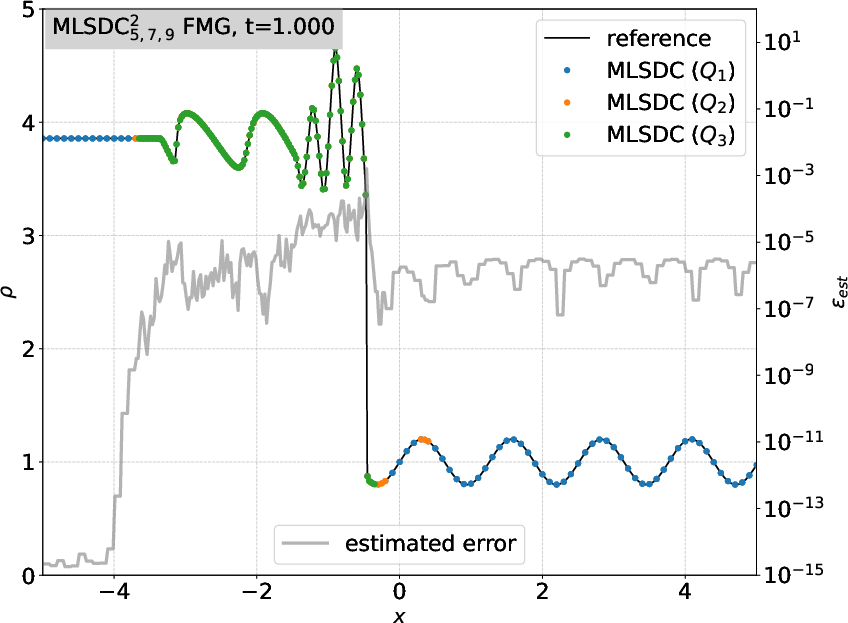
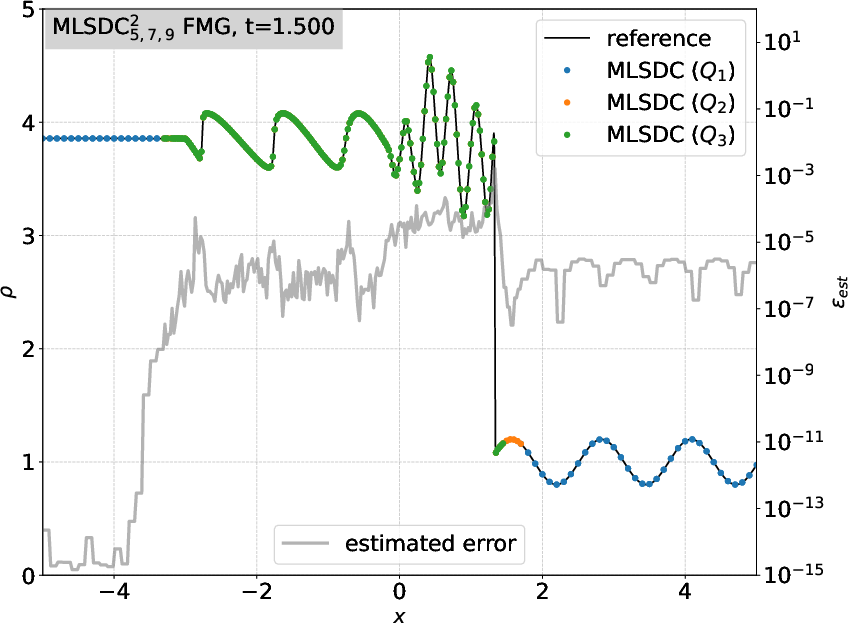

Figure 7: Solution and local error estimate for Shu-Osher shock-fluctuation at p8, element boundaries indicate local mesh adaptivity.
Diagnostic figures demonstrate that coarse and intermediate uniform SDC discretizations significantly underresolve the solution, while adaptive MLSDC achieves parity with the finest level.
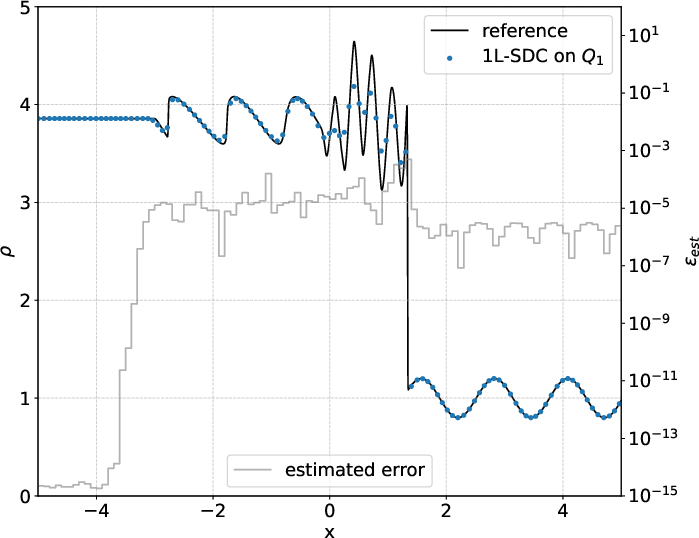
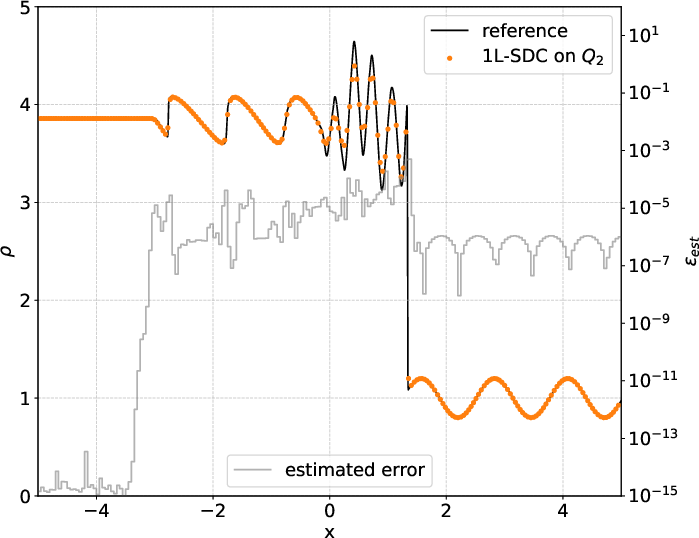
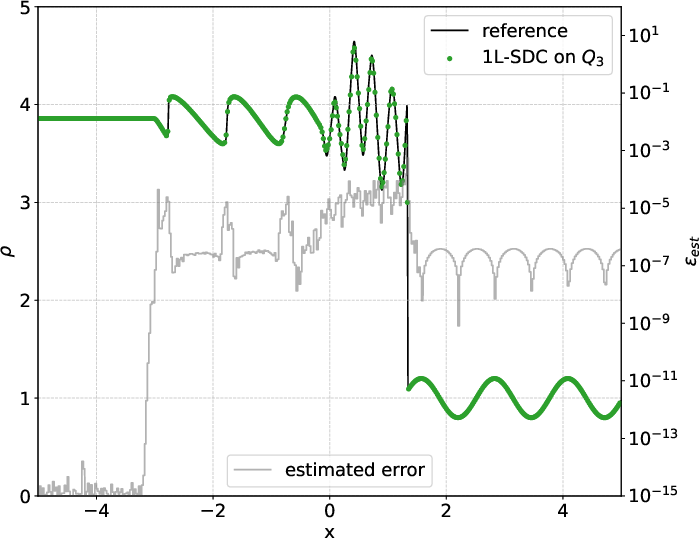
Figure 8: Solution for single-level SDC (level 1), highlighting underresolved features.
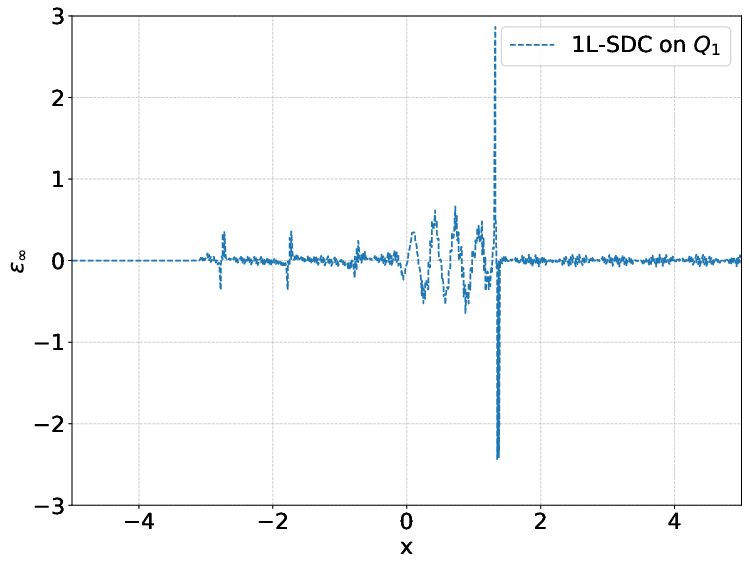
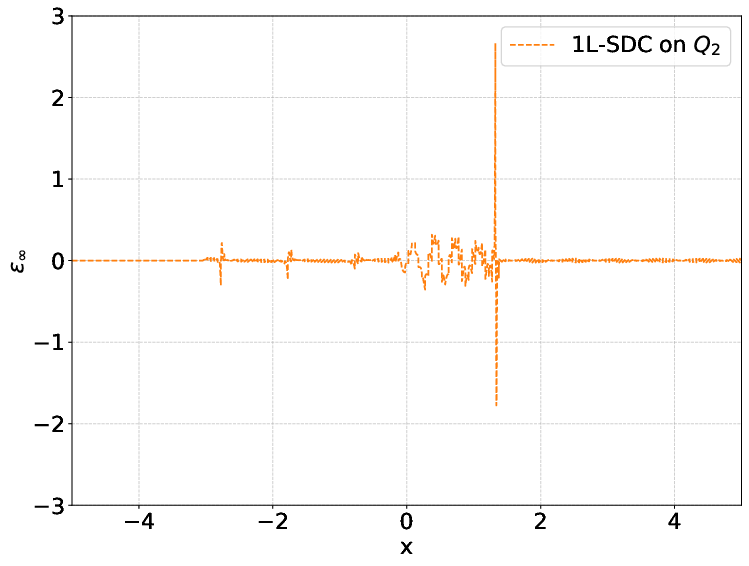
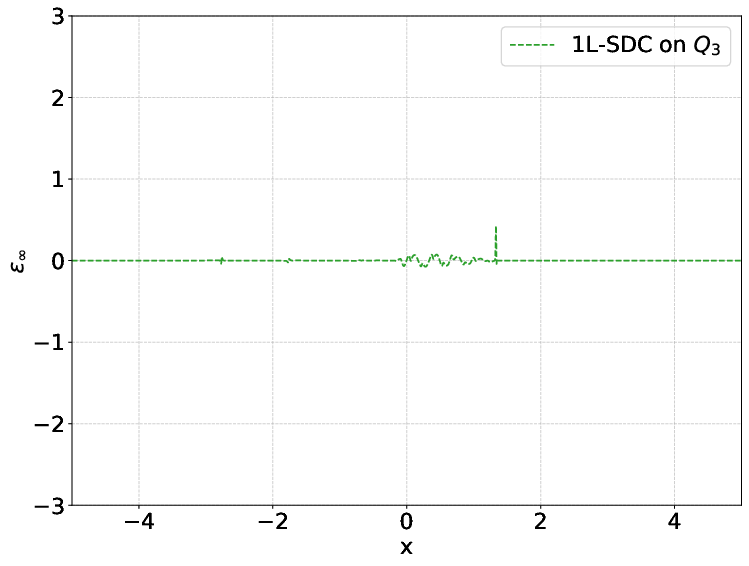
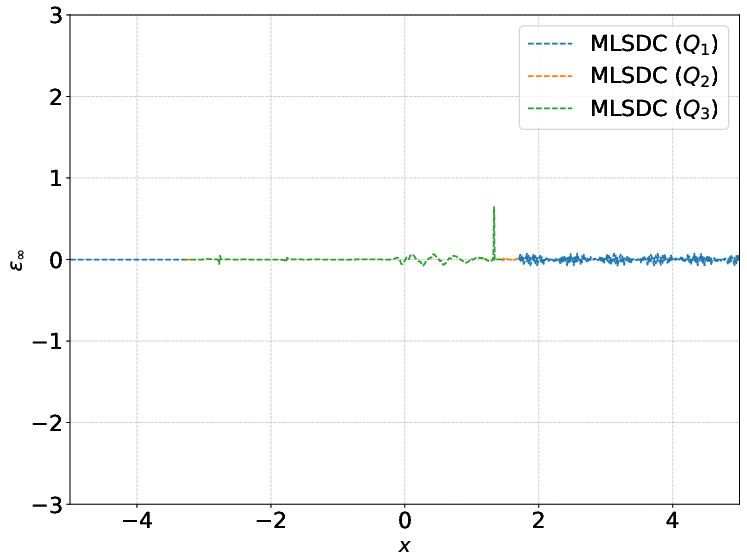
Figure 9: Difference to reference for single-level SDC (level 1), visualizing local error misdistribution.
Theoretical and Practical Implications
The method demonstrates that genuine local space-time adaptive refinement can be harnessed in high-order DG-SEM/MLSDC frameworks, yielding:
- Compact localized refinement regions (space and time), directly linked to the estimated local discretization error.
- Arbitrarily high-order accuracy in both space and time (p9-th order achievable), exceeding historic limits of four for prior adaptive MLSDC methods.
- Robust tracking of moving discontinuities and oscillatory features, leveraging spectral error estimators.
- Significant reduction in computational cost, with efficiency gains scaling with problem dimensionality.
The inclusion of a spectral estimator for time—sensitive to SDC collocation superconvergence—is a pronounced technical advancement, enabling error-driven 2Ml−10-refinement in time.
Future Directions
The work outlines several promising trajectories:
- Extension to three spatial dimensions, with anticipated multiplicative efficiency gains from localized refinement.
- Exploration of anisotropic adaptivity: independently triggering spatial or temporal refinement based on dominant error—made possible by the additive error structure.
- Introduction of robust temporal 2Ml−11-adaptivity protocols and assessment of MLSDC schemes based on alternative Runge-Kutta collocations with improved stability properties (e.g., TVD, SSP), enhancing performance on convection-dominated regimes.
- Systematic optimization of refinement thresholds and adaptivity criteria, potentially informed by adjoint-based or output-oriented indicators.
Conclusion
This paper provides a comprehensive framework for local high-order space-time adaptive simulation of conservation laws using MLSDC and DG-SEM discretizations. The method retains full arbitrary-order accuracy, robust conservation, and efficient local adaptivity in both space and time, validated on nonlinear scalar and systems test problems, and demonstrates substantial practical computational savings. Future research will likely focus on high-dimensional deployments, anisotropic adaptivity, and further refinement of error estimation and adaptivity protocols.

