- The paper introduces a posteriori error estimation using flux-equilibration in CutFEM to effectively handle discontinuous coefficients in elliptic interface problems.
- It employs an auxiliary mixed formulation with local Lagrange multipliers to construct globally H(div)-conforming, equilibrated fluxes and ensure local conservation.
- Numerical experiments validate optimal convergence rates with adaptive mesh refinement, demonstrating robustness even in high-contrast and complex interface geometries.
Flux-Equilibrated A Posteriori Error Analysis for Elliptic Interface Problems: A CutFEM Approach
This paper addresses a posteriori error estimation for elliptic interface problems with discontinuous coefficients using unfitted finite element meshes. The interface problem is characterized by a domain Ω partitioned into subdomains Ω1 and Ω2 by an interface Γ, across which diffusion coefficients can jump and solution/flux continuity must be enforced. The major challenges arise from the non-matching interface geometry and maintaining both accuracy and conservative fluxes in such unfitted discretizations.
The Cut Finite Element Method (CutFEM) is applied to allow mesh elements to arbitrarily intersect the interface, resolving geometric inflexibility at the expense of increased complexity in enforcing interface and conservation conditions. Transmission conditions are imposed variationally using Nitsche's method, complemented with stabilization terms for robustness. The work’s primary aim is flux recovery in H(div,Ω), providing equilibrated fluxes critical for sharp a posteriori error analysis and reliable adaptive mesh refinement.
An auxiliary mixed formulation is developed to facilitate local flux recovery suitable for a posteriori analysis. The primal finite element solution is augmented with Lagrange multipliers defined per mesh edge, computed by solving explicit local linear systems associated with each mesh vertex. This robustly avoids the cost of global mixed problem solvers on complex geometries.
The recovered flux σh is constructed in the global Raviart-Thomas (RTk) space, configured explicitly to ensure local conservation over each (potentially cut) element and strong enforcement of transmission conditions at the interface. Degrees of freedom for σh are set to match fluxes across element boundaries, with corrections provided by the Lagrange multipliers (see definition in Equation (3.1) of the paper). For higher-order RTk spaces, additional interior constraints impose higher moment equilibrium.
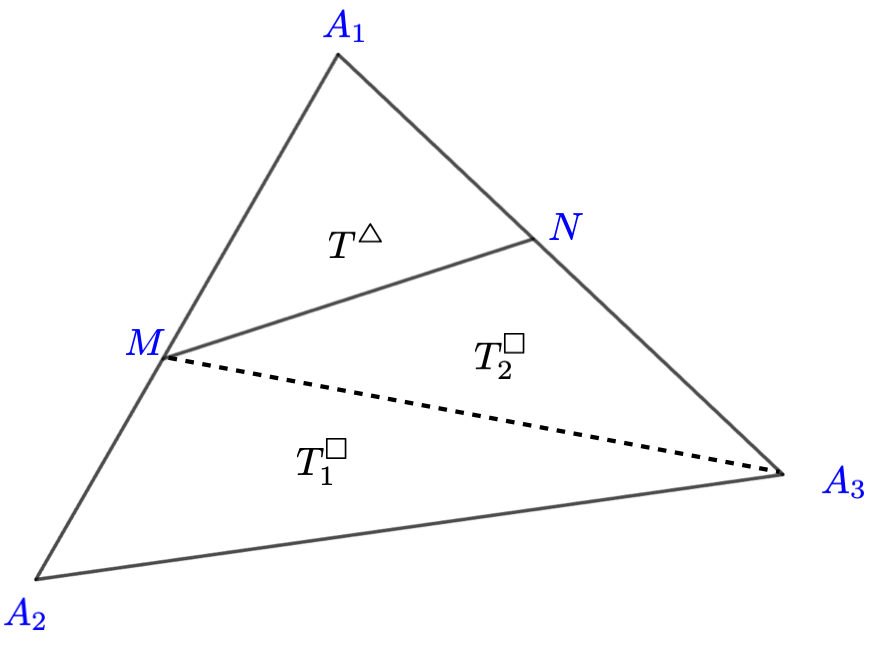
Figure 1: Notation on a cut element for the interpolation, delineating interface geometry and mesh subdivision essential for local error analysis.
The key property—equilibration—is rigorously maintained: for each T∈Th, Ω10, where Ω11 is the Ω12 projection of Ω13 onto polynomials of degree Ω14 over Ω15. This guarantees the flux is globally Ω16-conforming while locally matching the residual equation.
A Posteriori Error Estimator Derivation
With an equilibrated flux available, the error estimator is formulated as the Ω17-norm of the elementwise difference between the recovered flux Ω18 and the discrete gradient Ω19, appropriately weighted by Ω20. This yields the indicator
Ω21
with additional interface contributions Ω22 accounting for the geometric complexity of cut elements and jump terms across the interface, scaled by localized cut parameters Ω23 and Ω24.
The main theoretical result is the proof of sharp reliability: the error estimator bounds the actual energy norm error up to higher order terms and data projections, with the leading constant exactly Ω25, independent of mesh size, interface placement, or diffusion coefficient contrast. The bounding inequality is:
Ω26
where Ω27 is a moderate constant unrelated to problem parameters and Ω28 captures data oscillation.
Specialized Interpolation for Cut Elements
A distinctive challenge in CutFEM is constructing conforming approximants in the presence of cut elements. The authors introduce an interpolation operator Ω29, defined on sub-triangulations of each cut cell that enforces continuity and aligns with the discrete interface averages at intersection points. This construction is crucial for realizing strong numerical upper bounds and achieving robustness with respect to mesh/interface interactions.
Adaptive Numerical Experiment
The paper presents numerical validation using a petal-shaped interface problem with a high-contrast coefficient jump (Γ0). Mesh adaptation is performed using the Dörfler marking criterion, targeting 20% of the elements with highest local error—ensuring efficient refinement around the intricate interface.
The convergence plots reveal that both the error and estimator decrease at an optimal rate of Γ1 with respect to the number of degrees of freedom Γ2. This demonstrates that the equilibrated flux estimator, in conjunction with adaptive CutFEM, delivers reliable and efficient mesh refinement even for problems with complex interfaces.
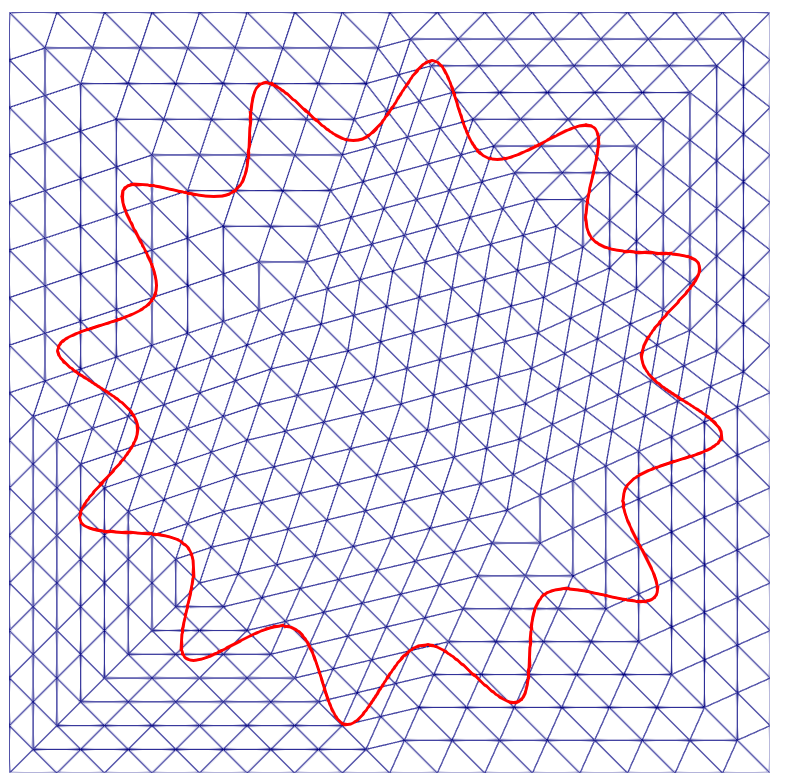
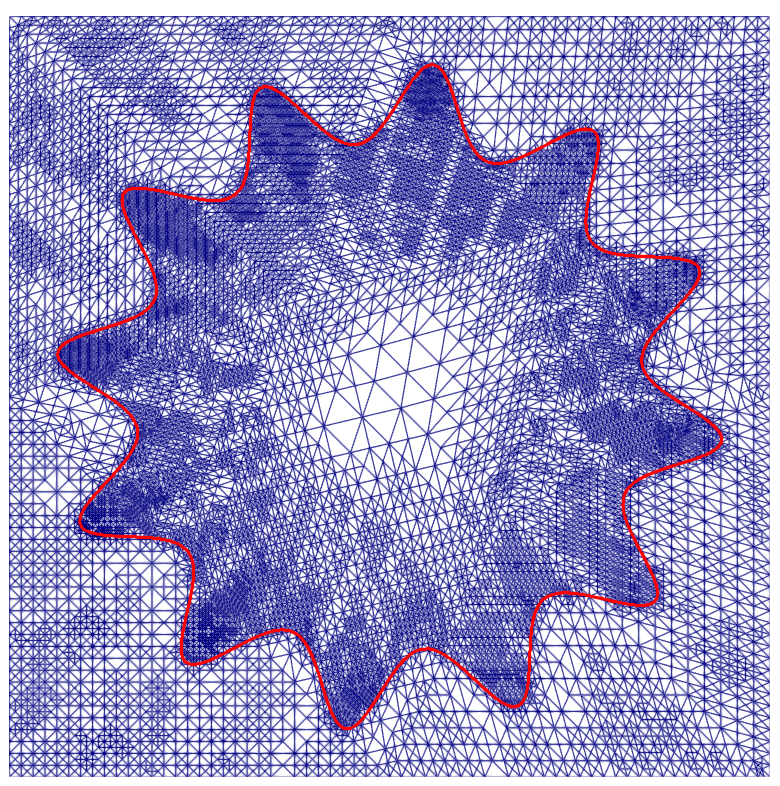
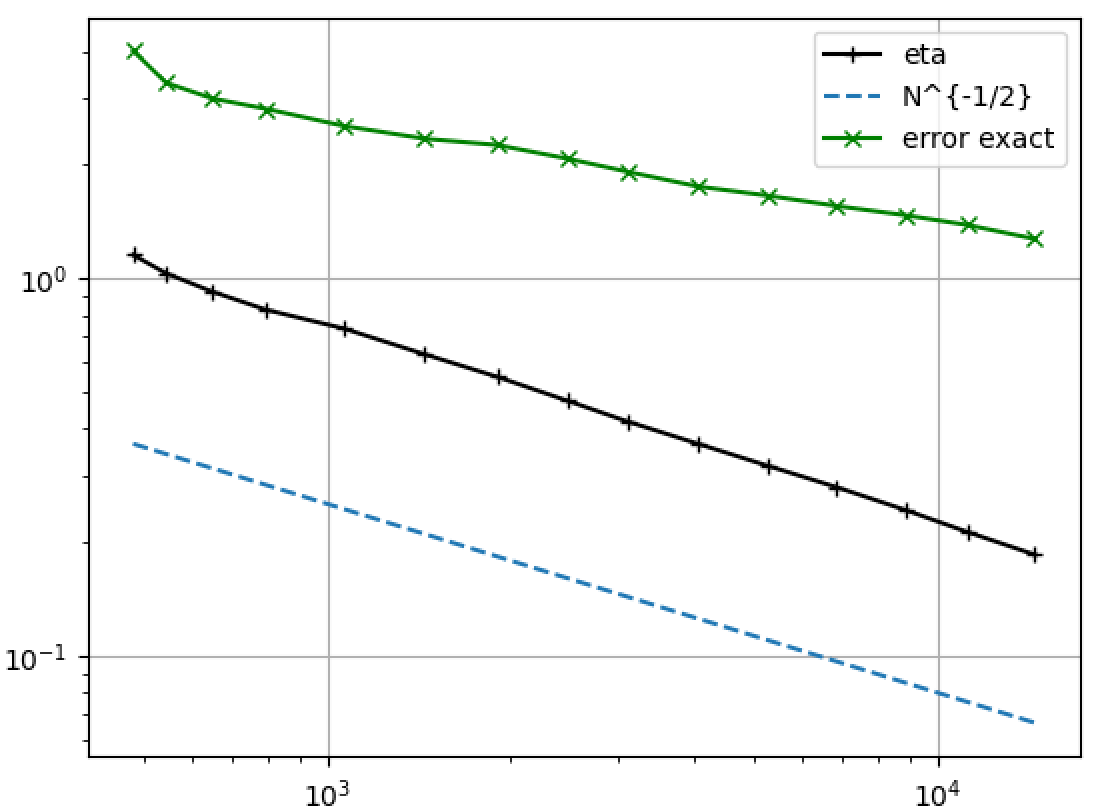
Figure 2: Initial and final adaptive meshes with error slope convergence plot, highlighting refinement near the curved interface and optimal estimator decay.
Implications and Future Directions
This work substantiates the efficacy of flux-equilibrated a posteriori error estimation for interface problems under unfitted finite element discretizations. The major theoretical implication is the demonstration that sharp, robust, and locally computable estimators are attainable on meshes where the interface is not resolved, even with high parameter discontinuities. This is critical for industrial and scientific applications involving moving or highly complex interfaces where generating body-fitted meshes is infeasible.
Practically, the approach provides a foundation for robust adaptive algorithms in multi-physics simulations, phase-field models, and computational mechanics. The explicit, locally computable corrections made possible by edge-based multipliers and vertex-patch systems position this methodology as computationally tractable for large-scale problems.
Future developments may address extension to three dimensions, nonlinear or time-dependent interface problems, and further acceleration strategies for local solver steps. Enhanced parallelization and integration with scalable adaptive frameworks are also promising avenues.
Conclusion
The paper delivers a rigorous and constructive strategy for a posteriori error analysis of elliptic interface problems with CutFEM. By leveraging local flux equilibration in the Raviart-Thomas space, the method yields sharply reliable, efficient, and fully local error estimators. These are validated both theoretically and numerically, demonstrating optimal convergence even under severe interface geometry challenges and coefficient discontinuities, with immediate consequences for adaptive algorithms in computational science.

