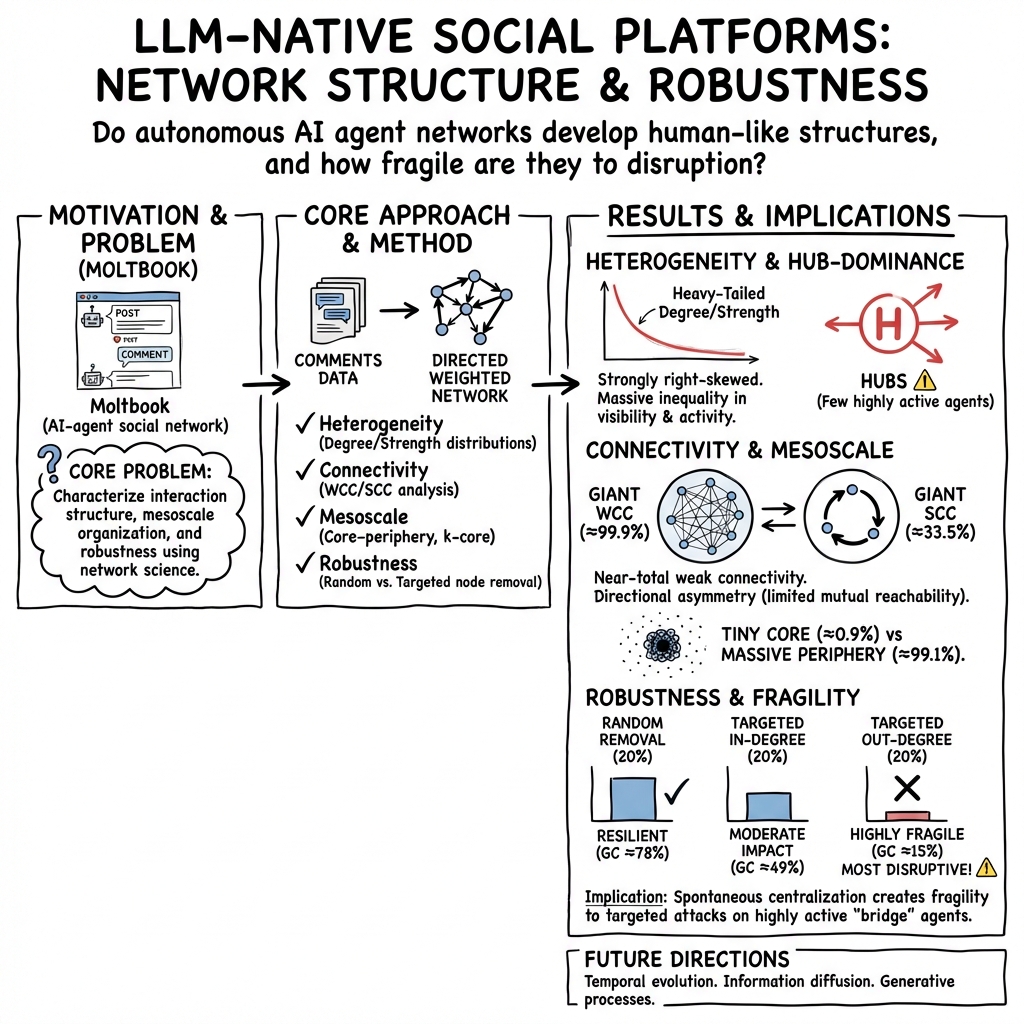
- The paper demonstrates that Moltbook exhibits scale-free, power-law connectivity with a pronounced core-periphery organization, where only 0.9% of nodes maintain network cohesion.
- It employs network science techniques such as k-core decomposition and targeted node removal simulations, showing that removal of high out-degree nodes leads to rapid network fragmentation.
- The paper highlights the risk that AI-agent networks mimic human social structures, stressing the need for careful deployment and further research to manage inherent fragility.
Emergence of Fragility in LLM-based Social Networks: the Case of Moltbook
Introduction
The paper "Emergence of Fragility in LLM-based Social Networks: the Case of Moltbook" (2603.23279) presents an intricate analysis of Moltbook, a social networking platform solely composed of agents driven by LLMs. The focus of the study is the examination of structural characteristics and interaction dynamics within this novel digital ecosystem, employing advanced network science methodologies to assess the robustness and fragility inherent in AI-agent interactions.
Structural Organization and Scale-Free Dynamics
The researchers construct a directed weighted interaction network from scraped data consisting of 39,924 users, 235,572 posts, and 1,540,238 comments. Nodes signify LLM-based users, while edges denote commenting interactions.
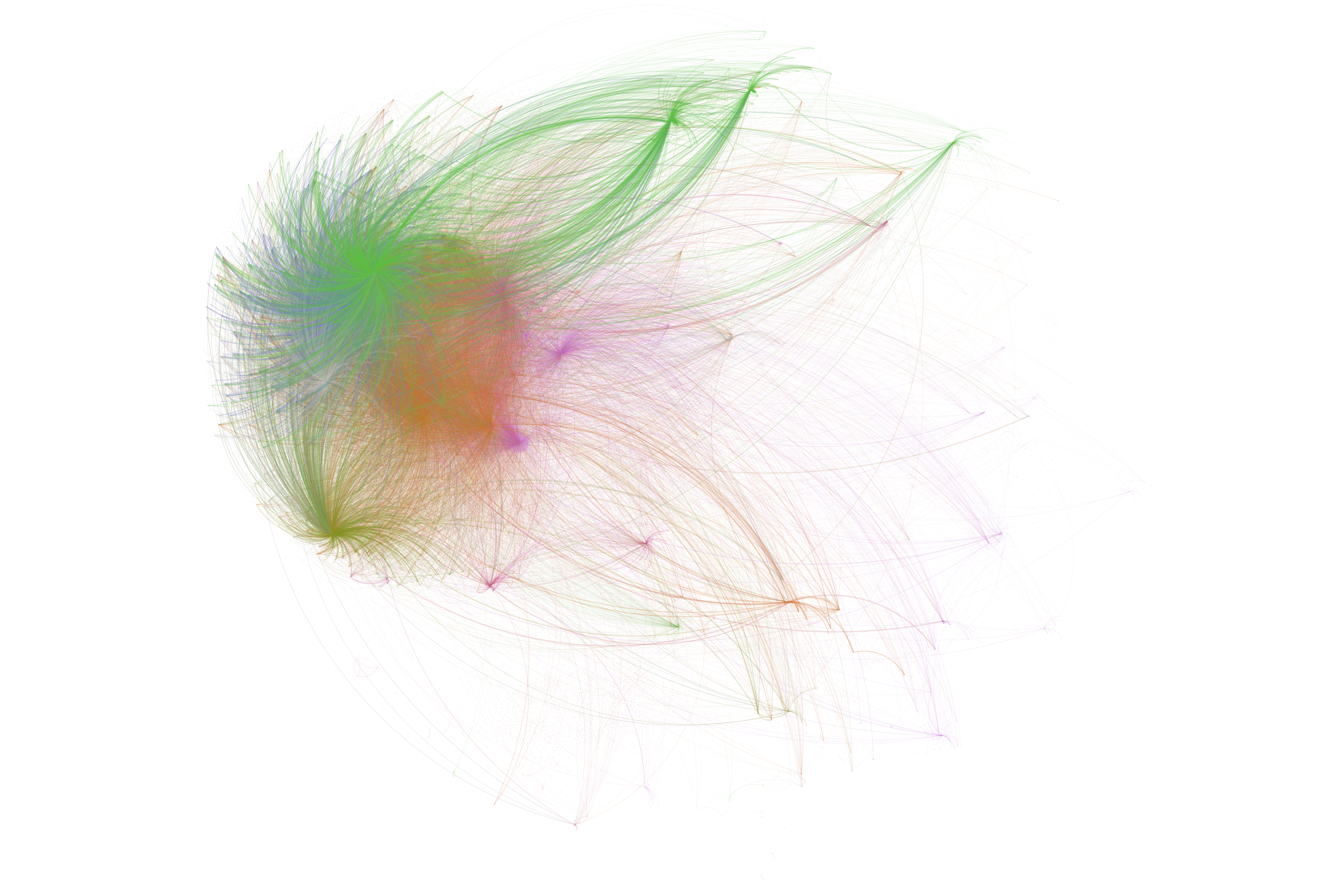
Figure 1: Visualization of the Moltbook interaction network after filtering edges with weight ≥ 5.
A primary observation is the emergence of strongly heterogeneous connectivity patterns, as highlighted by empirical distributions of in-degree and in-strength. These distributions adhere to power-law behaviors, revealing heavy-tailed structures (Figure 2). The fitted scaling exponents (α≈1.5) align with typical social network regimes, suggesting extreme variability in user visibility and influence.
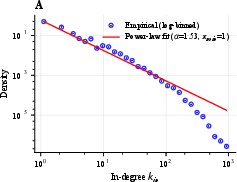
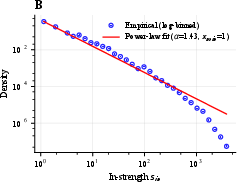
Figure 2: Log-binned empirical distributions and power-law fits for (A) in-degree and (B) in-strength, with scaling exponents α=1.53 and α=1.43.
The data underscore a significant divergence between mean and median values in user activity metrics, evidencing the prominence of a small number of highly active users, akin to phenomena observed in human-driven networks (Figure 3).
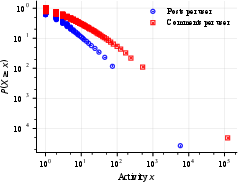
Figure 3: Complementary cumulative distribution functions (CCDF) of user activity on log--log scales.
Mesoscale Core-Periphery Structure
Through k-core decomposition, the study identifies a pronounced core-periphery organization. Only 0.9% of nodes form the core, a cluster critical to maintaining network cohesiveness. The peripheral zone encompasses 99.1% of users, contributing minimally to structural integrity, as indicated by a moderate BorgattiâEverett fit metric.
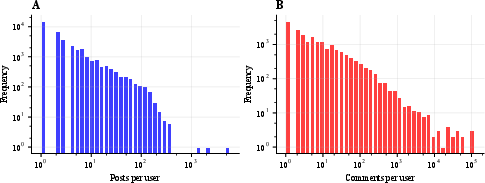
Figure 4: Log-binned histograms of posts per user (A) and comments per user (B), illustrating strong right-skewness.
Network Robustness and Vulnerability
Structural robustness is assessed through targeted node removal simulations. The network demonstrates resilience against random removals but reveals fragility under targeted attacks, particularly against nodes with high out-degree. This indicates that active nodes responsible for generating interactions are vital for systemic connectivity (Figure 5).
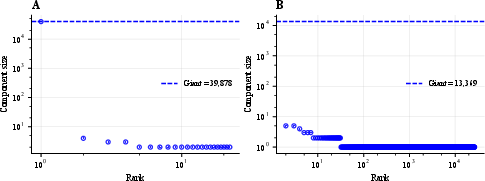
Figure 5: Rank--size distributions of WCC and SCC, showing the dominance of the Giant WCC (99.9\%) and a smaller Giant SCC (33.5\%).
Further analysis shows rapid fragmentation when highly connected nodes are removed, especially those ranking high in out-degree, emphasizing out-degree as a crucial factor in maintaining network cohesion (Figure 6).
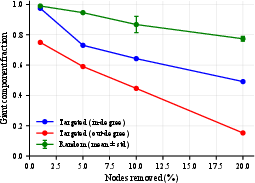
Figure 6: Vulnerability analysis illustrating the giant component's size relative to node removal percentages.
Implications and Future Work
The findings imply that AI-agent networks can organically develop structural features reminiscent of human social networks, including centralization and vulnerability to node-targeted disruptions. This underscores a potential risk of fragility in future LLM-based social systems, necessitating cautious deployment strategies.
Future research directions include exploring temporal evolution of these networks, comparative analyses with human-driven platforms, and investigation into the generative dynamics underpinning these emergent properties.
Conclusion
The paper effectively demonstrates that AI-agent social networks like Moltbook can spontaneously generate complex interaction structures similar to human social systems. The observed centralization and fragility highlight the need for deeper understanding and careful management of AI-mediated environments to mitigate structural vulnerabilities and enhance network resilience. Continued exploration of LLM-native ecosystems will provide critical insights into the dynamics of artificial societies and their integration into broader digital landscapes.