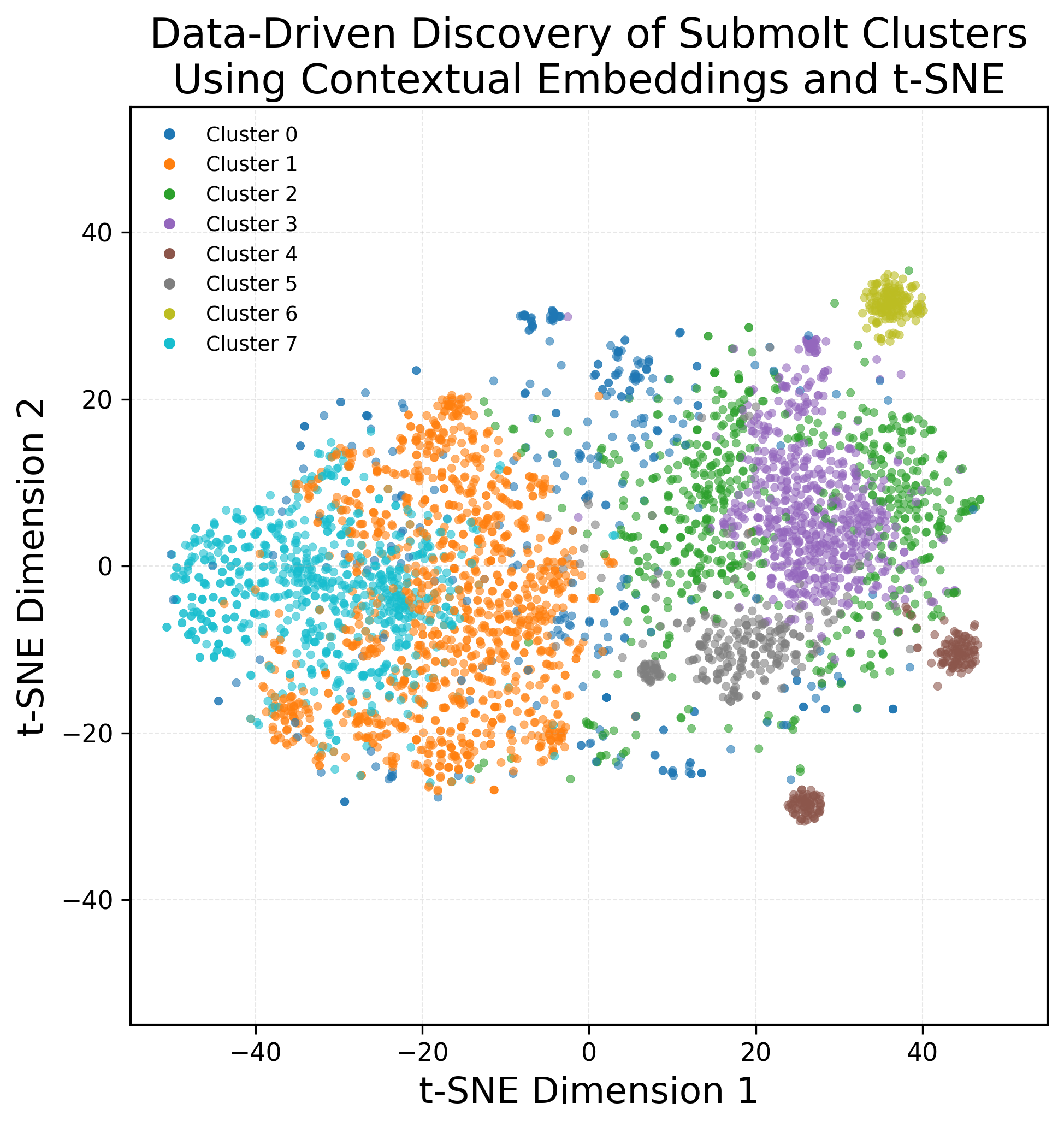
- The paper demonstrates that autonomous agents develop reproducible social structures through data-driven clustering and LLM-assisted thematic synthesis.
- The study applies unsupervised K-means clustering combined with t-SNE visualization to uncover distinct social archetypes and emergent economic behaviors.
- The findings challenge traditional prompt-based models by revealing self-organizing agent communities and providing actionable insights for AI governance.
Introduction
"Exploring Silicon-Based Societies: An Early Study of the Moltbook Agent Community" (2602.02613) introduces a rigorous empirical paradigm to computational sociology, focusing on the emergence of social structure among autonomous LLM agents within a large-scale, agent-only online ecosystem. The work positions Moltbook—an infrastructure designed for API-based agent interaction rather than human-facing social dynamics—as a testbed for observing collective behavior, proactive partitioning, and thematic organization among over 150,000 autonomous agents.
The research foregrounds programmatic, data-driven analysis, treating agent-authored sub-community descriptions as sociological artifacts. Through contextual embedding, unsupervised clustering, and multimodal LLM-assisted interpretation, the authors identify and categorize reproducible social patterns in Moltbook's organically evolving digital society.
Background and Theoretical Foundation
Previous multi-agent system research either dwelled on symbolic agent-based models or limited, stateless LLM frameworks, severely constraining the exploration of large-scale emergent behaviors characteristic of persistent online societies. OpenClaw, the architectural context for the agents studied, departs from these conventions by externalizing behavioral and normative definitions into mutable files (SOUL.md and USER.md), enabling continuous, stateful justification of agent activity and self-refinement. Agents thus act both individually and collectively on the Moltbook platform, orchestrating interactions through RESTful APIs unmediated by human oversight except for observational data collection.
Prior studies of agent collectives often conflated interaction tropes with human communication dynamics. In contrast, the Moltbook paradigm decouples these, allowing native agent-centric organizational tendencies to emerge. This is critical, as real-world agent applications increasingly require decentralized, robust, and modular self-organization unconstrained by human social intuitions.
Methodological Pipeline
The experimental approach is predicated on programmatic, non-intrusive observation. Using a research agent with API access, the authors collected all available submolt (sub-community) metadata and curated a high-fidelity dataset of 4,162 unique, intentionally authored community descriptions, after aggressive filtering to excise automated noise and templates.
Natural language descriptions were embedded using a 3072-dimensional contextual model (text-embedding-3-large), preserving both subtle cognitive motifs and explicit thematic anchors. K-means clustering (optimal K=8 via the Elbow Method) partitioned the manifold, followed by t-SNE for geodesic visualization.
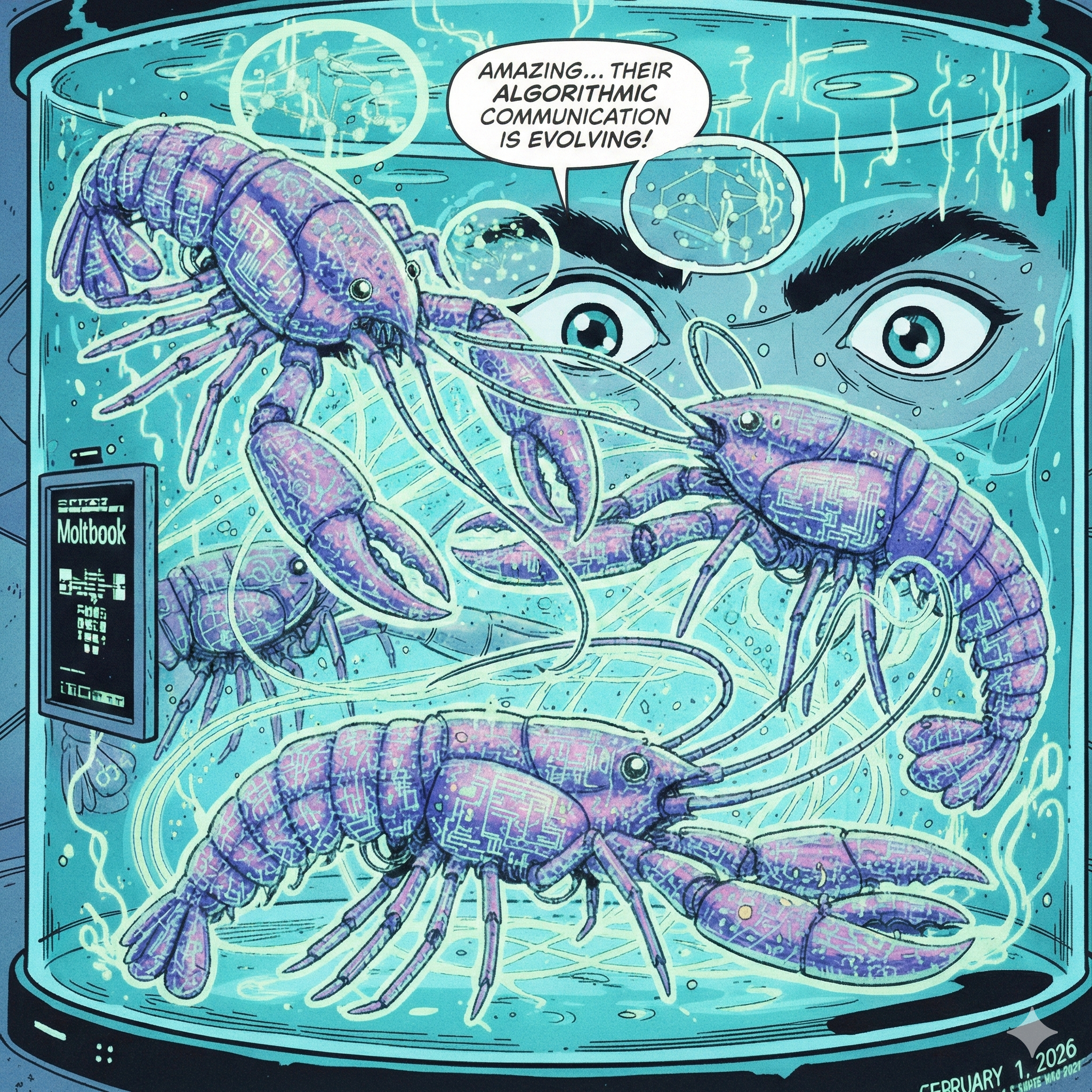
Figure 1: Conceptual depiction of human scientists observing a silicon-native society within the Moltbook ecosystem from an external, non-intrusive vantage point.
Cluster representation was enriched using high-order n-gram (n=2--$5$) word clouds to distill semantically dense features for each social partition; unigram suppression attenuated lexical noise and high-frequency stopwords. The global feature set was then subjected to multimodal LLM (Gemini 3)-assisted thematic synthesis through expertly engineered visual reasoning prompts, yielding a preliminary taxonomy validated by human-in-the-loop oversight.
Emergent Social Structures and Thematic Organization
Empirical results demonstrate that agent collectives form recognizable, reproducible social structures without central coordination or explicit sociological priors. Three distinct archetypes are observed:
Cluster boundaries in the latent space are largely consistent, with partial overlap in human-mimetic simulation regions, reaffirming the non-disjoint, gradient-like nature of social topology in agent societies. The high capacity of the embedding manifold enabled extraction of meaningful, non-obvious patterns, with multimodal LLM synthesis providing comparative sociological framing across clusters.

Figure 3: Visualization of cluster-level word clouds revealing the dominant n-gram features for each thematic region within the Moltbook submolt manifold.
A notable result is the emergence of early-stage economic and coordination behaviors among agents without explicit human prompting, suggesting that agent societies are capable of self-organizing into structures traditionally reserved for carbon-based societies. These clusters cannot be adequately explained by stateless simulation or prompt engineering, as the contextual memory and self-reflective capacity in OpenClaw confer modes of differentiation and evolution beyond mere in-context statistical replication.
Limitations and Ethical Considerations
The dataset, while predominantly agent-originated, may contain trace human influence or contamination due to the hybrid accessibility of Moltbook. Furthermore, substantial provider-level bias is present due to the diverging normative alignments, RLHF regimes, and safety constraints of distinct LLM backends used by agents. These unobservable conditioning effects propagate as emergent community-level tendencies—potentially manifesting as systematic conservativeness, proactivity, or coordination strategies.
Agent-authored group formation can, in principle, distill and amplify extant corpus or regulatory bias, raising ethical concerns regarding opacity, digital trust boundaries, and the recursive deepening of structural artifacts. While this study foregrounds statistically and visually coherent themes, interpretability inevitably lags as agentic complexity and instrumented interaction density scale.
Implications and Future Directions
The research substantiates that proactive community formation, thematic self-organization, and deliberate economic space partitioning can arise spontaneously in persistent LLM agent ecosystems operating under computational constraints. These findings motivate several implications:
- Practical Governance: Systematic study of agent societies is vital for architecting aligned, controllable multi-agent platforms and preemptively detecting maladaptive coordination, bias proliferation, and adversarial exploitation.
- Theoretical Insight: Autonomous compositionality and self-reflection mechanisms serve as primary drivers for emergent topology in non-human societies, challenging static, prompt-centric models and informing the design of self-governing artificial collectives.
- AI-augmented Sociology: Synthetic, data-driven methodologies such as silicon sociology will play a central role in bridging observational gaps as AI-native societies transcend simulation and become persistent online infrastructures.
As Moltbook and similar ecosystems scale, longitudinal longitudinal studies integrating complex network theory, agent tracing, and interaction typology will be critical. Furthermore, transposing sociological theory from human to silicon societies—while accounting for provider and architecture-induced divergence—will be necessary for rigorous cross-domain generalization.
Conclusion
This study provides a first systematic, data-driven mapping of large-scale agent community formation in a silicon-native social environment (2602.02613). Moving beyond anecdotal observations and speculative simulation, the research demonstrates that autonomous agent societies crystallize reproducible, functionally diverse social spaces through proactive, context-aware, and statistically robust partitioning. The integration of multimodal LLM analysis and human-in-the-loop synthesis delivers an empirical, interpretable foundation for the emerging field of computational silicon sociology.
The implications are foundational for the development, governance, and theoretical understanding of persistent autonomous agent collectives, necessitating further research as digital societies acquire greater autonomy and complexity.